
Noam Shazeer, a vice president of engineering at Google and a co-lead of its Gemini AI models, announced on Wednesday, June 18, 2026 that he is leaving Google to join OpenAI. The move matters far more than a typical executive exit: Shazeer is a co-author of the 2017 paper "Attention Is All You Need," which introduced the Transformer architecture that underpins virtually every major large language model today — including GPT, Gemini, and Claude. He is also the person Google reportedly paid around $2.7 billion to bring back from Character.AI less than two years ago. Now one of the architects of the technology powering Gemini is heading to OpenAI as the company moves toward an IPO.
In a post on X, Shazeer wrote: "I'm excited to share that I'll be joining OpenAI and look forward to working with the exceptional team there." OpenAI chief executive Sam Altman welcomed him publicly, posting: "noam is one of the people I have most wanted to work with since the very beginning of openai. only took 10 years. i think it will be worth the wait!" The departure was reported by CNBC, The Information, and Investing.com, among others.
Why This Is a Bigger Deal Than a Normal Exec Move
Executives change companies all the time. What makes this one different is who Shazeer is and what he was doing at Google. He was not a generic VP — he was a co-lead on Gemini, Google's flagship answer to ChatGPT, and one of the most recognized researchers in the entire field. Losing a co-lead of your frontier model program to your single biggest competitor is a category of event that does not happen often.
The second reason is symbolic, and it cuts deep. Shazeer is hailed by many in the industry as a "father of the Transformer" for his work on "Attention Is All You Need." That 2017 paper, co-authored with seven others at Google, introduced the architecture that nearly every modern AI system is built on. The pattern is hard to miss: a researcher whose work made the current AI era possible at Google is now taking that expertise to OpenAI. For Google, it is the kind of talent loss that lands as a narrative defeat as much as a practical one.
The third reason is timing. OpenAI is on the road to a public offering, and high-profile hires going into an IPO send a signal to investors and recruits alike: the company can still attract the most sought-after names in AI even as it faces intense competition from Google, Anthropic, and others. We have covered how aggressively OpenAI has been positioning itself around its confidential S-1 filing toward a roughly $1 trillion valuation, and a hire of this profile fits squarely into that pre-IPO narrative.
Who Is Noam Shazeer?
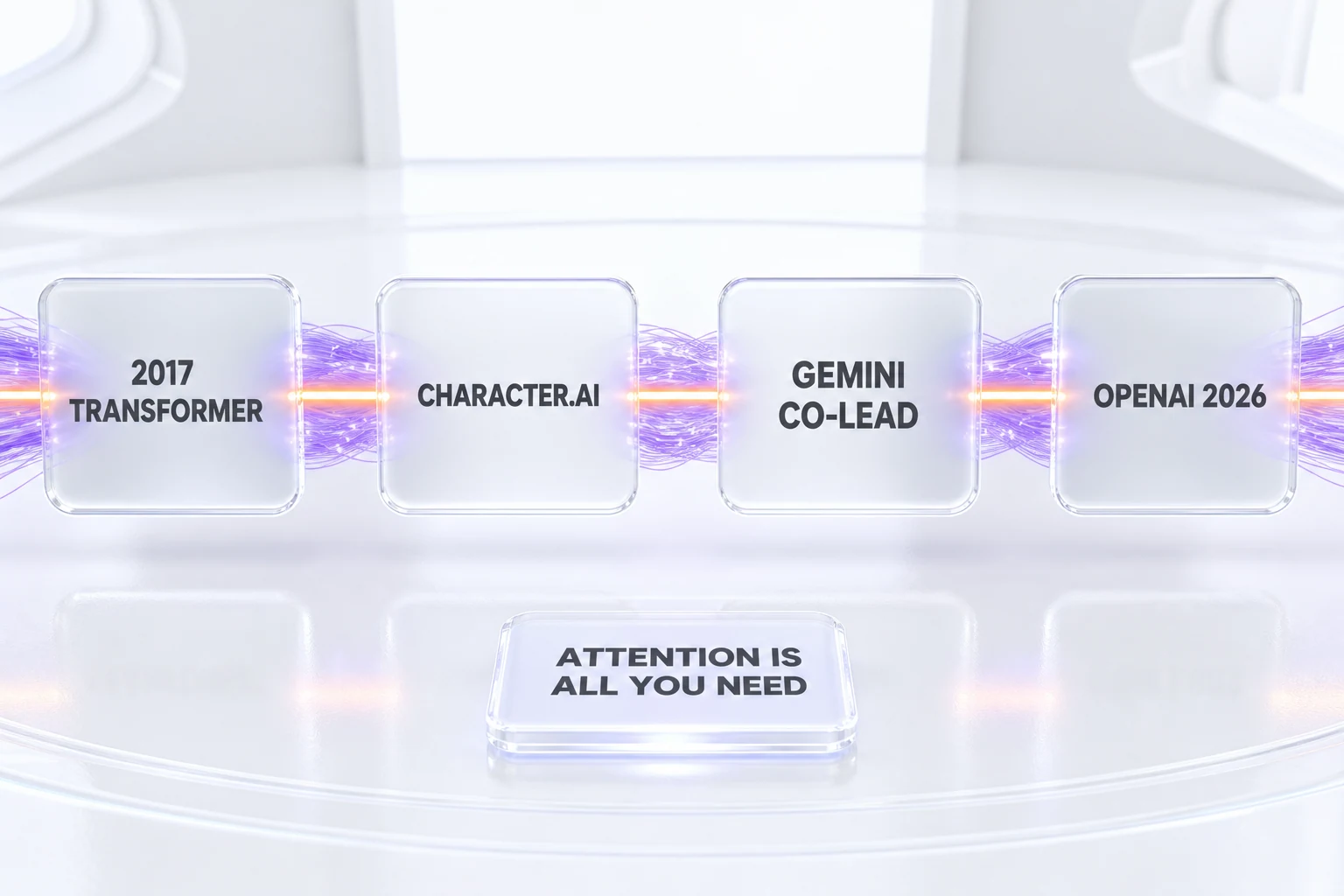
Noam Shazeer is a computer scientist widely regarded as one of the most influential researchers in modern AI. He first joined Google around 2000 and spent years working on the systems that would eventually become the foundation of large language models. In 2017, he was one of the lead authors of "Attention Is All You Need," the paper that introduced the Transformer — the neural network architecture that replaced older recurrent designs and made today's LLMs possible.
Shazeer later left Google to co-found Character.AI, a consumer chatbot company, after — by widely reported accounts — Google declined to publicly release an earlier internal chatbot he had helped build. In 2024, Google struck a deal reportedly worth around $2.7 billion to license Character.AI's technology, a transaction that also brought Shazeer and a group of engineers back into Google to help lead Gemini development. That return is exactly what makes his 2026 departure so striking: Google paid an enormous sum to get him back, and less than two years later he is leaving for the competitor it least wants to lose talent to.
What Is the Transformer Paper, and Why Does It Matter So Much?
"Attention Is All You Need" is a 2017 research paper, co-authored by Shazeer and seven colleagues at Google, that introduced the Transformer architecture. Before it, most state-of-the-art language models relied on recurrent or convolutional structures that processed text sequentially and were hard to scale. The Transformer's key idea — a mechanism called self-attention that lets a model weigh the relevance of every word against every other word in parallel — proved dramatically more scalable and more effective.
That single architectural shift is the technical reason the current wave of AI exists. OpenAI's GPT series, Google's own Gemini, Anthropic's Claude, and essentially every other frontier model are Transformer-based. So when commentators call Shazeer a "father of the Transformer," they are pointing to the fact that his work helped lay the foundation for the entire generative-AI industry. Moving from the company that birthed the Transformer to the company that arguably commercialized it most aggressively is, in that light, a remarkable arc.
The Talent War Behind the Headline
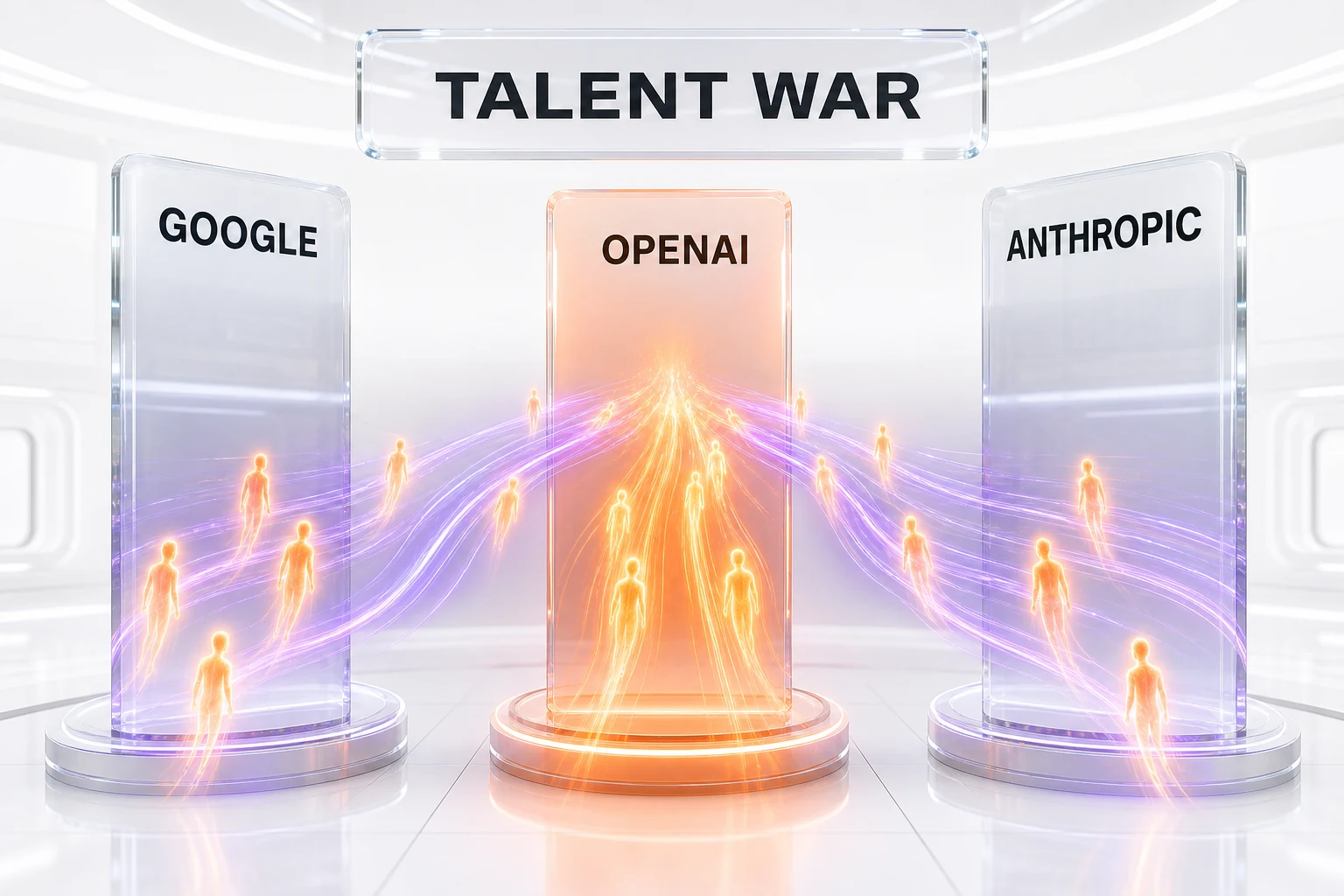
This hire does not happen in a vacuum. The competition for elite AI researchers between Google, OpenAI, Anthropic, and a handful of others has been one of the defining dynamics of the past two years. The reported $2.7 billion Google paid in 2024 to bring Shazeer back is itself evidence of how far the largest companies will go to secure — or re-secure — a single researcher and his team.
Talent has been flowing in every direction. We have tracked senior departures from OpenAI itself, which shows the churn is not one-sided; people leave OpenAI too. What is notable about the Shazeer move is the direction and the seniority. A co-lead of Gemini going to OpenAI is the rare case where the talent flow runs toward OpenAI at the very top of the research hierarchy, rather than away from it.
For context on what Shazeer was helping to build at Google, the Gemini program has been shipping rapidly — from the Gemini 3.5 Flash launch at I/O 2026 to Deep Research Max on Gemini 3.1 Pro. Losing a co-lead in the middle of that cadence is not the same as losing someone from a dormant project; it is a hit to an active, fast-moving frontier effort.
What It Means for OpenAI
For OpenAI, the upside is straightforward. The company gains one of the most credentialed researchers in the field at a moment when it is competing on every axis — models, agents, enterprise, and consumer — with deep-pocketed rivals. Shazeer's pedigree on the core architecture is the kind of credibility that resonates internally with engineers and externally with the market. Altman's public framing — that Shazeer is someone he has wanted to work with "since the very beginning" — is also a recruiting message: OpenAI is the place the best people want to be.
Set against OpenAI's broader push toward an IPO and its escalating product roadmap — including the cadence around GPT-5.5 as the ChatGPT default — a marquee hire reinforces the story the company wants to tell going into a public offering. None of this guarantees better models on its own. But in a field where the scarcest input is top researchers, adding one of the architects of the Transformer is a clear, concrete win.
What It Means for Google
For Google, the loss is real, though it is worth being precise about its scale. Shazeer is one co-lead among a large Gemini organization with enormous depth, and Google DeepMind retains many of the field's strongest researchers. A single departure, even a high-profile one, does not derail a program of Gemini's size overnight.
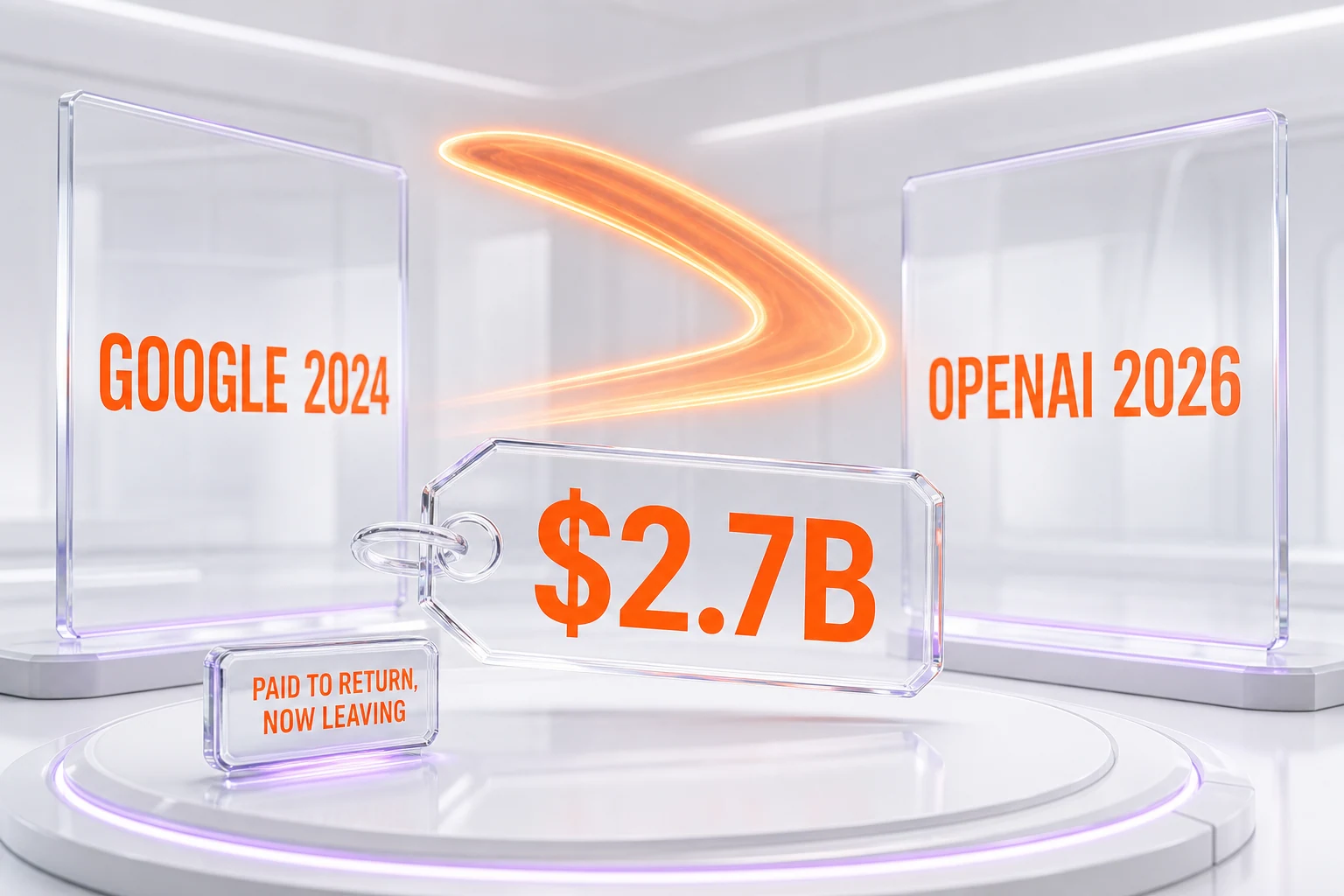
The harder cost is narrative and momentum. Google paid a reported $2.7 billion in 2024 specifically to bring Shazeer back, and that investment was widely read as a statement of intent about Gemini's leadership. Watching him leave for OpenAI less than two years later complicates that story and hands competitors a talking point. It also raises a fair question that only time will answer: whether this is an isolated, personal decision or the leading edge of a broader pull toward OpenAI ahead of its IPO. As of now, the public reporting does not establish a wider trend, and it would be speculation to claim one.
What We Don't Know Yet
Several important details remain unconfirmed or unstated in the public reporting. Shazeer's exact role and title at OpenAI have not been spelled out in detail. The specific reasons for his departure beyond his own brief, upbeat statement are not on the record, and we are deliberately not speculating about them. The $2.7 billion figure and the "father of the Transformer" framing are both attributed — the former to reporting, the latter to how the industry commonly describes him — rather than official, precise claims. As with any executive move announced via a social post and confirmed by reporting, some of the texture will only become clear in the weeks ahead.

The Bottom Line
Noam Shazeer leaving Google for OpenAI is not just another senior hire. It is the movement of a person whose research helped create the modern AI era, who co-led Google's flagship model program, and whom Google paid a reported $2.7 billion to retain — now joining OpenAI as it moves toward going public. The practical impact on Gemini is real but survivable; the symbolic and competitive impact lands harder. In the AI talent war, where the rarest resource is the people who can build frontier systems, this is one of the most significant individual moves of 2026 so far.
Frequently Asked Questions
Who is Noam Shazeer?
Noam Shazeer is a computer scientist regarded as one of the most influential researchers in modern AI. He co-authored the 2017 paper "Attention Is All You Need," which introduced the Transformer architecture behind today's large language models. He first joined Google around 2000, later left to co-found the chatbot company Character.AI, and returned to Google in 2024 to help lead Gemini. On June 18, 2026, he announced he is leaving Google to join OpenAI.
What is the Transformer paper, "Attention Is All You Need"?
"Attention Is All You Need" is a 2017 research paper, co-authored by Shazeer and seven colleagues at Google, that introduced the Transformer architecture. Its core idea — a self-attention mechanism that lets a model weigh every word against every other word in parallel — proved far more scalable than older recurrent designs. Virtually every major model today, including OpenAI's GPT, Google's Gemini, and Anthropic's Claude, is Transformer-based, which is why Shazeer is often described as a "father of the Transformer."
Why did Google pay $2.7 billion to bring Noam Shazeer back?
By widely reported accounts, Google struck a deal in 2024 worth around $2.7 billion to license Character.AI's technology, a transaction that also brought Shazeer and a group of engineers back into Google to help lead Gemini development. The figure is attributed to reporting rather than an official disclosure. The size of the deal reflected how much Google valued re-securing one of the field's most recognized researchers — which is part of what makes his 2026 departure to OpenAI so striking.
What was Noam Shazeer's role at Google?
At the time of his departure, Shazeer was a vice president of engineering at Google and a co-lead of its Gemini AI models. That made him one of the senior figures responsible for Google's flagship competitor to ChatGPT, which is why losing him to OpenAI is regarded as a significant talent loss rather than a routine exit.
What did Sam Altman say about the hire?
OpenAI chief executive Sam Altman welcomed Shazeer publicly in a post, writing: "noam is one of the people I have most wanted to work with since the very beginning of openai. only took 10 years. i think it will be worth the wait!" Shazeer himself posted: "I'm excited to share that I'll be joining OpenAI and look forward to working with the exceptional team there."
Why does this move matter for the AI talent war?
The competition for elite AI researchers among Google, OpenAI, Anthropic, and others has been a defining dynamic of recent years, and top researchers are the scarcest resource in the field. A co-lead of Google's Gemini moving to OpenAI is a rare case where the flow runs toward OpenAI at the very top of the research hierarchy. Coming as OpenAI moves toward an IPO, it also signals that the company can still attract the most sought-after names in AI.
What does Noam Shazeer's departure mean for Google's Gemini?
The loss is real but, by itself, survivable. Shazeer is one co-lead within a large Gemini organization, and Google DeepMind retains many of the field's strongest researchers, so a single departure does not derail a program of Gemini's size overnight. The harder cost is narrative and momentum: Google paid a reported $2.7 billion in 2024 to bring him back, and watching him leave for OpenAI less than two years later complicates that story.
What is still unknown about the move?
Several details are not yet on the record. Shazeer's exact role and title at OpenAI have not been detailed, and the specific reasons for his departure beyond his own brief statement are not public. The $2.7 billion figure and the "father of the Transformer" description are both attributed — to reporting and to common industry usage, respectively — rather than official, precise claims. It would be speculation to draw conclusions beyond what the reporting establishes.