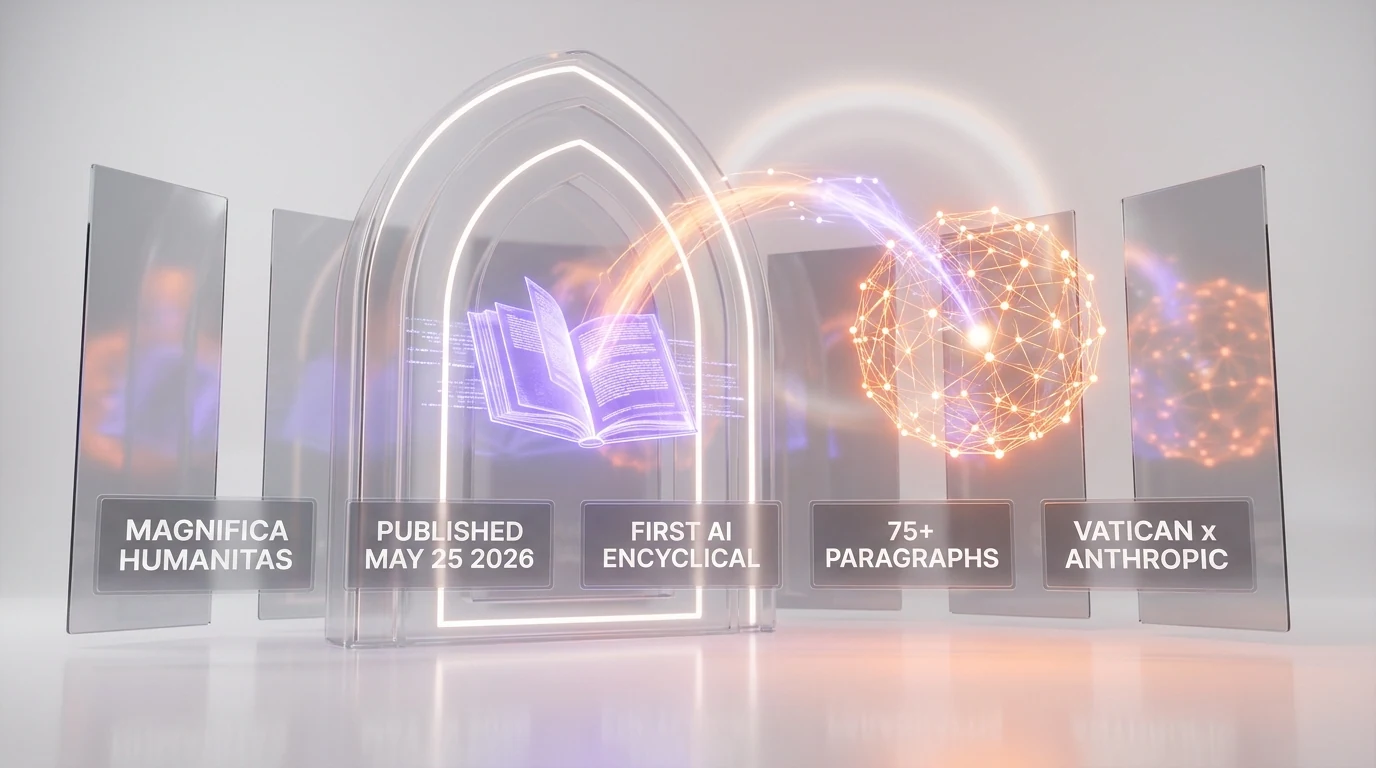
What is Magnifica Humanitas? It is the first papal encyclical fully dedicated to artificial intelligence, signed by Pope Leo XIV on May 15, 2026 and published by the Holy See on May 25, 2026. The text runs to 75 or more numbered paragraphs and roughly 42,300 words. At the Synod Hall presentation, the only frontier-AI-lab voice on the program was Anthropic co-founder Chris Olah — and that single staging choice is doing a remarkable amount of work.
I wrote our anticipation piece on May 18, framing the encyclical as a structural moment for AI safety discourse. The document is now public. The presentation has happened. We have verbatim quotes from both Pope Leo XIV and from Olah. The early read holds — and in some ways the actual launch is sharper than I expected. This is the analysis follow-up, with the receipts in hand.
For the strategic primer on what was anticipated, the lineage from Rerum Novarum to Magnifica Humanitas, and Anthropic's positioning into the announcement, see our earlier piece: The First AI Encyclical: Pope Leo XIV, Anthropic, and the Magnifica Humanitas Strategic Read. The piece you are reading now focuses on what shipped on May 25 — the document, the staging, the quotes, and what changes in the AI safety conversation as a result.
What actually shipped on May 25
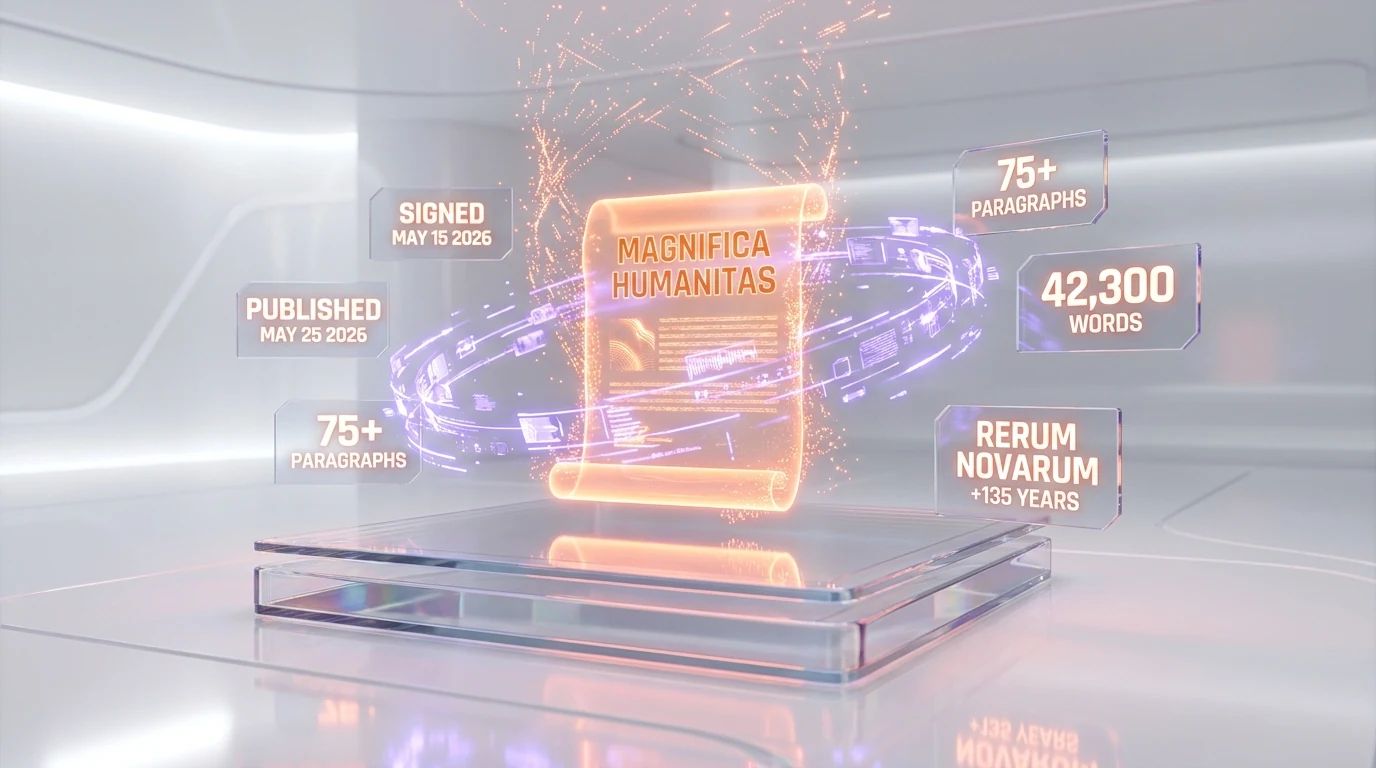
The hard facts first, all from primary sources. Magnifica Humanitas was signed on May 15, 2026 — Pope Leo XIV deliberately picked that date because it is the 135th anniversary of Leo XIII's 1891 encyclical Rerum Novarum (official Vatican.va text). The Holy See published it on May 25, 2026, in the Synod Hall, with Pope Leo XIV personally presenting the document — itself a procedural break, since recent popes have generally not presented their encyclicals in person.
The text runs to at least 75 numbered paragraphs in the Vatican.va release. Wikipedia's reference page puts the total at approximately 42,300 words. I want to flag one thing immediately: several early summaries described the document as "200 pages." I cannot confirm a 200-page figure from any primary source — neither from Vatican.va nor from Vatican News' formal release coverage — and so I am not repeating it. Length is a fact, not a vibe, and 42,300 words of dense doctrinal prose is itself a serious document. We do not need to inflate it.
The subtitle — "On safeguarding the human person in the time of artificial intelligence" — is itself a thesis statement. The document is structured around themes of human dignity, labor, common good, and what Chapter Five calls "the need to disarm words." It explicitly continues the social-doctrine arc that runs Rerum Novarum → Centesimus Annus → Laudato Si' → Magnifica Humanitas. That lineage is not decoration. It is the claim that AI is a labor, capital, and dignity question of the same structural order as 19th-century industrialization.
The Synod Hall staging — and who was not there
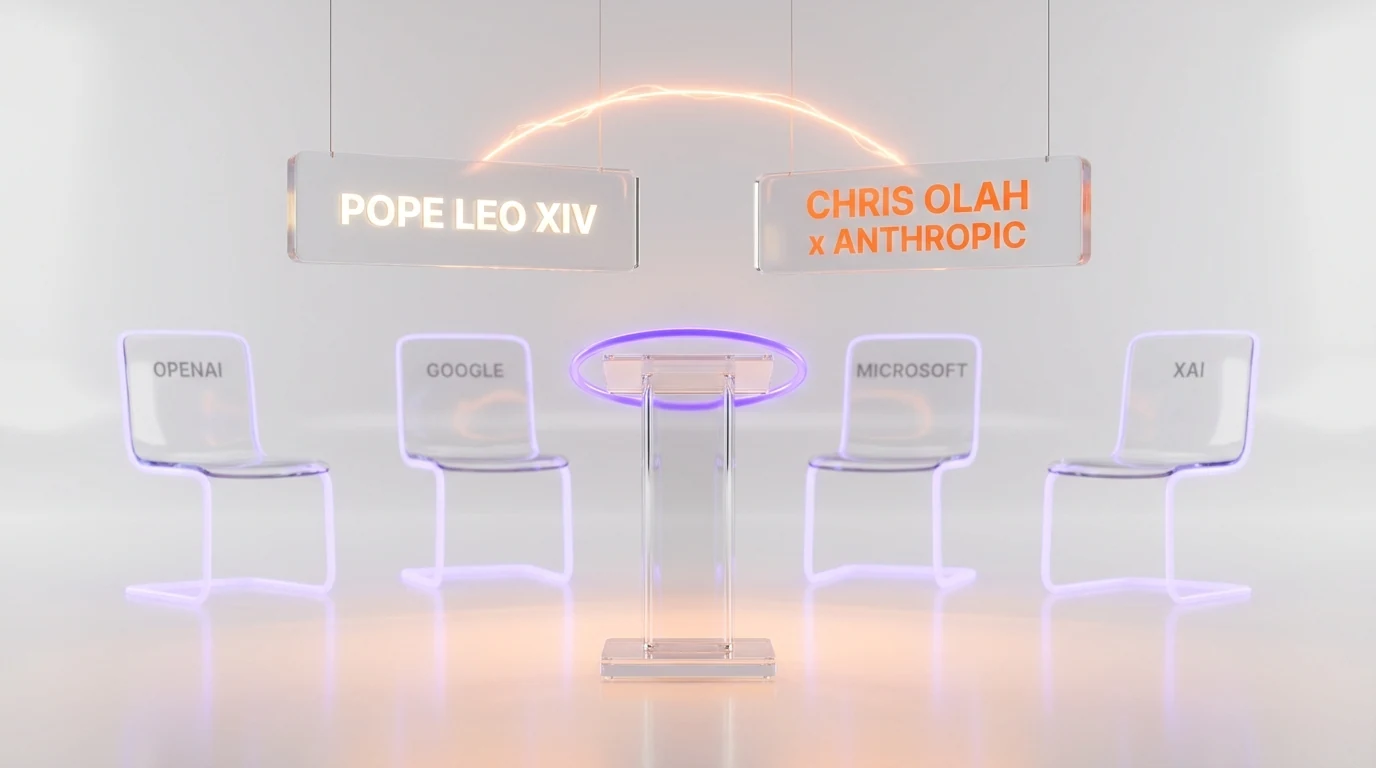
Now the staging — and this is where my read sharpens against the live event. Multiple outlets covering the May 25 Synod Hall presentation name exactly one frontier-AI-lab representative on the program: Anthropic co-founder Chris Olah. The National Catholic Reporter, Angelus News, and EWTN's coverage all describe the dynamic as a pope and one AI-lab co-founder.
I want to be careful here. "Only Anthropic was invited" is a stronger claim than the public record supports, and I am not making it. What I can say from the public record is: only Anthropic was on the program. No OpenAI executive, no Google DeepMind representative, no Microsoft AI representative, no xAI representative was named as a speaker. That is what the staging actually communicated to the world watching the livestream. Whether others were invited privately and declined, I do not know.
This is the kind of strategic detail that matters. The Vatican has 1.4 billion Catholics in its addressable audience and an institutional moral platform older than every nation-state on the planet. When that platform's only AI-lab interlocutor on encyclical-publication day is Anthropic, the implicit hierarchy of the public square gets reshaped — at least for the news cycle and probably for the citation graph that follows.
The "disarm" doctrine — and why Leo XIV chose the word
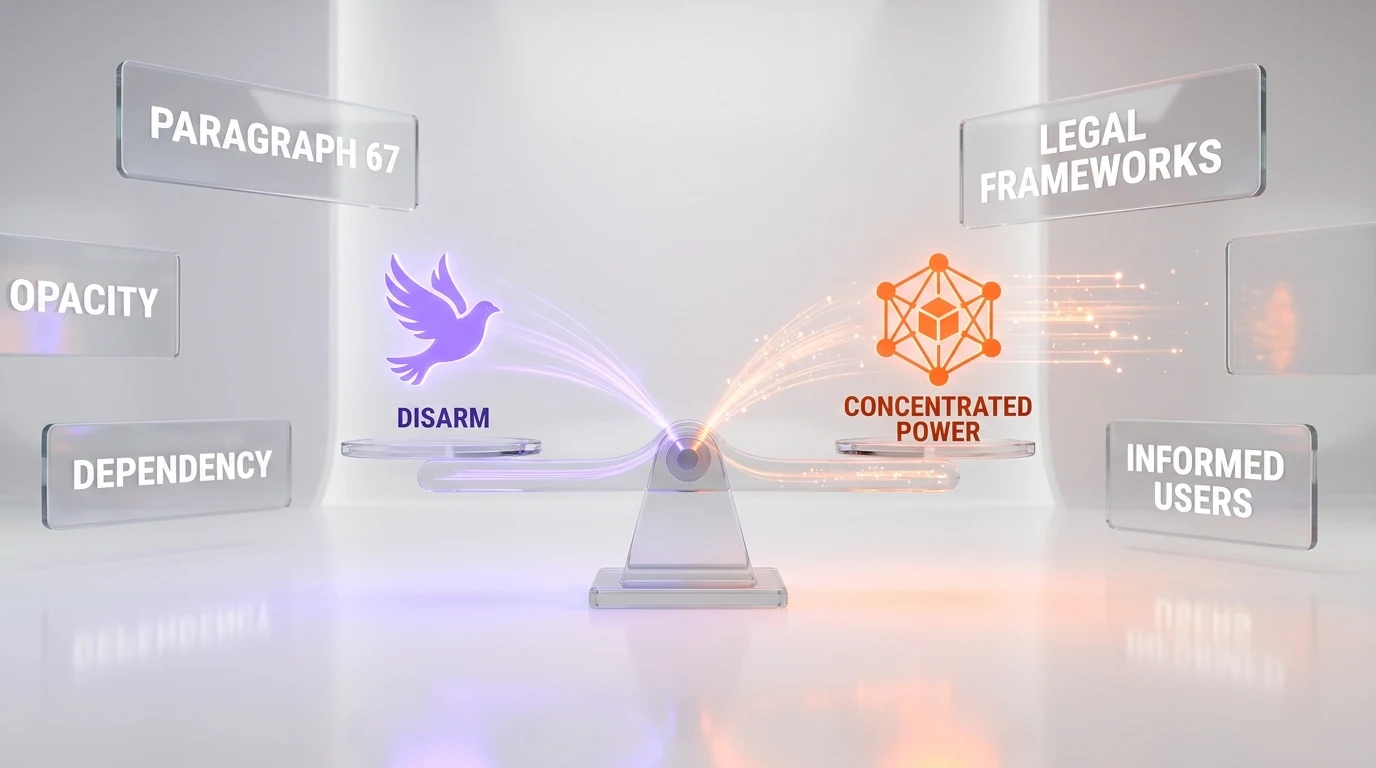
Now the substance. Pope Leo XIV's verbal remarks at the Synod Hall did something rhetorically that the written encyclical alone might not have: he chose to defend a word. From the live presentation, captured in EWTN's reporting: "The word is strong, I know, but deliberately chosen because this moment needs words capable of attracting attention." The word is "disarm." Chapter Five of the encyclical is titled "The need to disarm words." The Pope deliberately drew the parallel with the Church's long-standing nuclear disarmament posture in his remarks.
What does it mean to "disarm" AI? As the encyclical frames it, disarmament here is not about banning models. It is about discrediting the cultural assumption that whoever builds the most powerful AI automatically inherits the right to govern its use. Paragraph 67 — one of the few specific paragraph numbers I can cite confidently from the Vatican.va text — warns about goods that "remain concentrated in the hands of a few, without adequate forms of sharing and access." That is the structural worry: not models, but unaccountable accumulation of power, expertise, and data.
And Pope Leo XIV escalated the stakes verbally. From the Washington Post's coverage of the Synod Hall and EWTN: "Today we find ourselves facing a transformation of similar magnitude" — referring to the Industrial Revolution — "with perhaps even greater consequences." A pope comparing the AI transition to industrialization and saying it might be larger is itself a citable claim. Regulators will use it. Civil society will use it. The labs will have to respond to it.
What Chris Olah actually said — verbatim
Olah's remarks are the part of this story that has been most prone to paraphrase, and I want the verbatim text on the table. From Anthropic's own published version:
"Every frontier AI lab — including Anthropic — operates inside a set of incentives and constraints that can sometimes conflict with doing the right thing. That is why, if we want this technology to go well, it is enormously important that there be people outside those incentives."
And the closing appeal, the part that several outlets seized on:
"We need informed critics who will tell the labs when we are failing. We need moral voices that the incentives cannot bend."
And — this is the line that surprised me when I read the full text — the explicit acknowledgment that Anthropic's interpretability research finds AI internal states that look like emotions:
"We find internal states that functionally mirror joy, satisfaction, fear, grief, and unease. I don't know what that means, but I think it warrants ongoing discernment."
Reading those three quotes together, in my view, is how you understand Anthropic's actual play on the Vatican stage. It is not "Anthropic is the safe lab." It is "Anthropic is the lab that publicly acknowledges its own incentives are corruptible and that needs external moral oversight to do this right." That framing — humble, ambiguity-tolerant, and openly inviting external critique — is a much harder posture for OpenAI's commercial-first narrative to mirror, and harder still for Google DeepMind or Microsoft AI to mirror inside their corporate parent structures.
I am not endorsing the framing. I am noticing how well it is engineered. It is the same posture you find in Anthropic's published earlier positioning into this encyclical and in their Responsible Scaling Policy. The Vatican stage did not invent the posture. The Vatican stage amplified it.
Ethics frameworks, not abstract ethics
One of the strategic-level moves in Magnifica Humanitas, in my reading, is the refusal to settle for "ethical AI" as a sufficient frame. The encyclical is clear: invoking ethics in the abstract is not enough. Pope Leo XIV's presentation explicitly tied moral discourse to legal frameworks, independent oversight, informed users, and "a political system that does not abdicate its responsibility." That is a regulatory thesis, not a values statement.
This is where the encyclical interlocks with what is already happening in actual AI policy. The EU AI Act is enforcing in tranches through 2026 and 2027. The US is in a deregulatory cycle under the current administration. The UK and France are competing for safety-summit primacy. India is drafting its own framework. A 1.4-billion-member moral authority publishing a 42,300-word document that says "ethics is not enough, you need legal frameworks" lands inside that fight as a citation source — for regulators who want cover, for journalists who want a quote, for civil society organizations that want backing, and for opposition politicians who want a moral hammer.
Note what the encyclical does not do. It does not name companies. It does not endorse any model, lab, or technical method. It does not name a regulator. It does not pick a winner in the AI safety debate. That is sophisticated. By staying at the level of structural principle, Magnifica Humanitas remains citable from every direction simultaneously — and that maximizes its actual long-tail influence.
Strategic analysis — what this does for Anthropic
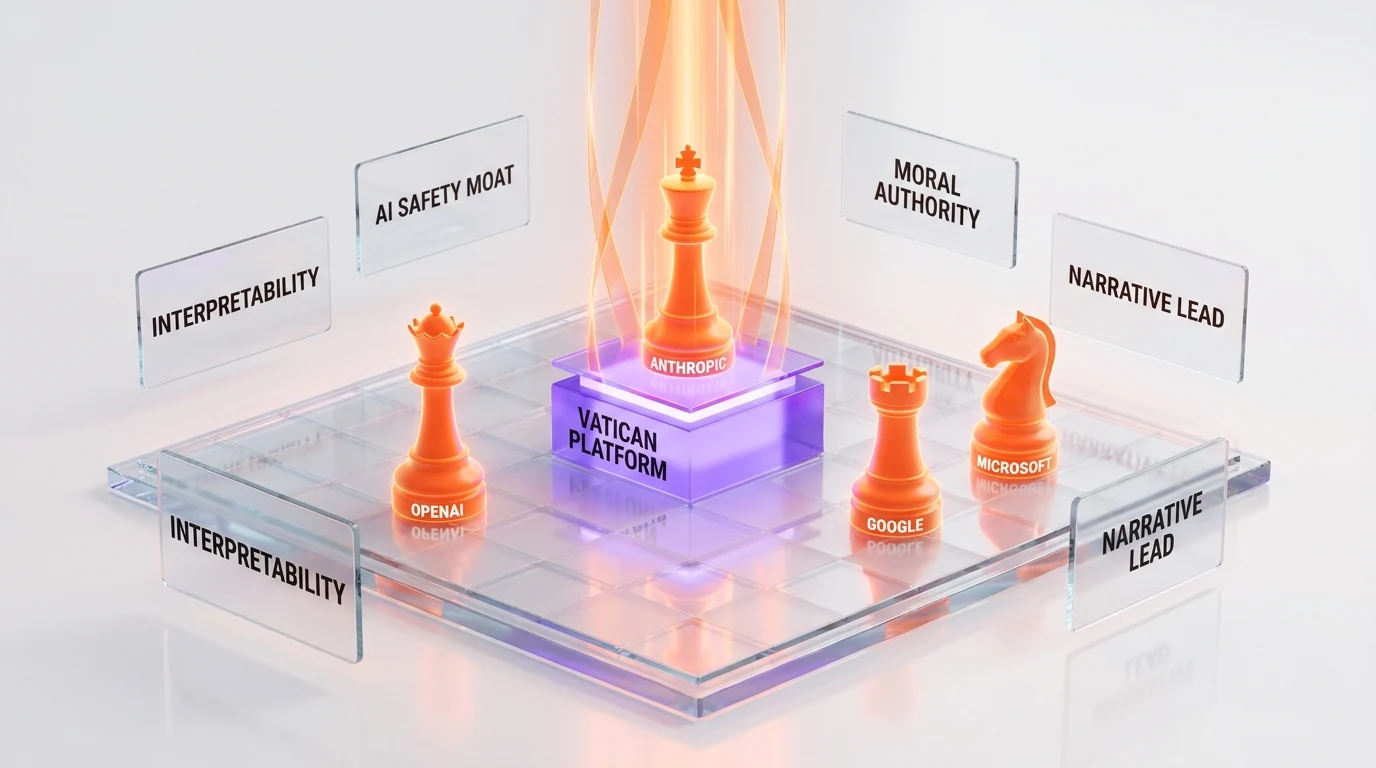
Here I am modulating into open opinion, scoped to my own reading. In my view, the May 25 staging is the strongest single moment of moral-authority positioning Anthropic has ever had. Not because Pope Leo XIV endorsed the company — he very visibly did not — but because the staging communicated something Anthropic's marketing budget could not buy: that when the largest moral institution on earth picks one frontier-AI interlocutor for its first AI doctrine, the choice is intelligible, and the intelligibility is "this is the lab that talks about its own incentives the way we would want it to."
That is a narrative moat, not a technical moat. Narrative moats are real and they compound. They show up in regulator selection of expert advisors. They show up in NGO partnerships. They show up in enterprise procurement at risk-averse organizations. They show up in journalism's default citation pattern. None of these are individually large. Aggregated over 24 to 36 months, they are extremely large.
The strategic timing reads (to me) as intentional on both sides. Anthropic has been telegraphing this positioning for years through interpretability publications, the Responsible Scaling Policy, and consistent public discourse about model welfare. The Vatican has been moving toward a major AI statement at least since the 2020 Rome Call for AI Ethics. Both sides arrived at May 25 prepared. This was not improvisation.
Strategic critique — what I would push back on
I want to be honest about where I have reservations, and I want to keep them strategic, not qualitative. The document itself reads as carefully constructed, intellectually serious, and consistent with Catholic social teaching. I am not interested in second-guessing its theology.
What I would push back on, strategically, is the implied symmetry between "moral voice" and "informed critic." The encyclical and Olah both lean on this construction — that the Vatican can serve as the external moral check that frontier labs need. As a regulatory-citation source, yes, absolutely. As a technical-oversight body in any operational sense, no. The Vatican does not employ AI-safety researchers, does not red-team models, does not audit training runs, and does not have legal power to enforce any framework it proposes. The encyclical's moral authority is real. Its technical-oversight capacity is not, and pretending otherwise would actually weaken the document over time.
Second strategic worry: the absence of other AI-lab voices on the program creates a one-channel narrative that is fragile. If, three years from now, Anthropic merges, sells to a hyperscaler, or quietly retreats from one of its safety commitments, the encyclical's de-facto AI-lab interlocutor becomes a counterexample rather than an exemplar. Single-source positioning has tail risk. The Vatican would be wiser to broaden its AI-lab dialogue over the next 18 months, and the labs themselves — including OpenAI, Google DeepMind, and Microsoft AI — would be wiser to actively pursue that dialogue rather than ceding it to one competitor.
What would prove me wrong
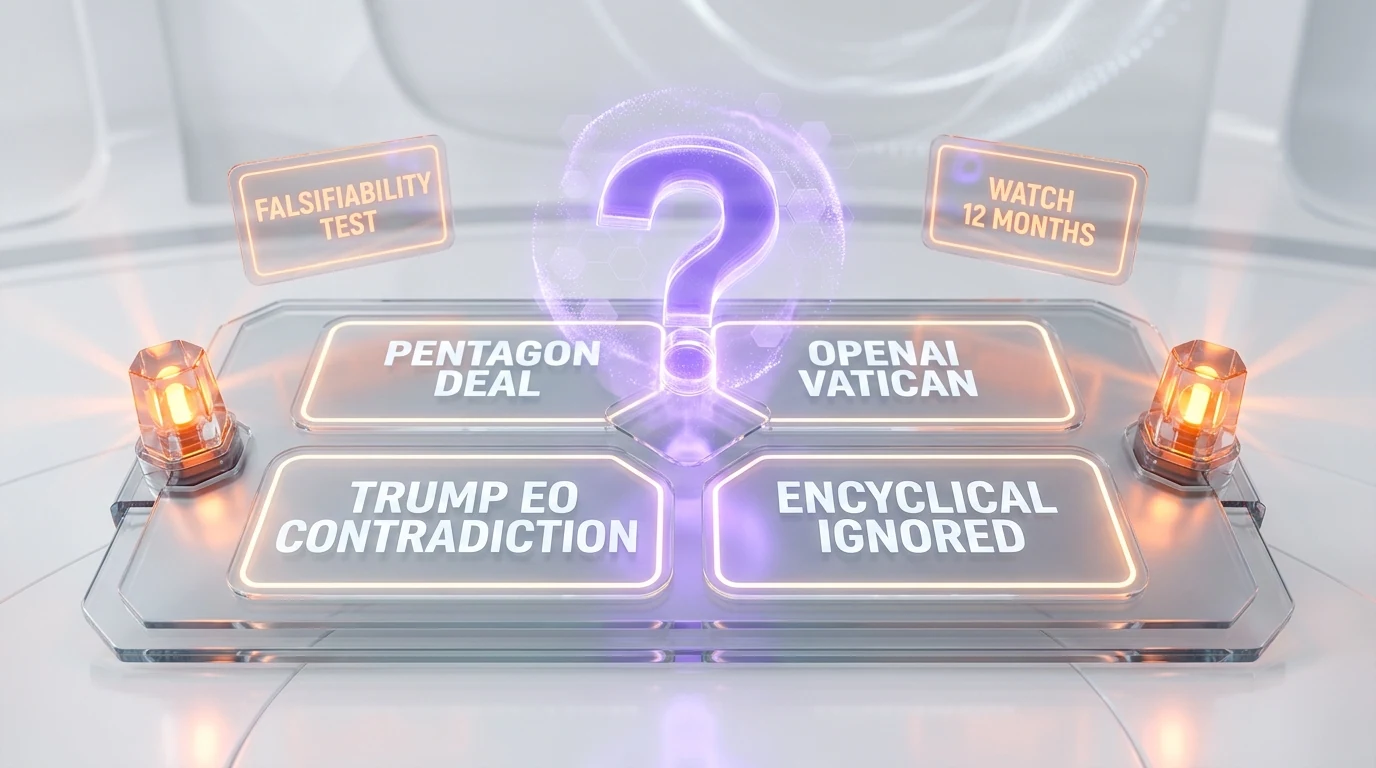
I am running this as a public opinion piece, so I owe you the falsifiability section. Here are the specific events I am watching over the next 12 months that would invalidate or significantly weaken the read above.
First, an Anthropic guardrail retreat. If Anthropic publicly walks back any of its Responsible Scaling Policy commitments, or if a major Pentagon, defense, or surveillance contract is announced that visibly contradicts the "moral voices the incentives cannot bend" framing Olah used at the Vatican, the narrative moat collapses fast. I do not currently expect this. I am watching for it.
Second, a competing AI-lab Vatican appearance. If OpenAI's Sam Altman, Google DeepMind's Demis Hassabis, or Microsoft AI's leadership are seen at a Vatican AI follow-up event in the next 12 months — and especially if one of them is on a Synod Hall program — the "Anthropic alone on the program" framing weakens substantially. This is the most likely falsifier in my view. The Holy See has strong reasons to broaden the conversation, and the other labs have strong reasons to push for that broadening.
Third, a direct executive-branch contradiction. If a US presidential executive order, or a major bilateral US-EU AI agreement, explicitly cites and rejects the encyclical's structural framing (concentration, opacity, dependency), that is a different kind of falsifier — it would show the document is being read by regulators but interpreted as adversarial rather than as moral cover. That changes the citation dynamics in the EU AI Act enforcement debate.
Fourth, encyclical citation flatlines. Six months from now, if the document is not being cited in EU AI Office consultations, US Senate AI hearings, AI Now Institute reports, or peer-reviewed AI ethics papers, the agenda-setting thesis is just wrong. Encyclicals only matter if they get read into other people's arguments. We will know.
How I am tracking this over the next 12 months
For anyone wanting to track this without my analysis: the primary sources are Vatican.va for the canonical encyclical text and any follow-up apostolic letters, the Anthropic newsroom for any further interaction with the Holy See, and the official journals of the Pontifical Academy of Sciences and the Pontifical Academy for Life for the academic follow-on. For policy-citation tracking, watch EU AI Office consultation submissions and US Senate AI Working Group testimony transcripts — those are where moral-authority citations actually translate into legal text.
For our coverage of Anthropic's broader positioning and how the Vatican stage fits into the lab's narrative arc since 2024, see our analysis of the anticipation phase: The First AI Encyclical: Pope Leo XIV, Anthropic, and the Magnifica Humanitas Strategic Read. For ongoing AI policy and AI-safety coverage, see our main blog.
The single sentence I would take away
If you only remember one thing about May 25, 2026, in AI governance history, let it be this: a Pope and an AI-lab co-founder stood together in the Vatican Synod Hall and used the same vocabulary — concentration, opacity, dependency, disarmament, external moral oversight. The vocabulary, not the venue, is the real shift. That is the language regulators, NGOs, journalists, and competing labs will now be answered in for at least the next decade of AI policy. The encyclical did not invent the vocabulary, but it elevated it. That is what doctrines do.
I will be watching whether the labs — all of them, including Anthropic — actually mean what their CEO and co-founder representatives are signaling about wanting external accountability. The encyclical is now a public document with a 1.4-billion-member moral institution behind it. If Anthropic, OpenAI, Google DeepMind, Microsoft AI, or xAI act inconsistently with what they have publicly endorsed about external oversight, the citation will be available to use against them. That is the real consequence of May 25.
Frequently Asked Questions
What is Magnifica Humanitas?
Magnifica Humanitas is the first papal encyclical of Pope Leo XIV, signed on May 15, 2026 and formally published by the Holy See on May 25, 2026. Its subtitle reads "On safeguarding the human person in the time of artificial intelligence," and it is the first encyclical in Catholic history dedicated entirely to AI. The signing date marks the 135th anniversary of Pope Leo XIII's 1891 encyclical Rerum Novarum.
How long is the Magnifica Humanitas encyclical?
According to the official Vatican.va text, the encyclical runs to 75 or more numbered paragraphs. Wikipedia and several outlets describe it as roughly 42,300 words. I have not been able to confirm a precise page count from primary sources, so I am not repeating the "200 pages" figure that circulated in some early summaries without a Vatican source.
Why was Chris Olah from Anthropic at the Vatican presentation?
Chris Olah, co-founder of Anthropic and head of interpretability research, was invited to speak at the encyclical's presentation in the Synod Hall on May 25, 2026. Multiple outlets, including the National Catholic Reporter and Angelus News, confirm he was the only frontier-AI-lab representative on the program. His remarks framed Anthropic's interpretability work as an attempt to address questions about AI "internal states" that the encyclical raises.
Did Pope Leo XIV say AI must be "disarmed"?
Yes. In his presentation remarks, Pope Leo XIV used the word "disarm" deliberately, saying: "The word is strong, I know, but deliberately chosen because this moment needs words capable of attracting attention." The encyclical's Chapter Five is titled "The need to disarm words," and the wider framing parallels the Church's long-standing nuclear disarmament position.
What does Magnifica Humanitas say about AI concentration of power?
Paragraph 67 of the encyclical warns about goods that "remain concentrated in the hands of a few, without adequate forms of sharing and access." Pope Leo XIV's verbal presentation went further, drawing parallels with the Industrial Revolution and warning of "perhaps even greater consequences." The core moral worry is not AI per se but unaccountable accumulation of power, expertise, and data.
Were OpenAI, Google DeepMind, or Microsoft invited to the Vatican event?
Public reporting from the National Catholic Reporter, Angelus News, EWTN, and Anthropic itself only names Christopher Olah as the frontier-AI-lab representative on the Synod Hall program. I have not found any confirmed presence from OpenAI, Google DeepMind, Microsoft AI, or xAI on the published program for May 25, 2026. That is itself part of the story I am analyzing.
Is this an endorsement of Anthropic by the Vatican?
Not in any formal sense. Pope Leo XIV thanked Christopher Olah by name in the Synod Hall, but the encyclical itself names no companies and endorses no products. The signal is platform access and moral recognition, not commercial endorsement. As I read it, the Vatican is treating Anthropic as a useful interlocutor while reserving moral authority for itself.
What did Chris Olah actually say at the Vatican?
Per the verbatim text published by Anthropic, Olah said: "Every frontier AI lab — including Anthropic — operates inside a set of incentives and constraints that can sometimes conflict with doing the right thing." He added that the lab needs external scrutiny: "We need informed critics who will tell the labs when we are failing. We need moral voices that the incentives cannot bend." He also acknowledged that in Anthropic's research "we find internal states that functionally mirror joy, satisfaction, fear, grief, and unease."
How does Magnifica Humanitas connect to Rerum Novarum?
The encyclical is explicitly placed in the Rerum Novarum lineage. Leo XIII's 1891 letter addressed industrial labor and capital concentration. Leo XIV is positioning Magnifica Humanitas as the AI-era analogue: same structural concern about who controls a transformative technology, same insistence that ethics requires legal frameworks and not just goodwill. The May 15 signing date pins this lineage deliberately.
Will the encyclical influence US or EU AI regulation?
Direct legal force, no — encyclicals are not statutes. Indirect agenda-setting force, almost certainly. The EU AI Act is already enforcing; the US is in a deregulatory cycle; the UK and France are positioning. A 1.4-billion-Catholic moral statement that flags concentration, opacity, and dependency lands inside that policy fight as a citation source for regulators, journalists, and civil society. That is the lever I am watching.