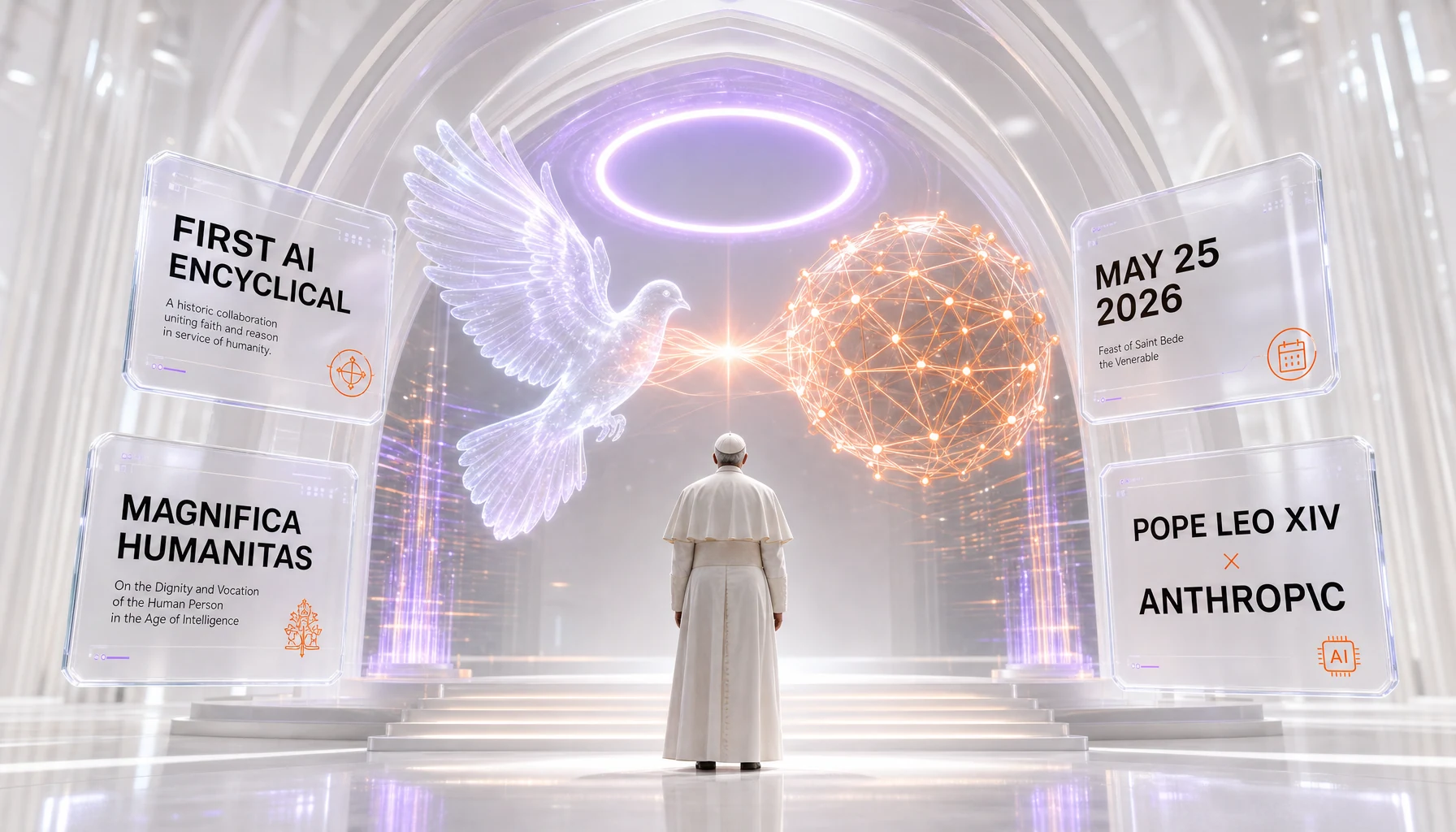
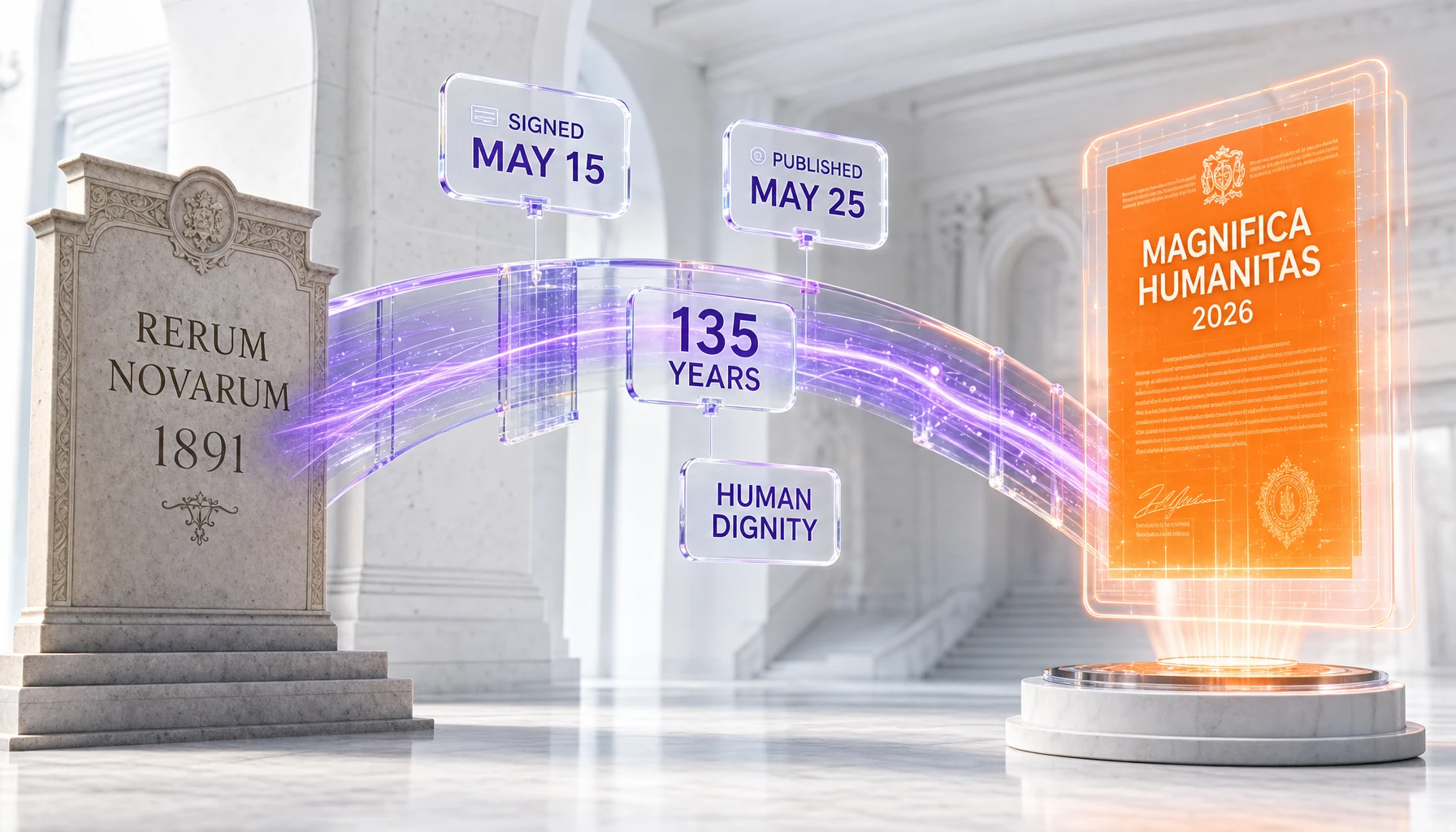
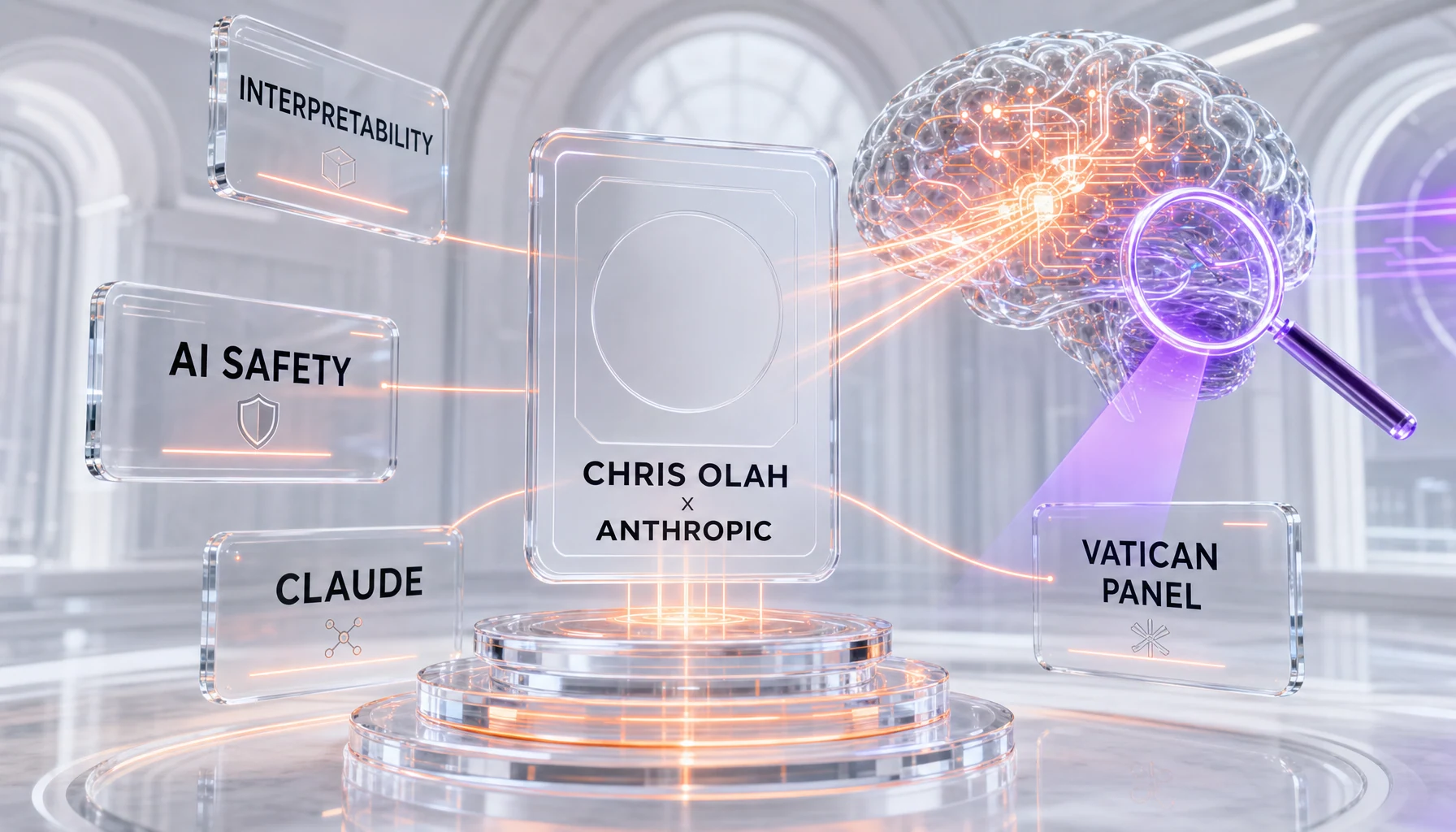
On May 18, 2026, the Vatican announced that Pope Leo XIV will publish Magnifica Humanitas: On the Protection of Human Dignity in the Age of Artificial Intelligence — the first papal encyclical fully dedicated to AI — on May 25, 2026. At the Vatican press conference, Christopher Olah, co-founder of Anthropic and head of its interpretability research, will appear as a panel speaker alongside theologians and cardinals. The encyclical was signed May 15, the 135th anniversary of Leo XIII's 1891 labor encyclical Rerum Novarum. This is the first time a pope shares a launch stage with a frontier-AI lab co-founder.
What the Vatican Confirmed
According to the Vatican's May 18 announcement and reporting by Vatican News, OSV News, the Washington Post, and Axios, the facts are now on the record. Pope Leo XIV's first encyclical is titled Magnifica Humanitas ("Magnificent Humanity"). Its declared subject is the protection of human dignity, justice, and labor in the face of accelerating artificial intelligence. It was signed on May 15, 2026, and is scheduled for publication on May 25, 2026.
The signing date is not incidental. May 15 marked the 135th anniversary of Rerum Novarum, the 1891 social encyclical issued by Pope Leo XIII during the first Industrial Revolution to address the rights of labor and the limits of capital. Pope Leo XIV chose his papal name partly in homage to Leo XIII, and the Vatican is explicitly framing Magnifica Humanitas as the AI-era successor to that document — a deliberate continuity in Catholic social teaching across two industrial transformations 135 years apart.
The presentation is scheduled for the Vatican's Synod Hall at 11:30 a.m. local time on May 25. According to OSV News, the panel includes Christopher Olah (co-founder of Anthropic, the company behind the Claude model family), British theologian Anna Rowlands, and theological ethics professor Léocadie Lushombo. Cardinal Víctor Manuel Fernández and Cardinal Michael Czerny also participate, with closing remarks delivered by Cardinal Pietro Parolin and Pope Leo XIV in person. Reporting describes the pope's personal presence at a press conference as itself an unprecedented gesture, and the inclusion of a frontier-AI lab co-founder on a magisterial launch panel as without modern precedent. The Washington Post first reported the Olah appearance.
One point demands discipline: as of this writing, the full text of Magnifica Humanitas has not been published. We are reporting what the Vatican and tier-1 outlets have confirmed about the document's title, themes, signatories, and launch — not its contents. We make no claims about specific arguments, doctrinal positions, or quotations from a text that does not yet exist publicly.
Why the Rerum Novarum Anchor Matters
Rerum Novarum is one of the most consequential documents in modern Catholic social thought. It established the Church's framework for the dignity of work, just wages, and the moral limits of unregulated industrial capitalism. By signing an AI encyclical on its 135th anniversary and adopting the Leonine name, Leo XIV is signaling that he reads artificial intelligence as a transformation of comparable magnitude to industrialization — a structural shift in how labor, value, and human worth are organized. That framing alone is a strategic statement, independent of the encyclical's specific text.
What Remains Unconfirmed
Sources do not yet confirm the encyclical's internal structure, chapter breakdown, specific policy recommendations, or any direct papal quotations on AI. Reporting also does not explain the precise reason Olah specifically — rather than another AI figure — was selected for the panel. We flag these gaps deliberately rather than fill them with speculation.
This restraint matters more here than on a typical news story. An encyclical is a teaching document with doctrinal weight, and its text will be parsed line by line by theologians, ethicists, policymakers, and the AI industry alike. Pre-empting its contents with inference would be both factually irresponsible and analytically weak. The honest position before May 25 is to separate the confirmed event — title, dates, signatories, launch panel — from the unpublished argument, and to analyze only the first. Everything in this piece is built on that separation.
How the Announcement Was Made
The Vatican made the announcement on May 18, 2026, three days after the May 15 signing and seven days before the scheduled May 25 publication. That cadence — sign, announce, then publish with a live presentation — is itself a communications choice. It builds a one-week window of global anticipation and guarantees that the document arrives into a primed audience rather than a cold one. Layering a frontier-AI co-founder onto the launch panel during that window maximizes press attention, which is consistent with an institution that understands it is entering a crowded and technical conversation and intends to be heard above it.
Christopher Olah and Anthropic's Role on the Stage
Christopher Olah is a co-founder of Anthropic and leads its research on the interpretability of artificial intelligence — the discipline of understanding what is actually happening inside large neural networks rather than treating them as opaque systems. Interpretability is one of the most safety-coded research agendas in the field: its entire premise is that you cannot govern, trust, or morally evaluate a system you cannot inspect.
That makes the choice of speaker legible, even though the Vatican has not stated its reasoning. An encyclical on human dignity in the age of AI needs a technical interlocutor who works on the question of whether these systems can be understood and held accountable at all. Olah's research area maps almost exactly onto the moral question the document is framed around. Anthropic builds the Claude model family — see our coverage of Claude and the developer-facing Claude Code — and has consistently positioned itself around safety, alignment, and the limits of deployment.
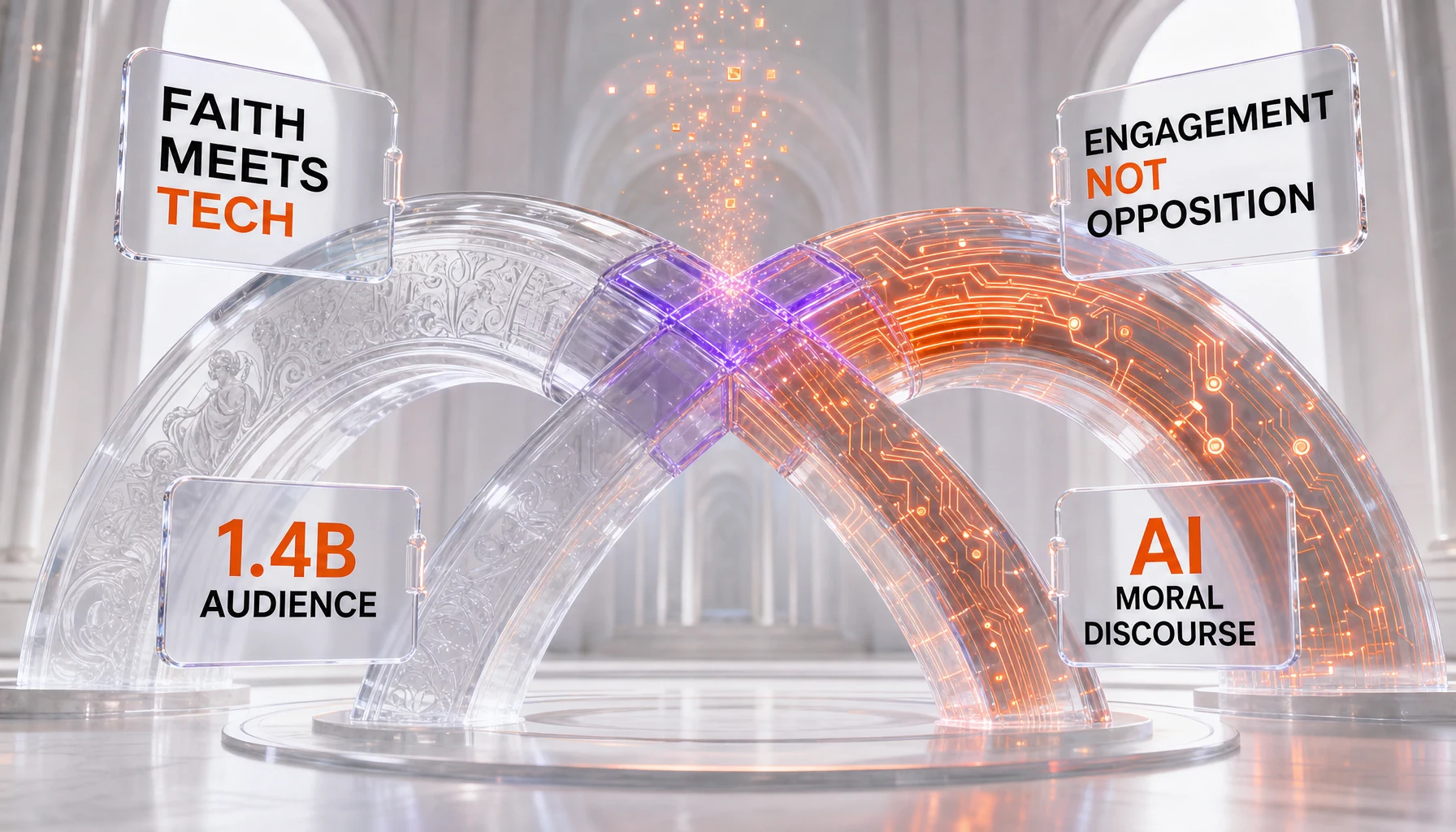
The strategic read here is positioning, not endorsement. For Anthropic, a seat on a papal launch panel places the company inside the highest-visibility moral conversation about AI on the planet, addressed to roughly 1.4 billion Catholics and an effectively global audience. It is a soft-power moment of a kind no benchmark, funding round, or product launch can manufacture. We have tracked Anthropic's deliberate values-forward posture across several inflection points, from its 10-gigawatt compute build-out to its $200M AI-for-good commitment with the Gates Foundation. Sharing a stage with a pope is the most concentrated expression of that posture to date.
Interpretability as the Bridge Between Faith and Engineering
There is a structural reason an interpretability researcher fits this moment better than, say, a CEO or a policy lead. Catholic moral theology has always asked whether an agent's interior intent can be known and judged. Interpretability asks a mechanically analogous question of machines: can we see inside the system well enough to attribute responsibility, detect deception, and verify alignment with stated values? The vocabularies differ entirely, but the underlying concern — that you should not trust what you cannot examine — is shared. That shared structure, not any theological agreement, is what makes the pairing coherent on a press dais.
Anthropic's Pattern of Moral Positioning
Anthropic has repeatedly accepted friction in exchange for a values narrative. We have documented cases where that posture carried real cost — including being locked out of a $200M Pentagon AI deal amid a public clash over the company's stance, and the unresolved tensions visible in its $1.5 billion copyright settlement. The Vatican appearance is consistent with that pattern: Anthropic spends reputational capital to occupy the moral high ground, and this is the highest-altitude version of that move available.
The Faith–Tech Intersection, Without the Caricature
It is easy to flatten this story into "the pope versus the robots" or "Silicon Valley gets a blessing." Neither framing survives contact with the facts. What is actually happening is more specific and more consequential: an institution with 2,000 years of accumulated doctrine on human dignity is formally entering the AI governance conversation as a moral authority, and it is doing so by placing a working AI researcher on its launch stage rather than excluding the industry.
This is a methodological choice with precedent. Catholic social teaching has historically engaged directly with the economic and technological systems it critiques rather than retreating from them. Rerum Novarum did not condemn industry wholesale; it argued for the dignity of the worker inside an industrial economy. The structural parallel suggests Magnifica Humanitas is likely to engage AI as a system to be morally shaped, not simply opposed — though, again, we are reasoning from the framing and the historical anchor, not from a text we have not read.
Why a Religious Institution Carries Weight in AI Discourse
From a purely strategic-communications standpoint, the Catholic Church occupies a position no government, lab, or standards body can replicate: a globally distributed moral vocabulary, centuries of institutional continuity, and an audience measured in the billions that is not segmented by technical literacy. When that institution issues a formal teaching document on AI, it reframes the conversation from a primarily technical and regulatory register into a moral one accessible to a mass audience. That shift in register is the actual news, regardless of where any reader stands on religion.
What This Is Not
This is not a doctrinal endorsement of Anthropic, nor evidence that the Church has taken a position on any particular AI company or product. Olah's panel seat is a speaking role at a presentation, not a partnership. We note this explicitly because the gap between "shared a stage" and "blessed the technology" is exactly where misreporting tends to occur. The accurate description is narrow and we are keeping it that way.
Implications for the Global AI Safety and Governance Discourse
The most durable effect of Magnifica Humanitas may have nothing to do with its specific arguments and everything to do with who is now in the room. Until now, the AI governance conversation has been dominated by three constituencies: the labs, the regulators (EU AI Act, US executive actions, UK and allied frameworks), and a relatively small expert civil-society layer. The entry of a global religious institution as a recognized moral voice adds a fourth, and it is the only one of the four with direct reach into the daily lives of over a billion people.
For the AI safety community specifically, this is a mixed signal worth reading carefully. On one hand, it dramatically expands the audience for concepts like alignment, interpretability, and the dignity-of-labor framing — ideas that have struggled to escape technical and policy circles. The presence of an interpretability researcher on the stage means those concepts arrive in mainstream moral discourse with at least one technically grounded translator rather than purely through journalism. On the other hand, moral framing can outrun technical nuance, and a mass-audience document risks compressing genuinely unresolved engineering questions into settled-sounding moral claims. Both effects are plausible; which dominates depends on the text and its reception.
The Regulatory Adjacency
Encyclicals are not legislation, and the Church is not a regulator. But formal Catholic social teaching has historically influenced policy debate in Catholic-majority jurisdictions and within international institutions, particularly on labor and human-dignity questions. A widely circulated AI dignity framework could become a reference point in legislative and multilateral discussion, especially in Europe and Latin America, in the same way Rerum Novarum shaped labor discourse far beyond the Church itself. This is an adjacency to watch, not a prediction of specific outcomes.
What Anthropic Gains, and What It Risks
The strategic ledger for Anthropic is straightforward. The gain is unmatched moral visibility and a reinforcement of its safety-first brand at a scale competitors cannot easily counter. The risk is reputational concentration: tying the company's public identity to a single high-profile moral event creates exposure if the encyclical's reception is contested, or if the "shared a stage" framing is later weaponized by critics as either over-claiming endorsement or, conversely, as the Church legitimizing commercial AI. Anthropic has historically managed this kind of exposure deliberately, as we have seen across its public-positioning moves, but the altitude here is higher than anything it has attempted before.
There is also a competitive dimension that is worth stating plainly without overstating it. No other frontier lab has secured a comparable moral platform, and the symbolic distance between "presented an AI encyclical alongside the pope" and any conventional product or partnership announcement is large. If the encyclical is well received, the association compounds over time as the document is cited and taught. If it is contested, the same association becomes a liability that is harder to unwind than a commercial misstep, precisely because moral positioning cannot be quietly rolled back the way a feature or a deal can. That asymmetry — durable upside, sticky downside — is the defining characteristic of this kind of soft-power bet, and it is why we read the move as deliberate rather than opportunistic.
The Signal for the Rest of the Industry
For competing labs, the encyclical sets a reference point that did not exist a week ago. The conversation about AI's moral stakes now has a billion-person institutional anchor, and the first lab voice attached to it works on interpretability rather than capability or commercialization. That framing — safety and inspectability as the entry point to the moral conversation — advantages companies that have invested in those agendas and creates a narrative gap for those that have not. Whether competitors respond by elevating their own safety messaging, contesting the framing, or staying silent will be one of the more telling industry signals to watch in the weeks after May 25. None of this requires the encyclical to name a single company; the framing alone does the work.
What Would Change This Read
Our analysis is built on the framing, the historical anchor, and the panel composition — not on the encyclical text. If the published document takes a sharply restrictive or condemnatory line on AI development, the "engagement not opposition" thesis weakens significantly. If Olah's role turns out to be substantive rather than ceremonial, the faith–engineering bridge argument strengthens. We will revisit this analysis once the full text is public on May 25.

The Bottom Line
Strip away the novelty and the headline, and the substance is this: a global moral institution with 135 years of continuity in social teaching is formally entering the AI governance conversation, and it has chosen to do so with an interpretability researcher from a frontier lab on its launch stage rather than against the industry. The confirmed facts — the title Magnifica Humanitas, the May 15 signing on the Rerum Novarum anniversary, the May 25 publication, Olah's panel seat — together describe a deliberate act of engagement, not condemnation. For Anthropic, it is the most concentrated soft-power moment in the company's history. For the AI safety discourse, it is the moment those ideas left the expert room and entered a billion-person moral vocabulary. What the text actually says, we will assess on May 25. What it already signals, we can read today.
Frequently Asked Questions
What is Magnifica Humanitas?
Magnifica Humanitas ("Magnificent Humanity") is Pope Leo XIV's first encyclical and the first papal encyclical fully dedicated to artificial intelligence. Its full title is "Magnifica Humanitas: On the Protection of Human Dignity in the Age of Artificial Intelligence." It was signed May 15, 2026, and the Vatican announced on May 18 that it will be published May 25, 2026.
When is the encyclical on AI being published?
The Vatican confirmed the encyclical will be published on May 25, 2026. A press conference is scheduled for the Vatican's Synod Hall at 11:30 a.m. local time that day, with Pope Leo XIV present in person to deliver closing remarks.
Who is Christopher Olah and why is he involved?
Christopher Olah is a co-founder of Anthropic, the company behind the Claude model family, and leads its research on AI interpretability. He is listed as a speaker on the Vatican press conference panel. The Vatican has not publicly stated its specific reasoning for selecting him, but his interpretability research maps directly onto the encyclical's core question of whether AI systems can be understood and held morally accountable.
Why was the encyclical signed on May 15?
May 15, 2026 marked the 135th anniversary of Rerum Novarum, the 1891 social encyclical by Pope Leo XIII that addressed labor and capital during the first Industrial Revolution. Pope Leo XIV chose his papal name partly in homage to Leo XIII, and the Vatican is framing Magnifica Humanitas as the AI-era successor to that foundational labor document.
Does this mean the Catholic Church endorses Anthropic?
No. Christopher Olah's role is a speaking seat on a presentation panel, not a partnership or doctrinal endorsement. The accurate description is that an Anthropic co-founder will speak at the encyclical's launch alongside theologians and cardinals — nothing in the confirmed reporting indicates the Church has taken a position on any AI company or product.
Who else is on the Vatican press conference panel?
According to OSV News, the panel includes Christopher Olah (Anthropic), British theologian Anna Rowlands, and theological ethics professor Léocadie Lushombo. Cardinal Víctor Manuel Fernández and Cardinal Michael Czerny also participate, with closing remarks by Cardinal Pietro Parolin and Pope Leo XIV.
What does the encyclical actually say about AI?
As of this writing, the full text has not been published, so its specific arguments, structure, and any papal quotations are not yet public. The Vatican has confirmed only its themes: the protection of human dignity, justice, and labor in the age of artificial intelligence. We are reporting confirmed facts about the document, not its contents.
How does this connect to Rerum Novarum?
Rerum Novarum (1891) established the Catholic Church's framework for the dignity of work and the moral limits of industrial capitalism. By signing Magnifica Humanitas on its 135th anniversary and adopting the Leonine papal name, Pope Leo XIV signals that he reads AI as a structural transformation comparable in magnitude to industrialization — a deliberate continuity in Catholic social teaching.
Why does a religious document matter for AI governance?
The Catholic Church reaches roughly 1.4 billion people with a globally distributed moral vocabulary and centuries of institutional continuity. A formal teaching document on AI shifts the conversation from a primarily technical and regulatory register into a moral one accessible to a mass audience, adding a fourth constituency to a debate previously dominated by labs, regulators, and expert civil society.
What does Anthropic gain from the Vatican appearance?
Strategically, Anthropic gains unmatched moral visibility and reinforcement of its safety-first brand at a scale competitors cannot easily counter. The risk is reputational concentration — tying public identity to a single high-profile moral event creates exposure if the encyclical's reception is contested or the "shared a stage" framing is later contested.
Is interpretability research related to the encyclical's themes?
Structurally, yes. Interpretability research asks whether we can see inside AI systems well enough to attribute responsibility, detect deception, and verify alignment with stated values. That question is mechanically analogous to long-standing moral concerns about knowing and judging an agent's interior intent — which is why an interpretability researcher fits the launch panel more coherently than a CEO or policy lead.
Where can I read the confirmed reporting on this?
The Washington Post first reported Christopher Olah's appearance at the launch. Vatican News, OSV News, and Axios have published corroborating coverage of the encyclical's title, signing date, publication date, and panel composition. The full encyclical text is scheduled for release on May 25, 2026.
This analysis reports confirmed facts as of May 18, 2026, from the Vatican announcement and tier-1 reporting (Washington Post, Vatican News, OSV News, Axios). The full text of Magnifica Humanitas had not been published at the time of writing; we make no claims about its specific contents. ThePlanetTools.ai has no affiliation with Anthropic or the Vatican. This piece takes no religious position and reports the event analytically.