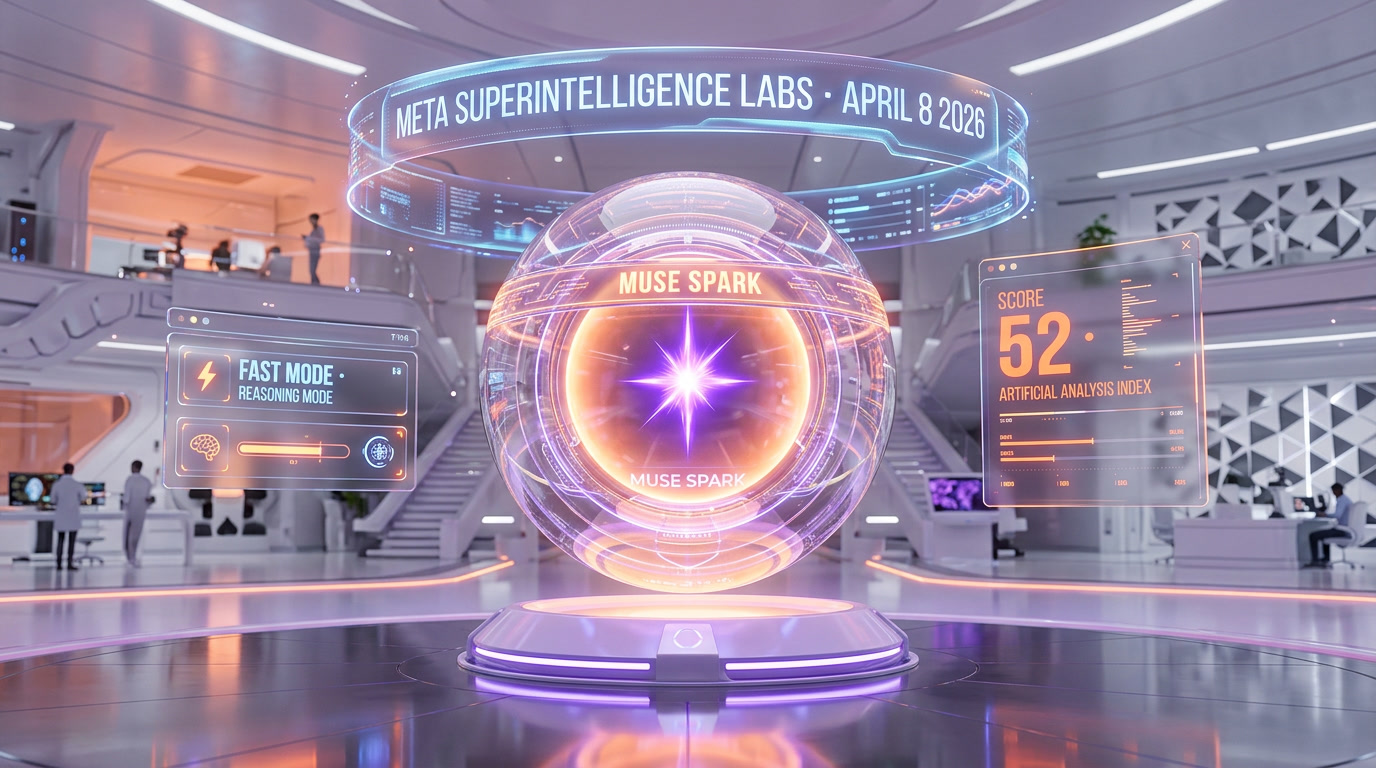
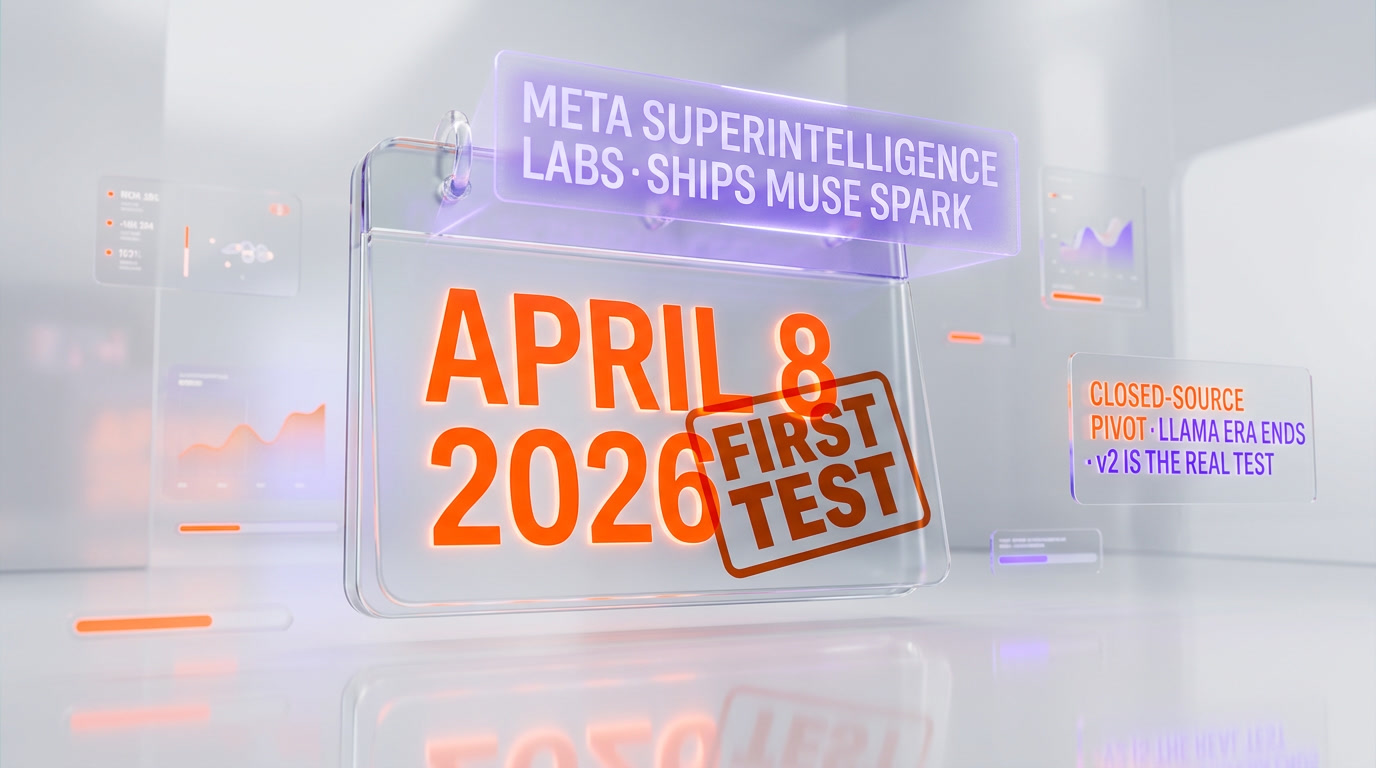
On April 8, 2026, Meta Superintelligence Labs launched Muse Spark, its first model since Mark Zuckerberg's $14.3 billion Scale AI deal and the hire of Alexandr Wang as division lead. Muse Spark scores 52 on the Artificial Analysis Intelligence Index, lands fast-mode and reasoning modes at release, ships strong results in health and visual understanding but weak results in coding and ARC-AGI-2, and marks Meta's decisive pivot away from its open-source Llama legacy. It is integrated immediately into the Meta AI app and meta.ai on web, with a roadmap for Facebook, Instagram and WhatsApp over the coming weeks. Meta stock rose on the announcement.
What is Meta Muse Spark, exactly
Muse Spark is the first frontier model shipped by Meta Superintelligence Labs (MSL), the division Mark Zuckerberg stood up in mid-2025 after spending, on public reporting, somewhere between $14 billion and $20 billion on acquisitions, infrastructure and recruitment. It is a general-purpose multimodal model — text, image and document understanding — with two operating modes: a low-latency fast mode for consumer chat, and a heavier reasoning mode for multi-step problems. Both modes ship on day one.
The launch framing from Meta is pointed: Muse Spark is positioned as a direct competitor to ChatGPT, Claude and Google Gemini 3, not as a supplement to the Llama line. There is no open-weight release attached. There is no Hugging Face checkpoint. There is, for the first time in a Meta flagship, no weights file at all. Access is through the Meta AI app, meta.ai on web, and (eventually) API partners.
The $14.3 billion acquisition that made this possible
Muse Spark does not exist without Scale AI. In mid-2025, Meta paid approximately $14.3 billion for a 49% stake in Scale AI and, more importantly, for Alexandr Wang himself. Wang left his CEO role at Scale, joined Meta as head of Meta Superintelligence Labs, and brought a core of Scale's applied research leadership with him. The deal was structured to avoid a full antitrust review, which meant Meta had to take a minority equity position — but the operating leadership transfer was effectively complete.
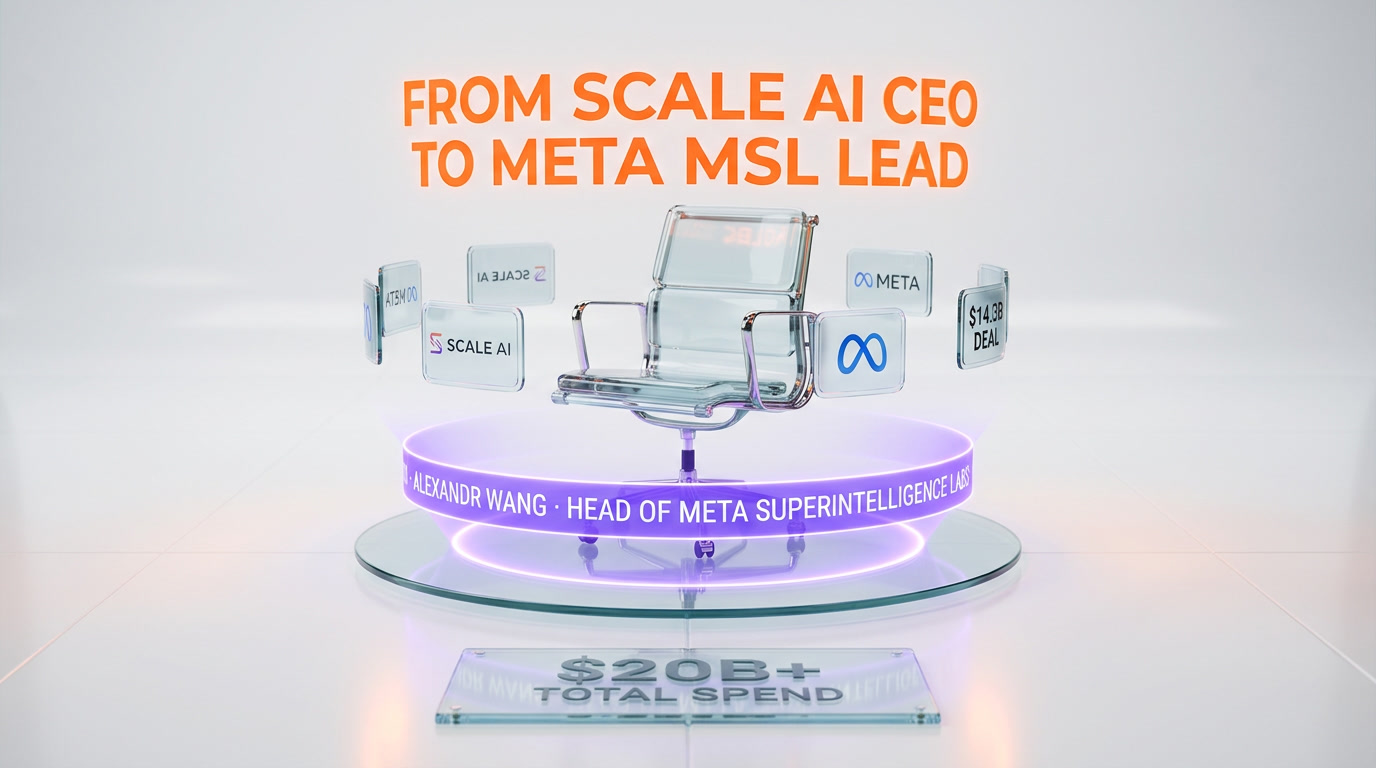
On top of the Scale transaction, Zuckerberg's recruiting blitz through 2025 and early 2026 is reported to have included individual offers in the $100 million to $200 million range for senior researchers from OpenAI, Anthropic, Google DeepMind and xAI. The hit rate was mixed — some big names declined — but enough research talent moved that Meta rebuilt a frontier-scale team in under nine months. Muse Spark is the first public proof the team assembled and shipped.
The number to hold in your head here is not the 52 Intelligence Index score. It is the cost of landing that 52. Add the Scale stake, the infrastructure build-out, the compensation war, and the rough total is somewhere above $20 billion for a model that, on current benchmarks, sits behind GPT-5.4 and Claude Opus 4.6. That gap is either the opening position of a long campaign or it is a very expensive lesson. It is too early to tell which.
Benchmarks: where Muse Spark wins and where it loses
The headline number is 52 on the Artificial Analysis Intelligence Index, which is a composite score across MMLU-Pro, GPQA Diamond, MATH, HumanEval and a handful of reasoning benchmarks. For reference, that puts Muse Spark in the middle of the current frontier pack — above most open-weight models, below the top tier from OpenAI, Anthropic and Google.

Where Muse Spark actually shines, according to Meta's own disclosures and early independent tests:
- Health reasoning. Muse Spark outperforms the current public frontier on several medical QA benchmarks — likely a direct consequence of the Scale AI data-labeling pipeline, which has been building high-quality medical annotation sets for years under Scale's enterprise customers.
- Visual understanding. On image description, chart reading and document-layout tasks, Muse Spark is competitive with or ahead of Gemini 3. This is the only frontier category where Meta has a clear lead.
- Long-context recall. Context windows and needle-in-a-haystack recall are solid, though not class-leading.
Where Muse Spark loses, and loses badly:
- Coding. On SWE-bench Verified and LiveCodeBench, Muse Spark trails Claude Opus 4.6 and GPT-5.4 by double digits. For a model shipping in April 2026, that is a significant gap — coding is the single highest-value token category in the enterprise market.
- ARC-AGI-2. On the current version of François Chollet's abstraction benchmark, Muse Spark scores in the low teens. GPT-5.4 reasoning mode is roughly three times higher. This is the benchmark the frontier labs now use as their north star for general intelligence, and Muse Spark is not close.
- Agentic task completion. Early tests on WebArena and similar agent environments put Muse Spark behind both Claude and GPT-5.4. The reasoning mode helps, but not enough to close the gap.
Our read: this is a model built by people who prioritized consumer chat UX and data-rich verticals (health, visual) over developer and agent workloads. That is a defensible choice — Meta has 3+ billion consumer users and zero enterprise API footprint — but it is a choice, and it shows in the scorecard.
Fast mode versus reasoning modes
Muse Spark ships with two modes from day one, which is new for a Meta release. Previous Llama launches were single-configuration. Muse Spark's split is:
- Fast mode. Low-latency, single-pass generation. This is what you get when you tap the Meta AI bubble in Instagram DMs or the search bar in the Meta AI app. It is optimized for sub-second first-token latency and short-to-medium responses.
- Reasoning mode. Chain-of-thought with internal scratchpad, multi-step tool use, and an explicit "thinking" UI. This is what you get when you toggle the reasoning button on meta.ai or when a prompt is classified as needing deliberation. Reasoning mode is where Muse Spark closes some — not all — of the gap to the current frontier top tier.
The mode split mirrors the GPT-5 and Claude Opus 4.6 pattern, where fast and reasoning variants share a base model and differ at inference. Meta's implementation looks clean. The open question is whether the reasoning mode is actually doing useful search — or whether it is a cosmetic layer on top of the same weights.
Rollout: Meta AI app first, then Facebook, Instagram, WhatsApp
Muse Spark is live, today, in the following surfaces:
- The Meta AI app (standalone) on iOS and Android — both fast and reasoning modes.
- meta.ai on the web — both modes, with a reasoning toggle.
- Ray-Ban Meta smart glasses — fast mode only, integrated with the existing Look and Ask flow.
Rolling out over the coming weeks, according to Meta's announcement:
- Facebook search and the Feed assistant — first in English, then in the ten most-used Meta languages.
- Instagram DMs and search — replacing the current Meta AI model in creator conversations and caption generation flows.
- WhatsApp — first as an opt-in assistant in personal chats, later surfaced in Business API flows.

If the rollout lands on its planned timeline, Muse Spark will be sitting in front of roughly 3 billion monthly active users by the end of Q2 2026. That is a distribution moat no frontier lab — not OpenAI, not Anthropic, not even Google — can match from a standing start. Distribution has always been Meta's real edge. Muse Spark is the first AI product where that edge gets to matter.
Is it worth the billions Meta spent?
On pure benchmark scores, no. A 52 on the Artificial Analysis Index for a model that cost somewhere north of $20 billion to produce is, on unit economics alone, a poor return. You can rent similar-scoring models from Mistral, DeepSeek or Qwen for a fraction of the sticker.
On strategic positioning, maybe. Three things have to be true for the bet to pay off:
- Version two has to close the gap fast. Muse Spark is version one of a model line that Alexandr Wang now owns. If Muse Spark v2 ships in Q3 2026 and scores 60+, the narrative flips instantly. If v2 slips or lands at 54, the narrative breaks.
- The distribution advantage has to convert. Putting Muse Spark in front of 3 billion users is meaningless unless those users actually use it — and unless Meta can monetize the engagement (ads, commerce, subscriptions). The jury is out on whether Meta AI interactions monetize at the same rate as Feed impressions.
- The data moat has to be real. Scale AI's core value inside Meta is the data pipeline, not just the people. If Scale's annotation and evaluation infrastructure gives Meta a durable data-quality advantage over OpenAI, Google and Anthropic, that shows up in v2, v3 and v4. If it doesn't, Meta paid $14.3 billion for a very expensive recruiter.
Meta stock rose on the Muse Spark announcement. The market liked the story. But the market also liked Reality Labs in 2021, and that bet has not aged well. Judgment on Muse Spark belongs to version two, not version one.
Muse Spark vs GPT-5.4 vs Claude Opus 4.6 vs Gemini 3
A compact scorecard, on the axes most readers care about:
- Raw intelligence (Artificial Analysis Index). Claude Opus 4.6 ≈ 68, GPT-5.4 ≈ 65, Gemini 3 ≈ 62, Muse Spark = 52. Muse Spark is a full tier behind.
- Coding (SWE-bench Verified). Claude Opus 4.6 leads at roughly 78%, GPT-5.4 at 72%, Gemini 3 at 65%, Muse Spark in the low 50s. This is the category where the gap hurts most.
- Health reasoning (MedQA, NEJM CPC). Muse Spark leads, which is new. This is the Scale AI dividend showing up on a benchmark.
- Visual understanding. Muse Spark is competitive with Gemini 3, ahead of GPT-5.4 on several chart and document-layout tasks. Second category where Meta actually wins.
- Price to the developer. Uncertain — Meta has not published API pricing yet. Consumer use in the Meta AI app is free.
- Distribution. Muse Spark wins by a mile — 3 billion users across Facebook, Instagram, WhatsApp, Messenger and the Meta AI app. No competitor comes within an order of magnitude.
- Openness. Claude and GPT-5.4 are closed. Gemini 3 is closed. Muse Spark is closed — a break from Llama. There is no open-weight frontier model left from a US-based lab. That is the most significant strategic shift in the release.
The closed-source pivot — Llama is over
This is the part of the announcement that most people are under-reacting to. Meta built its entire AI brand, from Llama 1 in early 2023 through Llama 4 in 2025, on the claim that frontier-class weights should be open. That brand positioning survived real internal debate, real commercial costs, and real pressure from US policymakers who wanted tighter controls on frontier weights.
Muse Spark breaks the pattern. It is closed. It ships through Meta-owned surfaces only. There is no weights release, no fine-tuning kit, no license. Meta has not formally announced that the Llama line is dead — the Llama 4 family is still on Hugging Face — but the signal is unmistakable: the next-generation frontier from Meta is going to be a closed platform, not an open commons.
There are several plausible reasons:
- Alexandr Wang's playbook is enterprise-closed. Scale AI sold high-margin services to closed-source labs. Wang's instincts, professionally, are commercial.
- Open-weight China is spooking Washington. With DeepSeek, Qwen and Kimi releasing strong open models, the US national-security argument for closed frontier weights has gotten louder in 2026. Meta doesn't want to be the vector.
- The ROI is better. Closed frontier models capture more revenue per inference than open releases. After $20 billion in spend, Meta's shareholders want that capture.
Whatever the mix of reasons, the consequence is stark: as of April 8, 2026, there is no major US-based frontier lab still shipping open weights at the top tier. That is a quiet end to an era that a lot of the developer community will miss.
What this means for 3+ billion Meta users
For the average Meta user, Muse Spark is going to show up as a small, meaningful upgrade to the assistants inside the apps they already use. Faster replies. Better image understanding. More useful suggestions. That is the consumer-surface story, and it is real.
For developers and power users, the picture is different:
- If you build on Meta AI Studio or the Meta AI API, you now have a new default model — and you should test it against your existing stack before committing.
- If you build on Llama 4, your fine-tunes are not going away, but you should assume Llama gets less investment from here on. Plan accordingly.
- If you evaluate frontier models against each other for production workloads, Muse Spark is not yet a serious candidate for coding or agentic tasks. Revisit at v2.
- If you care about privacy, Muse Spark runs on Meta infrastructure. Whatever you would tell Facebook, you can tell Muse Spark. Whatever you would not tell Facebook, do not tell Muse Spark.
Our verdict
Muse Spark is a competent first release from a team that has existed, as a team, for less than a year. Given that constraint, it is impressive. Scoring 52 on the Artificial Analysis Index with strong wins in health and visual categories is a credible debut. If the only question were "did Alexandr Wang ship on time," the answer would be yes.
The harder questions are the ones Meta shareholders will be asking in twelve months. Did the $14.3 billion Scale AI deal buy a durable data moat, or a very expensive recruiter? Does the closed-source pivot survive contact with the open-weight pressure from China? Does version two actually close the benchmark gap to Claude Opus 4.6 and GPT-5.4? And does Meta's distribution advantage translate into the kind of revenue that justifies the total spend?
We do not know the answers yet. Neither does Mark Zuckerberg. Muse Spark is the opening move in a game Meta is going to play for the next five years, and April 8, 2026 is the day we started keeping score. We will be watching version two closely — that is the release where the thesis actually gets tested.
Frequently asked questions
What is Meta Muse Spark?
Meta Muse Spark is the first frontier AI model released by Meta Superintelligence Labs, launched April 8, 2026. It is a multimodal text and image model with two operating modes — fast mode for low-latency chat and reasoning mode for multi-step problems. It scores 52 on the Artificial Analysis Intelligence Index and is shipped as a closed-source model, accessible through the Meta AI app, meta.ai on web, and integrations with Facebook, Instagram, WhatsApp and Ray-Ban Meta smart glasses.
Who is Alexandr Wang and why does he lead Meta Superintelligence Labs?
Alexandr Wang is the former CEO of Scale AI. In mid-2025, Mark Zuckerberg structured a $14.3 billion deal for a 49% stake in Scale AI that brought Wang over to Meta as head of Meta Superintelligence Labs (MSL). The deal was structured as a minority investment to avoid a full antitrust review, but the operational leadership transfer was effectively complete. Muse Spark is the first model Wang has shipped at Meta.
How does Muse Spark compare to GPT-5.4, Claude Opus 4.6 and Gemini 3?
On the Artificial Analysis Intelligence Index, Muse Spark scores 52 compared to roughly 68 for Claude Opus 4.6, 65 for GPT-5.4 and 62 for Gemini 3 — a full tier behind the current frontier leaders. Muse Spark leads on health-reasoning benchmarks and is competitive with Gemini 3 on visual understanding, but trails significantly on coding (SWE-bench Verified) and on ARC-AGI-2. Its biggest advantage is distribution: it ships on day one inside the Meta AI app with a roadmap to 3+ billion Facebook, Instagram and WhatsApp users.
Is Muse Spark open-source like Llama?
No. Muse Spark is closed-source — there is no weights release, no Hugging Face checkpoint, no fine-tuning kit. This is a decisive break from the open-weight strategy Meta pursued from Llama 1 in early 2023 through Llama 4 in 2025. Meta has not formally declared Llama dead, but Muse Spark's closed posture signals that the next-generation Meta frontier will be a closed platform. As of April 8, 2026, there is no major US-based frontier lab still shipping open weights at the top tier.
Where can I use Muse Spark right now?
Muse Spark is live on day one inside the Meta AI app on iOS and Android (both fast and reasoning modes), meta.ai on web with a reasoning toggle, and Ray-Ban Meta smart glasses in fast mode only. Over the coming weeks Meta plans to roll Muse Spark into Facebook search and Feed assistant, Instagram DMs and search, and WhatsApp as an opt-in personal-chat assistant and later inside the WhatsApp Business API.
What is the $14.3 billion Scale AI deal?
In mid-2025 Meta paid approximately $14.3 billion for a 49% equity stake in Scale AI. The transaction was structured as a minority investment to avoid a full antitrust review, but it was effectively a talent and infrastructure acquisition: Alexandr Wang left his CEO role at Scale, joined Meta as head of Meta Superintelligence Labs, and brought a core of Scale's applied research leadership with him. The deal is the single largest line item in Meta's roughly $20 billion-plus total spend on the MSL buildout through 2025 and early 2026.
How much did Meta spend in total to build Muse Spark?
Public reporting puts Meta's total spend on Meta Superintelligence Labs at somewhere north of $20 billion when you combine the $14.3 billion Scale AI stake, infrastructure build-out, and the recruiting war — which reportedly included individual offers in the $100 million to $200 million range for senior researchers from OpenAI, Anthropic, Google DeepMind and xAI. Meta has not published an official total, and the number depends heavily on how you account for existing Facebook AI Research (FAIR) infrastructure that was absorbed into MSL.
Is Muse Spark worth the billions Meta spent?
On raw benchmark scores alone, no — a 52 on the Artificial Analysis Index for a model that cost north of $20 billion is poor unit economics. On strategic positioning, it depends on three things: whether version two closes the gap to Claude Opus 4.6 and GPT-5.4, whether the 3+ billion user distribution actually monetizes at scale, and whether the Scale AI data pipeline gives Meta a durable data-quality moat that compounds across v2, v3 and v4. Meta stock rose on the announcement, which suggests the market is pricing in the strategic story rather than the version-one benchmark gap.