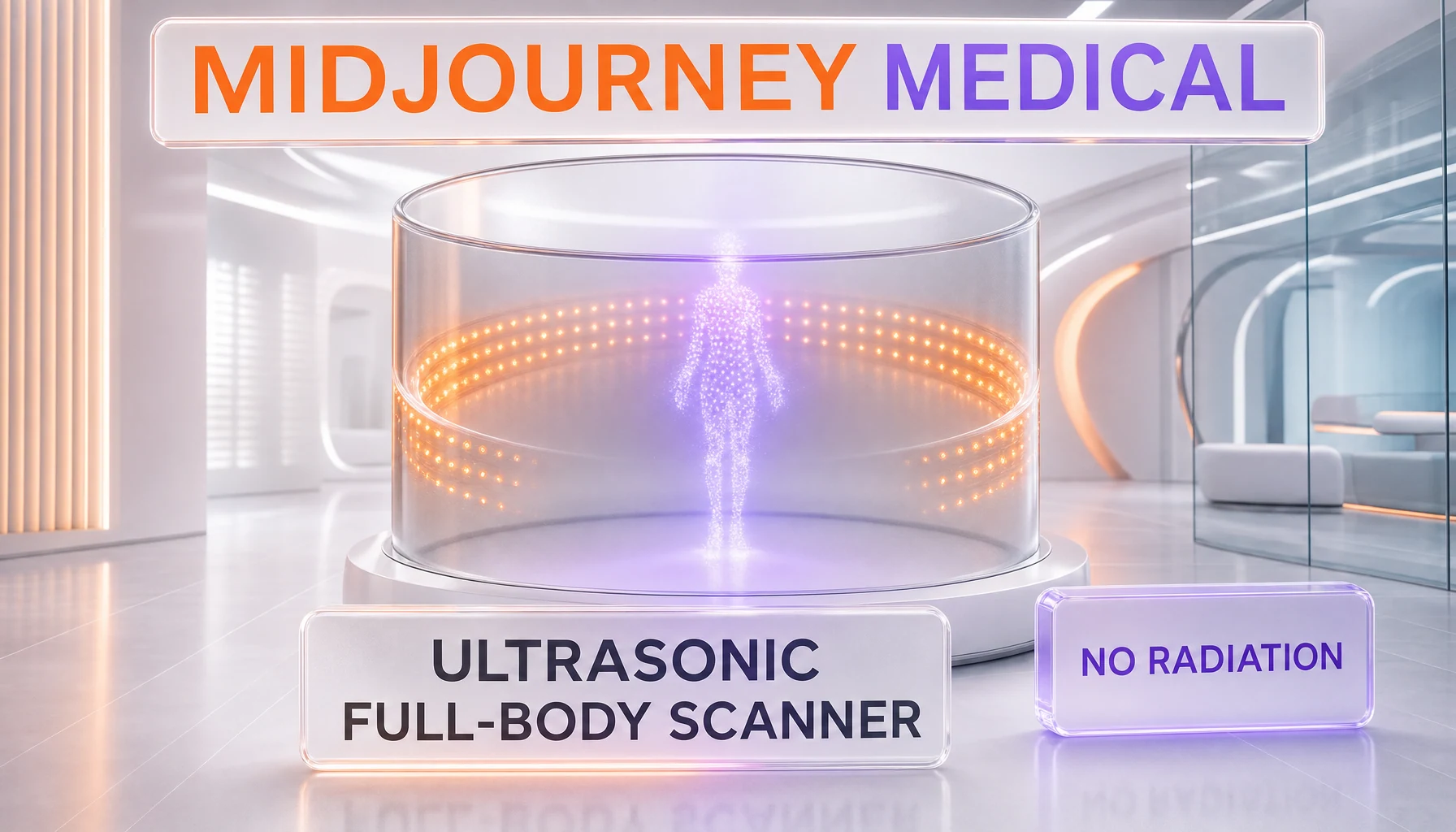
Midjourney Medical is a new health division from Midjourney, the AI image lab, built around its first hardware product: a full-body ultrasonic scanner that images muscle, fat, bone, and organs in roughly 60 seconds with no radiation and no magnets. Unveiled in a June 17, 2026 livestream, the scanner is a first-generation prototype with no FDA clearance — it currently produces body-composition maps, not diagnoses. Critically, it is a medical-imaging device, not an image-generation product: the underlying ultrasound comes from a co-development and licensing deal with Butterfly Network, not from Midjourney's text-to-image models.
What Happened
On June 16, 2026, Midjourney posted a cryptic teaser. A day later, on June 17, it published a blog post and ran a livestream revealing what almost nobody predicted from the company best known for generating images from text prompts: a physical machine. Midjourney Medical is a standalone health division, and its debut product is a full-body ultrasonic scanner the company describes as "as powerful as MRI and as casual as a trip to the spa."
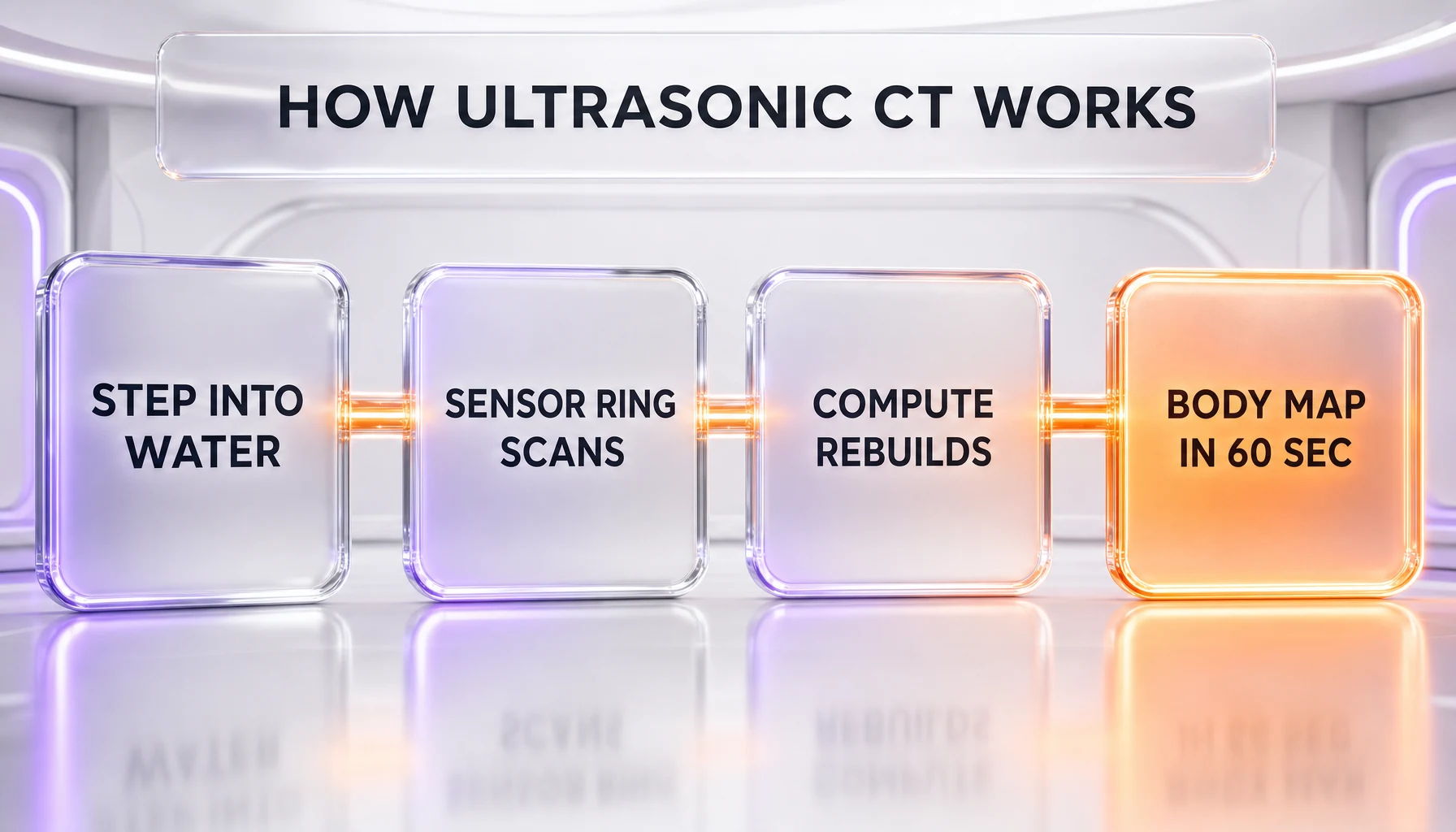
The mechanics are unusual. You step onto a platform and are lowered into a shallow pool of water at about two inches per second. As your body descends, it passes through a ring built from roughly half a million transducer elements — each the size of a grain of sand, each acting simultaneously as a tiny speaker and a tiny microphone. They fire ultrasonic waves through the body from many angles and record the ripples that return; a compute cluster then reconstructs those signals into a 3D map "down to a fraction of a millimeter." Midjourney calls the approach "Ultrasonic CT." The target is a complete scan in under 60 seconds, with no ionizing radiation and no strong magnetic field — the two things that make conventional CT and MRI expensive, bulky, and contraindicated for some patients.
This is the part that matters for anyone tracking the AI industry: a company that has never shipped hardware, founded by David Holz and run as a small, profitable, self-funded research lab, just announced a medical-imaging machine. The whole-body ultrasound concept had circulated as a rumor for weeks and was widely dismissed. It is now official, on the record, and tied to real industrial partners.
Is the Midjourney Ultrasound Real? A Quick Debunk
Two questions are getting conflated online, so let us separate them cleanly.
Is it real? Yes. This is an official Midjourney announcement, published on the company's own channels on June 17, 2026, and corroborated by an official statement from Butterfly Network's investor-relations team the following day. It is not a parody, a concept render, or a fan rumor. The earlier "ultrasound rumor" that skeptics waved off turned out to be accurate.
Is it an image-generation product? No. This is the distinction that trips people up. Midjourney Medical is a hardware medical-imaging system. The diagnostic-quality imaging does not come from Midjourney's generative models — it comes from Butterfly Network's ultrasound-on-chip technology, licensed under a co-development agreement. Midjourney's contribution is the system design, the compute reconstruction layer, and the consumer experience around it. So while Midjourney's brand is synonymous with AI-generated pictures, the "images" this device produces are reconstructed ultrasound cross-sections of a real body, not synthetic art. Anyone describing this as "Midjourney generating fake medical scans with AI" has it backwards.
The AI Image Lab That Just Became a Medical-Imaging Company
The strategic read is the headline itself. Midjourney built its reputation, and its revenue, on one of the most recognizable text-to-image products in the world. Pivoting — or more precisely, expanding — into health-tech hardware is one of the more unexpected moves an AI lab has made in 2026. It is not a software feature bolted onto an existing app. It is a different industry, with different physics, different supply chains, and a vastly more demanding regulatory environment.
That is why the framing matters. Calling Midjourney "an image-generation company" was accurate until June 17. After the announcement, the more honest description is a company building consumer medical-imaging hardware, with image generation as its origin story rather than its ceiling. Whether that bet pays off is a separate question — and the caveats below are substantial — but the direction of travel is now unambiguous.
Why Butterfly Network Is the Real Engine
The most important name in this story is not Midjourney. It is Butterfly Network, the medical-device company behind the "Ultrasound-on-Chip" platform that replaces traditional piezoelectric ultrasound crystals with a semiconductor array. In an official statement, Butterfly confirmed the relationship: a co-development agreement under its "Butterfly Embedded" / Ultrasound-on-Chip licensing initiative, disclosed in a Form 8-K filing on November 17, 2025.
The financial structure is worth stating precisely, because it has been garbled in some coverage. Butterfly disclosed up to $74 million in expected payments over a five-year term — and those payments are contingent on hitting development and commercial milestones, not a lump sum paid today. Butterfly also clarified the hardware: the current scanner prototype incorporates 40 Butterfly Ultrasound-on-Chip imaging modules per system, with future generations expected to use substantially more. Joseph DeVivo, Butterfly's President and CEO, called the device "an extraordinary whole-body scanner — no radiation, no magnetic risk, low cost, and accessible," and described the deal as "potentially a meaningful commercial opportunity for Butterfly." That last phrase — "potentially," "commercial opportunity" — is the language of a partner betting on milestones, not announcing a finished, shipping product.
Why It Matters
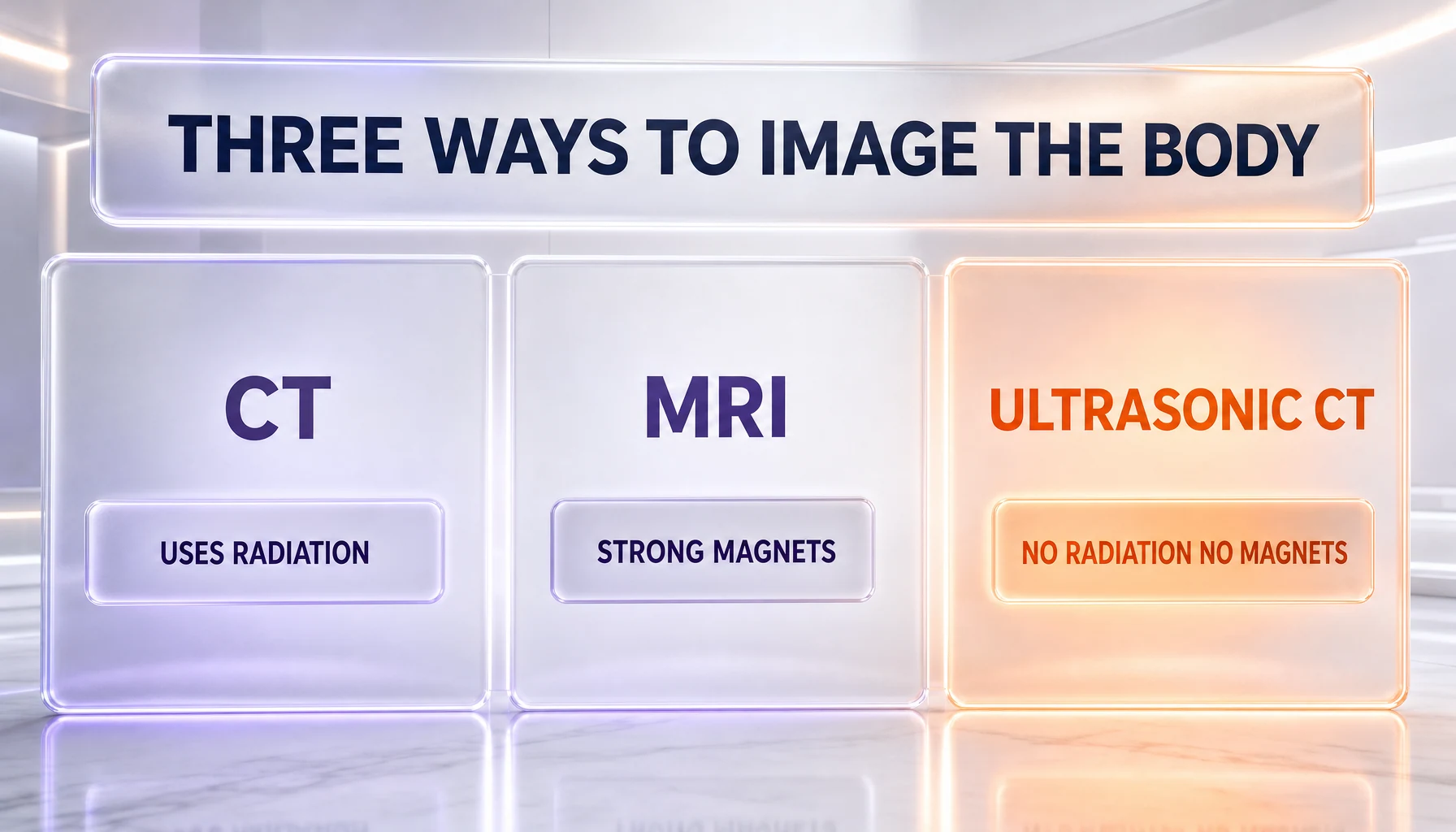
If the technology works as described, the implications are large. Conventional cross-sectional imaging is gated by two physical constraints: CT exposes patients to ionizing radiation, and MRI relies on powerful magnets that demand shielded rooms, exclude patients with certain implants, and cost millions to install and run. A high-resolution, full-body scan that uses neither — and runs in under a minute — would lower the cost and friction of whole-body screening dramatically. That is the vision Midjourney is selling: imaging that feels less like a hospital procedure and more like a wellness check.
It also signals something about where well-capitalized AI labs are heading. Compute-heavy reconstruction — turning half a million noisy ultrasound signals into a clean 3D volume in real time — is precisely the kind of problem that benefits from the AI infrastructure these labs already operate. We have argued before that inference, not just training, is becoming the real battleground for AI companies; turning physical-world sensor data into usable output at scale is a natural extension of that capability. Midjourney is betting that its expertise in large-scale image computation transfers to a domain where the "image" is your own anatomy.
How It Compares
It is tempting to slot this against MRI and CT machines from the established medical-imaging incumbents, but that comparison is premature. Those are cleared, validated, reimbursed diagnostic devices used in clinics worldwide. Midjourney's scanner is a first-generation prototype that, by the company's own framing, will launch by producing body-composition maps — the kind of muscle, fat, and tissue-distribution data that does not require diagnostic clearance — and add FDA-cleared diagnostic capabilities incrementally over time.
So the honest comparison today is narrower. As a body-composition tool, it would compete with DEXA scans and bioimpedance scales, not with diagnostic MRI. As a future diagnostic platform, it has to clear regulatory hurdles that take years and that many hardware startups underestimate. The transducer count is genuinely novel, and the no-radiation, no-magnet pitch is real. But "as powerful as MRI" is an aspiration the company will have to prove to regulators, not a validated claim. Treat it as a roadmap, not a spec sheet.
The Caveats You Should Not Skip
This is where sober reading is essential, because the gap between the announcement's ambition and its current reality is wide.
- It is a first-generation prototype. Not a shipping product. Not something you can book today. The hardware shown is an early build incorporating 40 Butterfly modules per system.
- It has no FDA clearance. The scanner "is not cleared by the Food and Drug Administration for diagnostic use." Midjourney plans to start with body-composition maps — which do not require clearance — and layer on FDA approvals incrementally. Until that happens, this is not a validated diagnostic device.
- It produces composition maps, not diagnoses. At launch, the output is a map of your body's tissue composition, not a clinical diagnosis. Conflating the two is exactly the kind of overreach that draws regulatory scrutiny.
- The timeline is long. The first "Midjourney Spa" — a flagship wellness location with hot tubs, sauna, and cold plunge, with scanners installed alongside — is targeted for San Francisco around the end of 2027. The headline ambition of roughly 50,000 scanners worldwide and a billion scans per month is pegged to 2031. These are multi-year horizons, and hardware timelines slip.
- The financials are milestone-contingent. The "up to $74 million" figure is expected payments to Butterfly over five years, gated on development and commercial milestones — not a guarantee that any of it gets spent if the program stalls.
None of this means the project is vaporware. The partner is real, the filing is public, and the executives are on the record. It means the responsible framing is "ambitious first-generation hardware with a long road to clinical validation," not "the MRI killer you can use next month."
Our Take
We have watched a lot of AI labs announce a lot of things in 2026, and most of them are software. This is the rare announcement where an AI company commits to atoms, not just bits — to manufacturing, regulatory pathways, and physical retail locations. That alone makes it one of the more interesting strategic moves of the year, regardless of whether the first Spa opens on schedule.
What we find most telling is the partnership structure. Midjourney did not try to invent ultrasound physics in-house. It licensed a proven semiconductor-ultrasound platform from Butterfly Network and focused its own effort on the part it is genuinely good at: large-scale computational reconstruction and consumer experience. That is a disciplined way to enter hardware, and it is a sharp contrast to the "we will build everything ourselves" instinct that has sunk many ambitious device startups.
The risk is equally clear. Consumer health hardware lives or dies on regulatory clearance and clinical trust, and a brand built on AI-generated art carries no inherent credibility in medicine. The "spa" framing is clever marketing, but it also blurs the line between wellness gadget and medical device — precisely the line regulators care most about. If Midjourney leans too hard on the spa-day vibe while quietly stretching toward diagnostic claims, it invites exactly the scrutiny it says it wants to avoid.
What's Next
The near-term milestones to watch are concrete: progress toward the first FDA submissions for diagnostic capabilities, the buildout of the San Francisco Spa targeted for around the end of 2027, and how many of the 40-module prototype's successors actually get built. Butterfly's future regulatory filings will also reveal whether the milestone-based payments are being triggered — a useful, independent signal of whether the program is on track or quietly stalling.
For now, the takeaway is simple. Midjourney Medical is real, it is hardware, and it is not an image-generation product. It is an early, unproven, regulatorily unfinished bet by an AI image lab on becoming a medical-imaging company. That is a genuinely surprising direction — and one worth following closely, with the caveats firmly attached. If you want the company's better-known side, our review of Midjourney's image-generation platform covers what it is still best known for today.
Frequently Asked Questions
What is Midjourney Medical?
Midjourney Medical is a new health division launched by Midjourney, the AI image lab, on June 17, 2026. Its first product is a full-body ultrasonic scanner that images muscle, fat, bone, and organs in roughly 60 seconds using a ring of about half a million transducer elements, with no radiation and no magnets. Midjourney calls the approach "Ultrasonic CT" and plans to house scanners in flagship wellness locations it calls "Midjourney Spas," starting in San Francisco around the end of 2027.
Is the Midjourney ultrasound scanner real?
Yes. It is an official Midjourney announcement, published on the company's own channels on June 17, 2026, and corroborated the next day by an official statement from Butterfly Network's investor-relations team. The whole-body ultrasound concept had circulated as a rumor for weeks and was widely dismissed, but it has now been confirmed on the record, with a public Butterfly Network Form 8-K filing disclosed November 17, 2025 underpinning the partnership.
Is Midjourney Medical an image-generation product?
No. This is the most common misconception. Midjourney Medical is a hardware medical-imaging device, not a text-to-image generator. The diagnostic-quality imaging comes from Butterfly Network's ultrasound-on-chip technology, licensed under a co-development agreement — not from Midjourney's generative AI models. The "images" it produces are reconstructed ultrasound cross-sections of a real body, not AI-generated art.
Is the Midjourney scanner FDA approved, and can I use it now?
No. The scanner is not cleared by the FDA for diagnostic use, and it is a first-generation prototype, not a shipping product. Midjourney says it will start by producing body-composition maps, which do not require regulatory clearance, and add FDA approvals incrementally over time. You cannot book a scan today; the first San Francisco location is targeted for around the end of 2027.
What is the connection between Midjourney and Butterfly Network?
Butterfly Network supplies the core imaging technology. Under a co-development and licensing agreement disclosed in a Form 8-K on November 17, 2025, Midjourney licenses Butterfly's Ultrasound-on-Chip platform, and the current prototype uses 40 Butterfly imaging modules per system. Butterfly disclosed up to $74 million in expected payments over a five-year term, contingent on development and commercial milestones. Butterfly's CEO described it as "potentially a meaningful commercial opportunity" for the company.
How is Ultrasonic CT different from a regular CT or MRI?
Conventional CT uses ionizing radiation, and MRI relies on powerful magnets that require shielded rooms and exclude some patients. Midjourney's Ultrasonic CT uses neither — it reconstructs a 3D body map from ultrasonic waves fired by roughly half a million transducer elements while you are immersed in water, targeting a scan in under 60 seconds. The "as powerful as MRI" claim, however, is an aspiration the company still has to prove to regulators, not a validated specification.