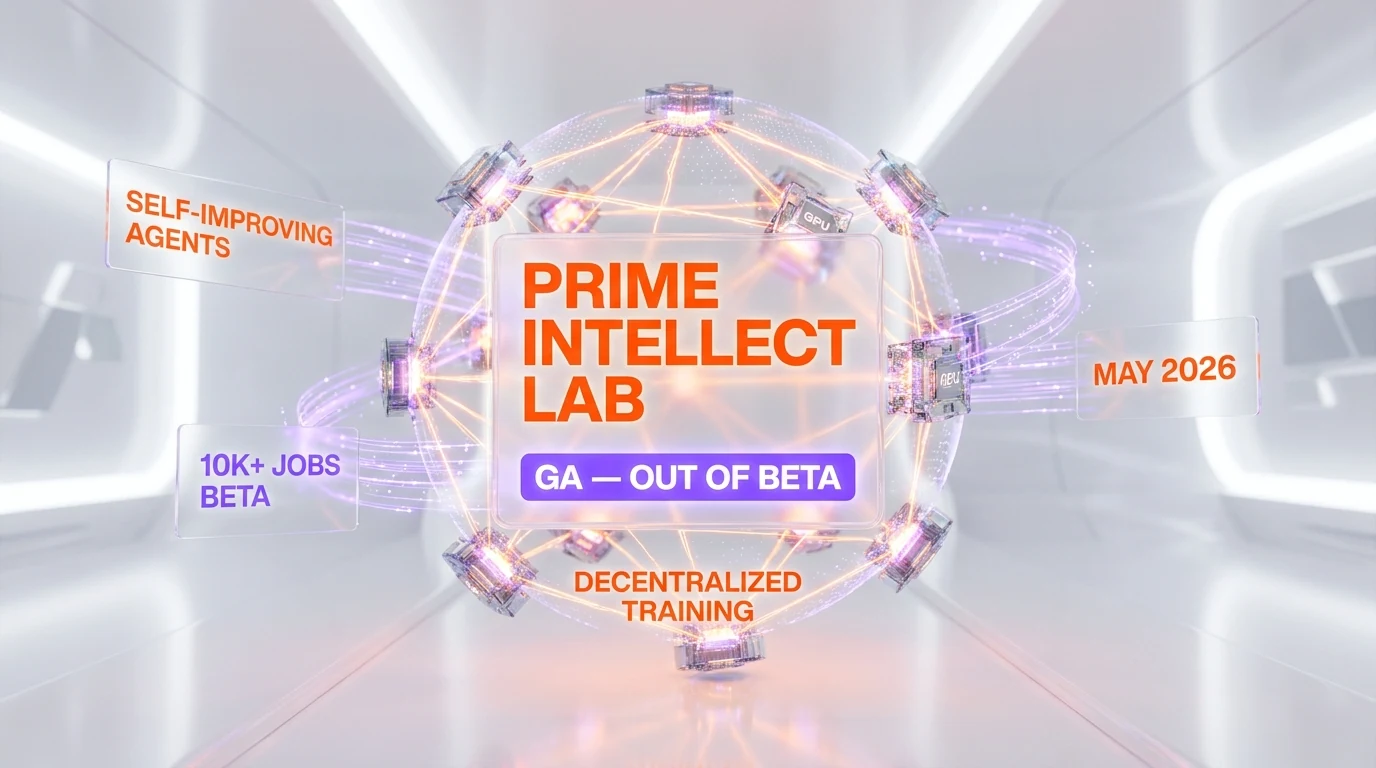
Prime Intellect Lab is a full-stack platform for training self-improving AI agents on decentralized compute, and it went generally available on May 7, 2026 after a beta that ran more than 10,000 training jobs. Lab compresses the entire agentic improvement loop — task specification, harness, evaluation, reinforcement training on reward signals, rollout inspection, adapter deployment, and OpenAI-compatible inference — into one pipeline. It bills per token of model movement instead of per cluster-hour, ships 14 base models from NVIDIA, OpenAI, Meta, and Qwen between 1B and 70B parameters, and is backed by Andrej Karpathy, Hugging Face CEO Clem Delangue, FlashAttention author Tri Dao, and Stability AI founder Emad Mostaque. It is the closest thing yet to a do-it-yourself frontier AI lab.
The Big Picture: A Lab in a Box, Built on Borrowed GPUs
For the last 18 months the AI infrastructure conversation has orbited a single gravity well: who owns the most gigawatts. Anthropic, OpenAI, and Google have turned compute accumulation into a geopolitical sport, and we have covered that empire-building in depth. Prime Intellect is running the opposite play. Instead of buying a Belgium of power, it is stitching together GPUs that already exist — in data centers, in idle clusters, in distributed nodes — and renting the orchestration layer to anyone who wants to train an agent that gets better at its job.
On May 7, 2026, that orchestration layer, called Lab, came out of beta. The official announcement is blunt about the ambition: Lab is "our training platform for self-improving agents," bringing "the full loop for agentic model improvement into one place." The phrase that matters there is full loop. Most of the open training ecosystem hands you a fine-tuning script and wishes you luck with the other nine problems. Lab is trying to own all ten.
This is the part of the AI map almost nobody is reporting on. The decentralized-training niche has been treated as a research curiosity — interesting papers about training large models over slow networks, occasional Twitter threads from people who think GPU centralization is a single point of failure. Prime Intellect just turned the curiosity into a product with a pricing page, 14 supported models, and a backer list that reads like a who's-who of people who actually built modern machine learning. That combination is why this release deserves a closer look than the 200-word news blurbs it got.
Anatomy of the Full-Stack Pipeline
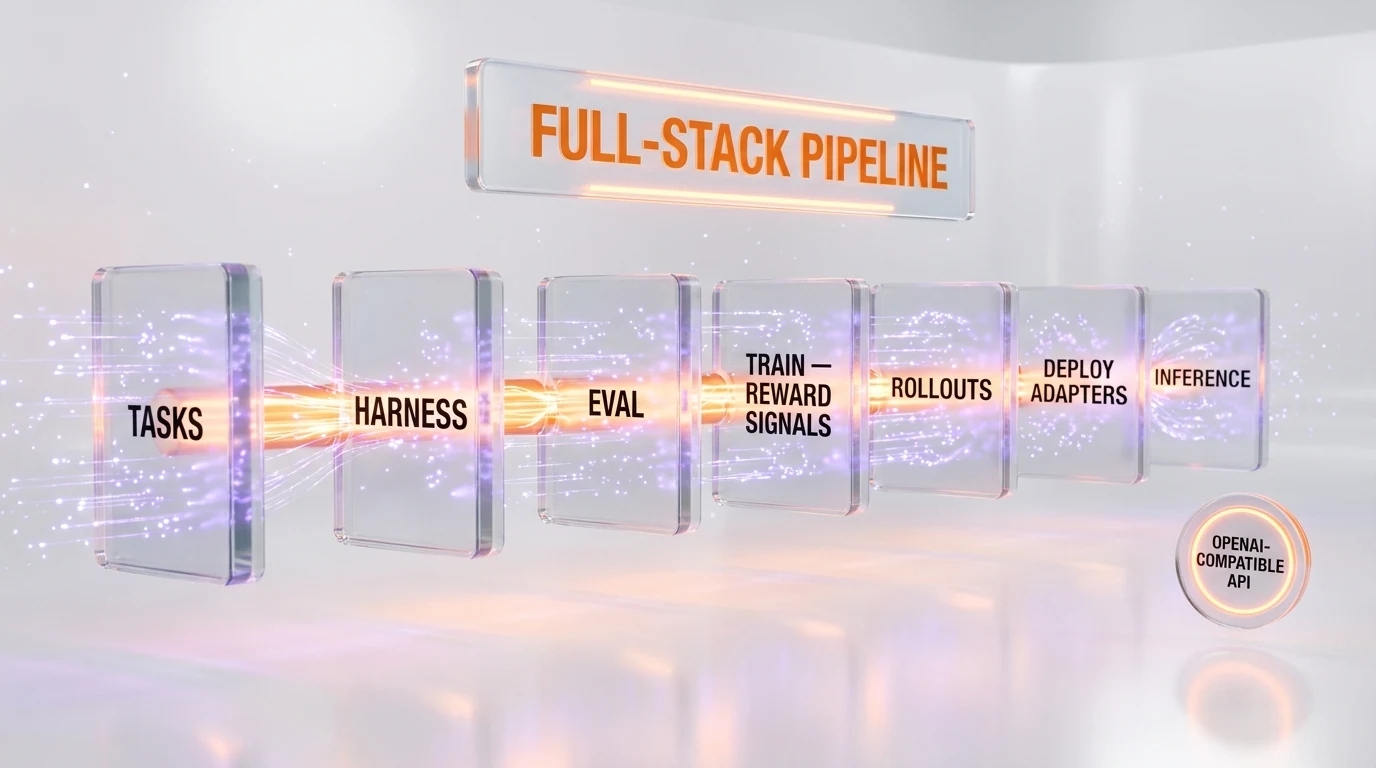
The reason Lab is interesting is structural, not marketing. Training a self-improving agent is not a single task — it is a chain of seven distinct engineering problems, and historically each one required a different tool, a different team, and a different week of glue code. Lab collapses that chain into one platform with one pricing model. Here is the actual pipeline as described in the announcement.
Stage 1 — Specify the Task
Everything starts with what you want the agent to get better at. In Lab's framing, you bring the task. During beta these spanned math, code, browser automation, games, customer support, long-horizon agents, and a handful of enterprise workflows. The breadth matters: a platform that only does math RL is a research demo, but a platform that handles customer-support trajectories and browser agents is a production tool. The task is the contract — it defines what "better" means before any GPU spins up.
Stage 2 — Define the Harness
The harness is where most homemade RL pipelines die. You need sandboxes so the agent can act without breaking things, context management so long-horizon rollouts do not blow the window, and the ability to wire in custom programs that represent your real environment. Lab provides this as a first-class primitive rather than something you bolt on with shell scripts. If you have ever tried to build a reproducible agent sandbox by hand, you already know this is the unglamorous 60 percent of the work.
Stage 3 — Evaluate the Model
Before you spend money moving weights, you need to know where the model stands. Lab ships hosted evaluations so you can baseline a candidate model against your task without provisioning your own eval infrastructure. This is the step that keeps RL honest — without a trustworthy eval, reward hacking is invisible and you optimize the model into a confident failure.
Stage 4 — Train on Reward Signals
This is the core. Lab's Hosted Training takes the reward signals defined by your harness and runs reinforcement learning to push the model toward the behavior the task rewards. The decentralized angle lives here: the actual gradient work is distributed across heterogeneous compute rather than a single reserved cluster. The headline pricing decision flows directly from this stage, and we will get to why it is a genuinely different bet.
Stage 5 — Inspect Rollouts
Reinforcement learning without rollout inspection is faith-based engineering. Lab lets you view the actual outputs and metrics the agent produced during training — the trajectories, the rewards, the failure modes. This is how you catch the model learning to game the reward instead of solving the problem. The teams that succeed with RL are the ones that stare at rollouts; the ones that fail trust the loss curve.
Stage 6 — Deploy Adapters
Once a run produces an improved model, Lab pushes the resulting adapter through Prime Inference. You are not exporting weights to figure out serving yourself — the deployment path is part of the same platform. For anyone who has shipped a LoRA adapter and then spent a day fighting a serving stack, the value of this being one step instead of a separate project is obvious.
Stage 7 — Run Inference
The deployed adapter is served behind an OpenAI-compatible API. That single design choice is doing a lot of strategic work. It means a self-improved agent trained on Lab drops into any existing codebase that already talks to the OpenAI SDK with a base-URL swap. We test a lot of inference layers, and OpenAI-compatibility is consistently the lowest-friction integration surface in the market. Prime Intellect choosing it for the exit ramp tells you they want adoption, not lock-in theater.
Put the seven stages together and the thesis is clear: the moat is not any single stage, it is the seam-free chain. Every handoff that used to be a glue-code project is now an internal API call. That is the actual product.
The Decentralized Training Model — Why It Is Not a Gimmick
Decentralized training has a credibility problem, and it earned it. For years the phrase mostly meant "we trained a small model slowly over a bad network and wrote a paper." Prime Intellect's earlier work — distributed training runs across globally scattered nodes — was the research that made the idea less of a punchline. Lab is the commercialization of that research, and the most important signal that it is serious is the pricing model, not the marketing copy.
Per-Token Pricing Changes the Incentive Structure
Lab prices runs per token rather than per cluster-hour. The announcement states it plainly: "You pay for the tokens that actually move the model — not for GPU time you reserved and didn't use." That sentence is the whole strategy. Cluster-hour pricing is the model that made centralized compute a fortress — you reserve a giant block, you pay whether or not it is productive, and only organizations with deep capital can play. Per-token pricing inverts the risk. You pay for movement, not for reservation. For a two-person startup trying to RL-tune a customer-support agent, that is the difference between a credible experiment and an impossible budget.
Heterogeneous Compute Is the Point, Not a Limitation
The classic objection to decentralized training is that mismatched, geographically scattered GPUs are slower and flakier than a tight cluster. That is true for naive approaches. The reason Lab can charge per token is that the orchestration layer is designed around heterogeneous compute as the default condition rather than a degraded one. The user never sees the cluster topology — they see tasks, harnesses, rollouts, and adapters. The complexity is absorbed by the platform. Whether the gradient work happened on one operator's idle H100s or spread across three providers is, from the user's chair, an implementation detail. That abstraction is the engineering achievement.
The 14-Model Substrate
Lab launched GA with 14 base models from NVIDIA, OpenAI, Meta, and Qwen, ranging from 1B to 70B parameters and spanning dense and mixture-of-experts architectures, reasoning modes, and text plus image modalities. This is a deliberately practical menu. Nobody RL-tuning an enterprise workflow agent in 2026 wants to start from a frontier 400B model — they want a capable 7B-to-70B base they can move cheaply and serve affordably. The model selection signals that Lab is built for people shipping agents, not for people chasing leaderboard headlines. It pairs naturally with the open-weights momentum we have tracked across the ecosystem, including DeepSeek V4's launch and the broader shift toward models you can actually own and modify.

Self-Improving Agents: What That Phrase Actually Means Here
"Self-improving agents" is one of the most abused phrases in the 2026 AI vocabulary. Vendors use it to mean everything from a chatbot with memory to a science-fiction recursive intelligence. Lab's definition is narrower and more useful, so it is worth pinning down precisely.
The Loop, Not the Singularity
In Lab's framing, a self-improving agent is one where the gap between the agent's current behavior and the behavior the task rewards is closed automatically by the training loop. You define what good looks like via the harness. You run rollouts. The reward signals from those rollouts feed reinforcement training. The improved adapter is redeployed. The agent at the end of the loop is measurably better at the specified task than the agent at the start. That is the entire claim. There is no mystical recursion — there is a tight, automatable RL loop with the operational friction removed. The honest framing is "continuous task-specific improvement," and that is genuinely valuable without needing the science-fiction varnish.
Why the Loop Was Previously Out of Reach
The reason most teams never ran this loop is not that the RL math is secret. It is that operationalizing the loop required standing up sandboxes, eval harnesses, distributed training, rollout logging, adapter serving, and an inference API — six infrastructure projects before the first reward signal. The teams capable of doing all six were already frontier labs. Lab's bet is that removing the operational tax democratizes the capability. The math was never the moat. The plumbing was. This is the same structural pattern we saw with agent platforms generally — including the trend toward agents that ship and self-correct in production, which we examined in our analysis of the broader self-improving agent stack at Anthropic's developer conference.
Where the Honest Caveats Live
We will not pretend this is frictionless. Reward design is still hard — a badly specified reward produces a confidently wrong agent faster, not a better one, and Lab does not solve specification for you. Decentralized training still carries a latency and coordination overhead relative to a single dedicated cluster for the largest runs; the per-token model is the right bet for most workloads but the economics flip if you are training something enormous and latency-sensitive. And "10,000+ training jobs in beta" is a usage number, not an outcome number — it tells you people tried it, not how many produced production-grade agents. These are not reasons to dismiss Lab. They are the boundaries any honest evaluation has to draw.
10,000+ Jobs and a Backer List That Signals Conviction
Two facts from this launch carry more weight than the feature list, and both are about credibility rather than capability.
The Beta Volume
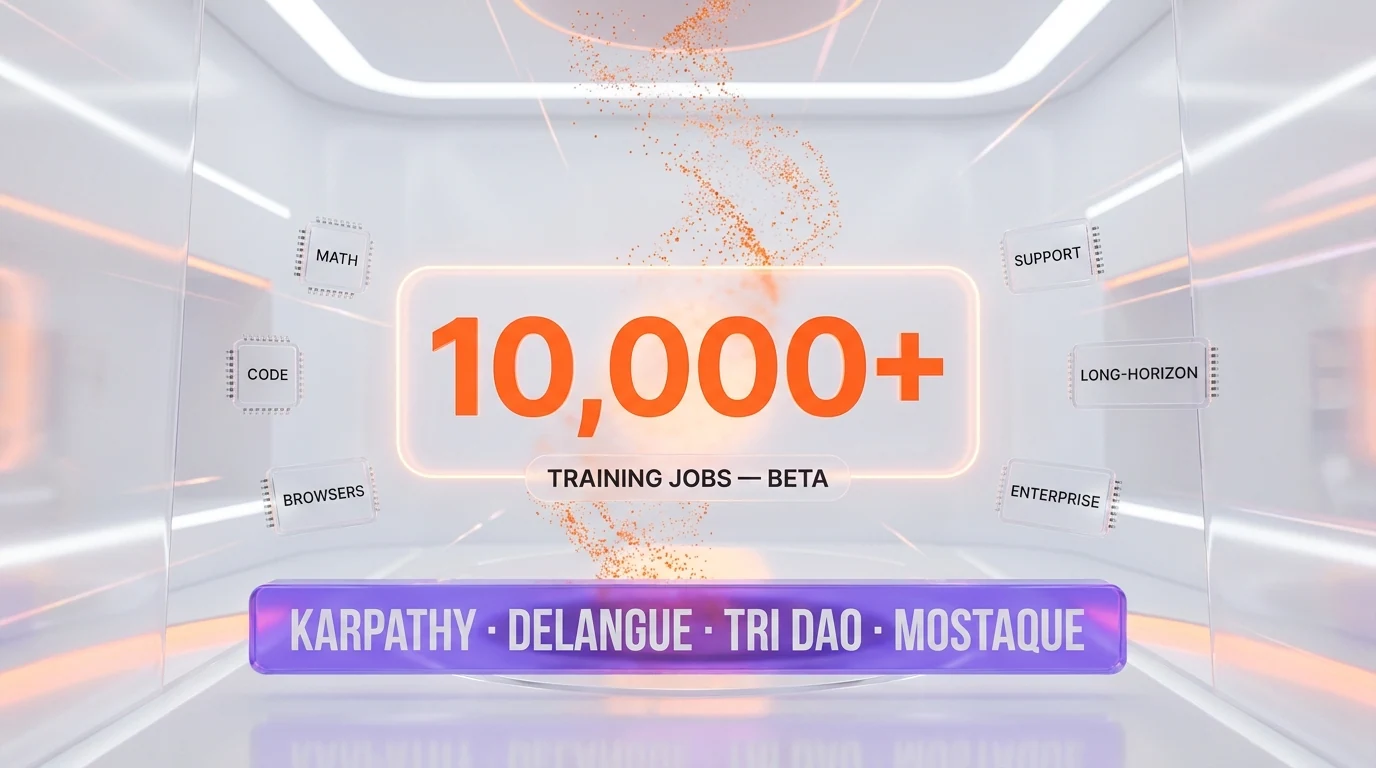
The announcement states that "hundreds of researchers, startups, and frontier teams have run more than 10,000 training jobs on the platform" during beta, across math, code, browsers, games, customer support, long-horizon agents, and enterprise workflows. Ten thousand jobs is not a vanity metric in the RL world — RL runs are expensive and fiddly, and people do not run thousands of them on a platform that does not work. The diversity of the workload categories matters as much as the count: a platform that handles both game-playing agents and enterprise customer-support trajectories has been stress-tested across genuinely different reward structures. That breadth is the strongest available evidence that the full-loop claim is not just architecture-diagram aspiration.
The Backers
Prime Intellect's investor and advisor roster includes Andrej Karpathy, Hugging Face CEO Clem Delangue, FlashAttention author Tri Dao, and Stability AI founder Emad Mostaque. This is not a generic VC cap table. It is a concentration of people who have personally built the foundational pieces of the modern ML stack — the training pedagogy, the open-model distribution hub, the attention kernel that made long context economically viable, and one of the original open-weights movements. When the people who built the substrate put their names on a decentralized-training platform, it is a directional signal about where serious practitioners think the infrastructure layer is heading. We weight that more heavily than any benchmark number, because these are not passive checks — they are reputational endorsements from people with reputations to protect.
How It Sits Next to the Open-Model Ecosystem
Lab does not exist in isolation — it sits inside a fast-moving open-model ecosystem. The decentralized-training angle complements rather than competes with the open-weights releases reshaping the field: capable base models from labs shipping under permissive licenses are exactly the substrate Lab is built to improve. The Hermes agent work from Nous Research on self-improving open agents is part of the same intellectual current — a community pushing the idea that frontier-grade agent capability should not require frontier-grade capital. Lab is the infrastructure expression of that thesis, and the overlap in backers and philosophy is not a coincidence.

The DIY Frontier Lab Implications
Strip away the feature list and the strategic question Lab raises is this: what happens to the AI power structure when the agentic training loop is a product instead of a privilege?
The Capital Barrier Was the Real Moat
For three years the implicit assumption has been that training competitive agents requires owning or renting enormous reserved compute, which requires enormous capital, which limits frontier agent development to a handful of well-funded labs. Lab's per-token decentralized model attacks that assumption directly. It does not claim a two-person team can out-train Anthropic on a general model — that would be dishonest and Lab does not say it. It claims a two-person team can run the full RL improvement loop on a task-specific agent without a reserved cluster. Those are very different claims, and the second one is both true and consequential. The frontier-general-model race stays capital-bound. The task-specific-agent race just got a lot more crowded.
The Strategic Positioning
Prime Intellect is not trying to win the gigawatt war — it is trying to make the gigawatt war less relevant for a specific, growing class of work. That is a smart strategic position precisely because it does not require beating the incumbents at their own game. The centralized labs are optimizing for the largest possible models. Lab is optimizing for the largest possible number of people running the improvement loop. Those are orthogonal bets, and orthogonal bets are how challengers survive against better-capitalized incumbents. The OpenAI-compatible inference exit ramp reinforces this read: Prime Intellect wants Lab-trained agents to slot into the existing ecosystem, not to build a walled garden that demands the whole world re-platform.
Who Should Pay Attention
If you are a startup building a vertical agent — customer support, code review, a browser-driven workflow — Lab is directly relevant: it is the first platform where the full improvement loop is a budget line rather than an infrastructure program. If you are a researcher, the per-token model changes which experiments are affordable. If you are an enterprise team that has been told frontier agent customization requires a frontier-lab partnership, Lab is a data point that the assumption is weakening. And if you are watching the AI infrastructure landscape strategically, the signal is that the decentralized-training niche just produced its first credible, well-backed, generally-available product — and under-covered niches that produce credible products are exactly where the next structural shift tends to start. The same dynamic is visible in adjacent inference and compute platforms; for context on the GPU layer these workloads run on, see our coverage of RunPod and how it fits the same democratization arc.
The Honest Bottom-Line Read
Lab is not a singularity machine and Prime Intellect does not pretend it is. It is a well-engineered collapse of a seven-stage pipeline into one platform, priced in a way that inverts the capital barrier for task-specific agent training, validated by 10,000+ beta jobs and a backer list of people who built the modern ML stack. The realistic outcome is not that Anthropic and OpenAI are threatened — they are not, on general models. The realistic outcome is that the long tail of vertical agents gets a credible production path, the decentralized-training niche stops being a research curiosity, and a strategic option that used to require a frontier-lab budget becomes a pricing-page decision. That is a smaller claim than the marketing, and a more durable one. For practitioners comparing model substrates to build on, our coverage of frontier open models like Claude and DeepSeek V4 pairs naturally with thinking about where the training loop itself now runs.
Our Verdict
Prime Intellect Lab going GA on May 7, 2026 is the most important release in a niche almost nobody is covering, and that is exactly why it matters. The decentralized-training story has been waiting for a product credible enough to make the idea concrete. Lab is that product: full-loop pipeline, per-token economics, 14 practical base models, 10,000+ beta jobs, and an advisor roster — Karpathy, Delangue, Tri Dao, Mostaque — that we read as a strong directional bet from people who built the field. We are not calling it a frontier-lab killer, because it is not one and does not claim to be. We are calling it the moment the do-it-yourself agent training loop stopped being a privilege and started being a product. In a year dominated by gigawatt headlines, the more interesting structural move was made by the company that decided the gigawatts were beside the point.
Frequently Asked Questions
What is Prime Intellect Lab?
Prime Intellect Lab is a full-stack platform for training self-improving AI agents on decentralized compute. It went generally available on May 7, 2026. Lab brings the entire agentic improvement loop — task specification, harness definition, evaluation, reinforcement training on reward signals, rollout inspection, adapter deployment, and OpenAI-compatible inference — into a single pipeline, and prices runs per token rather than per cluster-hour.
When did Prime Intellect Lab exit beta?
Lab went generally available on May 7, 2026. The announcement stated: "Today, Lab is out of beta and generally available to everyone." During the preceding beta, hundreds of researchers, startups, and frontier teams ran more than 10,000 training jobs on the platform.
What are the seven stages of the Lab pipeline?
The pipeline is: (1) specify the task, (2) define a harness with sandboxes and context management, (3) evaluate the model using hosted evaluations, (4) train on reward signals via Hosted Training, (5) inspect rollouts to view outputs and metrics, (6) deploy adapters through Prime Inference, and (7) run inference via an OpenAI-compatible API. The product value is that every handoff between stages is an internal API call rather than a glue-code project.
How does Lab's per-token pricing work?
Lab prices runs per token rather than per cluster-hour. The announcement states: "You pay for the tokens that actually move the model — not for GPU time you reserved and didn't use." This inverts the capital barrier of cluster-hour pricing, where you pay for reserved GPU time whether or not it is productive. Per-token pricing makes task-specific agent training economically viable for small teams.
What does "self-improving agent" actually mean in Lab?
It means an agent where the gap between current behavior and the behavior the task rewards is closed automatically by an RL loop: you define good via the harness, run rollouts, feed reward signals into reinforcement training, and redeploy the improved adapter. It is continuous task-specific improvement through an automated loop — not recursive science-fiction intelligence. The honest framing is operational, not mystical.
Which base models does Lab support?
Lab launched GA with 14 base models from NVIDIA, OpenAI, Meta, and Qwen, ranging from 1B to 70B parameters. The selection spans dense and mixture-of-experts architectures, reasoning modes, and text plus image modalities. The menu is deliberately practical — sized for teams shipping production agents rather than chasing frontier leaderboard headlines.
Who are the backers of Prime Intellect?
Prime Intellect's investor and advisor roster includes Andrej Karpathy, Hugging Face CEO Clem Delangue, FlashAttention author Tri Dao, and Stability AI founder Emad Mostaque. This is a concentration of people who personally built foundational pieces of the modern ML stack — training pedagogy, open-model distribution, the attention kernel behind economical long context, and an original open-weights movement.
How is decentralized training different from a centralized cluster?
Centralized training reserves a tight block of GPUs and bills per cluster-hour, which favors well-capitalized organizations. Lab distributes the gradient work across heterogeneous compute and bills per token of model movement. The orchestration layer absorbs the topology complexity, so the user sees tasks, harnesses, rollouts, and adapters rather than cluster management. For most task-specific workloads the per-token model is cheaper; for the very largest latency-sensitive runs, a dedicated cluster can still win.
Does Lab let a small team out-train Anthropic or OpenAI?
No, and Lab does not claim that. A small team cannot out-train a frontier lab on a general model — that race stays capital-bound. What Lab enables is running the full RL improvement loop on a task-specific agent without a reserved cluster. The frontier-general-model race is unchanged; the task-specific-agent race becomes far more accessible. Those are different claims, and only the second is true.
What are Lab's limitations?
Reward design is still hard — a badly specified reward produces a confidently wrong agent faster, and Lab does not solve specification for you. Decentralized training carries latency and coordination overhead relative to a dedicated cluster for the largest runs. And "10,000+ training jobs" is a usage signal, not an outcome metric — it shows adoption, not how many runs produced production-grade agents. These are real boundaries any honest evaluation must draw.
Why does the OpenAI-compatible inference API matter?
A Lab-trained adapter is served behind an OpenAI-compatible API, which means it drops into any codebase already using the OpenAI SDK with a base-URL swap. OpenAI-compatibility is consistently the lowest-friction integration surface in the market. Prime Intellect choosing it for the exit ramp signals a strategy built for adoption and ecosystem fit rather than lock-in.
Who should pay attention to Prime Intellect Lab?
Startups building vertical agents (customer support, code review, browser workflows) get a full improvement loop as a budget line instead of an infrastructure program. Researchers get a per-token model that changes which experiments are affordable. Enterprise teams told that frontier agent customization requires a frontier-lab partnership get a counter-data-point. And anyone watching AI infrastructure strategically should note that the decentralized-training niche just produced its first credible, well-backed, generally-available product.