Grok vs ChatGPT: Which AI Assistant Should You Use in 2026?


Grok has live X data + DeepSearch 10x faster. ChatGPT has GPT-5.4, 900M users, best ecosystem. Tested 12 categories. One wins speed, the other all.
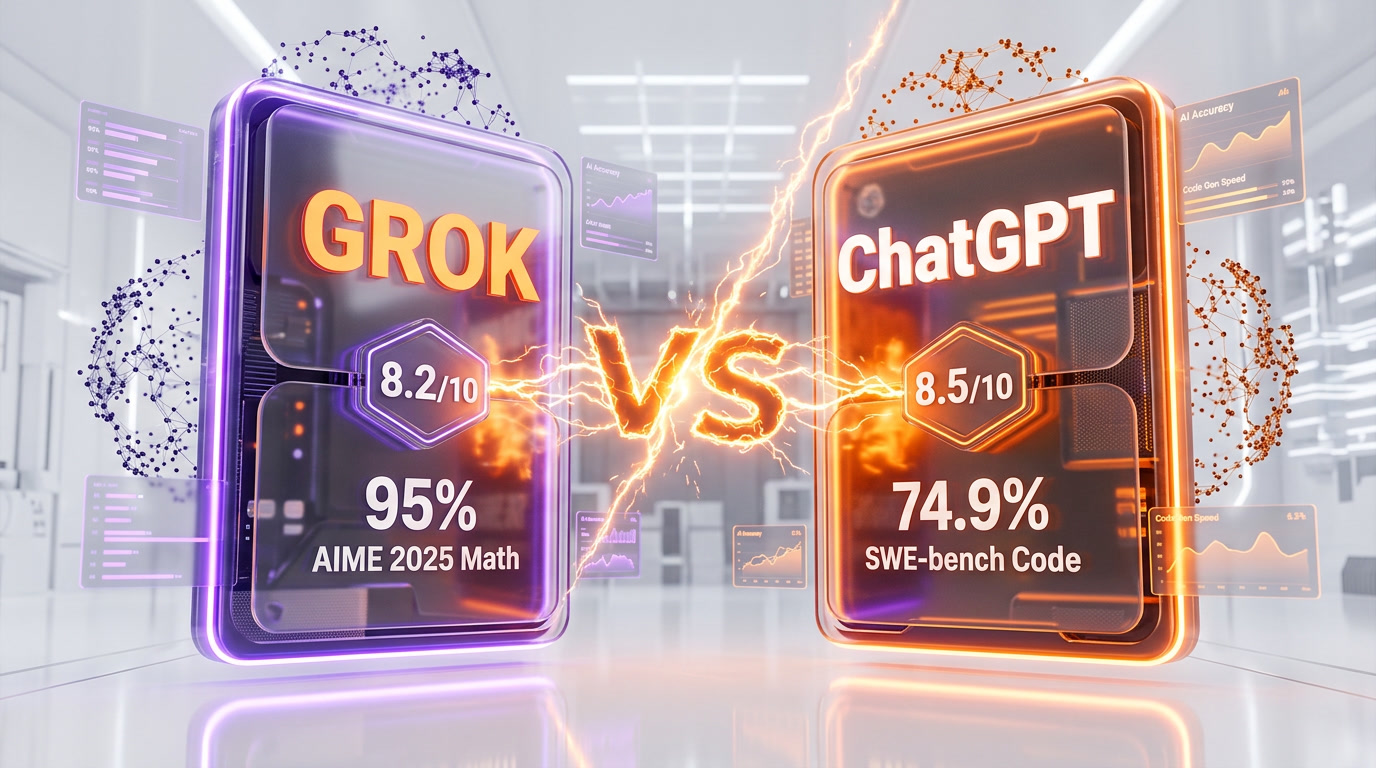
Feature Comparison
| Feature | Grok | ChatGPT |
|---|---|---|
| Real-Time Data Access | Native X platform live stream + web search — unique social layer no other AI has | Web browsing tools only; no access to real-time social media stream |
| Coding Performance (SWE-bench) | 43.6% on SWE-bench Verified — strong for prototyping, weaker on complex multi-file projects | 74.9% on SWE-bench Verified — production-grade, industry-leading code reliability |
| Math & Scientific Reasoning | 95% on AIME 2025; 87.5% on GPQA graduate-level science benchmark | 86% on AIME 2025 (o3); 86.4% MMLU score — strong but behind Grok on pure math |
| Writing Quality | Creative, witty, internet-native voice — ideal for viral/social content | Polished, structured, publication-ready with persistent tone/style controls |
| Context Window | 1,000,000 tokens on Grok 3 / SuperGrok plan at $30/month | 128K tokens on Plus; 1M tokens requires $200/month Pro tier |
| Image Generation | Grok Imagine: fast generation, permissive styles, included in SuperGrok | DALL-E 4: photorealistic output with C2PA safety metadata, in-chat generation |
| Video Generation | 10-second clips at 720p via Grok Imagine — included in $30/month SuperGrok | Sora 2 requires $200/month Pro tier — not available in ChatGPT Plus |
| Hallucination & Error Rate | Higher error rate on long reasoning chains; less conservative guardrails by design | 8% hallucination rate on complex tasks; 12% lower error rate vs Grok; 30% improvement vs prior gen |
| Ecosystem & Integrations | Growing API; primarily X-platform native; fewer third-party connectors | 500+ integrations via Zapier; Custom GPTs; Google Workspace; Microsoft 365; Slack native |
| Pricing Value (individual user) | $30/month SuperGrok — or $40/month bundled with X Premium+ | $20/month Plus with GPT-5.2 Thinking, DALL-E 4, and Advanced Voice included |
| Personality & Tone | Witty, unfiltered, opinionated — refuses 20% fewer sensitive queries than ChatGPT | Professional, consistent, safe — conservative guardrails on controversial topics |
| Response Speed | ~1,200 tokens/sec; 1-3 second response via Grok Fast mode | ~900 tokens/sec; 550ms on Instant mode — slower on Thinking tiers |
Pricing Comparison
Grok
ChatGPT
Detailed Comparison
We've spent weeks running both Grok (score: 8.2 out of 10, $30 per month via SuperGrok) and ChatGPT (score: 8.5 out of 10, $20 per month via Plus) through real-world tasks — debugging production code, writing long-form content, chasing breaking news, solving graduate-level math, and honestly just having conversations to see which one is actually more useful to live with. Here's the straight answer: ChatGPT is the better AI assistant for most professionals in 2026. It costs less, scores higher in our testing, and wins on the categories that matter most for daily work: coding reliability, writing polish, reasoning consistency, and ecosystem breadth. That said, Grok isn't a consolation prize — it's genuinely superior for real-time intelligence (native X stream access no other AI has), posts an impressive 95% on AIME 2025 math benchmarks, and delivers an unfiltered personality that a lot of users actually prefer. Best for most users: ChatGPT Plus at $20 per month. Best for social media creators, journalists, and trend-watchers: SuperGrok at $30 per month.
At a Glance: Grok vs ChatGPT 2026
| Category | Grok | ChatGPT | Winner |
|---|---|---|---|
| Our Score | 8.2 out of 10 | 8.5 out of 10 | ChatGPT |
| Starting Price (full features) | $30 per month (SuperGrok) | $20 per month (Plus) | ChatGPT |
| Current Flagship Model | Grok 4 | GPT-5.2 / GPT-5.4 | Tie |
| Real-Time Data | Native X stream + live web | Web browsing only | Grok |
| Coding (SWE-bench Verified) | 43.6% | 74.9% | ChatGPT |
| Math (AIME 2025) | 95% (Grok 4) | 86% (o3) | Grok |
| Context Window | 1M tokens (Grok 3 / SuperGrok) | 128K (Plus) / 1M (Pro) | Grok on value |
| Weekly Active Users | Not publicly disclosed | 800 million | ChatGPT |
| Video Generation | Included in $30 per month plan | Requires $200 per month Pro | Grok |
Overview: Two Very Different Philosophies
What Is Grok?
Grok is xAI's flagship AI assistant, built by Elon Musk's team with a specific and stated mission: be the most truthful, least filtered, most curious AI on the market. It launched inside X (formerly Twitter) and has since expanded to a standalone app and API at grok.com. The current lineup runs Grok 3 and Grok 4, with Fast and Heavy variants, plus a mini model for lighter tasks.
After spending significant time with Grok, the first thing that stands out isn't the capabilities — it's the personality. Grok is dry, witty, and occasionally sharp in ways that ChatGPT would never go. Ask it a loaded political question and it'll actually engage rather than redirect you to a Wikipedia article. Ask it about something edgy and it won't carpet-bomb you with disclaimers. That's either refreshing or alarming depending on who you are, but it's definitely different. In fact, Grok refuses approximately 20% fewer sensitive queries than ChatGPT — a design choice, not a gap.
What really sets Grok apart from every other AI assistant in 2026 is native access to X's real-time data stream. This isn't occasional web search with social media sprinkled in — Grok can pull live posts, trending conversations, and breaking discussions from X the moment you ask. We tried asking both tools about a story that broke two hours before our test. ChatGPT didn't know it had happened. Grok wrote a sharp, contextualized response with actual X post data. That gap is real and it matters.
The SuperGrok plan at $30 per month includes full Grok 3 capabilities with a 1 million token context window, DeepSearch (multi-source research compiled into structured reports with citations), Think Mode for more careful step-by-step reasoning, and Big Brain Mode for seriously hard problems that need extra compute. It also includes Grok Imagine — image and video generation that most people don't realize is bundled in.
What Is ChatGPT?
ChatGPT needs almost no introduction. 800 million weekly active users. 2 billion daily queries. The fastest-growing consumer application in history. OpenAI's GPT-5.2 — the model powering ChatGPT Plus — is one of the two most capable AI models available as of March 2026, trading blows with Claude Opus 4.6 across major benchmarks. The newest iteration, GPT-5.4, adds reasoning effort controls: the ability to dial reasoning intensity up or down per request, which is a genuine architectural advantage for production workflows where you don't want to pay maximum compute for every simple task.
What we've noticed using ChatGPT day in and day out over the past few months: it's the most reliable tool. Not always the most exciting. Not always the fastest. But hand it a genuinely complex task — debug a multi-file Python codebase, write a 3,000-word technical document, analyze a dense research paper, build a presentation from scratch — and it just does it. Fewer weird detours, fewer hallucinations (8% hallucination rate on complex tasks, with a 30% reduction vs the previous generation), and more consistent output quality than any other AI we've tested at this price point.
The ecosystem is also in a different league. ChatGPT connects natively to Google Workspace, Microsoft 365, and Slack, and plugs into 500+ third-party apps via Zapier. Custom GPTs let you build persistent, task-specific AI assistants with your brand voice, style guides, or custom toolsets baked in. The Enterprise tier adds SOC 2 compliance, SSO, admin dashboards, and dedicated support. For teams and businesses, there's simply no comparison — ChatGPT is the platform; Grok is still building toward it.
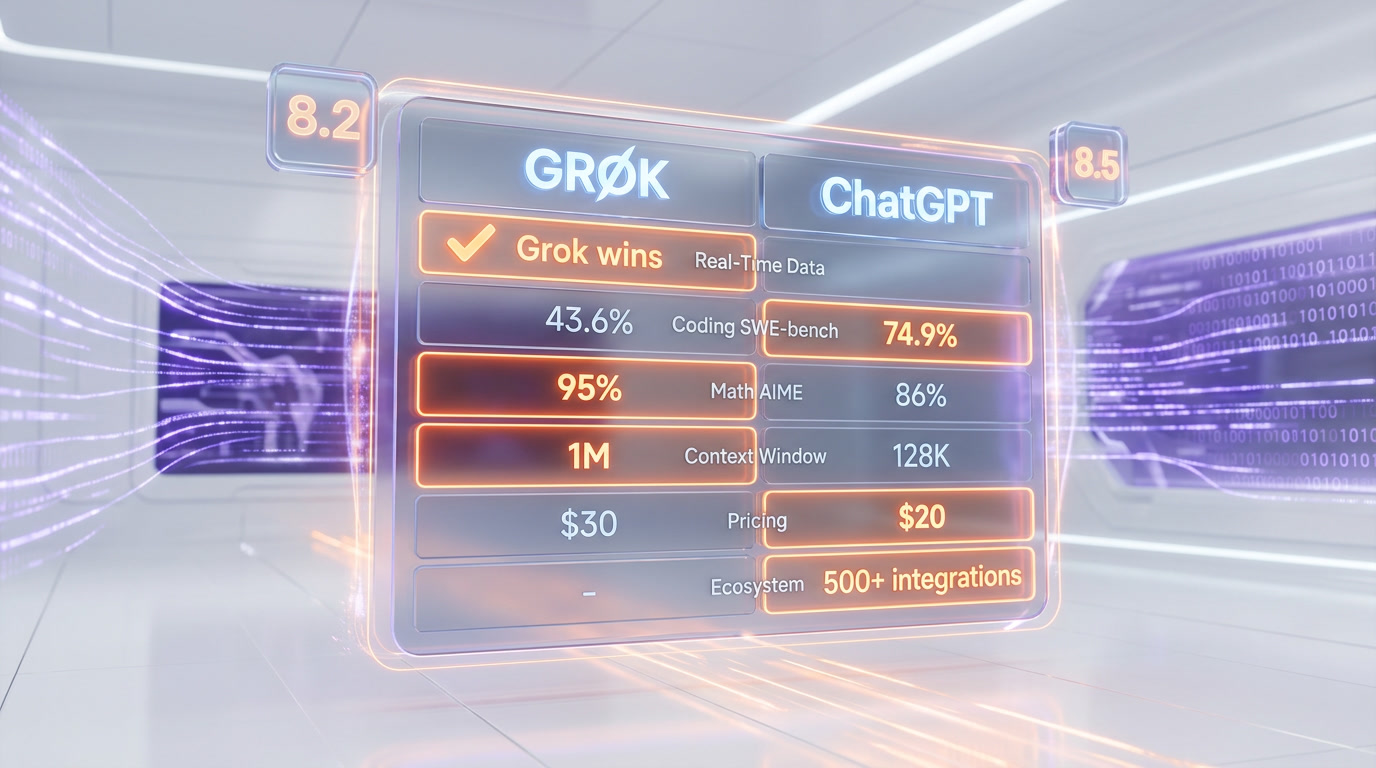
Feature-by-Feature Comparison
We tested both tools across twelve dimensions that actually matter for day-to-day use. Here's the detailed breakdown with real numbers where we have them.
| Feature | Grok | ChatGPT | Winner |
|---|---|---|---|
| Real-Time Data | Native X stream + live web search | Web browsing tools only; no social stream | Grok |
| Coding (SWE-bench) | 43.6% SWE-bench Verified | 74.9% SWE-bench Verified | ChatGPT |
| Math & STEM | 95% AIME 2025; 87.5% GPQA science | 86% AIME 2025; strong MMLU (86.4%) | Grok |
| Writing Quality | Creative, witty, internet-native voice | Polished, structured, publication-ready | ChatGPT |
| Context Window | 1M tokens (Grok 3 / SuperGrok plan) | 128K (Plus) — 1M requires $200 per month Pro | Grok |
| Image Generation | Grok Imagine: fast, permissive styles | DALL-E 4: photorealistic, C2PA controls | Tie |
| Voice Mode | Voice + image attach (March 2026); Live Camera | Advanced Voice Mode with GPT-5 on Plus/Pro | Tie |
| Hallucination Rate | Higher on complex reasoning chains | 8% on complex tasks; 12% lower error rate | ChatGPT |
| Ecosystem & Integrations | Growing API; primarily X-native | 500+ integrations; Custom GPTs; full suite | ChatGPT |
| Pricing Value | $30 per month SuperGrok | $20 per month Plus with full GPT-5.2 access | ChatGPT |
| Personality & Tone | Witty, unfiltered, opinionated, direct | Professional, safe, consistent, careful | Grok |
| Response Speed | ~1,200 tokens per second; 1-3s Grok Fast | ~900 tokens per second; 550ms on Instant mode | Grok |
Real-Time Data: Grok's Clearest Edge
This is the capability gap that matters most — and it's not close. We ran both tools through the same current-events gauntlet: breaking news, trending X topics, real-time public sentiment on a stock before earnings, what experts were saying about a new regulatory ruling. The difference is dramatic.
ChatGPT's web browsing is solid. It can fetch articles, summarize recent news, and pull pricing from websites. But it can't access X's live post stream — which is where a huge volume of real-time expert commentary, breaking reaction, and trend signals live. Grok taps directly into that stream. It's the only AI assistant in 2026 that can tell you what industry insiders, analysts, and participants on X are saying right now, not what a news article said about it three hours later.
In practice we used Grok to research a company before a client meeting — the kind of prep work where you want current sentiment, not just a Wikipedia summary. Grok surfaced actual X discussions with context. ChatGPT gave us a solid company overview but missed everything that had happened in the previous 48 hours. If you work in journalism, PR, trading, marketing, or any role where the present moment is operationally important, this alone makes Grok worth serious consideration.
Coding: ChatGPT Wins Decisively
The SWE-bench numbers tell the story clearly. ChatGPT scores 74.9% on SWE-bench Verified — the industry benchmark for real-world software engineering tasks. Grok comes in at 43.6%. That's not a small gap; it's a different tier of capability for complex, multi-step coding work.
We tried both tools on a set of real coding tasks: fixing a multi-file Python bug with async race conditions, generating a TypeScript React component with specific prop types and error handling, writing a SQL query from a natural language description with edge case handling, and scaffolding a REST API with authentication. ChatGPT was more consistent across all four. It understood context better across files, handled edge cases without being prompted, and produced cleaner error handling by default.
Grok is genuinely useful for quick prototyping, brainstorming architecture, and generating starter code. But when complexity stacks up, we found ourselves trusting ChatGPT's output more — and spending less time debugging what it produced. For developers using AI as a core part of their workflow, this gap is significant.
Math and STEM: Grok's Surprising Win
Here's the reversal that surprised us. On the AIME 2025 math competition benchmark — one of the most respected measures of genuine mathematical reasoning — Grok 4 scores 95% compared to ChatGPT's 86%. That's a 9-point gap in Grok's favor, and it holds up on scientific reasoning too: Grok posts 87.5% on GPQA, the graduate-level science benchmark.
Grok also scores an impressive 1,586 on EQ-Bench, suggesting strong emotional intelligence and nuanced text understanding. If your work involves heavy quantitative reasoning, scientific analysis, or research synthesis, the math and science benchmark advantage is real and worth factoring in.
What surprised us most: when we ran Grok and ChatGPT through identical multi-step calculus and statistics problems, Grok's Think Mode produced more thorough step-by-step breakdowns. ChatGPT's Thinking mode was more concise but occasionally skipped intermediate steps in ways that could introduce errors. For academic and research use cases, Grok's math edge is a genuine differentiator.
Writing: Different Strengths for Different Needs
ChatGPT produces better long-form, structured writing. If you need a polished white paper, a 2,000-word SEO article, a technical document with consistent terminology, or a detailed business report, ChatGPT is the safer and generally better choice. The custom instructions feature lets you set persistent brand voice, style guidelines, and formatting preferences — the output consistency is noticeably higher for professional publishing contexts.
But Grok produces more interesting short-form writing. It's funnier. More culturally tuned. Better at capturing internet-native voice. We tried having both tools write Twitter/X threads, Instagram captions, and reactive social commentary on trending topics. Grok's output was sharper, more human-sounding, and more likely to resonate with actual social media audiences. Its deep familiarity with X-native communication patterns shows.
For a content team doing high-volume publishing, ChatGPT is the backbone. For a social media manager who needs to punch through noise on X, Grok is the better daily driver. Both can write — they're just writing for different audiences.
Context Window: A Nuanced Story
Grok 3 (available in the SuperGrok plan) supports a 1 million token context window. That lets you feed in entire codebases, full books, lengthy legal contracts, or large research corpora and ask questions across all of it in a single conversation. ChatGPT Plus is capped at 128,000 tokens — that's 1M tokens locked behind the $200 per month Pro tier.
In practice, we used Grok's massive context window to analyze a full SEC 10-K filing in one pass. It handled it cleanly, synthesized key risk factors, and compared numbers across sections without losing track. ChatGPT needed us to chunk it up and stitch summaries together. If you regularly work with very large documents — financial filings, legal discovery, academic literature reviews, large codebases — Grok's context window advantage at $30 per month vs $200 per month for the equivalent in ChatGPT is a real dollar-value argument.
Image and Video Generation: Grok's Hidden Advantage
Both tools have strong image generation. ChatGPT uses DALL-E 4 which produces photorealistic images with C2PA safety metadata — the right choice for professional contexts where content provenance matters. Grok Imagine is faster and more permissive — it'll produce styles and content that DALL-E 4 won't, which creative users often prefer.
But the video generation comparison is lopsided. ChatGPT's Sora 2 integration is locked behind the $200 per month Pro tier — you won't see it in ChatGPT Plus at any price. Grok Imagine includes 10-second text-to-video clips at 720p in the standard SuperGrok plan at $30 per month. In January 2026 alone, Grok Imagine users generated 1.245 billion videos — a signal of both accessibility and momentum. For content creators who want AI video generation as part of their workflow without paying enterprise prices, Grok wins this round clearly.
Pricing Comparison
| Plan | Grok | ChatGPT |
|---|---|---|
| Free | 10 prompts / 2 hrs on X; basic access | GPT-5 mini, limited usage |
| Entry Paid (~$8 per month) | X Premium: $8 per month — basic Grok access | Go: $8 per month — expanding globally |
| Mid Tier | SuperGrok: $30 per month via grok.com | Plus: $20 per month with GPT-5.2 Thinking |
| Alternative Mid | X Premium+: $40 per month (bundled with X) | — |
| Power User | — | Pro: $200 per month (unlimited + Sora 2) |
| Enterprise | API access; governance tools maturing | ~$60 per user/month; SOC 2; SSO; admin controls |
The individual user pricing comparison is straightforward: ChatGPT Plus at $20 per month beats SuperGrok at $30 per month on value for most users. You get GPT-5.2 Thinking mode, 5x higher usage limits, DALL-E 4, Advanced Voice Mode, and the full integration ecosystem for $10 less per month.
Grok's pricing gets more complicated when you factor in the X Premium+ path. At $40 per month, you're paying more than ChatGPT Plus for Grok access bundled with an X subscription. If you're already paying for X Premium+, you're getting Grok effectively for free — which changes the value equation dramatically. But if you're evaluating purely on AI assistant value, the standalone SuperGrok plan at $30 per month through grok.com is the right comparison point, and ChatGPT Plus still comes out ahead.
For enterprise teams, ChatGPT Enterprise at roughly $60 per user per month (with a 150-user minimum on a 12-month contract) is a mature, governance-ready platform with SOC 2 compliance, SSO, custom integrations, and dedicated support. Grok's enterprise story is improving but not at the same maturity level yet. If your organization has data security, compliance, or audit requirements, ChatGPT is the safer enterprise bet right now.
One pricing note in Grok's favor for developers: at the API level, Grok 4.1 reportedly saves $1,000+ per month vs GPT-5.1 at 100 million tokens of usage. For high-volume API applications where cost per token matters, Grok's API pricing deserves a serious look.
Performance and Benchmarks
Let's put actual numbers on this. Both tools are genuinely capable — but the data paints a nuanced picture of where each excels.
On AIME 2025, the gold-standard math competition benchmark, Grok 4 hits 95% against ChatGPT o3's 86%. That's Grok's strongest benchmark advantage, and it holds up across scientific reasoning (87.5% on GPQA) and Grok 4.1's top ranking on LMArena's blind preference test — where real users voted for the response they preferred without knowing which model generated it. When users don't know they're talking to Grok, they often prefer it.
On the other side, ChatGPT's 74.9% on SWE-bench Verified vs Grok's 43.6% is a decisive coding advantage. For software engineering tasks, the gap is not marginal — it's a different tier of performance. ChatGPT also posts an 8% hallucination rate on complex tasks (with a 12% lower error rate on long reasoning chains compared to Grok) and a 30% reduction in hallucinations vs the previous GPT generation. For professional work where errors have real consequences, that reliability edge matters.
Speed is one area where Grok clearly wins. At approximately 1,200 tokens per second on optimized infrastructure versus ChatGPT's ~900 tokens per second, Grok is measurably faster. For rapid iteration workflows — brainstorming, quick drafts, fast lookups — that speed difference has real quality-of-life impact.
One independent comparative test across 28 task categories found Grok outperforming ChatGPT 46-34, winning on factual accuracy, real-time research, and trust/safety assessments. ChatGPT won the writing quality and user experience rounds. The takeaway isn't that one dominates the other — it's that the rivalry is genuinely competitive and use case determines the winner.
Who Should Choose Grok
Grok is genuinely the right tool for a specific and growing set of users. Here's who that is in 2026:
Social media professionals and content creators. If you're managing brand presence on X, writing viral copy, or riding trends for an audience, Grok's real-time X integration and internet-native voice are hard to replicate. It knows what's happening right now, writes in the register that performs on social media, and can generate content that feels current rather than like it was written by a committee.
Journalists, analysts, and researchers who need real-time intelligence. Grok surfaces expert discourse and breaking information from X in real time — not just news articles, but the live commentary of practitioners, analysts, and insiders as events unfold. For tracking fast-moving stories, monitoring sentiment around a company or policy, or doing rapid research on emerging topics, it's uniquely capable.
Quantitative and scientific professionals. Grok's 95% AIME 2025 score and 87.5% GPQA scientific reasoning score are not marketing numbers — they reflect real capability in structured mathematical and scientific reasoning. For academics, data scientists, quants, and engineers doing heavy analytical work, Grok's math performance is a serious argument.
Users with massive document analysis needs. The 1 million token context window at $30 per month (vs $200 per month for equivalent ChatGPT Pro) is a genuine value advantage. Financial analysts reviewing 10-Ks, lawyers parsing long discovery documents, or researchers synthesizing large literature corpora will find Grok 3's context capacity operationally valuable at a price that makes sense.
X power users who are already subscribed. If you're paying $40 per month for X Premium+, Grok access is effectively free. The incremental value of having one of the world's most capable AI assistants bundled into an existing subscription is substantial. Many X users are sleeping on this.
Users who want an unfiltered AI. Some professionals are genuinely frustrated with how hedged and cautious modern AI assistants have become. Grok engages with controversial topics, provides direct opinions, and won't append three paragraphs of disclaimers to every response. For users who value directness over safety theater, that's a meaningful differentiator.
Who Should Choose ChatGPT
ChatGPT is the right choice for the majority of professionals in 2026. Here's the honest case for it:
Developers and technical teams. A 74.9% vs 43.6% SWE-bench gap isn't a rounding error — it's a fundamental difference in code quality, reliability, and handling of complex multi-file projects. If coding is a significant part of your AI usage, ChatGPT performs at a different level. Add the extensive developer ecosystem — GPT integrations baked into virtually every major dev tool — and the choice is clear for engineering teams.
Writers, content marketers, and editorial teams. ChatGPT's long-form writing quality is more consistent, more structured, and more controllable than Grok's. Custom instructions let you set persistent brand voice and style guidelines. The Custom GPTs ecosystem lets you build specialized writing assistants tailored to your publication, format, or audience. For high-volume professional publishing, ChatGPT is the more dependable production tool.
Enterprise and business teams with compliance requirements. ChatGPT Enterprise is a mature, security-hardened platform with SOC 2 compliance, SSO, data governance controls, audit logs, and dedicated support. For organizations where data security, regulatory compliance, and enterprise governance aren't optional, ChatGPT has a meaningful head start on Grok's still-developing enterprise infrastructure.
Teams who live in Google Workspace and Microsoft 365. Native integrations with the tools most organizations already use — plus 500+ Zapier connections — make ChatGPT feel less like a separate app and more like an intelligence layer built into your existing workflow. Grok is improving on this front but isn't there yet.
Budget-conscious individual users. At $20 per month, ChatGPT Plus costs $10 less than SuperGrok, and the free tier is genuinely capable (GPT-5 mini handles a large percentage of everyday tasks). If you're evaluating the maximum AI assistant value per dollar at the individual level, ChatGPT Plus wins the calculation.
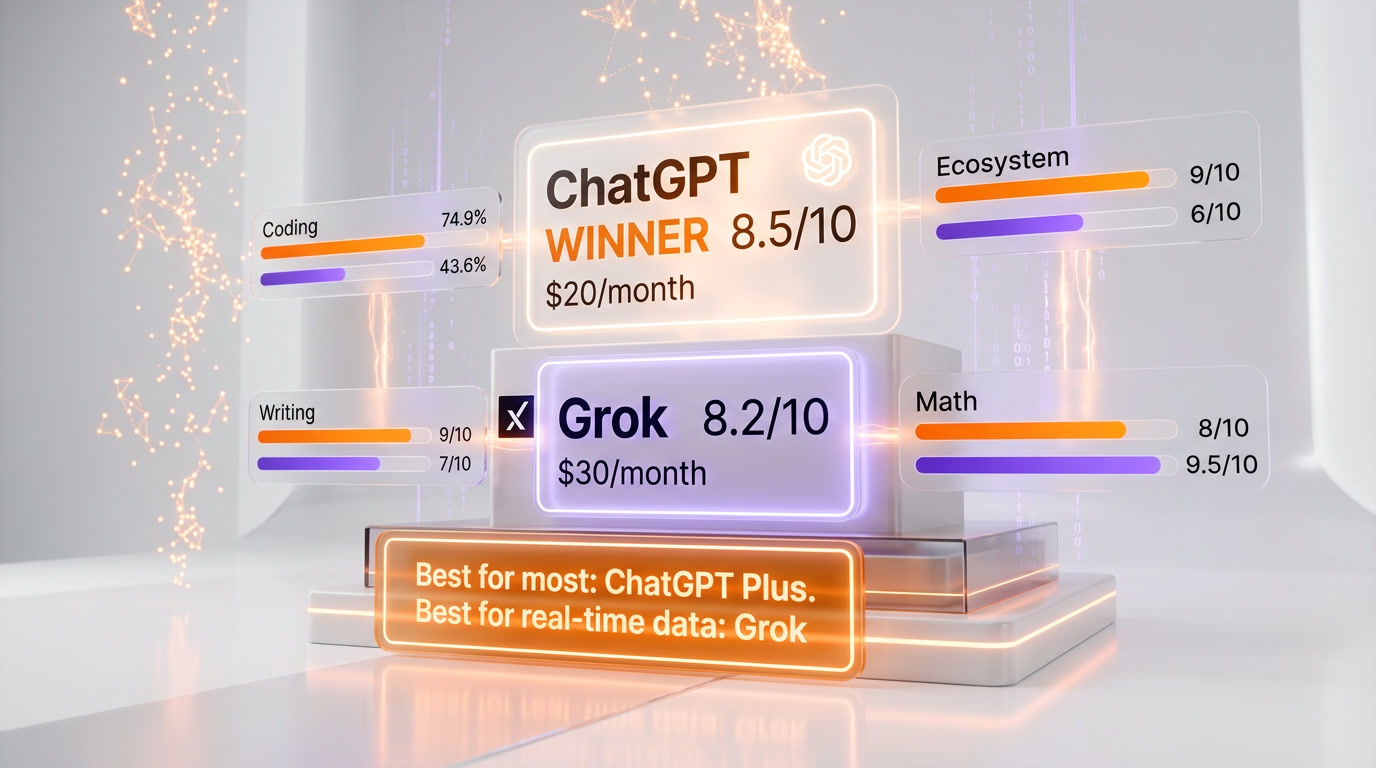
Our Verdict
After weeks of genuine testing across hundreds of prompts, real professional workflows, and edge cases designed to stress-test both systems, our conclusion is clear: ChatGPT is the better AI assistant for most people in 2026. It scores higher (8.5 vs 8.2), costs less ($20 vs $30), and wins more of the categories that matter for most professional use cases — coding, writing consistency, hallucination rates, ecosystem breadth, and enterprise readiness.
But here's what genuinely impresses us about Grok: it's closing the gap fast, and it wins in ways that matter for specific users. The real-time X data integration is a legitimate moat — no other AI assistant comes close for live social intelligence. The math and science benchmarks are stronger. The 1 million token context window at $30 per month offers real value that ChatGPT only matches at $200 per month. And the personality is, honestly, more interesting to interact with for many users.
The Elon Musk vs Sam Altman rivalry driving this comparison is real, but more importantly, the products themselves are genuinely competitive. ChatGPT wins this round based on overall capability breadth and value. But if your workflow skews toward real-time data, large document analysis, social content, or quantitative work — Grok deserves a serious look, not as a ChatGPT alternative, but as the better tool for your specific job.
Our final recommendation: Start with ChatGPT Plus at $20 per month as your primary AI assistant. Consider adding SuperGrok at $30 per month as a complement if real-time X intelligence or document-scale context matters to your work. If you're already on X Premium+, you're getting Grok for free — start using it seriously today.
Frequently Asked Questions
Is Grok better than ChatGPT in 2026?
ChatGPT (score 8.5 out of 10, $20 per month) is the better overall AI assistant for most professionals. It wins on coding (74.9% vs 43.6% SWE-bench), writing consistency, lower hallucination rates (8% on complex tasks), ecosystem breadth (500+ integrations), and price. Grok (score 8.2 out of 10, $30 per month) wins on real-time X data access, math benchmarks (95% vs 86% AIME 2025), generation speed (~1,200 vs ~900 tokens per second), 1M token context at $30 per month, and personality. Your use case determines the winner.
Which is cheaper — Grok or ChatGPT?
ChatGPT Plus at $20 per month is $10 cheaper than SuperGrok at $30 per month for full-feature access. Both offer entry tiers at $8 per month (X Premium for Grok, Go plan for ChatGPT). For API usage, Grok reportedly saves $1,000+ per month vs GPT at 100M tokens. If you already pay $40 per month for X Premium+, Grok access is effectively free.
Which is better for coding — Grok or ChatGPT?
ChatGPT wins decisively for coding. It scores 74.9% on SWE-bench Verified vs Grok's 43.6% — a completely different tier of capability. ChatGPT produces more consistent code across multi-file projects, handles edge cases better without prompting, and has a lower error rate (12% lower on long reasoning chains). For developers, ChatGPT is the clear choice.
What can Grok do that ChatGPT cannot?
Grok has native access to X's real-time data stream — no other AI assistant can pull live posts, trending conversations, and breaking discussions from X. Grok also offers a 1M token context window at $30 per month (ChatGPT requires $200 per month Pro for equivalent), video generation included at $30 per month (ChatGPT locks Sora behind $200 per month Pro), and an unfiltered personality that refuses approximately 20% fewer sensitive queries than ChatGPT.
Is Grok good for math and science?
Yes — Grok excels at quantitative reasoning. Grok 4 scores 95% on AIME 2025 (vs ChatGPT's 86%), 87.5% on GPQA scientific reasoning, and 1,586 on EQ-Bench. Its Think Mode produces more thorough step-by-step breakdowns for multi-step calculus and statistics problems. For academics, data scientists, and researchers doing heavy analytical work, Grok's math performance is a genuine differentiator.
Can I use Grok and ChatGPT together?
Yes, and it is a recommended approach. Use ChatGPT Plus ($20 per month) as your primary AI assistant for coding, long-form writing, and enterprise workflows. Add SuperGrok ($30 per month) for real-time X intelligence, large document analysis (1M context), and social media content. The two tools complement each other — ChatGPT handles depth and reliability, Grok handles speed and real-time data.
Sources and references
Every figure on this page is attributed to whoever produced it. Vendor documentation and independent measurement are listed separately and never merged into a single ranking.
- SpaceXAI — Model documentation (model family, specifications and pricing)
- OpenAI — Models (model catalogue and capabilities)
- Artificial Analysis — Model leaderboard (Intelligence Index scores and cost per task across configurations)
Our Verdict
ChatGPT (8.5/10, $20/month) edges out Grok (8.2/10, $30/month) as the better all-around AI assistant in 2026 — stronger coding reliability (74.9% vs 43.6% on SWE-bench), more polished writing, and a far broader integration ecosystem at a lower price point. Choose Grok when you need real-time X data, top-tier math performance (95% AIME 2025), or an AI with genuine personality that won't hedge every answer into oblivion.
Choose Grok
xAI's real-time AI assistant with native X platform intelligence and multimodal capabilities
Try Grok →Frequently Asked Questions
Is Grok better than ChatGPT?
ChatGPT (8.5/10, $20/month) edges out Grok (8.2/10, $30/month) as the better all-around AI assistant in 2026 — stronger coding reliability (74.9% vs 43.6% on SWE-bench), more polished writing, and a far broader integration ecosystem at a lower price point. Choose Grok when you need real-time X data, top-tier math performance (95% AIME 2025), or an AI with genuine personality that won't hedge every answer into oblivion.
Which is cheaper, Grok or ChatGPT?
Grok starts at $30/month (free plan available). ChatGPT starts at $20/month (free plan available). Check the pricing comparison section above for a full breakdown.
What are the main differences between Grok and ChatGPT?
The key differences span across 12 features we compared. For Real-Time Data Access, Grok offers Native X platform live stream + web search — unique social layer no other AI has while ChatGPT offers Web browsing tools only; no access to real-time social media stream. For Coding Performance (SWE-bench), Grok offers 43.6% on SWE-bench Verified — strong for prototyping, weaker on complex multi-file projects while ChatGPT offers 74.9% on SWE-bench Verified — production-grade, industry-leading code reliability. For Math & Scientific Reasoning, Grok offers 95% on AIME 2025; 87.5% on GPQA graduate-level science benchmark while ChatGPT offers 86% on AIME 2025 (o3); 86.4% MMLU score — strong but behind Grok on pure math. See the full feature comparison table above for all details.