Grok
xAI's real-time AI assistant with native X platform intelligence and multimodal capabilities

Quick Summary
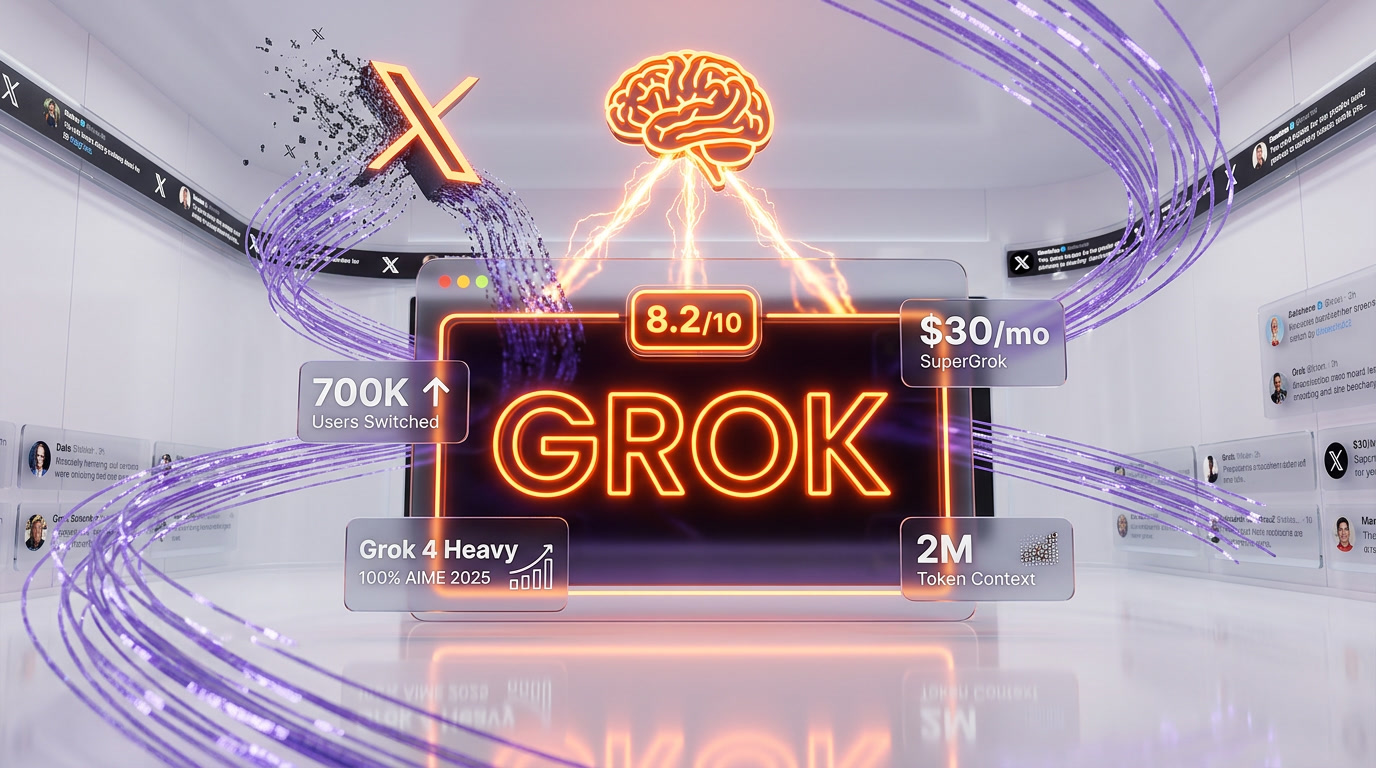
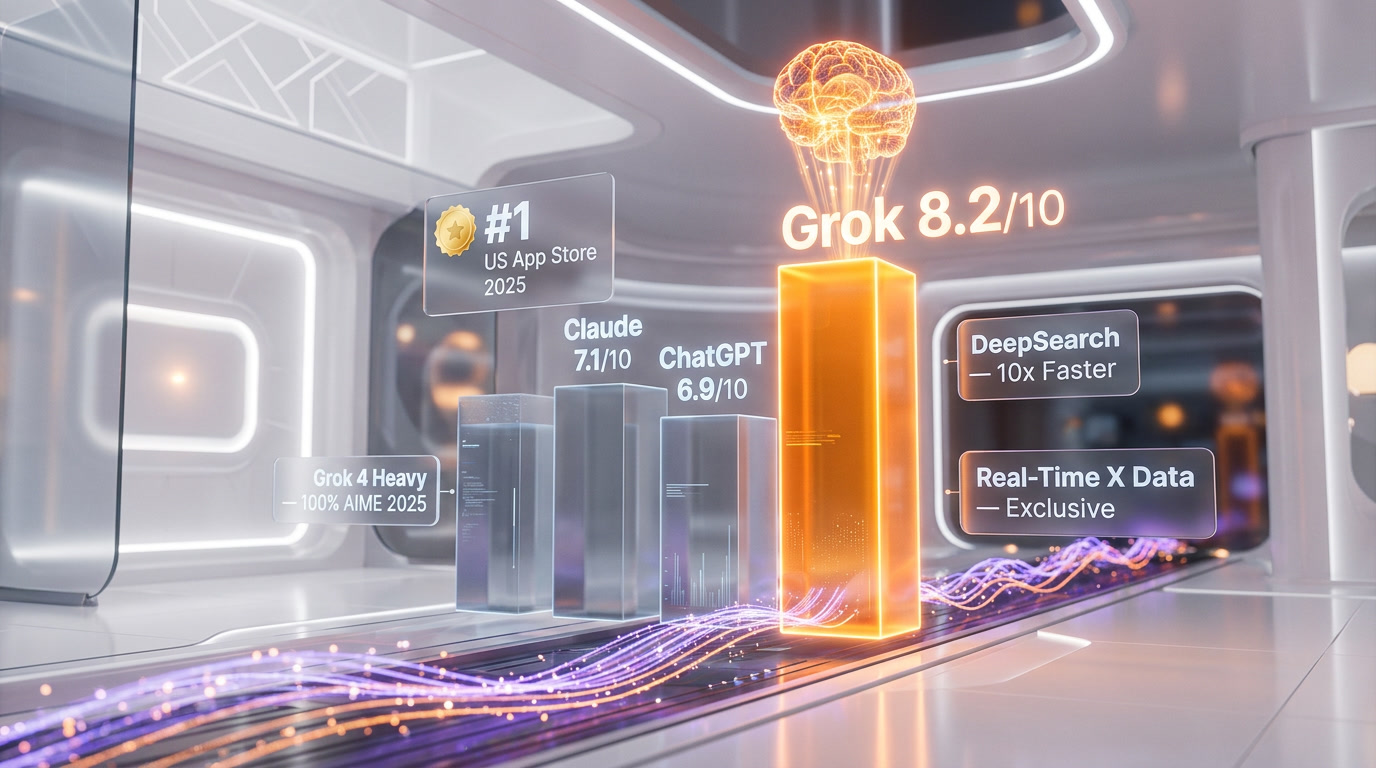
Grok is xAI's real-time AI assistant powered by live X (Twitter) data. Scored 8.2/10 with DeepSearch 10x faster than ChatGPT and a 2M-token context window. Free tier available; SuperGrok from $30/mo.
What is Grok?
Grok is xAI's real-time AI assistant powered by live X (Twitter) data. Scored 8.2 out of 10 with DeepSearch 10x faster than ChatGPT and a 2M-token context window. Free tier available; SuperGrok from $30 per month.
The core idea behind Grok is simple but powerful: what if your AI could actually see the internet in real time, not just a frozen snapshot from 18 months ago? Because Grok has native access to the full firehose of X (formerly Twitter), it knows what's trending right now, what people are saying about a product launch that happened an hour ago, and what news is breaking as you type. No other major AI assistant has that at the infrastructure level.
Beyond the real-time data angle, Grok has rapidly grown into a full-featured multimodal platform. It generates images via Aurora, creates videos via Grok Imagine, talks back in voice mode, reads your documents, writes and debugs code, and reasons through complex problems in Think Mode. The free tier is surprisingly capable, and the SuperGrok subscription at $30 per month unlocks the full power of Grok 4.1 and 4.20.
It's worth noting the cultural moment: in early 2025, the #QuitGPT movement drove an estimated 700,000 users away from ChatGPT. Grok 3 hit No. 1 on the U.S. App Store, dethroning ChatGPT just three days after launch. Grok is no longer the scrappy challenger — it's firmly in the conversation as a mainstream AI platform.
Our Experience with Grok
We've been using Grok across the free and SuperGrok tiers for several months now, and the first thing that genuinely surprised us was how different it feels from Claude or ChatGPT. It's hard to explain, but there's a personality to it. Grok will occasionally push back on you, crack a joke at its own expense, and won't pad every answer with five disclaimers. That can be refreshing when you're used to AIs that hedge everything into uselessness.
The real-time X data is legitimately useful in a way we didn't expect. We tested it by asking Grok about a product announcement that had just dropped — and it pulled real posts, reactions, and even initial reviews from X within seconds. ChatGPT gave us outdated context. Claude politely told us it couldn't verify recent events. Grok just... knew. For trend research, social listening, and staying on top of fast-moving topics, this is a genuinely unfair advantage.
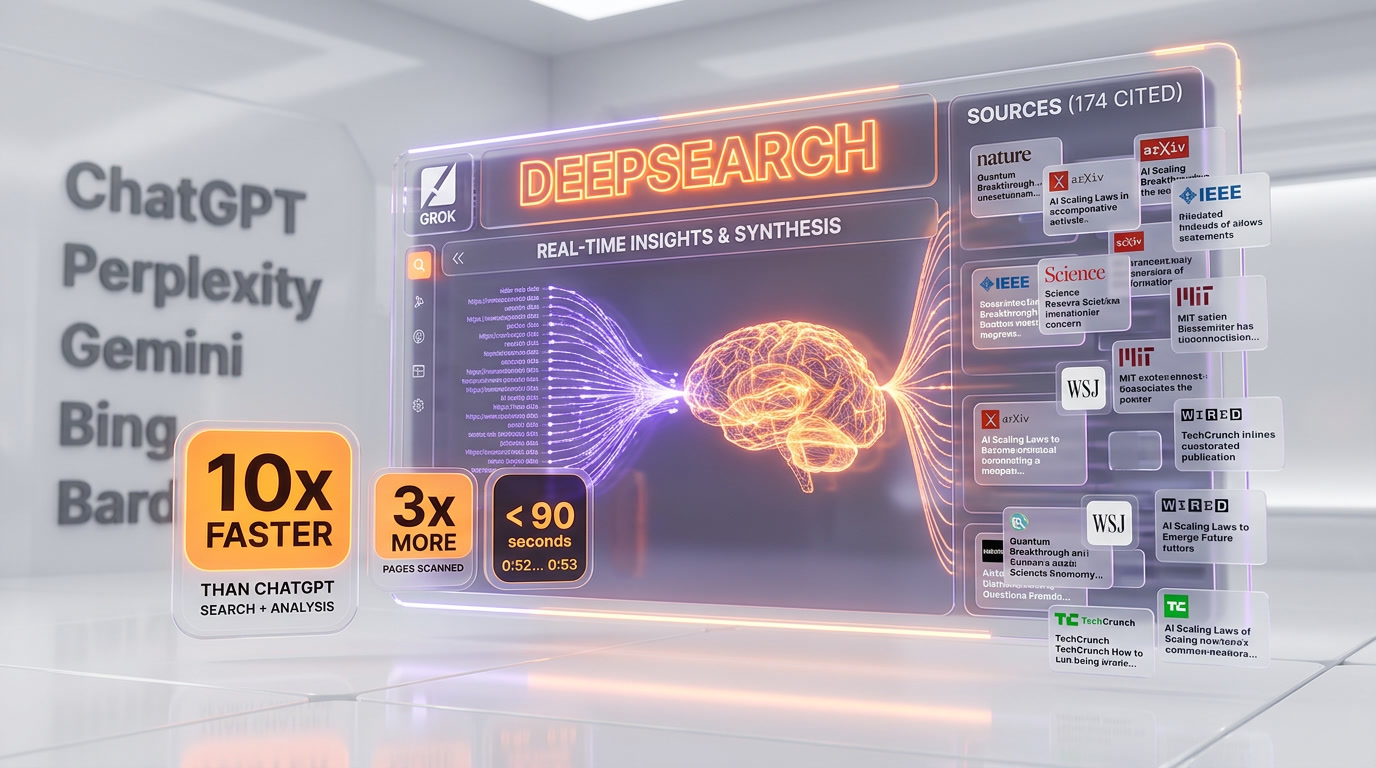
DeepSearch is Grok's extended research mode, and it's fast. Research from AIMultiple's benchmarking found Grok DeepSearch is roughly 10x faster than ChatGPT's equivalent deep research feature and scans about 3x more web pages. In our own testing on competitive research queries, DeepSearch returned structured, cited reports in under 90 seconds where other tools took 10+ minutes. That alone justifies the $30 per month for frequent researchers.
Think Mode (Grok's chain-of-thought reasoning toggle) is one of the more transparent implementations we've seen. You can literally watch Grok walk through its logic step by step, see when it second-guesses itself, and follow its reasoning before the final answer lands. It builds a surprising amount of trust. After spending time with it, we started leaving Think Mode on by default for anything complex.
Where Grok stumbles is consistency. We ran the same creative writing prompt three times on the same day and got wildly different tones — one almost literary, one practically a listicle, one conversational. ChatGPT is more predictable. Claude is more consistent. Grok is more exciting, but you sometimes have to regenerate to land in the right zone. For production workflows where you need reliable output formatting, this matters.
Voice mode with the Eve companion is smooth and low-latency — we tested it on mobile and it felt genuinely conversational, not robotic. It's not quite at GPT-4o's voice level for sustained back-and-forth, but it's close, and the fact that it integrates real-time web search into voice responses is a neat trick. Asking "what's happening with NVIDIA stock today" out loud and getting a spoken, current answer is useful in a way that static voice modes aren't.
Key Features
Real-Time X Platform Intelligence
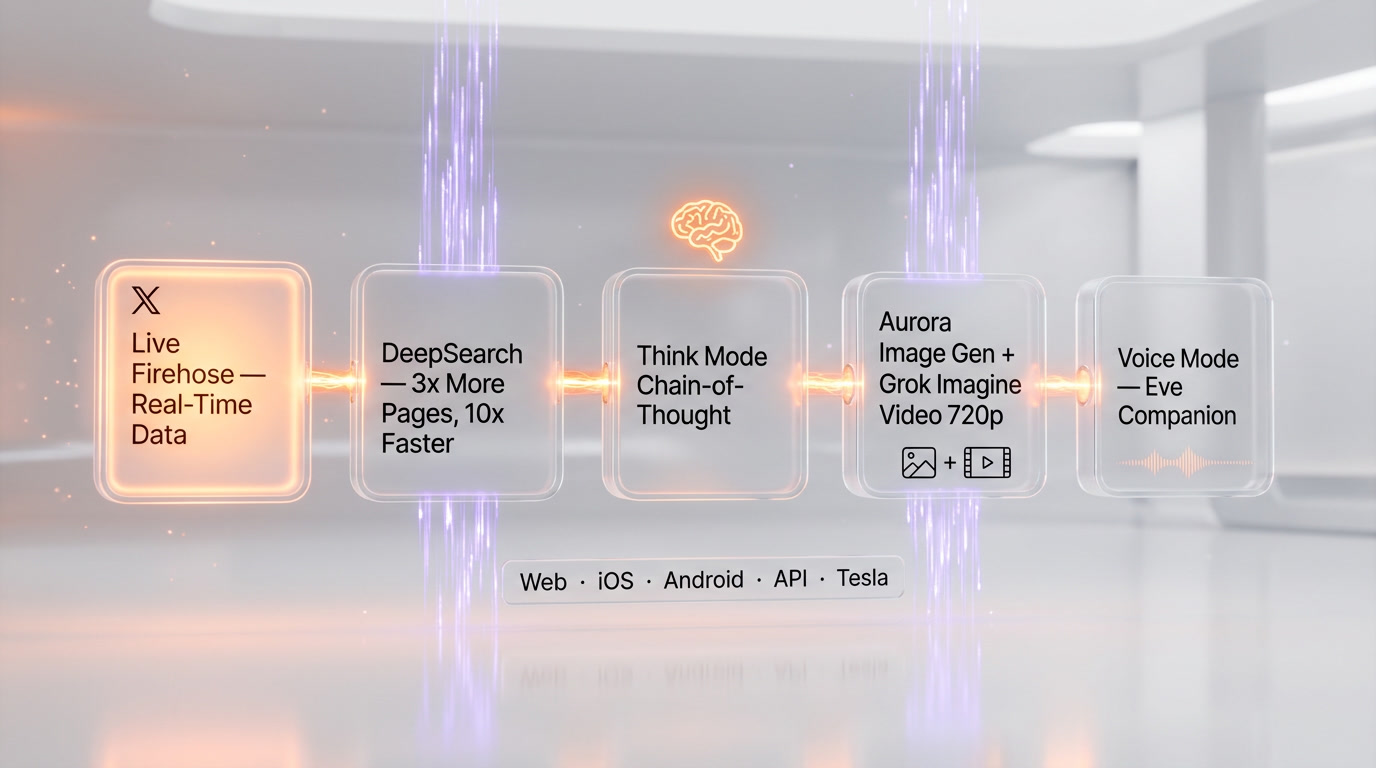
This is Grok's defining feature and genuine moat. Every other major AI assistant uses web search as an add-on layer — Grok has been trained with X data natively baked in and maintains live access to the platform. This means it can surface trending hashtags before they peak, find real user sentiment from actual posts, and give you context that no amount of Google Search scraping can match. For marketers, journalists, social media managers, and anyone who needs to track public discourse in real time, this is invaluable. We tried asking Grok to identify emerging topics in a specific niche on X from the past 24 hours, and it returned a structured breakdown with representative posts and engagement context. No other tool does this out of the box.
DeepSearch — Extended Web Research
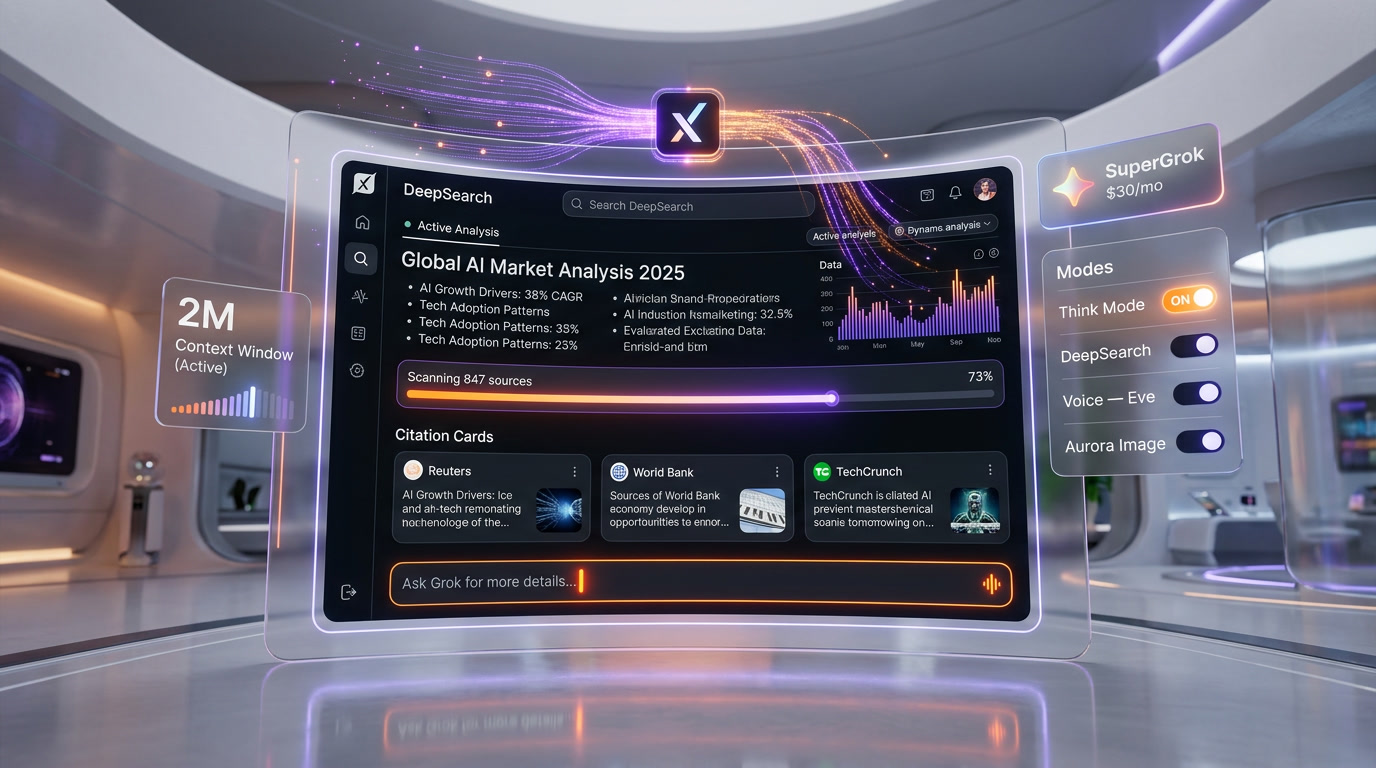
DeepSearch is Grok's deep research mode that scans hundreds of web sources, synthesizes them, and returns structured reports with citations. In benchmark tests, it processes results roughly 10x faster than ChatGPT's equivalent feature while scanning a broader set of pages. For SuperGrok subscribers, this is available with higher rate limits and priority routing. The output is clean, organized, and sourced — we used it for competitive analysis and found it consistently surfaced information from niche industry publications that simpler search modes missed entirely.
Think Mode — Transparent Chain-of-Thought Reasoning
Think Mode lets you watch Grok reason through a problem in real time before committing to an answer. It's particularly powerful for math, logic puzzles, multi-step planning, and nuanced questions where the reasoning process matters as much as the conclusion. Grok 4 Heavy scored 100% on AIME 2025 and 96.7% on HMMT math tournaments — numbers that are meaningless until you watch Think Mode work through a calculus problem and realize you're watching something operating at a genuinely different level. For everyday tasks it's optional, but for anything analytical, turning it on is worth the small latency tradeoff.
Aurora — AI Image Generation
Aurora is xAI's proprietary image generation model built directly into Grok. It uses an autoregressive mixture-of-experts architecture trained on billions of examples, and the results are genuinely impressive for photorealistic rendering and precise instruction-following. Free users get limited generations (around 10 per 2-hour window), while SuperGrok unlocks significantly higher quotas. What separates Aurora from Midjourney or Firefly in the Grok context is the conversational integration — you can generate an image, then ask Grok to explain the scene, ask for variations, or combine it with research about a topic, all in the same thread.
Grok Imagine — Video Generation
Grok Imagine launched publicly in July 2025 and hit version 1.0 in February 2026 with 10-second clips, 720p resolution, and synchronized audio generation. The March 2026 "Extend from Frame" update lets you chain clips together — the final frame of one generation becomes the first frame of the next, enabling smoother multi-segment videos. It's powered by Aurora under a 110,000 NVIDIA GB200 GPU cluster. For short-form social video and concept visualization, it's capable. It's not Sora-level cinematics, but for quick, branded social content it does the job in a fraction of the time.
Voice Mode with Eve
Voice Mode turns Grok into a spoken AI companion. The Eve interface supports real-time conversational turns, tool calling mid-conversation (so it can search the web while you're talking), and is available on iOS, Android, and even integrated into Tesla vehicles. Latency is low, it handles dozens of languages, and unlike pure voice synthesis tools, Eve can actually respond to follow-up questions about what it just said. It's genuinely hands-free AI that doesn't feel like shouting commands at a speaker.
2-Million-Token Context Window
Grok 4.1 and 4.20 support a 2-million-token context window — one of the largest of any consumer AI assistant. In practice, this means you can upload entire books, full codebases, or years of business documents and interrogate them in a single conversation without chunking. We tested it with a lengthy research corpus and Grok maintained context across the full document set without hallucinating cross-references. For document-heavy workflows, this is a real differentiator.
Multi-Agent Collaboration (Grok 4.20)
Grok 4.20 introduced a 4-agent parallel collaboration architecture — essentially four specialized sub-agents that debate, question, and verify each other's work before synthesizing a final answer. This internal consensus mechanism is part of why the model scores well on complex reasoning benchmarks. On the Artificial Analysis Intelligence Index, Grok 4.20 Beta ranks well above the median for comparable models, though below the frontier leaders. For complex, multi-faceted questions, this architecture produces noticeably more thorough answers than single-pass models.
Pricing Breakdown
Grok's pricing structure has evolved rapidly. Here's where things stand as of early 2026:
Free Plan ($0 per month) — Available to all users on grok.com. Includes limited access to Grok 3 (not Grok 4), basic image generation via Aurora, voice mode, real-time web search, and document analysis. Rate limits are approximately 10 requests per 2-hour window. For casual use or trying the platform, it's generous by industry standards.
SuperGrok ($30 per month) — This is the main paid tier for individuals. Unlocks Grok 4.1 and Grok 4.20 access with higher rate limits, DeepSearch with extended research capabilities, Big Brain Mode for longer reasoning chains, priority routing during peak times, expanded Aurora image generation quotas, Grok Imagine video generation, and longer voice mode sessions. At $30 per month, it's $10 more than ChatGPT Plus and the same as Claude Pro's rough equivalent — but the real-time X data and DeepSearch speed make it competitive value for the right use case.
SuperGrok Heavy ($300 per month) — Targets power users and serious researchers who need maximum context, Grok 4 Heavy access (the most capable variant), and the highest available rate limits. This is the tier that unlocked the 100% AIME 2025 benchmark performance. Enterprise and research teams doing intensive AI work would find this appropriate; casual users should stick to the standard SuperGrok tier.
Grok Business ($30 per seat/month) — Launched December 2025. Includes everything from SuperGrok plus team sharing features, collaborative prompt and project management, and admin controls. Minimum seat counts apply — this is designed for teams, not individual power users.
Grok Enterprise (Custom pricing) — For large organizations needing SSO, SCIM user directory sync, audit logs, secure data vaults, and compliance-grade controls. xAI launched this tier in December 2025, signaling the company's move upmarket. Pricing is negotiated directly. Documentation is still sparse compared to OpenAI's enterprise offerings.
X Premium Bundle ($8 per month) / X Premium+ ($40 per month) — If you're already on X's subscription tiers, Grok access is bundled in. X Premium gets basic Grok access; X Premium+ at $40 per month (price raised from $22 in December 2024 when Grok 3 launched) includes more robust Grok features alongside X platform perks.
API pricing for developers: Grok 4.1 Fast at $0.20 per million tokens input and $0.50 per million tokens output tokens makes it one of the most cost-effective high-quality APIs available. Grok 4 standard is $3.00 per million tokens input and $15.00 per million tokens output. Web search tool calls cost $5 per 1,000 invocations.
Who Should Use Grok?
Grok is genuinely excellent for a specific kind of user, and honestly not ideal for others. Let's be direct about who gets the most value here.
Social media managers and content strategists are the clearest winners. The real-time X data access gives you a competitive intelligence layer that no other AI tool can match. Identifying trending topics before they peak, monitoring brand sentiment as it happens, generating content tied to live conversations — this is where Grok is operating in a different league entirely.
Journalists and researchers who need to move fast will love DeepSearch. Getting cited, structured research briefs in under 90 seconds from a broad web crawl is a workflow accelerator. The 2M context window also means you can upload extensive source documents and ask nuanced follow-ups without the AI losing the thread.
Casual AI users who've been put off by the corporate, hedge-everything tone of other assistants will find Grok refreshing. It has opinions. It'll tell you when your idea is bad. It occasionally makes you laugh. The free tier is capable enough for daily use without paying anything.
Tesla owners and mobile-first users benefit from native voice integration that's genuinely hands-free and real-time — not a delayed, static voice assistant.
Grok is less ideal if your primary use case is serious software engineering (Claude and Copilot still lead there), long-form document editing with consistent voice (Claude wins on consistency), or enterprise-grade deployments with mature support infrastructure (OpenAI's enterprise offering is more mature as of early 2026).
Grok vs. Competition
The honest comparison: Grok, ChatGPT, and Claude are the three dominant AI assistants right now, with Gemini as a strong fourth. Each has a different center of gravity.
Grok vs. ChatGPT: ChatGPT has a larger ecosystem, more mature integrations, and a more consistent tone. ChatGPT Plus at $20 per month is cheaper than SuperGrok at $30 per month. But Grok's real-time X data is something ChatGPT simply cannot replicate, and DeepSearch is meaningfully faster. For general productivity, ChatGPT is the safer choice; for real-time intelligence and social-adjacent research, Grok wins clearly. Grok versus ChatGPT is the extended version of that call.
Grok vs. Claude: Claude (especially Claude 3.5 Sonnet / Claude 4) is the better choice for coding, long document analysis with nuanced summarization, and sustained creative writing with consistent voice. Claude also has a better safety and reliability reputation for enterprise use. Grok counters with better speed, real-time data, more personality, a larger free tier, and multimodal features (image and video generation) that Claude currently lacks natively. We actually find ourselves using both — Claude for production writing and code review, Grok for research and staying current on trends.
Grok vs. Perplexity: Perplexity is a search-first tool with AI layered on top. Grok is an AI-first assistant with real-time search as a feature. For pure web research citations, Perplexity is excellent and slightly more reliable for accuracy. For everything else — creative tasks, code, conversation, image generation — Grok is significantly more capable. They serve different primary workflows.
Grok vs. Gemini: Google's Gemini 2.5 Pro leads on coding tasks and large codebase analysis, leveraging Google's ecosystem. Grok beats it on real-time non-Google data (especially social media), personality, and video generation quality. For enterprise Google Workspace users, Gemini's integrations are hard to beat. For everyone else, the choice comes down to specific use cases.
One important note: Grok 4.20's multi-agent architecture and rapid learning system (it updates weekly from real-world feedback) mean the model is likely to improve faster than competitors running static quarterly update cycles. The trajectory matters as much as the current snapshot.
The Bottom Line
Grok is the most interesting AI assistant story of the past year. It went from being a novelty perk for X power users to one of the most-used AI platforms on the planet, and it earned that position by doing things genuinely differently — not by copying what ChatGPT did and iterating marginally. The real-time X integration is a real moat. DeepSearch is fast. Think Mode is transparent. Grok 4.20's multi-agent architecture is legitimately innovative. And a free tier that includes image generation, voice mode, and web search is hard to argue with as a starting point.
The rough edges are real: inconsistency in output tone, early-stage enterprise documentation, and some controversy around content moderation in image generation. These are valid concerns, and teams building production workflows should stress-test Grok's reliability before committing to it as a sole solution.
But for individual users, content teams, researchers, and anyone whose work requires staying on the pulse of real-time conversation — Grok at $30 per month for SuperGrok is one of the better investments in the current AI landscape. We give it an 8.2 overall. It's not perfect, but it's got something the others don't — and that something keeps getting better at a very fast pace.
Frequently Asked Questions
Is Grok free to use?
Yes, Grok offers a free plan on grok.com with limited access to Grok 3, basic Aurora image generation, voice mode, real-time web search, and document analysis. Rate limits are approximately 10 requests per 2-hour window. For full Grok 4.1 and 4.20 access with DeepSearch and higher limits, SuperGrok costs $30 per month.
How does Grok compare to ChatGPT?
ChatGPT Plus at $20 per month is cheaper and offers more mature integrations with a more consistent output tone. Grok at $30 per month counters with native real-time X (Twitter) data access that ChatGPT cannot replicate, DeepSearch that is roughly 10x faster than ChatGPT's deep research, and a 2-million-token context window. For general productivity, ChatGPT is safer; for real-time intelligence and social research, Grok wins clearly.
What is Grok DeepSearch and how fast is it?
DeepSearch is Grok's extended research mode that scans hundreds of web sources and returns structured, cited reports. According to AIMultiple benchmarking, it processes results roughly 10x faster than ChatGPT's equivalent and scans about 3x more web pages. In testing, it returned comprehensive competitive analysis reports in under 90 seconds where other tools took 10+ minutes.
What is the difference between SuperGrok and SuperGrok Heavy?
SuperGrok at $30 per month unlocks Grok 4.1 and 4.20, DeepSearch, Big Brain Mode, expanded Aurora image generation, Grok Imagine video, and priority routing. SuperGrok Heavy at $300 per month provides Grok 4 Heavy access (the most capable variant that scored 100% on AIME 2025), maximum context length, and the highest available rate limits. Heavy is designed for power users and serious researchers.
Can Grok generate images and videos?
Yes. Aurora is xAI's proprietary image generation model built into Grok, using an autoregressive mixture-of-experts architecture. Free users get roughly 10 generations per 2-hour window. Grok Imagine handles video generation with 10-second clips at 720p with synchronized audio. The March 2026 Extend from Frame update enables chaining clips together for longer sequences.
Is Grok good for coding?
Grok handles code generation and debugging but trails Claude and GitHub Copilot for complex software engineering tasks. Its strengths lie in real-time research, trend analysis, and creative work rather than sustained code production. For serious software development workflows, Claude or Copilot are more reliable choices as of early 2026.
Key Features
Pros & Cons
Pros
- Native real-time access to X (Twitter) data — no other major AI assistant has this at infrastructure level
- DeepSearch is ~10x faster than ChatGPT's equivalent and crawls 3x more pages
- Grok 4 Heavy scored 100% on AIME 2025 and 96.7% on HMMT — top-tier reasoning benchmarks
- 2-million-token context window supports entire codebases or book-length documents
- Full multimodal suite: Aurora image gen, Grok Imagine video, voice mode with live camera
- Generous free tier includes image generation, voice mode, and real-time web search
- Grok 4.1 reduced hallucinations by 65% (from 12.09% to 4.22%) vs prior version
Cons
- Output tone can be inconsistent — same prompt sometimes yields very different styles across sessions
- Enterprise documentation is sparse and support infrastructure less mature than OpenAI or Anthropic
- Image generation faced significant content moderation controversy in late 2024–early 2025
- SuperGrok at $30/month is $10 more than ChatGPT Plus with less proven consistency for production workflows
- Coding performance trails Claude and GitHub Copilot for complex software engineering tasks
Best Use Cases
Platforms & Integrations
Available On
Integrations
Compare Grok

We're developers and SaaS builders who use these tools daily in production. Every review comes from hands-on experience building real products — DealPropFirm, ThePlanetIndicator, PropFirmsCodes, and many more. We don't just review tools — we build and ship with them every day.
Written and tested by developers who build with these tools daily.
Frequently Asked Questions
What is Grok?
xAI's real-time AI assistant with native X platform intelligence and multimodal capabilities
How much does Grok cost?
Grok has a free tier. Premium plans start at $30/month.
Is Grok free?
Yes, Grok offers a free plan. Paid plans start at $30/month.
What are the best alternatives to Grok?
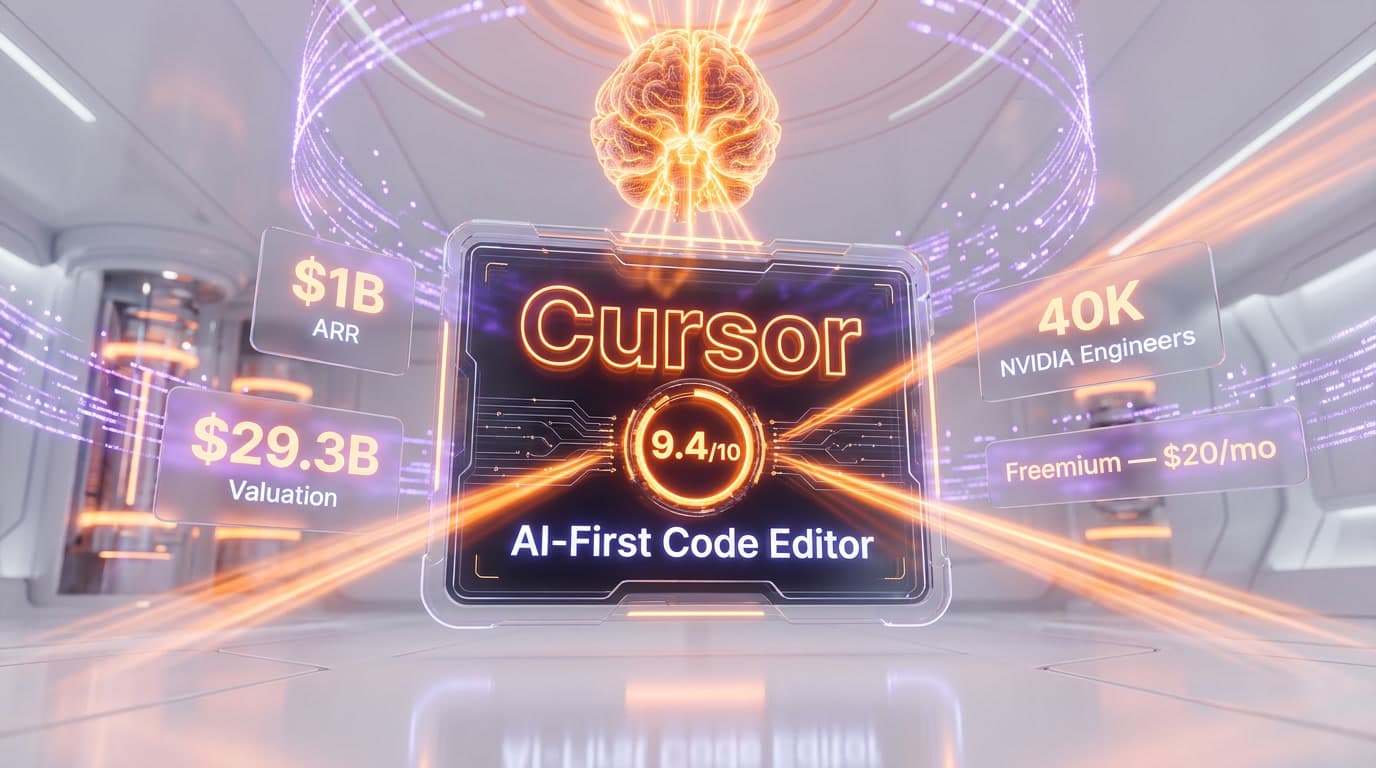
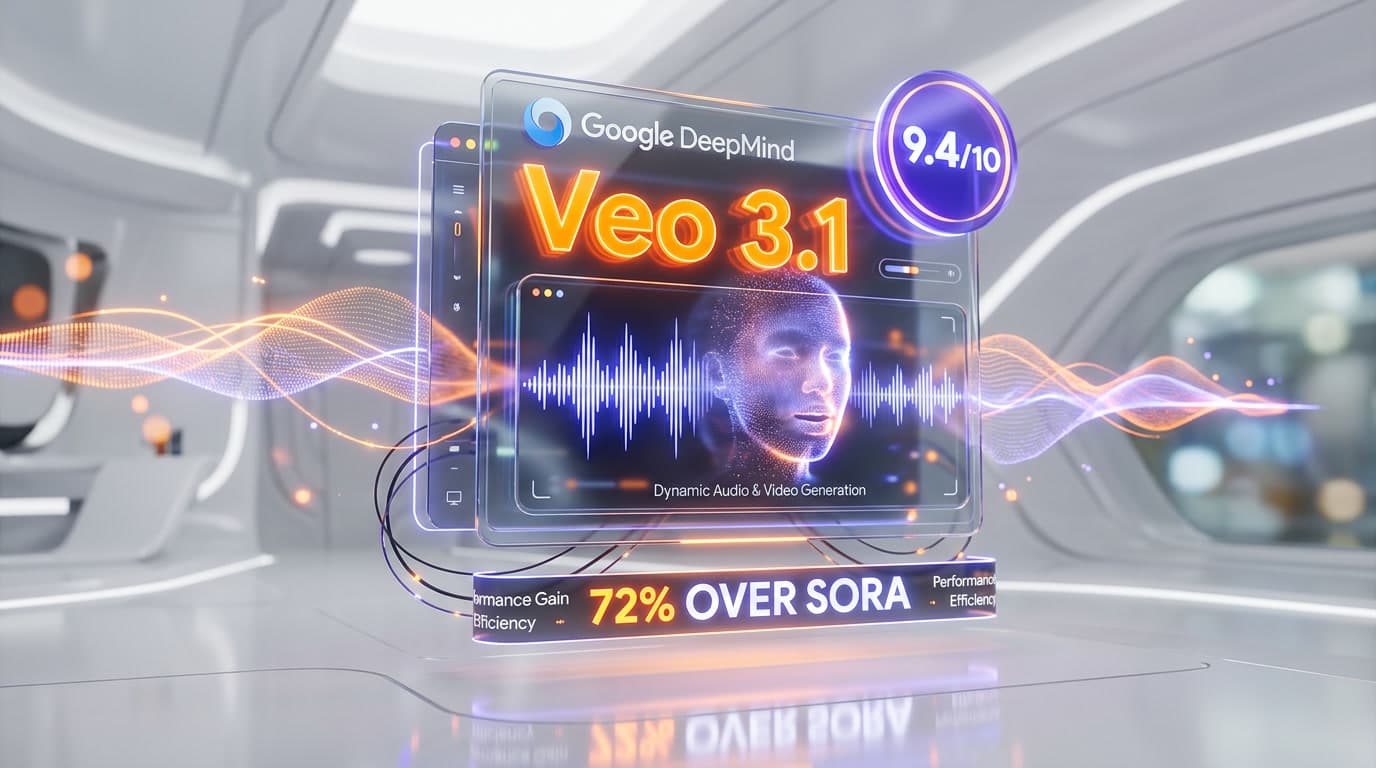
Top-rated alternatives to Grok include Claude Code (9.9/10), Cursor (9.5/10), Veo 3.1 (9.4/10), Claude Opus 4.7 (9.4/10) — all reviewed with detailed scoring on ThePlanetTools.ai.
Is Grok good for beginners?
Grok is rated 8.5/10 for ease of use.
What platforms does Grok support?
Grok is available on Web, iOS, Android, API, Tesla (in-vehicle).
Does Grok offer a free trial?
No, Grok does not offer a free trial.
Is Grok worth the price?
Grok scores 7.8/10 for value. It offers good value.
Who should use Grok?
Grok is ideal for: Real-time social media trend research and monitoring, Competitive intelligence using live X platform data, AI-generated image creation for marketing and content, Short-form social video production via Grok Imagine, Fast web research and summarization with DeepSearch, Voice-first AI interactions on mobile and in Tesla vehicles, Long-document analysis with 2M context window, Complex multi-step reasoning and math problem solving.
What are the main limitations of Grok?
Some limitations of Grok include: Output tone can be inconsistent — same prompt sometimes yields very different styles across sessions; Enterprise documentation is sparse and support infrastructure less mature than OpenAI or Anthropic; Image generation faced significant content moderation controversy in late 2024–early 2025; SuperGrok at $30/month is $10 more than ChatGPT Plus with less proven consistency for production workflows; Coding performance trails Claude and GitHub Copilot for complex software engineering tasks.
Best Alternatives to Grok
Ready to try Grok?
Start with the free plan
Try Grok Free →