HeyGen vs Synthesia: Best AI Avatar Video Platform in 2026?


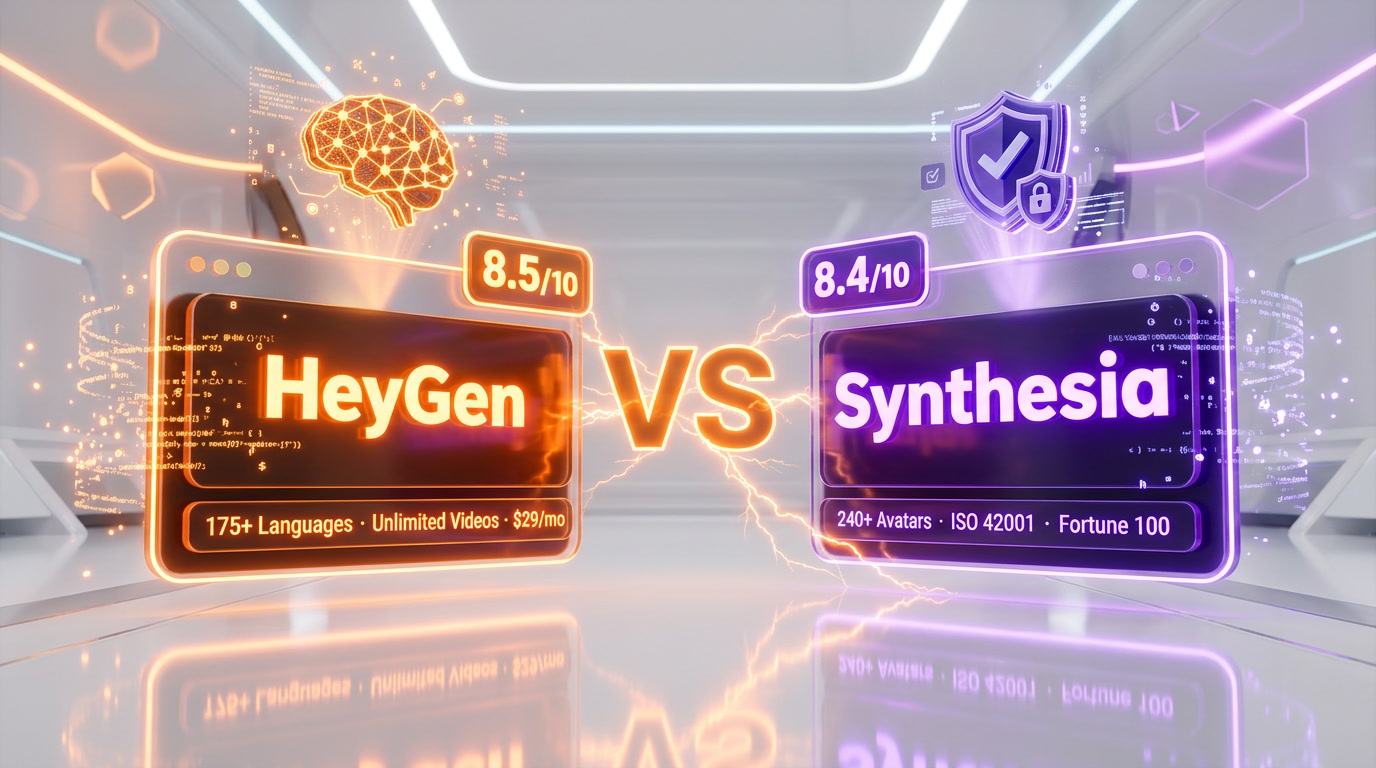
Same price, same promise, wildly different results. HeyGen wins realism and languages. Synthesia wins enterprise compliance. 10 videos on each. Real gap.
Feature Comparison
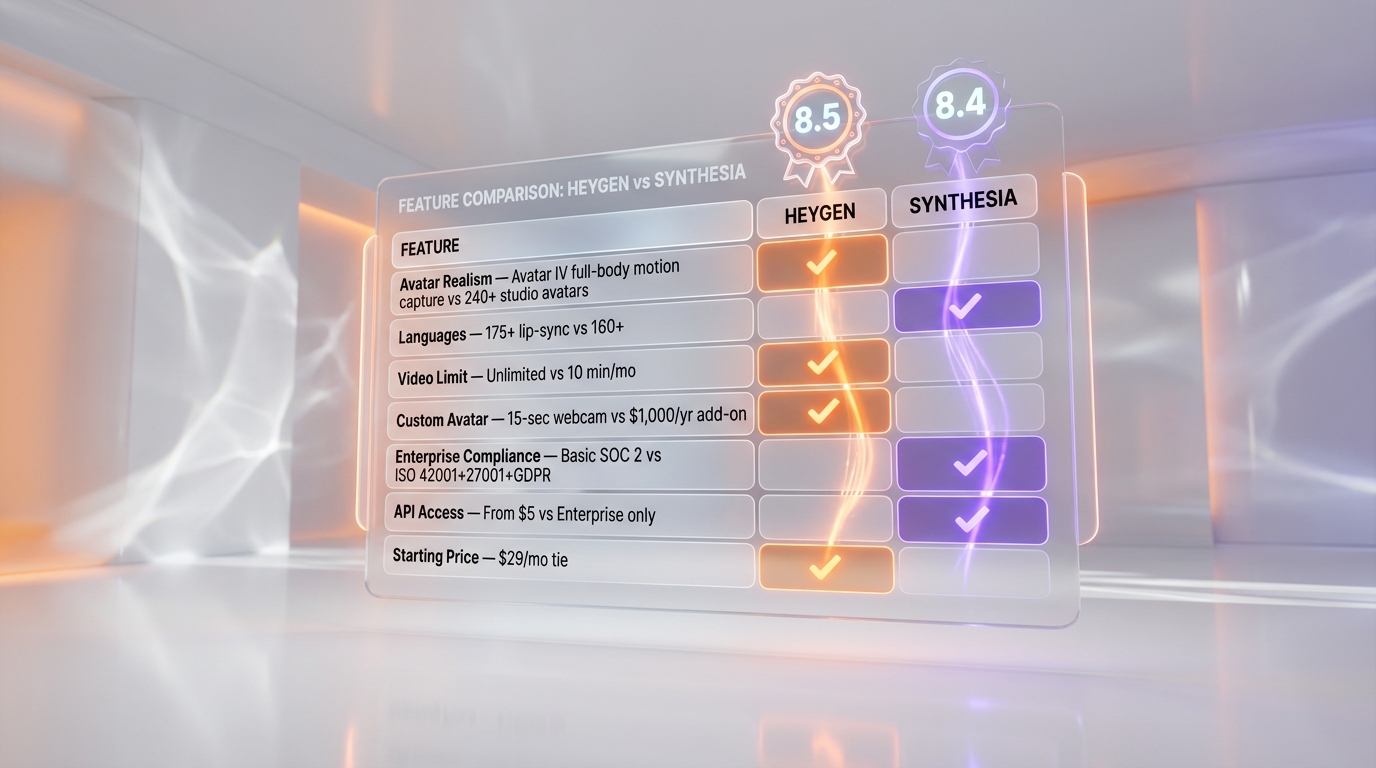
| Feature | HeyGen | Synthesia |
|---|---|---|
| Avatar Realism | Avatar IV: full-body motion capture, micro-expressions, natural hand gestures — near-human quality | 240+ professional studio avatars, polished corporate look, excellent lip-sync with technical language |
| Language Support | 175+ languages and dialects with lip-sync translation and unlimited audio dubbing | 140–160+ languages with lip-sync translation and cross-lingual voice cloning |
| Monthly Video Allowance | Unlimited videos on all paid plans (Premium Credits apply only to Avatar IV and lip-synced translation) | 10 min/mo on Starter, expanded on Creator, unlimited only on Enterprise |
| Custom Avatar Creation | 15-second webcam recording, near-instant Digital Twin, free on paid plans | $1,000/year add-on on non-Enterprise, studio session required, up to 10 days processing |
| Enterprise Compliance | Basic SOC 2; growing compliance posture but not ISO 42001 or ISO 27001 certified | SOC 2 Type II + ISO 27001 + ISO 42001 (world's first generative AI company) + GDPR; 60%+ of Fortune 100 |
| Starting Price | $29/mo Creator (unlimited videos); API from $5; Free: 3 videos/mo | $18/mo annual Starter (10 min/mo); $29/mo monthly; Free: ~3 min/mo, 9 avatars |
| Video Translation & Dubbing | Unlimited audio dubbing on all paid plans; lip-synced translation in 175+ languages; YouTube link import | Lip-sync translation in 140–160+ languages; refined script editing post-translation; higher plan gating |
| Voice Cloning Quality | ElevenLabs-powered; Voice Director + Voice Mirroring; 1,000+ AI voices; convincing on clean audio input | Cross-lingual voice cloning (clone once, use in 160+ languages); tightly integrated with avatar pipeline |
| API & Developer Access | REST API from $5; avatar video generation, TTS, translation, and enterprise APIs documented | API available on Enterprise plan only; limited access below enterprise spend |
| L&D / Training Workflow | Functional for training content; Video Agent 2.0 for automation; less refined multi-scene management | Built for L&D: SCORM export, LMS integrations, PowerPoint-to-video, multi-scene management, SCORM |
| Ease of Use | Highly intuitive; non-technical users producing videos in under 20 minutes; Video Agent 2.0 fully automates pipeline | Steeper learning curve; timeline-based editing offers precision; better for structured professional production |
| Team Collaboration | Business plan: SSO, Zapier, HubSpot integrations, up to 60-min videos, $149/mo + $20/seat | Enterprise: real-time collaboration, SAML SSO, brand kits, commenting, distributed team support |
Pricing Comparison
HeyGen
Synthesia
Detailed Comparison
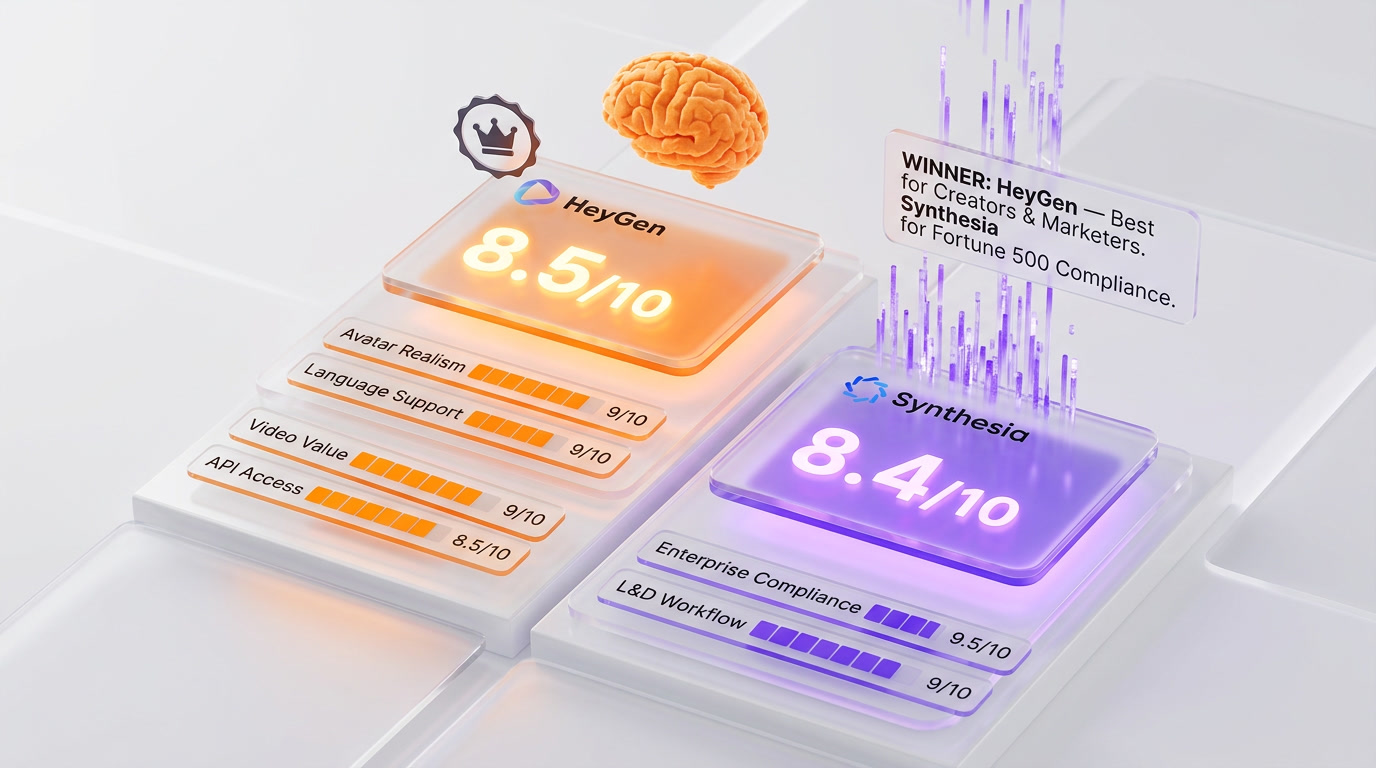
Bottom line up front: We've spent serious time inside both platforms, and the winner depends on who you are. HeyGen (score: 8.5, from $29 per month) beats Synthesia (score: 8.4, from $29 per month) on avatar realism, value for money, language coverage, and creative flexibility — making it the best AI avatar video platform for creators, marketers, and small-to-mid-size teams. Synthesia counters with the most rigorous enterprise compliance stack in the industry (ISO 42001, ISO 27001, SOC 2 Type II, GDPR) and is trusted by 60%+ of the Fortune 100 for corporate training and L&D workflows. Best for HeyGen: content creators, marketing teams, social media managers, agencies, and anyone who needs volume. Best for Synthesia: enterprise L&D teams, HR departments, compliance-heavy industries, and regulated organizations.
Quick Comparison: HeyGen vs Synthesia at a Glance
| Category | HeyGen | Synthesia | Winner |
|---|---|---|---|
| Our Score | 8.5 out of 10 | 8.4 out of 10 | HeyGen |
| Starting Price | $29 per month (Creator) | $18 per month annual / $29 per month monthly | Tie |
| Avatar Realism | Avatar IV — near-human quality | 240+ professional avatars | HeyGen |
| Languages Supported | 175+ | 140–160+ | HeyGen |
| Monthly Video Limit | Unlimited on all paid plans | 10 minutes per month on Starter | HeyGen |
| Custom Avatar Speed | ~15-sec webcam, near-instant | Studio session, up to 10 days | HeyGen |
| Enterprise Compliance | Basic SOC 2 | SOC 2 Type II + ISO 27001 + ISO 42001 + GDPR | Synthesia |
| API Access | From $5, robust REST API | Enterprise only | HeyGen |
| Video Translation/Dubbing | Unlimited dubbing, 175+ langs, lip-sync | 160+ langs, lip-sync, script editing | HeyGen |
| Best For | Creators, marketers, agencies | Enterprise L&D, compliance teams | Depends on use case |
Overview: What Are These Platforms Actually Doing in 2026?
After spending weeks inside both tools — generating product demos, dubbing existing videos into multiple languages, building custom avatars, and stress-testing their credit systems — here's what actually matters.
HeyGen launched as a scrappy challenger and has quietly become the platform that most creators and marketers reach for first. It was named G2's #1 Fastest Growing Product in the 2025 Best Software Awards, and the numbers back it up: 100,000+ businesses worldwide, $65M+ in funding, and a product roadmap that ships meaningful updates almost every month. The February 2026 update — which made audio dubbing unlimited on all paid plans and renamed "Generative Credits" to "Premium Credits" with upfront cost estimates — was the kind of change that shows the team actually listens to user feedback.
Synthesia has been in this game since 2017 and shows it. It's the measured, corporate elder statesman compared to HeyGen's scrappy energy. Where HeyGen is busy shipping new avatar models and translation features, Synthesia has been methodically building the compliance and security foundation that Fortune 500 procurement teams require. In September 2024, it became the first generative AI company on the planet to achieve ISO 42001 certification — the brand-new international standard for AI governance. That matters enormously if you're pitching AI video to a legal or compliance team at a bank, a pharmaceutical company, or a government agency.
They're the undisputed #1 and #2 in AI avatar video. The question isn't which is better in an abstract sense — it's which one is right for what you're actually trying to do.
Feature-by-Feature Comparison
1. Avatar Quality: HeyGen Avatar IV vs. Synthesia's Studio Avatars
This is the comparison that gets people animated (pun intended), and HeyGen has pulled decisively ahead for most use cases.
Avatar IV — launched in August 2025 and refined through early 2026 — is genuinely impressive. We tested it with a product demo script, a casual explainer, and an emotionally-driven customer testimonial. The full-body motion capture, micro-expressions, and timing-aware hand gestures feel organic. Not indistinguishable from a real human, but close enough that your audience focuses on the message rather than the medium. In our testing, the business-casual office setup earned what we'd grade an A-: smooth lip-sync, natural gestures, good eye contact. The emotional testimonial was a B+: tone shifts worked, but eye contact occasionally flickered and hand gestures repeated a bit too predictably.
Synthesia's avatars are polished and professional — 240+ options across ethnicities, ages, and professions. For formal corporate settings, they hold up extremely well. Lip-sync with technical jargon (the kind you get in compliance training or IT onboarding) was actually slightly more reliable than HeyGen in our tests — Synthesia has had years of institutional refinement on that front. What Synthesia's avatars lack is creative range. They skew corporate. HeyGen's library includes casual, expressive, and social-media-ready styles that Synthesia simply doesn't match.
The verdict here depends on your use case: HeyGen for creative range and emotional realism, Synthesia for polished corporate professionalism. But for most people? HeyGen's Avatar IV wins.
2. Video Translation and Dubbing
This is arguably where HeyGen creates its biggest competitive moat, and the February 2026 update made it even more compelling. Audio dubbing is now unlimited on all paid plans — no premium credits consumed. You can take any video (or paste a YouTube link), pick a target language from 175+ options, and HeyGen delivers a dubbed version with AI-matched voice and lip-sync in minutes.
We tested dubbing an English product demo into Spanish, French, Japanese, and Arabic. Results: Spanish and French were near-flawless. Japanese was very good with only minor unnatural pauses. Arabic required a bit of manual timing correction due to text direction and cadence differences. But the fact that a small team can push content to four markets in under an hour is a serious competitive advantage.
Synthesia supports 140–160+ languages with similar lip-sync translation capabilities. The script editing tools for post-translation are actually more refined, which matters when you're producing compliance content that needs to be legally precise in every language. But 175 vs. 140 is a real gap, and Synthesia's translation features are gated higher in the plan tiers.
3. Voice Cloning
Both platforms offer voice cloning, but the implementation differs meaningfully. HeyGen is powered by an ElevenLabs integration (the gold standard for AI voice quality) and includes Voice Director, Voice Mirroring, and Enhance Voice controls. In our test, cloning a voice from a 3-minute recording on a decent podcasting mic yielded a replica that handled scripted content convincingly. It struggled with unscripted, conversational ad-libs and heavy regional accents — nuance still escapes these models — but for scripted marketing or training content, it's genuinely impressive. The tech has evolved from "clearly synthetic" in 2023 to "wait, is that actually them?" in 2026.
Synthesia also offers cross-lingual voice cloning — you can clone a voice and use it across 160+ languages, which is powerful for executives who want to appear in global training content without re-recording every localized version. The quality is solid, though the ElevenLabs-powered HeyGen edges it on raw naturalness. Synthesia's strength is the workflow: voice cloning integrated tightly into the avatar + L&D pipeline.
4. Custom Avatar Creation
This is a major differentiator that often gets overlooked. HeyGen lets you create a Digital Twin from a 15-second webcam recording. It captures your appearance, facial movements, and expressions — and it works. Within a few minutes, you have a personalized avatar that you can script to say anything. The barrier is essentially zero for individuals, which is why creators and personal brands love it.
Synthesia's custom avatar creation is more thorough — and far more expensive. Non-enterprise users pay $1,000 per year as an add-on, and the process involves a dedicated studio session that can take up to 10 days to process. The result is a more precise, studio-quality digital twin that holds up better under sustained enterprise scrutiny. But for 90% of users, waiting 10 days and paying $1,000 per year is a non-starter when HeyGen can do something functional in 15 seconds.
5. Pricing and Value
Both platforms list $29 per month as a starting price, but the actual value proposition is very different. HeyGen's Creator plan at $29 per month includes unlimited video generation — that's a genuine unlimited on core videos. The caveat is the Premium Credits system: advanced features like Avatar IV and lip-synced translation consume credits (around 10 minutes of Avatar IV video per month on 200 credits). Run out, and you're buying $15 credit packs. A realistic heavy Creator-plan user spends closer to $44–59/month once credits are factored in.
Synthesia's Starter at $18 per month (billed annually) sounds cheaper on the surface, but the 10-minute monthly video cap is brutal. For any serious use, you're looking at the Creator plan at $64 per month (annual) or more. Synthesia's free tier includes only 3 minutes of video and 9 avatars — barely enough to evaluate the product.
For teams, HeyGen's Business plan ($149 per month + $20 per seat) includes SSO, Zapier/HubSpot integrations, 60-minute video limits, and collaboration tools. Synthesia's team features are largely gated behind the custom Enterprise plan, which makes pricing transparency difficult to compare directly.
6. Enterprise Compliance and Security
This is Synthesia's fortress, and it's not close. Synthesia holds SOC 2 Type II, ISO 27001, ISO 42001 (the world's first AI governance standard — Synthesia was the first generative AI company to achieve it), and full GDPR compliance. It's trusted by 60%+ of Fortune 100 companies. The AI Governance Council conducts ethical impact assessments before every major feature launch. Procurement teams at banks, pharma companies, and government agencies can pass Synthesia through their security reviews in ways that most AI tools can't survive.
HeyGen has basic security compliance but doesn't publish the same certification stack. For regulated industries, this isn't a minor footnote — it's often the deciding factor before a single video is created. If your compliance team is in the room, Synthesia wins this conversation every time.
7. Ease of Use and Interface
HeyGen is genuinely intuitive. We onboarded someone with no video production background and they had a passable Avatar IV video done in under 20 minutes. The interface is clean, the script-to-video pipeline is fast, and the Video Agent 2.0 feature — which automates the entire production from a single text prompt — is legitimately useful for high-volume content generation.
Synthesia has a steeper learning curve, particularly for the timeline-based editing features. But that depth is a feature, not a bug, for professional producers who want precise control over pacing, scene transitions, and presenter notes. The PowerPoint-to-video conversion (updated in 2026 to retain original designs and convert speaker notes to scripts automatically) is a killer feature for L&D teams already working in PowerPoint — and a lot of enterprise trainers still are.
8. API and Developer Access
HeyGen's API is accessible from $5, includes endpoints for avatar video generation, text-to-speech, video translation, and scalable enterprise APIs, and has solid documentation. For developers building AI video into products — chatbots, personalized outreach tools, automated content pipelines — HeyGen's API is the more realistic starting point.
Synthesia's API access is reserved for Enterprise plan customers. If you're not at that spend level, you're locked out. This is a significant constraint for mid-market companies and developers who want to prototype before committing to enterprise pricing.
Pricing Comparison
| Plan | HeyGen | Synthesia |
|---|---|---|
| Free Tier | 3 videos per month, 720p, watermarked | ~3 minutes per month, 9 avatars, watermarked |
| Entry Paid Plan | $29 per month — unlimited videos, 1080p, 175+ languages, voice cloning | $18 per month annual ($29 per month monthly) — 10 minutes per month, limited avatars |
| Mid Tier | $99 per month — 4K export, 10x Premium Credits | $64 per month annual ($89 per month) — expanded minutes & features |
| Team / Business | $149 per month + $20 per seat — SSO, Zapier, HubSpot, 60-min videos | Custom Enterprise — unlimited minutes, brand kits, SAML SSO |
| Enterprise | Custom — dedicated support, no video cap | Custom — ISO/SOC2/GDPR, Video Agents, LMS integrations |
| Custom Avatar Add-On | Free (15-sec webcam recording) | $1,000 per year on non-Enterprise plans |
| API Access | From $5 | Enterprise only |
The pricing story is more nuanced than the headline numbers suggest. HeyGen's Premium Credits system means the advertised $29 per month can creep toward $44–59/month for users who lean heavily on Avatar IV and lip-synced translation. Synthesia's annual pricing is cheaper at the Starter tier but the 10-minute cap is so restrictive it effectively forces most users up to Creator ($64 per month annual) to do anything meaningful.
For teams comparing the two at the business level: HeyGen's $149 per month + $20 per seat structure is transparent and predictable. Synthesia's enterprise pricing requires a sales conversation, which some procurement teams prefer for budgeting but others find frustrating when they just want to run a pilot program.
Real-World Performance: What It Feels Like to Actually Use These
We ran both platforms through a set of representative tasks: a 2-minute product explainer from scratch, dubbing an existing 5-minute English video into three languages, creating a custom avatar from a webcam recording, and building a simple onboarding training module with multiple scenes.
Product explainer (from scratch): HeyGen was faster. Script to finished Avatar IV video in roughly 12 minutes on a Creator plan. Synthesia took about 18 minutes for comparable quality but gave more precise control over scene timing. HeyGen's Video Agent 2.0 — paste a text prompt, get a full script and video back — genuinely accelerates the workflow for users who aren't precious about writing their own scripts.
Dubbing an existing video: HeyGen was noticeably better here. The audio dubbing unlimited feature meant no credit anxiety. Spanish and French results were production-ready. Synthesia's translation quality was solid but the workflow felt more manual and the results occasionally needed more timing corrections on longer sentences.
Custom avatar creation: HeyGen wins by a mile purely on accessibility. The 15-second webcam capture took about 3 minutes total from recording to usable avatar. It's not studio quality, but it's good enough for most content marketing and internal comms. Synthesia's $1,000 per year process is legitimately more refined — but you're waiting up to 10 days and paying significantly more.
Onboarding training module: Synthesia was better here, full stop. The multi-scene editing, PowerPoint import, and ability to structure a proper learning module with consistent presenter continuity is what Synthesia was built for. HeyGen can do it, but it takes more stitching together. If you're building a proper SCORM-exportable learning module for an LMS, Synthesia's workflow is cleaner.
What surprised us most about HeyGen was how far the voice cloning has come. We'd tested it 18 months ago and found it clearly synthetic. Now, with clean audio input, the replicas are genuinely convincing for scripted content. The ElevenLabs integration is a real advantage. What surprised us about Synthesia was how tightly integrated the compliance features are — security isn't bolted on, it's baked into the product architecture in ways that matter for enterprise IT teams doing vendor assessments.
Who Should Choose HeyGen
HeyGen is the right call if you fall into any of these categories:
- Content creators and solo creators who need volume, variety, and realistic avatars without breaking the bank. Unlimited videos on Creator plan is genuinely transformative for high-output workflows.
- Marketing teams running multilingual campaigns. The unlimited dubbing across 175+ languages with lip-sync is a legitimate superpower for global marketing — you can turn one English video into 10 market-specific versions in an afternoon.
- Agencies managing multiple clients. The custom avatar creation from a webcam recording means you can turn around client-branded avatar videos quickly without $1,000 add-ons per client.
- Developers and product teams who want to embed AI video into their products. HeyGen's $5 API entry point makes it viable to prototype before scaling.
- Small and mid-market businesses that need professional video content without enterprise budgets. The Creator-to-Business plan range covers most real-world use cases at accessible prices.
- Social media-focused brands that need expressive, dynamic avatars rather than stiff corporate presenters. HeyGen's avatar library has range; Synthesia's skews formal.
Who Should Choose Synthesia
Synthesia earns its place at the table — and for certain use cases, it's the only real choice:
- Enterprise L&D teams building structured training programs, onboarding modules, and SCORM-exportable courses for LMS platforms. Synthesia's scene management and PowerPoint import were built specifically for this workflow.
- Regulated industries — finance, healthcare, pharmaceuticals, government — where vendor compliance requirements are strict. SOC 2 Type II + ISO 27001 + ISO 42001 + GDPR is a stack that most enterprise procurement teams can pass without additional security review.
- Fortune 500 companies that are already Synthesia customers: 60%+ of the Fortune 100 use it, which means your procurement team has probably already approved it. That's more valuable than it sounds in large organizations.
- HR and internal communications teams producing multilingual executive updates, compliance training, and company-wide announcements at scale. The digital twin capabilities for executives (where precision matters more than speed) justify the $1,000 per year investment.
- Companies needing deep LMS integration. Synthesia's enterprise tier integrates with major LMS platforms and supports SCORM export — a non-negotiable for most formal training programs.
- Teams where legal and compliance are in the room during vendor selection. Synthesia's AI Governance Council and ISO 42001 certification will survive the scrutiny; HeyGen's current compliance posture may not in highly regulated contexts.
The 2026 Landscape: Where Both Platforms Are Heading
HeyGen's trajectory in 2026 is aggressive product expansion. The Avatar IV model is being continuously refined, and the Video Agent 2.0 automation pipeline points toward a future where a single prompt generates a polished, published video with no human intervention. The integration of the AI Playground — with access to models like Veo 3.1 for generating B-roll and supporting assets — shows ambition to become the end-to-end video production platform for the AI era.
Synthesia's 2026 roadmap leans into enterprise depth. The Video Agents feature — interactive avatar experiences that can respond dynamically to viewer inputs — is genuinely novel for L&D use cases. The AI screen recording capability and enhanced PowerPoint pipeline signal a company that understands its core buyers are still working in traditional enterprise software ecosystems. The ISO 42001 certification positions Synthesia to win large contracts in the coming regulatory wave around AI governance.
The risk for Synthesia is that its minute caps and enterprise-only gating are creating an opening. A mid-market company with $500 per month to spend on video will increasingly default to HeyGen because Synthesia's pricing structure doesn't serve them cleanly. Synthesia's risk of losing the mid-market to HeyGen is real, and the 2026 pricing update (Starter at $18 per month annual) seems like a response to that pressure — but 10 minutes of video per month isn't going to convert many fence-sitters.
The risk for HeyGen is the compliance gap. As AI governance regulations tighten globally (EU AI Act, state-level regulations in the US, sector-specific requirements), HeyGen will need to close the certification gap with Synthesia to compete seriously in regulated enterprise markets. The product quality is there; the paperwork isn't yet.
Our Verdict
We've used both extensively, and the honest answer is that HeyGen wins for most people reading this comparison. The Avatar IV model produces the most realistic AI avatars we've tested at this price point. Unlimited video on paid plans is a genuine differentiator when Synthesia is counting 10 minutes. The 175+ language support with unlimited dubbing opens international markets that Synthesia makes you pay more to access. And the custom avatar creation — 15-second webcam vs. $1,000 per year and a 10-day wait — is so lopsided it almost feels unfair.
At a score of 8.5 vs. Synthesia's 8.4, the gap is narrow on paper. In practice, the right call depends on one question: is enterprise compliance a hard requirement? If yes — if your procurement team, legal department, or industry regulator will be scrutinizing the vendor — Synthesia's ISO 42001 + SOC 2 Type II + GDPR stack is the only credible option in this category right now. If no, HeyGen gives you more video, better avatars, more languages, and more creative range at the same starting price.
For the majority of users — marketers, creators, agencies, product teams, and growing companies — HeyGen is the platform we'd pick in 2026. For the Fortune 500 L&D team building out a global compliance training library, Synthesia is still the safest, most defensible choice. Know which one you are before you sign up.
Frequently Asked Questions
Is HeyGen better than Synthesia in 2026?
HeyGen (score 8.5 out of 10, from $29 per month) edges out Synthesia (score 8.4 out of 10, from $18 per month annual) for most users. HeyGen wins on avatar realism (Avatar IV), unlimited video on paid plans, 175+ language support with unlimited dubbing, free custom avatar creation (15-second webcam), and API access from $5. Synthesia wins on enterprise compliance (SOC 2 Type II + ISO 27001 + ISO 42001 + GDPR), Fortune 100 trust (60%+), and structured L&D workflows with SCORM export.
Which is cheaper — HeyGen or Synthesia?
Both start at $29 per month, but the value differs dramatically. HeyGen Creator ($29 per month) includes unlimited videos and 200 Premium Credits. Synthesia Starter ($18 per month annual, $29 per month monthly) caps you at 10 minutes of video per month. For meaningful usage, Synthesia effectively costs $64 per month (Creator plan annual). HeyGen heavy users may spend $44-59/month with credit top-ups. For teams, HeyGen Business is $149 per month + $20 per seat; Synthesia requires custom enterprise pricing.
What are the main differences between HeyGen and Synthesia?
HeyGen is built for content creators, marketers, and agencies — with unlimited video generation, fast custom avatar creation (15-second webcam), unlimited dubbing in 175+ languages, and accessible API pricing from $5. Synthesia is built for enterprise L&D teams — with the strongest compliance stack in the industry (ISO 42001, first generative AI company to achieve it), multi-scene editing, PowerPoint-to-video conversion, and SCORM export for LMS platforms.
Which should I choose for corporate training videos?
Synthesia. Its multi-scene editing, PowerPoint import (converts speaker notes to scripts automatically), SCORM export for LMS platforms, and enterprise compliance certifications (SOC 2 Type II, ISO 27001, ISO 42001, GDPR) make it the clear choice for formal corporate training. 60%+ of Fortune 100 companies already use Synthesia for L&D. HeyGen can produce training videos but lacks the dedicated L&D workflow tools and compliance certifications.
Can I create a custom avatar on HeyGen and Synthesia?
Yes, both offer custom avatars but the experience is vastly different. HeyGen creates a Digital Twin from a 15-second webcam recording — free and near-instant. Synthesia requires a dedicated studio session costing $1,000 per year as an add-on (non-Enterprise plans), with processing taking up to 10 days. Synthesia's result is more precise and studio-quality, but for 90% of users, HeyGen's approach is faster, cheaper, and sufficient.
Which platform has better video translation and dubbing?
HeyGen. It supports 175+ languages with unlimited audio dubbing on all paid plans (no premium credits consumed). Synthesia supports 140-160+ languages but dubbing features are gated higher in the plan tiers. In our testing, HeyGen's Spanish and French dubs were near-flawless, Japanese was very good with minor pauses, and Arabic needed minor timing corrections. Both platforms offer AI lip-sync for translated content.
Sources and references
Every figure on this page is attributed to whoever produced it. Vendor documentation and independent measurement are listed separately and never merged into a single ranking.
- HeyGen (product capabilities and plans)
- Synthesia (product capabilities and plans)
- Artificial Analysis — Model leaderboard (Intelligence Index scores and cost per task across configurations)
Our Verdict
HeyGen wins for most users in 2026: Avatar IV delivers the most realistic AI avatars on the market, unlimited video on paid plans crushes Synthesia's strict minute caps, and 175+ language support with unlimited dubbing makes it the better value at $29/month. Synthesia is the right call for regulated enterprises — it's the only AI video platform holding ISO 42001, ISO 27001, SOC 2 Type II, and GDPR certifications simultaneously, making it indispensable for Fortune 500 compliance workflows.
Choose HeyGen
Turn text into studio-quality AI avatar videos in minutes — in 175+ languages
Try HeyGen →Choose Synthesia
Enterprise AI video platform that turns scripts into studio-quality avatar videos at scale
Try Synthesia →Frequently Asked Questions
Is HeyGen better than Synthesia?
HeyGen wins for most users in 2026: Avatar IV delivers the most realistic AI avatars on the market, unlimited video on paid plans crushes Synthesia's strict minute caps, and 175+ language support with unlimited dubbing makes it the better value at $29/month. Synthesia is the right call for regulated enterprises — it's the only AI video platform holding ISO 42001, ISO 27001, SOC 2 Type II, and GDPR certifications simultaneously, making it indispensable for Fortune 500 compliance workflows.
Which is cheaper, HeyGen or Synthesia?
HeyGen starts at $29/month (free plan available). Synthesia starts at $29/month (free plan available). Check the pricing comparison section above for a full breakdown.
What are the main differences between HeyGen and Synthesia?
The key differences span across 12 features we compared. For Avatar Realism, HeyGen offers Avatar IV: full-body motion capture, micro-expressions, natural hand gestures — near-human quality while Synthesia offers 240+ professional studio avatars, polished corporate look, excellent lip-sync with technical language. For Language Support, HeyGen offers 175+ languages and dialects with lip-sync translation and unlimited audio dubbing while Synthesia offers 140–160+ languages with lip-sync translation and cross-lingual voice cloning. For Monthly Video Allowance, HeyGen offers Unlimited videos on all paid plans (Premium Credits apply only to Avatar IV and lip-synced translation) while Synthesia offers 10 min/mo on Starter, expanded on Creator, unlimited only on Enterprise. See the full feature comparison table above for all details.