Lovable vs Bolt.new: Best AI App Builder for Vibe Coding in 2026?


$6.6B Lovable vs the OG vibe coding tool. Both promise prompt-to-app. Built identical MVPs. Lovable wins on Supabase, Bolt.new wins on flexibility.
Feature Comparison
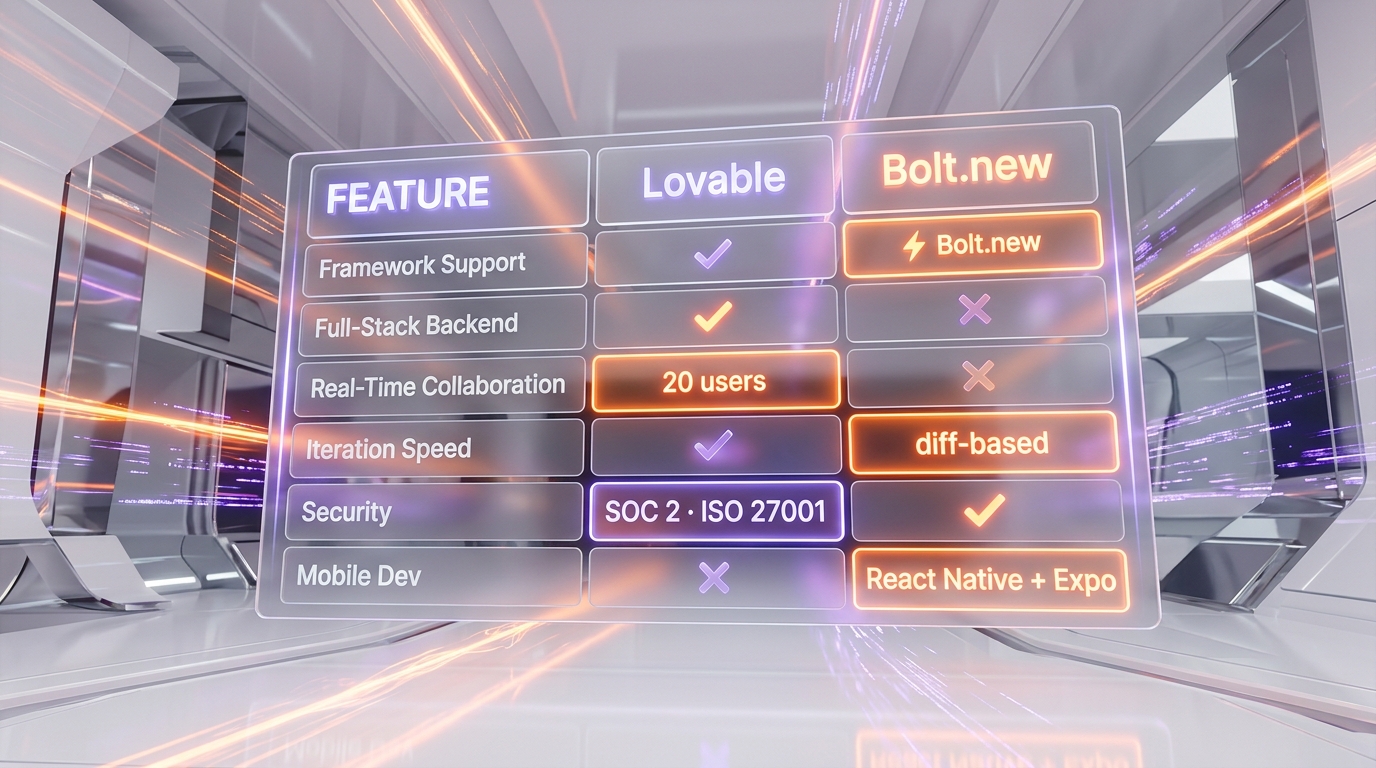
| Feature | Lovable | Bolt.new |
|---|---|---|
| Framework Support | React, TypeScript, Tailwind CSS only (fixed stack) | React, Vue, Svelte, Next.js, Astro, Remix, React Native via Expo |
| Beginner Friendliness | Excellent — pure chat UI, zero technical knowledge required | Good — browser IDE with terminal may overwhelm non-technical users |
| Full-Stack Backend Integration | Built-in Supabase (auth, PostgreSQL, RLS, edge functions, storage) | Manual setup required — supports Supabase, Firebase, or custom BaaS |
| Real-Time Collaboration | Up to 20 simultaneous users with live cursors (Lovable 2.0, Feb 2026) | Teams plan available — no real-time multi-cursor collaboration |
| Security and Compliance | SOC 2 Type 2, SOC 2 Type 1, ISO 27001:2022, built-in security scan | No formal certifications, no built-in vulnerability scanning |
| Iteration Speed | Slower — full code section rewrites per generation | Faster — diff-based updates rewrite only changed code files |
| Free Tier Generosity | 5 credits/day (~30 interactions/month) — very limited for real projects | 1M tokens/month with 300K daily cap — more headroom for testing |
| Pricing Predictability | Credit-based: 1 credit = 1 interaction regardless of complexity | Token-based: cost varies with codebase size per prompt — less predictable |
| Team Pricing Value | Unlimited users on Pro ($25 flat/month) | $30/user/month at Teams tier — $150+/month for a 5-person team |
| Mobile App Development | Web apps only — no native iOS or Android support | React Native + Expo support for iOS and Android prototyping |
| Figma Design Import | Not available — describe UI in text only | Native Figma frame import (powered by Anima) — live in 2026 |
| One-Click Deployment | Lovable Cloud with SSL, custom domain purchase built in, Netlify/Vercel supported | Bolt Cloud, Netlify deployment, GitHub export with editable URLs |
Pricing Comparison
Lovable
Bolt.new
Detailed Comparison
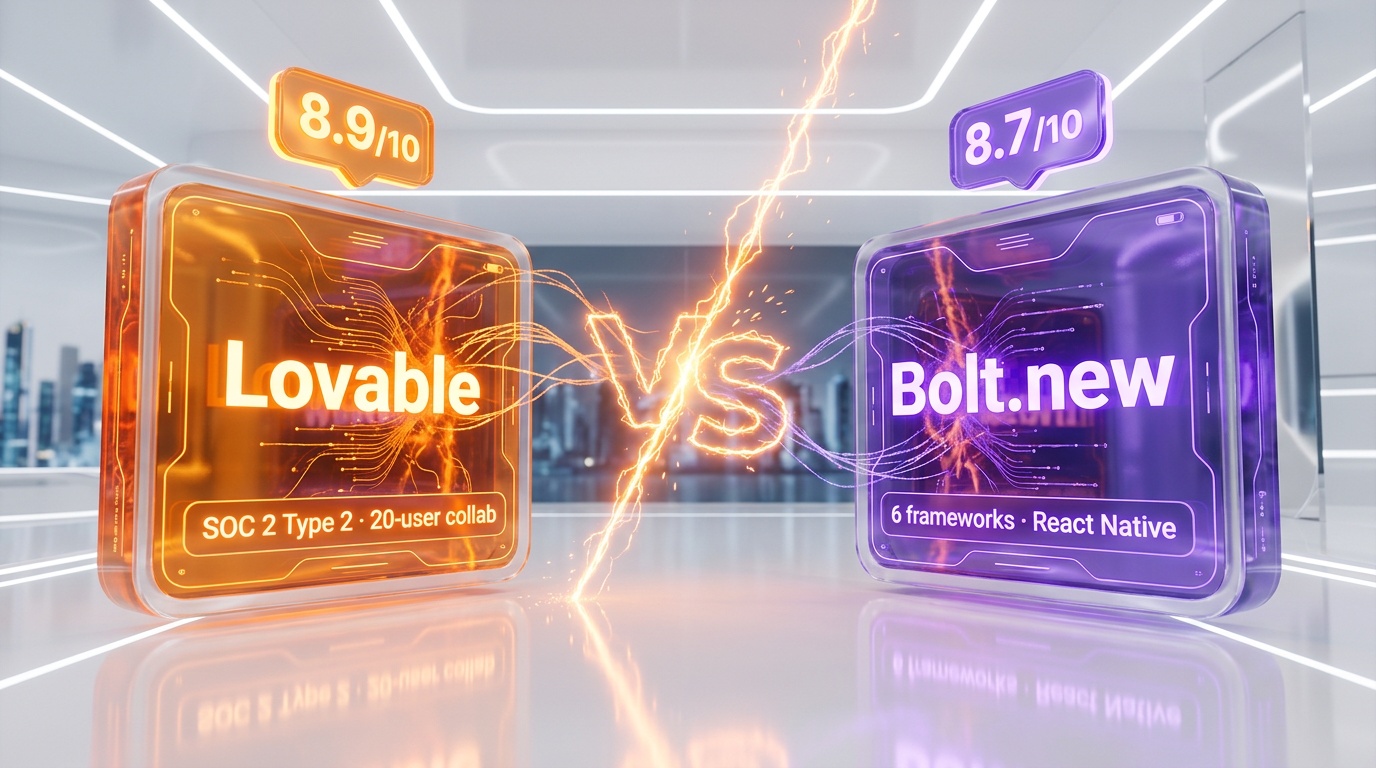
After spending months testing both platforms on real projects, here is our verdict: Lovable (score: 8.9 out of 10, from $25 per month) edges out Bolt.new (score: 8.7 out of 10, from $25 per month) as the better AI app builder for most vibe coders in 2026. Lovable wins on full-stack integration, built-in Supabase backend, SOC 2 Type 2 security compliance, and real-time collaboration for up to 20 users. Bolt.new wins on multi-framework support (React, Vue, Svelte, Next.js, React Native), faster diff-based iteration, a more generous free tier, and Figma import. Both cost the same at entry level, but they serve very different builders. Best for non-technical founders and startup teams: Lovable. Best for developers who want technical control and framework flexibility: Bolt.new.
Quick Comparison: Lovable vs Bolt.new at a Glance
| Factor | Lovable | Bolt.new | Winner |
|---|---|---|---|
| Our Score | 8.9 out of 10 | 8.7 out of 10 | Lovable |
| Starting Price | $25 per month (Pro) | $25 per month (Pro) | Tie |
| Best For | Non-technical founders, startup teams | Developers wanting framework flexibility | — |
| Tech Stack | React + TypeScript + Supabase (fixed) | React, Vue, Svelte, Next.js, React Native (flexible) | Bolt.new |
| Full-Stack Backend | Built-in Supabase (auth, DB, RLS, edge functions) | Manual setup, supports Supabase/Firebase | Lovable |
| Security Compliance | SOC 2 Type 2, ISO 27001, built-in security scan | No certifications, no security scanning | Lovable |
| Collaboration | Up to 20 users real-time (Lovable 2.0) | Teams plan, no real-time multi-cursor | Lovable |
| Free Tier | 5 credits per day (~30/month) | 1M tokens per month (300K daily cap) | Bolt.new |
| Iteration Speed | Slower (full code rewrites) | Faster (diff-based updates) | Bolt.new |
| Mobile App Support | Web only | React Native + Expo (iOS & Android) | Bolt.new |
Overview: Two Tools, Two Very Different Philosophies
Let us be honest about what vibe coding actually is in 2026: you describe an app in plain English, an AI generates the code, and you iterate until it ships. Both Lovable and Bolt.new are built for exactly this workflow. But they come from fundamentally different philosophies, and that matters far more than any single feature comparison.
Lovable started its life as GPT Engineer, one of the earliest AI coding experiments that went viral in 2023. After a rebrand and a stunning $330 million Series B in December 2025 that valued the company at $6.6 billion, Lovable has become the definitive poster child for the vibe coding movement. The numbers are almost hard to believe: over 25 million projects created on the platform, 100,000 new ones launching every single day, and $300M+ ARR achieved in under 12 months. For context, Zendesk reported going from idea to working prototype in three hours using Lovable, down from six weeks the traditional way. McKinsey teams are using it for internal tools. This is not a toy anymore.
Bolt.new came out of StackBlitz, the company that built WebContainers technology, a way to run full Node.js environments entirely inside your browser without any local installation. Launched in October 2024, Bolt hit $20M ARR by December of that year, doubled to $40M ARR by March 2025, and by May 2025 was pulling over 9 million website visits per month with an average session time of 22 minutes. MIT Technology Review named the broader vibe coding movement one of its 10 Breakthrough Technologies for 2026, with Bolt.new listed prominently alongside Lovable as the tools driving that shift.
In practice, the difference feels like this: Lovable is your AI co-founder who takes care of everything and hands you a finished, deployed product. Bolt.new is more like a very smart pair-programmer sitting next to you, helping you build quickly while you stay in control of every decision.
Feature-by-Feature Comparison
Tech Stack and Framework Support
This is the single biggest architectural difference between the two tools, and it is worth fully understanding before committing to either one.
Lovable locks you into React, TypeScript, Tailwind CSS, and Supabase. That is the stack, full stop. There is no switching to Vue if you prefer it, no Python backend, no Ruby or Go. For most non-technical founders, this is actually a feature rather than a limitation. The stack is proven, opinionated, and everything integrates seamlessly. When we built a SaaS prototype with Lovable, authentication, database tables, and API endpoints were all wired up correctly in a single prompt. We did not have to think about infrastructure configuration once.
Bolt.new, by contrast, supports React, Next.js, Vue, Nuxt, Svelte, Astro, Remix, and React Native via Expo. The StackBlitz WebContainers engine runs a real Node.js environment inside your browser, which means you get a genuine terminal, npm package installs, and a live IDE with file tree navigation, all without any local setup. When we asked Bolt to scaffold a Vue 3 plus Vite project, it handled it cleanly. When we asked for a React Native Expo project targeting mobile, it delivered a working structure. This multi-framework flexibility is genuine, not just marketing copy.
One caveat worth noting: React is still Bolt.new's default and best-supported stack. Vue and Svelte work, but the output quality is noticeably less polished compared to React output. And Bolt.new exclusively generates Node.js backends. If your team works in Python, Go, or Ruby, neither platform will help you there.
Ease of Use and Onboarding
After spending time with both platforms, the first thing that stands out with Lovable is how forgiving it is for total beginners. The interface is clean white, entirely chat-driven, and genuinely designed for people who have never written a line of TypeScript in their lives. The Agent Mode takes a rough paragraph description, something like a SaaS app where users can log their gym workouts with user accounts and a progress dashboard, and returns a working, deployable application with a database schema and login flow included. No configuration required, no technical decisions to make, no frustrating setup steps.
Bolt.new requires a bit more technical orientation. You are working in an actual browser-based IDE, complete with a file tree on the left, a terminal at the bottom, and a live preview pane on the right. For developers, this environment is comfortable and familiar. For total beginners, it can feel overwhelming. We have watched non-technical users struggle with Bolt when they encountered a console error they did not know how to interpret. Lovable, in the same situation, would surface a friendlier error message in the chat interface and suggest a fix automatically.
Full-Stack Backend Integration
Lovable's Supabase integration is genuinely impressive, and it is the feature that most clearly separates these two tools for practical full-stack development. In one click from the project settings, you connect a Supabase project. From that point forward you can prompt Lovable to add a table for user posts, set up row-level security so users can only see their own data, or create an edge function to send welcome emails. Lovable handles the SQL migration, the TypeScript types, the RLS policies, and the frontend code in a single generation pass. We tested this building a multi-tenant dashboard application, and the integration worked correctly on the first try roughly 80% of the time. The remaining 20% required one follow-up correction prompt.
Bolt.new V2 (released late 2024) added built-in databases, hosting, authentication, analytics, and file storage through Bolt Cloud, specifically to address the deployment gap that previously required connecting external services manually. In practice though, the backend integration still feels less seamless than Lovable's. Getting auth and database logic wired up correctly in Bolt typically required two to three times as many prompt iterations compared to Lovable. For experienced developers who are comfortable with Supabase or Firebase directly, this is not a problem at all. For non-technical users who just want everything to work, Lovable wins this round decisively.
Real-Time Collaboration
Lovable 2.0, released in February 2026, was the update that transformed Lovable from a personal prototyping tool into a genuine team platform. Real-time collaboration for up to 20 simultaneous users arrived, with live cursors, instant syncing, and a smart permission system where owners and admins invite freely while editors can only modify existing projects. The Teams plan at $30 per user per month unlocks the full workspace with shared credit pools and role-based access. Enterprise teams at Zendesk and McKinsey are using this collaborative prototyping workflow on real projects now.
Bolt.new has a Teams plan at $30 per user per month as well, but real-time multi-cursor collaboration is not a headline feature the same way it is for Lovable. For solo developers or two-person teams, this distinction does not matter much. For product teams of five or more where designers, product managers, and engineers need to iterate together on the same project, Lovable's collaboration model is noticeably more mature in 2026.
Security and Compliance
This is where Lovable has made its most significant enterprise-facing investment. In late 2025 and early 2026, Lovable achieved SOC 2 Type 2 compliance, SOC 2 Type 1 compliance, and ISO 27001:2022 certification. They moved to Vanta for compliance management and had their SOC 2 Type II independently audited by Prescient Security, with the next audit cycle scheduled for Q3 2026. A built-in Security Scan now runs automatically before you publish any application with a connected Supabase project, catching the most common vulnerability patterns in generated code.
Bolt.new has no equivalent security certifications and no built-in vulnerability scanning. For consumer apps, landing pages, and internal tools, this probably does not matter. But for any B2B SaaS targeting enterprise buyers, where procurement teams will ask for your SOC 2 report as a prerequisite to purchasing, Lovable's compliance posture is a genuine competitive advantage that Bolt.new currently cannot match.
One important caveat: Lovable's SOC 2 covers the Lovable platform itself, not the applications you build on top of it. Think of it as building in a secure facility. The building is certified, but your own shop's security is still your responsibility.
Iteration Speed and Developer Experience
Bolt.new is meaningfully faster for rapid iteration, and the reason is architectural. Bolt uses diff-based code updates: when you ask it to change a button color, refactor a component, or fix a specific function, it only rewrites the parts of the code that actually changed. Lovable rewrites larger code sections on each generation, which produces more thorough and holistic changes but takes noticeably longer and consumes more credits per interaction.
What surprised us in testing is how much this speed difference compounds over a long prototyping session. When you are making 20 to 30 small tweaks in an afternoon, Bolt's faster diff-based approach feels significantly snappier. Lovable's more comprehensive approach is better when you want the AI to make holistic structural decisions about your codebase, but it can feel sluggish when you just want to adjust a layout detail. Bolt also claims a 98% reduction in error loops through its autonomous debugging system, which matches our experience. Earlier Bolt iterations were notorious for context drift on complex projects, and the 2026 version is noticeably more stable.
Figma Import and Design Integration
This is an area where Bolt.new has a clear and genuine advantage. The 2026 Figma import feature, powered by Anima under the hood, lets you paste a Figma frame URL directly into the Bolt chat interface and get working React code scaffolded from the design. We tested this with a medium-complexity dashboard design containing about a dozen components, and got approximately 75 percent visual fidelity on the first pass. The remaining refinements took a handful of follow-up prompts. For teams working design-first, this is a significant workflow accelerator.
Lovable has no equivalent Figma import capability as of Q1 2026. You can describe your design intent in text, and Lovable will make reasonable UI decisions based on your description, but there is no way to drop a pixel-perfect design and have it translated to code. If your team has an existing Figma design system, this gap matters.
Mobile App Support
Bolt.new added React Native plus Expo support in late 2024, which means you can generate iOS and Android mobile app prototypes in the same browser-based environment you use for web apps. We tried generating a simple React Native habit tracker app and got a working Expo project with navigation and local state in under ten minutes. It is not going to replace a dedicated mobile developer, but for prototyping and MVPs it is genuinely useful.
Lovable is web-only, full stop. If mobile is part of your product roadmap, Bolt.new is the only option in this comparison.
Pricing Comparison
| Plan | Lovable | Bolt.new |
|---|---|---|
| Free | $0 — 5 credits per day (~30/month) | $0 — 1M tokens per month (300K daily cap) |
| Pro | $25 per month — 100 credits + 5 daily (up to 150/month) | $25 per month — 10M tokens per month |
| Mid Tier | $50 per month (Business) — 100 credits + SSO + team workspace | $50 per month (Pro 50) — 26M tokens per month |
| High Tier | $100 per month — higher credit volume | $100 per month (Pro 100) — 55M tokens per month |
| Max Tier | Enterprise (custom) | $200 per month (Pro 200) — 120M tokens per month |
| Teams | $30 per user/month — up to 20 users, shared workspace | $30 per user/month — team access |
| Pricing Unit | Credits (1 credit = 1 interaction, any complexity) | Tokens (scales with codebase size per prompt) |
| Credit/Token Rollover | Yes (Pro and above) | Yes (1 additional month on paid plans) |
| Add-on Purchases | Yes (on-demand top-ups) | Yes (token packs that never expire) |
| Annual Billing Discount | Available | Up to 28% off |
| Multi-User Value | Unlimited users on Pro ($25 flat) | Per-seat pricing at Teams tier ($30 per user) |
Both platforms start at $25 per month for Pro, which makes side-by-side pricing feel equal at first glance. The real story is more nuanced.
Lovable's credit model is more predictable at the individual interaction level. One credit equals one AI interaction regardless of whether that interaction builds an entire authentication system or just tweaks a button color. The Pro plan's 150 total credits per month (100 monthly plus 5 daily) sounds reasonable, but intensive vibe coding sessions can burn 60 to 100 credits on a single complex feature. We have seen reports of users exhausting their entire monthly allocation in the first four or five days of a project. Lovable does offer on-demand top-ups now, which helps, but the base credit count is tight for serious usage.
Bolt.new's token model gives you much more headroom on paper at each tier. Ten million tokens per month on the Pro plan is significantly more generous than Lovable's 150 credits for large-scale prototyping. But the predictability trade-off is real: because Bolt loads your entire codebase context with each prompt, token consumption scales with project complexity. A small landing page might use 50K tokens per prompt. A complex multi-page SaaS app can consume 500K to 1M tokens per single prompt. We have seen documented reports of users burning through $100+ in token costs during a single debugging-heavy session on Bolt. The 2025 rollover update (tokens carry to the following month on paid plans) helps, but the unpredictability remains.
The most important pricing insight for teams: Lovable's Pro plan at $25 per month supports unlimited users on a shared credit pool. Bolt.new's team features start at $30 per user per month. For a five-person startup team, that is $25 per month on Lovable versus $150 per month on Bolt. For a ten-person team, it is $25 versus $300. The gap is substantial.
Performance: What We Actually Built
We built three test applications on each platform to get a grounded sense of real-world performance rather than relying entirely on marketing claims.
The first was a simple landing page with a waitlist form. Both tools nailed this in under five minutes. Bolt.new was slightly faster with its diff-based updates. Lovable produced slightly more polished default styling and a more cohesive visual design out of the box, leveraging its Shadcn default design system.
The second test was a multi-page SaaS dashboard with user authentication, a PostgreSQL database, and role-based access control. Lovable was dramatically better here. The Supabase integration handled user sign-up, login, row-level security policies, and database relationships in a single conversation thread. The frontend and backend were deployed simultaneously with one click. On Bolt.new, the same project required approximately three times as many prompt iterations and several manual interventions to get the backend properly wired. Quality was comparable once both were finished, but Lovable's time-to-working-prototype was roughly half of Bolt's for this use case.
The third test was a real-time data visualization application with D3.js charts, WebSocket connections, and third-party API integrations. Bolt.new edged ahead here. Its more flexible stack handled the D3.js integration more gracefully, and the diff-based updates made iterating on chart configurations fast and predictable. Lovable struggled slightly with the complexity of the custom visualization library, repeatedly trying to find Supabase-native solutions for problems that needed direct JavaScript solutions.
Both tools share a fundamental limitation that is worth stating plainly and without hype: they reliably get you to about 70 percent of a production application. That first 70 percent feels like genuine magic. You describe what you want and within minutes you have a working prototype that would have taken days or weeks to build manually. The remaining 30 percent, which covers edge cases, performance optimization, complex state management, accessibility compliance, and production security hardening, still requires real human engineering. No valuation makes that go away entirely.
Lovable 2.0: The February 2026 Update That Changed the Game
Lovable's February 2026 release was genuinely transformative. Before 2.0, Lovable was a single-player tool. You could not collaborate in real time. You could not edit code directly. The security tooling was limited. The 2.0 update addressed most of the platform's major weaknesses in one release:
- Real-time collaboration for up to 20 users simultaneously, with live cursors and instant project syncing
- Chat Mode Agent, a reasoning-first mode that thinks through problems without immediately editing code
- Dev Mode, which lets paid users directly edit project source files within Lovable for surgical precision
- Visual Edits, enabling CSS-level visual editing without prompting the AI at all
- Built-in Security Scan, automatic vulnerability detection before each publish for Supabase-connected apps
- Domain purchasing built in, so you can go from app to live branded URL without leaving the platform
- 91 percent error reduction in the agentic mode compared to previous versions
The 91 percent error reduction claim was the one we were most skeptical about going in. The improvement is real. Earlier versions of Lovable notoriously entered debugging loops where fixing one bug would introduce another, burning through credits at an alarming rate. The new agentic mode is meaningfully more stable and self-correcting. It is not perfect, but it is a genuine and substantial improvement.
Bolt.new in 2026: The Upgrades Worth Knowing About
Bolt has not been standing still either. The 2026 roadmap has delivered several meaningful additions. The Figma import feature lets you paste any Figma frame URL into the Bolt interface and receive scaffolded code based on the design, using Anima under the hood for the conversion. Team Templates allow you to turn any existing project into a reusable starter template, which is genuinely useful for agencies and teams building multiple similar apps. The Opus 4.6 model upgrade with adjustable reasoning depth means Bolt can now tackle more architecturally complex prompts with better coherence. Editable Netlify URLs let you customize your deployment URL without needing a separate DNS configuration. And AI image editing inside the chat interface means you can iterate on visual assets without leaving the platform.
Bolt also claims autonomous debugging reduces error loops by 98 percent in its latest version. While we cannot independently verify this exact figure, our testing confirms that the 2026 version of Bolt is substantially more stable than the 2024 version, which had a reputation for losing context on complex projects and generating inconsistent code across sessions.
Who Should Choose Lovable
Lovable is the right choice if you fit any of the following profiles:
- Non-technical founders who need to get a full-stack MVP to market as fast as possible without hiring a developer. The React plus Supabase stack is pre-chosen for you, deployment is one click, and you never need to understand what a database migration file is.
- Product teams prototyping collaboratively across design, product, and engineering. Lovable 2.0 real-time collaboration for up to 20 users is a genuine workflow upgrade that Bolt cannot currently match.
- B2B SaaS builders targeting enterprise buyers. When a Fortune 500 procurement team asks for your SOC 2 report as part of a vendor evaluation, Lovable's certifications are a concrete competitive advantage. Bolt.new has no equivalent.
- Startup teams managing costs tightly. Lovable Pro supports unlimited users at $25 flat per month. For any team of three or more people, Lovable is dramatically cheaper than Bolt's per-seat pricing.
- Anyone who has tried AI coding tools before and hit frustration walls. The 2.0 error reduction improvements make Lovable the most reliable end-to-end option in the vibe coding category right now.
Who Should Choose Bolt.new
- Developers who want framework choice. If your team is already on Vue, Svelte, or Next.js, Bolt.new respects those preferences. Lovable does not offer any framework flexibility.
- Teams building mobile apps. Bolt.new's React Native plus Expo support enables iOS and Android app prototyping in the same environment. Lovable is web-only.
- Teams working from Figma designs. Bolt.new's Figma import is a real and useful feature for design-first workflows. Lovable has no equivalent.
- Solo power users doing intensive prototyping. Bolt's tiered plans scaling up to $200 per month for 120M tokens give individual heavy users more headroom and a clearer upgrade path than Lovable's credit tiers.
- Developers who want to stay close to the code. The browser IDE with a real terminal, npm access, and direct file editing makes Bolt.new feel more like an actual development environment. If you want to inspect, debug, or directly modify generated code without exporting first, Bolt is more comfortable.
- Rapid iteration specialists. If you are doing dozens of small tweaks in a single session, Bolt's diff-based updates feel genuinely faster in practice.

Our Verdict
We have been using both platforms on real projects for months, and our honest assessment is this: Lovable is the better product for the majority of people actually doing vibe coding in 2026. The reason comes down to who the target user really is. Most people picking up these tools are not developers who happen to want framework flexibility. They are founders, product managers, designers, and entrepreneurs who want to ship something real, fast, without a technical co-founder. For that majority use case, Lovable's opinionated stack, seamless Supabase integration, SOC 2 compliance, real-time team collaboration, and dramatically improved 2.0 stability make it the stronger end-to-end choice.
Bolt.new is not a consolation prize. It is genuinely the right tool for developers who want to stay close to the code, choose their own framework, build mobile apps, or work directly from Figma designs. The diff-based iteration is faster. The free tier is more generous at 1 million tokens per month versus Lovable's 5 daily credits. The multi-framework support is real. If you already know what a Vue composable is and have strong opinions about state management libraries, you will probably prefer the Bolt.new environment.
The pricing looks identical on the surface at $25 per month, but Lovable's unlimited-users Pro plan makes it dramatically better value for any team of three or more people. That pricing advantage, combined with the collaboration and security features from the 2.0 release, is why Lovable earns the slight overall edge here.
What surprised us most across this entire comparison is how genuinely complementary these tools are. Several engineering teams we spoke with use Lovable for initial full-stack scaffolding, then export to GitHub and continue iterating in Bolt.new or Cursor for rapid component-level changes. It is a workflow that plays directly to each tool's strengths, and one we recommend for anyone doing serious vibe coding work in 2026. Start with Lovable if you want the fastest path from idea to deployed production app. Start with Bolt.new if you want the fastest path from Figma design or existing codebase to a tightly iterated prototype.
Frequently Asked Questions
Is Lovable better than Bolt.new for vibe coding?
Lovable (score 8.9 out of 10, $25 per month) edges out Bolt.new (score 8.7 out of 10, $25 per month) for most vibe coders in 2026. Lovable wins on full-stack integration (built-in Supabase backend with auth, DB, RLS), SOC 2 Type 2 security compliance, real-time collaboration for up to 20 users, and unlimited users on Pro at $25 flat. Bolt.new wins on multi-framework support (React, Vue, Svelte, Next.js, React Native), diff-based iteration speed, Figma import, and a more generous free tier (1M tokens per month vs 5 credits per day).
Which is cheaper — Lovable or Bolt.new?
Both start at $25 per month for Pro, but the team economics differ dramatically. Lovable Pro supports unlimited users at $25 per month flat. Bolt.new Teams costs $30 per user/month. For a 5-person team: $25 per month on Lovable vs $150 per month on Bolt.new. For a 10-person team: $25 vs $300. Lovable's credit model (1 credit = 1 interaction) is more predictable, while Bolt.new's token model (scales with codebase size) can be unpredictable on complex projects.
Can Lovable build a full-stack app with a database?
Yes. Lovable has built-in Supabase integration that handles PostgreSQL database, authentication (email, Google, GitHub), row-level security, edge functions, file storage, and real-time features — all configured in a single prompt. In our testing, the Supabase integration worked correctly on first try roughly 80% of the time. Bolt.new added databases via Bolt Cloud in V2, but the backend integration still requires 2-3x more prompt iterations compared to Lovable.
Can Bolt.new build mobile apps?
Yes. Bolt.new supports React Native + Expo for iOS and Android prototyping in the same browser-based environment. We generated a working React Native habit tracker with navigation and local state in under 10 minutes. Lovable is web-only — if mobile is part of your product roadmap, Bolt.new is the only option in this comparison.
What are the main differences between Lovable and Bolt.new?
Lovable locks you into React + TypeScript + Supabase but handles everything end-to-end (frontend, backend, auth, deployment). It targets non-technical founders and startup teams. Bolt.new gives you framework flexibility (React, Vue, Svelte, Next.js, React Native), a real browser-based IDE with terminal access, and Figma import — but requires more technical knowledge and manual backend setup. Lovable builds products; Bolt.new helps developers build faster.
Which should I choose as a non-technical founder?
Lovable, without question. Its opinionated stack means you never choose a framework, configure a database, or write deployment scripts. Describe your app in plain English and get a working, deployed application with authentication, database, and hosting included. Bolt.new is better suited for developers who want framework flexibility and direct code control. Lovable 2.0 also reduced errors by 91%, making it the most reliable end-to-end vibe coding tool available.
Can I use both Lovable and Bolt.new together?
Yes, and several engineering teams recommend this workflow. Use Lovable for initial full-stack scaffolding (frontend + Supabase backend + auth + deployment), then export to GitHub and continue iterating in Bolt.new for rapid component-level changes using its diff-based updates. This plays to each tool's strengths: Lovable for the fastest path from idea to deployed app, Bolt.new for fast iteration on specific components.
Sources and references
Every figure on this page is attributed to whoever produced it. Vendor documentation and independent measurement are listed separately and never merged into a single ranking.
- Lovable (product capabilities and plans)
- Bolt (product capabilities and plans)
- Artificial Analysis — Model leaderboard (Intelligence Index scores and cost per task across configurations)
Our Verdict
Lovable (8.9/10, $25/month) wins for non-technical founders and teams who need a complete full-stack app with built-in Supabase integration, SOC 2 compliance, and real-time collaboration out of the box. Choose Bolt.new (8.7/10, $25/month) if you are a developer who wants multi-framework flexibility across React, Vue, Svelte, and React Native, or if faster diff-based iteration and Figma import are priorities.
Frequently Asked Questions
Is Lovable better than Bolt.new?
Lovable (8.9/10, $25/month) wins for non-technical founders and teams who need a complete full-stack app with built-in Supabase integration, SOC 2 compliance, and real-time collaboration out of the box. Choose Bolt.new (8.7/10, $25/month) if you are a developer who wants multi-framework flexibility across React, Vue, Svelte, and React Native, or if faster diff-based iteration and Figma import are priorities.
Which is cheaper, Lovable or Bolt.new?
Lovable starts at $25/month (free plan available). Bolt.new starts at $25/month (free plan available). Check the pricing comparison section above for a full breakdown.
What are the main differences between Lovable and Bolt.new?
The key differences span across 12 features we compared. For Framework Support, Lovable offers React, TypeScript, Tailwind CSS only (fixed stack) while Bolt.new offers React, Vue, Svelte, Next.js, Astro, Remix, React Native via Expo. For Beginner Friendliness, Lovable offers Excellent — pure chat UI, zero technical knowledge required while Bolt.new offers Good — browser IDE with terminal may overwhelm non-technical users. For Full-Stack Backend Integration, Lovable offers Built-in Supabase (auth, PostgreSQL, RLS, edge functions, storage) while Bolt.new offers Manual setup required — supports Supabase, Firebase, or custom BaaS. See the full feature comparison table above for all details.