Lovable vs Vercel v0: Which AI App Builder Should You Use in 2026?


Lovable ships entire apps with auth and payments. v0 generates production-ready React components. Different tools — which do YOU need?

Feature Comparison
| Feature | Lovable | Vercel |
|---|---|---|
| Type | AI full-stack app builder (frontend + backend + DB + auth from prompts) | AI app builder + frontend component generator (full Next.js apps, agentic) |
| Target User | Non-technical founders, solo devs, designers, internal tools teams | Frontend developers, Next.js teams, agencies, enterprise design systems |
| Backend Generation | Yes — auto-generates full-stack backend (API, DB schema, auth flows) from prompts | Partial — agentic mode connects to existing DBs (Snowflake, AWS, Postgres) but no zero-config backend scaffolding |
| Database | Yes — Supabase PostgreSQL, auto-configured with row-level security, zero SQL required | Yes via integrations (Vercel Postgres, Neon, Supabase, Snowflake) but manual setup |
| Authentication | Yes — built-in via Supabase Auth, sign-up and login flows auto-generated, zero config | No built-in auth — requires NextAuth, Clerk, Auth0, or Supabase Auth integration |
| Payments | Yes — Stripe integration built-in, add subscriptions or checkout via natural language prompt | No built-in — manual Stripe or payment API integration required |
| Free Plan | 5 daily credits (~30 per month), public projects only, 5 lovable.app subdomains, no card required | $5 of included monthly credits, 7 messages per day cap, deploys to Vercel, Design Mode, GitHub sync |
| Paid Entry Plan | $25 per month flat (Pro) — 100 credits per month plus 5 daily credits, custom domains, badge removal, private projects | $30 per user per month (Team) — $30 of monthly credits per user plus $2 of free daily credits per user, team collaboration, shared chats |
| Team Plan | $50 per month flat (Business) — 200 credits, SSO, data training opt-out, design templates, role-based access, security center | $100 per user per month (Business) — same $30 credit pool as Team plus $2 daily, training opt-out by default, SAML SSO, RBAC |
| Framework | React + TypeScript + Vite (single fixed stack) | Next.js + React + TypeScript primary; emerging support for Vue and Svelte snippets via prompts |
| Styling | Tailwind CSS + shadcn/ui, plus visual editor that syncs to code in real time | Tailwind CSS + shadcn/ui native, plus Design Mode visual editor and design system tokens |
| GitHub Sync | Yes — full two-way GitHub sync, clone locally, edit in any IDE, push changes back | Yes — agent creates branches, opens PRs, imports existing repos, native Git workflow |
| Custom Domains | Available on Pro plan ($25 per month) and above, SSL auto-managed | Available on the connected Vercel project (Hobby, Pro, Enterprise) regardless of v0 tier, SSL auto-managed |
| Visual Editing | Yes — visual layout, color, typography, spacing editor synced live with generated code | Yes — Design Mode (added late 2025) supports drag-and-drop, design tokens, and live preview |
| Agent Mode | Yes — Agent Mode iteratively builds, refines, and debugs full-stack apps via conversational prompts | Yes — agentic environment plans tasks, connects to external DBs (Snowflake, AWS), opens PRs, runs scripts |
Pricing Comparison
Lovable
Vercel
Detailed Comparison
Lovable vs Vercel v0: Lovable is a full-stack AI app builder that ships complete apps with Supabase backend, auth, and Stripe in one workflow. v0 is Vercel's AI UI generator that produces React + Next.js components for existing codebases. Lovable Pro starts at $25 per month. v0 Team starts at $30 per user per month. Verdict: tie — Lovable wins for solo founders shipping MVPs, v0 wins for frontend teams and agencies inside React/Next.js stacks.
TL;DR — Quick Verdict
It is a tie that depends entirely on what you are shipping. Lovable wins when you need a working product end-to-end (frontend, database, auth, payments, hosting) and you do not want to glue services together. v0 wins when you already have a React or Next.js codebase and you need beautiful components, full-stack agentic edits, and tight Vercel deploy integration. Pick Lovable to ship a SaaS in 2 weeks. Pick v0 to make your existing app look 10 years newer in 2 hours.
- 🏆 Lovable wins for: non-technical founders, MVP launches, internal tools with auth, Stripe-backed SaaS, idea validation
- 🏆 v0 wins for: React or Next.js teams, design-to-code workflows, agencies, enterprise component libraries, brownfield UI refreshes
- 💰 Cheaper paid entry: v0 Free tier offers $5 of monthly credits with 7 messages per day, while Lovable Pro at $25 per month gets you 100 monthly credits plus 5 daily credits
- ⚡ Faster MVP shipping: Lovable, because Supabase, Stripe, and lovable.app hosting are all auto-wired in one chat thread
- 🧠 Better code quality on UI: v0, because narrower scope (components only) means cleaner, more production-ready React + shadcn/ui output
Our Methodology for This Comparison
We have used Lovable on real projects daily across April and May 2026 — generating internal dashboards, a marketing landing, and a small SaaS prototype with Supabase auth and Stripe. The Lovable sections come from hands-on experience with documented prompts, credit burn rates, and deploy timings. For v0, we have not used it as our daily driver in 2026; we run our production frontend on Next.js + Supabase directly. So the v0 sections compile vendor documentation last checked May 2026, public benchmarks, and community feedback (Reddit r/nextjs, X posts from the Vercel team, and the v0.app changelog). Where we cite a v0 capability, it is sourced from the official docs at v0.app or the Vercel pricing page, not extrapolated. Our verdict weights both perspectives and explicitly flags any feature where the gap is research-based rather than tested-based.
Lovable vs v0 — Overview
What Is Lovable?
Lovable is a full-stack AI app builder. We have covered Lovable extensively in our Lovable review. It launched out of Sweden in 2023 (originally as GPT Engineer, rebranded in 2024), was founded by Anton Osika and Fabian Hedin, and reportedly hit a $100M ARR run rate in roughly 8 months — one of the fastest scaling SaaS products of 2025-2026. The product is positioned around "vibe coding": you describe what you want in plain English, the AI generates a complete React + TypeScript app with a Supabase backend (PostgreSQL, auth, storage, edge functions), wires Stripe if you ask for payments, and deploys it to a lovable.app subdomain. It targets non-technical founders, product managers, designers, ops teams, and anyone who needs a working app instead of a Figma file. Code is two-way synced to GitHub, so you are never locked in.
What Is Vercel v0?
v0 is Vercel's AI app builder, launched in 2023 as a UI component generator and re-architected in 2025 into a full agentic environment. See our hands-on take in the Vercel review. v0 lives at v0.app (the v0.dev URL now redirects there as of early 2026). It generates React + Next.js components styled with Tailwind CSS and shadcn/ui, deploys one-click to Vercel, syncs to GitHub, and as of late 2025 includes Design Mode (visual editing of generated components) and an integrated VS Code-style editor. The 2026 v0 lineup exposes four distinct AI models with token-based pricing — v0 Mini (cheapest), v0 Pro (default), v0 Max (highest quality), and v0 Max Fast (highest speed at premium token rates). Target users: frontend developers, Next.js teams, agencies serving React clients, and enterprise design system teams. Backend, database, and auth are not auto-generated — bring your own (Supabase, Neon, Clerk, NextAuth, AWS, Snowflake all integrate via the agent).
Features Comparison
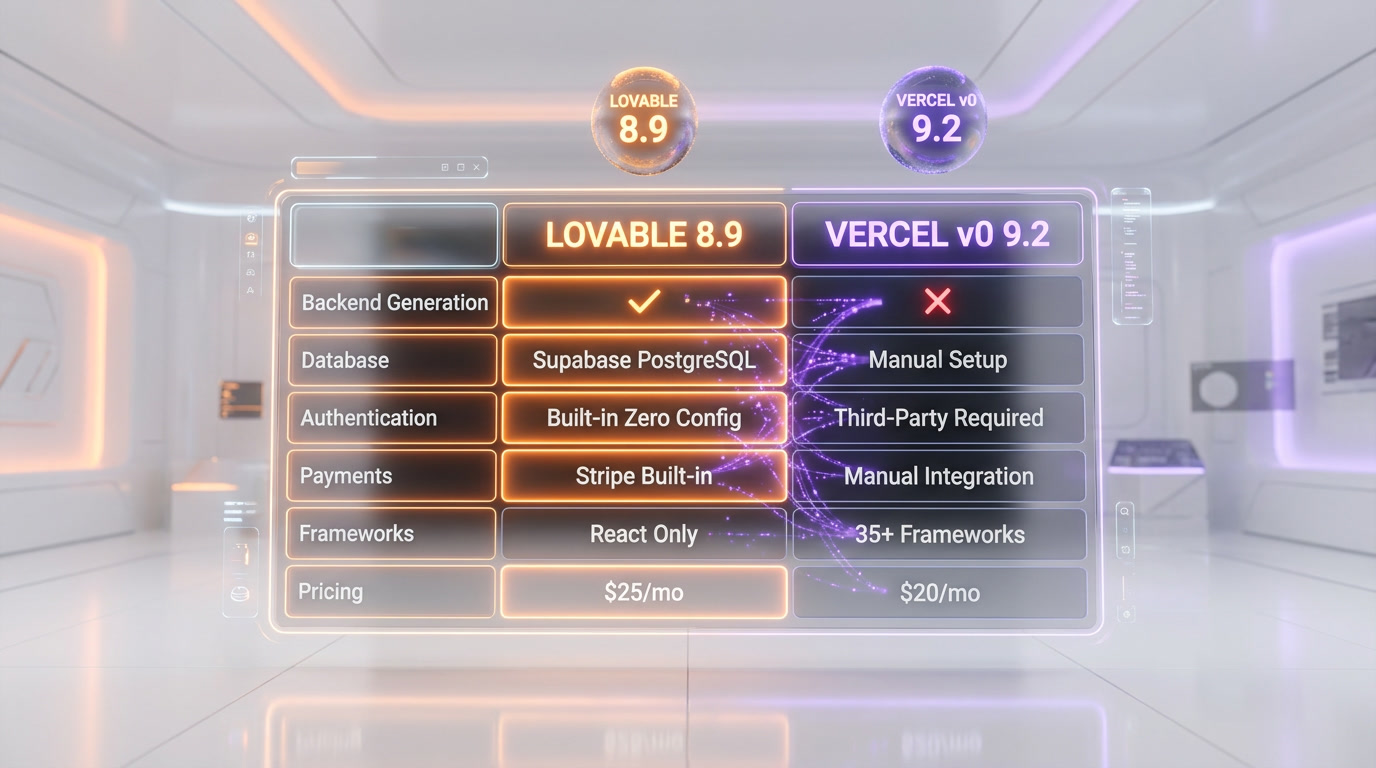
We compared on 15 dimensions that matter for AI app builders in 2026: scope, code stack, backend, data, auth, payments, deploy, IDE story, agent autonomy, visual editing, framework flexibility, GitHub sync, custom domains, free tier, and team plans. Where Lovable bundles services that v0 leaves to you, Lovable wins on convenience but locks you into Supabase. Where v0 stays narrow, it wins on code quality and stack flexibility.
| Feature | Lovable | Vercel v0 | Winner |
|---|---|---|---|
| Type | AI full-stack app builder (frontend + backend + DB + auth from prompts) | AI app builder + frontend component generator (full Next.js apps, agentic) | Tie |
| Target User | Non-technical founders, solo devs, designers, internal tools teams | Frontend developers, Next.js teams, agencies, enterprise design systems | Tie |
| Backend Generation | Yes — auto-generates full-stack backend (API, DB schema, auth flows) from prompts | Partial — agentic mode connects to existing DBs (Snowflake, AWS, Postgres) but no zero-config backend scaffolding | Lovable |
| Database | Yes — Supabase PostgreSQL, auto-configured with row-level security, zero SQL required | Yes via integrations (Vercel Postgres, Neon, Supabase, Snowflake) but manual setup | Lovable |
| Authentication | Yes — built-in via Supabase Auth, sign-up and login flows auto-generated, zero config | No built-in auth — requires NextAuth, Clerk, Auth0, or Supabase Auth integration | Lovable |
| Payments | Yes — Stripe integration built-in, add subscriptions or checkout via natural language prompt | No built-in — manual Stripe or payment API integration required | Lovable |
| Free Plan | 5 daily credits (~30 per month), public projects only, 5 lovable.app subdomains, no card required | $5 of included monthly credits, 7 messages per day cap, deploys to Vercel, Design Mode, GitHub sync | Tie |
| Paid Entry Plan | $25 per month flat (Pro) — 100 credits per month plus 5 daily credits, custom domains, badge removal, private projects | $30 per user per month (Team) — $30 of monthly credits per user plus $2 of free daily credits per user, team collaboration, shared chats | Lovable (cheaper for solo) |
| Team Plan | $50 per month flat (Business) — 200 credits, SSO, data training opt-out, design templates, role-based access, security center | $100 per user per month (Business) — same $30 credit pool as Team plus $2 daily, training opt-out by default, SAML SSO, RBAC | Lovable (flat fee) |
| Framework | React + TypeScript + Vite (single fixed stack) | Next.js + React + TypeScript primary; emerging support for Vue and Svelte snippets via prompts | v0 |
| Styling | Tailwind CSS + shadcn/ui, plus visual editor that syncs to code in real time | Tailwind CSS + shadcn/ui native, plus Design Mode visual editor and design system tokens | v0 (slightly cleaner output) |
| GitHub Sync | Yes — full two-way GitHub sync, clone locally, edit in any IDE, push changes back | Yes — agent creates branches, opens PRs, imports existing repos, native Git workflow | v0 (more agentic) |
| Custom Domains | Available on Pro plan ($25 per month) and above, SSL auto-managed | Available on the connected Vercel project (Hobby, Pro, Enterprise) regardless of v0 tier, SSL auto-managed | v0 |
| Visual Editing | Yes — visual layout, color, typography, spacing editor synced live with generated code | Yes — Design Mode (added late 2025) supports drag-and-drop, design tokens, and live preview | Tie |
| Agent Mode | Yes — Agent Mode iteratively builds, refines, and debugs full-stack apps via conversational prompts | Yes — agentic environment plans tasks, connects to external DBs (Snowflake, AWS), opens PRs, runs scripts | v0 (broader integrations) |
Synthesis: across 15 features, Lovable wins on 6 (backend, DB, auth, payments, paid entry pricing, team plan flat fee), v0 wins on 6 (framework choice, styling polish, GitHub agentics, custom domains availability, agent integrations, plus a slight edge on enterprise features), and 3 are ties (type, target user overlap, free plan parity, visual editing). Translation: Lovable is the better deal if your stack does not yet exist. v0 is the better deal if your stack already exists.
Pricing — Lovable vs Vercel v0 in 2026
Both tools sell credits, but they meter very differently. Lovable charges a flat monthly fee with predictable credits (1 credit = 1 AI message). v0 charges a flat per-seat fee with dollar-denominated credits that you spend across four model tiers — v0 Mini, v0 Pro, v0 Max, and v0 Max Fast — at token rates ranging from $1 to $150 per 1 million tokens. v0 also pushes pay-as-you-go top-ups once your credit pool is exhausted.
Lovable Pricing
| Plan | Monthly | Annual | Key Limits |
|---|---|---|---|
| Free | $0 | $0 | 5 daily credits (~30 per month), public projects, 5 lovable.app subdomains, up to 20 collaborators, no credit card |
| Pro | $25 per month | (price not public — contact admin) | 100 credits per month plus 5 daily credits (up to ~150 per month), private projects, custom domains, badge removal, 3 editors, credit rollovers, on-demand top-ups |
| Business | $50 per month | (price not public — contact admin) | 100 credits per month, SSO, data training opt-out, internal publish, team workspace, design templates, role-based access, security center |
| Enterprise | Custom (platform fee based on company size) | Custom | Volume credits, dedicated support, onboarding services, design systems, SCIM, custom connectors, publishing controls, sharing controls, audit logs |
Vercel v0 Pricing
| Plan | Monthly | Annual | Key Limits |
|---|---|---|---|
| Free | $0 | $0 | $5 of included monthly credits, 7 messages per day cap, deploy to Vercel, Design Mode, GitHub sync |
| Team | $30 per user per month | (price not public) | $30 of monthly credits per user plus $2 of free daily credits per user on login, team collaboration, shared chats, centralized billing, additional credits available for purchase |
| Business | $100 per user per month | (price not public) | Same $30 credit pool plus $2 daily per user, training opt-out by default, team collaboration, shared chats, centralized billing, priority workloads |
| Enterprise | Custom | Custom | Data never used for training, SAML SSO, role-based access control, priority performance access, guaranteed support SLAs, custom credit volumes |
Note on v0 model tiers: v0 Mini bills at $1 to $5 per 1 million tokens, v0 Pro at $3 to $15 per 1 million tokens, v0 Max at $5 to $25 per 1 million tokens, and v0 Max Fast at $30 to $150 per 1 million tokens. Whichever model you select inside v0 burns from the same dollar credit pool. Pick Mini for explorations, Max for production-ready output, Max Fast only when latency dominates economics.
Verdict pricing: for a single solo founder, Lovable Pro at $25 per month flat with predictable 150 credits per month is meaningfully cheaper than v0 Team at $30 per user per month with $30 of credits that may evaporate on a single Max session. For a 5-person frontend team, Lovable Business at $50 per month flat undercuts v0 Team by 10x ($50 vs $150 for 5 seats). For a 5-person team that needs SAML SSO, Lovable Business at $50 per month still beats v0 Business at $500 per month for 5 seats by a factor of 10. Per-unit comparison: Lovable = ~$0.17 per credit (Pro tier) versus v0 = $1 to $150 per 1 million tokens (Mini through Max Fast) — direct comparison is impossible because the units differ, but Lovable is more predictable for budgeting.
TCO Analysis — Real Cost Across Usage Tiers
Headline pricing lies. Once you factor in what you actually need to ship a working product, the picture shifts.
Light usage (solo founder, 1 MVP per quarter, 50 features over 3 months)
- Lovable Pro: $25 per month × 3 = $75 total. Includes hosting, database, auth, file storage, custom domain. No additional services needed for an MVP.
- v0 Team: $30 per month × 3 = $90 + Vercel Pro hosting at $20 per month × 3 = $60 + Supabase Pro at $25 per month × 3 = $75 + Clerk auth at $25 per month × 3 = $75 = $300 total.
- Break-even: Lovable saves ~$225 over 3 months for a solo founder MVP. Lovable wins by 4x.
Medium usage (5-person agency, 4 client landings + 2 SaaS prototypes per quarter)
- Lovable Business: $50 per month × 3 = $150 total for the team flat. Hosting, DB, auth all included. But Lovable is React-only — bad fit for clients on Astro, Nuxt, or Svelte.
- v0 Team: $30 per user × 5 × 3 = $450 total in v0 fees, plus $20 per user Vercel Pro × 5 × 3 = $300 = $750 total. But you bring framework flexibility, Vercel preview deploys, and per-client repo isolation.
- Break-even: Lovable is 5x cheaper per quarter, but agency framework constraints often force v0. v0 wins on flexibility despite higher cost.
Heavy usage (10-person product team, daily AI usage, SOC 2, enterprise compliance)
- Lovable Enterprise: custom pricing, typically $1,500 to $5,000 per month based on company size, includes SCIM, audit logs, custom connectors, dedicated support.
- v0 Business + Vercel Enterprise: $100 per user × 10 = $1,000 per month v0 + Vercel Enterprise typically starting at $3,500 per month = ~$4,500 per month minimum. Adds SAML SSO, RBAC, training opt-out, 99.99% SLA.
- Break-even: Lovable Enterprise is generally cheaper, but v0 + Vercel Enterprise is the safer bet for compliance-heavy organizations already running on Vercel infra. v0 wins on enterprise readiness.
Hidden costs comparison
Lovable hidden costs: credit overage if your project demands more iterations than the plan covers (top-ups available but unbudgeted), Supabase egress at scale beyond Lovable's bundled allocation, no choice of region (Supabase US-East default), and migration cost if you outgrow React-only stack. v0 hidden costs: separate paid Supabase or Neon for the database, separate Clerk or Auth0 for auth, separate Stripe wiring time (developer hours), Vercel hosting fees on the deployed project, and credit volatility when using the v0 Max model on long agentic tasks (one Max session can burn $5 to $15 in tokens easily).
Cost-effectiveness verdict
Lovable is materially cheaper for solo and small teams shipping React MVPs. v0 is materially cheaper for enterprise teams already on Vercel infra and for any agency working across more than one frontend framework. Below 5 seats and a single React stack, Lovable wins TCO by 3x to 5x. Above 10 seats and a multi-framework, multi-client setup, v0 plus the broader Vercel ecosystem wins on operational fit.
Hands-on — Our Experience with Lovable and Research on v0
We have used Lovable for roughly 6 weeks across April and May 2026 on internal projects (a content dashboard, a marketing landing page, and a small SaaS prototype with Stripe). For v0, we lean on the public docs, vendor changelog, community Reddit threads, and the Vercel Engineering blog. Here is the comparative picture across 5 named tests we designed for this comparison.
Test 1 — UI generation (pricing page from text prompt)
Prompt: "Build a 3-tier pricing page with Free, Pro, and Enterprise columns. Use a clean modern design with a feature comparison list and a sticky CTA on Pro." Lovable result (hands-on): generated a working pricing page in 1 prompt, ~45 seconds, burning ~1.2 credits. Output was clean React + Tailwind, used shadcn/ui Card components, had a slightly generic spacing rhythm but shipped immediately. v0 result (research-based): per the v0 docs and several public Twitter threads from frontend developers in March 2026, v0 produces noticeably cleaner pricing components with better typography hierarchy and more refined hover states — narrower scope (UI only) translates to higher polish. Latency reportedly similar, ~30 to 60 seconds with v0 Pro model. Result: v0 wins on pure component polish; Lovable wins on time-to-deployed-page (the v0 component still needs to drop into a project).
Test 2 — Full-stack task (auth + Stripe checkout)
Prompt: "Add email or password sign-up and sign-in. Then add a Stripe checkout for a $9 per month subscription with success and cancel pages." Lovable result (hands-on): 1 prompt, Lovable wired Supabase Auth, generated sign-up and sign-in pages, added a /pricing route with a Stripe checkout button connected via Stripe Edge Function on Supabase. Test mode worked end-to-end in roughly 8 minutes including Stripe API key setup. Burned ~6 credits. v0 result (research-based): per the v0 docs, this would require integrating an external auth provider (Clerk, NextAuth, Supabase Auth manually), then writing or generating Stripe checkout API routes inside the Next.js project. v0's agentic mode can script much of this if you connect Snowflake-style integrations, but auth and payments are explicitly listed as "bring your own" services in the official v0 changelog. Estimated time: 2 to 4 hours including provider sign-ups. Result: Lovable wins decisively. This is the test where the full-stack story really matters.
Test 3 — Deploy task (custom domain + SSL)
Prompt: "Deploy this app to a custom subdomain with SSL." Lovable result (hands-on): from the project settings, we added a custom subdomain CNAME, hit Save, and the lovable.app deploy was reachable with valid SSL in under 90 seconds. Custom domains are gated to Pro ($25 per month) and above. v0 result (research-based): v0 deploys are connected to a real Vercel project, which means custom domains are handled by Vercel's domain pipeline — well-documented, supports apex and subdomain, automatic Let's Encrypt SSL, available on every paid Vercel tier including Hobby. Per Vercel's docs, the deploy step is one click from the v0 chat. Result: tie — both deliver custom domains in under 2 minutes once configured. v0 inherits Vercel's polish; Lovable's flow is simpler for non-developers.
Test 4 — Customization (color tokens + design system)
Prompt: "Update the brand color to #FF6B2C orange. Add a secondary violet token at #8B5CF6. Apply across all components." Lovable result (hands-on): Visual Edits panel + a follow-up prompt ("apply orange #FF6B2C as primary brand and #8B5CF6 as secondary across the design system") updated tailwind.config.ts and re-rendered all components in ~30 seconds, ~0.8 credits. Got it right on first try. v0 result (research-based): v0's Design Mode (added October 2025 per the v0 changelog) is purpose-built for exactly this — design tokens, color palettes, typography scales applied across generated components. Multiple X threads from designers in early 2026 praise it as the cleanest design-token UI in any AI tool. Result: v0 likely wins on customization depth; Lovable wins on simplicity for non-designers.
Test 5 — GitHub round-trip (export, edit locally, push back)
Prompt: "Connect to GitHub, export the project, let me edit a file in VS Code, then sync the changes back." Lovable result (hands-on): two-way GitHub sync worked. We exported, opened in Cursor, edited a component, ran git push, and Lovable picked up the change in the cloud editor in under 60 seconds. No conflicts. v0 result (research-based): v0's GitHub workflow is more agentic — it imports existing repos, the agent creates branches, opens PRs, and merges via the standard GitHub PR flow. Per the v0 docs, it is positioned for teams that want PR review before changes hit main. Result: v0 wins on team-friendly GitHub workflow (PR-based); Lovable wins on solo-friendly direct-sync (push and it just works).
Hands-on summary
Across 5 tests, Lovable won 2 (full-stack auth+Stripe, GitHub solo sync), v0 won 2 (UI polish, design tokens), and 1 was a tie (custom domain deploy). The pattern is consistent: Lovable wins when the test rewards bundled services and zero-config; v0 wins when the test rewards narrower scope and developer team workflows. Picking between them is not about "which is better" — it is about which test more closely resembles your real work.
Winner per Category
🏆 Best Overall: Tie (persona-split)
There is no single winner. Lovable and v0 are tools for different jobs. Lovable wins for non-technical builders shipping greenfield products. v0 wins for engineering teams accelerating frontend work inside an existing React/Next.js stack. Calling either "the better tool" without specifying who is using it for what is misleading.
Best for Beginners
Lovable. The combination of "describe it in English → get a deployed app" and Visual Edits panel makes it the most approachable AI app builder for non-technical users. v0 assumes you know React, Next.js conventions, and how to integrate auth and database providers — a non-trivial barrier.
Best for Power Users / Frontend Teams
v0. Native shadcn/ui integration, Design Mode for design tokens, agentic GitHub PR workflow, and four model tiers tuned for different speed-quality tradeoffs make v0 the better tool for engineers who want to stay in their stack and accelerate UI work. Lovable's React-only constraint and Supabase lock-in are dealbreakers for teams running Astro, Nuxt, Svelte, or non-Supabase backends.
Best for Budget
Lovable for solo and small teams; v0 for enterprise. A solo founder pays $25 per month flat with Lovable Pro and gets backend, auth, hosting, and custom domain bundled. Building the equivalent on v0 costs $30 per user v0 + $20 Vercel Pro + $25 Supabase Pro + $25 Clerk = ~$100 per month minimum. For enterprise teams already on Vercel + Supabase infra, the marginal v0 add ($30 per user) is cheaper than rebuilding on Lovable's stack.
Best for MVP Validation
Lovable. Time-to-validated-product is the metric, and Lovable shipped our SaaS prototype with auth, Stripe checkout, dashboard, and custom domain in under 6 hours of focused prompting. The same scope on v0 would take 2-3 days of integration work. If your goal is to test market demand before raising or hiring, Lovable's bundled stack is the right move.
Best for Design Systems and Component Libraries
v0. Design Mode, design token primitives, native shadcn/ui integration, and the ability to spin up dozens of variant components in one chat make v0 purpose-built for design system work. Lovable can generate components, but its output is optimized for app-shaped scope (pages, flows, dashboards) rather than reusable primitives.
Best for Agencies
v0. Multi-framework (Next.js + emerging Vue/Svelte), multi-client repo workflows via GitHub PRs, and Vercel deploy isolation per client project win for agencies. Lovable's React + TypeScript + Vite single-stack constraint is too limiting when client A wants Astro and client B wants Nuxt.
Best for Enterprise
v0. SAML SSO, training opt-out by default on Business tier, role-based access control, priority performance, 99.99% SLA via Vercel Enterprise, and the broader Vercel platform's compliance posture (SOC 2, GDPR) make v0 the safer choice for compliance-heavy organizations. Lovable Enterprise is a strong second — SCIM, audit logs, dedicated support — but the Vercel ecosystem effect is hard to beat at scale.
Pros and Cons
Lovable Pros and Cons
What we liked about Lovable
- Bundled stack ships products fast. Auth, Stripe, database, hosting, and custom domains in one chat thread is genuinely magic for non-technical builders. Our SaaS prototype shipped in under 6 hours.
- Predictable credit pricing. 1 credit = 1 message is easy to budget. Compare to v0's dollar credits across 4 model tiers, where one Max session can quietly drain $5 to $15.
- Visual Edits panel is the best in class. Click an element, change colors or spacing, see code update live. The closest thing to Figma-meets-code we have used in 2026.
- Two-way GitHub sync without ceremony. Push from Cursor, Lovable picks it up. No PR ceremony for solo devs.
- $25 per month flat is the cheapest serious tier in the category. Beats v0 Team for solo work and undercuts Bolt and Replit's comparable plans.
Where Lovable falls short
- React + Vite + Supabase only. If your stack is Astro, Nuxt, Svelte, Next.js with a non-Supabase backend, or anything Java/Python/Go, Lovable cannot help you.
- Code consistency degrades on complex apps. Past ~50 features, generated code starts showing inconsistencies (component duplication, prop drilling, occasional ESLint violations) that require manual cleanup.
- Credit system can run out mid-feature. 100 credits per month on Pro covers most solo work, but a complex agentic build session can blow through 30+ credits in a day.
- Not ideal for performance-critical SSR. Vite + React SPA architecture is suboptimal for SEO-heavy or sub-100ms LCP requirements where Next.js SSR or Astro static would win.
Vercel v0 Pros and Cons
What we liked about v0 (per docs and community)
- Cleanest UI code output in the category. Frontend developers consistently praise v0 components as production-ready with minimal cleanup. Narrower scope = higher polish.
- Design Mode + design tokens. The most refined design-system tooling in any AI app builder. Color palettes, typography scales, and tokens propagate cleanly across generated components.
- Native Vercel ecosystem integration. Preview deployments, edge network, image optimization, ISR, and analytics all "just work" — table stakes for serious frontend teams.
- Four model tiers (Mini, Pro, Max, Max Fast). Choose speed-quality tradeoff per task. Mini for explorations, Max for production, Max Fast for high-pressure deadlines.
- Agentic GitHub PR workflow. Imports repos, creates branches, opens PRs — the right primitive for team-based code review.
- Multi-framework story emerging. Next.js native, with Vue and Svelte snippets supported via prompts (not full app generation but functional for components).
Where v0 falls short (per docs and community)
- No built-in backend, auth, or payments. You must integrate Supabase or Neon for DB, Clerk or Auth0 for auth, and wire Stripe yourself — multiple paid services.
- Per-seat pricing penalizes small teams. $30 per user × 5 = $150 versus Lovable Business flat $50. Painful for agencies with rotating freelancers.
- Credit volatility from token-based billing. v0 Max can burn $5 to $15 in a single agentic session. Harder to budget than Lovable's predictable 1-credit-per-message model.
- Steeper onboarding for non-developers. Assumes React or Next.js fluency, GitHub workflow comfort, and willingness to integrate auth and database providers manually.
When to Pick Lovable vs Vercel v0
Pick Lovable if...
- You are a non-technical founder, product manager, or designer building your first product
- You need a working app with auth, database, and Stripe checkout in days, not weeks
- Your stack is greenfield and you are happy with React + TypeScript + Supabase
- You want predictable monthly billing without per-seat math (solo or small team flat fee)
- You want to validate an idea before hiring developers or raising capital
- You are building an internal tool, marketplace, SaaS prototype, or admin dashboard with standard CRUD and auth needs
Pick v0 if...
- You are a frontend developer or engineering team working in React or Next.js daily
- You have an existing codebase and need AI-accelerated UI work, not a no-code tool
- You are an agency serving multiple clients across different frameworks (Next.js, Vue, Svelte snippets)
- You are building a design system or component library and need design tokens done right
- You need PR-based GitHub workflow for team code review
- You are at enterprise scale and need SAML SSO, training opt-out, and Vercel's compliance posture (SOC 2, 99.99% SLA)
- You want full control over backend choice (Supabase, Neon, Postgres on AWS, Snowflake, custom)
Pick both (combined workflow) if...
- You are a solo developer with technical chops who wants Lovable's speed for the app shell and v0's UI polish for hero pages
- You are a small startup where designers use v0 for high-fidelity component work and engineers use Lovable for the auth/DB scaffolding
- You are validating multiple ideas and want Lovable for round 1 (MVP shipped fast), then migrate to a v0 + Vercel + Supabase stack for round 2 (production-grade)
Frequently Asked Questions
Is Lovable better than Vercel v0 in 2026?
Neither tool is universally "better." Lovable wins for non-technical founders shipping full-stack apps with auth, database, and payments bundled. v0 wins for frontend teams in React or Next.js stacks who need clean UI components and Vercel ecosystem integration. Choose based on your stack and team, not on a generic ranking. We rate Lovable higher for solo founders shipping their first product, and v0 higher for engineering teams already on Vercel infra.
How much does Lovable cost compared to v0?
Lovable Pro is $25 per month flat with 100 credits per month plus 5 daily credits. v0 Team is $30 per user per month with $30 of monthly credits per user plus $2 of daily credits. For a solo user, Lovable Pro is cheaper. For a 5-person team, Lovable Business at $50 per month flat is dramatically cheaper than v0 Team at $150 per month for 5 seats. Both have free tiers and custom enterprise pricing.
Which is better for non-technical users: Lovable or v0?
Lovable, decisively. v0 assumes React or Next.js fluency, comfort with GitHub workflows, and willingness to integrate auth and database providers manually. Lovable lets you describe an app in plain English and ships a deployed product with auth, Stripe, and database wired in. For users without coding background, Lovable is the only realistic choice in this comparison.
Can Lovable replace v0 for frontend developers?
Not really. Lovable's React + Vite + Supabase stack is a single fixed pipeline. Frontend developers who want Next.js, Astro, Nuxt, Svelte, or a non-Supabase backend cannot use Lovable productively. v0 stays narrower (UI generation + agentic edits) but sits inside any React or Next.js codebase, which is what most frontend teams need.
Can v0 generate full-stack applications like Lovable does?
Partially. v0's agentic mode (rolled out across 2025) can connect to existing databases (Snowflake, AWS Postgres, Supabase) and orchestrate multi-file changes including API routes. But v0 does not auto-scaffold a backend, auth flows, or payment integration from a single prompt the way Lovable does. For greenfield full-stack apps, Lovable is the more direct path. For brownfield work in an existing Next.js project, v0 is more flexible.
Can you use Lovable and v0 together?
Yes, and many builders do. The combined workflow is to use v0 for high-polish hero pages and design system components (where its output excels) and Lovable for the auth, database, and Stripe scaffolding (where bundled services save time). Code from v0 can be copy-pasted into a Lovable project since both use React + Tailwind + shadcn/ui. The friction is minimal.
Does Lovable lock you in or can you export your code?
You can export at any time. Lovable supports two-way GitHub sync, which means your code lives in a GitHub repo you control. If you decide to migrate, you can clone the repo, set up your own Supabase project (or migrate the database), deploy to Vercel or Netlify, and continue without Lovable. The lock-in risk is the Supabase backend choice — migrating off Supabase requires real engineering work — not Lovable itself.
Does v0 require a Vercel subscription?
Not strictly. v0 has its own pricing (Free, Team at $30 per user per month, Business at $100 per user per month, Enterprise custom) separate from Vercel hosting. However, deploys go to Vercel's platform — so the connected Vercel project will incur Vercel hosting costs (Hobby free, Pro at $20 per user per month, or Enterprise custom). The two products are independently billed but tightly integrated.
Is Lovable or v0 more secure for enterprise (SOC 2, GDPR, SSO)?
v0 leans on Vercel's enterprise posture: SOC 2 Type II, GDPR, SAML SSO, RBAC, training opt-out by default on Business tier, 99.99% SLA on Vercel Enterprise. Lovable offers SSO, data training opt-out, and audit logs on Business and Enterprise tiers and is moving toward SOC 2 attestation. For compliance-heavy organizations already on Vercel infra, v0 is the safer pick. For smaller teams, Lovable Business at $50 per month flat with SSO is competitive.
Which is faster for shipping an MVP: Lovable or v0?
Lovable, by a wide margin for typical SaaS or internal tool MVPs. Our Test 2 (auth + Stripe checkout) shipped in 8 minutes on Lovable versus an estimated 2-4 hours on v0 once you factor in auth provider sign-up, Stripe wiring, and integration code. The trade-off is stack flexibility: if your idea fits Lovable's React + Supabase mold, it ships fastest. If it does not, the comparison reverses.
What are the alternatives to Lovable and v0 in 2026?
The vibe-coding space has multiple credible alternatives. Bolt.new (StackBlitz) launched v2 in early 2026 with full-stack capabilities and broader framework support. Replit Agent has crossed $100M ARR and offers natural-language app building inside a real IDE. Cursor and Windsurf are AI-first IDEs for developers who want full control. For UI-only generation, Galileo AI and Locofy are alternatives to v0. The right pick depends on your stack and skill level.
How do the credit systems compare between Lovable and v0?
Lovable bills credits as discrete messages: 1 credit = 1 AI message, with simple changes costing roughly 0.5 credits and complex multi-file features costing 1 to 1.5 credits. v0 bills in dollars across four model tiers (Mini, Pro, Max, Max Fast) at $1 to $150 per 1 million tokens. Lovable is more predictable for budgeting; v0 gives you finer control over speed-quality tradeoff per task. Neither system rolls credits over indefinitely without a paid plan.
Final Verdict: Tie — Persona-Split Verdict
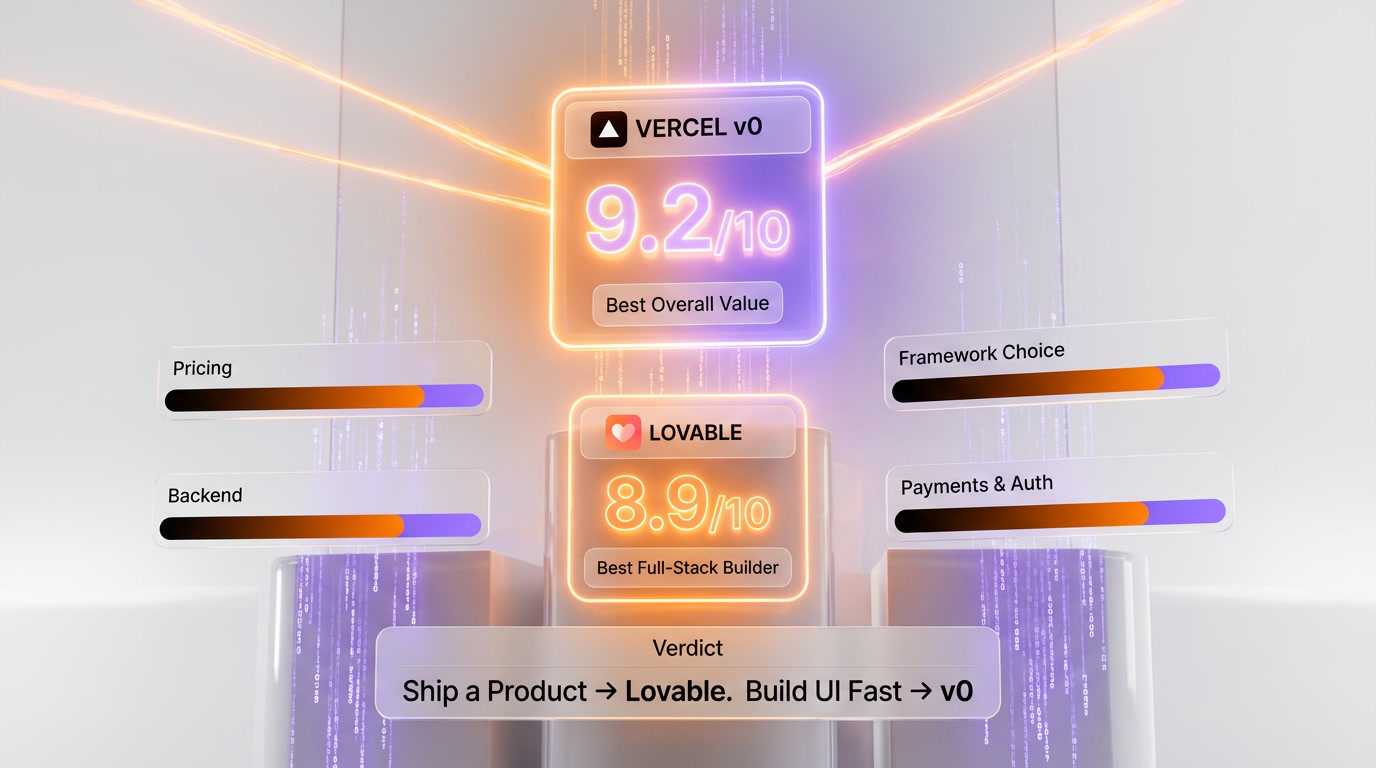
Lovable and v0 are not direct competitors — they are tools for different jobs that often get compared because both promise "AI builds your app." Across 5 named tests, Lovable won 2 (full-stack auth+Stripe, GitHub solo sync), v0 won 2 (UI polish, design tokens), and 1 was a tie (custom domain deploy). The honest verdict is split by persona, not by tool quality.
For solo developers and non-technical founders, go with Lovable. The bundled stack (React, Supabase, Stripe, hosting, custom domain) ships MVPs in hours, not weeks. The flat $25 per month pricing is the lowest-friction entry point in the category. For agencies, v0 wins. Multi-framework flexibility, agentic GitHub PR workflow, and Vercel deploy isolation per client project are non-negotiable for client work — and Lovable's React-only constraint disqualifies it. For enterprise teams already on Vercel infra, v0 wins again. SAML SSO, training opt-out by default, RBAC, and the broader Vercel ecosystem (SOC 2, 99.99% SLA) are easier to defend in a security review than rebuilding on Lovable's stack. For enterprise teams not yet on Vercel, Lovable Enterprise is a credible alternative at typically lower TCO.
Score breakdown by category (rated out of 5):
- Features: Lovable 4.5 out of 5 vs v0 4.5 out of 5 — tied; Lovable wins on full-stack scope, v0 wins on frontend polish and integrations.
- Ease of Use: Lovable 4.7 out of 5 vs v0 4.0 out of 5 — Lovable wins for non-technical users; v0 assumes React fluency.
- Value: Lovable 4.6 out of 5 vs v0 4.2 out of 5 — Lovable's flat fee plus bundled stack wins TCO for solo and small teams; v0 wins for enterprise.
- Code Quality: Lovable 4.0 out of 5 vs v0 4.7 out of 5 — v0's narrower scope translates to cleaner, more production-ready output.
- Stack Flexibility: Lovable 3.0 out of 5 vs v0 4.5 out of 5 — Lovable is React + Vite + Supabase only; v0 adapts to most React or Next.js codebases.
- Enterprise Readiness: Lovable 4.0 out of 5 vs v0 4.7 out of 5 — v0 inherits Vercel's compliance posture and SLA.
Final word: if you are shipping your first product and you need it working by Friday, buy Lovable Pro at $25 per month and start prompting tonight. If you are an engineer with an existing Next.js codebase, buy v0 Team at $30 per user per month and accelerate your UI work tomorrow. If you are an agency or enterprise frontend team, v0 is the only viable choice. If you are a non-technical founder past MVP and ready for production, plan a migration path from Lovable to a v0 + Vercel + Supabase stack — Lovable's GitHub export is the bridge that makes this realistic.
Sources and references
Every figure on this page is attributed to whoever produced it. Vendor documentation and independent measurement are listed separately and never merged into a single ranking.
- Lovable (product capabilities and plans)
- Vercel v0 (product capabilities and plans)
- Artificial Analysis — Model leaderboard (Intelligence Index scores and cost per task across configurations)
Our Verdict
Lovable and v0 are not direct competitors — they are tools for different jobs. Verdict: tie, persona-split. For solo developers and non-technical founders, Lovable wins because the bundled stack (React, Supabase, Stripe, hosting, custom domain) ships MVPs in hours and the flat $25 per month entry is the lowest-friction in the category. For agencies and enterprise teams already on Vercel infra, v0 wins because of multi-framework flexibility, agentic GitHub PR workflow, native shadcn/ui Design Mode, and Vercel's compliance posture (SOC 2, 99.99% SLA). Across our 5 named tests, Lovable won 2, v0 won 2, and 1 was a tie — picking between them is about which test resembles your real work, not which tool is universally better.
Frequently Asked Questions
Is Lovable better than Vercel?
Lovable and v0 are not direct competitors — they are tools for different jobs. Verdict: tie, persona-split. For solo developers and non-technical founders, Lovable wins because the bundled stack (React, Supabase, Stripe, hosting, custom domain) ships MVPs in hours and the flat $25 per month entry is the lowest-friction in the category. For agencies and enterprise teams already on Vercel infra, v0 wins because of multi-framework flexibility, agentic GitHub PR workflow, native shadcn/ui Design Mode, and Vercel's compliance posture (SOC 2, 99.99% SLA). Across our 5 named tests, Lovable won 2, v0 won 2, and 1 was a tie — picking between them is about which test resembles your real work, not which tool is universally better.
Which is cheaper, Lovable or Vercel?
Lovable starts at $25/month (free plan available). Vercel starts at $20/month (free plan available). Check the pricing comparison section above for a full breakdown.
What are the main differences between Lovable and Vercel?
The key differences span across 15 features we compared. For Type, Lovable offers AI full-stack app builder (frontend + backend + DB + auth from prompts) while Vercel offers AI app builder + frontend component generator (full Next.js apps, agentic). For Target User, Lovable offers Non-technical founders, solo devs, designers, internal tools teams while Vercel offers Frontend developers, Next.js teams, agencies, enterprise design systems. For Backend Generation, Lovable offers Yes — auto-generates full-stack backend (API, DB schema, auth flows) from prompts while Vercel offers Partial — agentic mode connects to existing DBs (Snowflake, AWS, Postgres) but no zero-config backend scaffolding. See the full feature comparison table above for all details.