Lovable
AI-powered full-stack app builder from natural language

Quick Summary
Lovable is an AI-powered full-stack app builder that generates complete web applications — frontend, backend, database, auth, and payments — from natural language prompts. It scores 8.9/10 in our hands-on review, with top marks for ease of use (9.5/10). Free plan available; paid plans start at $25/month with native Supabase, Stripe, and GitHub integrations included.

What is Lovable?
Lovable is an AI-powered application builder that lets you create full-stack web applications from natural language descriptions. Instead of writing code line by line, you describe what you want in plain English (or any language), and Lovable generates a complete, production-ready application with a frontend, backend, database, and authentication — all in minutes rather than weeks.
Founded with the mission of making software creation accessible to everyone, Lovable has positioned itself at the forefront of what the industry now calls "vibe coding" — the practice of building software by describing your intent rather than dictating exact implementation. According to Ramp spending data, Lovable has been one of the fastest-growing SaaS products, reflecting a massive shift in how individuals and teams approach application development.
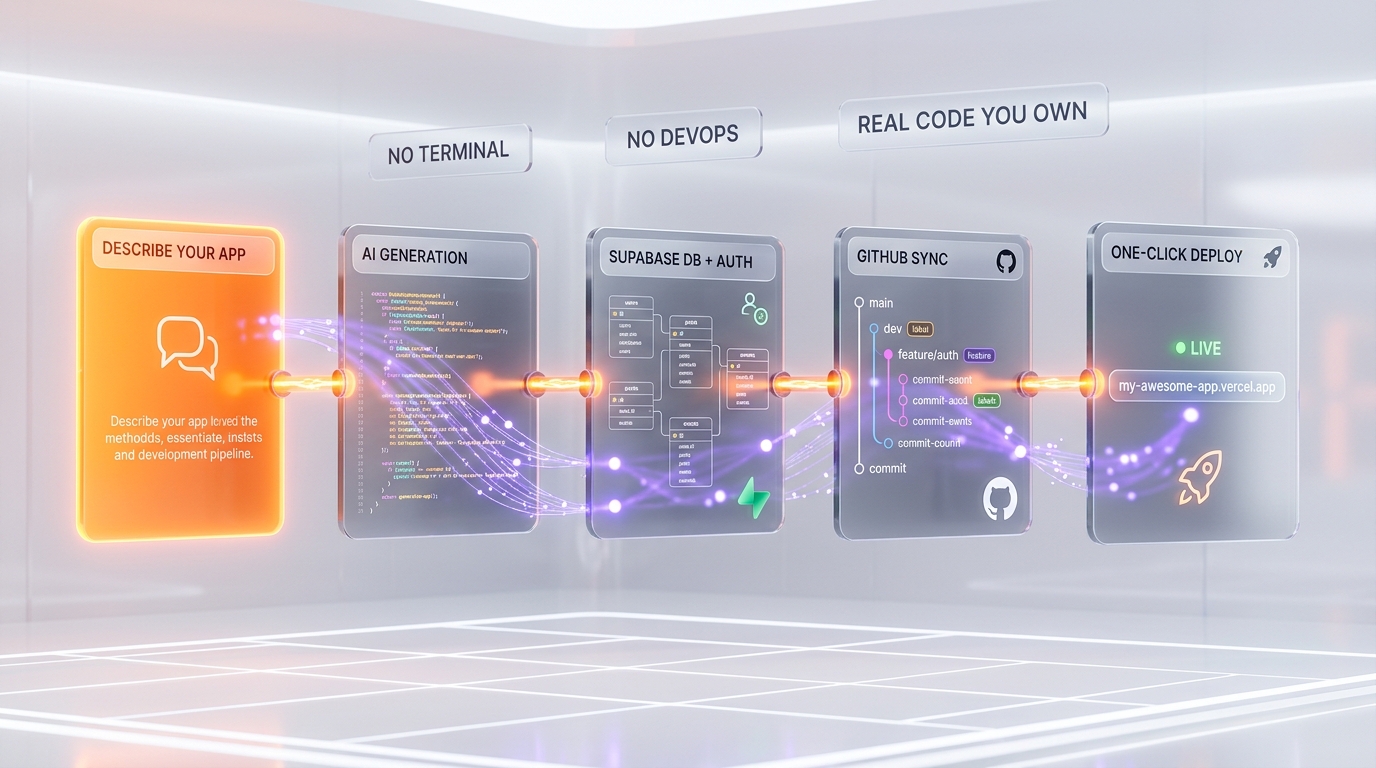
At its core, Lovable is not just a prototyping tool. It generates real, deployable applications with clean codebases that you fully own. The platform integrates natively with Supabase for database and authentication, Stripe for payment processing, and GitHub for version control. You can deploy with one click and attach custom domains — meaning you can go from idea to live product without ever touching a terminal or reading documentation.
Lovable targets a broad audience: non-technical founders who need an MVP, designers who want to bring their mockups to life, developers who want to accelerate prototyping, and teams inside larger organizations who need internal tools built fast. The tool runs entirely in the browser, requiring no local setup, no dependencies to install, and no DevOps knowledge.
Key Features in 2026
Natural Language to Full-Stack App
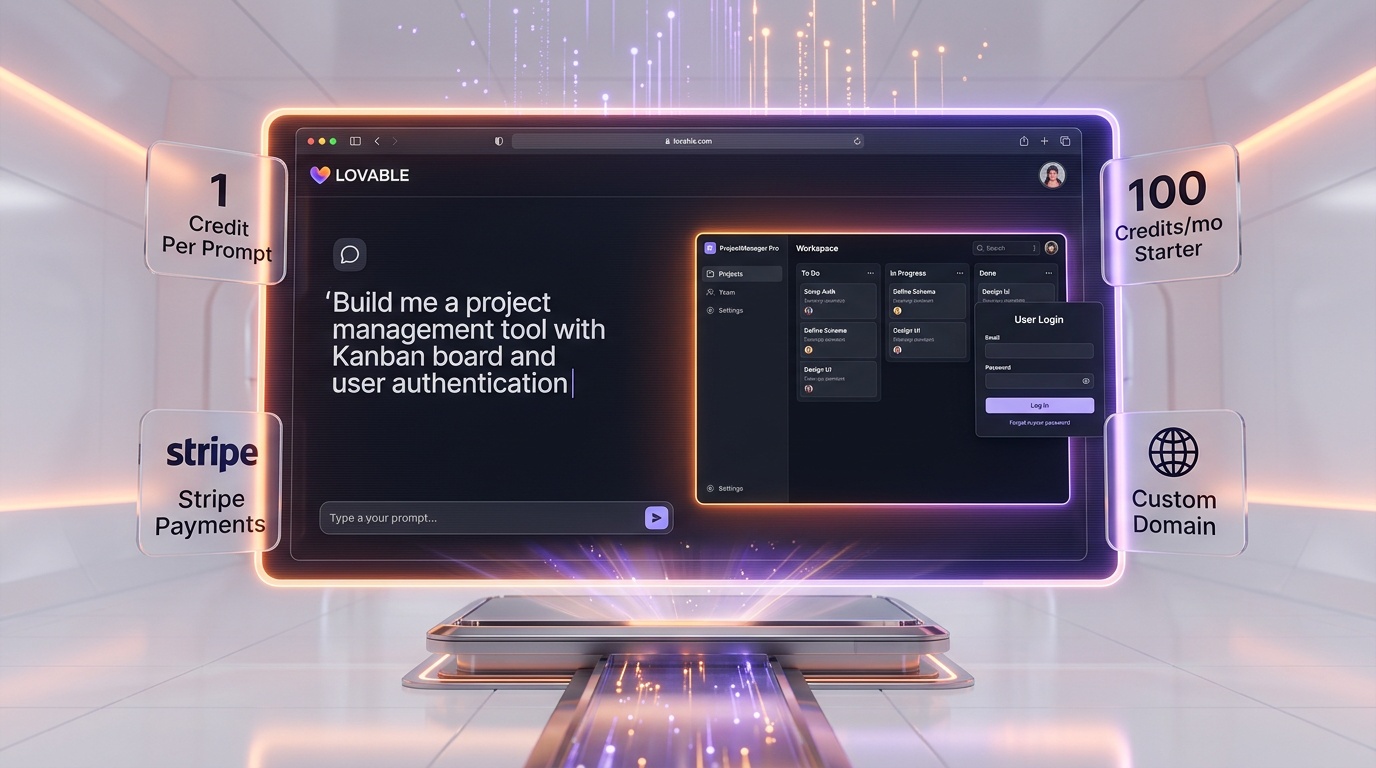
Lovable's primary interaction model is a chat interface where you describe your application. You might type something like "Build me a project management tool with user authentication, team workspaces, and a Kanban board." Lovable will generate the full application — frontend UI components, backend logic, database schema, and authentication flows — in a single generation cycle. You can then iterate by giving follow-up instructions to refine the design, add features, or modify behavior.
Built-in Supabase Integration
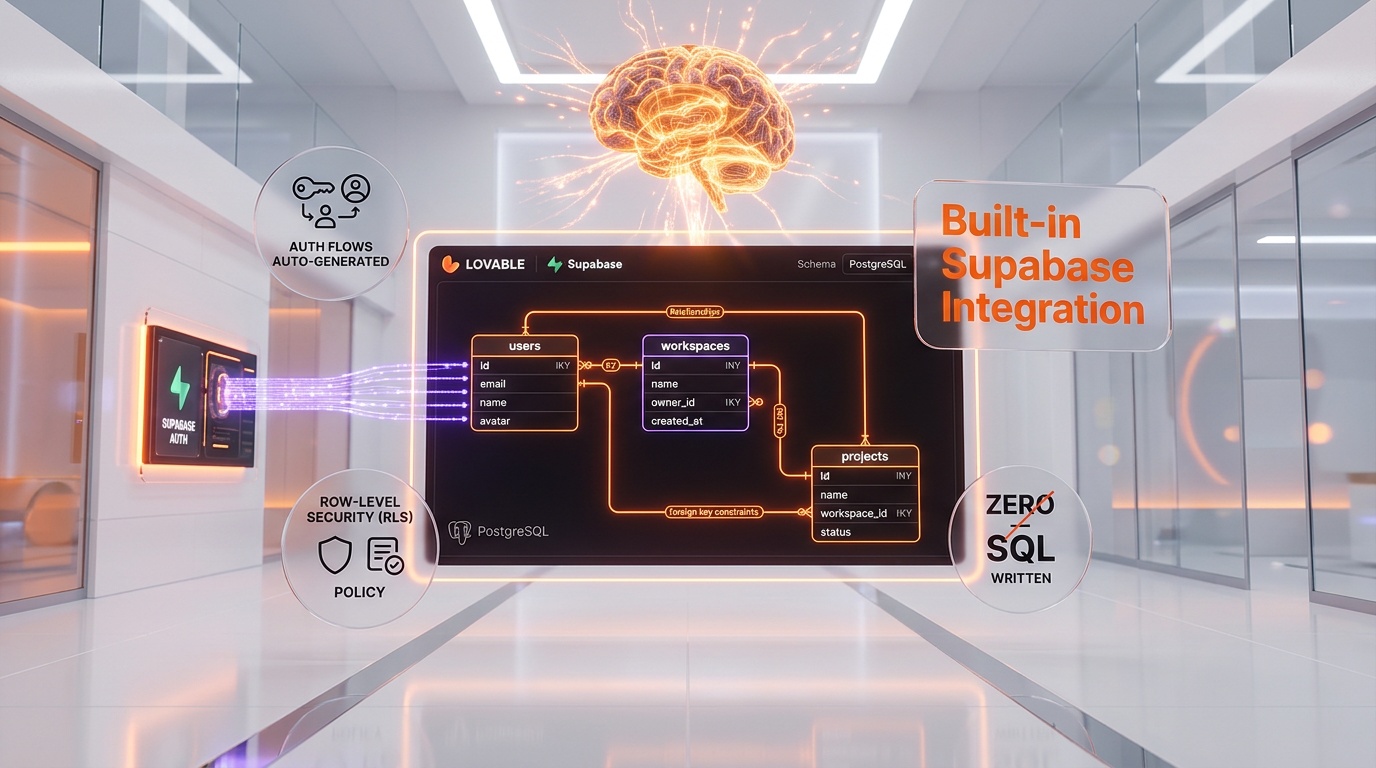
One of Lovable's strongest differentiators is its native integration with Supabase. With a few clicks, Lovable connects your app to a Supabase project, automatically generating database tables, row-level security policies, and authentication logic. This means your app gets a real PostgreSQL database, user sign-up/login flows, and proper data security without you writing a single SQL query or configuring auth providers manually.
Stripe Payments Integration
For builders creating SaaS products, marketplaces, or any monetized application, Lovable offers built-in Stripe integration. You can add subscription billing, one-time payments, or checkout flows by describing what you need. The platform handles the Stripe API integration, webhook configuration, and payment UI components.
GitHub Sync and Version Control
Every application built on Lovable is backed by a real GitHub repository. You can sync your project to GitHub at any time, clone it locally, and continue development in your preferred IDE. This means Lovable is never a dead end — your code is portable and fully yours. Changes made locally can be synced back, and vice versa.
One-Click Deploy and Custom Domains
Lovable provides built-in deployment infrastructure. With one click, your application goes live on a Lovable-hosted URL. You can then attach your own custom domain with SSL certificates handled automatically. This eliminates the need to configure hosting, set up CI/CD pipelines, or manage server infrastructure.
Visual Editing and Design Controls
Beyond text prompts, Lovable provides visual editing capabilities. You can adjust layouts, colors, typography, and spacing through a visual interface that updates the underlying code in real time. This hybrid approach — part AI chat, part visual editor — makes it easier to achieve pixel-perfect designs.
Credit-Based Interaction Model
Lovable uses a credit system where each interaction (each prompt you send) costs 1 credit, regardless of the complexity of your request. Whether you ask for a simple color change or an entire new feature module, the cost is the same. This transparent model lets you plan your usage precisely.
Pricing Breakdown
| Plan | Price | Credits | Key Features |
|---|---|---|---|
| Free | $0 per month | 5 daily credits | Basic access, Lovable-hosted URL, community support |
| Starter | $25 per month | 100 credits per month | GitHub sync, custom domains, priority support |
| Launch | Mid-tier pricing | Higher credit allocation | Additional deployment options, enhanced features for growing projects |
| Business | $50 per month | Generous allocation | SSO (Single Sign-On), team features, advanced integrations, priority support |
At the time of writing, each credit corresponds to one interaction with the AI — one prompt equals one credit, regardless of whether you're asking for a minor tweak or a major feature addition. Unused credits do not roll over between months on most plans.
For individuals testing the waters, the Free plan with 5 daily credits is surprisingly generous for exploring what Lovable can do. The Starter plan at $25 per month with 100 credits is the sweet spot for solo builders actively working on a project. The Business tier at $50 per month adds enterprise features like SSO that make it viable for teams within larger organizations.
Pros and Cons
Pros
- Fastest path from idea to deployed app. No other tool in the market lets you go from a text description to a live, full-stack web application as quickly as Lovable.
- Native Supabase integration. The built-in database and auth integration eliminates one of the biggest pain points in app development — setting up a backend.
- Real code you own. Unlike some no-code platforms, Lovable generates actual source code in a GitHub repository that you can take anywhere.
- Stripe integration. Being able to add payment processing through natural language prompts dramatically reduces the barrier to launching monetized products.
- No lock-in. GitHub sync means you can leave Lovable at any time and continue development elsewhere with your full codebase.
- Transparent pricing. The 1 credit = 1 interaction model is easy to understand and budget for.
- No setup required. Everything runs in the browser. No terminal, no package managers, no environment configuration.
Cons
- Credit consumption can be fast. When iterating heavily on design or complex features, 100 credits per month can run out quickly, especially during active development sprints.
- Complex custom logic has limits. While Lovable handles standard CRUD applications and common patterns extremely well, highly specialized or performance-critical business logic may require manual coding.
- Learning curve for prompting. Getting optimal results requires learning how to structure your prompts effectively. Vague instructions can lead to outputs that need multiple iterations to refine.
- Dependent on AI model capabilities. The quality of generated code is tied to the underlying AI models, which may occasionally produce suboptimal patterns or make architectural choices you wouldn't make manually.
- Limited offline capability. As a fully browser-based tool, Lovable requires an internet connection for all interactions.
Who Should Use Lovable?
Non-technical founders who need to build an MVP to validate a business idea will find Lovable transformative. Instead of spending $10,000–$50,000 on a development agency or spending months learning to code, you can have a working prototype in hours.
Solo developers and freelancers who want to accelerate their output will benefit enormously. Lovable handles the boilerplate — authentication, database setup, UI scaffolding — letting you focus on unique business logic.
Designers who want to bring their concepts to life without depending on a developer can use Lovable to create functional applications that match their vision.
Internal tools teams at companies who need to build dashboards, admin panels, or data management tools quickly will find that Lovable can produce in an afternoon what would typically take a sprint or two.
Hackathon participants and builders who need to move from concept to demo as fast as possible will appreciate Lovable's speed and deployment capabilities.
Who Should NOT Use Lovable?
Teams building highly regulated or compliance-critical applications (healthcare, finance, government) should be cautious. While Lovable generates functional code, applications requiring specific compliance certifications typically need extensive manual review and hardening.
Projects requiring extreme performance optimization — real-time gaming engines, high-frequency trading systems, or applications processing millions of concurrent requests — are beyond what any AI app builder can handle at the time of writing.
Developers who need full control over every architectural decision may find the AI's choices frustrating. If you have strong opinions about state management libraries, folder structures, or design patterns, manually writing code gives you more control.
Large engineering teams with established codebases are better served by AI coding assistants like Cursor or GitHub Copilot that work within existing projects rather than generating new ones from scratch.
Lovable vs Competitors
Lovable vs Bolt.new
Both Lovable and Bolt.new let you build applications from natural language, but they differ in philosophy. Lovable emphasizes the full product lifecycle — from building to deploying to scaling — with native Supabase and Stripe integrations. Bolt.new, built on StackBlitz's WebContainer technology, focuses more on the development environment experience with its in-browser IDE and recently introduced autonomous debugging. Lovable's credit-per-interaction model is simpler to understand than Bolt.new's token-based system, but Bolt.new's free tier (1M tokens per month) may offer more raw interaction volume for certain use cases. We built the same MVP twice, once on Bolt.new and once here, and scored where the two pull apart in Lovable versus Bolt.new.
Lovable vs v0 by Vercel
v0 by Vercel excels at generating UI components and frontend code, particularly React components using shadcn/ui. However, v0 is primarily a frontend tool — it doesn't generate backends, connect databases, or handle authentication. Lovable is a full-stack solution. If you need a complete application with data persistence and user accounts, Lovable is the more comprehensive choice. If you need to generate individual UI components for an existing project, v0 may be more appropriate. That frontend-versus-full-stack split is the entire verdict in Lovable versus Vercel v0, which lands on a deliberate tie and sorts the two by which job you actually have in front of you.
Lovable vs Replit
Replit offers a broader development environment that supports dozens of programming languages and includes collaborative coding features. Replit's AI agent can build applications, but Replit is fundamentally a general-purpose cloud IDE with AI features added on, whereas Lovable is purpose-built for AI-first application generation. Lovable typically produces more polished, production-ready results for web applications, while Replit offers more flexibility for diverse project types.
What's New in 2026
Lovable has continued to evolve rapidly. The platform has been recognized as one of the fastest-growing SaaS products according to Ramp spending data, reflecting both individual adoption and increasing enterprise interest. The "vibe coding" movement that Lovable helped pioneer has become a recognized paradigm in software development, with industry analysts and developers alike acknowledging that describing intent rather than writing implementation is a viable and increasingly preferred workflow for many application types.
The platform has been iterating on its AI capabilities, improving the quality and consistency of generated code. Integration depth with Supabase has expanded, and the overall reliability of multi-step application generation has improved significantly. The team continues to focus on making the path from idea to deployed product as frictionless as possible.
At the time of writing, Lovable remains one of the leading platforms in the AI app builder space, competing primarily with Bolt.new and v0 for developer mindshare while maintaining its position as the go-to choice for non-technical builders who need full-stack applications.

FAQ
Is Lovable free to use?
Yes, Lovable offers a free plan with 5 daily credits. Each credit equals one interaction with the AI. This is enough to explore the platform and build simple applications. For serious development, paid plans start at $25 per month with 100 credits.
Can I export my code from Lovable?
Absolutely. Lovable syncs with GitHub, so your entire codebase lives in a Git repository that you own. You can clone it locally, continue development in any IDE, and deploy it anywhere. There is no vendor lock-in.
What programming languages does Lovable use?
Lovable primarily generates web applications using React for the frontend and integrates with Supabase (PostgreSQL) for the backend. The generated code uses modern JavaScript/TypeScript patterns and popular UI libraries.
How does Lovable compare to hiring a developer?
For standard web applications — SaaS tools, landing pages, dashboards, CRUD apps — Lovable can produce in hours what might take a developer days or weeks. However, for highly specialized, performance-critical, or compliance-heavy applications, a skilled developer provides expertise that an AI builder cannot yet match. Many teams use Lovable for rapid prototyping and initial development, then bring in developers for optimization and specialized features.
Does Lovable support mobile apps?
At the time of writing, Lovable generates responsive web applications that work well on mobile browsers. It does not generate native iOS or Android applications. However, the responsive web apps it creates can provide a mobile-like experience and can be deployed as Progressive Web Apps (PWAs).
How does the credit system work?
Each prompt you send to Lovable costs 1 credit, regardless of the complexity of your request. Whether you ask for a minor color change or a major feature addition, the cost is the same. The Free plan gives you 5 credits per day, the Starter plan provides 100 credits per month, and higher tiers offer more generous allocations.
Can I use Lovable for commercial projects?
Yes. The code Lovable generates belongs to you. You can use it for commercial projects, sell products built with it, or incorporate it into client work. There are no restrictions on commercial use of the generated code.
Does Lovable support team collaboration?
Yes. The Business plan at $50 per month includes team features and SSO (Single Sign-On). Multiple team members can collaborate on projects, and the GitHub integration allows standard collaborative development workflows.
What happens if Lovable generates buggy code?
You can iterate with follow-up prompts to fix issues — each fix costs 1 credit. You can also export your code to GitHub and debug manually. Lovable's AI has improved significantly in code quality, but as with any AI tool, occasional issues are expected. The ability to refine through conversation makes fixing problems straightforward.
Can Lovable connect to external APIs?
Yes. You can instruct Lovable to integrate with external APIs by describing the integration you need. The platform can generate API calls, handle authentication tokens, and process responses. Common integrations include payment processors, email services, and third-party data providers.
Key Features
Pros & Cons
Pros
- Full-stack app generation from prompts
- Supabase database integration built-in
- Auth, Stripe, file uploads included
- GitHub sync and one-click deploy
- Clean, maintainable generated code
- Custom domains
Cons
- Generated code can be hard to customize deeply
- Limited to web apps (no native mobile)
- Complex apps may need manual refinement
- Credits can run out quickly on complex projects
Best Use Cases
Platforms & Integrations
Available On
Compare Lovable
Active Deals for Lovable
Students: 50% Off Pro
Lovable offers verified students 50% off their Pro plan, making AI-powered full-stack app building more accessible for student projects.

We're developers and SaaS builders who use these tools daily in production. Every review comes from hands-on experience building real products — DealPropFirm, ThePlanetIndicator, PropFirmsCodes, and many more. We don't just review tools — we build and ship with them every day.
Written and tested by developers who build with these tools daily.
Frequently Asked Questions
What is Lovable?
AI-powered full-stack app builder from natural language
How much does Lovable cost?
Lovable has a free tier. Premium plans start at $25/month.
Is Lovable free?
Yes, Lovable offers a free plan. Paid plans start at $25/month.
What are the best alternatives to Lovable?
Top-rated alternatives to Lovable include Claude Code (9.9/10), Cursor (9.5/10), Claude Opus 4.7 (9.4/10), Vercel (9.2/10) — all reviewed with detailed scoring on ThePlanetTools.ai.
Is Lovable good for beginners?
Lovable is rated 9.5/10 for ease of use.
What platforms does Lovable support?
Lovable is available on web.
Does Lovable offer a free trial?
No, Lovable does not offer a free trial.
Is Lovable worth the price?
Lovable scores 8.5/10 for value. We consider it excellent value.
Who should use Lovable?
Lovable is ideal for: MVP prototyping, Internal tools, SaaS MVPs, Landing pages, Hackathon projects, Client projects.
What are the main limitations of Lovable?
Some limitations of Lovable include: Generated code can be hard to customize deeply; Limited to web apps (no native mobile); Complex apps may need manual refinement; Credits can run out quickly on complex projects.
Best Alternatives to Lovable



Ready to try Lovable?
Start with the free plan
Try Lovable Free →