
If you have ever deployed a web application, you have probably heard of Vercel. The platform has become synonymous with modern frontend development, powering some of the fastest websites on the internet and serving as the company behind Next.js, the most popular React framework in the world. Whether you are a solo developer shipping a side project or part of a large enterprise team deploying mission-critical applications, Vercel has positioned itself as the go-to platform for frontend cloud infrastructure in 2026.
But is Vercel actually worth the hype? In this comprehensive review, we break down everything you need to know about Vercel in March 2026: its features, pricing, strengths, weaknesses, and how it stacks up against competitors like Netlify, Cloudflare Pages, and AWS Amplify. No fluff, no affiliate bias. Just an honest, thoroughly researched analysis to help you decide if Vercel is right for your next project.
What Is Vercel?
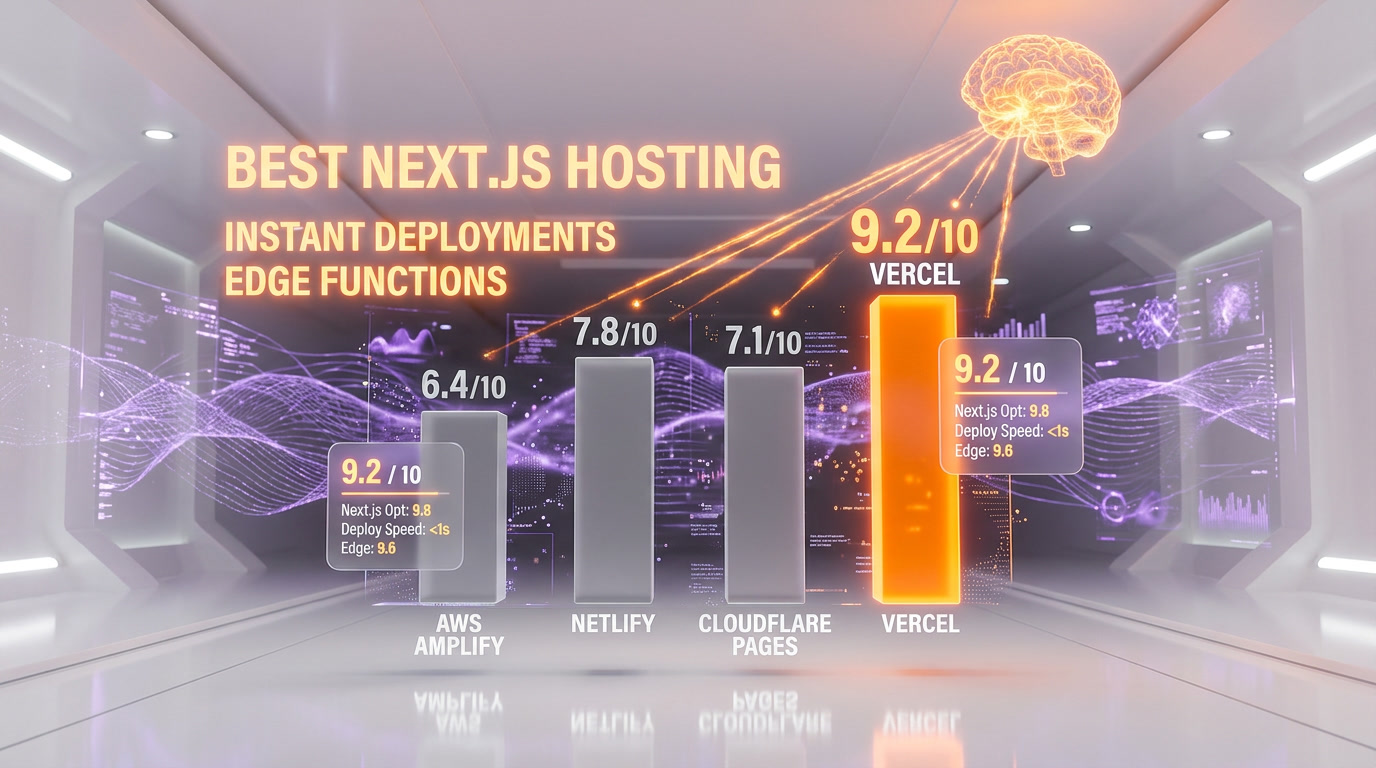
Vercel is the frontend cloud platform behind Next.js, offering git-push deployments to 100+ edge locations, serverless/edge functions, Partial Prerendering, and the v0 agentic AI development environment. Score: 9.2 out of 10 — free Hobby tier (non-commercial), Pro from $20 per seat/month. Key differentiator: the only platform where Next.js features like PPR and ISR work natively, replacing fragmented DevOps toolchains with a single deploy-and-scale workflow.
At its core, Vercel provides a deployment pipeline that connects directly to your Git repository (GitHub, GitLab, or Bitbucket). Every push to your repository triggers an automatic build and deployment to Vercel's global edge network, which spans over 100 points of presence worldwide. The result is near-instant deployments with zero configuration required for most frameworks.
But Vercel has evolved far beyond simple static hosting. In 2026, the platform encompasses serverless functions, edge computing, AI-powered development tools (v0), image optimization, web analytics, feature flags, speed insights, a firewall, and a comprehensive suite of storage solutions including Vercel KV, Vercel Postgres, Vercel Blob, and Edge Config. It is, in essence, a full-stack frontend cloud.
Vercel supports over 35 frameworks out of the box, including Next.js, Nuxt, SvelteKit, Astro, Remix, Gatsby, Angular, and Vue. However, its deepest integration and best performance will always be with Next.js, which is developed in-house.

Key Features in 2026
Zero-Configuration Deployments
Vercel's hallmark feature remains its effortless deployment workflow. Connect your Git repository, push your code, and your site is live globally in seconds. The platform automatically detects your framework, configures the build pipeline, and deploys to its edge network. Preview deployments are generated for every pull request, giving your team a unique URL to test changes before merging to production. This Git-based workflow is the gold standard in the industry, and competitors have spent years trying to match it.
Serverless and Edge Functions
Vercel Serverless Functions allow you to run backend logic without managing servers. These functions are powered by AWS Lambda under the hood but are abstracted behind a clean developer experience. In 2026, Vercel has introduced "Fluid Compute," a proprietary optimization that reduces cold starts by approximately 25% for Node.js functions through intelligent warming and connection reuse. Edge Functions, which run on Vercel's global edge network, provide near-zero cold starts and are ideal for middleware, authentication checks, A/B testing, and geolocation-based routing.
Partial Prerendering (PPR)
One of the most significant Next.js innovations available on Vercel is Partial Prerendering. PPR allows you to combine static and dynamic content within a single page, where the static shell is pre-generated and served from the cache while dynamic portions are streamed in a single HTTP request. This gives you the speed of static sites with the flexibility of server-rendered applications. While PPR is a Next.js feature, it works most reliably on Vercel's infrastructure.
v0 — AI-Powered Development
v0 (v0.app) is Vercel's AI-powered development assistant, and it received a massive overhaul in early 2026. The new v0 is not just a UI generator anymore; it is a full agentic development environment. It can import any GitHub repository, automatically pull environment variables from Vercel, and create production-ready code with proper Git workflows. The new Git panel lets you create branches, open pull requests, and deploy on merge, all from within v0. Secure integrations with Snowflake and AWS databases enable anyone to build reporting tools and internal dashboards. Vercel is positioning 2026 as "the year of agents," with v0 at the center of their agentic AI strategy. That repositioning puts v0 up against the prompt-to-app builders rather than the component generators, and Lovable versus Vercel v0 ends in a deliberate tie: Lovable takes solo founders with its bundled full-stack, v0 takes teams already on Vercel infrastructure who want multi-framework output and a pull-request workflow.
Web Analytics and Speed Insights
Vercel provides built-in Web Analytics that give you detailed insights into your website's visitors, including top pages, referrers, and demographics, all without third-party scripts. Speed Insights monitors your Core Web Vitals (LCP, FID, CLS, TTFB) with real user data, giving you actionable performance metrics broken down by route, device, and geography.
Vercel Firewall and DDoS Protection
The platform includes automatic HTTPS, SSL encryption, industry-leading DDoS mitigation, and a managed Web Application Firewall (WAF). Enterprise customers get up to 1,000 custom WAF rules, IP allowlists, and advanced bot protection.
Storage Solutions
Vercel now offers a complete suite of data storage options: Vercel KV (Redis-compatible key-value store), Vercel Postgres (serverless PostgreSQL), Vercel Blob (file storage), and Edge Config (ultra-low-latency configuration data). These services are designed to work seamlessly with serverless and edge functions, eliminating the need for separate database providers in many use cases.
Image Optimization
Vercel's built-in image optimization automatically serves images in modern formats (WebP, AVIF) at the optimal size for each device. Combined with the Next.js Image component, this can dramatically reduce page load times and bandwidth costs. The Hobby plan includes 5,000 image transformations per month, while Pro includes 50,000.
Pricing Breakdown
Vercel's pricing model consists of three tiers: Hobby (free), Pro ($20 per month per developer seat), and Enterprise (custom). All plans include usage-based billing for resources that exceed included limits.
| Feature | Hobby (Free) | Pro ($20 per seat/mo) | Enterprise (Custom) |
|---|---|---|---|
| Price | $0 | $20 per developer/month | Custom (contact sales) |
| Commercial Use | No (personal only) | Yes | Yes |
| Fast Data Transfer | 100 GB per month | 1 TB per month (then $40 per 100GB) | Custom |
| Edge Requests | 1M/month | 10M/month | Custom |
| Serverless Function Invocations | 1M/month | 10M/month | Custom |
| Build Minutes | 6,000 minutes per month | 24,000 minutes per month | Custom |
| Concurrent Builds | 1 | 3 | Custom (12+) |
| Image Optimizations | 5,000/month | 50,000/month | Custom |
| Blob Storage | 1 GB | 100 GB | Custom |
| Team Collaboration | No | Yes (unlimited read-only) | Yes |
| Preview Deployments | Yes | Yes (password-protected) | Yes (advanced controls) |
| Web Analytics | Basic | Advanced | Advanced + custom |
| SAML SSO | No | Available | Included |
| Support | Community | Dedicated CSM + SLA | |
| SLA | None | None | 99.99% uptime |
| Compliance | None | Basic | SOC 2, ISO 27001, HIPAA, PCI DSS |
| Managed WAF | No | Basic | 1,000 custom rules |
Important pricing notes: The Pro plan includes a $20 monthly usage credit that covers baseline resource consumption. Additional usage is billed at published overage rates. Enterprise pricing is negotiated directly with Vercel's sales team and typically starts in the low thousands per month depending on traffic volume and team size. The Hobby plan explicitly prohibits commercial use, so any business project requires at minimum the Pro tier.
Pros and Cons — Our Honest Take
Pros
- Best-in-class developer experience: From git-push deployments to preview URLs, Vercel's workflow is unmatched in terms of polish and reliability.
- Deepest Next.js integration: As the company behind Next.js, Vercel supports every Next.js feature first and most reliably. Features like PPR, ISR, and the App Router work flawlessly on Vercel.
- Global edge network: Over 100 points of presence ensure fast load times worldwide.
- v0 AI tooling: The revamped v0 is genuinely useful for rapid prototyping and even production workflows.
- Comprehensive platform: Storage, analytics, firewall, and functions mean you can build a complete application without leaving Vercel's ecosystem.
- Excellent documentation: Vercel's docs are thorough, well-organized, and frequently updated.
- Preview deployments: Every PR gets its own deployment URL, making code review and QA seamless.
Cons
- Expensive at scale: Per-seat pricing adds up quickly for larger teams. A 10-person team pays $200 per month before any usage overages.
- Vendor lock-in risk: Deep reliance on Vercel-specific features (Edge Config, ISR, Middleware optimizations) makes migration difficult.
- Hobby plan is non-commercial: Unlike Cloudflare Pages, you cannot use Vercel's free tier for business projects.
- Overage costs can surprise you: Usage-based billing beyond included limits can lead to unexpected bills, especially for bandwidth-heavy applications.
- Next.js favoritism: While Vercel supports many frameworks, the best features and optimizations are reserved for Next.js. Other frameworks feel like second-class citizens.
- No unlimited bandwidth on any plan: Unlike Cloudflare Pages, which offers unlimited bandwidth for free, Vercel meters bandwidth on every tier.

Who Should Use Vercel?
- Next.js developers: If your stack is Next.js, Vercel is the natural choice. No other platform matches its integration depth.
- Frontend-focused teams: Teams that want a managed platform with minimal DevOps overhead will love Vercel's workflow.
- Startups and scale-ups: The Pro plan offers a good balance of features and cost for growing companies.
- Agencies: Preview deployments and team collaboration features make Vercel excellent for client work.
- Teams exploring AI-assisted development: v0 is a genuinely powerful tool for rapid prototyping and shipping UI faster.
- Projects requiring edge computing: Vercel's Edge Functions and Middleware provide powerful capabilities for personalization, A/B testing, and geolocation-based logic.
Who Should NOT Use Vercel?
- Budget-conscious teams with large developer counts: At $20 per seat/month, a 20-person team pays $400 per month before usage. Cloudflare Pages or AWS Amplify can be significantly cheaper.
- Non-JavaScript projects: If you are deploying a static site, Hugo blog, or non-JS application, Vercel's value proposition diminishes significantly.
- High-bandwidth applications: If your app serves a lot of media or large files, Vercel's bandwidth pricing can become expensive. Cloudflare Pages offers unlimited bandwidth.
- Teams needing full backend control: Vercel is a frontend-first platform. If you need complex backend infrastructure, container orchestration, or custom server configurations, a traditional cloud provider like AWS or GCP is more appropriate.
- Developers who want to avoid vendor lock-in: Vercel's optimizations are often Vercel-specific. If portability is a priority, consider Cloudflare Pages or self-hosted solutions.
- Hobby developers with commercial projects: The free tier does not allow commercial use, so even a small business site requires the $20 per month Pro plan.
Vercel vs Competitors
| Feature | Vercel | Netlify | Cloudflare Pages | AWS Amplify |
|---|---|---|---|---|
| Starting Price | Free (non-commercial) / $20 per seat Pro | Free / $19 per seat Pro | Free (commercial OK) / $5 per month Pro | Pay-as-you-go |
| Bandwidth (Free) | 100 GB per month | 100 GB per month | Unlimited | 15 GB per month (free tier) |
| Bandwidth (Paid) | 1 TB (Pro) | 1 TB (Pro) | Unlimited | $0.15 per GB |
| Edge Locations | 100+ | Fewer (AWS-based) | 300+ | 20+ AWS regions |
| Next.js Support | Best (official) | Good (adapter, some lag) | Good (OpenNext adapter) | Good (SSR supported) |
| Cold Start Performance | Fast (Fluid Compute) | Moderate | Near-zero (Workers) | Moderate (Lambda) |
| Build Speed | Fastest (aggressive caching) | Moderate | Moderate | Moderate |
| AI Tools | v0 (agentic AI) | None built-in | Workers AI | Amazon Q integration |
| Commercial Free Tier | No | Yes | Yes | Yes (12 months free tier) |
| DDoS Protection | Included | Included | Industry-leading | AWS Shield Standard |
| Container Support | No | No | Yes (2026) | Yes |
| Best For | Next.js teams | Content sites, Jamstack | Cost-sensitive, high-traffic | AWS-native teams |
Vercel vs Netlify: Netlify was once Vercel's closest competitor, but it has fallen behind in 2026. Netlify's Next.js support lags behind Vercel's, with features like Partial Prerendering not yet supported. Netlify's shift to credit-based pricing in late 2025 has also introduced complexity. However, Netlify remains a solid choice for content-focused sites and has a more generous free tier that allows commercial use.
Vercel vs Cloudflare Pages: Cloudflare Pages is Vercel's most formidable competitor in 2026. With unlimited free bandwidth, 300+ edge locations, near-zero cold starts, and Docker container support, Cloudflare offers better raw performance at a fraction of the price. The trade-off is developer experience: Vercel's deployment workflow, preview URLs, and Next.js integration are still superior. If cost and performance are your top priorities, Cloudflare wins. If developer experience and Next.js support matter most, Vercel wins.
Vercel vs AWS Amplify: Amplify is the budget option for teams already in the AWS ecosystem. With zero per-seat costs, Amplify can be 40% cheaper than Vercel for larger teams. However, Amplify's developer experience is significantly worse, documentation is less polished, and Next.js support, while improved, still trails Vercel. Choose Amplify if you are cost-conscious and already invested in AWS; choose Vercel if you value developer productivity.

What's New in March 2026
Vercel has been busy in early 2026. Here are the most notable recent updates:
- v0 Agentic Overhaul: The completely rebuilt v0 now supports importing any GitHub repo, automatic environment variable configuration, proper Git workflows with branch creation and PR management, and secure database integrations with Snowflake and AWS. This is a major step toward Vercel's vision of "self-driving infrastructure."
- AI Gateway Updates: Vercel's AI Gateway now supports Gemini 3.1 Flash Image Preview, improving visual quality while maintaining flash-tier speed and cost. Google Image Search grounding is also available for outputs rooted in real-world imagery.
- AI SDK Releases: The Vercel AI SDK received significant updates in March 2026, with new model integrations and improved streaming capabilities for building AI-powered applications.
- Fluid Compute Improvements: Ongoing optimizations to Vercel's serverless function runtime continue to reduce cold starts and improve connection pooling.
- Enhanced Observability: New logging and monitoring features provide deeper visibility into function execution, edge network performance, and error tracking.
Tips for Getting the Most Out of Vercel
- Use preview deployments religiously: Every PR should be reviewed on its preview URL. Share these URLs with designers, PMs, and QA testers for feedback before merging.
- Leverage ISR and PPR: Incremental Static Regeneration and Partial Prerendering can dramatically improve performance while keeping content fresh. Use them for pages that do not need to be fully dynamic.
- Monitor your usage: Set up billing alerts in the Vercel dashboard to avoid surprise overage charges. Pay particular attention to bandwidth and function invocations.
- Use Edge Functions for middleware: Move authentication checks, redirects, A/B tests, and geolocation logic to Edge Functions for near-instant execution.
- Optimize images with the Next.js Image component: This automatically leverages Vercel's image optimization pipeline, serving WebP/AVIF images at the right size for each device.
- Use Vercel's built-in analytics: Before adding Google Analytics or Plausible, check if Vercel's built-in Web Analytics and Speed Insights cover your needs. They are privacy-friendly and add zero JavaScript overhead.
- Explore v0 for prototyping: v0 can generate production-ready UI components in seconds. Use it to rapidly prototype layouts, forms, and dashboards before polishing by hand.
- Cache aggressively: Vercel's edge cache is fast. Use proper Cache-Control headers and stale-while-revalidate patterns to minimize origin requests.
- Use environment variables wisely: Store secrets in Vercel's encrypted environment variables. Use different values for development, preview, and production environments.
- Audit your team seats: Since Pro pricing is per-seat, periodically review who needs developer access versus read-only access. Unlimited free read-only seats on Pro can save significant money.
Frequently Asked Questions
Is Vercel free to use?
Yes, Vercel offers a free Hobby plan that includes 100 GB bandwidth, 1 million function invocations, and unlimited deployments. However, the Hobby plan is strictly for personal, non-commercial projects. Any commercial use requires the Pro plan at $20 per month per developer seat.
Is Vercel only for Next.js?
No. Vercel supports over 35 frameworks including Nuxt, SvelteKit, Astro, Remix, Gatsby, Angular, and Vue. However, Next.js receives the deepest integration and best optimizations since Vercel develops it. Other frameworks work well but may not benefit from features like PPR or optimized ISR.
How does Vercel compare to Netlify in 2026?
Vercel leads Netlify in build speed, Next.js support, edge function performance, and AI tooling (v0). Netlify has shifted to credit-based pricing and lags on features like Partial Prerendering. However, Netlify offers commercial use on its free tier and remains solid for content-focused static sites.
Is Cloudflare Pages better than Vercel?
It depends on your priorities. Cloudflare Pages offers unlimited free bandwidth, 300+ edge locations, near-zero cold starts, and lower pricing. Vercel offers a superior developer experience, better Next.js support, and more polished tooling. For cost-sensitive, high-traffic projects, Cloudflare wins. For Next.js teams that value DX, Vercel wins.
What is Vercel's v0?
v0 (v0.app) is Vercel's AI-powered development platform. It can generate UI components from text prompts, import GitHub repositories, create branches and pull requests, and deploy directly to Vercel. In 2026, it was rebuilt as a full agentic development environment with database integrations and proper Git workflows.
Can I use Vercel for a backend API?
Vercel supports serverless functions and edge functions for backend logic, but it is not designed to replace a full backend server. For simple APIs, authentication endpoints, and webhook handlers, Vercel works great. For complex backend services requiring persistent connections, WebSockets, or long-running processes, a traditional server or containerized solution is more appropriate.
Does Vercel have a CDN?
Yes. Vercel operates its own global edge network with over 100 points of presence worldwide. All static assets and cached content are automatically distributed to edge locations nearest to your users.
What happens if I exceed my Vercel plan limits?
On the Hobby plan, you are blocked until the next billing cycle. On the Pro plan, overages are billed at published rates (e.g., $40 per additional 100 GB of bandwidth). On Enterprise, limits are negotiated and typically much higher.
Is Vercel HIPAA compliant?
HIPAA compliance is available on the Enterprise plan only. Vercel also offers SOC 2, ISO 27001, and PCI DSS compliance support for Enterprise customers. Pro and Hobby plans do not include compliance certifications.
Can I self-host Next.js instead of using Vercel?
Yes. Next.js is open-source and can be self-hosted on any Node.js server, Docker container, or cloud provider. However, some Vercel-optimized features like ISR, Image Optimization, and Edge Middleware may behave differently or require additional configuration on self-hosted setups. The OpenNext project has made self-hosting on Cloudflare and AWS much easier in 2026.
Does Vercel support monorepos?
Yes. Vercel has built-in support for monorepos using Turborepo (which Vercel also develops), npm/yarn/pnpm workspaces, and Nx. Root directories can be configured to deploy specific packages within a monorepo.
How fast are Vercel deployments?
Vercel is known for the fastest build times among frontend hosting platforms, thanks to aggressive caching strategies. Simple static sites deploy in under 10 seconds. Larger Next.js applications typically deploy in 30-90 seconds, with subsequent builds being faster due to caching.