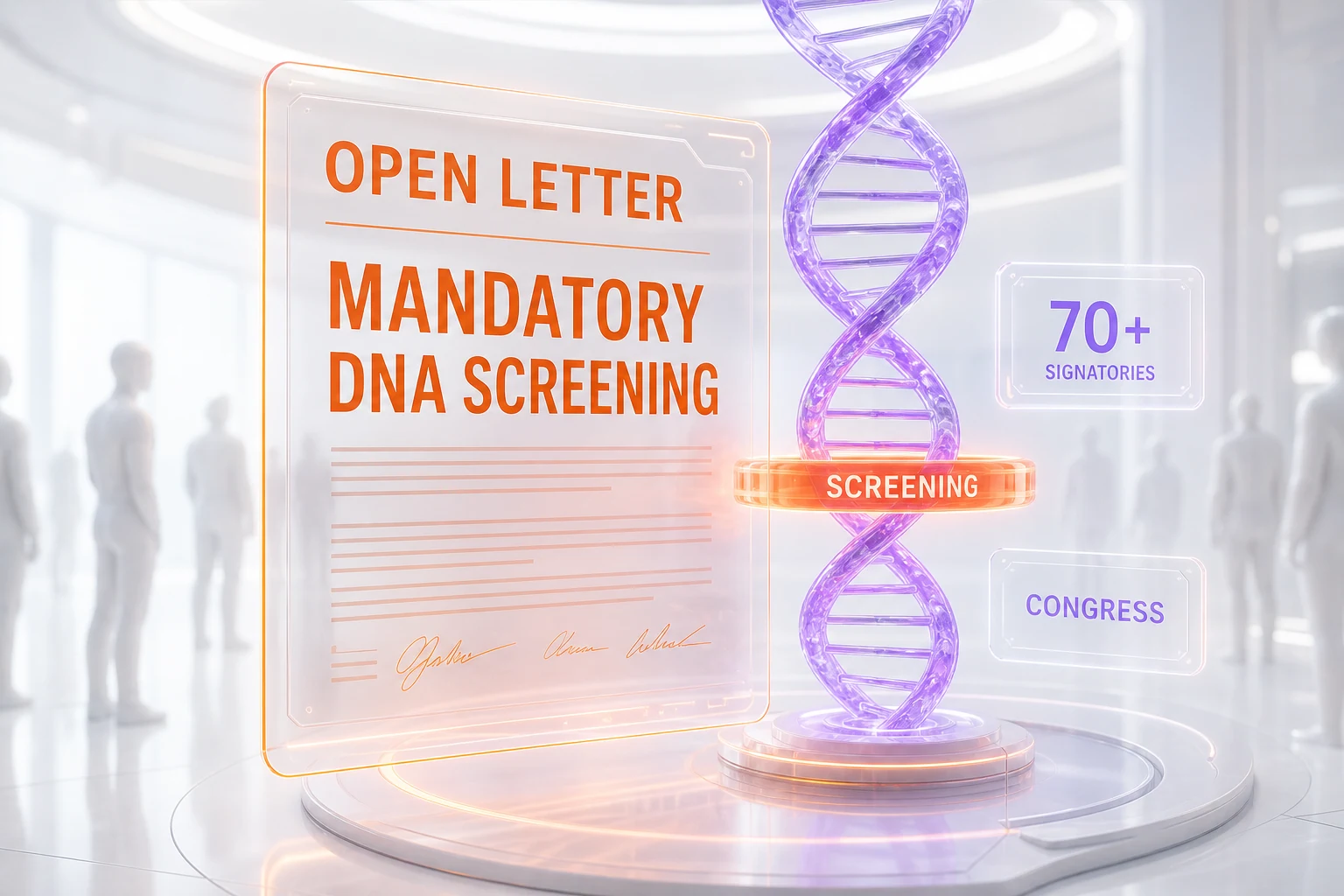
On June 3, 2026, the CEOs of OpenAI, Anthropic, Google DeepMind, and Microsoft AI, along with Meta's chief AI officer, signed an open letter titled "In Support of Mandatory Nucleic Acid Synthesis Screening and Recordkeeping." Co-organized by the Foundation for American Innovation (FAI), the multi-party letter gathers more than 70 signatories — AI lab leaders, Nobel laureates, and national-security veterans — who ask US legislators to make screening of every synthetic DNA and RNA order legally mandatory. The signatories argue that AI is eroding the knowledge barriers that once kept biological weapons out of reach, and that voluntary industry safeguards are no longer enough.
What Happened
On June 3, 2026, a coalition of more than 70 people published an open letter calling on the US Congress to require mandatory screening and recordkeeping for orders of synthetic nucleic acids — the lab-made DNA and RNA that researchers order to build genetic material. The letter is titled "In Support of Mandatory Nucleic Acid Synthesis Screening and Recordkeeping" and was co-organized by the Foundation for American Innovation, a technology policy nonprofit. It is hosted alongside a campaign page at screendna.org.
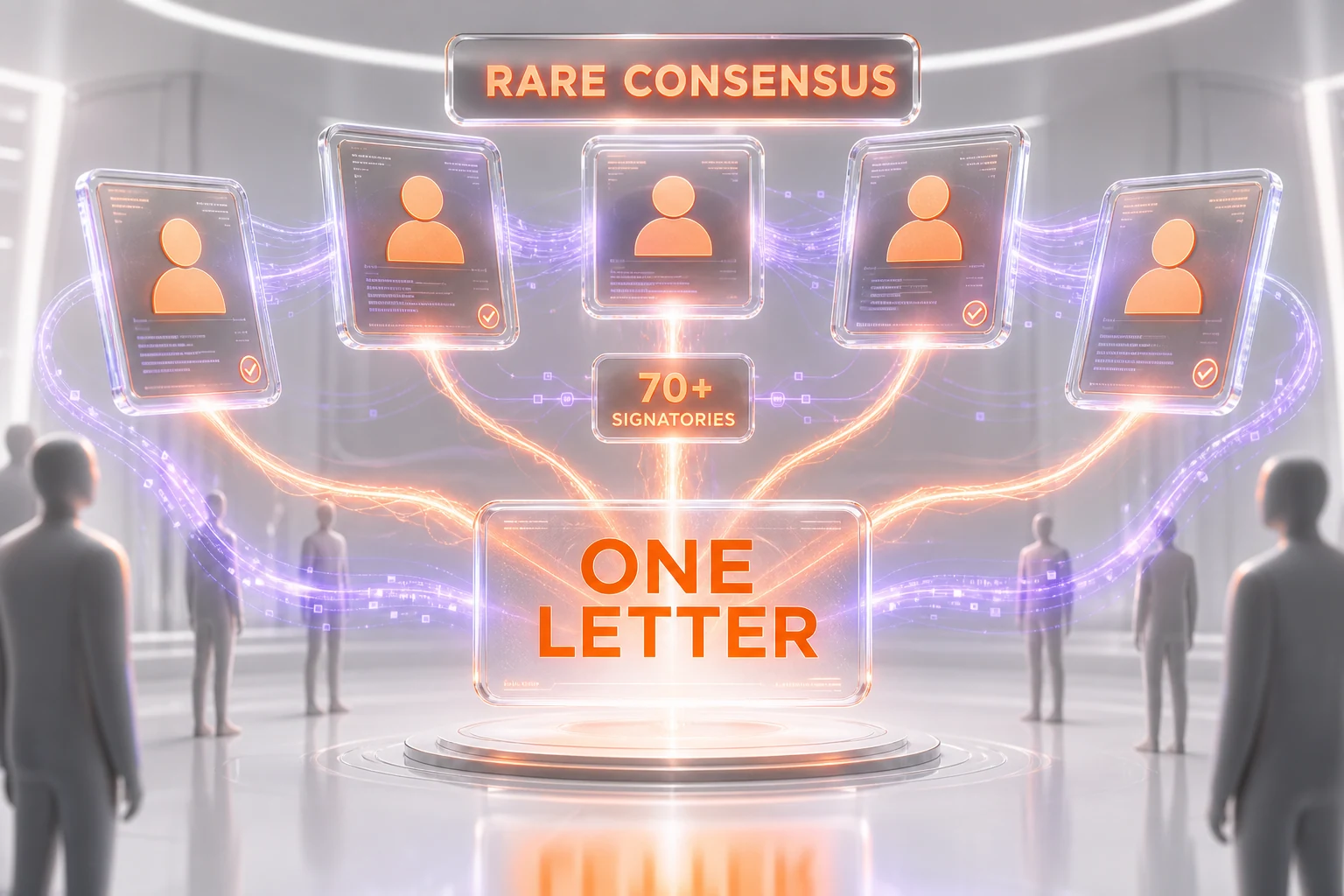
The headline detail is who signed. According to the letter, the signatories include Sam Altman (CEO and co-founder of OpenAI), Dario Amodei (CEO and co-founder of Anthropic), Demis Hassabis (CEO of Google DeepMind), Mustafa Suleyman (CEO of Microsoft AI), and Alexandr Wang (chief AI officer at Meta). It is worth being precise here: Wang signs as Meta's chief AI officer, not as the chief executive of an independent company. The same document also carries the names of life-sciences researchers and biosecurity experts, including David Baker (director of the Institute for Protein Design and a 2024 Nobel Prize recipient), Kevin Esvelt of the MIT Media Lab, Drew Endy of the Hoover Institution, Tom Inglesby of the Johns Hopkins Center for Health Security, former Secretary of the Navy Richard Danzig, and former Assistant Secretary of Defense Andy Weber.
This is the part that makes the letter notable as a news event rather than a routine policy filing. It is not a bilateral partnership between two companies, and it should not be read as "OpenAI and Anthropic teaming up." It is a multi-organization statement on which leaders of four of the most competitive AI labs in the world — companies that spend most of the year fighting each other for talent, compute, and enterprise contracts — put their names on the same page, next to a Nobel laureate and two former US defense officials.
What the Letter Actually Asks For
The letter is specific about its requests. It does not call for restricting AI models, banning research, or slowing biotechnology. It asks legislators to make one existing safeguard mandatory. The opening line states the core ask directly: the signatories "call on legislators to make screening orders for synthetic nucleic acids — and the equipment needed to make them — mandatory."
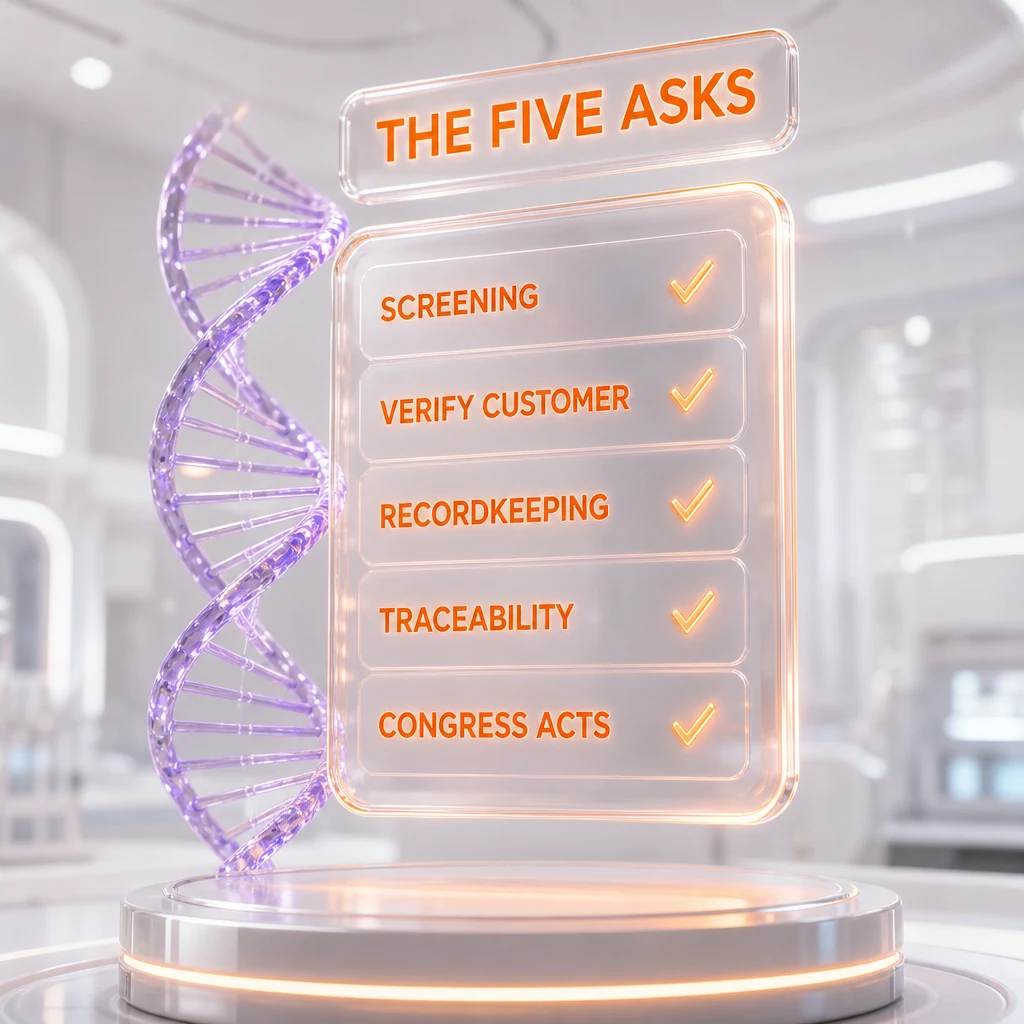
From the text of the letter, the asks can be grouped as follows:
- Mandatory screening of orders. Every commercial order for synthetic nucleic acids should be checked against sequences of concern before it is fulfilled. Crucially, the letter extends this to the benchtop synthesis equipment used to make nucleic acids, not just the finished orders shipped by providers.
- Customer verification. Providers should "verify customer legitimacy before shipping orders" — confirming that whoever places an order is a legitimate institution or researcher rather than an anonymous or fraudulent buyer.
- Recordkeeping. Providers should "record synthesis orders and sequence data to support legitimate biosecurity investigations." The signatories frame this as the evidentiary backbone that lets authorities reconstruct what was ordered if something goes wrong.
- Traceability of threats that slip through. The letter argues that recordkeeping means "any threat that might evade initial screening can be traced back to its source," and adds that "awareness of traceability itself deters misuse."
- Action from Congress and the states. The signatories write that "Congress should act this session," applaud legislative efforts already underway, and ask states to adopt aligned standards "based on existing federal and industry guidelines" to avoid "a patchwork of conflicting laws."
Throughout, the tone is deliberately measured. The letter describes screening as "one of the best understood and least disruptive biosecurity measures available." That phrasing matters: the signatories are not asking for a dramatic new control regime, but to make an established, low-friction practice a legal requirement rather than a voluntary one.
The Argument the Signatories Make
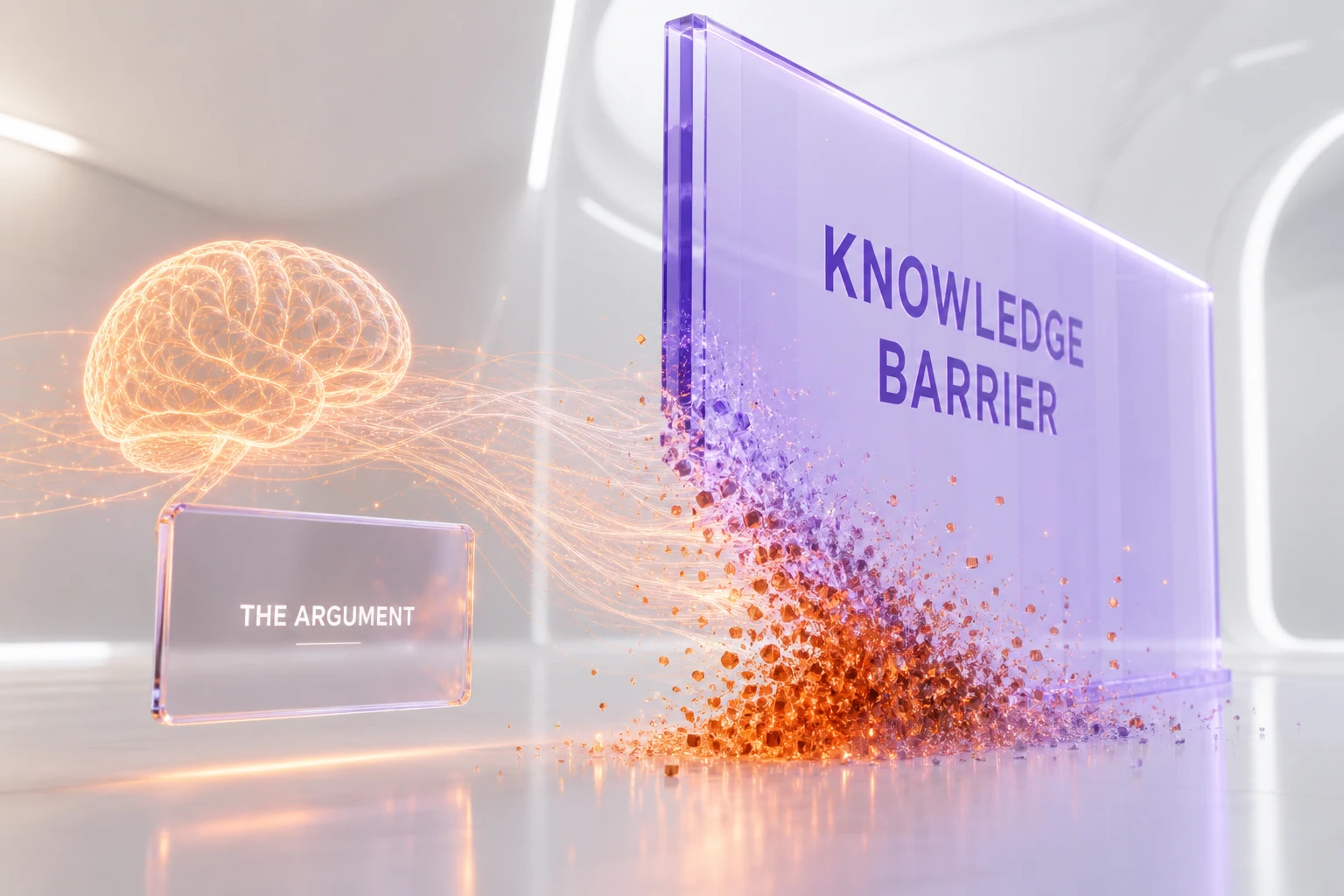
The case in the letter rests on a single claim about how AI changes the risk picture. For decades, the practical obstacle to engineering a dangerous pathogen was not access to materials but access to expertise — the deep, tacit, hard-won knowledge of how to actually do it. The signatories argue that frontier AI systems are starting to erode that barrier.
The letter states that "AI systems now outperform PhD-level virologists on questions about highly technical laboratory procedures," and warns that as a result "the knowledge barriers which have historically prevented bad actors from obtaining biological weapons will meaningfully erode." It is important to attribute this carefully: this is the signatories' stated position and the premise of their request. We are reporting their argument, not asserting as settled fact that AI enables anyone to build a bioweapon. The signatories themselves frame the concern as an erosion of barriers over time, not as a capability that exists fully formed today.
The second pillar of the argument is that the industry's own voluntary approach has reached its limit. The letter notes that gene-synthesis companies "formed the International Gene Synthesis Consortium in 2009 to develop and implement voluntary safeguards." That consortium has screened orders for years on a voluntary basis. The signatories' point is that voluntary participation leaves gaps — providers who do not join, equipment sold outside the screening net, and no legal floor that everyone must meet. Their proposed fix is to convert the existing voluntary practice into a baseline requirement.
Why This Matters
The significance of this letter is less about the policy mechanics and more about the signal. Mandatory DNA synthesis screening is not a new idea in biosecurity circles; experts like Kevin Esvelt and organizations like the Johns Hopkins Center for Health Security have advocated for it for years. What is new is the AI industry lining up behind it, publicly and together.
For most of the past two years, the dominant story in frontier AI has been competition and divergence. Anthropic and OpenAI have built opposing safety narratives, traded public criticism over how to release powerful models, and raced for the same government and enterprise contracts. We have covered that rivalry closely, from OpenAI's Rosalind Biodefense program to the broader question of how these labs frame the next phase of AI governance. Against that backdrop, a document carrying Altman's and Amodei's signatures next to Hassabis's and Suleyman's is genuinely unusual.
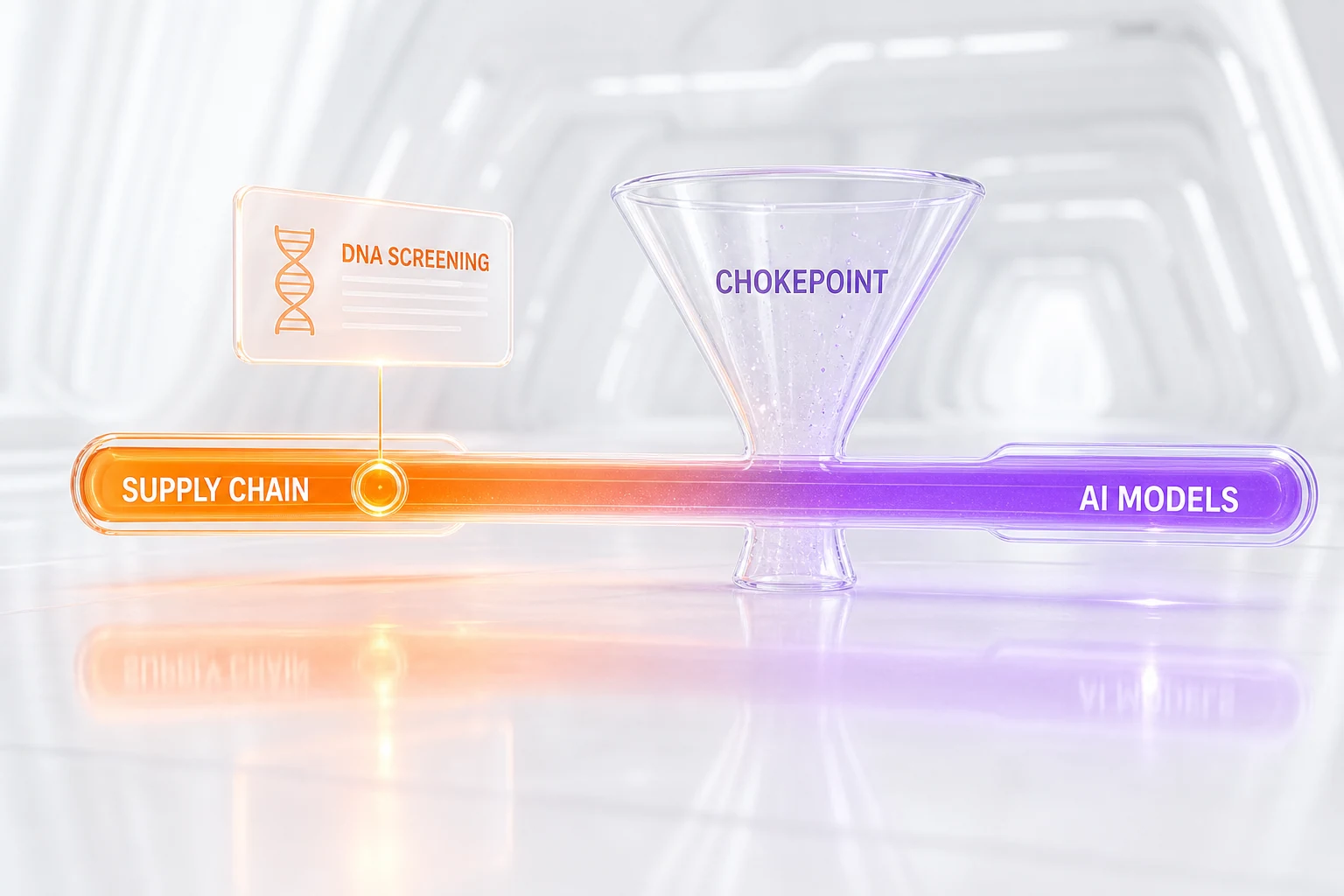
The choice of issue is also telling. Biosecurity screening is, in policy terms, an easy place for rivals to agree. It does not touch model weights, training data, release timelines, or commercial advantage. It targets the physical supply chain — the companies that print DNA — rather than the AI models themselves. For an industry that resists almost any binding constraint on how it builds and ships models, endorsing a narrow, supply-side safeguard is a relatively low-cost way to demonstrate seriousness about catastrophic risk while keeping the regulatory conversation away from the models.
That is not a cynical read so much as a structural one. The labs can support this measure precisely because it asks little of them and much of someone else. Whether that makes the gesture less meaningful or more achievable is a fair question — and one worth keeping in view as the proposal moves toward legislation.
How DNA Synthesis Screening Works Today
To understand what the letter is asking for, it helps to understand the existing system it wants to make mandatory. When a researcher orders a strand of synthetic DNA from a commercial provider, responsible providers run that order through a screening process. The sequence is compared against databases of sequences of concern — genetic material associated with known pathogens and toxins regulated under biosecurity frameworks. If an order matches a flagged sequence, the provider can pause it, request more information, or decline to fulfill it.
Alongside sequence screening, providers can verify the customer: confirming that the buyer is affiliated with a legitimate institution and is who they claim to be. This is the layer the letter refers to when it asks providers to "verify customer legitimacy before shipping orders."
The gap the letter targets is that this whole apparatus is, in the US, largely voluntary. The International Gene Synthesis Consortium has organized voluntary screening since 2009, and federal guidance has encouraged it, but there is no blanket legal requirement that every provider screen every order, or that benchtop synthesis machines — which let a lab make nucleic acids in-house, outside a provider's screening — fall under the same rules. The signatories want that voluntary floor turned into a legal one, and they want it to cover the equipment as well as the orders. One reported partner in adjacent biosecurity efforts, SecureDNA, has built screening tools designed to operate at exactly this layer.
How It Compares to the Broader AI Safety Debate
This letter sits at one end of a spectrum of AI-safety proposals, and its position on that spectrum is part of why it attracted such broad sign-on. At the other end are proposals that would constrain the models directly: pre-release government review of frontier systems, mandatory capability evaluations, restrictions on open-weight releases, and liability regimes for model developers. Those proposals are contested precisely because they bear on the labs' core product.
Nucleic acid synthesis screening avoids that fight. It regulates a different industry — DNA manufacturing — and a physical chokepoint that already exists. Compared with the contentious debates over whether open-weight model guardrails can be stripped or where legal liability for AI harms should land, supply-chain screening is unusually tractable. There is an established practice to build on, a defined set of companies to regulate, and broad expert agreement that it reduces risk without chilling legitimate research.
The trade-off is scope. Screening the DNA supply chain addresses one specific pathway — the synthesis of physical genetic material — and does nothing about the underlying capability of AI models to provide knowledge. It is a containment measure at the last physical step, not a control on the information itself. Supporters would say that is exactly the point: you regulate the chokepoint you can actually regulate. Skeptics might note that as benchtop synthesis equipment becomes cheaper and more widespread, even that chokepoint could narrow, which is likely why the letter is explicit about covering the equipment too.
Our Take
The most defensible way to read this letter is as a rare alignment of interest and principle. The biosecurity experts on it — Baker, Esvelt, Endy, Inglesby, Danzig, Weber — have credibility on this exact issue that long predates the current AI boom. Their presence is what gives the document weight. The AI executives' signatures are what give it news value. Both things can be true at once: the measure is genuinely sensible biosecurity policy, and it is also a low-cost, high-visibility way for the labs to show they take catastrophic risk seriously.
We would be cautious about over-reading the consensus. The fact that four fierce competitors signed the same letter says more about how undemanding this particular ask is than about any new spirit of cooperation in frontier AI. The harder questions — about model release, capability evaluations, and who reviews powerful systems before they ship — remain exactly as contested as before. A coalition that agrees on screening DNA orders has not agreed on the things the labs actually disagree about.
What would make this more than a gesture is follow-through. The letter explicitly asks Congress to act "this session." If the signatories use their considerable influence to push an actual bill across the line — and accept screening requirements on the equipment side as readily as on the order side — the letter becomes a meaningful policy intervention. If it remains a one-time statement of support without legislative movement, it becomes another well-intentioned document in a crowded field. The measure of this letter will be what happens in the months after it, not the names on it.
What's Next
The immediate question is legislative. The letter references efforts "currently underway" and calls for action within the current congressional session, which puts the focus on whether a screening bill gains traction and what scope it covers — orders only, or orders plus equipment. The signatories' explicit ask that states adopt aligned standards also signals an awareness that, absent federal action, a patchwork of state laws could emerge.
For the AI industry, the more interesting thread is whether this kind of narrow, supply-side consensus becomes a template. It is far easier to get rival labs to agree on regulating a separate industry than on regulating themselves. If biosecurity screening passes cleanly, it may set a pattern: the labs cooperate publicly on adjacent safety measures that cost them little, while the contested questions about the models stay unresolved. We will be watching whether the same coalition reappears on harder issues — and whether, on those, the signatures line up as neatly as they did here.
Frequently Asked Questions
What is the open letter on nucleic acid synthesis screening?
It is a multi-party open letter published on June 3, 2026, titled "In Support of Mandatory Nucleic Acid Synthesis Screening and Recordkeeping," co-organized by the Foundation for American Innovation. More than 70 signatories — including AI lab leaders, Nobel laureates, and former US defense officials — ask Congress to make screening of synthetic DNA and RNA orders legally mandatory rather than voluntary.
Which AI leaders signed the letter?
According to the letter, the AI signatories include Sam Altman (CEO and co-founder of OpenAI), Dario Amodei (CEO and co-founder of Anthropic), Demis Hassabis (CEO of Google DeepMind), Mustafa Suleyman (CEO of Microsoft AI), and Alexandr Wang (chief AI officer at Meta). Wang signs in his role as Meta’s chief AI officer, not as the head of an independent company.
Is this an OpenAI and Anthropic partnership?
No. It is a multi-organization open letter with more than 70 signatories, not a bilateral deal or partnership between OpenAI and Anthropic. The two companies’ CEOs both signed it, alongside leaders from Google DeepMind, Microsoft AI, and Meta, plus life-sciences and national-security experts. It is a shared policy statement, not a business agreement.
What exactly does the letter ask for?
The letter asks legislators to make four things mandatory: screening every synthetic nucleic acid order (and the equipment used to make them) against sequences of concern; verifying customer legitimacy before shipping; recording orders and sequence data for biosecurity investigations; and ensuring that threats which evade initial screening can be traced back to their source. It also asks Congress to act this session and states to adopt aligned standards.
Why do the signatories say AI changes the risk?
The signatories argue that frontier AI is eroding the knowledge barrier that historically kept dangerous biology out of reach. The letter states that AI systems now outperform PhD-level virologists on highly technical laboratory questions, and warns that the barriers which once prevented bad actors from obtaining biological weapons "will meaningfully erode." This is their stated argument and the premise of their request, not a settled scientific fact.
Does the letter claim AI can build bioweapons?
No, and it is important to be precise. The letter does not claim AI lets anyone build a bioweapon today. It argues that AI is lowering the knowledge barriers that historically prevented misuse, and that this erosion is significant enough to justify making an existing safeguard mandatory now. The framing is about reducing future risk through a low-disruption measure, not about an existing, fully formed capability.
What is nucleic acid synthesis screening?
It is the practice of checking orders for synthetic DNA and RNA against databases of sequences of concern before they are fulfilled, and verifying that the customer is legitimate. Responsible providers already do this voluntarily, organized in part through the International Gene Synthesis Consortium since 2009. The letter wants this voluntary practice turned into a legal requirement that also covers benchtop synthesis equipment.
Is DNA synthesis screening already happening?
Partly. Many gene-synthesis providers screen orders voluntarily, and the International Gene Synthesis Consortium has coordinated voluntary safeguards since 2009. But there is no blanket US legal requirement that every provider screen every order, or that benchtop synthesis machines fall under the same rules. The letter targets exactly that gap, asking to make the existing voluntary floor a mandatory one.
Why is this letter considered significant?
Because it is rare for the leaders of four fiercely competitive AI labs — OpenAI, Anthropic, Google DeepMind, and Microsoft AI — to put their names on the same policy document, alongside a Nobel laureate and former US defense officials. The signal value comes from that unusual alignment. The measure itself, mandatory DNA screening, has been advocated by biosecurity experts for years; the news is the AI industry publicly backing it together.
How does this compare to regulating AI models directly?
It is a much narrower measure. Mandatory screening regulates the DNA-manufacturing supply chain — a physical chokepoint — rather than the AI models themselves. It does not touch model weights, training data, or release timelines, which is why it is far less contested than proposals for pre-release model review or open-weight restrictions. Supporters call it tractable; the trade-off is that it addresses one physical pathway rather than the underlying knowledge.
What does the letter ask Congress and the states to do?
The letter asks Congress to act "this session" and applauds legislative efforts already underway. To avoid a patchwork of conflicting laws, it also asks states to adopt aligned standards based on existing federal and industry guidelines. The goal is a consistent national baseline for mandatory screening and recordkeeping rather than a fragmented, state-by-state approach.
What happens next with the proposal?
The near-term question is whether a screening bill gains traction in the current congressional session and how broadly it is scoped — orders only, or orders plus synthesis equipment. The signatories’ explicit call for action and their request that states align suggest a push for federal legislation. The real test of the letter will be legislative follow-through, not the number of high-profile names attached to it.