
Anthropic is being sued in a proposed class action over the usage limits on its Claude Max subscriptions. The complaint, Kahn v. Anthropic, PBC (docket 3:26-cv-05763, U.S. District Court for the Northern District of California), was filed June 14, 2026 by Washington, D.C. resident Karl Kahn. It alleges that the $100 per month Max 5x plan and the $200 per month Max 20x plan deliver far less usage than advertised — the complaint claims roughly "three and a half times" Pro instead of 5x, and "six to eight times" Pro instead of 20x. The allegations are unproven, Anthropic has declined to comment, and nothing has been decided by the court.
Disclosure: ThePlanetTools.ai covers Anthropic's Claude products across our tools and comparison pages. We have no affiliate relationship with Anthropic that affects this coverage, and we earn no commission on Claude subscriptions. This article reports the filing and its context. It is not legal advice, it does not take a position on the merits, and it does not predict an outcome. Every claim attributed to the plaintiff below is an allegation that has not been proven in court.
What the Lawsuit Actually Claims
On June 14, 2026, Karl Kahn filed a proposed class action against Anthropic, PBC in the U.S. District Court for the Northern District of California. The case is captioned Kahn v. Anthropic, PBC, docket number 3:26-cv-05763. (Some early coverage, including Engadget, listed the filing date as June 15; the court docket reflects a June 14 filing.) Kahn is represented by the law firm Vaca Daffan LLP.
According to the complaint, Kahn signed up for Claude Pro in 2025, upgraded to the Max 5x tier, and then moved to the top Max 20x tier in April 2026 as he leaned more heavily on Claude for coding work. The filing alleges he "overpaid for both subscriptions, received less usage than Anthropic advertised, and at times purchased additional usage after reaching plan limits," per reporting by PYMNTS.
The core allegation is about the gap between the plan names and the usage they allegedly deliver. The complaint asserts that "the actual usage provided by the Max 5x and Max 20x plans is far below the advertised amount of usage," as quoted by Engadget. More specifically, the complaint alleges — these are the plaintiff's estimates, not an independent measurement — that the $200 per month "20x" plan delivers closer to "six to eight times" the usage of Pro, and that the $100 per month "5x" plan delivers closer to "three and a half times" Pro, according to Decrypt and Quartz. The complaint also alleges that a single five-hour work session consumed roughly 15 percent of Kahn's weekly allotment.
It is important to be precise here. The "six to eight times" and "three and a half times" figures are the plaintiff's characterization of his own experience. They are not the result of an independent audit, and Anthropic has not confirmed them. Anthropic publishes usage limits in terms of messages and prompts per window rather than a single fixed "5x" or "20x" number, which is part of what the complaint disputes — it alleges the limits are "nearly impossible" for a typical user to verify.
What Claude Max Advertises
Anthropic markets three consumer Claude tiers. Claude Pro is the entry paid plan at $17 per month (billed annually). Above it sit two Max tiers: Max 5x at $100 per month, described as offering roughly five times the Pro plan's usage, and Max 20x at $200 per month, described as offering roughly twenty times Pro's usage. The Max plans are aimed at heavy users — in particular developers running Claude Code, Anthropic's command-line coding agent.

The table below contrasts the advertised positioning with the figures the complaint alleges. Read the right-hand column as the plaintiff's claim, not as established fact.
| Plan | Price | Advertised vs Pro | Alleged in complaint (plaintiff's estimate) |
|---|---|---|---|
| Claude Pro | $17 per month | Baseline (1x) | Baseline |
| Claude Max 5x | $100 per month | About 5x Pro usage | Allegedly about 3.5x Pro |
| Claude Max 20x | $200 per month | About 20x Pro usage | Allegedly about 6x to 8x Pro |
Anthropic does not publish a guaranteed message count for each tier. Usage depends on conversation length, model choice, attachments, and especially Claude Code sessions, which can consume far more tokens than chat. That variability is central to the dispute: the complaint argues the multipliers function as marketing claims, while usage-based products generally describe limits as approximate and subject to change.
The Four Legal Claims
The complaint asserts four causes of action, all framed around the allegation that the Max plans were marketed as delivering more usage than they actually provide:
- Violation of California's Consumers Legal Remedies Act (CLRA) — the state statute covering deceptive practices in consumer transactions.
- Violation of California's False Advertising Law — covering untrue or misleading advertising claims.
- Negligent misrepresentation — alleging Anthropic conveyed information about usage that the plaintiff says was inaccurate.
- Breach of contract — alleging the delivered usage fell short of what subscribers were promised when they paid.
Each of these is an allegation. Anthropic has not yet filed a response, no class has been certified, and a court has not ruled on whether any claim has merit. The filing seeks refunds for affected customers and a judicial finding regarding Anthropic's marketing of the high-tier plans.
Who the Proposed Class Covers
The complaint seeks to certify a class of, in the filing's framing, all U.S. residents who purchased or upgraded to a Claude Max 5x or Max 20x subscription through Claude.com or the Claude desktop app between April 9, 2025 and the present. A proposed class is not a certified class: a judge must still decide whether the case can proceed on a class-wide basis, and that decision can take months or longer. Until then, the "class" is a request, not a ruling.
The Context: Weekly Rate Limits and Why Anthropic Added Them
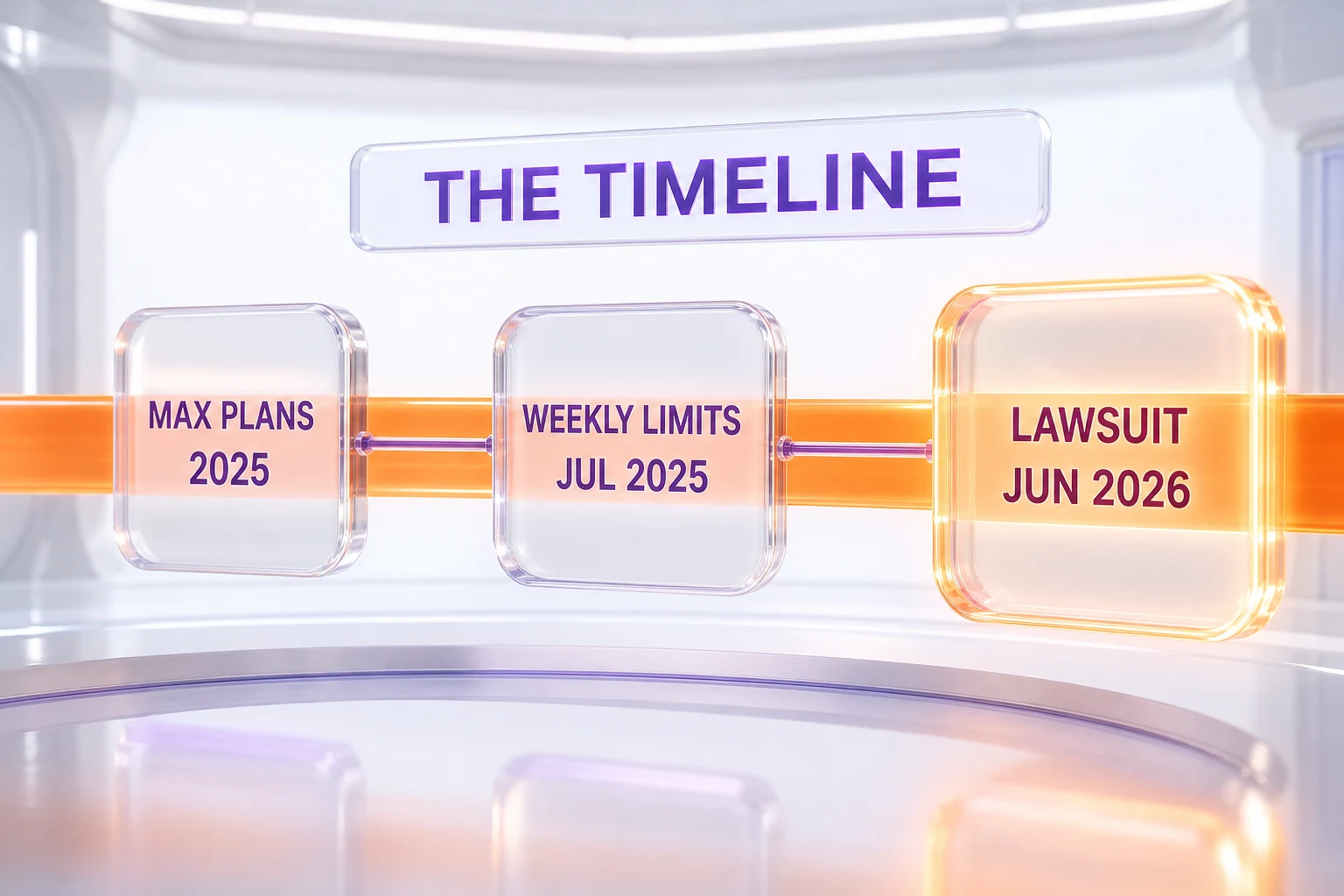
The lawsuit lands against a backdrop that Anthropic has discussed publicly. On July 28, 2025, the company announced new weekly rate limits for its Claude subscriptions, with the limits taking effect on August 28, 2025. At the time, Anthropic said the change was a response to a small number of power users — including people running Claude Code "continuously in the background, 24/7" — as well as account sharing and reselling that violated its usage policies.
Anthropic estimated then that the new weekly caps would affect under 5 percent of subscribers based on existing usage patterns. In other words, the company's stated position before this lawsuit was that the vast majority of subscribers would never hit the weekly limits, and that the caps were aimed at extreme or abusive consumption rather than typical use. The complaint, by contrast, alleges that a normal heavy user like Kahn hit the caps quickly. Whether the limits behave as Anthropic described or as the complaint alleges is exactly the kind of factual question a court would need to examine — and it has not done so yet.
How This Compares Across the Industry
Usage-based caps on flat-rate AI subscriptions are not unique to Anthropic. OpenAI applies message and tool limits to ChatGPT Plus and Pro, Google applies usage limits across its Gemini subscription tiers, and Perplexity caps the number of advanced "Pro" searches on its paid plan. The general industry pattern is that a monthly subscription buys a generous-but-bounded amount of usage, with the heaviest consumption — long agentic coding runs in particular — eating into those bounds fastest.
That shared pattern cuts in two directions, and the lawsuit will likely test both. On one hand, it supports the view that approximate, adjustable usage limits are a standard and disclosed feature of AI subscriptions rather than a deception. On the other hand, the complaint's argument is not that limits exist — it is that a plan explicitly named and sold as "20x" allegedly delivers materially less, and that the real limits are too opaque for buyers to verify. The case may turn less on whether caps are normal and more on whether a numeric plan name like "20x" creates a specific advertised promise.
What It Means for Claude Max Subscribers Right Now
For current Max subscribers, the practical situation has not changed because of the filing. Claude Pro, Max 5x, and Max 20x remain available at $17, $100, and $200 per month respectively, and the published usage limits still apply. A lawsuit at this stage does not pause a product, refund anyone, or alter the terms of service.
If you rely on Claude for heavy coding workloads through Claude Code, the more useful takeaway is operational rather than legal: usage on agentic coding sessions can be consumed quickly, so it is worth monitoring how a long session draws down a weekly window before committing to a tier. Anthropic exposes usage information inside the product, and the per-token economics of the API are a separate consideration from the flat-rate Max subscriptions. For developers weighing the trade-offs, our coverage of Claude Code and the latest flagship model Claude Opus 4.8 walks through where the heavy token consumption tends to come from, and our overview of Claude covers the plan structure in more detail.
What Would Prove Each Side Right
Because nothing has been decided, the honest framing is to lay out what each side would need to show. Several things would tend to support the plaintiff's case: internal Anthropic data establishing a consistent gap between the advertised multipliers and delivered usage; evidence that the "5x" and "20x" labels were presented as concrete usage guarantees rather than relative positioning; and proof that typical subscribers — not just 24/7 automation — routinely received far less than the names imply.
Several things would tend to support Anthropic's position: disclosures and terms showing the multipliers were described as approximate and subject to change; usage data confirming that the large majority of subscribers stay well within limits, consistent with the company's "under 5 percent" estimate from 2025; and evidence that the named plaintiff's consumption was unusually heavy. None of this has been litigated. At this early stage, the only settled facts are that the complaint was filed, what it alleges, and that Anthropic has declined to comment.
Where Things Stand
As of mid-June 2026, the status is straightforward: a single named plaintiff has filed a proposed class action, the complaint alleges that Claude Max 5x and Max 20x deliver less usage than their names suggest, and the figures cited ("three and a half times" and "six to eight times" Pro) are the plaintiff's estimates. Anthropic has declined to comment and has not yet responded in court. No class has been certified and no finding of wrongdoing has been made. We will update this article as the docket progresses — including any Anthropic response, motions to dismiss, or a class-certification decision.
Frequently Asked Questions
Who is suing Anthropic over Claude Max?
Karl Kahn, a Washington, D.C. resident, filed a proposed class action against Anthropic, PBC on June 14, 2026 in the U.S. District Court for the Northern District of California (docket 3:26-cv-05763). He is represented by the law firm Vaca Daffan LLP. The case seeks to represent U.S. residents who bought Claude Max 5x or Max 20x plans since April 9, 2025. The allegations have not been proven in court.
What exactly does the Claude Max lawsuit allege?
The complaint alleges that the $100 per month Max 5x and $200 per month Max 20x plans deliver far less usage than advertised. It claims the "20x" plan delivers closer to six to eight times Pro usage and the "5x" plan closer to three and a half times Pro. Those figures are the plaintiff's estimates, not an independent measurement. The suit raises four claims: California's CLRA, California's False Advertising Law, negligent misrepresentation, and breach of contract.
How much do Claude Pro, Max 5x, and Max 20x cost?
Claude Pro is $17 per month, Claude Max 5x is $100 per month, and Claude Max 20x is $200 per month. The Max 5x plan is advertised as offering roughly five times Pro's usage and the Max 20x plan roughly twenty times Pro's usage. The lawsuit disputes whether the delivered usage matches those multipliers.
Has Anthropic responded to the lawsuit?
Anthropic declined to comment when contacted by reporters, and as of mid-June 2026 it had not yet filed a formal response in court. For context, in July 2025 Anthropic announced weekly rate limits, attributing them to a small number of power users running Claude Code continuously 24/7 and to account sharing, and estimated the caps would affect under 5 percent of subscribers. That earlier statement is not a response to this lawsuit.
Do other AI companies like OpenAI and Google use similar usage limits?
Yes. Usage-based caps on flat-rate AI subscriptions are common across the industry. OpenAI applies message and tool limits to ChatGPT Plus and Pro, Google sets usage limits on its Gemini tiers, and Perplexity caps advanced Pro searches. The lawsuit does not claim limits themselves are improper — it alleges that a plan named "20x" created a specific advertised promise that, per the complaint, was not met.
Does this lawsuit change anything for current Claude Max subscribers?
No. The filing does not pause the product, trigger refunds, or change the terms of service. Claude Pro, Max 5x, and Max 20x remain available at their current prices and published usage limits. A proposed class action is an early-stage filing; a court has not certified a class or found any wrongdoing.
What happens next in Kahn v. Anthropic?
The next steps would typically include Anthropic's response — possibly a motion to dismiss — followed at some point by a class-certification decision, which can take months or longer. Nothing has been decided. The only settled facts today are that the complaint was filed, what it alleges, and that Anthropic has declined to comment.