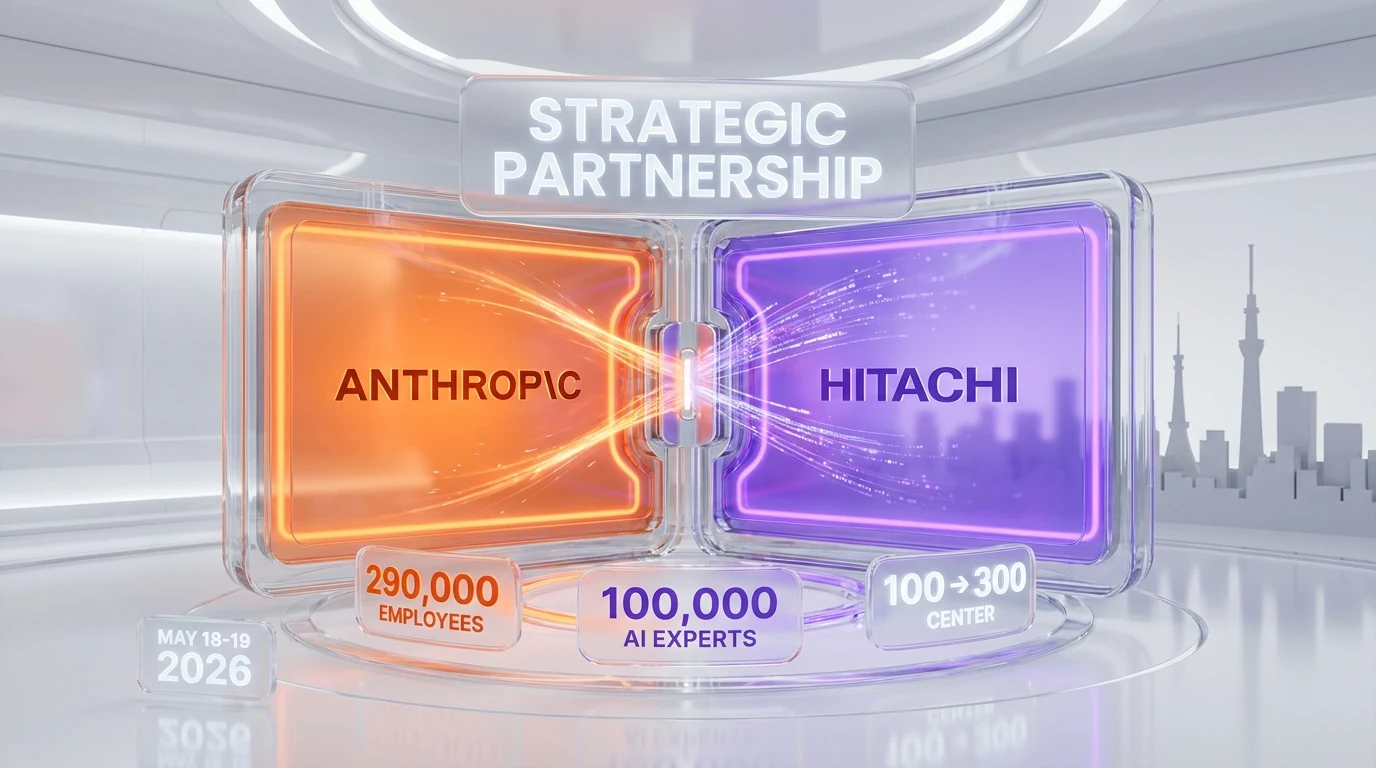
The Hitachi-Anthropic partnership, announced May 18-19, 2026 in Santa Clara and Tokyo, will deploy Anthropic's Claude across Hitachi's 290,000 global employees, train 100,000 AI professional talents, and launch a joint Frontier AI Deployment Center initially staffed by 100 experts and scaling to 300 across North America, Europe, and Asia. The deal anchors Hitachi's Lumada 3.0 strategy in frontier AI and extends Anthropic's enterprise streak after PwC, KPMG and SAP.
On the same week Google occupied the AI news cycle with I/O 2026 keynotes about Gemini consumer features, Anthropic quietly signed a 110-year-old Japanese industrial conglomerate to deploy Claude across its entire workforce. The contrast is the story. While the keynote crowd was watching Gemini demos for shopping and search, Anthropic was locking down 290,000 Hitachi employees, a "Customer Zero" rollout, and a joint research-and-deployment center spanning three continents.
This is the fourth Anthropic enterprise mega-deal in roughly two weeks. PwC certified 30,000 professionals on Claude on May 14. KPMG expanded its Claude integration. SAP made Claude the reasoning brain inside Joule at Sapphire 2026. And now Hitachi — a critical-infrastructure conglomerate with operations in energy, transport, manufacturing and finance — picks the same vendor. The pattern is now too consistent to dismiss as marketing.
What Hitachi and Anthropic actually announced
The press release, titled "Hitachi announces strategic partnership with Anthropic to strengthen 'Lumada 3.0' through frontier AI," was issued in Santa Clara on May 18 and re-issued in Tokyo on May 19, 2026. Four concrete commitments sit inside it. None of them are speculative roadmap items — they are described as active rollouts.
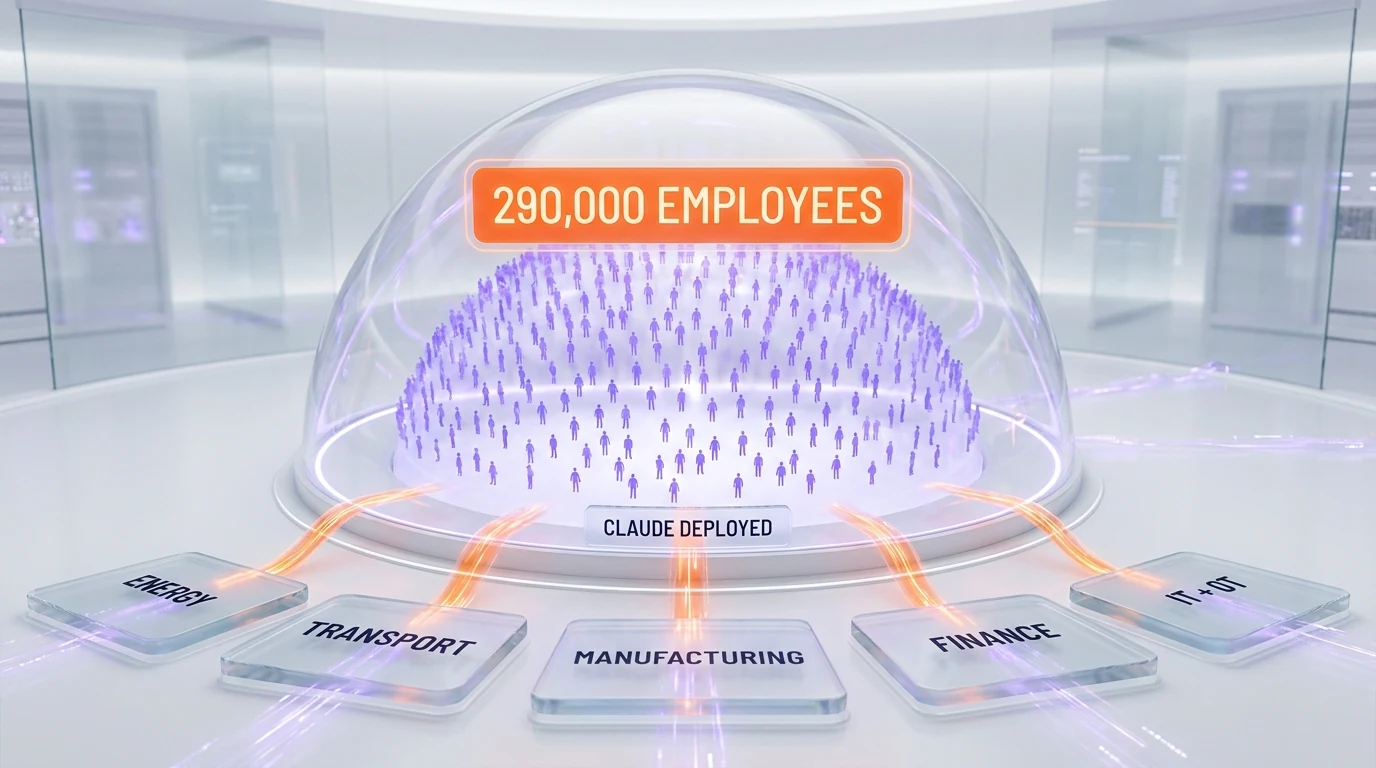
First, enterprise-wide deployment. Hitachi will deploy Anthropic's Claude across all 290,000 employees worldwide, embedding it in business processes from R&D to back-office workflows. The press release does not specify which Claude models will be used, nor does it disclose the number of seats or the contract value. We will not invent those figures. What is confirmed is the population: 290,000 people, every Hitachi business unit, every region.
Second, the talent commitment. Hitachi pledges to develop 100,000 AI professional talents — internal certifications, working knowledge of Claude-native workflows, and applied AI engineering roles. That is a workforce-scale commitment with no public analog at Anthropic so far. PwC's 30,000 certifications were already the largest single-vendor program in consulting. Hitachi triples it inside one announcement.
Third, the joint Frontier AI Deployment Center. This is not a research lab — it is described as a deployment-focused unit, staffed initially by 100 experts from Hitachi and Anthropic, scaling to a target of 300, and physically distributed across North America, Europe and Asia. Its mandate is to translate frontier AI into shipped systems in critical infrastructure sectors. The geography matters: Anthropic's enterprise footprint has been heavily US-skewed; this center pins meaningful presence into Asia and Europe.
Fourth, the "Customer Zero" approach. Hitachi will deploy Claude internally first, then feed the operational lessons back into HMAX, its in-house industrial AI platform, and into Lumada 3.0 customer offerings. This is the same flywheel pattern Anthropic ran with Ramp last year and that PwC adopted on May 14. The vendor's internal product team and the customer's deployment teams co-author the offering before it ships externally.
Lumada 3.0: where Claude actually sits in Hitachi's strategy
To understand why this deal is consequential, you need to understand Lumada. Lumada is Hitachi's digital business platform, launched in 2016 and re-architected twice since. Lumada 3.0 is the current iteration — the version that pushes "physical AI" into operating environments where uptime, safety and regulation matter more than benchmark scores. Power grids. Rail signaling. Manufacturing lines. Capital markets back office. Insurance underwriting.
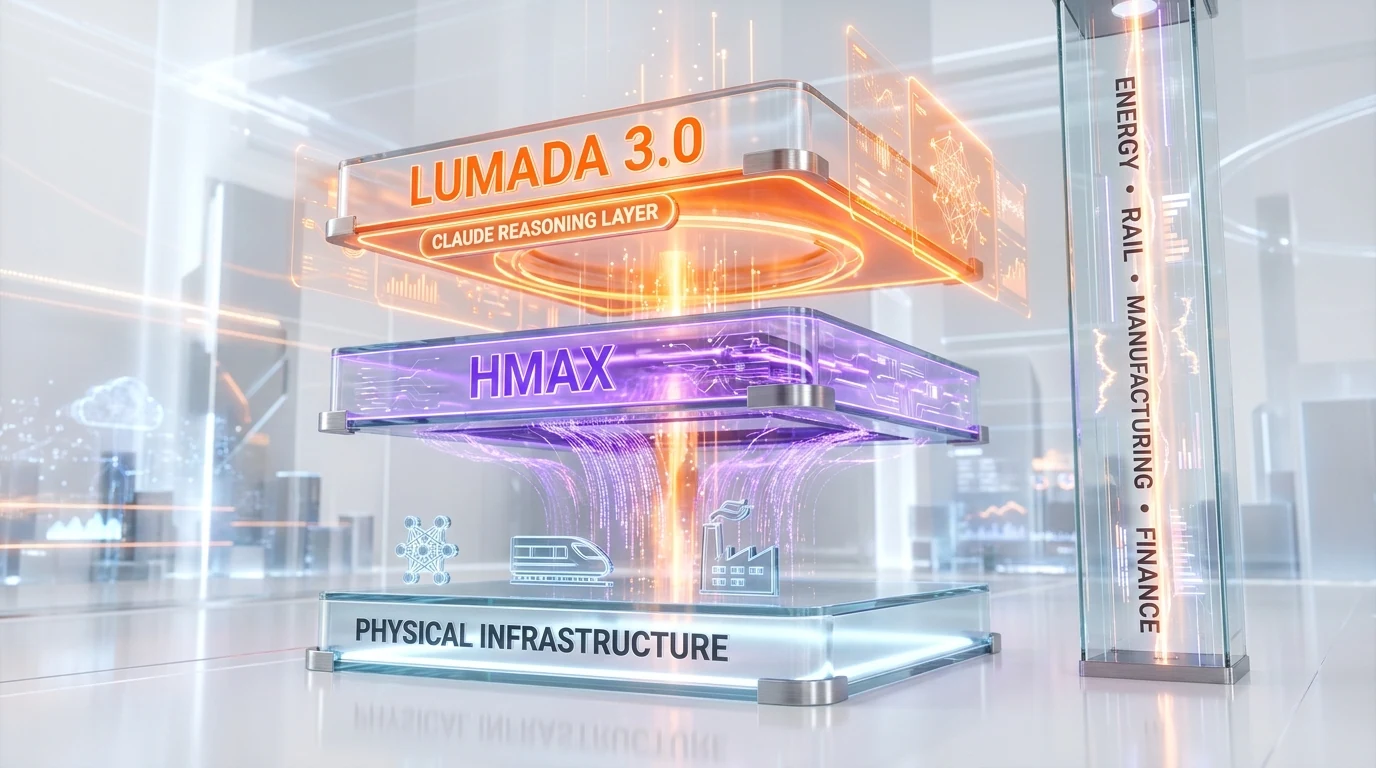
Anthropic's Claude is being slotted in as the reasoning layer for that platform. Not just a chatbot, not just a coding assistant — the layer that proposes actions, drafts documents, summarizes operational state, and increasingly drives agentic workflows inside HMAX. HMAX is Hitachi's internal AI orchestration solution; the press release frames Claude as a primary model inside it, deployed alongside Hitachi's existing operational technology stack.
The strategic claim from Hitachi is explicit. In Jun Abe's words, the partnership lets Hitachi "jointly solve customer and social challenges by combining Anthropic's highly trusted AI technology with Hitachi's domain expertise in mission-critical areas and our IT, OT, and product capabilities." Abe is Executive Vice President and Head of Hitachi's Digital Systems & Services Sector — meaning he runs the part of Hitachi that turns AI into shipped industrial systems, not the part that writes whitepapers about it.
"Through our Social Innovation Business, Hitachi has long contributed to the realization of a sustainable society. Today, as challenges facing frontline workers become more pronounced due to a shrinking workforce, we are very pleased that through this strategic partnership, Hitachi can jointly solve customer and social challenges by combining Anthropic's highly trusted AI technology with Hitachi's domain expertise in mission-critical areas and our IT, OT, and product capabilities." — Jun Abe, Executive Vice President, Head of Digital Systems & Services Sector, Hitachi.
The Frontier AI Deployment Center: a three-continent build
The most unusual element of this announcement is the joint deployment center. Most enterprise AI partnerships announce certifications, training programs and reference architectures. Very few announce a co-staffed entity that physically distributes deployment engineers across three regions.
The center launches with 100 experts from both sides and targets 300. That headcount target alone signals scope: it is not a customer-success team for one large account, it is a multi-region deployment shop sized to support hundreds of enterprise rollouts simultaneously. By comparison, the typical "joint center of excellence" in big-consultancy AI deals tops out at 30 to 60 people.
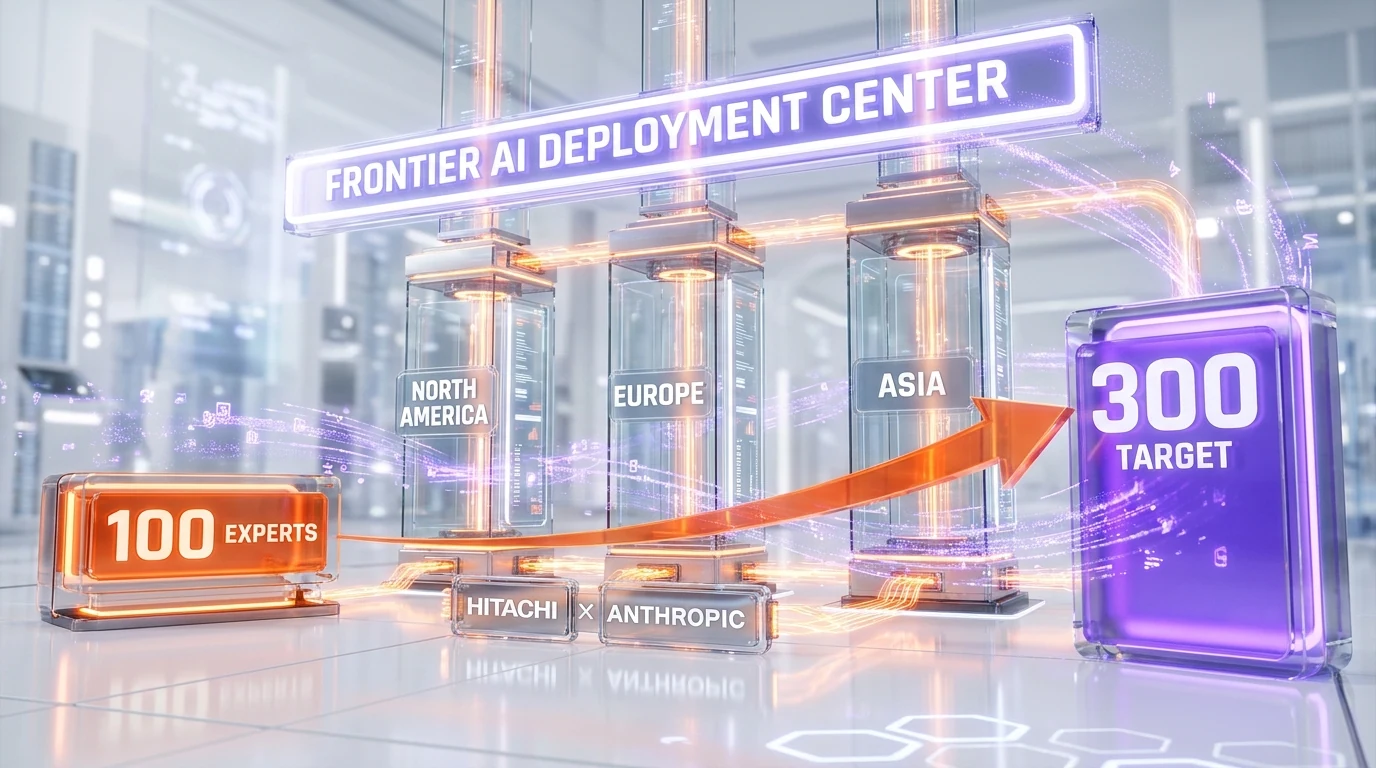
The geographic distribution is also strategic. Anthropic's deployment expertise is concentrated in San Francisco; Hitachi's industrial domain expertise is concentrated in Tokyo and across European industrial hubs. Pinning the joint center in all three regions removes the friction of time zones, regulation and language for critical-infrastructure customers — many of whom cannot legally move data or workflows to US-only support models.
The center's mandate, as disclosed, is twofold. It runs Hitachi's internal Customer Zero rollout: every Hitachi business unit gets Claude embedded in workflows, and the center owns the change management. It also runs joint go-to-market: enterprise customers buying Lumada 3.0 services get a deployment squad that includes Anthropic engineers, not just Hitachi consultants.
Customer Zero: the Ramp playbook, scaled to a conglomerate
"Customer Zero" is now Anthropic's signature deal structure. Ramp piloted it: the customer becomes a live laboratory, the vendor's product team gets feedback from production usage at scale, and the offering that ships externally is co-authored. Anthropic ran a version of this with PwC on May 14. Hitachi is the largest Customer Zero relationship Anthropic has disclosed.
The scale changes the meaning. 290,000 employees, spread across regulated industries — energy, rail, finance — means Claude will see workflows that no Anthropic researcher in San Francisco could have realistically reconstructed. Safety-critical OT workflows. Multi-jurisdiction compliance drafting. Industrial control documentation. Power grid operations and reliability writeups. This is feedback Anthropic cannot buy from any other customer.
For Hitachi, the trade is also legible. The conglomerate gets first-look access to Anthropic's frontier models and tooling. It gets co-development of features specific to its industrial workflows. And it gets — implicitly — a competitive moat. Once Claude is embedded across 290,000 employees and 100,000 specialists are certified on it, a rival conglomerate trying to deploy a different model starts that race 24 months behind.
Timing: announced under the I/O 2026 spotlight, deliberately
The week of May 18-22, 2026, was Google's. I/O keynotes dominated AI coverage: Gemini consumer features, AI mode for Search, Veo updates, Project Astra demos. Most enterprise AI announcements scheduled that week would have been buried. Hitachi-Anthropic was not.
That timing decision is interesting. One reading: Anthropic chose to announce inside the I/O window precisely because mainstream tech media would be saturated covering Google, leaving the enterprise audience — CIOs, industrial procurement, Japanese press — to receive the news through trade channels with less noise. Another reading: Hitachi's annual fiscal calendar drove the date, and Anthropic's PR team adjusted around it. Both are plausible. What is observable is the outcome — the announcement landed cleanly with industrial-AI and enterprise-software outlets, even as Google dominated consumer tech blogs.
Strategically, the contrast is the headline. Google's I/O 2026 was about distribution: getting Gemini in front of billions of consumers through Search, Workspace, and Android. Anthropic's week was about depth: getting Claude into the operational guts of one of the world's largest industrial conglomerates. Two completely different theories of how to win.
The pattern: PwC, KPMG, SAP, Hitachi — Anthropic's enterprise streak
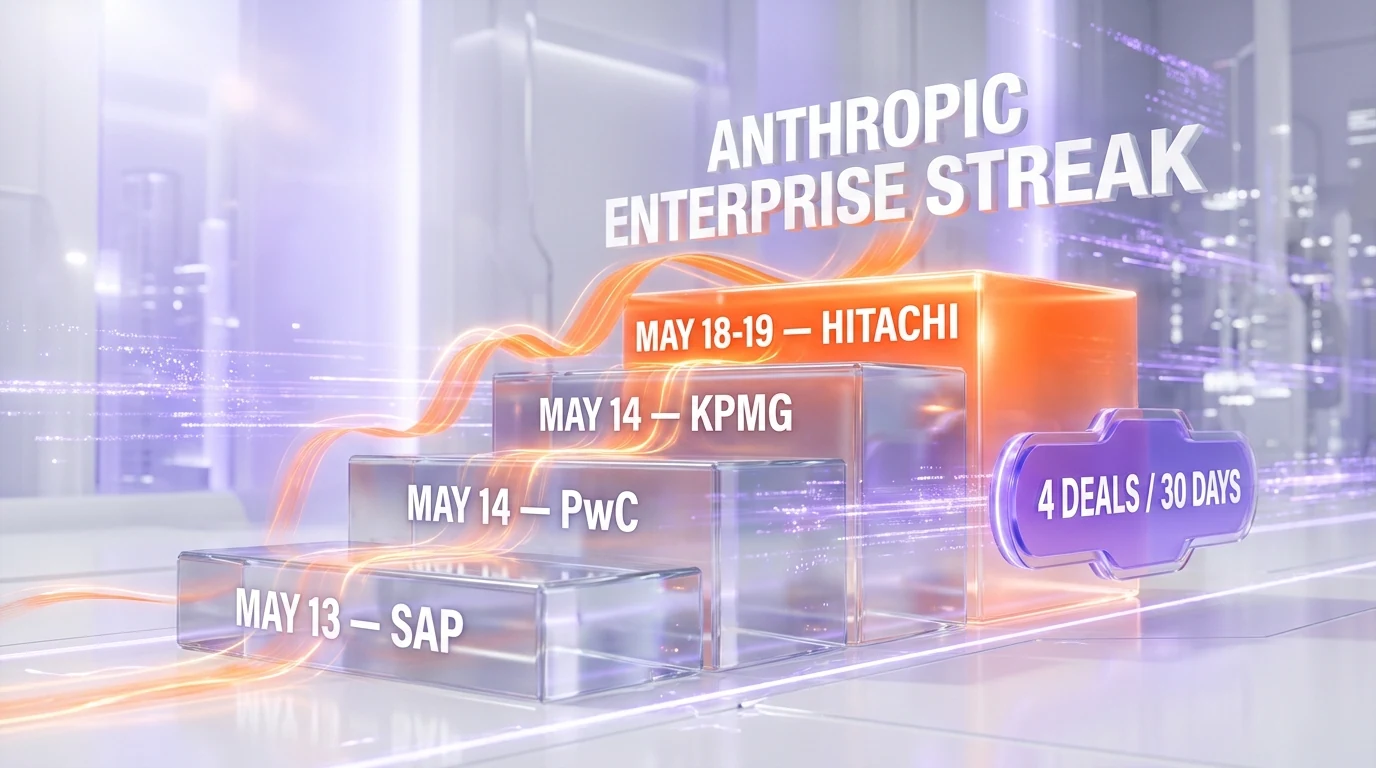
If you zoom out to the last 30 days, Anthropic has signed (or expanded) four headline enterprise deals that are individually significant and collectively a thesis:
- SAP — May 13, 2026, Sapphire keynote. Claude became the reasoning brain inside Joule, SAP's enterprise AI assistant. The ERP floor of the Fortune 500 routes through it. Full analysis →
- PwC — May 14, 2026. PwC certifies 30,000 US professionals on Claude, deploys Claude Code and Claude Cowork, opens a joint Center of Excellence. The Big Four bets on Anthropic. Full analysis →
- KPMG — Expanded Claude integration across audit and advisory practices (announced same window as PwC). Two of the Big Four are now vendor-aligned with Anthropic.
- Hitachi — May 18-19, 2026. 290,000 employees, 100,000 AI specialists, Frontier AI Deployment Center.
The common shape across these four deals is worth naming. Each one combines a large workforce certification, a co-staffed delivery unit, and an explicit "Customer Zero" or equivalent internal rollout commitment. Each one positions Claude as the primary frontier model inside the customer's flagship AI platform — Joule at SAP, Cowork at PwC, HMAX and Lumada 3.0 at Hitachi. And each one is signed without a public competing announcement from OpenAI or Google Cloud in the same enterprise segment.
That third observation matters. Microsoft's enterprise distribution through Copilot is enormous, and OpenAI's models still power most of it under the hood. But the named-vendor strategic partnerships — the ones where a Fortune 100 customer publicly chooses one frontier-model house over the others — have skewed heavily toward Anthropic in this window.
Critical infrastructure: the part nobody talks about loudly
Hitachi is not a consumer brand in the United States, so the deal undersells in US tech media. But Hitachi runs trains, power systems, financial infrastructure, and manufacturing operations across most major economies. The sectors named in the press release — energy, transportation, manufacturing, finance, critical infrastructure — are the highest-stakes deployment environments for any AI model.
Putting Claude into those workflows is a different kind of bet than putting it into a marketing department or a customer-service chat. Reliability, auditability, hallucination cost, regulatory traceability — they all get harder by an order of magnitude. The fact that Hitachi chose Anthropic for this is itself a signal about how Hitachi's risk teams have scored the major model families. We do not have those scoring documents, and we will not pretend to. But the choice is the data.
It is also a long bet. A workforce-wide rollout, a 100,000-person certification program, and a three-continent joint deployment center are not 12-month initiatives. They are 3-to-5-year structural commitments. Switching costs at year 3 are enormous. The customer is, in effect, building Claude into its operating model.
What this means for Anthropic, strategically
Three reads, from most conservative to most aggressive.
Conservative read. Anthropic has found a repeatable enterprise sales motion — Customer Zero, joint workforce certification, joint deployment center — and is executing it at high cadence. It is monetizing the part of the market that pays in eight-figure annual contracts rather than the part that pays in $20 per month consumer subscriptions. This is a defensible, high-margin business, and it is independent of any single foundation-model leadership gap.
Middle read. Anthropic is positioning itself as the enterprise-of-record frontier-model house. Google still wins on distribution. OpenAI still wins on brand and consumer mind-share. But the named-customer strategic partnerships are skewing to Anthropic, and that is the segment where compute commitments, ten-year roadmaps and physical-world deployments are negotiated. If that holds for two more quarters, the enterprise data flywheel compounds in Anthropic's favor.
Aggressive read. The four-deal streak — SAP, PwC, KPMG, Hitachi — is not coincidence; it is a sequencing strategy aimed at locking the enterprise stack faster than Google Cloud or OpenAI can respond. Pick the ERP floor (SAP). Pick the consulting floor (PwC, KPMG). Pick the industrial floor (Hitachi). After those, the obvious next moves are major banks, major telcos, and a national-government deal. We do not have evidence those are signed. We have evidence the previous four are. Three more would make this look like a deliberate enterprise blitz.
What this means for the rest of the market
For other industrial conglomerates — Siemens, GE, Mitsubishi, Schneider Electric — the Hitachi deal sets a benchmark. A 290,000-employee rollout with a joint deployment center is now a thing that has been done. The board-level question changes from "should we explore frontier AI" to "what is our equivalent of Hitachi's deal."
For competing model houses, the cost of catching up rises with each Anthropic mega-deal. Once Claude is the reasoning brain inside Lumada 3.0 and HMAX, the next vendor pitching Hitachi has to dislodge an embedded production system, not just win a procurement evaluation. Switching costs are real.
For procurement teams and CIOs evaluating frontier-model vendors right now, the takeaway is plain: the largest industrial buyers and the largest consulting firms have made their picks, publicly, in a 30-day window. That is the kind of cluster that signals which way the enterprise market is moving, even before pricing or benchmark data settles.
Open questions we are watching
Five things were not disclosed and we will not speculate on:
- Contract value — not disclosed. Multi-hundred-million is the analyst whisper number; we have no primary-source confirmation and will not print it as fact.
- Claude model variants — the press release says "Anthropic's Claude" without specifying Opus 4.7, Sonnet 4.6, or future versions. The deployment likely uses a mix; the specific variant assignments are not public.
- Compute commitments — neither side disclosed reserved compute, GPU commitments, or training-cluster access tied to the deal.
- Exclusivity — the press release does not state Hitachi is excluding other foundation models. Industrial conglomerates rarely sign single-vendor exclusives; we assume Hitachi will continue running multiple models in parallel, with Claude as primary.
- Timeline to full rollout — 290,000 employees do not get a new tool overnight. Realistic full deployment is multi-year. The 100,000 AI-specialist target is also undated in the public release.
Where we get hard data — earnings calls, follow-up press releases, regulatory filings — we will update this article and note the changes.
Frequently asked questions
What did Hitachi and Anthropic announce on May 18-19, 2026?
Hitachi Ltd. and Anthropic PBC announced a strategic partnership to deploy Anthropic's Claude across Hitachi's 290,000 global employees, train 100,000 AI professional talents, and launch a joint Frontier AI Deployment Center initially staffed by 100 experts and scaling to 300 across North America, Europe and Asia. The deal anchors Hitachi's Lumada 3.0 strategy in frontier AI.
How does the Hitachi-Anthropic deal compare to the PwC and KPMG partnerships?
PwC certified 30,000 US professionals on Claude and opened a joint Center of Excellence on May 14, 2026. KPMG expanded its Claude integration in the same window. Hitachi triples the workforce-certification commitment to 100,000 AI specialists and adds a three-continent Frontier AI Deployment Center, on top of a 290,000-employee Claude rollout. It is the largest Anthropic enterprise commitment disclosed to date by total population.
What is the Frontier AI Deployment Center?
It is a joint Hitachi-Anthropic unit that will own internal Claude rollouts at Hitachi and joint go-to-market with enterprise customers buying Lumada 3.0 services. It launches with 100 experts and targets 300, distributed across North America, Europe and Asia.
Which Claude models will Hitachi deploy?
The press release uses the generic phrasing "Anthropic's Claude" without naming Opus 4.7, Sonnet 4.6 or specific variants. The realistic assumption is a mix of models aligned to workload — coding, reasoning, summarization — but the specific assignments were not disclosed.
Is Hitachi switching away from OpenAI or Google Gemini?
The press release does not state exclusivity. Industrial conglomerates of Hitachi's size typically run multiple foundation models in parallel. What is disclosed is that Claude becomes a primary model inside HMAX and Lumada 3.0 for the workflows covered by this partnership.
What is "Customer Zero" in this deal?
Customer Zero is Anthropic's approach where the customer deploys the product internally first, at full scale, and the operational lessons feed back into both the vendor's product roadmap and the customer's external offerings. Anthropic used a version of this with Ramp last year and with PwC on May 14, 2026. Hitachi is the largest Customer Zero relationship Anthropic has disclosed.
How much is the Hitachi-Anthropic deal worth?
The contract value was not disclosed by either party. Analyst whisper numbers exist but no primary-source confirmation. We will not print a figure that is not in the press release.
Why announce during Google I/O 2026?
The deal landed during the May 18-22 I/O window. One reading is that Anthropic let mainstream tech media stay focused on Gemini consumer demos while enterprise-trade outlets covered Hitachi-Anthropic with less noise. Another reading is that Hitachi's fiscal calendar drove the date. Both are plausible. The observable outcome is that the deal landed cleanly with enterprise-software and industrial-AI press.
What is Lumada 3.0?
Lumada is Hitachi's digital business platform. Lumada 3.0 is the current iteration, focused on "physical AI" for critical infrastructure — energy, transport, manufacturing, finance — where reliability, safety and regulatory traceability outweigh benchmark scores. Claude is being slotted in as a reasoning layer inside Lumada 3.0 and HMAX, Hitachi's in-house industrial AI platform.
How does this affect Siemens, GE and other industrial competitors?
The Hitachi deal sets a benchmark. A 290,000-employee Claude rollout with a joint three-continent deployment center is now a thing that has been done in the industrial conglomerate segment. Boards at Siemens, GE, Mitsubishi and Schneider Electric will need a response, not an exploration phase.
Is Anthropic dependent on a small number of enterprise mega-deals?
Anthropic has signed or expanded four headline enterprise deals in roughly 30 days — SAP (May 13), PwC (May 14), KPMG (same window), Hitachi (May 18-19). The streak suggests a repeatable enterprise sales motion rather than dependence on any single account. Concentration risk is still a real question, but the cadence does not look like an artifact of one big customer.
Where can I read the primary-source press release?
The official Hitachi press release, titled "Hitachi announces strategic partnership with Anthropic to strengthen 'Lumada 3.0' through frontier AI," is published on hitachi.com under press articles dated May 19, 2026. Anthropic had not posted a corresponding entry on its newsroom page at the time of this article.