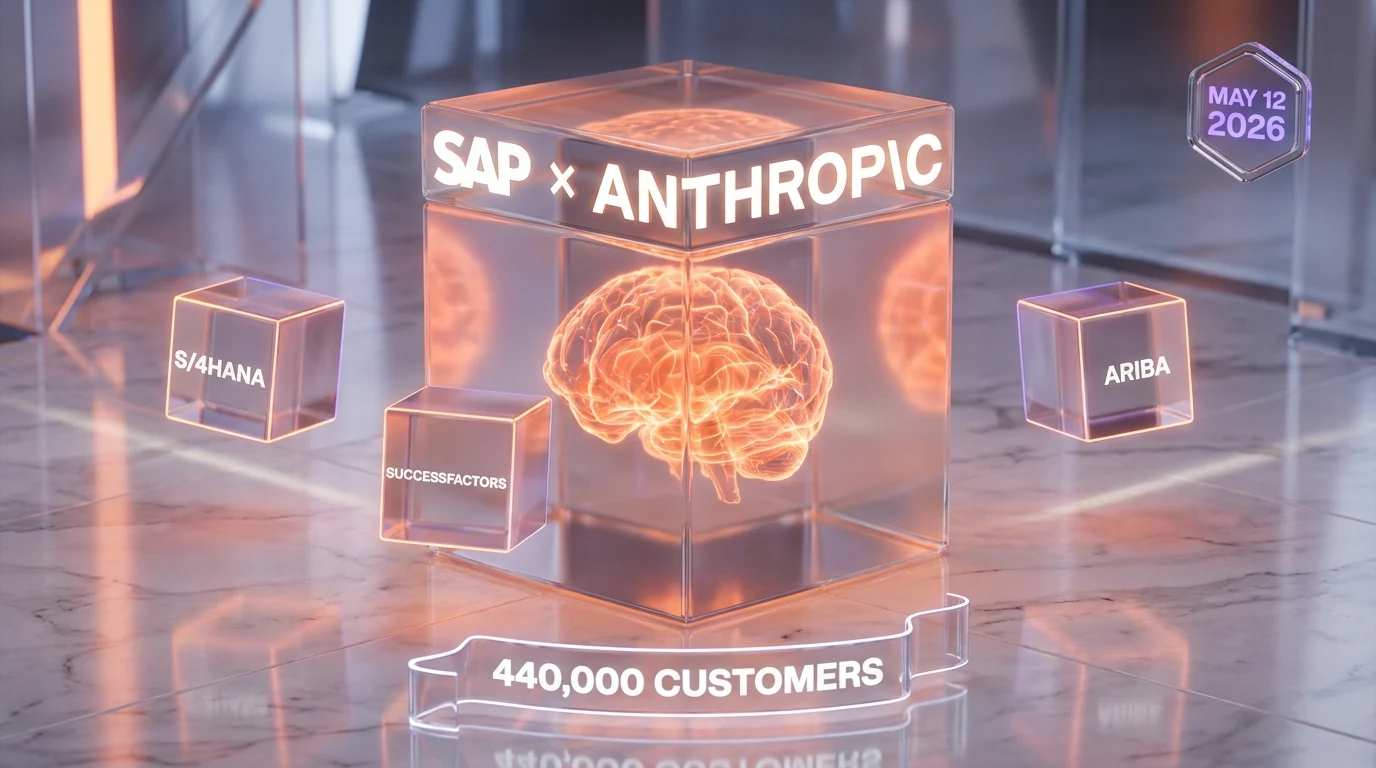
At the SAP Sapphire 2026 keynote on May 12, 2026, SAP and Anthropic announced that Claude — Anthropic's frontier model family including Opus 4.7, Sonnet 4.6, and Haiku 4.5 — will become the primary reasoning and agentic capability embedded across the SAP Business AI Platform, the company's unified AI layer wrapping BTP, Business Data Cloud, and Business AI. The deal puts Claude directly inside Joule, SAP's AI assistant, and into the 200+ specialized Joule agents that now operate across S/4HANA, SuccessFactors, and Ariba. With roughly 440,000 enterprise customers globally — including most of the Fortune 500 — SAP is the largest enterprise software footprint Anthropic has ever anchored. Forrester analyst Faram Medhora published the same day that "Claude as the anchor creates concentration risk that becomes board-level in regulated industries within 24 months." Hours earlier, Anthropic shipped Claude Platform on AWS to general availability — meaning the same May 12 saw Anthropic lock in both the F500 ERP layer and the hyperscaler-native enterprise stack on AWS.
What SAP and Anthropic Actually Announced
The Sapphire 2026 keynote in Orlando ran two parallel announcements that, taken together, redraw the enterprise AI map. The first — billed by SAP as the headline — was the SAP Autonomous Enterprise vision, anchored by a unified SAP Business AI Platform. The second, the SAP × Anthropic partnership, is the one that matters for the next two years of competitive positioning across enterprise software.
The Claude anchor position
Per SAP's announcement post and Forrester's day-of analysis, Claude is now positioned as the primary reasoning model anchoring the SAP Business AI Platform. SAP's blog uses the language "primary reasoning and agentic capability" — wording chosen carefully to give Claude default position without ruling out alternative routing. The supporting model portfolio rounds out as follows:
- SAP-RPT-1. SAP's own tabular foundation model, optimized for structured business data, shipped GA on May 12 alongside the Anthropic announcement.
- Prior Labs. SAP confirmed the pending acquisition of Prior Labs for non-SAP tabular workloads, with closing targeted Q2 to Q3 2026.
- Mistral and Cohere. Both listed as partners for sovereign deployment options — the regulated-industry exit valve when Claude routing is not acceptable to a specific compliance posture.
The architectural read: Claude carries the reasoning and agentic load by default. SAP-RPT-1 handles the bulk tabular crunching where Claude would be overkill or too expensive. Mistral and Cohere are the second-source insurance policy. This is the same multi-model topology that finance giants Citadel, BNY, and Carlyle adopted earlier in 2026 when they put 10 Claude agents into production — and it is becoming the dominant pattern for regulated industries that want frontier reasoning but cannot afford single-vendor exposure.
The executive quotes that matter
Two quotes anchored the announcement and they are worth reading in full because they signal where each company sees the moat. SAP CEO Christian Klein, per the May 12 SAP News post: "The Autonomous Enterprise requires AI that understands business context and acts within the controls organizations depend on." Daniela Amodei, Anthropic co-founder and president: "That work happens inside the systems enterprises have already invested in." Klein is selling control. Amodei is selling presence — Anthropic at the desk, not in a separate browser window.
Joule, the 200+ Agent Army Now Running on Claude
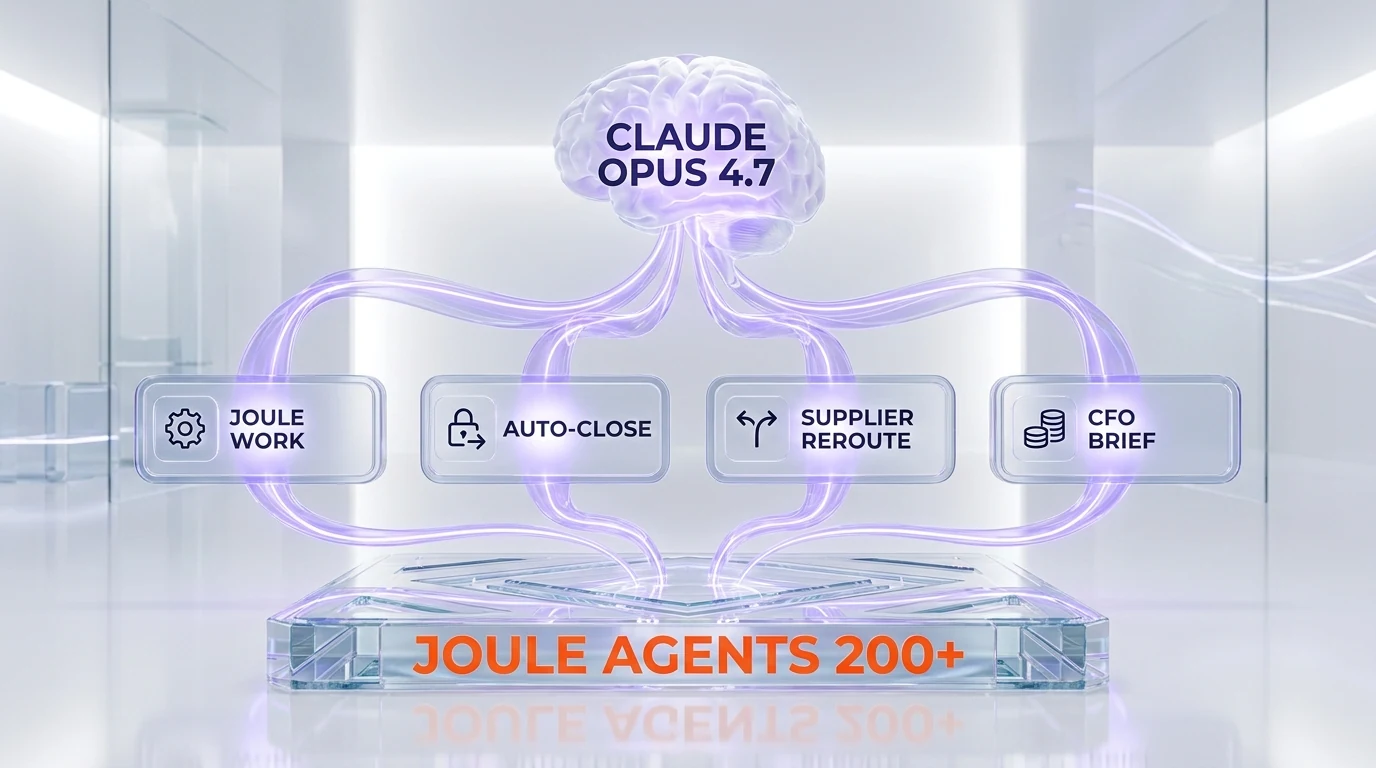
Joule was SAP's AI-enabled business assistant before May 12. After May 12, Joule is the productized surface where Claude reasons inside SAP's processes. Per SAP's announcement, Joule now ships with 200+ specialized agents for precise task execution and 50+ domain-specific Joule Assistants across finance, supply chain, procurement, HR, and customer experience. Joule operates on desktop, mobile, and voice across SAP and non-SAP systems via Model Context Protocol connectors.
Four jobs Claude runs inside Joule today
SAP's keynote showcased four production-grade Joule capabilities anchored on Claude's reasoning layer, each one a workflow that would have required a human team six months ago:
- Closing quarterly books. The Autonomous Close Assistant — running on Claude reasoning over S/4HANA ledger data — compresses the financial close cycle from weeks to days. JPMorgan Chase CFO Jeremy Barnum confirmed on stage that the bank is running its general ledger migration toward this exact pattern.
- Answering employee leave questions. A Joule Assistant inside SuccessFactors reads policy, parses the employee's tenure and accrual, and returns a structured answer — the kind of question that used to consume 10 to 20 percent of HR triage tickets.
- Rerouting supplier orders mid-shipment. An Ariba-side Joule agent that observes supply-chain telemetry, identifies a shipment disruption, evaluates alternative routes against contract terms, and re-routes — all with auditable change logs back into the procurement system.
- Preparing CFO briefings with live data. Joule Work — the new natural-language outcome interface — ingests "describe the business outcome you need" and orchestrates the workflow across S/4HANA finance modules to produce a briefing pack with live numbers.
None of these are demo-only. SAP listed Bayer, Novartis, Takeda, Ericsson, and H&M as production anchors for the Autonomous Enterprise stack. The pharma triple in that list — Bayer plus Novartis plus Takeda — is what gives the announcement its weight. Pharma is where regulatory exposure is highest and where "AI in production" claims usually fall apart on closer reading. If three of the world's top ten pharma companies are running Claude reasoning inside their SAP stacks at any meaningful scale, that is a credibility signal that no marketing budget can manufacture.
Why now — the strategic timing for SAP
SAP did not do this deal because Anthropic was the cheapest reasoning option. SAP did this deal because Anthropic was the only frontier lab that would let SAP put Claude inside the customer's environment — within governance, within compliance, within the controls organizations depend on. That phrase from Klein's keynote — "within the controls organizations depend on" — is doing heavy lifting. It signals that the integration runs inside SAP's IAM and audit boundary, not via a separate Anthropic console. The customer's data does not leave the SAP perimeter for inference except where the customer has explicitly opted in.
The competitive read: OpenAI's deepest enterprise play this quarter was the $4 billion Bain plus McKinsey plus Capgemini Deployment Company JV — a services-led motion. SAP × Anthropic is a product-led motion: Claude shows up inside the software the F500 already runs every day. Services beats product on velocity; product beats services on retention. For a 24-month strategic horizon, product wins.
The Three-System Coverage — S/4HANA, SuccessFactors, Ariba
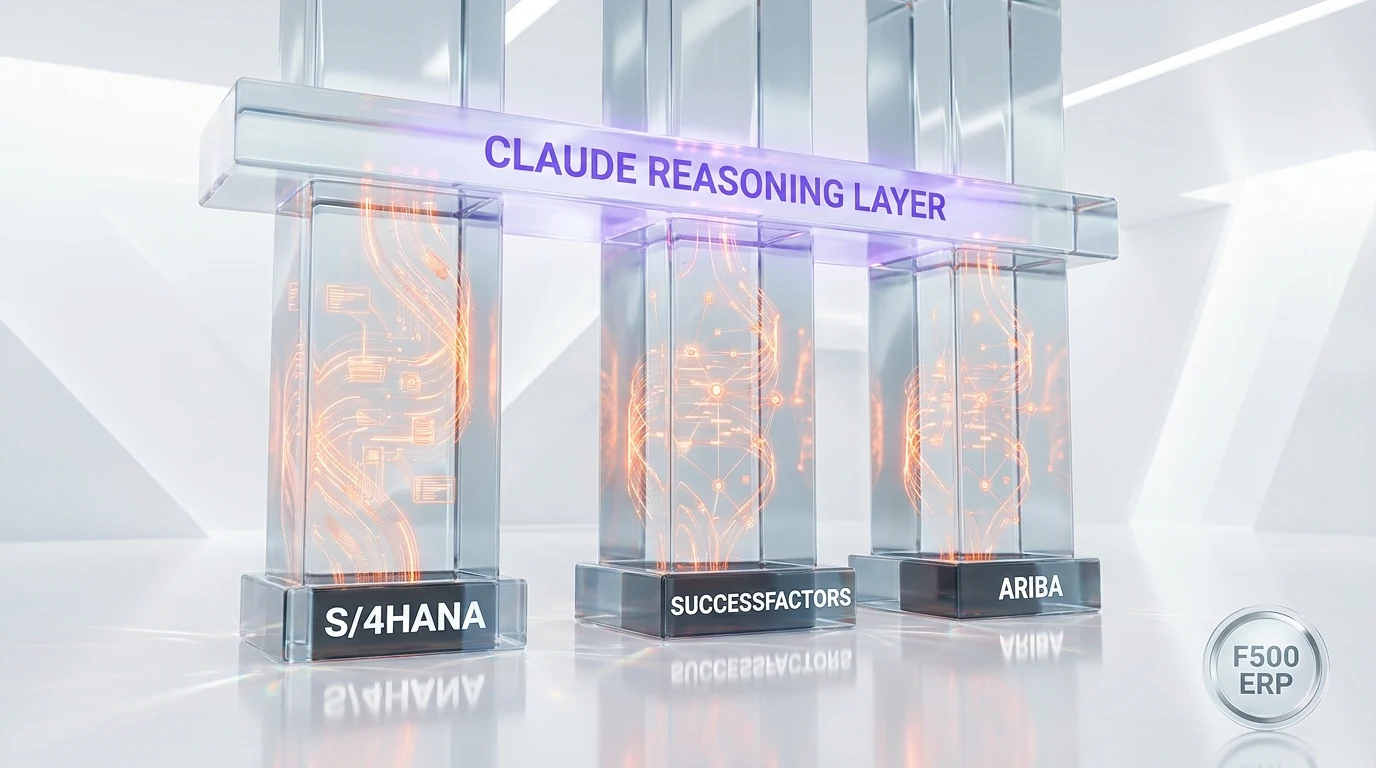
Three SAP systems matter for the May 12 announcement because they form the core operational stack at most Fortune 500 companies. Each one is now a place where Claude's reasoning layer can be invoked from inside the application, not as an external API call.
S/4HANA — finance, operations, supply chain
S/4HANA is SAP's flagship ERP suite. It runs general ledger, accounts payable, accounts receivable, manufacturing execution, and supply-chain operations for most of the Fortune 500. Per the May 12 announcement, Joule agents on S/4HANA now invoke Claude as the default reasoning model for analytical tasks: cash flow projections, variance analysis, multi-entity consolidation, anomaly detection in vendor invoices. The integration spans both S/4HANA Cloud and S/4HANA on-premises customers eligible via the RISE with SAP program. ECC customers — running on the predecessor ERP suite — also gain access to select Joule scenarios through their migration path.
SuccessFactors — workforce, talent, learning
SuccessFactors handles HR operations, talent management, learning, and workforce planning across SAP's enterprise customer base. The new SuccessFactors Joule integration uses Claude to handle policy interpretation, employee self-service questions at scale, talent-pipeline reasoning, and learning-path recommendations. SAP's AI Agent Hub includes governance controls that map workforce data through the SuccessFactors workforce graph before Claude reasons over it — preserving employee privacy boundaries that are non-negotiable in EU and other regulated jurisdictions.
Ariba — procurement, supplier network, spend analysis
Ariba is the supplier-network and procurement system handling roughly $3 trillion in commerce annually across SAP's customer base. Joule on Ariba uses Claude to reason over supplier risk, contract terms, spend categories, and disruption-response routing. The supplier-reroute demo at Sapphire — re-routing a mid-shipment order based on a disruption signal — was the headline Ariba Joule agent example, and it is the kind of workflow that demonstrates Claude's plan-execute-report loop applied to a real procurement decision.
The horizontal coverage matters more than any single integration. A Fortune 500 CFO can now ask Joule a question that spans finance (S/4HANA), workforce cost (SuccessFactors), and procurement spend (Ariba), and Claude reasons across all three system contexts. That cross-system reasoning is the killer enterprise feature, and it is what no other AI vendor can match inside the SAP estate.
Claude Platform on AWS Goes GA the Same Day
The second half of May 12 — easy to miss because the SAP keynote dominated the news cycle — is that Anthropic took Claude Platform on AWS to general availability. The launch matters because it gives enterprise customers a third procurement and deployment path: directly via Anthropic, via AWS commitments, and now inside SAP. Anthropic has not had this kind of channel triangulation before.
What shipped on AWS
Per Anthropic's launch post and the AWS Machine Learning blog, Claude Platform on AWS bundles the full Anthropic developer surface: Messages API, Claude Managed Agents in beta, web search and web fetch tools, code execution, the Files API, Skills, the MCP connector, prompt caching, citations, and batch processing. Authentication runs through native AWS IAM with no separate Anthropic API keys required. Billing flows through AWS Marketplace as a single consolidated invoice that retires against existing AWS commitments. Audit logging plugs into AWS CloudTrail. Coverage spans 18 AWS regions including US East, US West, Canada, multiple European geographies, and Asia Pacific.
For procurement teams, this is the elimination of three friction points: separate vendor onboarding, separate billing reconciliation, and separate compliance review. For builders, it means the full Claude Opus 4.7, Sonnet 4.6, and Haiku 4.5 lineup is available behind an AWS-native auth surface — and the agentic primitives (Skills, MCP, Managed Agents) all ship inside the same boundary.
The double-play strategic read
SAP × Anthropic and Claude Platform on AWS, announced the same Tuesday, function as a coordinated enterprise pincer movement. SAP delivers Claude inside the application surface the F500 already uses for finance, HR, and procurement. AWS delivers Claude as a hyperscaler-native platform for everything the F500 wants to build on top. Between the two, Anthropic has now occupied both the application layer (SAP) and the infrastructure layer (AWS) for enterprise reasoning workloads — a coverage geometry that OpenAI does not currently match across Microsoft's Azure + Microsoft 365 stack.
For comparison: OpenAI's deepest enterprise infrastructure play is Azure OpenAI Service, and its application-layer presence is Microsoft 365 Copilot — but Microsoft, not OpenAI, owns the Copilot integration economics. Anthropic now has an SAP integration where Anthropic, not SAP, owns the reasoning brand. The branding distinction matters when customers are choosing between "AI inside SAP" and "AI from SAP." The May 12 messaging from both Klein and Amodei consistently used the former framing.
The Concentration Risk Forrester Just Made Board-Level

The most important paragraph in any May 12 analyst note came from Forrester's Faram Medhora, who published the same day as the keynote. Medhora's exact phrase, worth quoting verbatim because it is going to anchor every CIO conversation for the next four quarters: "Claude as the anchor creates concentration risk that becomes board-level in regulated industries within 24 months." That is the most precise framing of the SAP × Anthropic risk surface anyone has published, and it deserves unpacking.
What concentration risk actually means here
Concentration risk in this context has three specific components, and each one is on a different time horizon:
- Vendor pricing power. Once Claude is the default reasoning anchor across an F500 customer's SAP estate, switching costs are measured in tens of millions of dollars and 18-month migration cycles. Anthropic has structural pricing power on contract renewal. Forrester's note flags a 2027 pricing cliff as a budgeting challenge that CFOs need to model now.
- Model behavior dependency. If Claude's reasoning approach changes materially in a future model version — say, a different stance on financial hedging recommendations, or a different tolerance for procurement risk — every Joule agent built on Claude inherits that drift. SAP's governance layer mitigates this, but does not eliminate it.
- Vendor solvency and continuity. Anthropic's $10 billion-plus annualized revenue run-rate as of Q1 2026 makes solvency risk look low today, but the company is still in a phase of frontier-lab capital intensity. A regulated-industry CIO has to underwrite Anthropic's continuity in a way that, ten years ago, they had to underwrite SAP or Oracle.
Medhora's "24 months" timeline is the answer to "when does this go from CIO-level worry to board-level discussion?" The reading: by Q2 2028, audit committees at regulated F500 companies will need a documented stance on Claude-anchor concentration. That is a corporate-governance event, not just a procurement event.
How SAP is trying to mitigate the risk
SAP knew the concentration question would come, which is why the May 12 architecture deliberately includes second-source paths. SAP-RPT-1 covers the tabular workloads where Claude would be overkill. Prior Labs, pending acquisition closing in Q2 to Q3 2026, extends the tabular capability to non-SAP data. Mistral and Cohere serve as the sovereign-deployment exit for customers in jurisdictions or industries where Claude routing is not acceptable. The model-routing layer inside Joule is designed to be model-agnostic at the architectural level even though Claude is the default at the policy level.
Whether that architectural mitigation will satisfy a board-level concentration review is the open question. The pattern we have seen in regulated industries — banking, pharma, energy — is that "model-agnostic by architecture, single-anchor by default" gets challenged in the first regulatory audit cycle that crosses the SAP × Anthropic boundary. Watch for the first European banking regulator inquiry into Joule-on-Claude usage by Q1 2027 as the leading indicator.
Anthropic's Enterprise 2026 Landscape Just Got Definitive

The SAP partnership does not exist in isolation. Anthropic spent Q1 and the first half of Q2 2026 building an enterprise stack that, by May 12, looks like the most comprehensive enterprise positioning any frontier lab has assembled. Reviewing the partnerships in order of when they shipped and what they unlock:
EPAM — 10,000 certified Claude architects
The EPAM partnership announced earlier in May commits the global consulting firm to training 10,000 Claude-certified solution architects. EPAM is one of the four or five large enterprise systems integrators that gets called into every F500 digital transformation. Having 10,000 EPAM architects who default to Claude is the kind of capacity build that converts Anthropic from a vendor relationship into a default ecosystem choice.
Goldman + Blackstone — $1.5B services JV
The Goldman Sachs and Blackstone joint venture at $1.5 billion funding extends Anthropic's enterprise services motion into the financial-services and private-capital world. Goldman brings the investment-banking and asset-management distribution. Blackstone brings the portfolio-company access — Blackstone owns major stakes in companies across software, financial services, healthcare, and consumer goods. Together they create an enterprise services channel that, alongside EPAM, blankets the high-value F500 deal flow.
NEC Japan — 30,000 employees, AI-native engineering
The NEC partnership in Japan retrofits 30,000 engineers across one of Japan's largest technology integrators into an AI-native engineering team standardized on Claude. NEC is the gateway to Japanese enterprise — a market where SAP also has deep penetration. The SAP × Anthropic move and the NEC × Anthropic move stack on top of each other in Japan: a Japanese enterprise running SAP and considering AI options now has both the application-layer pull (Joule on Claude) and the systems-integrator push (NEC trained on Claude) pointing the same direction.
Citadel, BNY, Carlyle — 10 production finance agents
The 10 Wall Street agents announcement earlier in 2026 put Claude into production at Citadel, BNY Mellon, and Carlyle Group — three of the most demanding financial-services environments on Earth. Each one validates Claude's regulated-industry posture, which is precisely what SAP needed to point at when SAP's own customers in pharma and banking asked "can Anthropic handle our compliance bar?"
10 gigawatts of compute — the foundation underneath
Standing behind all of it is the 10-gigawatt compute empire Anthropic has been assembling across AWS, Google Cloud, and dedicated capacity build-outs. The compute layer is what makes the SAP-scale anchoring credible. A 440,000-customer SAP customer base running Claude reasoning on production workflows would have melted any 2024-era inference fleet. By May 2026, the 10 GW number is what makes the architecture plausible at SAP volume.
What Would Prove This Overhyped
We are bullish on the strategic positioning and cautious on the rollout. Three signals in the next 12 months will determine whether the SAP × Anthropic narrative survives contact with production reality or whether the concentration-risk discount kicks in early.
Customer adoption curve through 2026 H2
SAP's S/4HANA installed base is large and slow-moving. Joule agents on Claude need to show measurable adoption at SAP customer events through Q3 and Q4 2026 — not just announced pilots, but documented production usage. If SAP's October 2026 customer summit lacks a clean set of named customers running Joule on Claude in production beyond the keynote anchors, the rollout is behind schedule.
The first major Claude incident inside SAP
Every enterprise-scale AI integration has its first major incident. Anthropic's most recent operational stress test came in April 2026 when a state-affiliated attacker used Claude in a sustained operation against the Mexican water utility — a different vector than enterprise integration but the same model dependency. The SAP × Anthropic equivalent will be the first time a Joule agent makes a materially wrong call inside an S/4HANA financial workflow at a regulated customer. How SAP and Anthropic respond — speed, transparency, governance changes — will define the partnership's durability.
The 2027 pricing renegotiation
Forrester flagged a 2027 pricing cliff as a budgeting challenge. Anthropic's enterprise pricing has not faced its first hard renewal cycle at SAP scale yet. The first contract renegotiations — likely landing in Q3 and Q4 2027 — will reveal whether Anthropic exercises the pricing power that concentration suggests or holds back to preserve the partnership. The market will price the answer hard in either direction.
Our Strategic Read
The May 12 announcement is, in our reading, the most consequential enterprise AI deal of 2026 to date — bigger than the Goldman plus Blackstone services JV in funding size, bigger than the EPAM training commitment in long-tail capacity, and bigger than any of Anthropic's individual customer wins because SAP × Anthropic compounds across SAP's existing 440,000-customer relationship pipeline. Anthropic did not just sign a software partnership. Anthropic anchored itself inside the operational substrate that the Fortune 500 already pays SAP to run.
The strategic timing is sharp. Anthropic chose to ship the same day as Claude Platform on AWS GA, multiplying the press cycle. SAP chose to anchor Claude precisely as the autonomous-enterprise narrative is becoming a board-level conversation across the F500. The two moves reinforce each other in the analyst notes and in the customer pipeline reviews that close Q2.
The strategic risk is also sharp. Forrester's concentration-risk framing is not going away. The 24-month clock starts now. The customers that will pay the most attention are not the SAP customers at Sapphire — they are the audit committees and the chief risk officers two steps removed who read the keynote summary at 7 AM the morning after. Their question is not "is Claude good?" Their question is "what happens to us if Anthropic is not here in 2030?" SAP and Anthropic have an answer that involves SAP-RPT-1, Prior Labs, Mistral, Cohere, and the agnostic-by-architecture-default-by-policy framing. Whether that answer holds for the first audit cycle is the test we are watching.
For builders and CIOs reading this in the next two weeks: the practical implication is that any new enterprise project involving SAP, agentic reasoning, or F500 ERP integration now has Claude as the default-considered model. Even if you choose differently, you will have to justify the deviation. That is the consequence of a default-position win. Anthropic now has it inside SAP. The next two years will determine whether anyone can pry it loose.
Frequently Asked Questions
What did SAP and Anthropic actually announce at Sapphire 2026?
On May 12, 2026, at the SAP Sapphire keynote in Orlando, SAP and Anthropic announced that Claude — Anthropic's Opus 4.7, Sonnet 4.6, and Haiku 4.5 model family — will be the primary reasoning and agentic capability embedded across the SAP Business AI Platform. Claude now powers Joule, SAP's AI assistant, and the 200+ specialized Joule agents that run across S/4HANA, SuccessFactors, and Ariba. The deal was announced jointly with the GA launch of Claude Platform on AWS the same day.
Which SAP products are covered by the Claude integration?
The Claude reasoning layer covers the SAP Business AI Platform (which unifies BTP, Business Data Cloud, and Business AI), Joule and Joule agents, S/4HANA (cloud and on-premises via RISE), SuccessFactors (HR), and Ariba (procurement). SAP ECC customers gain access to select Joule scenarios through their migration path. The SAP Autonomous Suite is the broader umbrella covering these systems.
Why is Forrester warning about concentration risk?
Forrester analyst Faram Medhora wrote on May 12 that "Claude as the anchor creates concentration risk that becomes board-level in regulated industries within 24 months." The concern has three dimensions: pricing power on contract renewal once switching costs are sunk, model-behavior drift that propagates through every Joule agent, and Anthropic vendor solvency in a phase of frontier-lab capital intensity. The 24-month timeline points to corporate-governance audit cycles by Q2 2028.
How does SAP mitigate the Anthropic dependency?
SAP's architecture deliberately includes second-source paths: SAP-RPT-1 (SAP's own tabular foundation model, shipped GA May 12) for structured business data workloads, Prior Labs (pending acquisition closing Q2-Q3 2026) for non-SAP tabular data, and partnerships with Mistral and Cohere as sovereign-deployment options for regulated industries where Claude routing is not acceptable. Joule's routing layer is model-agnostic by architecture even though Claude is the default by policy.
What can Joule agents actually do with Claude reasoning?
SAP showcased four production-grade workflows at Sapphire 2026: closing quarterly books via the Autonomous Close Assistant inside S/4HANA, answering employee leave questions via SuccessFactors Joule Assistants, rerouting supplier orders mid-shipment via Ariba Joule agents, and preparing CFO briefings with live data via Joule Work natural-language orchestration. SAP also disclosed 50+ domain-specific Joule Assistants across finance, supply chain, procurement, HR, and customer experience.
Which Fortune 500 customers are running this in production?
SAP listed Bayer, Novartis, Takeda, Ericsson, and H&M as production anchors for the SAP Autonomous Enterprise stack. JPMorgan Chase CFO Jeremy Barnum appeared on stage during the keynote and confirmed the bank is running its general ledger migration toward the Autonomous Close pattern. The pharma triple in particular — Bayer plus Novartis plus Takeda — gives the deal regulated-industry credibility that marketing alone could not.
What is Claude Platform on AWS and why did it ship the same day?
Claude Platform on AWS reached general availability on May 12, 2026, the same day as the SAP × Anthropic announcement. The platform bundles the Messages API, Claude Managed Agents in beta, Skills, MCP connector, Files API, code execution, and prompt caching behind AWS IAM authentication and AWS Marketplace billing. The coordinated timing gives Anthropic both an application-layer enterprise win (SAP) and an infrastructure-layer enterprise win (AWS) on the same day, locking in both surfaces of the F500 stack.
How does SAP × Anthropic compare to OpenAI's enterprise plays?
OpenAI's deepest enterprise presence runs through Microsoft Azure and Microsoft 365 Copilot, but Microsoft, not OpenAI, owns the Copilot integration economics. OpenAI's services-led push includes the $4 billion Deployment Company JV with Bain, McKinsey, and Capgemini announced May 11. SAP × Anthropic is structurally different: Anthropic, not SAP, owns the reasoning brand inside Joule, and the integration is product-led rather than services-led. Forrester framed the May 12 landscape as "Microsoft-OpenAI and SAP-Anthropic become the two dominant alignments."
What does Joule Work specifically change for end users?
Joule Work is the new natural-language outcome interface inside Joule. Instead of running structured workflows, users describe the business outcome they need — "prepare a CFO briefing with last quarter's variance against budget" or "draft a procurement plan for our European warehouses" — and Joule orchestrates the workflow across SAP and non-SAP systems autonomously. The reasoning loop runs on Claude. Joule Work is available on desktop, mobile, and voice.
Is there a pricing risk on the Anthropic relationship for SAP customers?
Forrester flagged a 2027 pricing cliff as a budgeting challenge for SAP customers running Claude-anchored Joule workflows. The first hard contract renegotiation cycles for Anthropic's enterprise pricing inside SAP are likely to land in Q3 and Q4 2027, after switching costs have been sunk into agent customization, training, and governance setup. CFOs should model the renewal-cycle pricing exposure now rather than at renewal. SAP's mitigation lever is the SAP-RPT-1 plus Mistral plus Cohere fallback architecture, but that lever is most useful for tabular and sovereign workloads, not for the core reasoning surface.
Is this the biggest enterprise AI deal of 2026 so far?
In our reading, yes. The SAP × Anthropic deal compounds across SAP's roughly 440,000-customer relationship pipeline, anchors Anthropic inside the operational substrate that the Fortune 500 already runs (finance, HR, procurement), and ships the same day as Claude Platform on AWS GA. Compared to the Goldman plus Blackstone $1.5 billion services JV, the EPAM 10,000-architect training commitment, or the NEC Japan 30,000-engineer partnership, SAP × Anthropic carries more compounding leverage because it ships Claude inside the application surface customers already pay to run, rather than as a services or training motion.
Sources
- SAP News Center — SAP and Anthropic Plan to Bring Claude to SAP Business AI Platform (May 12, 2026)
- SAP News Center — SAP Unveils the Autonomous Enterprise (May 12, 2026)
- Forrester — SAP Sapphire 2026: The Autonomous Enterprise Is Credible, But It Comes With Concentration Risk by Faram Medhora (May 12, 2026)
- AWS Machine Learning Blog — Introducing Claude Platform on AWS (May 12, 2026)
- Anthropic — Claude Platform on AWS Now Generally Available (May 11, 2026)