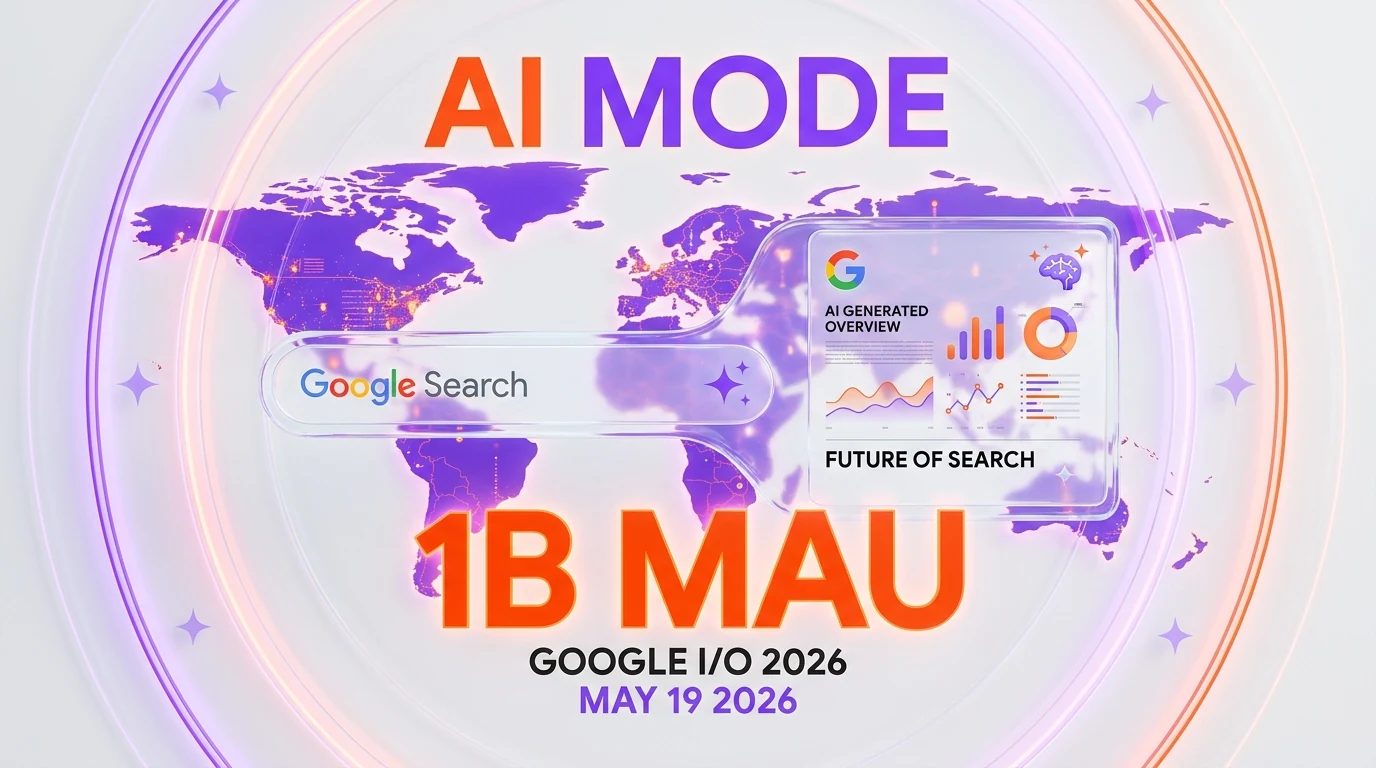
How many people use Google AI Mode in 2026? Google announced at I/O on May 19, 2026 that AI Mode has surpassed 1 billion monthly active users globally. According to Google's own data, the average AI Mode search is triple the length of a traditional Search query, more than one in six U.S. searches now uses voice or images, and image searches are growing over 40% month-over-month. The implication for content publishers is direct: the answer-engine layer is now the default front door to Google Search, and every SEO playbook written before this moment is operating against a different machine.
This is not a "Google is testing something" story. AI Mode is the conversational answer layer inside Google Search, and as of the I/O 2026 keynote it is the largest answer engine on earth by user count. The number that matters is not the billion — ChatGPT, Gemini and Perplexity have all crossed enormous audience thresholds in their own ways. The number that matters is the structure of the traffic Google just confirmed: longer queries, multimodal inputs, planning intent, brainstorming intent. Those four signals together describe an entirely different content surface from the one publishers optimized for in 2023 and 2024.
I run ThePlanetTools.ai. We publish into Google, into AI Overviews, into AI Mode, and into the citation graphs of ChatGPT, Claude, and Perplexity. So this article is not a recap of Google's blog post. It is a strategic read on what shifted on May 19, 2026, what every editorial team should stop doing this week, and which parts of your stack you can leave alone. I will be precise about what Google verifiably said, and I will be equally precise about where my interpretation begins.
What Google Actually Confirmed At I/O 2026
The source for every number in this section is Google's own post on the Keyword blog, published May 19, 2026 and authored by Shivani Mohan, Vice President of Data Science and User Experience Research. There are no leaked decks, no anonymous sources, no analyst extrapolations in the figures below. Verbatim, from the announcement:
- "surpassed a billion monthly active users globally" — AI Mode passed the 1B MAU threshold worldwide.
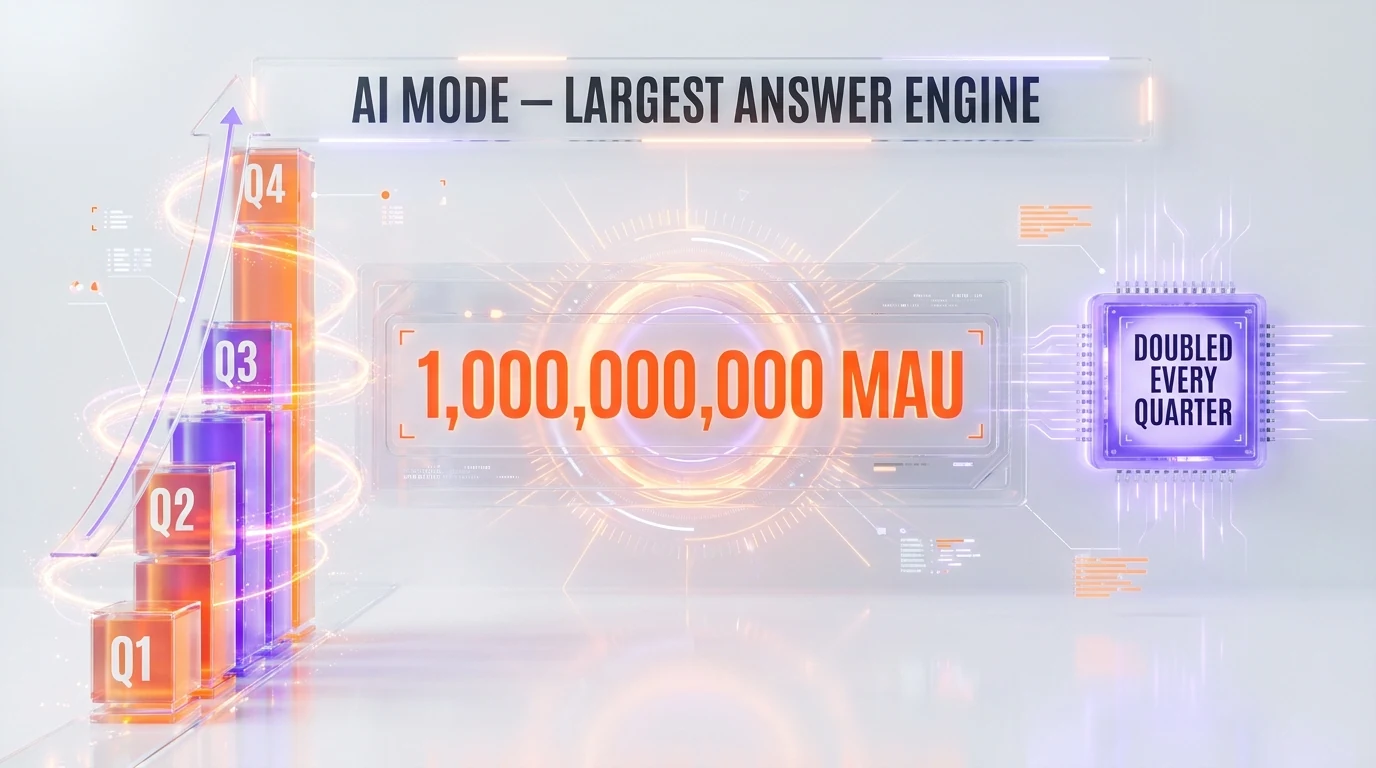
- "AI Mode queries have more than doubled every quarter since launch" — sequential quarterly growth above 100%.
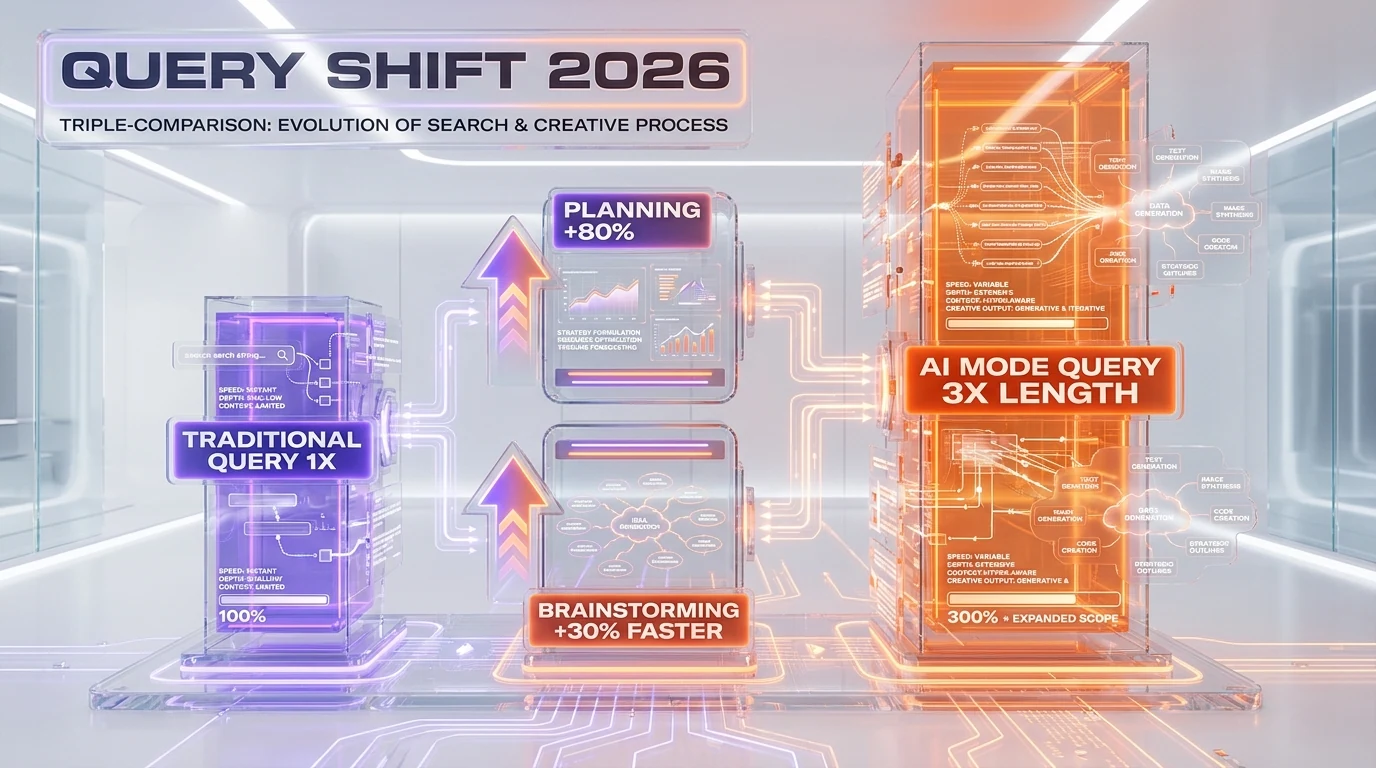
- "the average AI Mode search is triple the length of a traditional Search query" — queries are roughly 3x longer than classic web search.
- "More than one in six searches in the U.S. now use voice or images" — multimodal share is past 16% in the United States.
- "image searches growing over 40% month-over-month" — the visual front door is the fastest-growing input modality.
- Planning queries in AI Mode "have grown faster than AI Mode queries overall by 80% in the past 6 months."
- Brainstorming queries in AI Mode have "grown 30% faster than queries overall since launch."
That is the raw fact set. Everything beyond it — including everything below — is a read, not a quote.
Why The 2024 SEO Playbook Is Officially Dead
The 2024 playbook was built around three assumptions. Short keyword-anchored queries. Ten blue links as the dominant SERP. A single dominant input modality, the text box. Google just confirmed that all three are now minority cases on its largest surface.
Triple-length queries are not "long-tail" queries in the 2014 sense. A long-tail query in the old model was a five-word string that still behaved like a keyword. A triple-length AI Mode query is a sentence with intent, context, and constraints baked in — "what is the cheapest API right now for transcribing long Zoom calls in French that I can call from a Next.js route handler with under 50 lines of code" is not a keyword, it is a brief. The 2024 playbook can answer queries; it cannot answer briefs.
One in six U.S. searches using voice or images means optimization can no longer assume the user's input is a typed string. Voice favors natural-language phrasings, lower-frequency verbs, and definition-first structures because that is what gets read back. Image search favors content where ImageObject schema, structured captions, and EXIF-aligned alt text describe what is in the frame in terms the model can verify. A site whose images are decorative stock with empty alt attributes is now invisible on a sixth of all U.S. queries.
The 40% month-over-month growth in image searches is the line that should change anyone's image strategy this quarter. That growth rate, sustained, doubles the surface every two months. A publisher who treats images as "the thing at the top of the article" rather than as a primary ranking signal is leaving the fastest-growing input channel completely uncovered.
For the deeper mechanics of how this connects to GEO and AEO — the disciplines of optimizing for generative and answer engines — I keep a working playbook in our SEO, GEO, and AEO guide for 2026. The piece you are reading is the news read; that guide is the structural map.
Planning And Brainstorming Are The New Money Stages
The two growth-rate numbers Google buried in its post are the most strategically important in the whole announcement. Planning queries up 80% versus overall AI Mode growth in 6 months. Brainstorming queries up 30% faster than overall queries since launch. These are not vanity stats. They are a confession about where the high-intent traffic is actually concentrating inside the answer engine.
"Planning" in this context is the decision stage — the user is comparing options, weighing trade-offs, scoping a project, picking a date, sequencing a workflow. "Brainstorming" is the ideation stage — the user is exploring a space before they have settled on the decision they need to make. Both are stages where a content publisher historically had a chance to introduce a product, a tool, a methodology, or a point of view.
In a classic ten-blue-links SERP, those two stages were served by listicle and round-up content. In AI Mode, those two stages are served by whichever sources the answer engine pulls into its synthesized response. If your content is not structured to be extracted, paraphrased, and cited at the planning and brainstorming stages, you are not in the consideration set on the queries that are growing fastest inside the largest answer engine on earth.
This is also where the gap between optimizing for ChatGPT, Claude, Perplexity and optimizing for AI Mode narrows further. The mechanics of being cited by an answer engine — definition-first paragraphs, fact-dense tables, explicit comparison structures, named entities, source links — are now the mechanics of being visible in Google's largest single surface. The playbooks have converged.
What To Change In Your Content Stack This Week
Below is the short list of actions that map directly to what Google confirmed. Not "best practices in general." Specifically the moves that respond to the three structural shifts in the announcement: longer queries, multimodal input, and planning/brainstorming intent growth.
1. Rewrite introductions as direct answers
If your articles open with a paragraph of context-setting before the first concrete fact appears, you are writing for a 2018 SERP. AI Mode pulls the first answer-shaped sentence it finds. Open every piece with a single sentence that names the entity, the action, the number, and the date. Then keep going. The piece you are reading does exactly this in its first paragraph by design.
2. Treat images as ranking assets, not decoration
With image search growing over 40% month-over-month and one in six U.S. searches multimodal, every image is now a ranking surface. That means alt text describes the verifiable content of the image in plain language (not "hero illustration"). It means an ImageObject schema entry per image. It means the image conveys actual data — labels, numbers, named entities — instead of being stock atmosphere. The five figures in this article each carry visible labels and verifiable numbers for that reason.
3. Build content explicitly for planning and brainstorming stages
If your editorial calendar is 80% "what is X" definitional content and 20% comparative content, invert the ratio. Comparison pieces, decision frameworks, sequencing guides, scoping checklists — these are the planning-stage formats. "How would I think about choosing between X, Y, and Z if I cared about A and B" — that is the brainstorming-stage format. Both are the formats most likely to be pulled into the AI Mode response cards on the fastest-growing query types.
4. Surface named entities aggressively
Answer engines including ChatGPT, Claude, and Gemini 3.1 Pro all favor sources that name real entities — products, companies, people, places, versions — in a way the model can pin to its knowledge graph. Generic "leading AI assistants" prose loses to "Gemini 3.1 Pro, ChatGPT, Claude, Copilot, and Perplexity" prose every time, because the second version is extractable into a list, a comparison, or a recommendation. Apply this rule sentence by sentence on the next ten pieces you publish.
5. Add explicit comparison tables for planning intent
AI Mode loves structured comparison data. A table with named columns and rows is the single highest-leverage block you can add to a planning-stage piece. Not because tables are pretty, but because they are the cleanest extraction target on the page. Publishers who add even one well-structured comparison table per planning piece tend to see those pieces pulled into answer engines disproportionately.
6. Ship FAQ blocks mapped to real long-tail questions
Triple-length queries are functionally questions. A FAQ section whose questions mirror the long-tail phrasing of real user briefs — and whose answers are crisp, definition-first paragraphs with named entities — is the most extractable block in your article. It is also the block most likely to win a featured snippet, an AI Overview citation, or an AI Mode pull-quote. The FAQ at the bottom of this article was written with that constraint as its first principle.
What This Announcement Does Not Mean
Two narratives are already circulating that are worth pushing back on, because they will distract from the real work.
This does not mean classic SEO is over. Google still ships ten blue links beneath the AI Mode card on the majority of queries. Domain authority, technical SEO, Core Web Vitals, internal linking, schema markup, sitemap hygiene — none of it became less important on May 19, 2026. The signals that get you cited inside AI Mode are largely the same signals that get you ranked beneath it. AI Mode did not replace SEO; it raised the ceiling of what SEO needs to optimize for.
This does not mean ChatGPT, Claude, and Perplexity are losing. A billion users on AI Mode is not a billion users leaving ChatGPT. Most heavy answer-engine users now use multiple tools. The strategic question for a publisher is not "which engine wins" but "is your content cite-able in all of them?" — and the answer is mostly yes, because the structural requirements have converged. Optimize once for extractability and you show up on Google, ChatGPT, Claude, Perplexity, and Bing's answer surfaces simultaneously.
The Deeper Shift: Search Has Become A Conversation
The single line in Google's announcement worth re-reading is "the average AI Mode search is triple the length of a traditional Search query." Triple the length means the user is no longer typing keywords. The user is typing a brief. That is the structural change. Every other number — the multimodal share, the planning growth, the brainstorming growth — is a downstream consequence of that one shift.
When users type briefs instead of keywords, content that reads like a brief response wins. Content that reads like an SEO-optimized listicle from 2019 loses. The grammar of the SERP changed; the grammar of the content has to change with it. Sentences with subjects, verbs, named entities, and verifiable numbers. Paragraphs that hand the model an answer block. Articles that open with a direct answer and earn the right to elaborate.
This is also why E-E-A-T did not get easier in 2026. If the content needs to read like a real expert briefing a real user, the source has to look like a real expert. Author bylines with real LinkedIn profiles. Editorial policies that are linked from every article. Disclosure on what was generated and what was reviewed. The structural shift toward briefs makes the surface-level signals of authority more visible, not less.
How I Am Adjusting Our Own Stack This Month
Concrete, not theoretical. The actions on our side at ThePlanetTools.ai in response to this announcement, in priority order:
- Audit every article hero figure for verifiable labels. Empty stock imagery gets replaced. Every figure now ships with at least three named entities and one quantitative label baked into the image, so the visual surface is also extractable.
- Move planning-stage content to the top of the editorial calendar. "How to choose," "when to use which," "sequencing for X" — these pieces move up the queue. Definitional pieces remain, but they no longer dominate the publish schedule.
- Standardize a brief-shaped intro on every piece. One sentence that names the entity, the action, the number, the date. Then the article. Then the analysis. The piece you are reading is the working template.
- Tighten the FAQ block contract. Ten to twelve real questions per major piece, written in the phrasing of real long-tail briefs. Answers definition-first. Named entities throughout. This block carries disproportionate weight in AI Mode synthesis.
- Push image structured data harder. Every figure gets a full ImageObject with creator, license, copyright, and credit text. Image search is the fastest-growing input modality; the schema needs to be airtight.
None of this is rocket science. All of it is a direct response to what Google verifiably said on May 19, 2026.
Bottom Line
One billion monthly active users on AI Mode is a milestone. The query-shape change underneath that milestone is the real story. Triple-length queries, multimodal inputs growing past a sixth of all U.S. searches, planning and brainstorming intent growing faster than the engine itself — these are the signals every editorial team should be re-pointing their content stack against this week. Not next quarter. This week.
The piece you are reading was written, structured, and shipped against exactly those constraints. If it works in your AI Mode result card, the test was honest. If it does not, the experiment is the work.
Frequently Asked Questions
How many people use Google AI Mode in 2026?
Google announced at I/O on May 19, 2026 that AI Mode has surpassed 1 billion monthly active users globally. The announcement was authored by Shivani Mohan, Vice President of Data Science and User Experience Research at Google. Google also confirmed that AI Mode queries have more than doubled every quarter since launch, which is a sequential quarterly growth rate above 100% sustained across multiple quarters.
What is Google AI Mode?
AI Mode is the conversational answer layer integrated inside Google Search. It uses a Gemini-family model to synthesize answers across the web in response to longer, more natural-language queries, including voice and image inputs. It sits inside the same Google Search experience users already use, which is one of the structural reasons it reached a billion monthly active users faster than most independent answer engines.
How is AI Mode different from AI Overviews?
AI Overviews are the short, top-of-SERP synthesized answers that appear above the classic ten blue links. AI Mode is the dedicated conversational mode where the user can ask longer, multi-turn questions, including image and voice inputs, and receive structured answer-engine responses. AI Overviews are an enhancement to traditional Search; AI Mode is the full answer-engine experience inside Search.
How long is the average AI Mode query compared to traditional Search?
According to Google's own May 19, 2026 announcement, the average AI Mode search is triple the length of a traditional Search query. This is the single most consequential statistic in the announcement for content publishers, because it changes the grammar of what users are typing — from keyword strings to natural-language briefs with intent, context, and constraints embedded.
What share of U.S. searches use voice or image input in 2026?
Google confirmed that more than one in six searches in the U.S. — over 16% — now use voice or images. Image searches specifically are growing over 40% month-over-month, making image input the fastest-growing modality on Google Search. For publishers this means alt text, ImageObject schema, and verifiable visual content are now first-class ranking signals, not optional polish.
What are planning queries and why are they growing 80% faster than overall AI Mode growth?
Planning queries are decision-stage searches — comparing options, weighing trade-offs, scoping a project, sequencing a workflow. Google confirmed they have grown faster than AI Mode queries overall by 80% in the past six months. They are the queries where comparison content, decision frameworks, and structured tables tend to be pulled into the answer card, which is why publishers should re-weight editorial calendars toward planning-stage formats.
What are brainstorming queries on AI Mode?
Brainstorming queries are ideation-stage searches — the user exploring a problem space before they have decided what specific decision to make. Google confirmed they have grown 30% faster than queries overall since launch. They favor open-ended "how would I think about" and "what are my options for" formats, where well-structured exploratory content has a high chance of being pulled into the answer.
Does AI Mode mean classic SEO is dead?
No. Google still ships ten blue links beneath the AI Mode card on the majority of queries. Domain authority, technical SEO, Core Web Vitals, internal linking, schema markup, and sitemap hygiene remain core ranking signals. AI Mode raised the ceiling of what SEO needs to optimize for, but it did not replace the foundational signals. The signals that get content cited inside AI Mode are largely the same signals that get it ranked beneath the card.
Is Google AI Mode bigger than ChatGPT, Claude, or Perplexity?
By the monthly active user count Google disclosed at I/O 2026, AI Mode is the largest answer engine on the internet at 1 billion MAU. ChatGPT, Claude, and Perplexity each have substantial audiences in their own right, and most heavy answer-engine users now use multiple tools. The strategic implication for publishers is not "pick a winner" but "make content cite-able in all of them," because the structural extraction requirements have converged across engines.
What should I change in my SEO strategy after Google AI Mode hit 1 billion users?
Six concrete moves: open every article with a direct answer sentence, treat images as ranking assets with full alt text and ImageObject schema, build content explicitly for planning and brainstorming stages, name real entities aggressively in prose, add explicit comparison tables on planning-intent pieces, and ship FAQ blocks whose questions mirror real long-tail briefs. All six are direct responses to what Google verifiably confirmed on May 19, 2026.
Where can I read Google's full announcement?
The full post is on Google's Keyword blog, titled around AI Mode US insights, published May 19, 2026, authored by Shivani Mohan, Vice President of Data Science and User Experience Research at Google. It contains the verbatim figures cited throughout this article — the billion monthly active users globally, the triple-length query stat, the one-in-six multimodal share, the 40% month-over-month image growth, and the planning and brainstorming intent growth rates.
How fast is AI Mode growing?
Google confirmed that AI Mode queries have more than doubled every quarter since launch. Sustained quarter-over-quarter doubling is an exponential growth curve, which is how the surface reached 1 billion monthly active users globally so quickly. Combined with the 40% month-over-month growth in image searches specifically, the absolute scale of the answer-engine surface is expanding faster than most publishers' production capacity, which is itself the strategic problem.
Sources: Google Keyword blog — AI Mode US Insights (May 19, 2026).