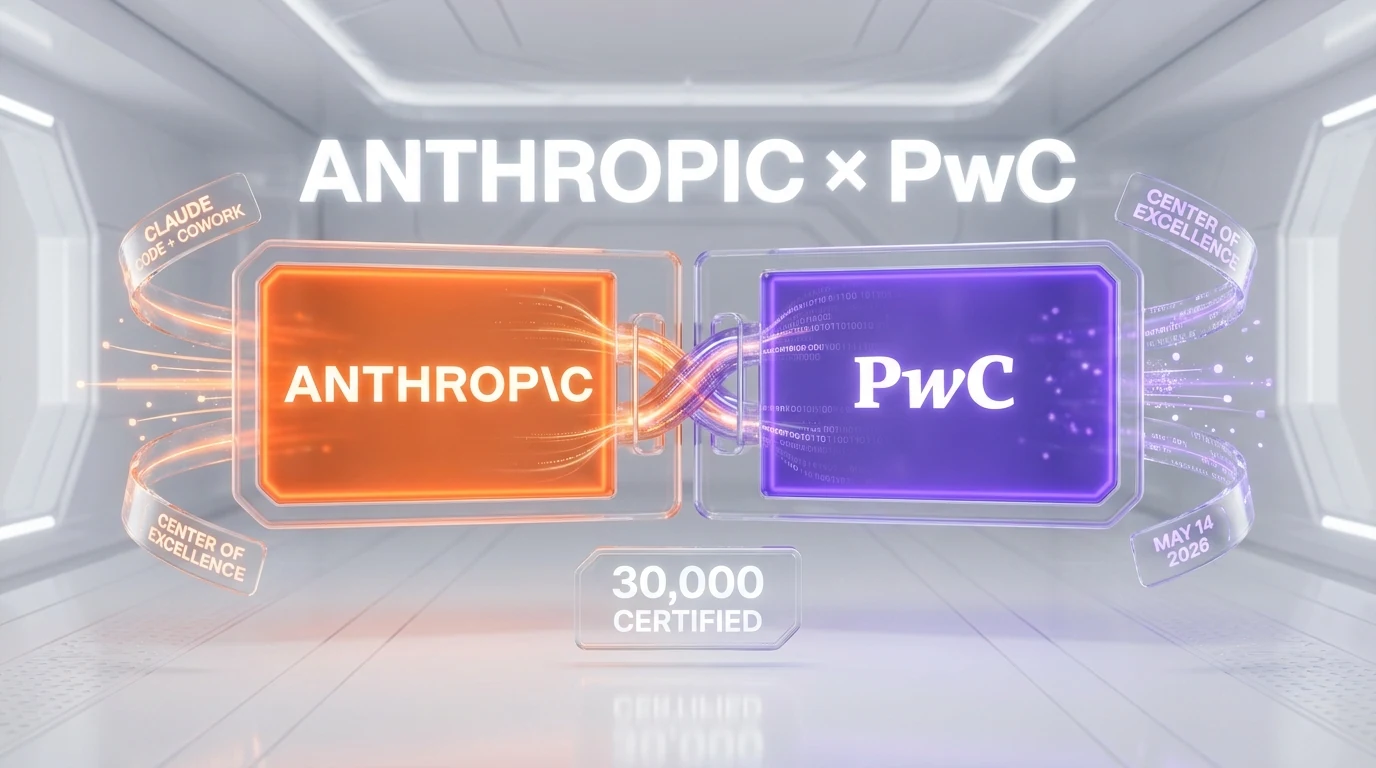
On May 14, 2026, Anthropic and PwC announced an expanded partnership in which PwC deploys Claude Code and Claude Cowork across its US workforce — scaling toward hundreds of thousands of professionals globally — certifies 30,000 US professionals on Claude, and stands up a joint Center of Excellence. PwC also confirmed a new standalone Office of the CFO business group anchored on Claude. It is the largest Big Four consulting commitment to Anthropic disclosed to date, and it lands two weeks after Anthropic overtook OpenAI in business adoption on Ramp.
What Anthropic and PwC Actually Announced
The headline is not a pilot. PwC is rolling Claude Code and Claude Cowork into live delivery and certifying 30,000 US professionals on Claude, with a stated path to scale across "hundreds of thousands" of its people worldwide. The two firms are co-funding a joint Center of Excellence, and PwC is launching a new standalone Office of the CFO business group built on Claude technology, with an initial industry focus on banking, insurance, and healthcare.
Paul Griggs, US Senior Partner and CEO of PwC, framed the customer motivation directly: "Clients are looking for ways to apply AI that are secure, responsible, and capable of delivering measurable outcomes." Dario Amodei, co-founder and CEO of Anthropic, anchored the announcement in production numbers rather than promise: "Insurance underwriting that took 10 weeks now takes 10 days. Security work that took hours now takes minutes."
That framing matters. The 10-weeks-to-10-days and hours-to-minutes figures are not projections — they are cited as outcomes already in production across PwC client deployments, with the firms claiming up to 70% delivery improvement across some engagements. The full source is the official Anthropic announcement, PwC and Anthropic expand their partnership.
The Four Numbers That Define the Deal
Strip the announcement to its load-bearing facts and four numbers carry it: 30,000 US professionals certified on Claude; hundreds of thousands the global scaling target; two products — Claude Code and Claude Cowork — moving into live delivery, not sandbox; and one new standalone PwC business group, the Office of the CFO, anchored entirely on Claude. Each number is a different kind of commitment, and read together they describe a consulting firm restructuring around a single AI vendor's stack.
Why a Center of Excellence Is the Real Signal
Vendor certifications come and go. A joint Center of Excellence is structural. It means shared roadmap input, co-developed delivery methodology, and a standing institutional relationship rather than a procurement line item. When a Big Four firm co-funds a CoE with a model lab, it is signaling to its own partners and to the market that this is the default stack for AI-native delivery — not one option among several.
There is a second-order effect worth naming. A CoE produces reusable assets: reference architectures, security review templates, agent evaluation harnesses, deployment runbooks. Those assets compound. Every engagement that runs through the CoE makes the next one faster and cheaper to deliver, which steadily widens the gap between a firm that has institutionalized a stack and one still treating each AI project as bespoke. That compounding is the actual moat, and it does not show up in a press release headline — it shows up two years later in win rates and delivery margin.
The Stated Strategic Focus Areas
The announcement frames the partnership around three focus areas: building agentic technology, AI-native deal-making, and reinventing enterprise functions. Read strategically, that is a deliberate progression. Agentic technology is the capability layer. AI-native deal-making is how PwC reshapes its own commercial motion — pricing outcomes rather than hours. Enterprise function reinvention is the client-facing payoff. The three together describe a firm intending to change not just what it delivers but how it sells and how it is structured internally.
The Numbers in Context
Scale claims only mean something against a baseline. PwC employs on the order of 370,000 people globally, so a 30,000 US certification commitment is a meaningful single-digit-percentage slice of the global headcount concentrated in its largest market — and the "hundreds of thousands" scaling target implies the firm intends Claude fluency to become a majority-workforce expectation, not a specialist skill.
Set against peers, the contrast sharpens. EPAM committed to roughly 10,000 Claude-certified architects against an engineering base near 50,000 — a deep but narrower technical bet. PwC's 30,000 is roughly three times that absolute number and spans consultants, not only architects, which is why we read it as a delivery-standard commitment rather than a technical-specialist one. The difference between certifying architects and certifying the broad consulting bench is the difference between a capability and an operating model.
One number is conspicuously absent: PwC and Anthropic disclosed no contract value. That is normal for services partnerships and not a red flag, but it does mean the financial weight of the deal has to be inferred from structural commitments — a co-funded Center of Excellence and a net-new business group — rather than a headline dollar figure. We treat the structural commitments as the more reliable signal anyway, because dollar figures in AI partnerships are frequently multi-year, conditional, and non-comparable.

Claude Code and Cowork Move From Pilot to Production
The product choice is the strategic tell. PwC is not just buying Claude API access for internal experimentation — it is deploying Claude Code and Claude Cowork as delivery infrastructure. Claude Code is Anthropic's agentic coding environment; Cowork is the agentic work surface for non-engineering knowledge tasks. Together they cover both the technical and the business-process halves of a consulting engagement.
Why Both Products, Not Just One
A consulting engagement is rarely pure code. It is requirements work, document synthesis, financial modeling, security review, and stakeholder communication wrapped around an implementation. Deploying Claude Code alone would cover the build; deploying Cowork alongside it covers the surrounding 80% of billable work. Choosing both is PwC saying the agentic surface — not just the model — is the unit of delivery transformation.
The Production Metrics PwC Is Willing to Put Its Name On
Consulting firms are conservative about public performance claims because clients hold them to numbers. PwC co-signing "insurance underwriting from 10 weeks to 10 days" and "security work from hours to minutes" is a reputational commitment, not marketing copy. The firms also cite up to 70% delivery improvement across some engagements. We read the willingness to attach these figures publicly as the strongest evidence that the deployments are real and already billing.
Active Deployment Areas
The announcement names live deployment areas across professional sports, insurance, mainframe modernization, HR, and cybersecurity — alongside an Advocate Health collaboration referenced by Andy Crowder, Chief Digital and AI Officer at Advocate Health. The breadth matters: this is not one flagship demo, it is a portfolio of production engagements spanning regulated industries where audit trails and responsible deployment are non-negotiable.
Mainframe modernization deserves a callout because it is the least glamorous and most telling entry on that list. Mainframe migration is the canonical multi-year, high-risk consulting engagement — the kind clients postpone for a decade. If agentic tooling is compressing even that workload, it changes the economics of the single hardest category of enterprise IT work. Anthropic's own framing — security work from hours to minutes — points the same direction: the deployments PwC is publicizing are concentrated in exactly the high-stakes, regulated workloads where consulting firms earn their highest margins and where buyers are most resistant to unproven tooling.
The Responsible-Deployment Angle Is a Sales Argument
Paul Griggs' phrasing — "secure, responsible, and capable of delivering measurable outcomes" — is not boilerplate. In regulated industries, the blocker for AI adoption is rarely capability; it is governance, auditability, and risk sign-off. Anthropic has positioned its brand around responsible scaling, and PwC's existing role as an assurance and risk advisor makes the pairing commercially coherent. The partnership is, in effect, selling AI deployment with the audit and governance wrapper already attached — which is precisely what a banking or insurance CIO needs to get a deployment past their own risk committee.

30,000 Certified and a Joint Center of Excellence
Certification at this scale is a workforce strategy, not a training budget. Thirty thousand US professionals certified on Claude means PwC is standardizing how its consultants build, review, and deliver — converging on one vendor's tooling so engagement quality is repeatable across teams, offices, and industries.
What 30,000 Certifications Actually Buys
The number's value is consistency. When 30,000 people are certified on the same stack, a banking engagement in New York and an insurance engagement in Chicago can be staffed, reviewed, and quality-assured against a shared baseline. That is the difference between AI as a productivity tool individual consultants choose and AI as a delivery standard the firm guarantees. The latter is what enterprise buyers actually pay a premium for.
The Center of Excellence as Roadmap Leverage
A joint CoE gives PwC something most Anthropic customers do not have: a structured channel into the roadmap. It also gives Anthropic a permanent enterprise feedback loop from one of the largest professional-services delivery engines in the world. This is the same pattern we documented in the EPAM x Anthropic partnership, where EPAM committed to 10,000 Claude-certified architects — except PwC's number is three times larger and Big Four branded.
The Office of the CFO Business Group
The most underrated line in the announcement is the new standalone Office of the CFO business group, anchored on Claude, with an initial focus on banking, insurance, and healthcare. PwC is not just using Claude inside existing practices — it is creating a net-new revenue line whose value proposition is built on Anthropic's stack. That is the difference between adopting a tool and betting a business unit on a vendor.
The Big Four Consulting Shift Behind Claude
This announcement does not stand alone. It is the clearest data point yet in a pattern we have tracked across the spring: enterprise consulting is consolidating behind Anthropic, and the generic "AI strategy deck" era is ending in favor of vendor-certified delivery practices.
The Pattern: EPAM, SAP, and Now PwC
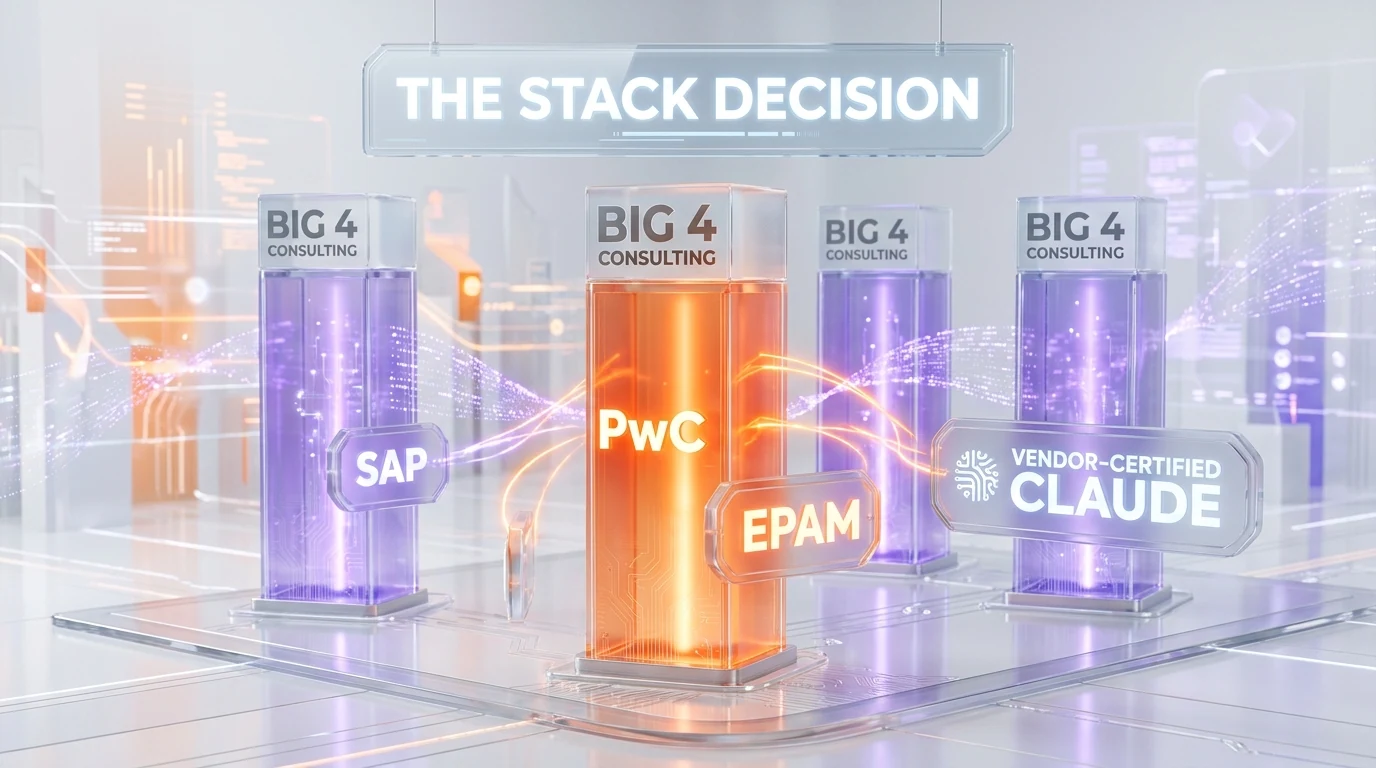
Within a two-week window the market saw EPAM commit 10,000 architects to Claude certification, SAP anchor its Joule business AI platform on Claude, and now PwC certify 30,000 professionals and launch a Claude-anchored CFO business group. Three different categories of company — a digital engineering firm, an enterprise software giant, and a Big Four consultancy — independently converging on the same vendor in the same fortnight is not coincidence. It is a market deciding.
Why Consulting Is Picking a Stack Now
Consulting firms historically stayed vendor-neutral to preserve advisory credibility. That neutrality is breaking because clients no longer want a recommendation — they want a team that can ship production agentic systems on day one. Shipping requires deep, specific tooling expertise. You cannot be expert in everything, so firms are picking a stack and certifying their bench against it. PwC picking Claude at 30,000-certification scale is the most consequential such pick to date.
The Competitive Read for the Other Three
Deloitte, EY, and KPMG now face a positioning problem. PwC has a Big Four branded, publicly disclosed, 30,000-certification Claude commitment plus a net-new CFO business line. The strategic question for the other three is no longer whether to certify on a frontier model stack but which one — and how fast, before client RFPs start asking which vendor practice you specialize in rather than whether you understand AI. We expect catch-up announcements over the next 90 days.
There is a sequencing trap here. A firm that announces a competing certification commitment in three months will be read by the market as following, not leading — and in professional services, perceived leadership directly affects which firm gets the first call on a transformation RFP. PwC has not just made a commitment; it has set the reference point against which every subsequent Big Four AI announcement will be measured. That framing advantage is hard to claw back with a larger number announced later, because the narrative is already anchored.
What "Vendor-Certified" Replaces
The era this ends is the generalist AI strategy engagement: a slide deck on AI opportunity, a maturity assessment, a roadmap, and a recommendation to "build capability." That product is being commoditized because clients have read enough decks. What they will pay for now is a team that arrives already certified on the exact stack they intend to run in production, with reusable accelerators and a delivery method proven in their industry. PwC's 30,000-certification number is a direct bet that the billable unit of the next consulting cycle is certified delivery capacity, not advisory hours.
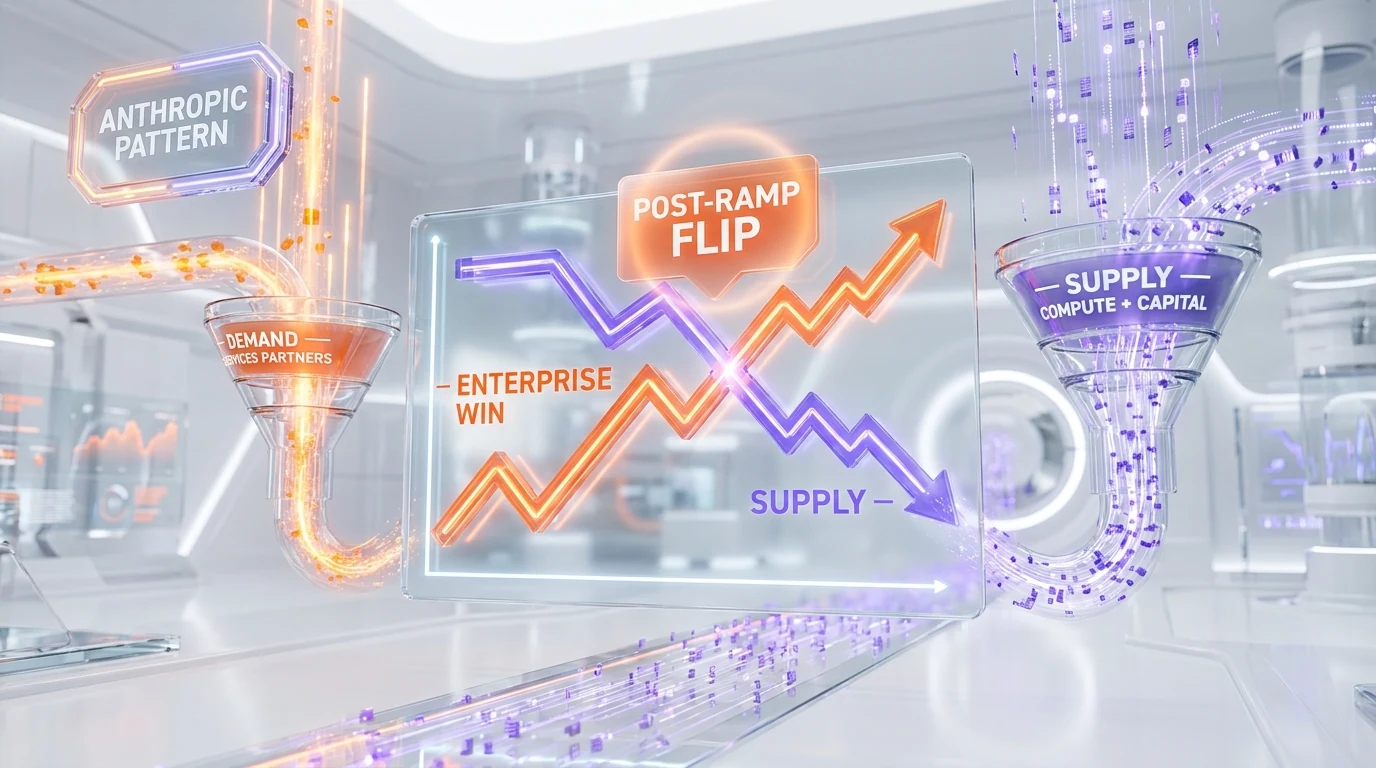
Anthropic's Enterprise Pattern, Post-Ramp Flip
Two weeks before this announcement, Anthropic overtook OpenAI in business adoption on Ramp — a leading indicator drawn from real corporate-card spend rather than survey sentiment. The PwC deal is what that leading indicator looks like once it converts into structural enterprise commitments.
From Spend Signal to Structural Lock-In
The Ramp flip showed Anthropic winning the marginal enterprise dollar. The PwC partnership shows Anthropic winning the channel that influences thousands of enterprise dollars. A Big Four firm certifying 30,000 people and standing up a Claude-anchored business group does not just buy Claude — it sells Claude, embedded inside every banking, insurance, and healthcare engagement PwC delivers. Channel capture compounds faster than direct sales.
The Compute Side of the Same Strategy
Demand-side scale only matters if supply can meet it. Anthropic has been locking compute at the same cadence — see our analysis of the 10-gigawatt compute build behind Claude's coding push and the Goldman and Blackstone 1.5 billion dollar AI services joint venture. The pattern is consistent: lock enterprise demand through services partners, lock supply through compute and capital deals, and let the two reinforce each other.
What This Means for the Claude Stack
For teams evaluating Claude and Claude Code, the PwC deal is a procurement signal. When the world's largest professional-services firms standardize on a stack, that stack accumulates integration depth, delivery playbooks, and certified talent — the exact ecosystem advantages that historically locked in enterprise software. The moat here is not the model alone; it is the consulting bench now trained to deploy it.
What Would Prove This Read Wrong
A strategic analysis is only honest if it states what would falsify it. There are three credible counter-scenarios, and tracking them is how we will know whether this read holds.
Counter-Scenario One: The Certification Number Is Soft
"Certified" is not a regulated term. If PwC's 30,000 figure turns out to mean a short online module rather than assessed, hands-on capability, the workforce-standardization thesis weakens considerably. The tell to watch is whether PwC discloses a tiered structure — a deep specialist tier comparable to EPAM's Black Belt designation — or whether the number stays flat and unqualified. A flat number is a marketing metric; a tiered one is a capability commitment.
Counter-Scenario Two: Multi-Vendor Hedging Resumes
Consulting firms have strong structural incentives to stay vendor-plural. If, within two quarters, PwC announces a comparably scaled certification commitment on a competing frontier stack, the "consulting picks Claude" narrative collapses into "consulting certifies on everything" — which is just the old neutrality in new packaging. The single-vendor depth of the Office of the CFO business group is the strongest evidence against this scenario, but it is not conclusive.
Counter-Scenario Three: The Production Metrics Do Not Generalize
The 10-weeks-to-10-days and hours-to-minutes figures are co-signed by the parties selling the service. If independent client references over the next two quarters fail to reproduce results in that range, the deployment-proof argument — the strongest part of the announcement — gets discounted, and the deal reads as channel positioning rather than capability transfer. We would treat the absence of named, independent client outcomes by Q3 2026 as a yellow flag.
Timeline: How the Spring 2026 Consolidation Unfolded
The PwC deal is the most visible point on a curve, not an isolated event. Tracing the sequence makes the pattern legible.
Late April: The Spend Signal
The leading indicator arrived first. Anthropic overtook OpenAI in business adoption on Ramp — a metric grounded in real corporate-card spend rather than survey sentiment. At the time it read as a notable but soft signal; in hindsight it was the demand curve turning before the structural commitments made it visible.
Early May: The Services Partners
Within roughly two weeks the structural commitments landed in clusters: EPAM committing 10,000 architects to Claude certification, and SAP anchoring its Joule business AI platform on Claude. Two different categories of company — digital engineering and enterprise software — moved in the same window.
Mid-May: The Big Four Confirmation
PwC's 30,000-certification commitment and Claude-anchored Office of the CFO is the confirmation point. When a Big Four firm restructures around a vendor stack two weeks after a spend-based leading indicator flipped, the sequence stops looking like coincidence and starts looking like a market clearing. The order — spend signal, then services partners, then Big Four — is exactly the order you would expect if a genuine preference shift were propagating through the enterprise stack rather than a single marketing push.
The Strategic Bottom Line
Read at the highest level, the Anthropic x PwC expansion is three moves in one announcement: a workforce standardization (30,000 certified), an institutional alignment (joint Center of Excellence), and a new revenue bet (the Claude-anchored Office of the CFO). Each alone would be notable. Together, from a Big Four firm, they confirm that the enterprise AI services market is consolidating behind Anthropic — and that the consolidation is now visible in org charts, not just spend data.
The honest caveat: production metrics like "10 weeks to 10 days" are co-signed by the vendor and the firm selling the service, so independent verification will take time. What is not in question is the strategic commitment. Firms do not restructure business units around vendors they consider replaceable. PwC just did.
Frequently Asked Questions
What did Anthropic and PwC announce on May 14, 2026?
Anthropic and PwC announced an expanded partnership in which PwC deploys Claude Code and Claude Cowork across its US workforce — scaling toward hundreds of thousands of professionals globally — certifies 30,000 US professionals on Claude, co-funds a joint Center of Excellence, and launches a new standalone Office of the CFO business group anchored on Claude, with an initial focus on banking, insurance, and healthcare.
How many PwC professionals are being certified on Claude?
PwC is certifying 30,000 US professionals on Claude, with a stated path to scale Claude Code and Cowork across hundreds of thousands of its people worldwide. The 30,000 US figure is the disclosed near-term commitment; the global hundreds-of-thousands number is the scaling target.
Which Anthropic products is PwC deploying?
PwC is deploying Claude Code, Anthropic's agentic coding environment, and Claude Cowork, the agentic work surface for non-engineering knowledge tasks. Both move into live PwC delivery rather than sandbox testing, covering the technical and business-process halves of consulting engagements.
What is the joint PwC and Anthropic Center of Excellence?
It is a co-funded, standing institutional structure for shared delivery methodology and roadmap input. Unlike a procurement contract, a Center of Excellence signals a permanent strategic relationship — PwC gets a structured channel into Anthropic's roadmap, and Anthropic gets a continuous enterprise feedback loop from a Big Four delivery engine.
What is the PwC Office of the CFO business group?
It is a new standalone PwC business group anchored on Claude technology, with an initial focus on banking, insurance, and healthcare. It is significant because PwC is not just using Claude inside existing practices — it is creating a net-new revenue line whose value proposition is built on Anthropic's stack.
What production metrics did Anthropic and PwC cite?
Dario Amodei cited insurance underwriting dropping from 10 weeks to 10 days and security work dropping from hours to minutes. The firms also cite up to 70% delivery improvement across some engagements. These are presented as outcomes already in production across PwC client deployments, not projections.
Who are the executives quoted in the announcement?
Paul Griggs, US Senior Partner and CEO of PwC, framed client demand for secure, responsible, measurable AI. Dario Amodei, co-founder and CEO of Anthropic, cited the production metrics. Andy Crowder, Chief Digital and AI Officer at Advocate Health, referenced a healthcare collaboration with both firms.
How does the PwC deal compare to the EPAM x Anthropic partnership?
Both are vendor-certified consulting commitments to Claude. EPAM committed to 10,000 Claude-certified architects; PwC is certifying 30,000 US professionals — roughly three times the headcount — and is Big Four branded with a net-new Claude-anchored CFO business group. PwC is the larger and more structurally significant of the two.
Why is consulting consolidating behind Anthropic?
Clients no longer want vendor-neutral advice — they want teams that can ship production agentic systems immediately. Shipping requires deep, specific tooling expertise, so firms are picking a stack and certifying their bench against it. Within two weeks EPAM, SAP, and PwC independently converged on Claude, indicating a market decision rather than coincidence.
How does this connect to Anthropic overtaking OpenAI on Ramp?
Two weeks earlier, Anthropic overtook OpenAI in business adoption on Ramp, a leading indicator from real corporate-card spend. The PwC deal is what that signal looks like once it converts into structural commitments — Anthropic winning not just the marginal enterprise dollar but the channel that influences thousands of enterprise dollars.
What does this mean for Deloitte, EY, and KPMG?
PwC now has a Big Four branded, publicly disclosed, 30,000-certification Claude commitment plus a net-new CFO business line. The strategic question for the other three is no longer whether to certify on a frontier model stack but which one and how fast. Catch-up announcements over the next 90 days are likely.
Should enterprise buyers change how they evaluate AI consulting?
Yes. RFPs that previously asked whether a consultancy understands AI should now ask which vendor stack it specializes in, because that materially affects delivery quality and time-to-production. When the largest professional-services firms standardize on a stack, that stack accumulates integration depth, certified talent, and delivery playbooks — durable ecosystem advantages.