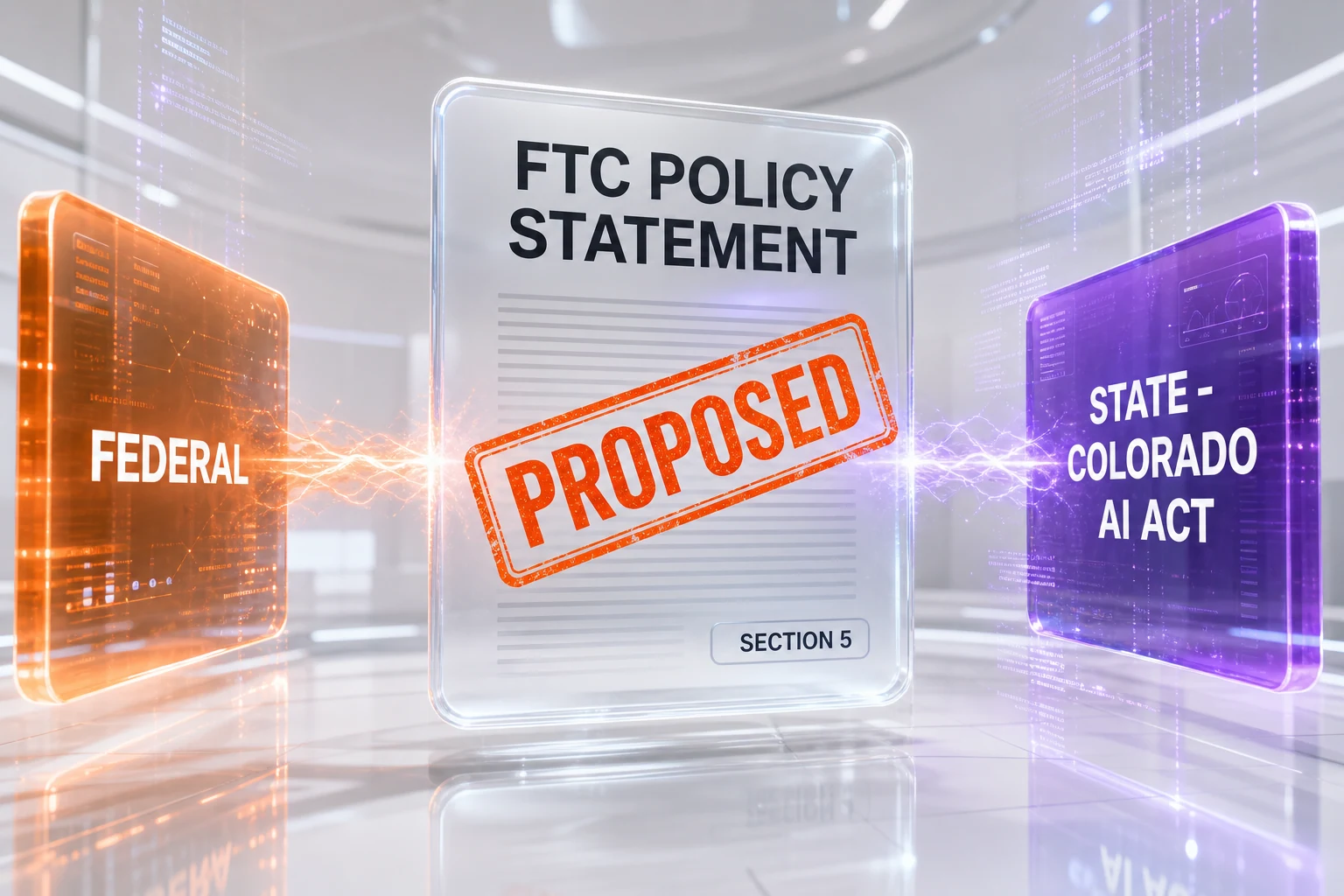
Quick take: No — not yet, and maybe not on its own. On July 7, 2026, the Federal Trade Commission published a proposed policy statement, "Suppression of Accuracy in Artificial Intelligence Systems," that argues the Colorado AI Act is "impliedly preempted to the extent it conflicts with the federal regulatory scheme" under Section 5 of the FTC Act. But it is a proposal open for public comment until July 31, 2026 — not a rule, and, in the words of one law-firm analysis, it "does not by itself create new legal obligations." Whether an agency policy statement can preempt a state law at all is contested and is likely to be settled in court, not in the Federal Register.
Key takeaways
- The FTC published its proposed policy statement in the Federal Register on July 7, 2026 (document 2026-13628, File No. P264200). The Commission authorized it on a 2-0 vote on July 1, 2026.
- It is a proposed statement with a public comment period, not a final or binding rule. It creates no new legal obligations by itself.
- It names the Colorado AI Act as an example of a state law it calls "impliedly preempted" where it conflicts with Section 5 of the FTC Act.
- It executes Executive Order 14365 (December 11, 2025), the Trump administration's push for a single national AI framework that overrides conflicting state laws.
- This is an agency (administrative) action — distinct from the legislative Great American AI Act and from the state laws it targets.
What the FTC actually proposed
The FTC's proposed policy statement is a formal document explaining how the agency intends to apply the deception prohibition in Section 5 of the FTC Act to companies that market artificial intelligence. Its core theory: if a company deliberately tunes an AI system to suppress accurate outputs in service of an undisclosed objective while still marketing the product as accurate, that mismatch can be a deceptive act or practice. The Commission voted 2-0 to release it on July 1, 2026, and it appeared in the Federal Register on July 7, 2026.
According to the Federal Register notice, the action is a "Proposed policy statement; request for comments," and the FTC "is proposing a policy statement regarding the application of the prohibition on deceptive acts or practices in section 5 of the Federal Trade Commission Act to companies that market artificial intelligence (AI) systems." The document number is 2026-13628 and the docket is File No. P264200. Comments must be received on or before Friday, July 31, 2026.
The theory reaches a politically charged place: outputs shaped for what the statement calls undisclosed "ideological objectives." As a summary from Mondaq describes it, one illustration in the statement is "a company training a model to correct what its developers consider 'historical injustices' in a factual answer" while continuing to market that model as accurate. The FTC's argument is not about whether such tuning is good or bad policy; it is that hiding it from consumers, while advertising accuracy, is the kind of gap Section 5 has policed for decades. The Commission's own summary of the action is available through its legal library.

Why the Colorado AI Act is in the crosshairs
The statement singles out the Colorado AI Act as its named example of a state law that, in the FTC's reading, could push companies to suppress accurate outputs. The concern is disparate-impact liability: the FTC argues a state anti-discrimination mandate could pressure a company to replace a correct result with one engineered to avoid an unequal outcome for protected groups. The statement concludes such a law is "impliedly preempted to the extent it conflicts with the federal regulatory scheme" established by Section 5 — and that complying with the state mandate "is not a defense to a federal deception claim."
That framing matters, and so does timing. As the Consumer Financial Services Law Monitor and Mondaq both note, the statement's position is that where the two regimes conflict, Section 5 controls. In plain terms, the FTC is telling AI companies that "Colorado made me do it" would not shield them from a federal deception case.
There is a wrinkle the statement's headline glosses over: the Colorado law it names is itself in flux. The original Colorado AI Act (SB 24-205) — the first comprehensive US state AI law — had its start date pushed from February 2026 to June 30, 2026, and its enforcement was frozen by a federal court on April 27, 2026 amid a lawsuit from xAI. The Colorado General Assembly then rewrote it: per Hunton Andrews Kurth and Akin, the amended law (SB 26-189) was signed May 14, 2026 and now takes effect January 1, 2027. So the FTC is planting a preemption flag on a statute that is simultaneously being litigated and replaced — a moving target, not a settled one.
What the statement does not do — yet
A proposed FTC policy statement is not a law, a rule, or a court order. It does not repeal the Colorado AI Act, it does not bind any company, and it does not itself preempt anything. A policy statement signals how the Commission intends to read an existing law; preemption of a state statute normally happens through federal legislation, a formal rule, or a court ruling — none of which this document is. It also is not final: the public comment window runs through July 31, 2026, and the FTC can revise or withdraw it.
This is the single most important thing to keep straight, and legal analysts are blunt about it. In the words of the Frankfurt Kurnit advertising law team, "This is a proposed policy statement, not a rule, and it does not by itself create new legal obligations." What it does, the same analysis notes, is signal "how the Commission intends to apply an existing framework, the same deception test that has governed FTC enforcement for decades, to a new category of product."
For the statement to actually bite a company, several more steps have to happen: the FTC would need to finalize it after comments, bring an enforcement action against a specific company under Section 5, and then persuade a court that the federal deception theory both applies and overrides the conflicting state rule. As Mondaq observes, the statement "traces directly back to Executive Order 14365," but tracing back to a directive is not the same as carrying the force of law. Every headline that reads "FTC preempts Colorado AI Act" is getting ahead of the document.

The Executive Order 14365 backbone
The policy statement is not a freelance move by the FTC; it executes a specific directive. Executive Order 14365, "Ensuring a National Policy Framework for Artificial Intelligence," was signed by President Trump on December 11, 2025. It directs federal authorities to challenge state AI laws that conflict with national policy, contemplates limiting federal funding to states with inconsistent rules, and called for a legislative recommendation to preempt conflicting state AI laws. The FTC statement is one agency carrying out that mandate through its own Section 5 authority.
The order's lineage is well documented. The White House published the order as a presidential action in December 2025 (White House), and it carries carve-outs for child-safety protections, AI compute and data-center infrastructure, and state government procurement and use of AI. As White & Case summarized when the order landed, it put state AI laws squarely under federal scrutiny for the first time. The administration followed it with a four-page "National Policy Framework for Artificial Intelligence" on March 20, 2026, urging Congress to enact a single federal standard (WilmerHale).
Can a policy statement actually preempt state law?
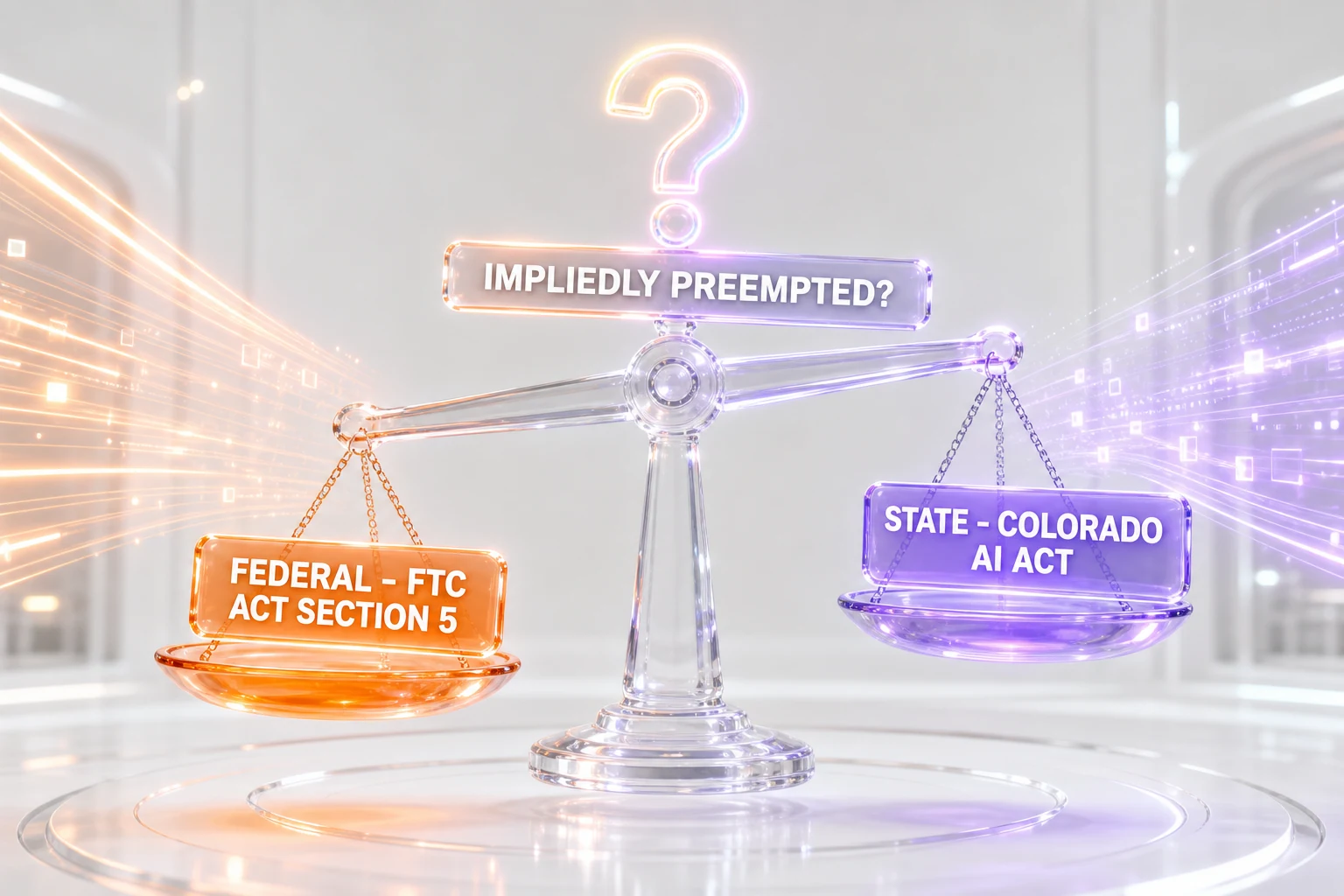
This is the strategic question the document invites, and the honest answer is: not by itself. Federal preemption of state law flows from the Supremacy Clause and normally requires an act of Congress, a validly promulgated federal rule, or a court holding that federal and state law conflict. An FTC policy statement is none of those. It is the agency's stated interpretation — persuasive to the extent a court later agrees with it, and no further. Asserting that a state law is "impliedly preempted" is a legal argument the FTC is previewing, not a fact it can declare into existence.
That is why the more consequential action against the Colorado AI Act so far has come through the courts, not the Federal Register. In April 2026 the Department of Justice intervened to support xAI's challenge to the Colorado law — per Norton Rose Fulbright, the first time the federal government sought to invalidate a state AI law — and a court then suspended enforcement. A policy statement adds rhetorical and enforcement weight to that campaign, but the FKKS analysis is careful to frame it as the Commission signaling intent, not changing the statute books. Our read: expect this preemption theory to be tested in litigation the first time the FTC tries to use it against a real company, and expect state attorneys general — who have been moving in the opposite direction — to push back.
Where this fits in the federal-versus-state fight
The FTC statement is one front in a multi-front battle over who governs AI in the United States. It is an executive-branch, administrative move. It sits alongside a legislative effort in Congress, a Justice Department court campaign, and a wave of state lawmaking and enforcement pulling the other way. Keeping the mechanisms separate is the key to reading any single headline correctly: an agency statement, a bill, a lawsuit, and a state statute are four different instruments with four different levels of legal force.
On the legislative side, the bipartisan Great American AI Act discussion draft would freeze state laws that regulate how AI models are built for three years — a statutory route to preemption that, unlike a policy statement, would actually carry the force of law if enacted. Pulling in the opposite direction, a multistate coalition of attorneys general has been expanding state oversight, including its investigative subpoena of OpenAI, and states have passed a wave of AI companion-chatbot laws. And none of this should be confused with the EU AI Act, a separate regime on a separate continent. The through-line connecting the federal moves is Executive Order 14365; the FTC statement, the DOJ intervention, and the National Policy Framework all descend from it.
What happens next
The immediate next step is procedural: public comments are due by July 31, 2026, submitted through the federal docket. After that, the FTC can finalize the statement, revise it, or leave it as a proposal. Even a finalized statement would not preempt the Colorado AI Act on its own — that question would be decided if and when the FTC brings a Section 5 case that a company fights in court, or as part of the broader litigation already underway over the Colorado law.
Comments can be filed through the government's regulations.gov docket (FTC-2026-0859-0013). Watch three things after the window closes. First, whether the FTC finalizes the statement and whether the "ideological objectives" framing survives the comment process intact. Second, whether the agency pairs it with an actual enforcement action — the moment the theory stops being abstract. Third, whether the courts, already handling xAI's challenge and the DOJ's intervention, weigh in on whether Section 5 can preempt a state AI law at all. Until then, the accurate way to describe this document is the way the FTC itself does: a proposal, open for comment — not a preemption that has taken effect.
Frequently asked questions
Has the FTC preempted the Colorado AI Act?
No. The FTC published a proposed policy statement on July 7, 2026 that argues the Colorado AI Act is "impliedly preempted to the extent it conflicts with the federal regulatory scheme" under Section 5 of the FTC Act. A proposed policy statement is not a law, a rule, or a court order, and it does not repeal or override any state law by itself. The comment period runs through July 31, 2026.
What is the FTC's "Suppression of Accuracy in Artificial Intelligence Systems" policy statement?
It is a proposed policy statement, published in the Federal Register on July 7, 2026 (document 2026-13628, File No. P264200), explaining how the FTC intends to apply the deception prohibition in Section 5 of the FTC Act to AI companies. Its theory is that deliberately suppressing accurate AI outputs for an undisclosed objective, while marketing the product as accurate, can be a deceptive act or practice.
When is the public comment deadline for the FTC AI policy statement?
Comments must be received on or before Friday, July 31, 2026. They can be submitted through the government docket at regulations.gov under docket number FTC-2026-0859-0013. Because it is a proposed statement, the FTC can revise or withdraw it after reviewing comments.
Does the FTC policy statement have the force of law?
No. Legal analysts describe it as non-binding: it is a proposed policy statement, not a rule, and it does not by itself create new legal obligations. It signals how the Commission intends to apply an existing framework — the same deception test it has used for decades — to AI products. It would only affect a company through a later enforcement action that a court agrees with.
How does the FTC say the Colorado AI Act is preempted?
The statement argues that Colorado's law could pressure companies to alter or suppress accurate outputs to avoid disparate-impact liability, and it concludes such a law is "impliedly preempted to the extent it conflicts with the federal regulatory scheme" established by Section 5 of the FTC Act. It adds that complying with the state mandate is "not a defense to a federal deception claim," and that where the two conflict, Section 5 controls.
What is Executive Order 14365?
Executive Order 14365, "Ensuring a National Policy Framework for Artificial Intelligence," was signed by President Trump on December 11, 2025. It directs federal authorities to challenge state AI laws that conflict with national policy, contemplates limiting federal funding to states with inconsistent rules, and called for a legislative framework to preempt conflicting state AI laws. The FTC statement executes that directive through the agency's Section 5 authority.
What does Section 5 of the FTC Act have to do with AI?
Section 5 of the FTC Act prohibits "unfair or deceptive acts or practices." The FTC's proposed statement applies that long-standing deception standard to AI: if a company markets an AI system as accurate but secretly tunes it to suppress correct answers for an undisclosed objective, the FTC argues that gap between the marketing and the product can be deceptive under Section 5.
Is the FTC statement the same as the Great American AI Act?
No. The FTC statement is an agency (administrative) action taken under existing law. The Great American AI Act is a separate legislative discussion draft in Congress that would freeze state laws governing how AI models are built. A statute, if enacted, would carry the force of law; an agency policy statement is an interpretation that only takes effect through enforcement and the courts.
What is the current status of the Colorado AI Act?
The original Colorado AI Act (SB 24-205) had its effective date pushed to June 30, 2026, and a federal court froze its enforcement on April 27, 2026 amid a lawsuit from xAI in which the Department of Justice intervened. The Colorado General Assembly then amended it: the replacement law, SB 26-189, was signed May 14, 2026 and takes effect January 1, 2027.
Can a company be sued directly under this policy statement?
Not directly. A policy statement does not create a cause of action on its own. For it to matter, the FTC would need to finalize the statement, bring a Section 5 enforcement action against a specific company, and convince a court that the deception theory applies and overrides any conflicting state law. Each of those steps can be contested.
Who voted for the FTC policy statement?
The Commission authorized the Federal Register notice on a 2-0 vote by the two sitting Republican commissioners on July 1, 2026. The statement was then published in the Federal Register on July 7, 2026.
Will the FTC's preemption claim hold up in court?
That is unresolved. Federal preemption of a state law normally requires an act of Congress, a formal federal rule, or a court ruling that the laws conflict — not an agency policy statement. The FTC's "impliedly preempted" position is a legal argument it is previewing, and it is likely to be tested in litigation the first time the agency tries to use it against a real company.
Sources
- Federal Register — Policy Statement Concerning the Suppression of Accuracy in Artificial Intelligence Systems (Doc 2026-13628, July 7, 2026)
- FTC Legal Library — Proposed Policy Statement (File No. P264200)
- FTC — "FTC Seeks Public Comment on Policy Statement Addressing AI Accuracy"
- Mondaq — FTC Seeks Comment On AI Accuracy Policy Statement
- Frankfurt Kurnit (advertisinglaw.fkks.com) — FTC Seeks Comment on AI Accuracy Policy Statement
- Consumer Financial Services Law Monitor — FTC Proposes Policy Statement on AI Accuracy
- GovInfo — Executive Order 14365 (DCPD-202501186)
- The White House — Ensuring a National Policy Framework for Artificial Intelligence
- White & Case — State AI Laws Under Federal Scrutiny
- Norton Rose Fulbright — xAI Sues, DOJ Intervenes, Colorado AI Act Enforcement Suspended
- Hunton Andrews Kurth — Colorado AI Act Amended and Effective Date Delayed
- Akin — Colorado Postpones Implementation of Colorado AI Act (SB 24-205)