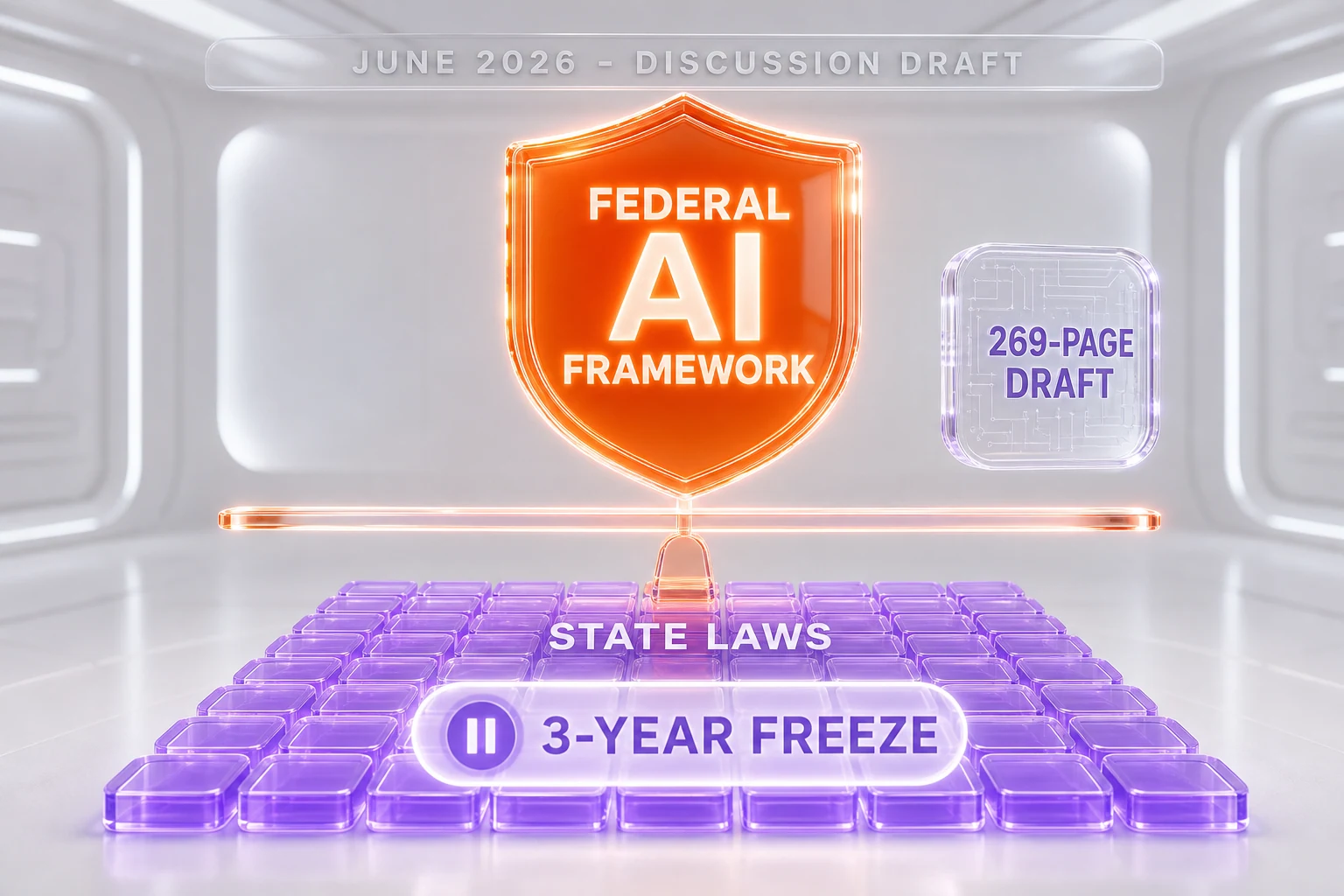
The Great American Artificial Intelligence Act is a 269-page bipartisan discussion draft released on June 4, 2026, by Reps. Jay Obernolte (R-CA) and Lori Trahan (D-MA). As of June 2026 it is not law: it is a draft circulated for feedback. Its core trade is the most consequential AI-policy bargain Congress has put on paper to date. In exchange for the first comprehensive federal safety framework for large AI developers, it would impose a three-year freeze on state laws that specifically regulate how AI models are built, while leaving states free to police how AI is used. Supporters call it a compromise that ends a fragmenting patchwork; critics call it a federal ceiling that erases a state accountability floor.
This is a US federal story, and it should not be confused with the EU AI Act, which is a separate regime on a separate continent. The fight here is between Washington and the 50 state capitals — and it sits directly on top of the labs we cover most closely: OpenAI, Anthropic, Google, and xAI. Below we lay out what the draft actually says, the "build versus use" distinction that does all the load-bearing work, the timeline that led here, and the two competing readings of what it means — without taking a side in a debate that, as of this writing, is far from settled.
What is the Great American AI Act?
The Great American Artificial Intelligence Act is a bipartisan discussion draft that would create the first comprehensive federal framework for governing frontier AI development in the United States. Released as a 269-page draft on June 4, 2026, it pairs new federal safety, transparency, and audit obligations for the largest AI developers with a temporary, three-year preemption of state laws that specifically regulate how those models are developed. It is sponsored in the House and, as of June 2026, has not been introduced as formal legislation or voted on.
The draft was released jointly by Rep. Jay Obernolte (R-CA) — a computer scientist who has co-chaired Congressional AI efforts — and Rep. Lori Trahan (D-MA). According to reporting from Roll Call, additional co-sponsors on the discussion draft include Reps. Suhas Subramanyam (D-VA), Scott Franklin (R-FL), Scott Peters (D-CA), and Erin Houchin (R-IN), giving the text a bipartisan footprint across both chambers' usual fault lines.
Two framing points matter before going further. First, the word that recurs in every analysis is "discussion draft." It is explicitly an invitation for comment, not a bill on a markup calendar. Second, its sponsors present it as a compromise — a narrower preemption than earlier proposals — while its loudest opponents present it as a giveaway. Both characterizations are political claims, and this article attributes them rather than endorsing either.
The "build vs use" distinction: the line that decides everything
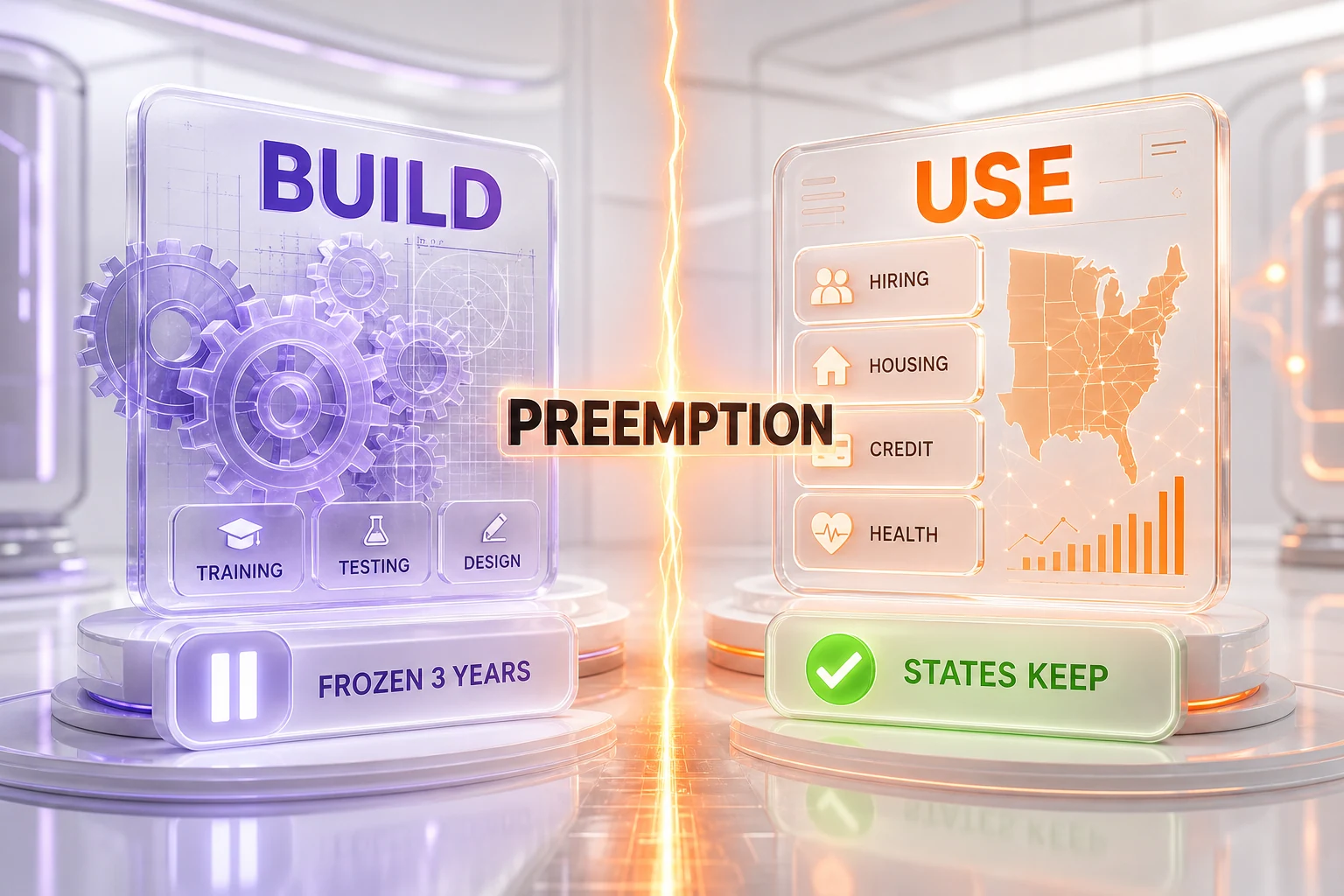
The Great American AI Act draws a sharp line between regulating how AI models are built (training, testing, and design before release) and how AI systems are used (deployment in hiring, housing, lending, or healthcare). The draft's preemption applies only to state laws that "specifically regulate the development" of AI models. It explicitly preserves state laws governing "post-deployment activities, including the implementation, distribution, offering, or use of AI systems." States would lose authority over the first category for three years and keep the second.
This distinction is the entire ballgame. Per analysis from the Future of Privacy Forum, the draft's preemption clause targets laws "that specifically regulate the development of an AI model," while expressly carving out laws governing post-deployment use. In plain terms: a state could still ban an AI tool from making discriminatory hiring decisions, but it could not, during the freeze, require a model developer to publish its training-data sources or watermark generated content.
What states keep, and what they would lose
The clearest way to see the split is by sorting concrete state laws into the two buckets. Based on the Future of Privacy Forum's comparison and a FAQ from Rep. Trahan's office cited by Broadband Breakfast:
| Category | Examples | Status under the draft (as of June 2026) |
|---|---|---|
| Build / development laws (frozen for 3 years) | California SB 53 (frontier model requirements); California AB 2013 (training-data transparency); portions of California SB 942 (AI content watermarking); New York RAISE Act; Illinois SB 315 | Likely preempted during the freeze |
| Use / deployment laws (preserved) | State rules on AI in employment, housing, credit, and healthcare decisions; anti-discrimination statutes of general applicability | Survive — states retain authority |
The practical upshot for the labs we track: a developer like OpenAI, Anthropic, Google, or xAI would answer to one federal standard on how it trains and releases a frontier model, rather than to California, New York, and Illinois separately. But any company deploying those models into a regulated decision — a bank using AI for credit scoring, an employer using AI to screen resumes — would still face the full stack of state use laws. The freeze does not touch them.
What the federal framework actually requires
In exchange for the three-year preemption, the Great American AI Act would impose binding obligations on the largest AI developers. Developers with more than $500 million in gross revenue for the prior calendar year would have to publish frontier AI frameworks, submit to semi-annual third-party audits by Independent Verification Organizations licensed through NIST's Center for AI Standards and Innovation, and protect whistleblowers. Penalties for non-compliance with safety requirements could reach up to $1 million per day.
The draft's substantive requirements, as detailed by Roll Call and the Future of Privacy Forum, include:
- Public frontier AI frameworks for large frontier developers (the >$500 million revenue threshold), describing how they manage catastrophic risk — defined in the draft around incidents involving more than 50 deaths or injuries, or more than $1 billion in property damage — alongside cybersecurity and internal oversight.
- Semi-annual third-party audits conducted by "Independent Verification Organizations" (IVOs) that are licensed through NIST's Center for AI Standards and Innovation (CAISI).
- Mandatory disclosure of information about frontier models, plus whistleblower protections for employees and contractors who report violations.
- Incident reporting on a tighter federal clock than several state laws (a 15-day window, or 24 hours for an imminent risk, versus the 72-hour windows in New York and Illinois cited by FPF).
- Enforcement teeth: penalties of up to $1 million per day for non-compliance with safety requirements, and roughly $100 million authorized for CAISI for each of fiscal years 2027 through 2029.
It is precisely because these obligations are real — audits, disclosures, daily penalties — that the bill's authors frame the preemption as the federal government stepping in, not stepping back. Whether that framing holds is exactly what the two camps disagree about.
How we got here: a timeline (EO 14365 to the June draft)
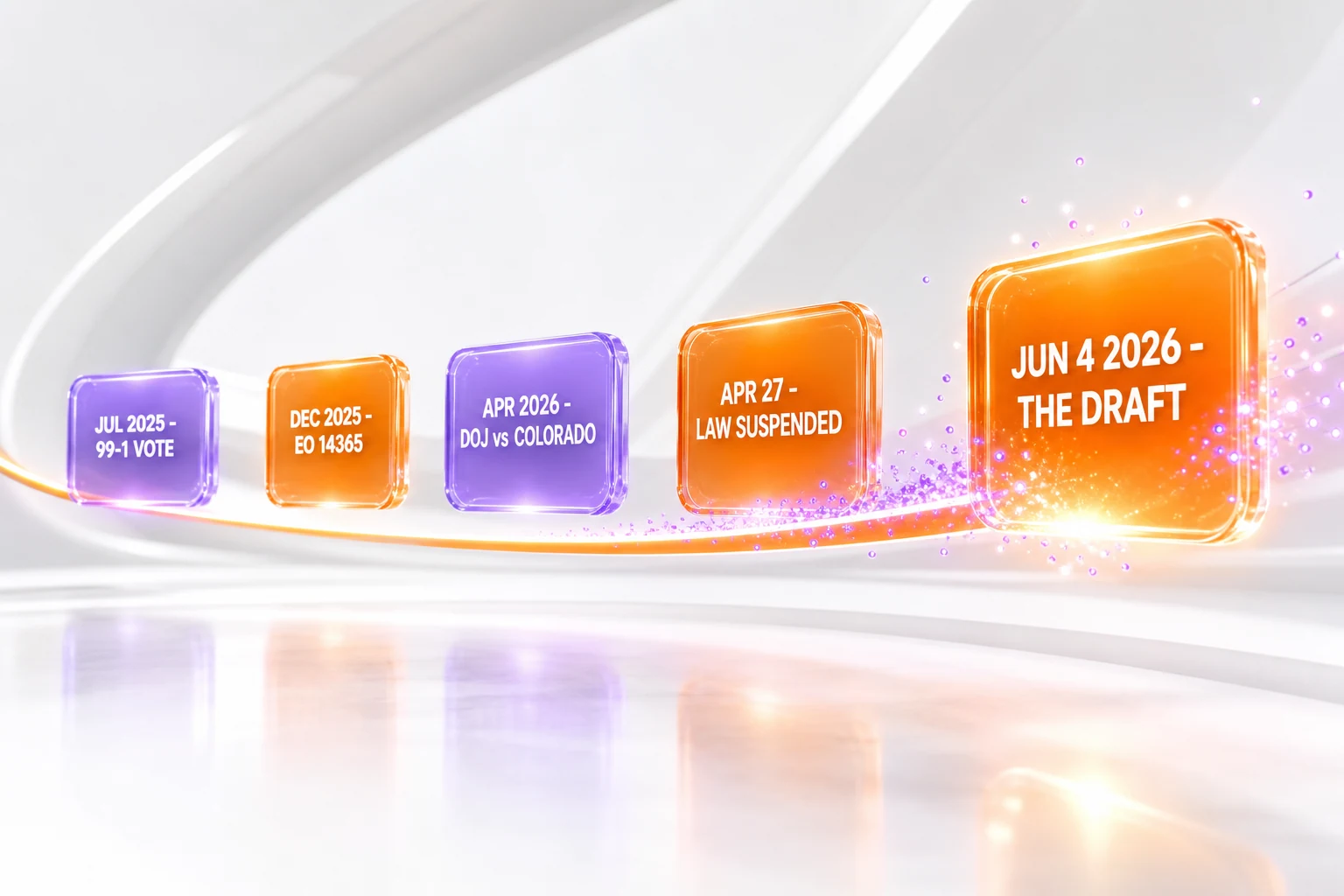
The Great American AI Act did not appear in a vacuum. It follows roughly six months of escalating federal action to override state AI laws, beginning with Executive Order 14365 on December 11, 2025, running through a Department of Justice intervention against the Colorado AI Act in April 2026, and arriving at the June 4, 2026 discussion draft. Understanding the sequence is essential to reading the draft's intent.
- July 2025 — The 10-year moratorium fails. The Senate voted 99-1 to strip a proposed 10-year moratorium on state AI laws from the budget reconciliation package. That near-unanimous rejection is the backdrop against which the new three-year, development-only freeze is pitched as a narrower compromise.
- December 11, 2025 — Executive Order 14365. President Trump signed an order titled "Ensuring a National Policy Framework for Artificial Intelligence," directing the federal government to address the growing number of state AI laws. Per the White House, it instructs the Attorney General to stand up an AI Litigation Task Force and the Commerce Secretary to identify "onerous" state AI laws.
- January 9, 2026 — DOJ AI Litigation Task Force. The Attorney General formally established the Task Force by memorandum, per White & Case.
- March 20, 2026 — National Policy Framework. The administration released a four-page blueprint called for by the EO, urging Congress to enact a unified federal AI standard and preempt state laws.
- April 24, 2026 — DOJ intervenes against the Colorado AI Act. The DOJ moved to intervene in support of xAI's challenge to Colorado's AI Act — the first time, per Norton Rose Fulbright, that the federal government sought to invalidate a state AI law.
- April 27, 2026 — Colorado enforcement suspended. A court granted a joint motion by xAI and the Colorado Attorney General to temporarily suspend enforcement of the AI Act, which had been scheduled to take effect June 30, 2026.
- June 4, 2026 — The Great American AI Act discussion draft. Obernolte and Trahan released the 269-page draft, moving the preemption fight from executive action and the courts into proposed legislation.
One caveat the timeline makes unavoidable: the executive-branch pillar of this strategy is itself contested in court. The DOJ's theory in the Colorado case has not been adjudicated on the merits, and the enforcement suspension is temporary. The legislative draft is thus arriving while the legal foundations beneath it are still being litigated.
Two readings of the same 269 pages
Because this is a politically charged, moving target, the most useful thing we can do is present the two competing interpretations side by side, name the people making each argument, and let readers weigh them.
Reading one: the industry and sponsors — uniformity over a patchwork
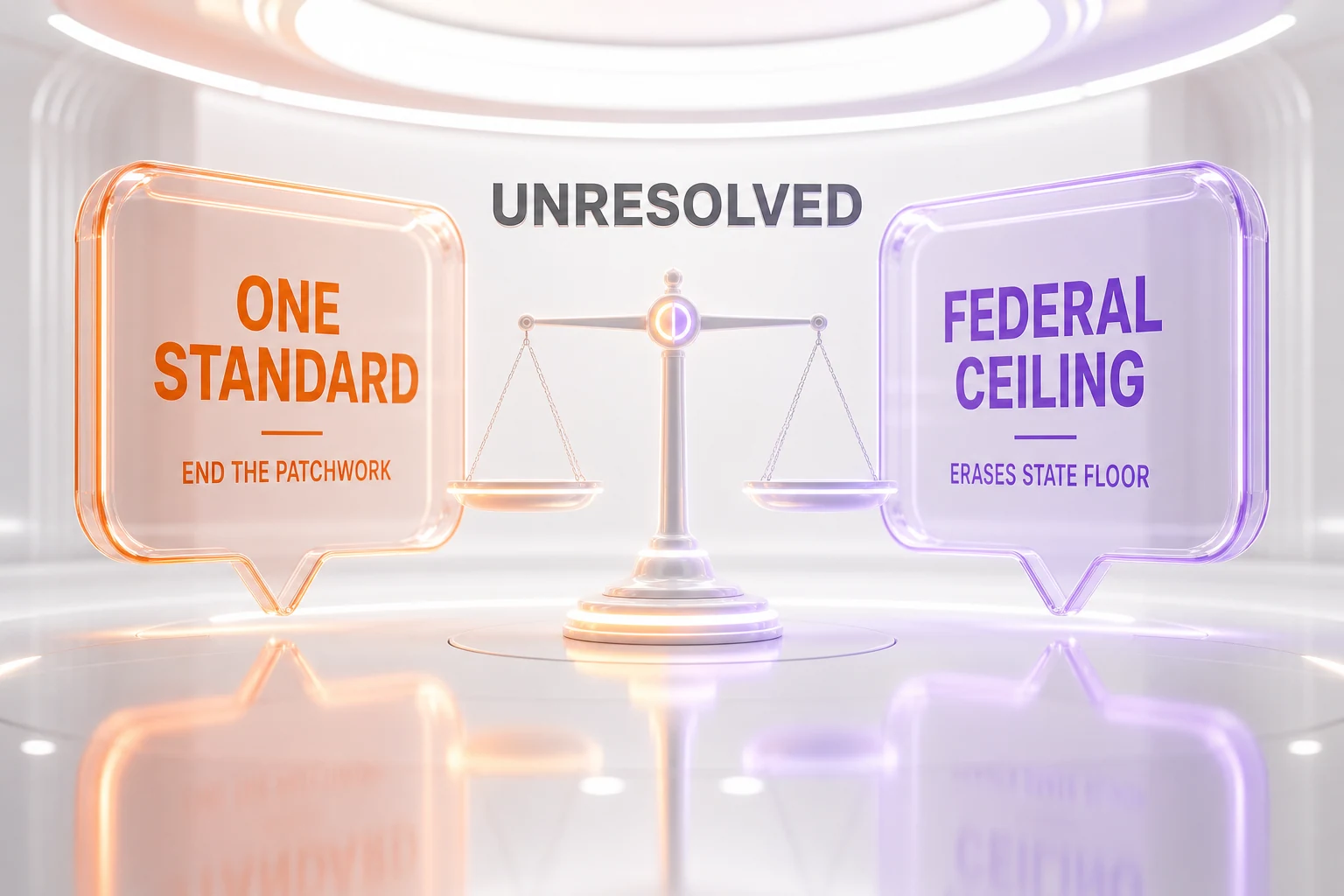
The pro-preemption case is that a single federal standard is better for safety and competitiveness than 50 divergent regimes. On this view, a developer should not have to satisfy conflicting training-data, watermarking, and disclosure rules in California, New York, and Illinois to ship one model nationwide. The sponsors frame the draft as the federal government finally taking responsibility for frontier-model oversight, with real audits and penalties, rather than leaving a vacuum that states rushed to fill.
This argument has well-funded backing outside Congress. The super PAC network "Leading the Future" — launched in August 2025 with more than $100 million, and backed, per public reporting, by Andreessen Horowitz (a16z), OpenAI President Greg Brockman, and Palantir co-founder Joe Lonsdale — has run campaigns explicitly calling for federal preemption of state AI laws and has long warned of a "patchwork of state laws." Their involvement is itself part of the story: it is why opponents frame the bill as industry-driven, even though the draft is bipartisan.
Reading two: critics — a federal ceiling that erases a state floor
The opposing case is that preemption removes hard-won state protections faster than the federal framework can replace them, and that a three-year freeze on development rules cedes control over how the most powerful models are built. This reading emerged within 24 hours of the draft's release, drawing scrutiny from civil-society groups including Public Citizen, Public Knowledge, and the AFL-CIO.
The most-quoted line comes from Brad Carson, president of Americans for Responsible Innovation and a former Democratic Representative from Oklahoma, who told Roll Call the bill "takes the current floor on state AI legislation and turns it into a federal ceiling." Brendan Steinhauser, CEO of the Alliance for Secure AI, argued the draft "falls short of the framework necessary to keep Americans safe from the dangers of advanced AI." Notably, not all criticism comes from the safety camp: Patrick Hedger, policy director at NetChoice — an industry group — raised the opposite concern, flagging an "aggressive auditing regime" and data-sharing requirements that could risk trade secrets.
That last detail is worth dwelling on, because it complicates any tidy "industry versus advocates" narrative: the draft is being criticized simultaneously for going too far (NetChoice) and not far enough (Alliance for Secure AI), with the preemption itself the flashpoint for consumer and labor groups.
A note on the "last-ditch Big Tech maneuver" framing
One popular characterization holds that the bill is a final attempt by Big Tech to escape accountability before state laws bite. That is a real argument advanced by opponents, and the "Leading the Future" spending gives it weight. But it is a characterization, not an established fact: the draft is co-sponsored by members of both parties and is presented by its authors as a negotiated compromise with binding new obligations. We report the argument and attribute it to the people making it; we do not assert it in our own voice.
Why this matters for the AI tools you use
For the labs at the center of our coverage, the stakes are concrete. A single federal development standard would change how OpenAI, Anthropic, Google DeepMind, and xAI document, test, and disclose frontier models — and the semi-annual IVO audit requirement would be a first in US law. The >$500 million revenue threshold means the obligations land squarely on the frontier labs, not on the long tail of smaller startups and open-weight projects.
It also reshapes the broader regulatory map. We have tracked the wave of state-level AI legislation — five states moving on AI companions in three months — and the global regulatory crackdown on individual models. The Great American AI Act would not touch most of those use-focused rules, but it would freeze the development-focused ones, redrawing where the action sits. And it lands in the same season as the G7 governance conversation and the EU's own AI Act recalibration — three jurisdictions converging on the same question of who governs frontier models, and arriving at very different answers.
What happens next is genuinely open. A discussion draft can be rewritten, stalled, or never introduced. The executive-branch preemption strategy could win or lose in court. State legislatures may respond by accelerating use-focused laws that the freeze does not reach. The only safe forecast, as of June 2026, is that this is the opening move in a multi-year fight over American AI governance — not its conclusion.
The bottom line
As of June 2026, the Great American AI Act is a 269-page bipartisan discussion draft, not a law. It offers the first comprehensive federal AI safety framework — semi-annual third-party audits, public frontier frameworks, whistleblower protections, and penalties up to $1 million per day for the largest developers — in exchange for a three-year freeze on state laws that specifically regulate how AI models are built, while leaving state authority over AI use intact. Supporters see uniformity replacing a patchwork; critics see a federal ceiling replacing a state floor. The debate is unresolved, and the underlying executive-branch preemption push is still being litigated.
Frequently asked questions
Is the Great American AI Act law yet?
No. As of June 2026 it is a discussion draft, released June 4, 2026 by Reps. Jay Obernolte (R-CA) and Lori Trahan (D-MA). A discussion draft is circulated to gather feedback; it has not been introduced as formal legislation, marked up in committee, or voted on. Its provisions could change substantially or never become law.
What is AI preemption?
AI preemption is the use of federal law to override or block state laws on artificial intelligence. The Great American AI Act would preempt — meaning suspend — state laws that "specifically regulate the development" of AI models for three years, while preserving state laws governing how AI systems are used or deployed. Federal preemption of state law is grounded in the Supremacy Clause of the US Constitution.
What is the "build vs use" distinction in the bill?
The draft separates regulating how AI models are built (training, testing, and design before release) from how AI systems are used (deployment in hiring, housing, lending, or healthcare). For three years, states could not pass new laws on the "build" side, but they keep full authority over the "use" side. For example, a state could still ban discriminatory AI hiring, but could not require a developer to publish training-data sources during the freeze.
Which state AI laws would be frozen by the Great American AI Act?
According to the Future of Privacy Forum and a FAQ from Rep. Trahan's office, development-focused laws likely preempted include California SB 53, California AB 2013 (training-data transparency), portions of California SB 942 (AI watermarking), the New York RAISE Act, and Illinois SB 315. Use- and deployment-focused state laws — covering employment, housing, credit, and healthcare — would survive.
What would the federal framework require of AI developers?
Developers with more than $500 million in gross revenue for the prior year would have to publish frontier AI frameworks, undergo semi-annual third-party audits by Independent Verification Organizations licensed through NIST's Center for AI Standards and Innovation, disclose information about frontier models, and protect whistleblowers. Penalties for non-compliance with safety requirements could reach up to $1 million per day.
Who supports and who opposes the bill?
Sponsors from both parties and the pro-preemption super PAC "Leading the Future" (backed by a16z, OpenAI President Greg Brockman, and Palantir's Joe Lonsdale) argue a single federal standard beats a patchwork of state laws. Critics — including Public Citizen, Public Knowledge, the AFL-CIO, and Americans for Responsible Innovation's Brad Carson, who called it a move from "a state floor" to "a federal ceiling" — argue it strips state protections. NetChoice, an industry group, separately criticized the audit requirements as too aggressive.
How does this relate to Executive Order 14365 and the Colorado AI Act case?
The draft follows a federal push that began with Executive Order 14365 (December 11, 2025), which created a DOJ AI Litigation Task Force (established January 9, 2026). On April 24, 2026, the DOJ intervened against the Colorado AI Act in support of xAI, and a court suspended that law's enforcement on April 27, 2026. The legislative draft thus arrives while the executive-branch preemption strategy is still being litigated.
Is the Great American AI Act the same as the EU AI Act?
No. The Great American AI Act is a US federal proposal addressing the relationship between Washington and the 50 states. The EU AI Act is a separate, already-adopted European Union regulation with its own risk-based structure and timeline. The two are independent regimes, and the US draft has no bearing on EU obligations.
How long would the state preemption last?
Three years, with a sunset provision. The freeze on state AI development laws would expire unless reauthorized by Congress. This is narrower than a proposed 10-year moratorium that the Senate voted 99-1 to remove from a budget reconciliation package in July 2025 — a precedent the sponsors cite when describing the three-year version as a compromise.