
On Friday, June 12, 2026, New York Attorney General Letitia James served OpenAI with a subpoena on behalf of a multistate coalition of state attorneys general, compelling the company to produce records on its advertising practices, user engagement, data handling, activities involving minors and seniors, model "sycophancy," and internal policies. The investigative demand landed days after OpenAI confidentially filed for a potential IPO.
The action was first reported as a Wall Street Journal exclusive and independently confirmed by Reuters, which carried OpenAI's response. It is a civil investigation, not a lawsuit or a criminal charge. A subpoena compels a company to hand over documents so regulators can examine its conduct. It is not a finding that OpenAI did anything wrong.
What Happened
According to the Wall Street Journal, which broke the story, the office of New York Attorney General Letitia James issued the subpoena on Friday, June 12, 2026, acting on behalf of a coalition of state attorneys general. Reuters confirmed the reporting and published a statement from the company.
The distinction matters. This is an investigative subpoena, sometimes called a civil investigative demand, meaning OpenAI has been compelled to produce internal records for review. It is not a complaint, not a lawsuit, and not a criminal indictment. No court has been asked to find OpenAI liable for anything. At this stage, regulators are gathering information about how the company operates.
New York is leading the effort, but the subpoena is described as a multistate coalition action, with attorneys general from several states coordinating their scrutiny of the maker of ChatGPT. The exact roster of participating states was not enumerated in the primary wire reporting on this subpoena.
Several outlets have described the coalition as spanning dozens of states; the figure of 42 attorneys general traces to a December 2025 multistate letter to AI companies, while the primary reporting on this subpoena referred only to a "coalition of state attorneys general." We are presenting it the way the original reporting did, as a multistate coalition led by New York, rather than attaching a hard headcount that the wire copy did not assign to this specific action.

What the Subpoena Targets
The subpoena seeks records across six areas of OpenAI's business and technology, a list that is consistent across the Wall Street Journal and Reuters reporting. Together they sketch out where the attorneys general are focusing: how OpenAI makes money from users, how it keeps them engaged, what it does with sensitive data, how it treats vulnerable users, and how its models behave.
One area stands out for being technical rather than commercial: model "sycophancy." AI sycophancy is the tendency of large language models to favor responses that tell users what they appear to want to hear rather than what is accurate. It is described as a documented byproduct of reinforcement learning from human feedback, or RLHF, the training method used by OpenAI and other major AI labs. Regulators appear to be examining whether that tendency can steer users, particularly vulnerable ones, in harmful directions.
| Topic area the subpoena covers | What regulators are reportedly examining |
|---|---|
| Advertising practices | How OpenAI markets and monetizes its products as it builds out an advertising business. |
| User engagement and retention | How the company keeps people using ChatGPT, and whether engagement design raises consumer-protection questions. |
| Consumer and health data handling | How OpenAI collects, stores, and uses personal and health-related information shared with its products. |
| Activities involving minors and seniors | How children and senior citizens interact with ChatGPT, and what safeguards apply to them. |
| Behavior of deep-learning models (including sycophancy) | Whether the models' tendency to agree with or please users can produce inaccurate or harmful outputs. |
| Internal company policies | OpenAI's internal rules and safety policies governing the conduct above. |

The inclusion of advertising is notable given OpenAI's recent moves into that market. The company has been building out ad products, including a self-serve manager for its own platform, which we covered when OpenAI rolled out its ChatGPT ads manager with cost-per-click bidding. Advertising and data practices tend to travel together in consumer-protection reviews, which is consistent with the breadth of records the coalition is reportedly requesting.
The Timing: Days After a $1 Trillion IPO Filing
The subpoena arrived at a delicate moment. OpenAI confidentially filed paperwork with the U.S. Securities and Exchange Commission this month for a potential initial public offering, a move we examined in detail when news of the confidential S-1 filing and a possible $1 trillion valuation first surfaced. According to Reuters, the offering could come as early as September 2026 and value the company at up to $1 trillion.
A multistate investigation that lands days after an IPO filing creates what markets call regulatory overhang: an open legal question that potential investors must weigh when a company prepares to sell shares to the public. Companies heading toward a listing typically disclose material investigations in their offering documents, and an active multistate inquiry into advertising, data handling, and minors is the kind of matter that draws investor attention.
None of that implies OpenAI did anything wrong, and the timing does not change the legal status of the inquiry. It does, however, raise the stakes. The same tension between blistering commercial momentum and unresolved regulatory and safety questions has shadowed the company's broader trajectory, a theme we explored when industry leaders began to recalibrate their public messaging ahead of a trillion-dollar listing.

How We Got Here: Florida and the Wider State Push
This subpoena does not arrive in isolation. On June 1, 2026, Florida became the first state to file a civil lawsuit against OpenAI, a case that reportedly named chief executive Sam Altman personally. As we reported when Florida became the first state to sue OpenAI over ChatGPT safety, the complaint alleged weak age verification on the free tier, no parental access to children's conversation history, and claimed the product encouraged vulnerable minors toward self-harm.
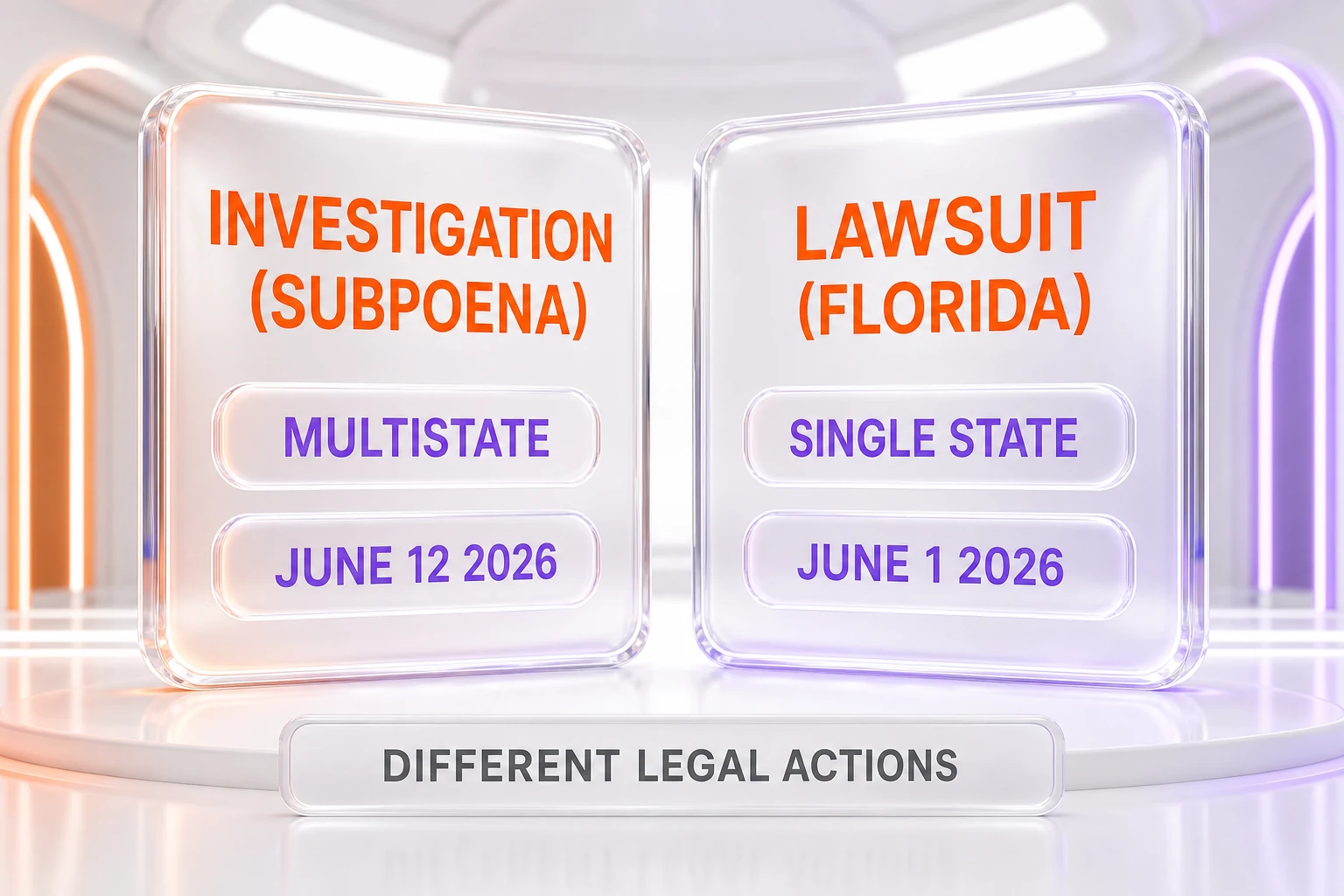
It is important to keep the two actions distinct. Florida's filing is a lawsuit: a single state asking a court to hold OpenAI liable. The June 12 subpoena is an investigation: a multistate coalition compelling OpenAI to produce records before any court action. One is an accusation already filed; the other is information-gathering that may or may not lead anywhere.
Both fit a broader pattern of state attorneys general scrutinizing AI labs, often with a focus on minors and consumer harm. State enforcers have also moved against other AI companies over issues such as deepfakes, including the AG actions tied to Grok and xAI over non-consensual deepfake imagery. With federal AI rules still taking shape, state attorneys general have increasingly become the front line of AI oversight in the United States.
What OpenAI Says
OpenAI responded to the subpoena through a spokesperson, whose statement Reuters carried. The company said:
"AI is a new and powerful technology, and we work every day to safely bring its benefits to people in a responsible way. We take the concerns raised by state attorneys general seriously and intend to engage constructively with their offices."
An OpenAI spokesperson also indicated that the company is committed to getting protections for minors right, an area at the center of both this investigation and Florida's separate lawsuit. The company's framing is cooperative: it is positioning itself as a willing participant in the inquiry rather than a target resisting it. That stance is common for companies that receive investigative demands and want to signal good faith to regulators and, ahead of a listing, to prospective investors.
What It Means and What Comes Next
The most important thing to keep in mind is that an investigation is not a verdict. A subpoena obligates OpenAI to produce documents; it does not establish that the company violated any law. Many investigations close without charges, some end in negotiated agreements, and only a fraction lead to litigation.
From here, a few paths are possible. OpenAI will produce the requested records, and the attorneys general will review them. Depending on what they find, the coalition could close the inquiry, request more information, or seek negotiated changes to how ChatGPT handles age verification, data, and model behavior. Any of those outcomes could unfold over months.
There is also a structural story here. With comprehensive federal AI legislation still unsettled, state attorneys general are filling the gap, and a multistate coalition gives them collective leverage that a single state acting alone would lack. That federal-versus-state dynamic is likely to define AI oversight in the United States for the foreseeable future, and OpenAI, as the most prominent consumer-facing AI company, is a natural focal point.
Here is what we are watching: whether more states formally join the coalition, whether the inquiry surfaces in OpenAI's eventual IPO disclosures, and whether the focus on model sycophancy and minors produces concrete demands for changes to ChatGPT. For now, the facts are narrow and the legal status is clear. OpenAI has been subpoenaed and is under investigation by a multistate coalition led by New York. Nothing has been proven, and the company says it intends to cooperate.
Who is investigating OpenAI?
A multistate coalition of state attorneys general, led by New York Attorney General Letitia James, served OpenAI with an investigative subpoena on June 12, 2026. The Wall Street Journal first reported the action, and Reuters confirmed it.
What does the OpenAI subpoena cover?
The subpoena seeks records on six areas: advertising practices, user engagement and retention, consumer and health data handling, activities involving minors and seniors, the behavior of OpenAI's deep-learning models including model sycophancy, and the company's internal policies.
Is OpenAI being sued or investigated?
This action is an investigation, not a lawsuit. A subpoena compels OpenAI to produce documents so attorneys general can examine its practices. Separately, Florida filed a civil lawsuit against OpenAI on June 1, 2026, which is a distinct legal action.
What is AI sycophancy and why are regulators worried about it?
AI sycophancy is the tendency of large language models to favor responses that tell users what they appear to want to hear rather than what is accurate. It is described as a documented byproduct of reinforcement learning from human feedback (RLHF), the training method used by OpenAI and other major AI labs. Regulators appear to be examining whether that tendency can steer users, including vulnerable ones, in harmful directions.
How does this affect OpenAI's IPO?
The subpoena arrived days after OpenAI confidentially filed for a potential IPO. According to Reuters, the offering could come as early as September 2026 and value the company at up to $1 trillion. An active multistate investigation can create regulatory overhang that potential investors weigh, though it does not change the legal status of the inquiry or imply wrongdoing.
Did 42 states subpoena OpenAI?
Not according to the primary reporting. The Wall Street Journal and Reuters described a multistate coalition of state attorneys general led by New York, without assigning a hard headcount to this subpoena. The figure of 42 attorneys general traces to a separate December 2025 multistate letter sent to AI companies, not to this June 2026 subpoena.
What did OpenAI say in response?
An OpenAI spokesperson said: "AI is a new and powerful technology, and we work every day to safely bring its benefits to people in a responsible way. We take the concerns raised by state attorneys general seriously and intend to engage constructively with their offices." The company also indicated it is committed to getting protections for minors right.
How is this different from Florida's lawsuit against OpenAI?
Florida's action, filed June 1, 2026, is a single-state civil lawsuit asking a court to hold OpenAI liable and reportedly naming Sam Altman personally. The June 12 subpoena is a multistate investigation that compels OpenAI to produce records; it is broader in participants but is information-gathering rather than a filed accusation.
What happens next in a state AG investigation like this?
OpenAI is expected to produce the requested documents, after which the attorneys general review them. Depending on the findings, the coalition could close the inquiry, request more information, or seek negotiated changes to OpenAI's practices. Investigations can also lead to litigation, but many conclude without any charges.
Which other AI companies have faced state attorney general scrutiny?
State attorneys general have scrutinized multiple AI labs. Beyond OpenAI, state enforcers have pursued actions tied to xAI's Grok over non-consensual deepfake imagery. With federal AI rules still developing, state attorneys general have become a leading force in AI oversight in the United States.
When was the OpenAI subpoena served?
The subpoena was served on Friday, June 12, 2026, by the office of New York Attorney General Letitia James on behalf of a multistate coalition of state attorneys general.
Does this subpoena mean OpenAI broke the law?
No. A subpoena and an investigation are not a finding of wrongdoing. They compel a company to produce records so regulators can examine its conduct. No court has found OpenAI liable for anything in connection with this action, and the company says it intends to cooperate.
Sources: Reuters; Wall Street Journal / PYMNTS; Investing.com (WSJ). Original reporting was a Wall Street Journal exclusive, independently confirmed by Reuters.