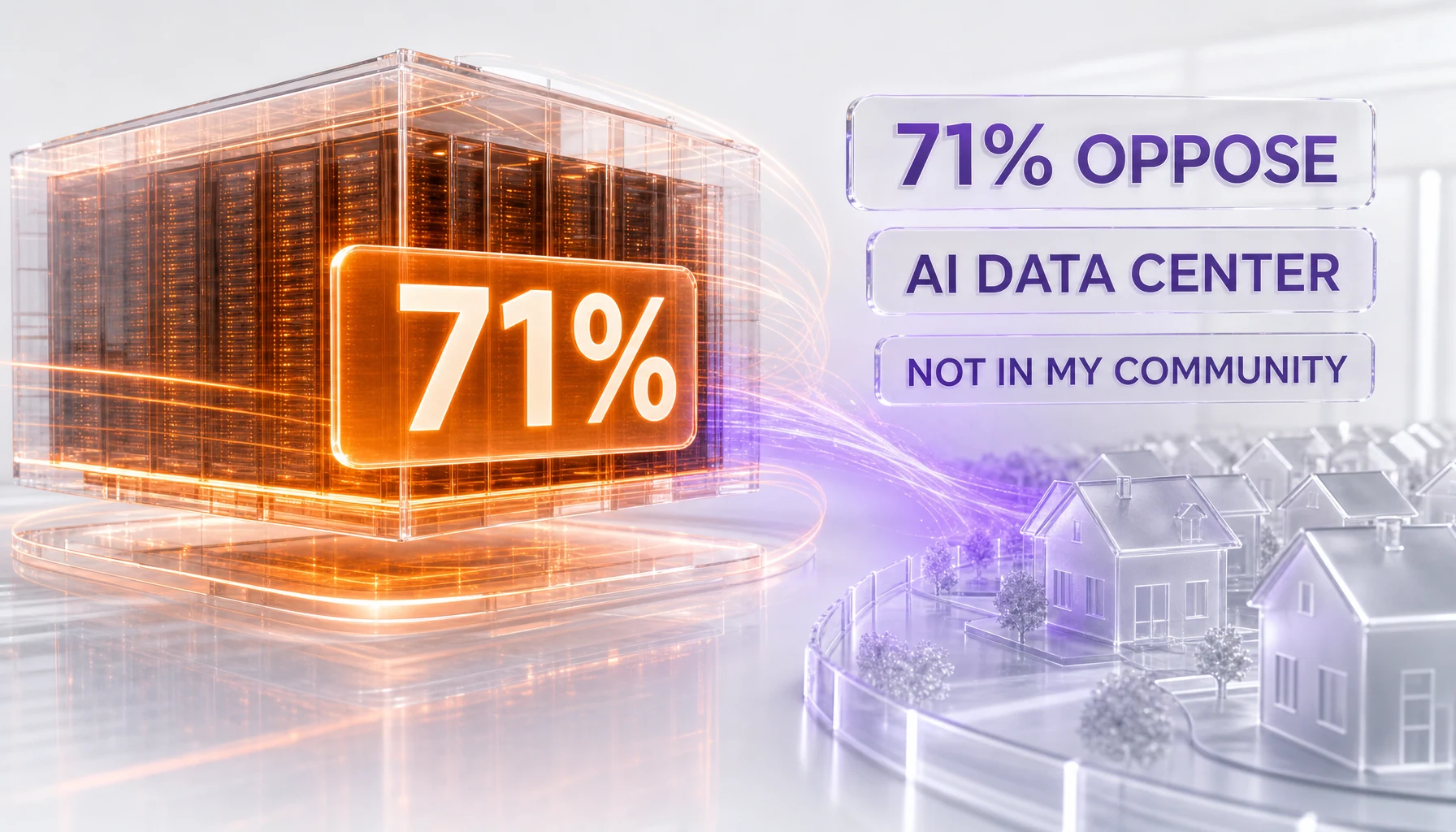
AI data centers are now more unpopular with Americans than nuclear power plants. A Gallup poll of 1,000 US adults, conducted March 2 to 18, 2026 across all 50 states and DC, found that 71% oppose building an AI data center in their own community, including 48% who strongly oppose it. By comparison, only 53% oppose a local nuclear plant. The backlash cuts across party lines and is driven mainly by concerns over water and energy use.
What the Gallup Poll Found
Gallup surveyed 1,000 US adults aged 18 and older across all 50 states and the District of Columbia, with telephone interviews fielded by Recon MR between March 2 and March 18, 2026. The margin of sampling error is about plus or minus 4 percentage points. The headline number: 71% of Americans say they would oppose the construction of an AI data center in their local community.
That 71% breaks into 48% who strongly oppose and 23% who somewhat oppose. The strong-opposition share is the part that matters most for local politics, because strongly opposed residents are the ones who show up at zoning hearings, sign petitions, and vote against projects. Nearly half of the country falls into that category for AI data centers specifically.
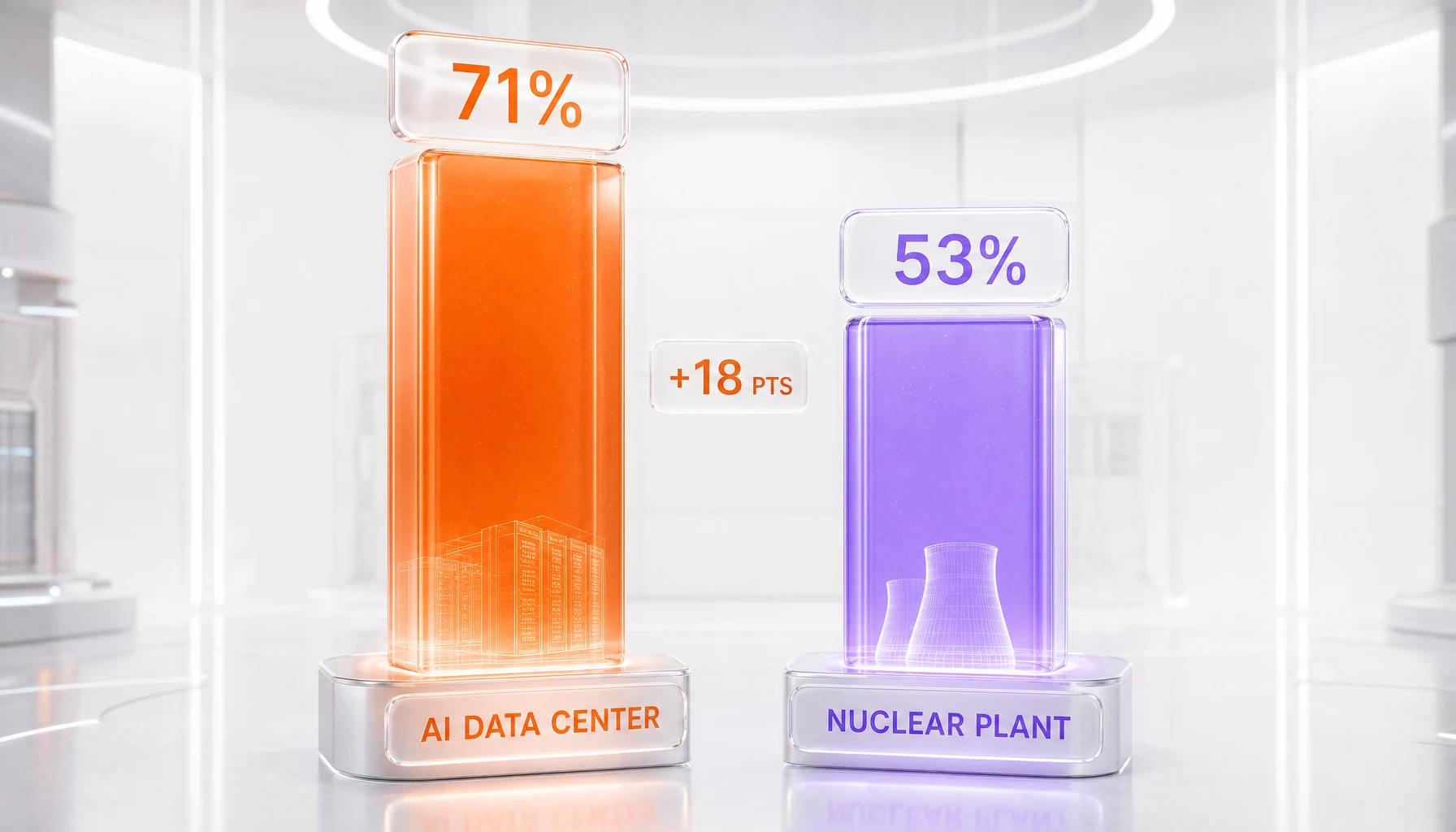
The single most striking comparison in the data is with nuclear power. Only 53% of Americans oppose a nuclear plant in their community — an 18-point gap. For decades, a local nuclear plant has been the textbook example of a not-in-my-backyard project, the thing people least want next door. As of March 2026, the AI data center has overtaken it. Notably, that 53% figure is itself the highest level of opposition to nuclear power Gallup has recorded since 2001, which makes the data center's lead over it even more remarkable.
Opposition at a Glance
| Project type (local community) | Total opposed | Strongly oppose |
|---|---|---|
| AI data center | 71% | 48% |
| Nuclear power plant | 53% | — |
By party, opposition to a local AI data center splits like this: Democrats 56%, Independents 48%, Republicans 39% strongly oppose. The takeaway is not that one side is for and one side is against — every group leans against, and the differences are about intensity, not direction.
Why This Is More Than a NIMBY Story
It is tempting to file this under standard NIMBY behavior, where residents object to any new development near their homes. But the nuclear comparison breaks that frame. If this were simply about generic opposition to industrial sites, AI data centers would track roughly with nuclear plants, refineries, or landfills. Instead, the data center now sits at the top of the list, ahead of the facility that has symbolized local dread for a generation.
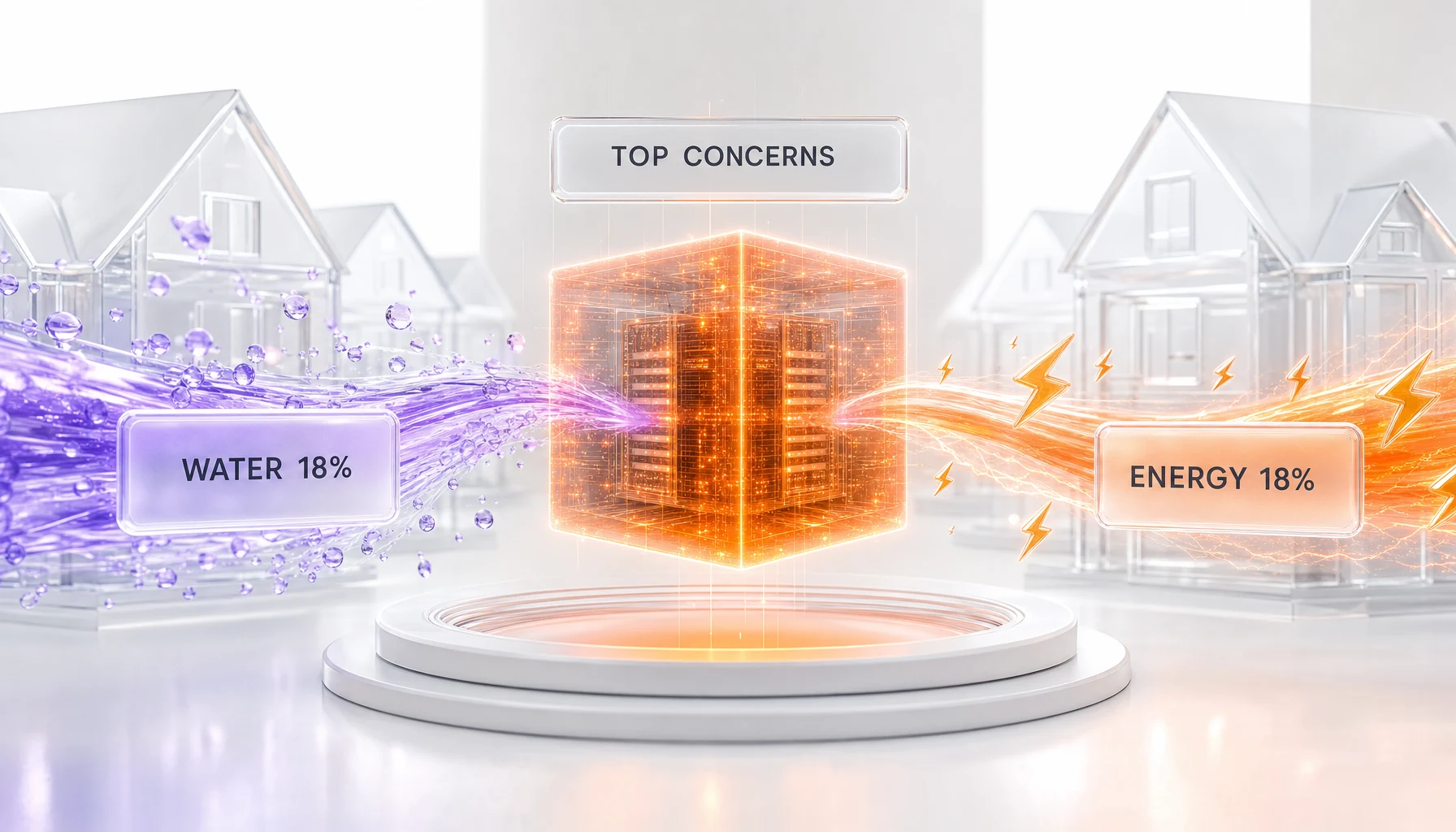
Something specific to AI infrastructure is driving the number. A separate Gallup Panel survey — a web-based study of 2,054 respondents fielded in April 2026, distinct from the headline phone poll — asked people why. The two reasons that rose to the top were excessive use of resources: water at roughly 18% and energy at roughly 18%. People are not abstractly suspicious of computers in a warehouse. They are worried about what those warehouses pull from the local grid and the local watershed.
This connects to a hard physical reality we have covered repeatedly. The bottleneck for AI is no longer chips, it is power and the grid interconnection that delivers it. We laid this out in our analysis of GridCARE and the power-for-AI thesis, where the scarce resource has moved upstream from the GPU to the substation. When a hyperscale campus asks for hundreds of megawatts in a region where the grid is already tight, residents feel it as a direct claim on the same infrastructure that powers their homes.
Independent Corroboration: A Second Poll Says 71% Too
Single polls can be noise. What makes this one hard to dismiss is that an independent survey landed on the same headline figure. Heatmap Pro, working with Embold Research, polled 4,118 registered voters between May 15 and May 28, 2026 and also found 71% opposition to a local AI data center, with 55% strongly opposed. This is a distinct study from Gallup, with a different methodology, a different population — registered voters rather than all adults — and a different field window. When two separate instruments converge on the same number two months apart, the signal is real.
The Heatmap and Embold result, with its higher strong-opposition share of 55%, also hints that the intensity of feeling may be hardening over time, not softening. That is the opposite of what the industry would hope for as data centers become more common and, in theory, more familiar.
The Resources at the Heart of It: Water and Energy
The two concerns Gallup respondents cited most — water and energy, each near 18% — are not vague fears. Large AI training and inference clusters draw enormous, sustained electrical load and, depending on the cooling design, can consume significant volumes of water for evaporative cooling. In a community where summers are already straining the grid or where the aquifer is already under pressure, a new campus reads as competition for finite local resources.
This is also why the issue does not map neatly onto the usual political divide. Energy bills and water access are kitchen-table concerns. A retiree on a fixed income worried about electricity prices and a younger resident worried about drought can land in the same place — against the project — for overlapping reasons. That is exactly the cross-party pattern the Gallup numbers show, with majorities or strong pluralities opposed across Democrats, Independents, and Republicans alike.
The industry is not blind to this. The same physical constraints have pushed capital toward power discovery and, in the more speculative case, toward leaving the planet's surface entirely. We covered the most extreme version of that escape in our piece on Starcloud's orbital data centers, a $170M bet on putting compute in space where land, water permits, and angry neighbors are not part of the equation. Orbital data centers are years away and unproven, but the fact that serious money is chasing them is itself a measure of how hard the terrestrial siting problem has become.
What This Means for the Trillion-Dollar Buildout
The timing is awkward for the industry. The same months that produced these poll numbers also produced the largest infrastructure commitments in the sector's history. In Europe, we wrote about SoftBank's up-to-75-billion-euro bet on French AI data centers, one of the biggest infrastructure gambles ever attempted on the continent. The capital is flowing into physical sites at a scale that assumes communities will say yes.
Gallup's data suggests that assumption is fragile, at least in the United States. A project does not need a national majority to stall — it needs a hostile city council, a contested zoning vote, or a few hundred strongly opposed residents organizing locally. With 48% nationally in the strong-opposition camp, almost every proposed site will have a ready-made opposition base before the first shovel hits dirt.
This does not mean the buildout stops. It means it gets slower, more expensive, and more dependent on locations where the politics are favorable — places that want the tax base and the jobs, and where the grid and water can absorb the load. Expect more projects to route toward willing rural counties, more emphasis on closed-loop cooling and on-site or behind-the-meter generation, and more aggressive community-benefit agreements designed to flip local sentiment. The economics of where you can build just got tighter.
Reading the Numbers Honestly
A few cautions are worth stating plainly, because polling on AI is easy to over-read. First, Gallup does not publish the exact verbatim wording of its question, so we describe what it measured — opposition to a local AI data center — rather than quoting a precise sentence. Second, opposition in a survey is not the same as turnout at a hearing; stated attitudes overstate how many people will actually organize. Third, the two reasons-why findings come from a separate Gallup Panel web survey of 2,054 people, not from the same 1,000-person phone sample, so they should be read as a companion data point rather than a breakdown of the headline number.
None of that softens the core result. Two independent surveys, run by different firms with different methods, both put opposition at 71%. The strong-opposition share is near or above half in both. And the comparison to nuclear power — the previous gold standard of unwanted infrastructure — is the kind of finding that does not happen by accident. For a sector betting hundreds of billions of dollars on physical expansion, the message is direct: the technology may be wanted, but the buildings that run it are not welcome next door.
The Bottom Line
As of March 2026, Americans oppose a local AI data center more than they oppose a local nuclear plant — 71% versus 53%, with nearly half strongly opposed. A second independent poll in May confirmed the 71% figure with even higher intensity. The drivers are concrete and bipartisan: water and energy, the two resources a data center competes for most directly with the surrounding community. For an industry pouring record capital into physical sites, the data is a warning that the hardest constraint on AI's expansion may not be chips or even power generation, but the consent of the people who live near where it gets built.
Frequently Asked Questions
What percentage of Americans oppose AI data centers?
According to a Gallup poll of 1,000 US adults conducted March 2 to 18, 2026, 71% of Americans oppose building an AI data center in their local community. That total includes 48% who strongly oppose and 23% who somewhat oppose. An independent poll by Heatmap Pro and Embold Research, covering 4,118 registered voters from May 15 to 28, 2026, found the same 71% opposition figure.
Are AI data centers more unpopular than nuclear power plants?
Yes. In the same Gallup poll, 71% of Americans opposed a local AI data center while only 53% opposed a local nuclear power plant — an 18-point gap. This means AI data centers have overtaken nuclear plants as the local infrastructure project Americans least want in their community. The 53% opposition to nuclear is itself the highest Gallup has recorded since 2001.
Why do Americans oppose AI data centers?
The top reasons are resource use. In a separate Gallup Panel web survey of 2,054 respondents conducted in April 2026, excessive water use was cited by roughly 18% of respondents and excessive energy use by roughly 18%. Large AI clusters draw sustained electrical load and can consume significant water for cooling, which residents see as direct competition for finite local grid and water resources.
Who conducted the data center opposition poll?
The headline poll was conducted by Gallup, which surveyed 1,000 US adults aged 18 and older across all 50 states and the District of Columbia. Telephone interviews were fielded by Recon MR between March 2 and March 18, 2026, with a margin of sampling error of about plus or minus 4 percentage points. A second, independent poll was run by Heatmap Pro with Embold Research.
Is opposition to AI data centers a partisan issue?
No, it cuts across party lines. In the Gallup data, strong opposition to a local AI data center reached 56% among Democrats, 48% among Independents, and 39% among Republicans. Every group leans against the projects; the difference is intensity rather than direction. This bipartisan pattern reflects that water and energy costs are kitchen-table concerns rather than ideological ones.
How big was the second poll that confirmed the 71% figure?
The corroborating poll was conducted by Heatmap Pro in partnership with Embold Research. It surveyed 4,118 registered voters between May 15 and May 28, 2026, and found 71% opposition to a local AI data center, with 55% strongly opposed. It is a distinct study from Gallup, using a different population of registered voters rather than all adults, which makes the matching 71% result more credible.
Do AI data centers really use a lot of water?
Many large data centers use water for evaporative cooling, and depending on the cooling design and climate, the volumes can be significant and sustained. This is one of the two top concerns Gallup respondents named, cited by roughly 18% of them. Newer designs increasingly use closed-loop or air-based cooling to cut water draw, but water consumption remains a central reason communities resist new AI campuses.
Will this opposition stop AI data centers from being built?
It is unlikely to stop the buildout, but it will slow and reshape it. A project does not need a national majority to stall — a hostile city council or a few hundred strongly opposed residents can block a site. With 48% strongly opposed nationally, developers will increasingly route projects toward willing rural counties, adopt closed-loop cooling and behind-the-meter power, and offer community-benefit agreements to win local consent.
Why is energy the main constraint for AI data centers?
The scarce resource for AI has moved from the chip to the power that runs it. Hyperscale AI campuses can request hundreds of megawatts in regions where the grid is already tight, and interconnection can take years. This is why companies are investing in grid-capacity discovery, as we covered in our analysis of GridCARE, and why power, not GPUs, is now widely seen as the gating factor for AI expansion.
Are companies trying to build data centers in space to avoid this?
Some are exploring it. Startups like Starcloud have raised funding — $170M in Starcloud's case — to build orbital AI data centers where land, water permits, and local opposition are not factors. Orbital data centers remain years away and technically unproven, but the investment reflects how difficult terrestrial siting has become as communities increasingly reject projects on the ground.
How does this affect the trillion-dollar AI infrastructure buildout?
The poll arrived as the sector committed record capital to physical sites, including SoftBank's bet of up to 75 billion euros on French AI data centers. Gallup's data suggests the assumption that communities will accept these projects is fragile in the US. The likely effect is a slower, costlier buildout concentrated in politically favorable locations with available grid and water capacity.
What are the limitations of the Gallup data center poll?
Three caveats apply. Gallup does not publish the verbatim question wording, so we describe what it measured rather than quoting it. Survey opposition overstates real-world organizing — stated attitudes are not turnout at hearings. And the reasons-why findings come from a separate Gallup Panel web survey of 2,054 people, not the 1,000-person phone sample, so they are a companion data point rather than a breakdown of the headline 71%.