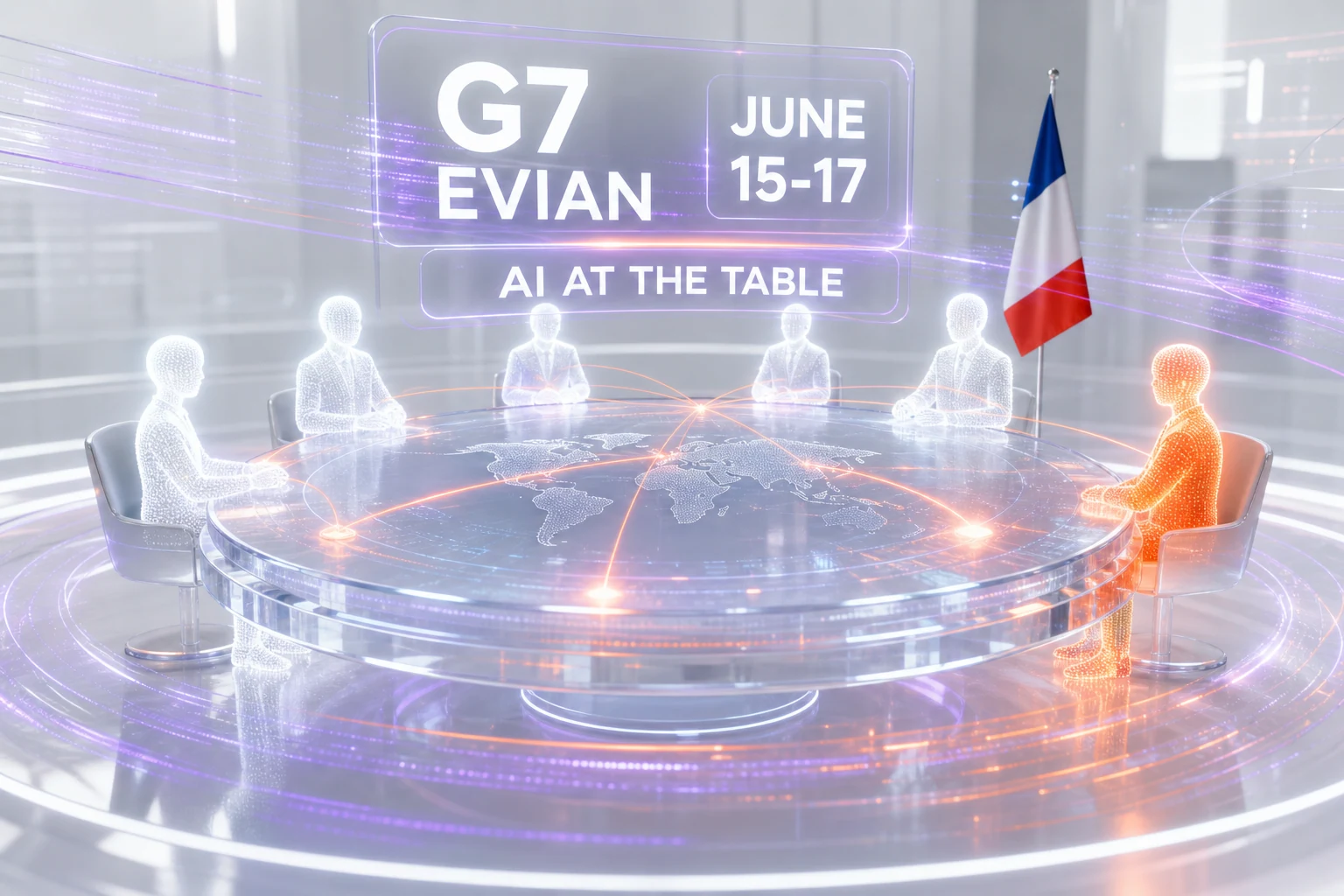
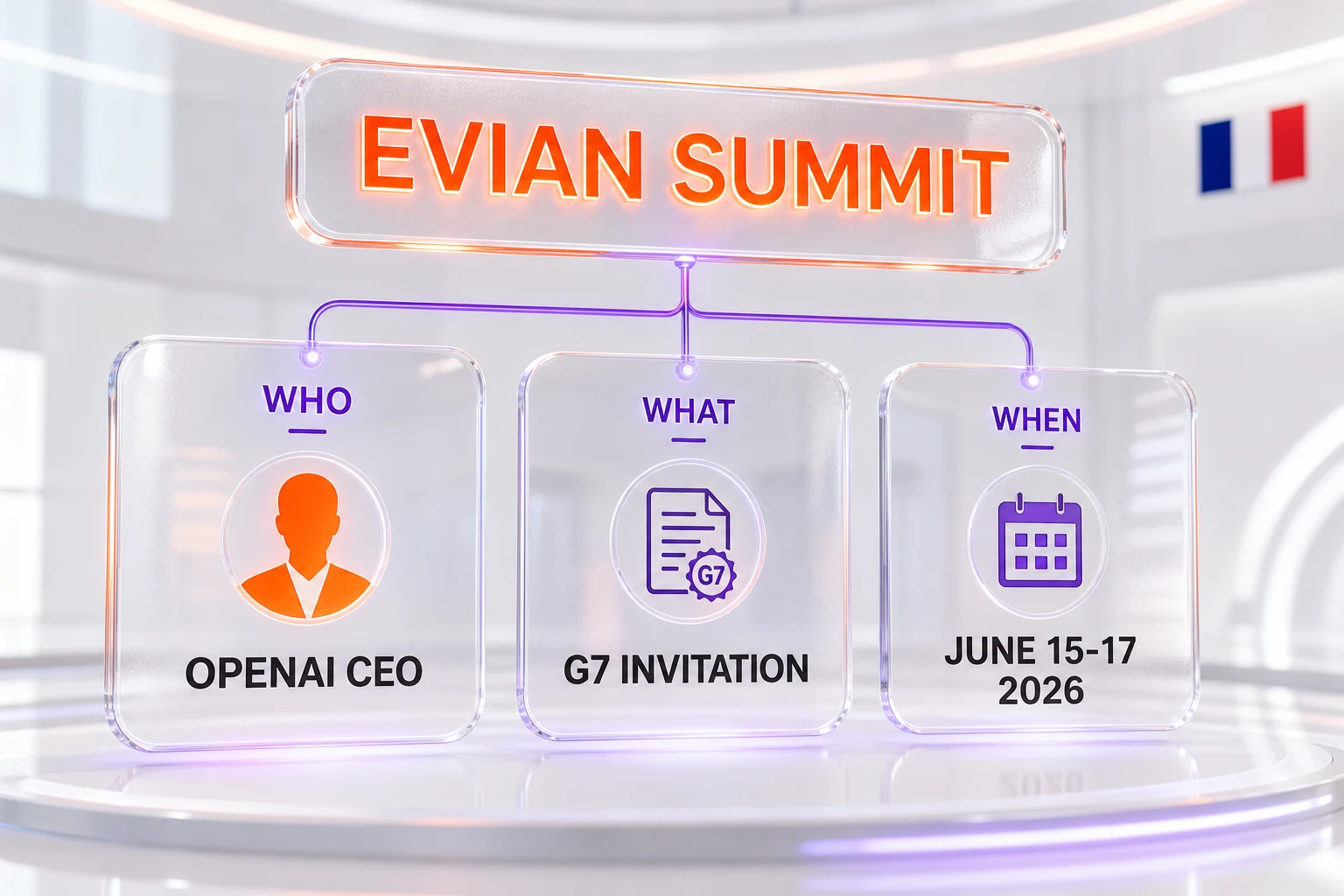
President Emmanuel Macron has invited OpenAI CEO Sam Altman to attend the G7 leaders summit in Evian-les-Bains, France, held June 15 to 17, 2026. OpenAI's Chief Global Affairs Officer, Chris Lehane, confirmed the invitation to CNBC on June 3, saying "the expectation is that he will be engaging in the leaders-level conversation at the G7." It marks the first time Altman attends the annual gathering of G7 heads of state, and his stated priority is the online safety of children and young people.
What Happened
On June 3, 2026, OpenAI confirmed that Sam Altman had been personally invited by Emmanuel Macron to the 52nd G7 summit, which France is hosting in Evian-les-Bains in the Haute-Savoie. The confirmation came from Chris Lehane, OpenAI's Chief Global Affairs Officer, who spoke to CNBC. "The expectation is that he will be engaging in the leaders-level conversation at the G7," Lehane said. He framed the moment in blunt terms: "AI has moved from a future-tense debate to a governing reality."
The summit runs from June 15 to 17, 2026. It is the second time Evian has hosted a summit of this kind, after the 2003 G8. According to the French presidency, the heads of state and government of the seven member economies will be joined by four invited countries: India, Brazil, Kenya, and the Republic of Korea.
What makes the invitation notable is not the venue but the guest. Altman runs a private company, not a government. He is being brought into a room normally reserved for elected leaders and their delegations. Lehane said Altman's top priority for the discussions would be the safety of children and young people online, with frontier AI risks in the cyber and biological domains cited as a secondary track. OpenAI expects the conversation to produce voluntary commitments from technology companies rather than binding rules.
The Facts at a Glance
Before the analysis, here is the verified record, drawn from OpenAI's statement to CNBC, reporting by Yahoo and AFP, and the official G7 Evian site published by the French presidency.
| Item | Detail |
|---|---|
| Event | 52nd G7 leaders summit |
| Host and inviter | France, President Emmanuel Macron |
| Location | Evian-les-Bains, Haute-Savoie, France |
| Dates | June 15 to 17, 2026 |
| Guest | Sam Altman, CEO of OpenAI |
| Source of confirmation | Chris Lehane, OpenAI Chief Global Affairs Officer, to CNBC, June 3, 2026 |
| Altman's stated priority | Online safety of children and young people |
| Secondary track | Frontier AI risk in cyber and biological domains |
| Invited partner countries | India, Brazil, Kenya, Republic of Korea |
One framing deserves an early correction, because several headlines blur it. Evian is not an AI summit. The French presidency's published priorities list geopolitical crises, childhood and online protection, the fight against organized crime, the rules of global governance, critical minerals resilience, and development finance reform. Artificial intelligence is not a headline theme. Altman is a guest inside a broader agenda, not the reason the summit exists.
Why It Matters
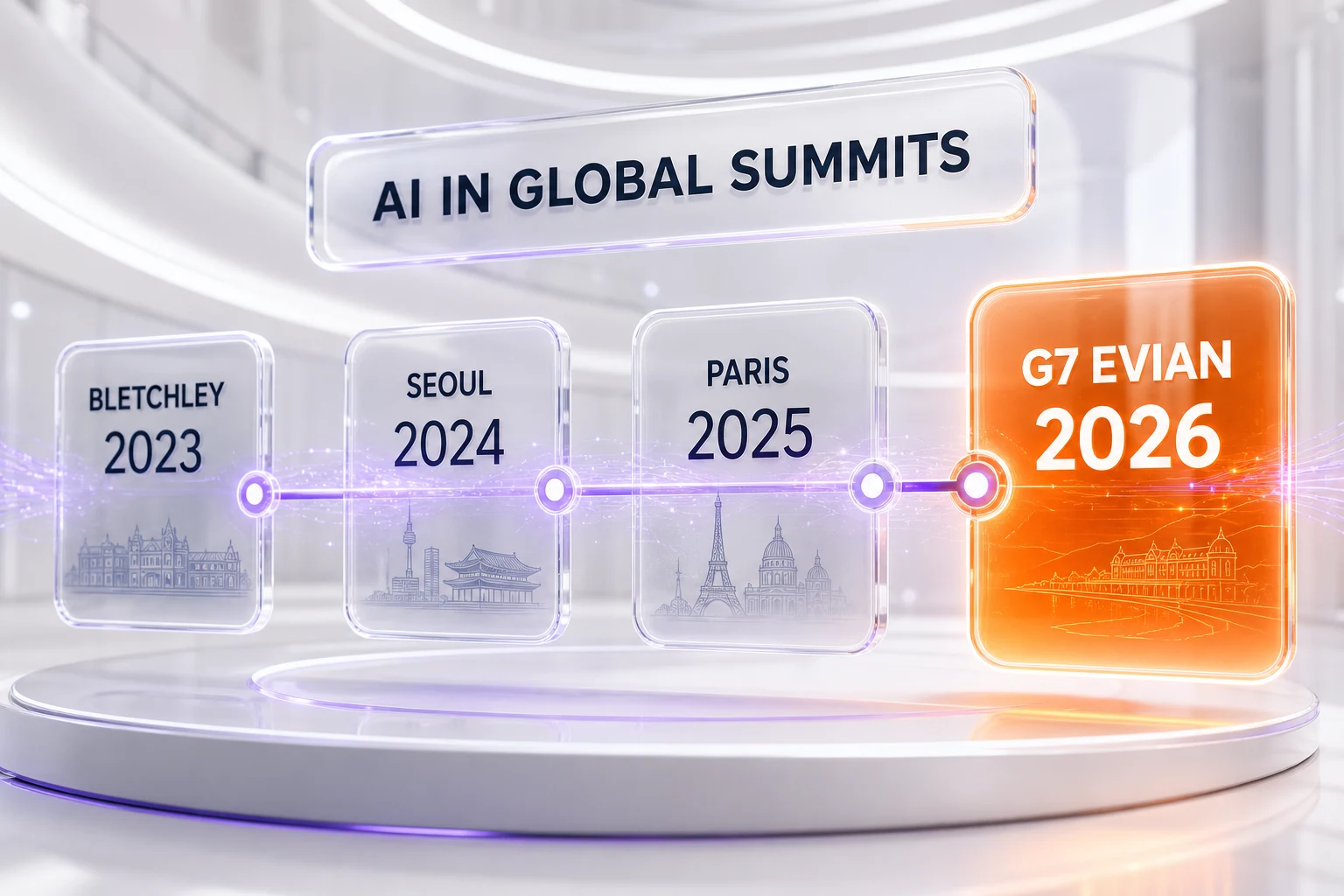
The significance is the precedent, not the photo opportunity. For most of the last decade, AI governance has been negotiated at events built specifically for it: the UK's Bletchley Park AI Safety Summit in 2023, the Seoul follow-up in 2024, and the Paris AI Action Summit that Macron himself co-hosted in February 2025. Those were dedicated forums. The G7 is not. It is the steering committee of the established industrial democracies, and the standing invitation list is governments.
Placing a single AI CEO inside that room sends a message about where influence now sits. It signals that, in the view of at least one G7 host, you cannot have a credible leaders-level conversation about online child safety, cyber risk, or governance without the company that operates one of the most widely used consumer AI products on the planet, ChatGPT, at the table. That is a meaningful upgrade in standing for OpenAI, and for the AI industry generally.
It also raises an old question in a new setting. When the head of a private firm sits in a leaders conversation, what is he there to do: inform the discussion, or shape the outcome in his company's favor? OpenAI's own framing, voluntary commitments rather than binding rules, is the answer that benefits the company most. Voluntary commitments preserve flexibility. Binding rules constrain it. That is not a criticism of the substance; it is simply the structural incentive that any reader should hold in mind.

The Child Safety Angle Is Not a Coincidence
The single most important detail for understanding why this invitation fits the agenda is the one most coverage skips. Altman's chosen priority, the online safety of children, maps almost exactly onto a priority the French presidency had already set for Evian. The official G7 Evian agenda lists "childhood matters, from supporting development to online protection" as a headline theme. Child safety online is on the program regardless of whether any AI executive shows up.
That alignment is why the invitation reads as coherent rather than opportunistic. In late May 2026, G7 digital ministers reached a joint agreement on protecting children online. An AI CEO arriving to discuss youth safety is therefore stepping into an existing workstream, not parachuting a new topic onto the table. It is a way to be present at the leaders summit on a subject where the company has a defensible reason to contribute, and where its consumer product is directly implicated.
The timing is also pointed. Days before the invitation surfaced, Florida had become the first US state to sue OpenAI and Altman personally over ChatGPT safety, a case we covered in detail. Appearing at a G7 to champion child safety is, among other things, a public-positioning move while litigation over exactly that issue is live at home. Both things can be true at once: the policy contribution can be genuine and the optics can be convenient.
How It Fits Macron's Wider AI Strategy
This invitation does not appear in isolation. It is the latest move in a sustained French campaign to position the country as Europe's center of gravity for AI capital and compute. Macron co-hosted the Paris AI Action Summit in February 2025. France has courted large data center and infrastructure commitments, including a major SoftBank-backed plan for French AI data centers that we have written about separately. The through-line is consistent: France wants the labs, the chips, the campuses, and the executives to view Paris and the French ecosystem as a home base inside Europe.
Seen that way, inviting Altman to Evian is brand-building for the host as much as it is a favor to the guest. A G7 hosted by France that features a leaders-level exchange with the CEO of OpenAI reinforces the narrative that France is where AI policy and AI business meet. It is a soft-power play, executed through a guest list.
There is a tension worth naming. France and the European Union have also been the home of the most ambitious AI regulation in the world, the EU AI Act, whose high-risk rules were recently pushed back to December 2027. Courting AI executives while simultaneously regulating them is a balancing act. The Evian invitation leans toward engagement; it places a leading AI builder inside the conversation rather than across the table from it.

The Governance Question Underneath
Strip away the venue and the personalities, and the event is really about a governance question that has been building for two years. Who sets the rules for general-purpose AI, and who is in the room when those rules are debated? For most of the modern era, the answer at a G7 would have been: elected governments, their ministers, and their permanent staffs. Industry was consulted, but consulted from outside.
The Evian invitation does not overturn that arrangement, but it bends it. A company founder being brought into a leaders-level conversation is a recognition that the technical and operational facts of frontier AI sit inside a small number of private firms, and that governments increasingly need those firms in the room to govern the technology at all. That is a real argument. It is also a real concentration of access, and access is its own form of power.
The honest read is that this is neither a scandal nor a triumph. It is a data point on a trend line. Every time an AI executive moves from being a witness at a hearing to being a participant in a leaders conversation, the center of gravity for AI policy shifts a little further toward the firms that build the models. Evian is one such shift, made visible.
How It Compares to Past AI Diplomacy
It helps to place Evian against the recent history of AI in international forums. The pattern over three years is a steady migration from purpose-built side events toward the core institutions of global governance.
| Forum | When | Nature | AI's role |
|---|---|---|---|
| Bletchley Park AI Safety Summit | November 2023 | Dedicated AI summit | The entire event |
| Seoul AI Summit | May 2024 | Dedicated AI summit | The entire event |
| Paris AI Action Summit | February 2025 | Dedicated AI summit, France co-host | The entire event |
| G7 Evian | June 2026 | General leaders summit | One thread inside a broad agenda |
The difference in the last row is the story. At Bletchley, Seoul, and Paris, AI was the reason everyone gathered. At Evian, AI is woven into a summit about inequality, geopolitics, child protection, and global governance, and an AI executive is invited into that broader room. The technology has graduated from having its own conference to being a standing item at the main one.
What We Do Not Know Yet
Several important details remain open, and it is worth being explicit about them rather than filling the gaps with speculation. We do not know the precise format of Altman's participation, whether he addresses leaders directly, joins a specific session, or takes part in side conversations. We do not know whether other AI executives have received similar invitations. We do not know what, if anything, the summit will produce on AI in writing, beyond OpenAI's expectation of voluntary commitments.
We also do not treat as settled the framing, repeated in some coverage, that this is a "G7 summit on AI." The French presidency's own published priorities do not support that description. AI is present as a thread, most clearly through the child-safety workstream, but it is not the organizing theme. Readers should be skeptical of any account that elevates the Altman invitation into the summit's headline purpose.
Our Take
The most useful way to read this is as a status signal rather than a policy event. Nothing binding is expected to come out of Evian on AI. What is happening is symbolic, and symbols in diplomacy matter. A G7 host has decided that a private AI CEO belongs in the leaders conversation, and has built that decision around a child-safety agenda that was already on the program. The choreography is tight, and it benefits both sides: France gets to look like the European address for serious AI conversations, and OpenAI gets the highest-status seat available short of a head-of-state title.
We would push back on one piece of the surrounding narrative. The version where Macron is "hosting an AI summit" is wrong, and it inflates the story. The more accurate, and more interesting, version is that AI has become normal enough, and consequential enough, that it no longer needs its own summit to be in the room. It now travels inside the general agenda of the most established economic club in the world. That is the quieter, larger shift, and it is the one worth watching after the cameras leave Evian.
Frequently Asked Questions
Who invited Sam Altman to the G7, and when was it confirmed?
French President Emmanuel Macron invited OpenAI CEO Sam Altman to the G7 leaders summit. The invitation was confirmed on June 3, 2026 by Chris Lehane, OpenAI's Chief Global Affairs Officer, who told CNBC that "the expectation is that he will be engaging in the leaders-level conversation at the G7."
Where and when is the 2026 G7 summit being held?
The 2026 G7 leaders summit is being held in Evian-les-Bains, in the Haute-Savoie region of France, from June 15 to 17, 2026. It is the second time Evian has hosted a summit of this kind, after the 2003 G8.
Is the G7 Evian summit an AI summit?
No. According to the French presidency, the headline priorities for Evian are geopolitical crises, childhood and online protection, the fight against organized crime, the rules of global governance, critical minerals resilience, and development finance reform. Artificial intelligence is not listed as a headline theme. Altman is a guest inside a broader agenda, not the reason the summit exists.
What is Sam Altman's stated priority at the G7?
According to Chris Lehane, Altman's top priority for the discussions is the online safety of children and young people. A secondary track is frontier AI risk in the cyber and biological domains. OpenAI expects the conversation to produce voluntary commitments from technology companies rather than binding rules.
Why does the child-safety focus fit the G7 agenda?
The French presidency's official Evian agenda lists "childhood matters, from supporting development to online protection" as a headline priority. In late May 2026, G7 digital ministers also reached a joint agreement on protecting children online. Altman's youth-safety focus therefore steps into an existing workstream rather than adding a new topic.
Has an AI CEO ever joined a G7 leaders conversation before?
This is the first time Sam Altman attends the annual G7 leaders summit. The G7 is the steering committee of the established industrial democracies, and its standing invitation list is governments. Bringing a private AI CEO into the leaders-level conversation is a notable departure from that norm.
How is this different from the Bletchley, Seoul, and Paris AI summits?
The 2023 Bletchley Park, 2024 Seoul, and February 2025 Paris AI Action Summit were dedicated events where AI was the entire reason participants gathered. At the G7 Evian, AI is one thread inside a broad agenda covering inequality, geopolitics, child protection, and global governance. The shift is from AI having its own conference to being a standing item at the main one.
What countries are attending the G7 Evian summit?
The summit brings together the heads of state and government of the seven member economies. According to the French presidency, four invited partner countries are also attending: India, Brazil, Kenya, and the Republic of Korea.
How does the invitation fit Macron's broader AI strategy?
France has run a sustained campaign to position itself as Europe's center for AI capital and policy. Macron co-hosted the Paris AI Action Summit in February 2025 and has courted major data center and infrastructure commitments, including a large SoftBank-backed plan for French AI data centers. Inviting Altman to Evian reinforces the narrative that France is where AI policy and AI business meet.
Is there a legal or political backdrop to Altman championing child safety?
Yes. Days before the invitation surfaced, Florida became the first US state to sue OpenAI and Sam Altman personally over ChatGPT safety. Appearing at a G7 to champion online child safety is, among other things, a public-positioning move while litigation over that exact issue is live in the United States.
What is expected to come out of the summit on AI?
Based on OpenAI's own framing, the most likely outcome is voluntary commitments from technology companies rather than binding regulation. As of early June 2026, the precise format of Altman's participation and any written AI outcomes from Evian have not been confirmed.
Why does this invitation matter beyond the summit itself?
The significance is the precedent. Each time an AI executive moves from being a witness at a hearing to a participant in a leaders conversation, the center of gravity for AI policy shifts toward the firms that build the models. Evian is one such shift made visible: AI has become consequential enough that it no longer needs its own summit to be in the room.