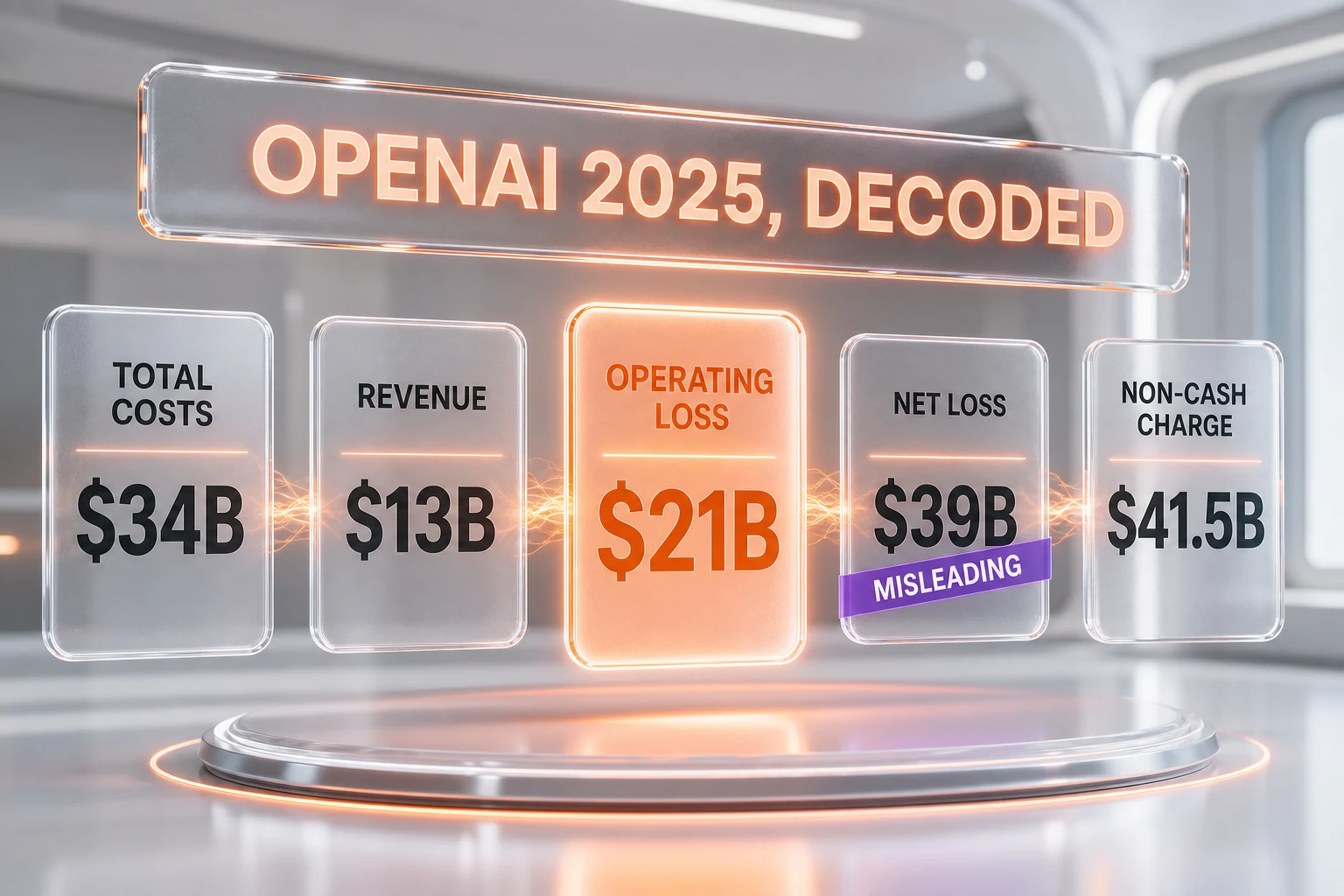
According to the Financial Times, which says it reviewed audited financial documents, OpenAI ran up about $34 billion in total costs and expenses in 2025 against roughly $13 billion in revenue. The widely shared "$39 billion loss" headline is real but misleading: that net loss is inflated by a one-time, non-cash charge of about $41.5 billion tied to OpenAI's nonprofit-to-for-profit conversion — money that never left the company. Look at the business itself and the relevant figure is the operating loss of about $21 billion. OpenAI has not published audited accounts and declined to comment on the reported figures.
Five different numbers are flying around for the same company in the same year, and most coverage treats them as interchangeable. They are not. The cost figure is not the cash burn. The net loss is not the operating loss. And the scariest number of all is the one that never left a bank account. This is the part the headlines skip, so let us decode it.
The Five Numbers, On One Table
Here is the cleanest way to see why "How much did OpenAI lose in 2025?" has no single answer. Each row below measures a genuinely different thing. The figures are as reported by the Financial Times on audited documents and echoed by Bloomberg, Quartz, and The Next Web; OpenAI itself has not confirmed them.
| The number | Figure (2025) | What it actually measures |
|---|---|---|
| Total costs & expenses | ~$34 billion | Everything OpenAI spent to operate: R&D, compute, sales, admin. Not a loss, not cash out the door. |
| Operating loss | ~$21 billion | Total costs (~$34B) minus revenue (~$13B) — the clearest measure of how much the business itself is burning. |
| Reported net loss | ~$38.5 billion | The bottom-line accounting loss, the "$39B" headline. Includes the huge non-cash conversion charge. |
| Non-cash conversion charge | ~$41.5 billion | A paper charge from the nonprofit-to-for-profit restructuring. No money left the company. |
| Revenue | ~$13 billion | What OpenAI earned in 2025, more than triple 2024 and ahead of its reported internal target of about $10 billion. |
Read that table twice. The number people quote in horror, "$39 billion," and the number that reflects how much the operations actually burned, the roughly "$21 billion" operating loss, are different measures — and the headline sits higher mainly because it carries a one-time, non-cash accounting charge from how a charity turned itself into a company.
Why the "$39 Billion Loss" Headline Is Misleading
The net loss is the figure that travels furthest because it is the biggest and the simplest to tweet. But a net loss is the end of a long subtraction, and 2025 dropped an unusual term into that subtraction. According to the Financial Times, OpenAI booked a charge of about $41.5 billion described as changes in the fair value of convertible interests and warrant liability, the financial residue of converting from a nonprofit into a for-profit public benefit corporation.
That charge is non-cash. It does not represent compute bills, salaries, or chips. It is the accounting system revaluing the equity-like instruments that the restructuring created. Quartz, Bloomberg, and The Next Web all draw the same distinction the Financial Times does: the roughly $38.5 billion net loss is "widened by" or "after accounting for" this one-time conversion charge, so it sits far above the roughly $21 billion operating loss the same business produced.
Some reporting goes a step further. Before certain accounting adjustments, the gross figure has been cited as high as roughly $60 billion. That number is even more detached from operations than the headline net loss. The lesson is not that one figure is the "true" one and the rest are lies. The lesson is that each number answers a different question, and the question that matters before an IPO is rarely the one in the headline.

Where the $34 Billion Actually Went
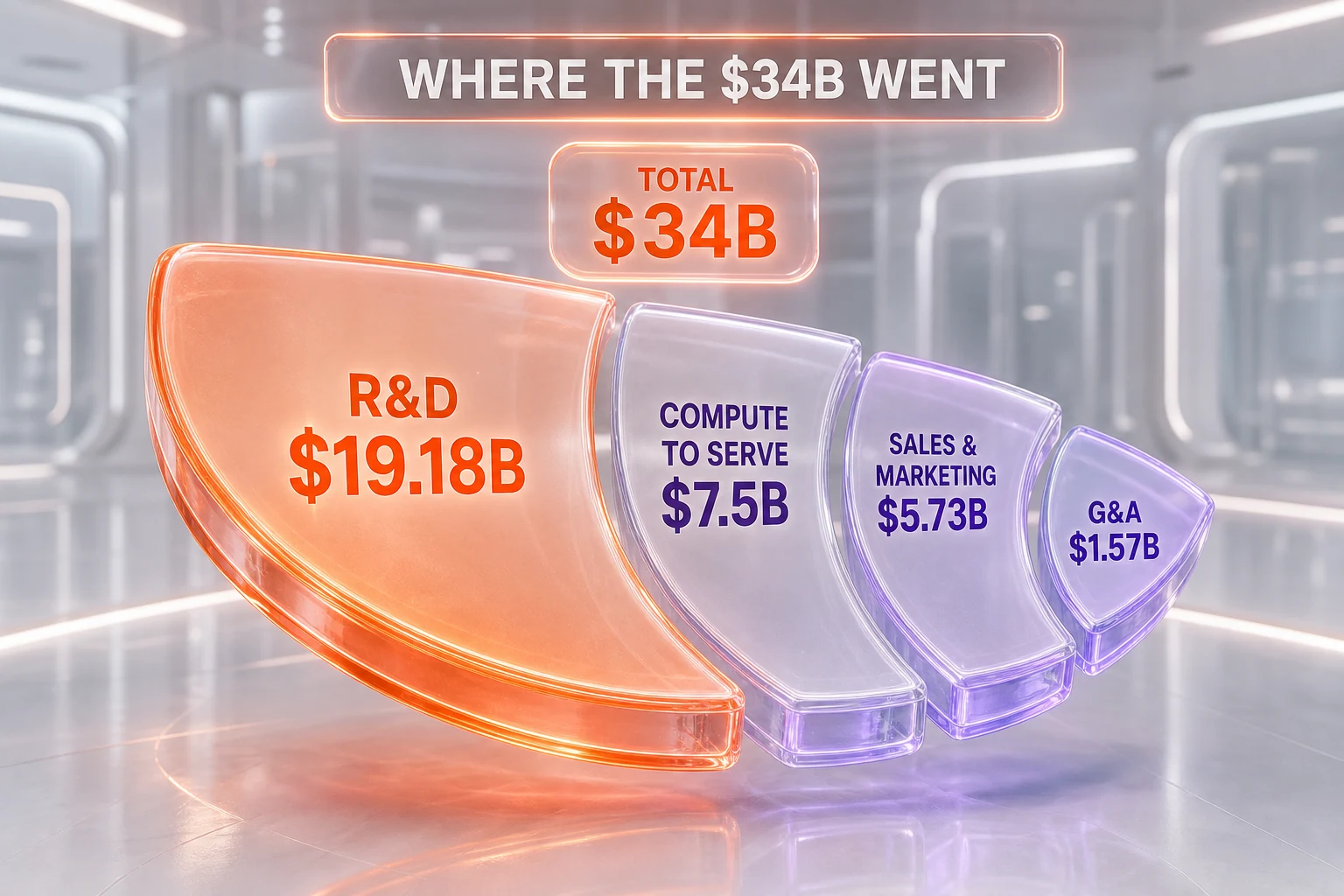
The cost figure is the most honest mirror of OpenAI's strategy because it is the hardest to dress up. The Financial Times breakdown of the roughly $34 billion in total costs and expenses points to four buckets:
- Research & development, ~$19.18 billion. The largest single line by far. This is the cost of training frontier models and the talent to build them. Notably, the reporting attributes a large slice of OpenAI's Microsoft spending, around $10.59 billion, to R&D, which is partly cloud and compute booked under the research line.
- Cost of revenue (compute to serve users), ~$7.5 billion. The inference bill: the GPUs that answer every ChatGPT and API request. This scales directly with usage, and usage is exploding.
- Sales & marketing, ~$5.73 billion. Nearly six billion dollars to acquire and retain users and enterprise accounts, a striking figure for a product often described as marketing itself.
- General & administrative, ~$1.57 billion. The smallest bucket: the corporate overhead of running a company at this scale.
Add those and you land at roughly $34 billion. The shape tells the story: this is a research lab with a consumer product bolted on, not a software business with a research budget. More than half of all spending is R&D, and a large share of the rest is the raw compute needed to keep the lights on for hundreds of millions of users.
Cost Is Not Cash Burn (And Net Loss Is Neither)
This is the conflation that does the most damage in casual coverage. Three terms get used as synonyms when they are three different things:
Total cost is what the income statement says it cost to operate the business this year, including non-cash items like depreciation and stock-based compensation. Cash burn is what actually leaves the bank account, which can be very different from reported cost in either direction. Net loss is cost minus revenue plus or minus every other accounting effect, including the kind of one-time conversion charge that defined OpenAI's 2025.
OpenAI's own filings to investors illustrate the gap. Per documents cited by the Financial Times, the company finished the year with just over $50 billion in assets, roughly half of it in cash. A company that lost "$39 billion" in the literal headline sense does not sit on $25 billion of cash unless a large chunk of that loss never touched cash, which is exactly the point. The conversion charge is paper. The cash position is real. Both are true at once, and only one of them tells you whether the company can keep operating.
The "Eightfold Increase" Needs an Asterisk
Several outlets, including Bloomberg, led with the line that OpenAI's losses grew roughly eightfold, from about $5.09 billion in 2024 to roughly $38.5 billion in 2025. The multiple is arithmetically correct and analytically loaded.
An eightfold jump in net loss sounds like a business losing control. But the dominant driver of that jump is the one-time conversion charge, an event that happens once in a company's life and then never again. Strip that one-time charge out and the business sits on an operating loss of about $21 billion — steep, and well up from 2024, but a company spending aggressively to scale rather than a sudden cliff. The "eightfold" framing is true; it is also the single easiest number to weaponize without the asterisk.
What This Says Heading Into the IPO
OpenAI filed confidentially for an IPO in 2026, and these leaked financials are the first detailed look at the body beneath the valuation. We mapped the open questions earlier in our breakdown of the four numbers OpenAI's S-1 would have to answer. These reported financials are, in effect, the partial answer that leaked before the prospectus did.
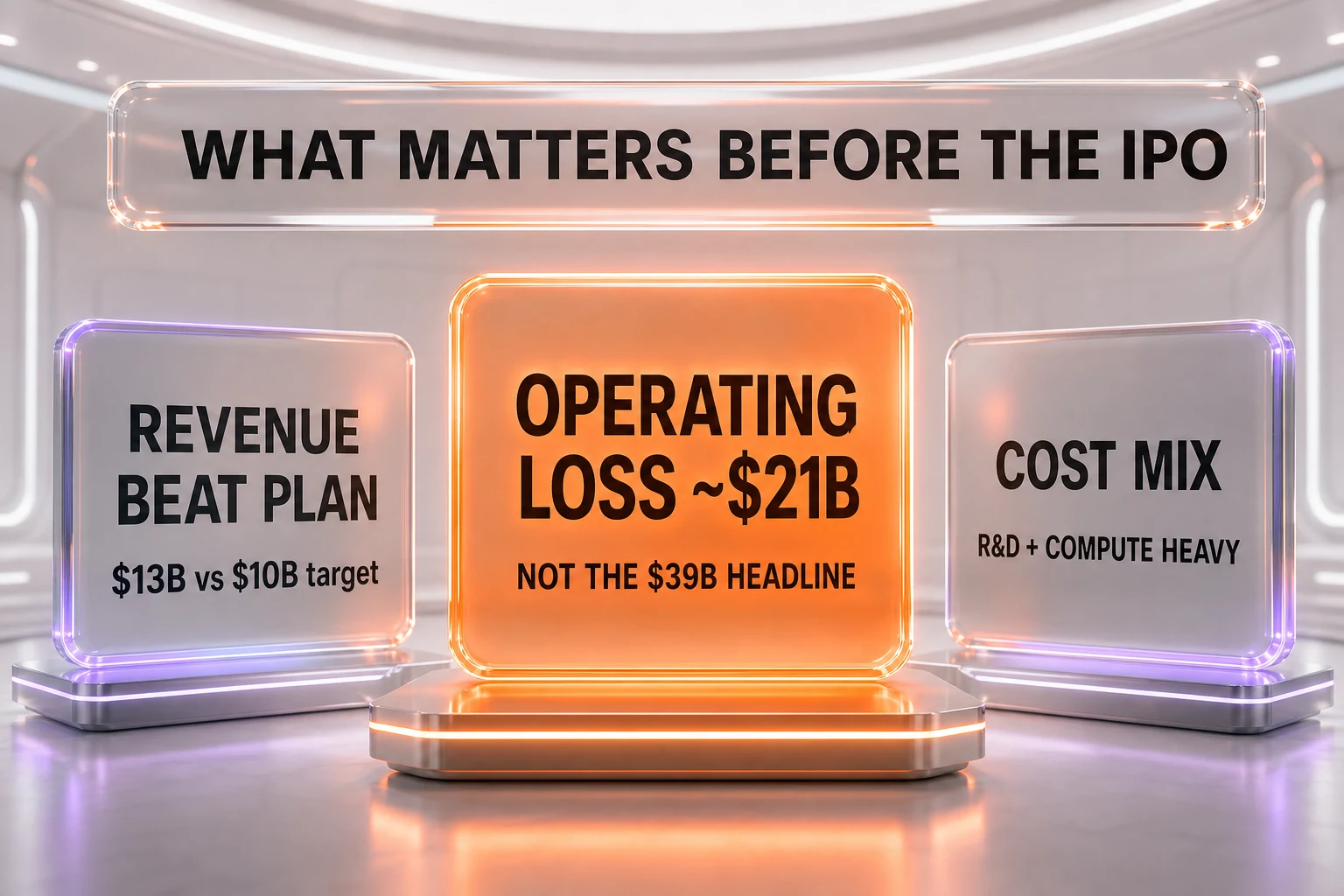
Read against those questions, three things stand out. First, revenue of roughly $13 billion beat OpenAI's own internal target of around $10 billion, so the top line is running ahead of plan even as costs run far ahead of revenue. Second, the ~$21 billion operating loss, not the headline number, is the figure a disciplined investor will anchor on, because it strips out the once-ever conversion charge and shows what the business itself is actually burning. Third, the cost mix, dominated by R&D and compute, signals that OpenAI is still in land-grab mode rather than margin mode, which is a strategic choice with a clear deadline attached once public shareholders are involved.
None of this is a verdict on solvency, and we are not making one. OpenAI has not published audited accounts, and a single year of leaked figures is a snapshot, not a trend line. What we can say is narrower and more useful: the number that frightened the timeline is inflated by a one-time accounting charge, the number that should inform the IPO debate is the ~$21 billion operating loss, and anyone quoting a single figure for "how much OpenAI lost in 2025" is, almost by definition, quoting the wrong one.
Our Take
We cover AI tools and the companies behind them, and we read a lot of financial headlines that collapse five numbers into one scary one. This is the cleanest recent example. The honest framing of OpenAI's 2025 is not "the company lost $39 billion." It is: OpenAI spent about $34 billion, mostly on research and compute, earned about $13 billion, and posted an operating loss near $21 billion, with a giant one-time, non-cash accounting charge stacked on top — because it stopped being a charity — that pushed the headline to $39 billion. Every one of those clauses matters. Drop any of them and you have a number without a meaning, which is precisely what most of the coverage delivered.
For builders and operators, the practical signal is simpler still. A company burning at this rate, even on the operating-loss reading of about $21 billion, has to convert research dominance into durable revenue before public markets lose patience. That clock started ticking the moment the IPO paperwork went in.
Frequently Asked Questions
How much did OpenAI lose in 2025?
It depends on which loss you mean. According to the Financial Times, OpenAI's reported net loss was about $38.5 billion, often rounded to "$39 billion." But that figure includes a one-time, non-cash charge of roughly $41.5 billion from its nonprofit-to-for-profit conversion — money that never left the company. On an operating basis (total costs minus revenue), the 2025 loss was about $21 billion. OpenAI has not confirmed these figures.
How much did OpenAI spend in 2025?
OpenAI's total costs and expenses were about $34 billion, per the Financial Times. The breakdown: roughly $19.18 billion in research and development, about $7.5 billion in cost of revenue (compute to serve users), around $5.73 billion in sales and marketing, and roughly $1.57 billion in general and administrative costs.
Why is the "$39 billion loss" figure misleading?
Because most of it is a paper loss. The reported net loss of about $38.5 billion is inflated by a roughly $41.5 billion non-cash charge tied to changes in the fair value of convertible interests and warrant liability, created by OpenAI's conversion from a nonprofit to a for-profit entity. No cash left the company for that charge. The operating loss — what the business itself burned — was about $21 billion.
What is the difference between OpenAI's cost, operating loss, and net loss?
Total cost (~$34 billion) is everything OpenAI spent to operate. Operating loss (~$21 billion implied) is revenue of about $13 billion minus that cost. Net loss (~$38.5 billion) is the bottom-line accounting figure, which adds the large one-time conversion charge. They measure three different things and should never be used interchangeably.
What was the $41.5 billion charge in OpenAI's accounts?
According to the Financial Times, it was a non-cash charge for "changes in the fair value of convertible interests and warrant liability," arising from OpenAI's restructuring from a nonprofit into a for-profit public benefit corporation in 2025. It is an accounting revaluation of equity-like instruments, not money spent, so it inflates the reported net loss without affecting cash.
What was OpenAI's revenue in 2025?
About $13 billion, with one detailed figure cited at roughly $13.07 billion. That beat OpenAI's reported internal target of around $10 billion, even though total costs of about $34 billion still vastly exceeded revenue.
Did OpenAI's losses really increase eightfold?
By reported net loss, yes: from about $5.09 billion in 2024 to roughly $38.5 billion in 2025. But that jump is driven mainly by the one-time conversion charge. On an operating basis, the 2025 loss was about $21 billion — up sharply from 2024 but far short of an eightfold collapse, consistent with aggressive scaling.
Did OpenAI confirm these 2025 financial figures?
No. These figures come from documents reported by the Financial Times and echoed by Bloomberg, Quartz, and other outlets. OpenAI has not published audited accounts and declined to comment on the reported numbers, so they should be treated as credible reporting rather than official company disclosure.
How much cash does OpenAI have?
Per documents cited by the Financial Times, OpenAI finished 2025 with just over $50 billion in assets, roughly half of it in cash, around $25 billion. That cash position is one reason the "$39 billion loss" headline is misleading: a large part of that reported loss was a non-cash accounting charge that never touched the bank balance.
What do these financials mean for OpenAI's IPO?
OpenAI filed confidentially for an IPO in 2026. The most relevant figure for investors is the operating loss of about $21 billion, not the headline net loss, because it strips out the once-ever conversion charge. Revenue beating internal targets is a positive signal, but the R&D-and-compute-heavy cost structure shows OpenAI is still prioritizing scale over margins, a choice that public shareholders will eventually press on.