Token capital is a business concept, not a cryptocurrency. Coined by Microsoft CEO Satya Nadella in a June 14, 2026 essay titled "A frontier without an ecosystem is not stable," token capital is "the AI capability a firm builds and owns" using its own workflows, data, evaluations, and accumulated expertise. Nadella pairs it with human capital and argues the real prize is a self-reinforcing "learning loop" where the two compound. The post drew more than 28 million views.
What is Satya Nadella's "token capital"?
Token capital is the proprietary artificial intelligence capability a company builds and owns — the systems, models, prompts, evaluations, and tuned workflows trained on its own data and expertise. In Satya Nadella's framing, it is one of two forms of capital that will define the firm in the AI era. The other is human capital. Microsoft's CEO laid out the idea in a long-form essay posted to X and shared as a LinkedIn blog on June 14, 2026, under the title "A frontier without an ecosystem is not stable." The piece went viral fast, crossing 28 million views within days.
The headline argument: the model you license is not your competitive advantage. Anyone can rent the same frontier model. What no competitor can copy is the loop you build on top of it — the way your people and your AI systems learn from each other and improve over time. As Nadella puts it, "The real opportunity is not in picking the best model but instead in building a learning loop on top of models where human capital and token capital compound."
One disambiguation up front, because it matters: the "token" in token capital is the AI token — the basic unit of text an AI model reads and generates — not a blockchain or crypto token. This framework has nothing to do with Web3, ICOs, or digital coins. We unpack that confusion in detail below, because the phrase has been mislabeled across some crypto-adjacent coverage.
Token capital in one table
| Concept | Definition (Nadella's framing) | Can a competitor copy it? |
|---|---|---|
| The model | The frontier LLM you license (GPT, Claude, Gemini, an open model) | Yes — anyone can rent the same one |
| Human capital | "Knowledge, judgment, relationships, ingenuity and ability to recognize important patterns" of your people | No — it lives in your team |
| Token capital | "The AI capability a firm builds and owns" using its workflows, data, evals, and expertise | No — it is built on your proprietary loop |
| The learning loop | Where human + token capital compound into "the new IP of the firm" | No — "it compounds" and becomes the moat |
Who this matters for: CEOs, CTOs, and strategy teams deciding how to build with AI; anyone weighing whether to simply buy AI access or invest in owning a capability; and analysts trying to value AI-era moats. It is a strategy framework, not a product launch.
Token capital vs human capital: the two-capital model
Nadella's central move is to split the firm's value into two distinct, complementary assets and argue that neither wins alone.
Human capital, in his words, is "the knowledge, judgment, relationships, ingenuity and ability to recognize important patterns" of a company's people. It is the tacit, hard-won expertise that does not show up on a balance sheet but drives every good decision.
Token capital is "the AI capability a firm builds and owns." Critically, this is not just "we use ChatGPT." It is the stack a company constructs on top of foundation models — the proprietary data it feeds in, the evaluations it writes to measure quality, the agents it tunes to its own processes, and the institutional context it encodes. That stack is owned by the firm and improves as the firm uses it.
The relationship between the two is the part people miss. Nadella is emphatic that AI does not make people less valuable. He writes: "Human capital does not become less valuable as token capital grows. It only becomes more valuable." And the reason is direction. "Without human direction, you have compute running in circles," he warns — raw model capability without human judgment just burns tokens without producing insight.

The "learning loop": where the two compound
If human capital and token capital are the two assets, the learning loop is the engine that links them. This is the most original part of the essay and the part Nadella spends the most energy on.
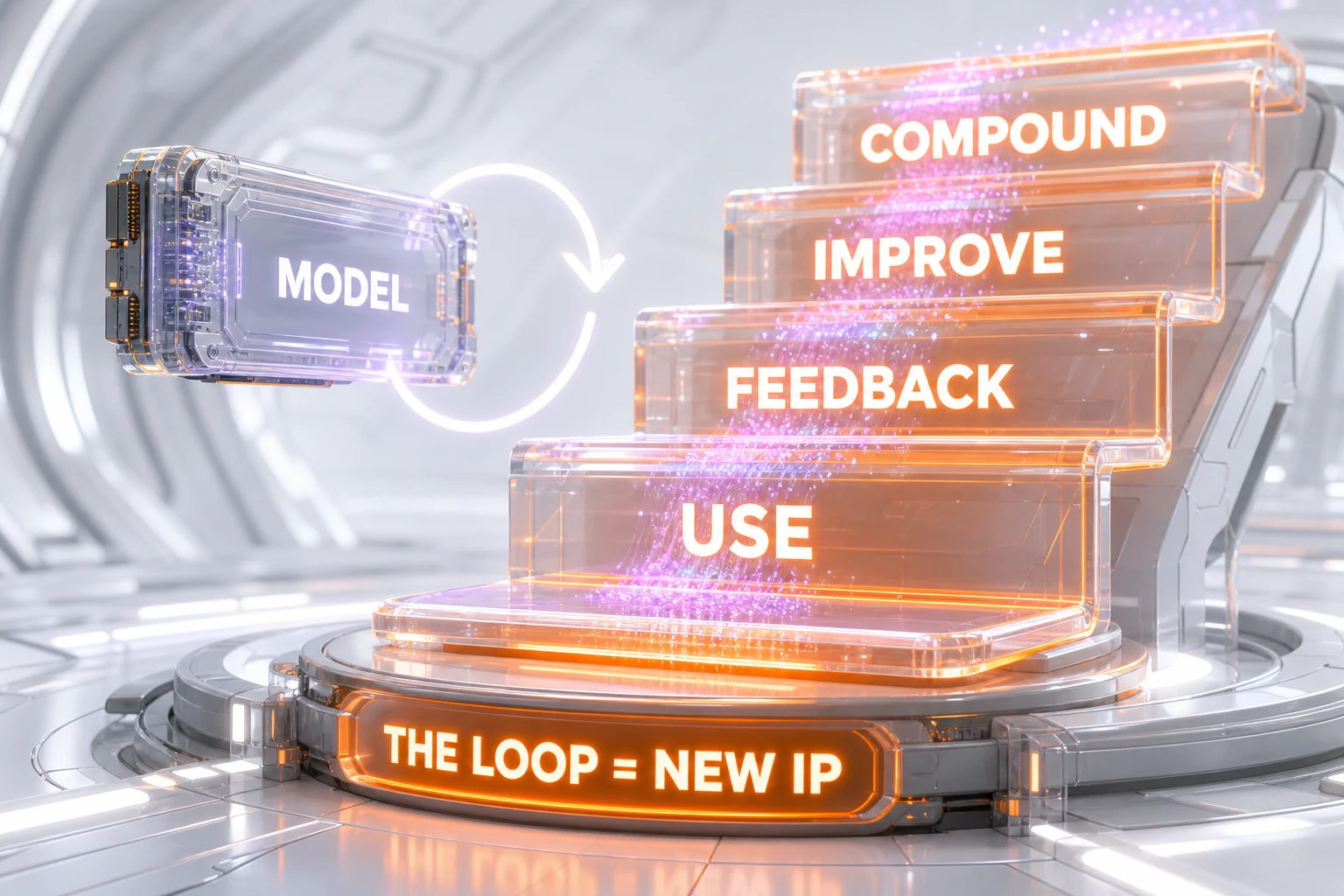
The idea: every time your people use your AI systems, both sides should get smarter. People learn from what the AI surfaces; the AI capability improves from the data, corrections, and judgment your people feed back in. Do this repeatedly and the loop accumulates value that compounds — like interest — rather than depreciating like most assets.
Nadella describes the outcome directly: "This loop becomes the new IP of the firm. I think of it as a hill climbing machine. And unlike most assets, it compounds." The "hill climbing machine" metaphor is deliberate — a system that keeps taking small upward steps, never resetting to zero.
He also draws a sharp line between offloading work and offloading learning. "You can offload a task, or even a job, but you can never offload your learning," he writes. The implication for leaders: you can hand routine work to AI agents, but if you let the learning leave your organization — if all the improvement accrues to a third-party model instead of your own loop — you have given away the only thing that was ever defensible.
There is a design corollary here too. Nadella argues a company should be able to swap out a generalist model without losing the "company veteran" expertise built into its system — meaning the loop, the evals, and the proprietary context should be portable across whichever frontier model is best at the moment. The model is a replaceable component; the loop is the asset.
Why Nadella is making this argument now
The framework is not abstract philosophy. It is a direct response to a fear Nadella has voiced repeatedly: that AI commoditizes the professional knowledge of entire industries — absorbing companies' hard-won expertise into general-purpose models and selling it back to their competitors at commodity prices.
In the essay he paints the dystopian version bluntly, warning of "a world where every company across every sector is ceding value to a few models that eat everything they see." His view is that this is not only an economic risk but a political one: "There is no societal permission for an AI future that hollows out entire industries."
That is the deeper meaning of the title, "A frontier without an ecosystem is not stable." A frontier model dominating everything, with no ecosystem of firms owning their own capability beneath it, is — in Nadella's read — an unstable arrangement that invites backlash. The two-capital framework is his prescription: build an ecosystem where every company, industry, and country can own a learning loop, so value is not hoovered up by a handful of model providers.
It is worth separating this from the cost-side debate. We have covered the token economics driving Microsoft's choices — when running AI agents can cost more than an engineer. That is about the price of consuming tokens. Token capital is the opposite lens: not what tokens cost to run, but the durable asset you build by owning the capability. Same vocabulary, very different argument — one is an expense line, the other is a balance-sheet asset.

From "tokens per dollar per watt" to "token capital": how the thinking evolved
This is not the first time Nadella has put tokens at the center of his economic framework. The interesting throughline is how his unit of analysis has moved over five months.
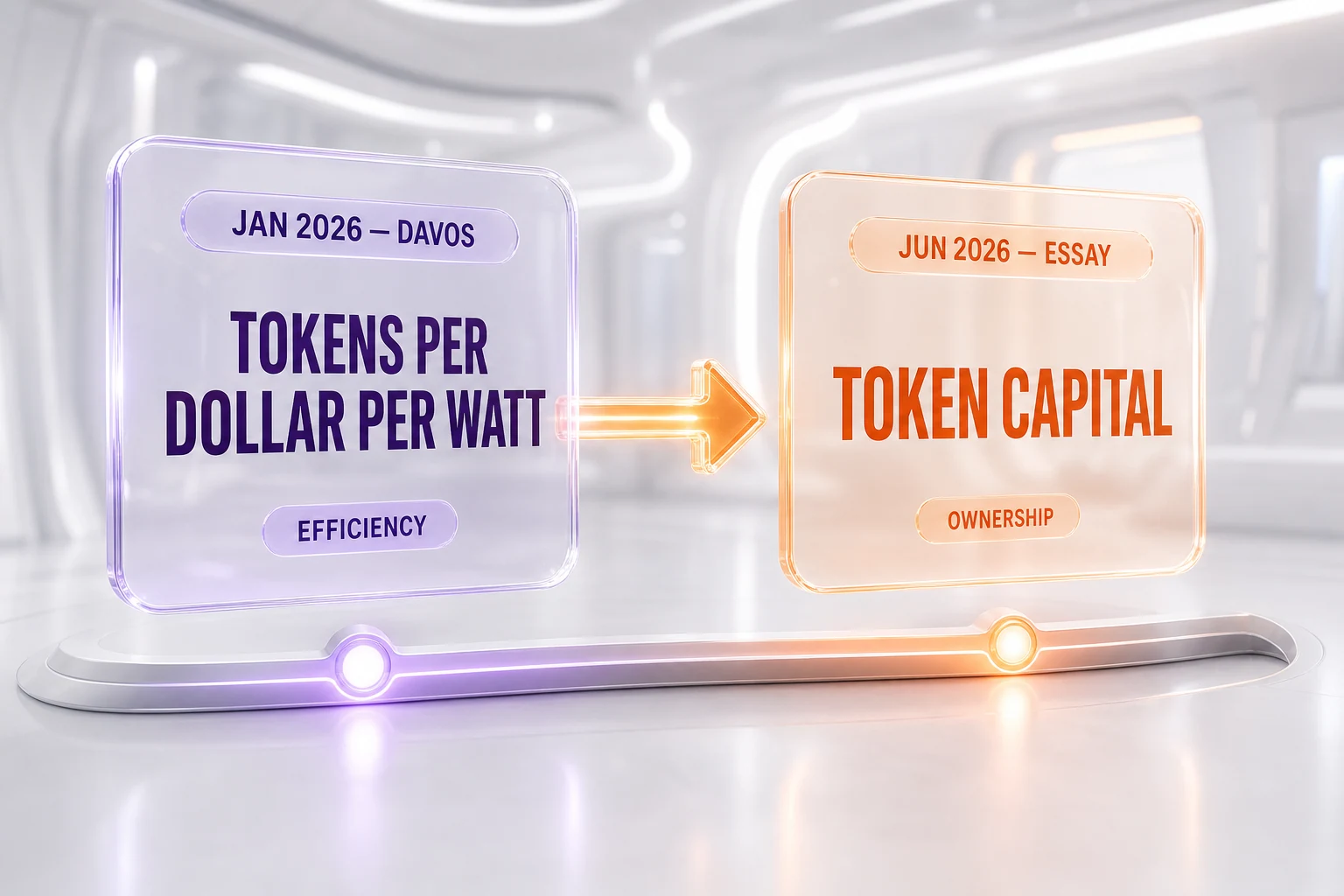
At the World Economic Forum in Davos on January 20, 2026, in conversation with BlackRock CEO Larry Fink, Nadella introduced the metric "tokens per dollar per watt." His argument then was macroeconomic: AI tokens are becoming a global commodity, and a country's or company's competitiveness depends on how many intelligent tokens it can produce per dollar of cost and per watt of energy. He went as far as to say GDP growth would be "directly correlated" to the cost of energy used to run AI.
"Tokens per dollar per watt" was about efficiency of production — how cheaply and cleanly you can generate intelligence. "Token capital," five months later, is about ownership and accumulation — how you turn that generated intelligence into a durable, compounding asset your firm owns.
Read together, the two frameworks form a coherent worldview: tokens are the new commodity (Davos), and the firms that win are the ones that build proprietary loops to compound that commodity into owned capability (June essay). It is a notable evolution — from measuring the input cost of intelligence to defining the strategic asset built from it.
The market backdrop
Context matters for why this landed when it did. Microsoft stock has been the weakest performer among the "Magnificent Seven" in 2026, with MSFT down roughly 19% year-to-date as of mid-June — the worst of the group. Investors have questioned the return on Microsoft's enormous AI capital expenditure. An essay arguing that the real value is not the model itself but the durable, compounding loop a firm owns reads, in part, as a strategic narrative aimed at that skepticism.
It also fits a pattern in Nadella's recent public stance. He has previously warned about Microsoft becoming "the next IBM" if it failed to adapt to the AI shift — a fear we examined in our coverage of the Musk v. Altman trial and Nadella's "next IBM" anxiety. The token-capital framework is, in a sense, his answer to that anxiety: the way an incumbent stays relevant is by owning the learning loop, not just renting the model.
And it is consistent with what Microsoft is actually doing. The company has been building its own in-house frontier models — a direct, literal example of accumulating token capital rather than depending entirely on a third party. We broke down that strategy in our analysis of Microsoft's three in-house MAI models and its push to reduce OpenAI dependency. Whatever you make of the framework, Nadella is, by his own definition, building token capital at the platform level.
Is "token capital" a crypto token? No — here is the difference
Token capital has nothing to do with cryptocurrency, blockchain, or Web3. Because the word "token" carries heavy crypto connotations, a slice of coverage — especially on crypto-focused outlets — framed the essay as if it were about digital assets. It is not. The confusion is purely linguistic.
The "token" in Nadella's framework is the AI token: the unit of text (a word, sub-word, or character fragment) that a large language model reads as input and produces as output. When you prompt an AI model, your text is split into tokens; the model's response is measured in tokens; and AI providers price their APIs per million tokens. That is the only "token" Nadella means.
| AI token (Nadella's "token capital") | Crypto token | |
|---|---|---|
| What it is | A unit of text processed by an AI model | A digital asset on a blockchain |
| Underlying tech | Large language models / neural networks | Distributed ledger / blockchain |
| How it is "owned" | As a built AI capability and learning loop | In a crypto wallet, recorded on-chain |
| Tradable? | No — it is an internal firm capability | Yes — on crypto exchanges |
| Nadella's meaning | Yes — "the AI capability a firm builds and owns" | No relationship whatsoever |
So when Nadella talks about a firm accumulating "token capital," he means the company is building an owned, compounding AI capability — measured in the intelligence (tokens) it can produce and apply — not stockpiling digital coins. If you arrived here from crypto coverage, that is the disambiguation: this is enterprise AI strategy, full stop.
What it means for how you build with AI
Stripped of the framing, the practical takeaways from Nadella's essay are concrete:
- Owning beats renting — at the capability layer, not the model layer. You do not need to train your own foundation model. You need to own the loop on top of it: your data, your evals, your tuned agents, your institutional context.
- Keep the model swappable. Architect so you can switch the underlying frontier model without losing the "company veteran" expertise baked into your system. The model is a component; your loop is the asset.
- Do not let learning leak. Offload tasks to AI freely — but make sure the improvement accrues to your system, not solely to a third-party provider. Capture corrections, outcomes, and feedback inside your own loop.
- Invest in people, not instead of people. The framework explicitly rejects the "AI replaces humans" narrative. Human judgment is what directs the compute; without it, you get "compute running in circles."
- Think in compounding terms. A loop that improves every time it is used is a different kind of asset than a one-off deployment. The strategic question becomes: is our AI capability getting better the more we use it, or are we just paying a meter?
It is, in essence, a moat argument for the AI era: in a world where everyone can rent the same intelligence, your edge is the proprietary loop you build and own.
Our take
The framework is sharper than the usual executive AI thought-leadership, and the "you can never offload your learning" line is genuinely useful as a planning heuristic — it cleanly separates what you can delegate from what you must keep. The two-capital split also gives non-technical leaders a vocabulary to reason about AI investment without getting lost in model benchmarks.
The fair skepticism: the framework conveniently flatters Microsoft's position. A company selling the platform layer (Azure, Foundry, Copilot tooling) benefits enormously if every firm decides to build owned loops — on infrastructure Microsoft happens to sell. The "frontier without an ecosystem is not stable" thesis is sincere, but it is also good for the business of the firm pitching it. And "token capital" remains a coinage, not yet a measurable line item; it is harder to quantify than "tokens per dollar per watt." Whether it becomes durable strategic language or fades as a viral essay will depend on whether anyone can actually measure a company's token capital. For now, it is a useful lens — and a clear window into how the CEO of the most-watched AI platform company is thinking about defensibility.
Frequently Asked Questions
What is Satya Nadella's "token capital"?
Token capital is "the AI capability a firm builds and owns," in Satya Nadella's words — the proprietary AI systems, data, evaluations, and tuned workflows a company constructs on top of foundation models. Microsoft's CEO introduced it in a June 14, 2026 essay titled "A frontier without an ecosystem is not stable," pairing it with human capital as the two assets that define the firm in the AI era.
Is token capital a cryptocurrency or crypto token?
No. Token capital has nothing to do with cryptocurrency, blockchain, or Web3. The "token" refers to the AI token — the unit of text a large language model reads and generates — not a digital coin. Some crypto-focused coverage mislabeled the essay, but Nadella's framework is an enterprise AI strategy concept, not a digital asset.
What is the difference between token capital and human capital?
Human capital is "the knowledge, judgment, relationships, ingenuity and ability to recognize important patterns" of a company's people. Token capital is "the AI capability a firm builds and owns." Nadella argues they are complementary: "Human capital does not become less valuable as token capital grows. It only becomes more valuable," because "without human direction, you have compute running in circles."
What is the "learning loop" Nadella describes?
The learning loop is the engine that links human capital and token capital so both improve over time and compound. Nadella calls it "the new IP of the firm" and "a hill climbing machine," noting "unlike most assets, it compounds." People learn from the AI; the AI capability improves from human feedback, data, and judgment — and the loop accumulates value rather than depreciating.
How does "token capital" relate to "tokens per dollar per watt"?
They are two stages of Nadella's thinking. At Davos on January 20, 2026, he introduced "tokens per dollar per watt" — a metric for the efficiency of producing AI intelligence. "Token capital," five months later, is about ownership: turning that produced intelligence into a durable, compounding asset a firm owns. Together: tokens are the new commodity, and the winners build owned loops to compound them.
Where and when did Satya Nadella publish the token capital essay?
Nadella published it on Sunday, June 14, 2026, as a long-form post on X and as a blog shared via LinkedIn, titled "A frontier without an ecosystem is not stable." It went viral quickly, drawing more than 28 million views within days.
Why did Nadella write about token capital now?
He is responding to a fear that AI will commoditize the expertise of entire industries — absorbing companies' knowledge into "a few models that eat everything they see" and selling it back at commodity prices. He warns "there is no societal permission for an AI future that hollows out entire industries." The framework is his prescription: own a learning loop so value is not absorbed by a handful of model providers.
Does building token capital mean training your own AI model?
No. Nadella's point is that you do not need to build a foundation model. You build the capability layer on top of one — your proprietary data, evaluations, tuned agents, and institutional context. He argues a company should be able to swap out a generalist model without losing the "company veteran" expertise built into its system, meaning the loop is the asset and the model is a replaceable component.
How does this connect to Microsoft's own AI strategy?
It mirrors what Microsoft is doing. The company has built its own in-house MAI models to reduce dependence on OpenAI — a literal example of accumulating token capital rather than only renting it. The essay also lands as MSFT trades as the weakest "Magnificent Seven" stock in 2026 (down roughly 19% year-to-date by mid-June), reframing AI value as the owned loop rather than the model itself.
Is "token capital" an official accounting or balance-sheet term?
No. It is a strategic concept Nadella coined, not a recognized accounting line item. Unlike "tokens per dollar per watt," which is a measurable efficiency metric, token capital is currently a framing for thinking about AI-era moats — the durable, compounding AI capability a firm owns — rather than something companies report as a quantified asset.