What Happened
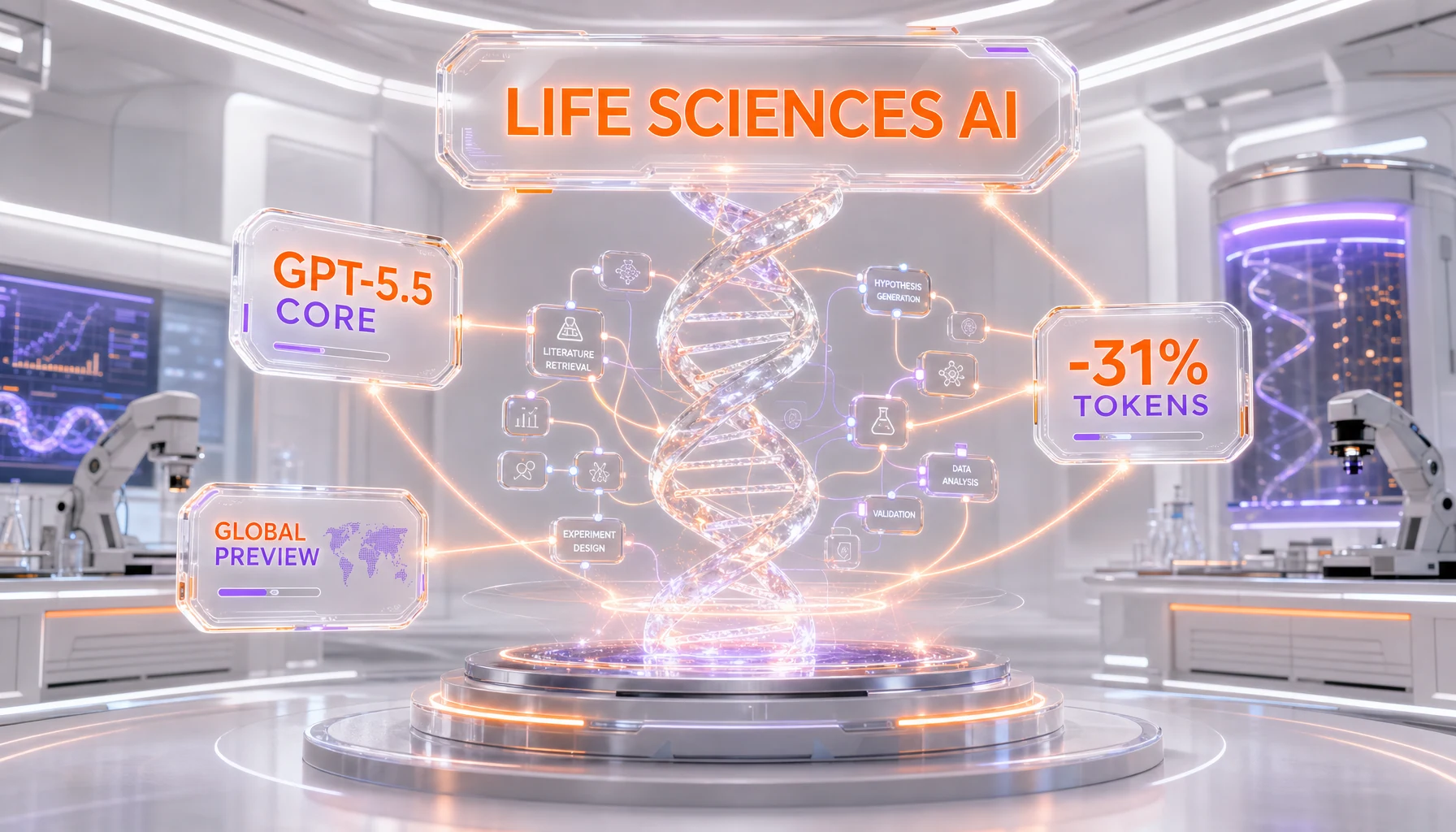
On June 3, 2026, OpenAI announced a major capability upgrade for GPT-Rosalind, its life-sciences model, now built on the GPT-5.5 agentic coding and tool-use architecture. The update reports roughly 31% fewer tokens than GPT-5.5 on long-horizon quantitative biology analyses, adds two new Codex plugins — Life Sciences Research and Life Sciences NGS Analysis — introduces a new externally judged benchmark called LifeSciBench, and opens a research preview to eligible organizations worldwide for the first time.
This is OpenAI's broadest push yet to position a frontier model inside the day-to-day workflow of biologists, bioinformaticians, and computational researchers. Where GPT-Rosalind started in April 2026 as a specialized reasoning model in limited research preview, the June 3 update reframes it as a working research instrument: agentic, tool-using, and now wired into Codex through dedicated plugins for literature and experimental design work and for next-generation sequencing (NGS) analysis.
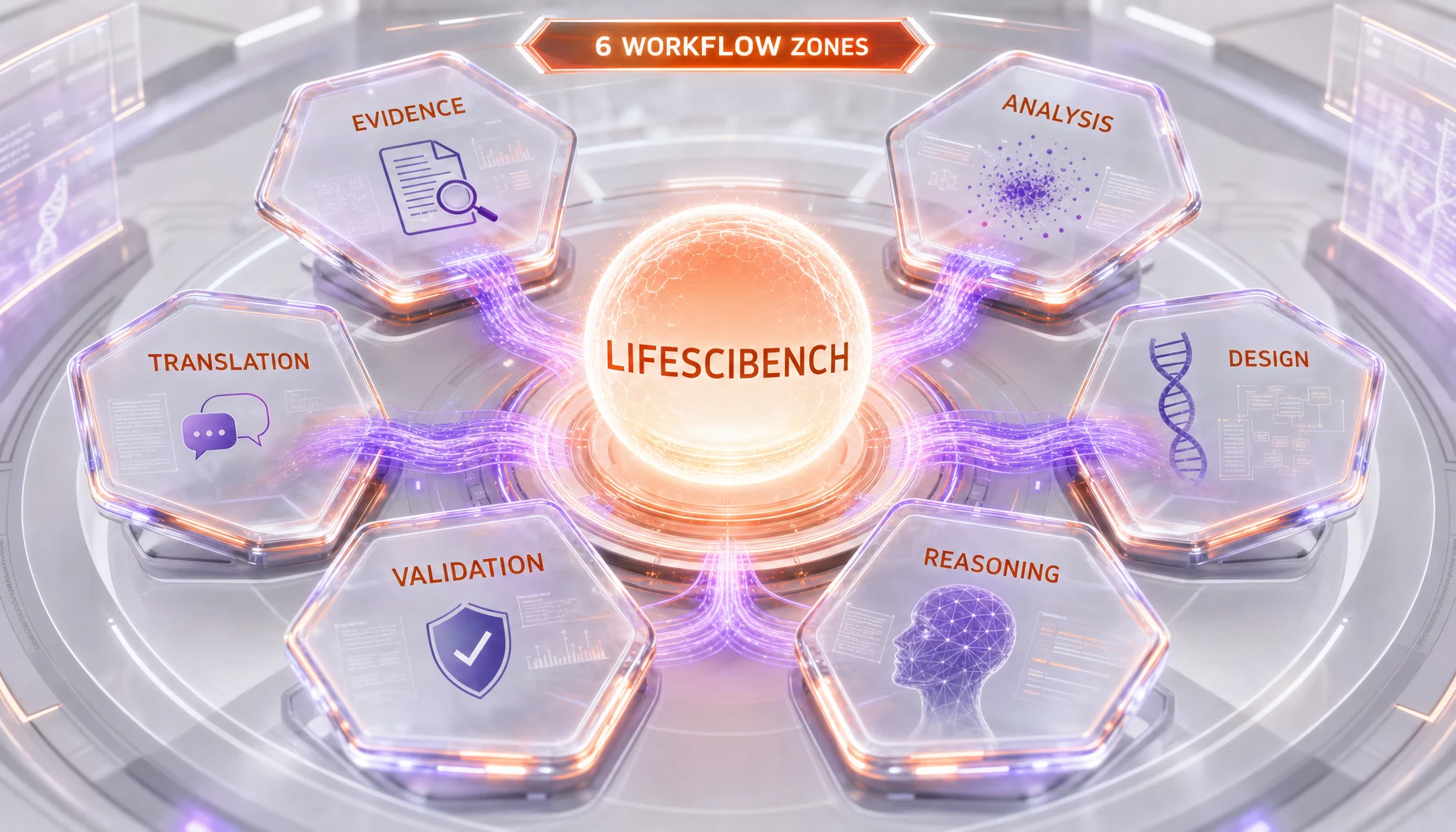
It is worth being precise about what is new and what is not. The model is not a separate product line from OpenAI's coding stack — it inherits the GPT-5.5 architecture that already powers OpenAI's agentic coding tools. The new layer is the life-sciences specialization, the two Codex plugins, the LifeSciBench evaluation, and the global access tier. OpenAI describes LifeSciBench as judged by external domain experts across six workflow zones: evidence handling, analysis, design and optimization, scientific reasoning, validation and operations, and translation and communication.
This Is Not the Biodefense Announcement
Two OpenAI life-sciences stories have landed within a week of each other, and they are distinct. On May 29, 2026, OpenAI announced Rosalind Biodefense, a government-partnership program that pairs GPT-Rosalind with vetted national labs and biosecurity bodies for pandemic preparedness and societal resilience. That was about who gets sponsored, gated access for defensive use cases, and how OpenAI wires itself into the state's biological-defense apparatus.
The June 3 update is about capability and reach: a new GPT-5.5 foundation, token-efficiency gains, Codex plugins, a benchmark, and a worldwide research preview for eligible organizations. One story is a defense program; the other is a broad capability release. They share the GPT-Rosalind brand and the same underlying ambition — making frontier AI useful to the life sciences — but they answer different questions. We cover the biodefense program separately and in depth.
LifeSciBench: A Benchmark Judged by Experts, Not Multiple Choice
The headline scientific artifact in this release is LifeSciBench. OpenAI frames it as an evaluation designed around how life-sciences work actually unfolds, rather than around the multiple-choice or single-answer formats that dominate older science benchmarks. Instead of asking whether a model can recall a fact, LifeSciBench asks whether it can move usefully through a research workflow — and it leans on external domain experts to judge the outputs.
OpenAI describes six workflow zones in LifeSciBench:
- Evidence handling — finding, reading, and synthesizing the relevant literature and data.
- Analysis — running and interpreting quantitative analyses on biological data.
- Design and optimization — proposing and refining experimental designs or candidate approaches.
- Scientific reasoning — chaining inferences across steps the way a trained researcher would.
- Validation and operations — checking results, catching errors, and managing the practical mechanics of an analysis.
- Translation and communication — turning technical findings into clear, defensible explanations.
We are deliberately staying qualitative on the numbers here. OpenAI's materials emphasize the structure of LifeSciBench and the use of expert judges, but a benchmark like this is only as trustworthy as its methodology disclosure, its judge pool, and its reproducibility — none of which can be independently verified from a launch announcement. Treat LifeSciBench as a vendor-authored evaluation until third parties can inspect it. That is the right posture for any new benchmark, and it is doubly true in a domain where errors have real-world stakes.
The 31% Token Efficiency Claim
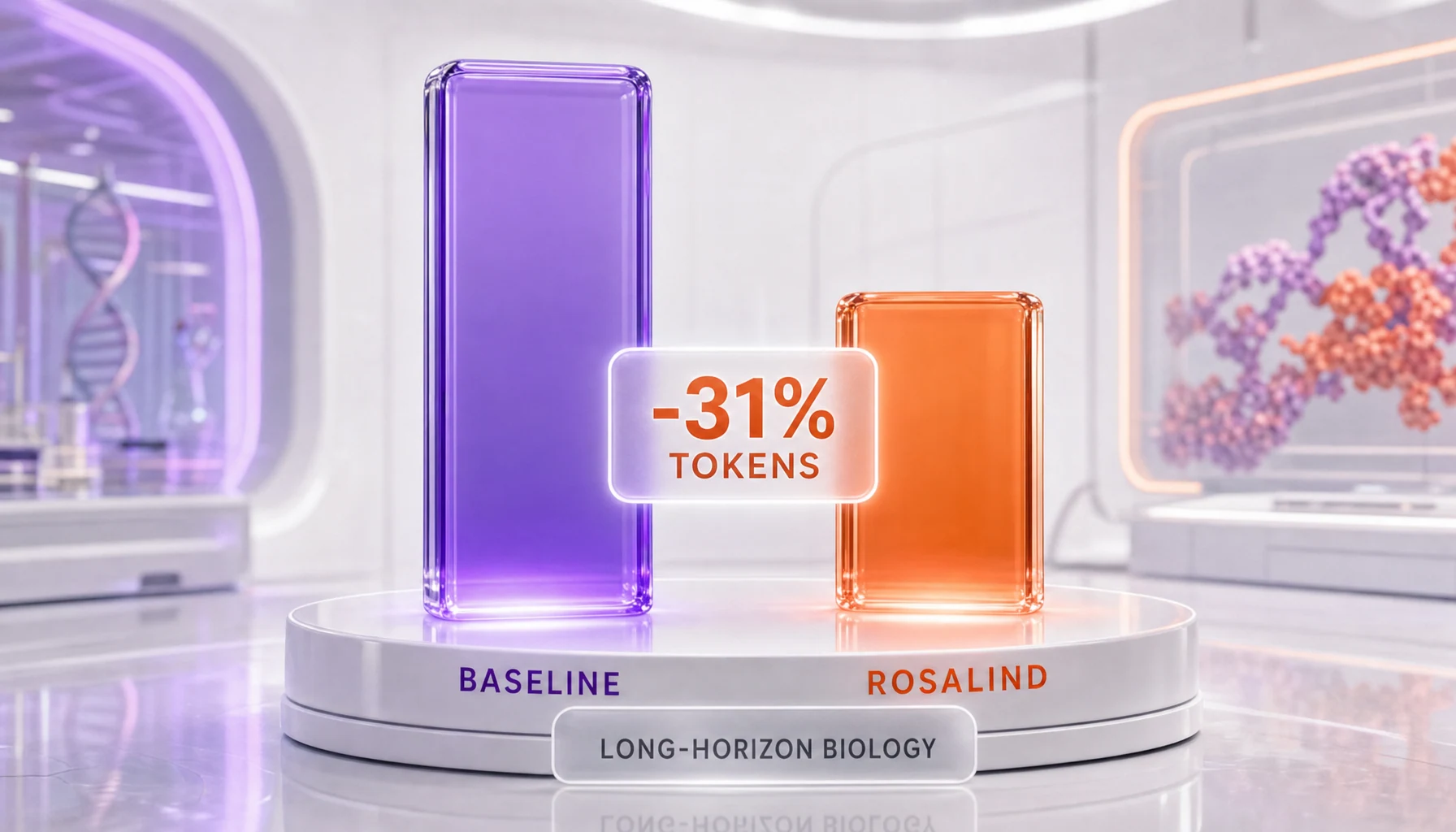
The one quantitative figure we are comfortable repeating is the efficiency gain: OpenAI reports that GPT-Rosalind uses roughly 31% fewer tokens than GPT-5.5 on long-horizon quantitative biology analyses. The qualifier matters — this is a comparison on a specific class of tasks (long-running, quantitative, biology-focused analyses), not a blanket claim that the model is 31% cheaper or faster everywhere.
Why does token efficiency matter in life sciences specifically? Quantitative biology workflows are long-horizon by nature. A single analysis can chain dozens of reasoning and tool-use steps — pulling data, running calculations, checking intermediate results, revising, and documenting. Each step consumes tokens, and in agentic workflows those tokens compound. A model that reaches the same destination with fewer tokens is cheaper to run at scale and, often, faster to a result. For institutional users running many analyses, a one-third reduction in token consumption on the heaviest workloads is a meaningful operational lever, not a rounding error.
The honest caveat: a token-efficiency claim is a vendor benchmark until independent users reproduce it on their own workloads. Efficiency gains measured on OpenAI's internal task suite may or may not transfer to a given lab's pipelines. We would treat the 31% figure as a credible directional signal — efficiency on agentic long-horizon tasks is exactly where GPT-5.5's architecture was designed to improve — while waiting for outside confirmation.
Two New Codex Plugins: Research and NGS Analysis
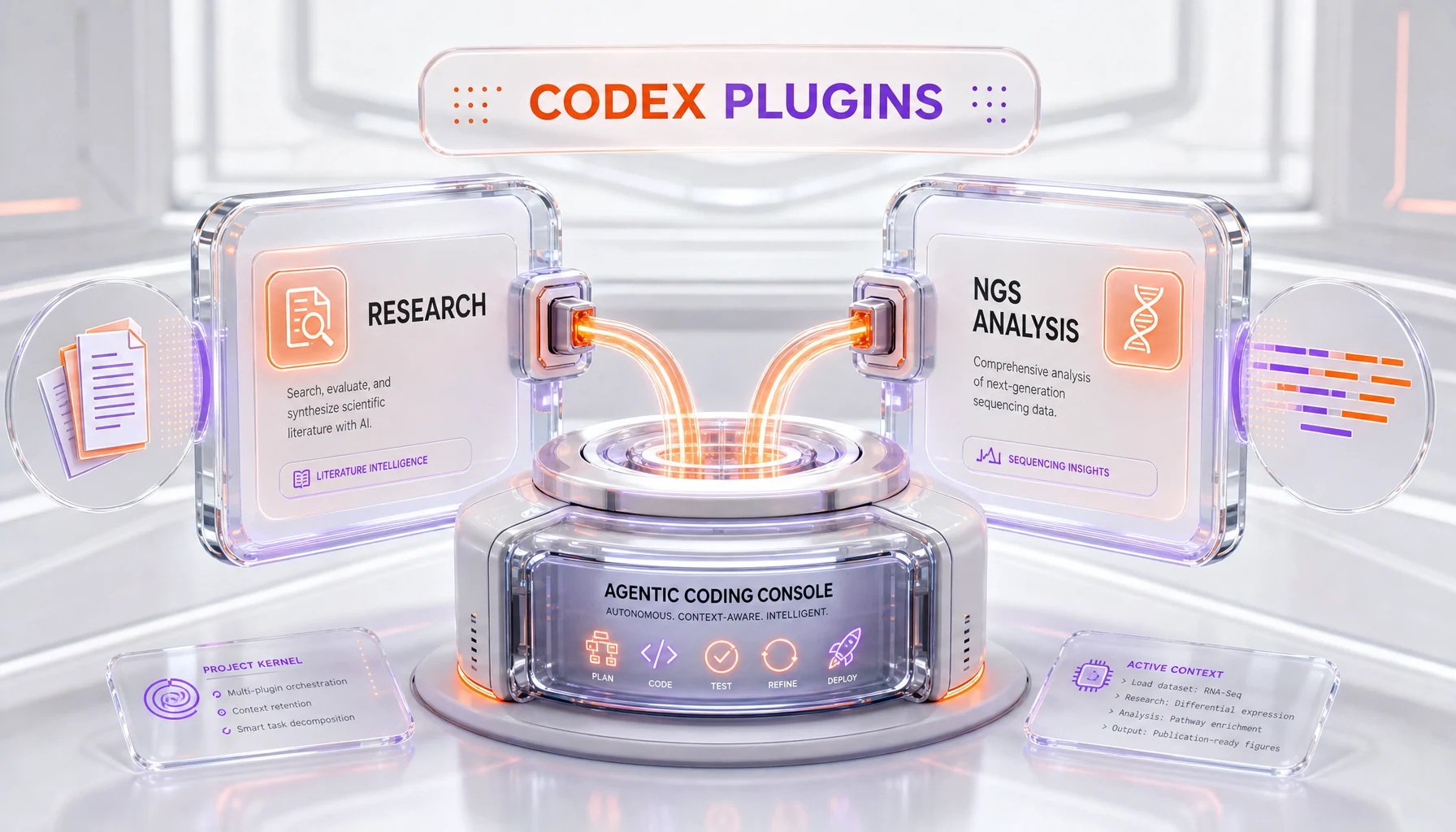
The most concrete, hands-on part of this release is the pair of Codex plugins. OpenAI's Codex is its agentic coding surface, and these plugins extend it into life-sciences-specific work. There are two:
Life Sciences Research. This plugin is oriented toward the upstream, knowledge-intensive part of research — working with literature, evidence, and experimental design inside an agentic coding environment. It maps closely to the LifeSciBench zones of evidence handling, design and optimization, and scientific reasoning.
Life Sciences NGS Analysis. This plugin targets next-generation sequencing analysis, a core bioinformatics workload. NGS analysis is heavily computational — processing sequencing reads, running pipelines, and interpreting outputs — which is precisely the kind of long-horizon quantitative task where the token-efficiency gains, if they hold, would have the most operational impact.
Packaging life-sciences capability as Codex plugins is a strategically interesting choice. Rather than shipping a standalone biology product, OpenAI is meeting computational researchers where many of them already work — in a coding agent. That lowers the adoption barrier for bioinformaticians and lets the life-sciences specialization ride on top of the broader GPT-5.5 agentic stack. It also keeps OpenAI's surface area consolidated: the same Codex environment that handles general software work now hosts domain plugins.
Why It Matters
This release matters because it moves a frontier model from demo to workflow. Benchmarks judged by experts, a token-efficiency claim aimed at long-horizon biology work, and Codex plugins for research and NGS analysis together signal that OpenAI wants GPT-Rosalind embedded in real pipelines, not just admired in a paper. For computational biology teams, the value proposition is concrete: an agent that can move through evidence, analysis, and validation steps, available inside a coding environment many already use.
The worldwide research preview is the other reason this is a notable step. Until now, GPT-Rosalind access had been narrow — research preview for trusted-access customers, and in the biodefense program, sponsored access for vetted government and allied partners. Opening a research preview to eligible organizations globally is the first time the model has been offered at this scale. It widens the pool of researchers who can put the model and its plugins under real-world pressure, which is exactly how a benchmark like LifeSciBench gets stress-tested beyond its authors.
It also fits a broader OpenAI pattern. The company has been wiring itself into high-stakes verticals — security, government, and now the life sciences — building on its core models. GPT-Rosalind on GPT-5.5, with Codex plugins, is the life-sciences expression of that strategy: take the agentic foundation, specialize it, package it where practitioners work, and expand access in stages.
A Necessary Note of Caution
Life sciences is a domain where AI assistance touches questions that can ultimately affect health and safety, so a measured tone is warranted. A few things are worth stating plainly.
First, none of this makes GPT-Rosalind a substitute for trained scientific judgment, peer review, or wet-lab validation. An agentic model that handles evidence and analysis can accelerate and organize work, and it can also be confidently wrong. In research contexts, model outputs are inputs to a scientific process, not conclusions. The translation-and-communication zone of LifeSciBench is a useful reminder that explaining and defending a result is part of the work — and that a fluent explanation is not the same as a correct one.
Second, the benchmark and the efficiency figure are, for now, vendor-reported. LifeSciBench is judged by external experts according to OpenAI, which is a stronger design than self-grading, but the judge pool, scoring rubric, and reproducibility have not been independently audited. The 31% token-efficiency claim is similarly a vendor number until labs reproduce it. We are reporting these as OpenAI's claims, not as settled facts.
Third, broad access changes the risk surface. A worldwide research preview means more hands on a capable life-sciences model. OpenAI's stated approach across its Rosalind work has leaned on eligibility screening and gated access; the biodefense program is the most explicit example. How the eligibility criteria for this broader preview are defined and enforced will matter, and those details were not exhaustively specified in the announcement. We will track them.

How It Fits OpenAI's Stack and Strategy
GPT-Rosalind sits on top of GPT-5.5, the agentic architecture OpenAI shipped earlier in 2026 with coding-agent and tool-use capabilities at its center. That lineage explains why the life-sciences model is delivered through Codex plugins rather than a separate app: the same tool-use foundation that makes GPT-5.5 a strong coding agent is what makes GPT-Rosalind a workable research agent. Reusing that base is efficient for OpenAI and familiar for users already inside the ChatGPT and Codex ecosystem.
Strategically, the June 3 update and the May 29 biodefense program are two faces of the same bet: that frontier reasoning is now good enough to be useful in the life sciences, and that OpenAI can capture that domain by combining a specialized model, practitioner-facing tooling, expert-judged evaluation, and staged access. The broad preview seeds adoption among researchers; the biodefense program secures the high-stakes, government-facing flank. Together they describe a company trying to own the AI layer of biology the way it has tried to own the AI layer of software.
What We Still Do Not Know
Several details were not specified in a way we can verify, and we will not fill the gaps with guesses. We do not have LifeSciBench's full methodology, judge composition, or scoring rubric. We do not have granular benchmark scores broken down by zone or by competing model, and we are not going to invent them. We do not have the model's context length or other architecture specifications beyond its GPT-5.5 lineage. We do not have pricing, the precise eligibility criteria for the worldwide research preview, or a published list of which organizations have been admitted. And we cannot independently confirm the 31% token-efficiency figure outside OpenAI's own testing.
Those gaps are normal for a launch-day announcement, and they are the right things to watch as the picture fills in. The most useful early signals will be independent reproductions of the efficiency claim, outside scrutiny of LifeSciBench, and clarity on who actually gets into the preview and under what terms.
The Bottom Line
OpenAI's June 3 GPT-Rosalind update is a substantive step: a GPT-5.5 foundation, a reported ~31% token-efficiency gain on long-horizon quantitative biology, two Codex plugins for research and NGS analysis, a new expert-judged LifeSciBench evaluation, and a first-ever worldwide research preview for eligible organizations. It is the broad-capability counterpart to the narrower, government-facing Rosalind Biodefense program from a few days earlier.
The right way to read it is with interest and discipline. The packaging is smart — meeting computational researchers inside Codex — and the efficiency angle is credible given GPT-5.5's design. But the benchmark and the efficiency number are vendor-reported until the field can check them, and in a domain adjacent to health and safety, that distinction is not pedantry. This is a capable tool aimed at a serious domain, launching faster than the independent scrutiny that should accompany it. We will keep watching for the data that turns OpenAI's claims into confirmed facts.
Frequently Asked Questions
What did OpenAI announce for GPT-Rosalind on June 3, 2026?
OpenAI announced a capability upgrade for GPT-Rosalind, its life-sciences model, now built on the GPT-5.5 agentic coding and tool-use architecture. The update reports roughly 31% fewer tokens than GPT-5.5 on long-horizon quantitative biology analyses, adds two Codex plugins (Life Sciences Research and Life Sciences NGS Analysis), introduces a new expert-judged benchmark called LifeSciBench, and opens a research preview to eligible organizations worldwide for the first time.
How is this different from the Rosalind Biodefense announcement?
They are distinct. Rosalind Biodefense, announced May 29, 2026, is a government-partnership program that pairs GPT-Rosalind with vetted national labs and biosecurity bodies for pandemic preparedness, using sponsored, gated access. The June 3 update is a broad capability release: a new GPT-5.5 foundation, token-efficiency gains, Codex plugins, the LifeSciBench benchmark, and a worldwide research preview. Both share the GPT-Rosalind brand but answer different questions — one about defense partnerships, the other about capability and reach.
What is GPT-Rosalind built on now?
GPT-Rosalind is now built on GPT-5.5, OpenAI's agentic architecture with coding-agent and tool-use capabilities at its center. That lineage is why the life-sciences specialization is delivered through Codex plugins rather than a standalone app: the same tool-use foundation that powers GPT-5.5 as a coding agent is what makes GPT-Rosalind a workable research agent.
What is LifeSciBench?
LifeSciBench is a new benchmark OpenAI introduced with this update, designed to evaluate the model across how life-sciences work actually unfolds rather than via multiple-choice formats. OpenAI says it is judged by external domain experts across six workflow zones: evidence handling, analysis, design and optimization, scientific reasoning, validation and operations, and translation and communication. As a vendor-authored evaluation, its methodology, judge pool, and reproducibility have not been independently audited yet.
What does the 31% token efficiency claim mean?
OpenAI reports that GPT-Rosalind uses roughly 31% fewer tokens than GPT-5.5 on long-horizon quantitative biology analyses. The qualifier matters: it is a comparison on a specific class of long-running, quantitative, biology-focused tasks, not a blanket claim of being 31% cheaper or faster everywhere. It is a vendor benchmark until independent users reproduce it on their own workloads.
What are the two new Codex plugins?
The two plugins are Life Sciences Research and Life Sciences NGS Analysis. Life Sciences Research targets upstream, knowledge-intensive work — literature, evidence, and experimental design inside an agentic coding environment. Life Sciences NGS Analysis targets next-generation sequencing analysis, a core bioinformatics workload that is heavily computational and well suited to the model's long-horizon, quantitative strengths.
Who can access GPT-Rosalind now?
OpenAI is opening a research preview to eligible organizations worldwide for the first time. Previously, access had been narrow — research preview for trusted-access customers, and sponsored access for vetted partners in the Rosalind Biodefense program. The precise eligibility criteria for this broader worldwide preview, and the list of admitted organizations, were not exhaustively specified in the announcement.
Is GPT-Rosalind a replacement for scientists or peer review?
No. An agentic model that handles evidence and analysis can accelerate and organize research work, but it can also be confidently wrong. Its outputs are inputs to a scientific process — not conclusions — and they do not replace trained scientific judgment, peer review, or wet-lab validation. A fluent explanation from a model is not the same as a correct one.
Why does token efficiency matter for life sciences specifically?
Quantitative biology workflows are long-horizon by nature: a single analysis can chain dozens of reasoning and tool-use steps, each consuming tokens that compound in agentic workflows. A model that reaches the same result with fewer tokens is cheaper to run at scale and often faster. For institutions running many analyses, a one-third reduction in token consumption on the heaviest workloads is a meaningful operational lever.
Can the LifeSciBench results and efficiency figure be trusted?
They should be treated as vendor-reported claims for now. LifeSciBench being judged by external experts is a stronger design than self-grading, but the judge pool, scoring rubric, and reproducibility have not been independently audited. The 31% token-efficiency figure is likewise a vendor number until labs reproduce it. We report these as OpenAI's claims rather than settled facts.
How does this fit OpenAI's broader strategy?
It fits a pattern of OpenAI wiring its core models into high-stakes verticals — security, government, and now the life sciences. GPT-Rosalind on GPT-5.5, packaged as Codex plugins with an expert-judged benchmark and staged access, is the life-sciences expression of that strategy: take the agentic foundation, specialize it, ship it where practitioners work, and expand access in stages. The broad preview seeds adoption while the biodefense program secures the government-facing flank.
What do we still not know about this release?
Several details remain unverified: LifeSciBench's full methodology, judge composition, and scoring rubric; granular benchmark scores by zone or competing model; the model's context length and other architecture specs beyond its GPT-5.5 lineage; pricing; and the precise eligibility criteria and admitted-organization list for the worldwide preview. The 31% efficiency figure also cannot be independently confirmed outside OpenAI's own testing yet.