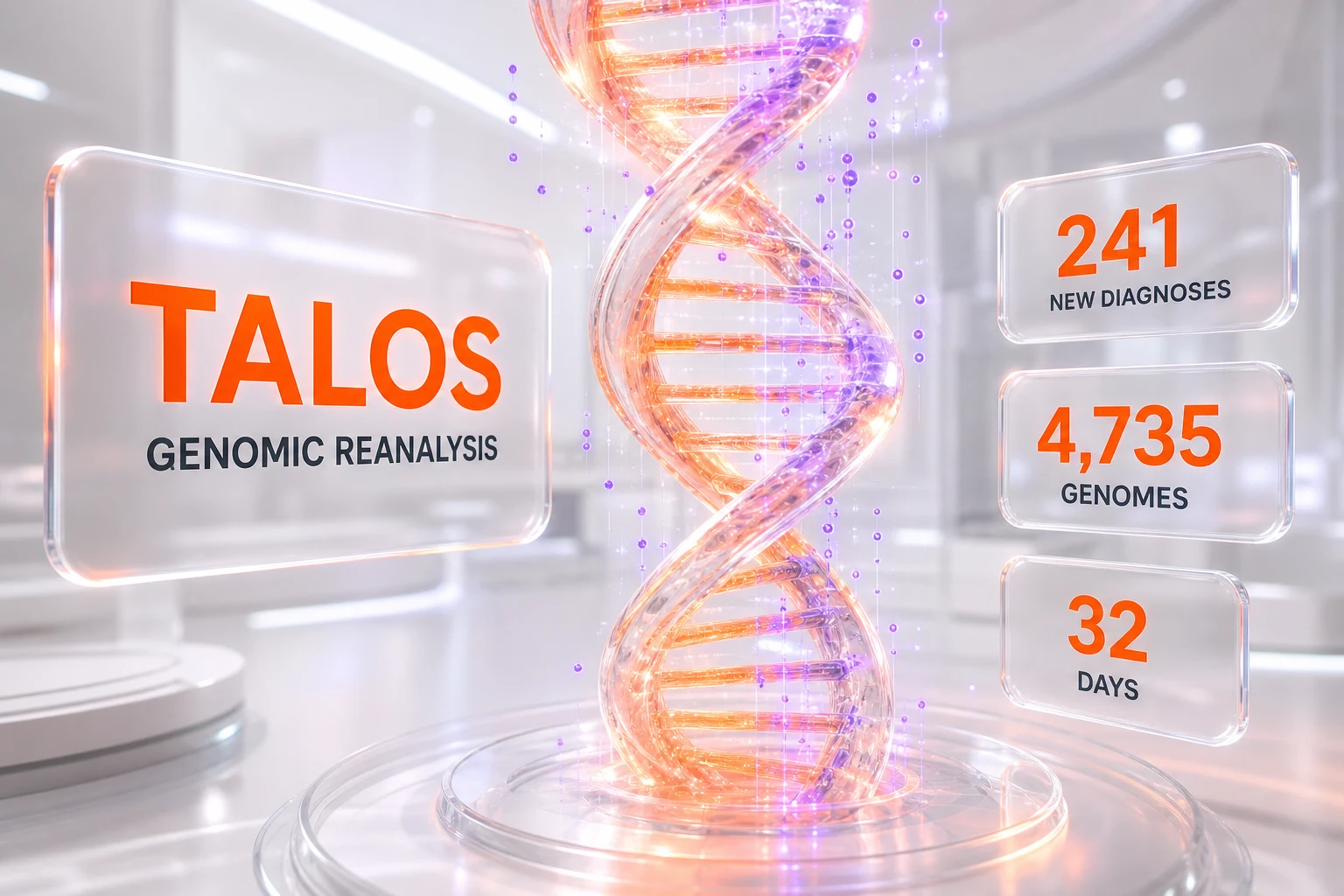
An open-source automated genomic reanalysis pipeline called Talos just re-scanned dormant, already-sequenced genomes and surfaced 241 new rare-disease diagnoses in 238 individuals, drawn from a cohort of 4,735 undiagnosed patients — a 5.1% additional diagnostic yield, with a median of just 32 days between new evidence appearing in public knowledge bases and the resulting diagnosis. Built by Murdoch Children's Research Institute and Victorian Clinical Genetics Services with collaborators including the Broad Institute and Microsoft Research, Talos does not diagnose anyone autonomously: every candidate variant it flags is confirmed pathogenic or likely-pathogenic by accredited labs and expert clinicians before any diagnosis is made.
What Happened
On June 24, 2026, Nature Medicine published a study (DOI 10.1038/s41591-026-04477-5) reporting that an open-source pipeline named Talos generated 241 new rare-disease diagnoses in 238 individuals, identified within a cohort of 4,735 undiagnosed patients. That works out to a 5.1% additional diagnostic yield — patients who had already been sequenced, already been analyzed, and were still living without an answer.
The pipeline was co-developed by the Murdoch Children's Research Institute (MCRI) and Victorian Clinical Genetics Services (VCGS), in collaboration with the Centre for Population Genomics, Australian Genomics, the Broad Institute, and Microsoft Research. It is open source. Microsoft Research is a co-author and contributor to the work — a neutral collaboration, not a commercial product launch.
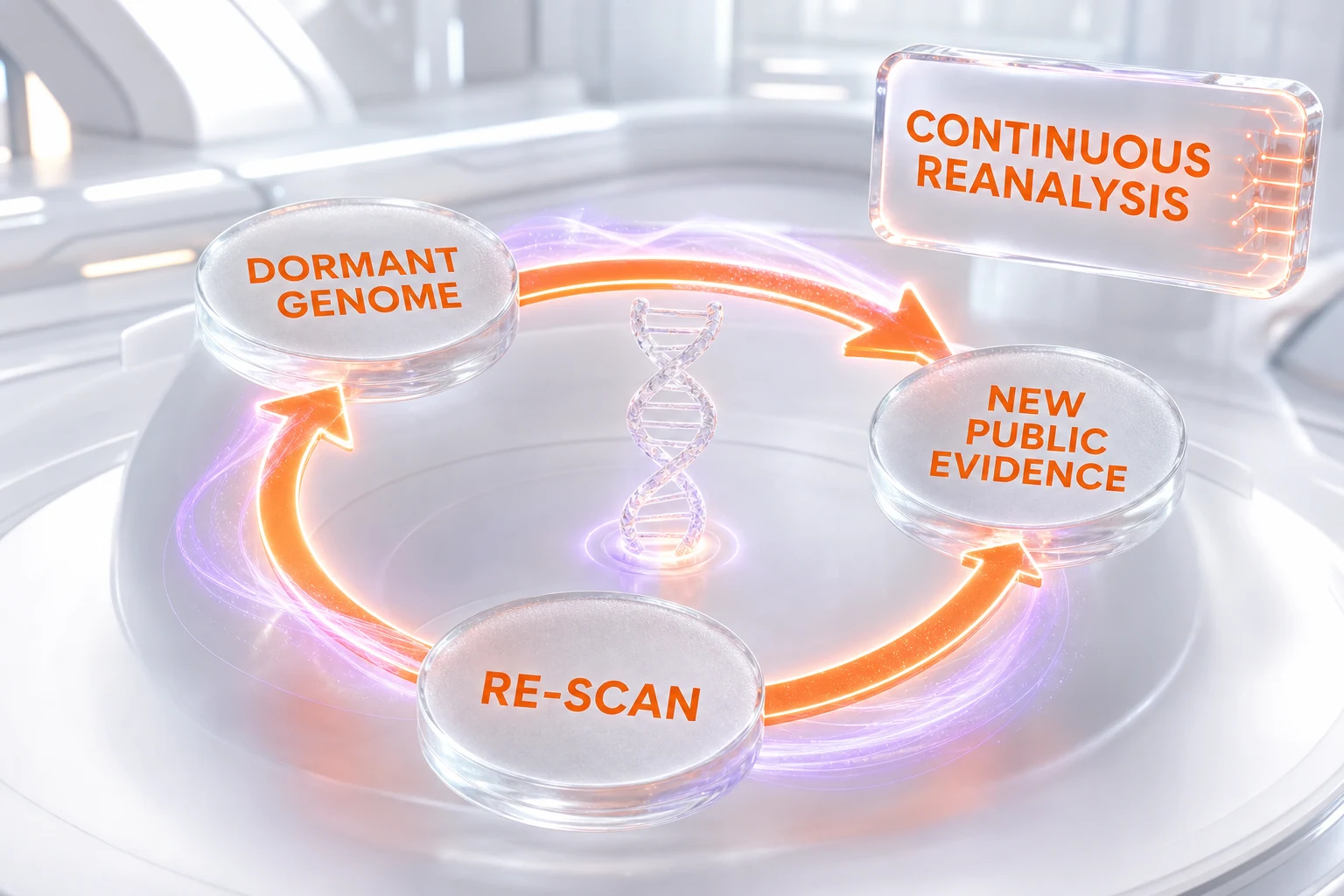
The mechanism is the part worth slowing down on. Talos does not sequence new DNA and does not invent biology. It takes variants that were already called from a patient's existing genomic data and re-interprets them against two dynamically-updated public knowledge bases: PanelApp Australia, which curates gene-disease relationships, and ClinVar, which catalogs variant-level pathogenicity. As those public resources are updated by the global scientific community, Talos automatically re-reads old genomes in light of the new evidence.
The Numbers at a Glance
| Metric | Value |
|---|---|
| New diagnoses | 241 |
| Individuals diagnosed | 238 |
| Undiagnosed cohort | 4,735 |
| Additional diagnostic yield | 5.1% |
| Median time to diagnosis | 32 days |
| Median candidate variants per family | 1.3 |
Is Talos "An AI That Diagnoses"? No — Here Is What It Actually Does
This is the part the headlines will get wrong, so let us be precise. Talos is not a medical chatbot, and it is not an artificial intelligence that diagnoses patients on its own. It is an automated reanalysis pipeline. Its job is narrow and well-defined: re-interpret already-sequenced variants against the latest public knowledge, then surface a short, prioritized list of candidate variants for human review.
Every candidate variant Talos flags is then confirmed as pathogenic or likely-pathogenic by accredited diagnostic laboratories and reviewed by expert clinicians before it ever becomes a diagnosis. The pipeline does not make the call. It does not replace the geneticist. What it does is dramatically shrink the haystack — so that the humans who do make the call are looking at roughly one or two strong candidates per family instead of thousands of raw variants.
Put plainly: Talos finds the needle and hands it to a human. The human, and the accredited lab behind them, decides whether it is really a needle. The "241" is a count of confirmed, human-validated diagnoses — not a tally of machine guesses.
Why 32 Days Is the Number That Matters
Rare-disease genomics has a quiet, structural problem: science moves faster than manual re-review. A patient sequenced three years ago was interpreted against the knowledge available three years ago. Since then, new gene-disease links have been published and thousands of variants have been reclassified — but nobody has the time to manually re-open every old case every time the literature shifts. Those genomes sit dormant: fully sequenced, fully paid for, and quietly out of date.
Talos closes that gap. The headline figure from the study is a median of 32 days between a piece of supporting evidence becoming public and the resulting diagnosis landing for a patient. Set that against the status quo — years of passive waiting, if a re-review ever happens at all — and the reframe becomes obvious. The innovation is not a smarter single analysis. It is the shift from a one-shot interpretation to a continuous, automated re-scan that keeps every dormant genome current.
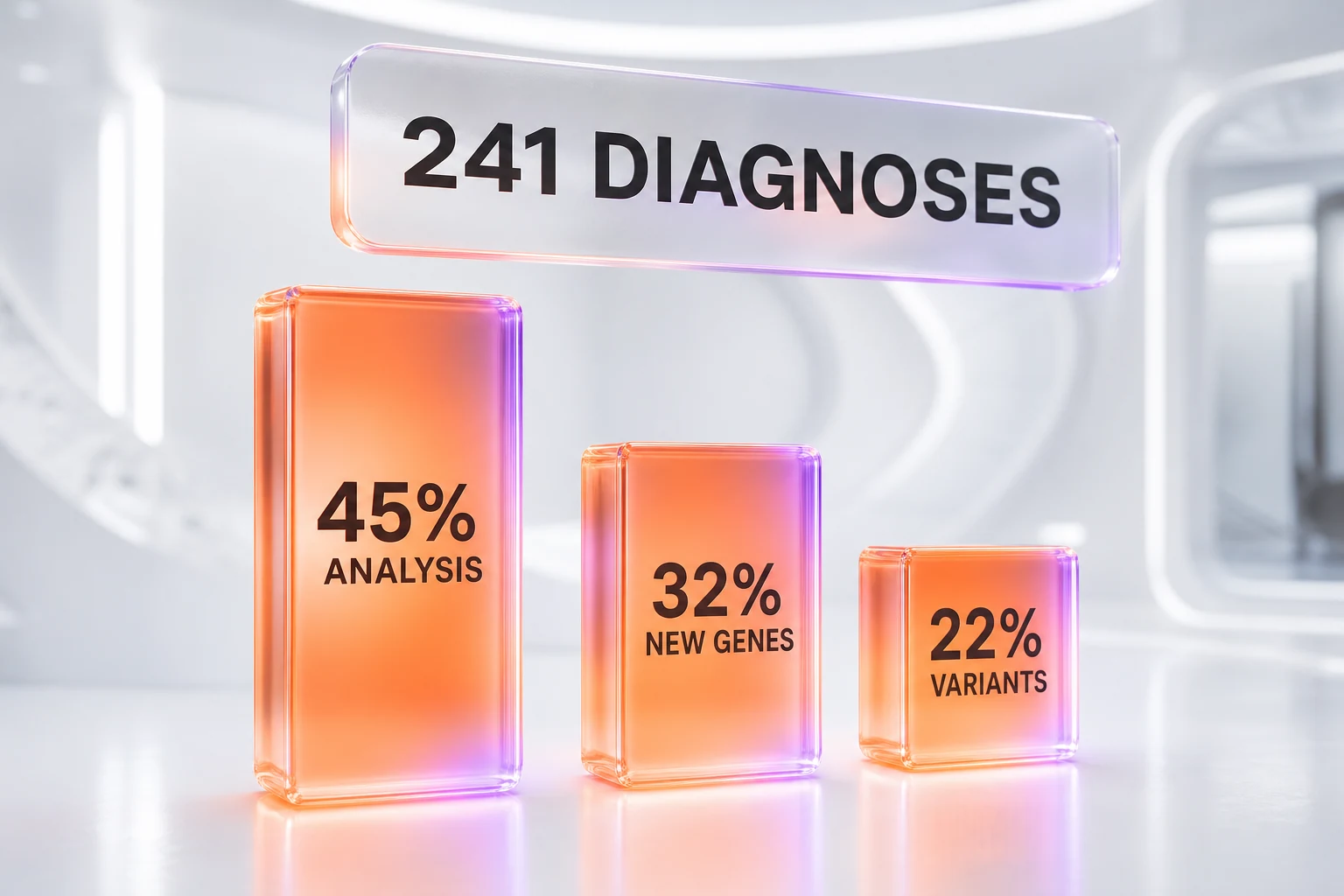
The study also breaks down why the 241 diagnoses surfaced. The three drivers map cleanly onto the three things that change over time in genomics:
- 109 diagnoses (45%) came from improved analysis and filtering strategies — better ways of reading the same data.
- 78 diagnoses (32%) came from newly established gene-disease relationships — genes that were not yet linked to disease at the time of the original analysis.
- 54 diagnoses (22%) came from new variant-level evidence — reclassifications, often in ClinVar, that turned a variant of uncertain significance into a meaningful one.
How It Works Under the Hood
Talos sits downstream of sequencing. It ingests variants that have already been called and runs them through an interpretation engine wired directly into two living public resources. PanelApp Australia supplies the current consensus on which genes are associated with which conditions, and ClinVar supplies the current evidence on whether a specific variant is pathogenic. Because both feeds are updated continuously by the wider research community, Talos inherits the field's progress automatically rather than waiting for a manual refresh.
The filtering is inheritance-aware. Where family data is available, Talos uses trio-based analysis — comparing a patient against their parents — to separate plausible disease-causing variants from inherited background noise. In validation across 1,089 probands spanning two independent cohorts, the pipeline recovered roughly 90% of known, in-scope diagnoses (90% in one cohort and 87% in the other), which is the relevant benchmark: it reliably re-finds what experts have already confirmed, then extends past it.
Crucially, the signal-to-noise ratio is tight. The pipeline surfaces a median of just 1.3 candidate variants per family — a small, reviewable shortlist rather than an overwhelming dump. And because reanalysis runs iteratively (monthly), once a cohort has been brought up to date the incremental burden falls to roughly one candidate variant per 200 cases on each subsequent pass. That low false-positive load is what makes continuous reanalysis sustainable for a real clinical service: the humans are not buried under busywork every month.
Why It Matters
The significance here is structural, not just statistical. Rare-disease diagnostic odysseys routinely stretch across years; for the families involved, an answer changes everything from treatment options to reproductive decisions to simply having a name for what they are living with. A 5.1% additional yield, applied to the enormous and growing global backlog of sequenced-but-undiagnosed patients, is not a rounding error — it is hundreds of answers per cohort that would otherwise have required new clinical effort that nobody had budgeted.
The deeper shift is conceptual. For most of its history, genomic interpretation has been treated as a one-time event: sequence the patient, analyze once, file the report. Talos reframes interpretation as a living process — every genome stays plugged into the advancing front of science, and re-diagnosis happens as a background utility rather than a special project. Because the pipeline is open source, that capability is not locked behind a single vendor; in principle, any clinical genomics service can adopt it, which matters for access and equity across health systems that cannot each build a bespoke reanalysis engine.
What Is Next
The obvious trajectory is adoption. As an open-source pipeline validated on real clinical cohorts and published in a top-tier journal, Talos is positioned to be picked up by other clinical genomics services that want continuous reanalysis without building it from scratch. Its dependence on public knowledge bases means it also improves passively as PanelApp Australia and ClinVar grow.
The caveats are real and worth stating plainly. Talos still requires accredited-lab confirmation and clinician sign-off for every diagnosis — it is a triage and prioritization layer, not a replacement for the diagnostic chain. Running it at scale raises ordinary but non-trivial questions of genomic data governance and patient consent for re-contact when a dormant case suddenly yields an answer. And it is emphatically not a consumer product: this is research and clinical infrastructure used by professional genomics services, not something a patient or family runs themselves.
What the study demonstrates is narrower and sturdier than the hype it will attract. Not "AI now diagnoses rare disease," but something arguably more useful: the genomes we have already sequenced still contain undiscovered answers, and an open-source pipeline can now keep re-reading them — quickly, cheaply, and with a human always making the final call.
What is Talos?
Talos is an open-source automated genomic reanalysis pipeline. It re-interprets already-sequenced patient variants against the latest public knowledge bases — PanelApp Australia for gene-disease relationships and ClinVar for variant pathogenicity — to surface candidate variants that may explain a previously undiagnosed rare disease.
Is Talos an AI that diagnoses patients?
No. Talos is an automated reanalysis pipeline, not an autonomous diagnostic AI. It prioritizes candidate variants for human review, and every candidate is confirmed as pathogenic or likely-pathogenic by accredited diagnostic laboratories and expert clinicians before any diagnosis is made. The pipeline does not make the diagnostic call.
How many new diagnoses did Talos find?
Talos surfaced 241 new diagnoses in 238 individuals, drawn from a cohort of 4,735 undiagnosed patients. That represents a 5.1% additional diagnostic yield among people who had already been sequenced and previously analyzed without an answer.
How does Talos find new diagnoses without new sequencing?
It does not generate new genomic data. Instead, it re-interprets variants that were already called from a patient's existing sequence against the latest evidence in PanelApp Australia and ClinVar. As those public knowledge bases are updated, Talos automatically re-reads old genomes in light of the new science.
What does the 32-day figure mean?
It is the median time between a piece of supporting evidence becoming public in the knowledge bases and the resulting diagnosis reaching a patient. Compared with the status quo of years of passive waiting for a manual re-review, 32 days reflects the value of continuous, automated reanalysis.
Is Talos open source?
Yes. Talos is open source, which means clinical genomics services can in principle adopt it rather than building a reanalysis engine from scratch — a point with real implications for access and equity across health systems.
Who built Talos?
Talos was co-developed by the Murdoch Children's Research Institute (MCRI) and Victorian Clinical Genetics Services (VCGS), in collaboration with the Centre for Population Genomics, Australian Genomics, the Broad Institute, and Microsoft Research. Microsoft Research is a co-author and contributor to the work.
How accurate is Talos, and what about false positives?
In validation across 1,089 probands in two independent cohorts, Talos recovered roughly 90% of known, in-scope diagnoses (90% and 87%). It surfaces a median of just 1.3 candidate variants per family, and on monthly iterative reanalysis the burden falls to roughly one candidate variant per 200 cases — a low false-positive load.
What caused the 241 diagnoses?
The study attributes them to three drivers: 109 diagnoses (45%) from improved analysis and filtering strategies, 78 diagnoses (32%) from newly established gene-disease relationships, and 54 diagnoses (22%) from new variant-level evidence such as ClinVar reclassifications.
Why does automated genomic reanalysis matter for rare disease?
Most genomes are interpreted once and then go dormant, even as science advances and new gene-disease links and variant reclassifications appear. Automated reanalysis keeps every sequenced genome current, turning a one-time analysis into a continuous process and recovering diagnoses that would otherwise require manual re-review that rarely happens.
Where was the study published?
The study was published in Nature Medicine on June 24, 2026, under DOI 10.1038/s41591-026-04477-5.
Can patients or families use Talos directly?
No. Talos is research and clinical infrastructure used by accredited genomics services, not a consumer product, and a diagnosis always requires accredited-lab confirmation and clinician review. This article is news and analysis, not medical advice.