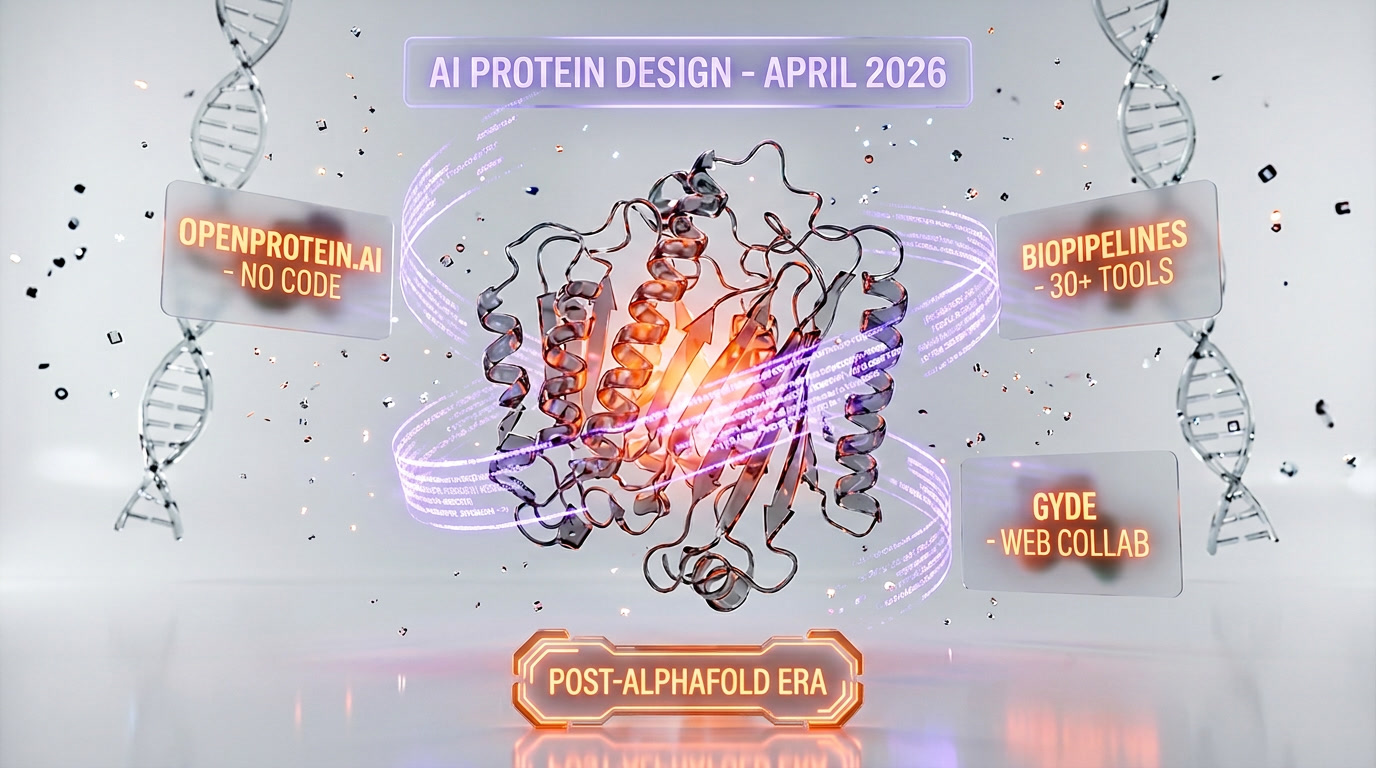
AI protein design just became accessible to biologists without machine learning expertise. On April 17, 2026, MIT News spotlighted OpenProtein.AI — a no-code platform built by MIT alumni Tristan Bepler and Tim Lu — alongside two parallel open-source releases, BioPipelines (a Python framework integrating 30+ AI tools, MIT license, March 13, 2026) and GYDE (Guide Your Design and Engineering, a web-based collaboration platform, March 27, 2026). Together they compress workflows that previously required a computational biology PhD into a point-and-click interface, a one-line Python call, or a shared browser session. Boehringer Ingelheim already uses OpenProtein.AI for cancer and autoimmune antibody discovery.
What Happened
Three protein-design platforms landed in public view within a 35-day window. Their common thesis is the same: the post-AlphaFold era produced a wave of state-of-the-art AI models for protein structure prediction, inverse folding, and binder design — but most of them remain locked behind Python notebooks, CUDA dependencies, and PhD-level glue code. Biologists at the bench couldn't touch them without a computational collaborator. These three launches change that.
OpenProtein.AI — featured by MIT News on April 17, 2026 — is the commercial no-code leader. Founded in 2020 by Tristan Bepler (MIT PhD 2020, Department of Biological Engineering) and Tim Lu (MIT PhD 2007, former MIT associate professor), the platform runs on internally developed foundation models and is free for academic researchers. Its flagship model is PoET (Protein Evolutionary Transformer), with a newer PoET-2 released in 2025 that Bepler says "outperforms larger models while using fewer computing resources and experimental data." Boehringer Ingelheim adopted the platform in early 2025 and expanded the partnership for cancer and autoimmune/inflammatory work.
BioPipelines, posted as a bioRxiv preprint on March 13, 2026 by the laboratory of Protein Design and Immunoengineering at the University of Zurich (GitHub: locbp-uzh/biopipelines, MIT license), is the open-source Python framework. It integrates 30+ tools across five categories — structure generation (RFdiffusion, BoltzGen), sequence design (ProteinMPNN, LigandMPNN), structure prediction (AlphaFold, Boltz2), compound screening, and analysis. Workflows run on SLURM clusters via biopipelines-submit or interactively in Jupyter/Colab.
GYDE (Guide Your Design and Engineering), posted on bioRxiv on March 27, 2026 (GitHub: proteinverse/gyde), is the collaboration layer. It is a web-based, open-source platform that lets bench scientists run and share sequence-structure-function analyses of proteins and antibodies through a visual interface. A published GYDE case study redesigned an anti-PD-1 rabbit antibody using ProteinMPNN and generated a variant with improved affinity.
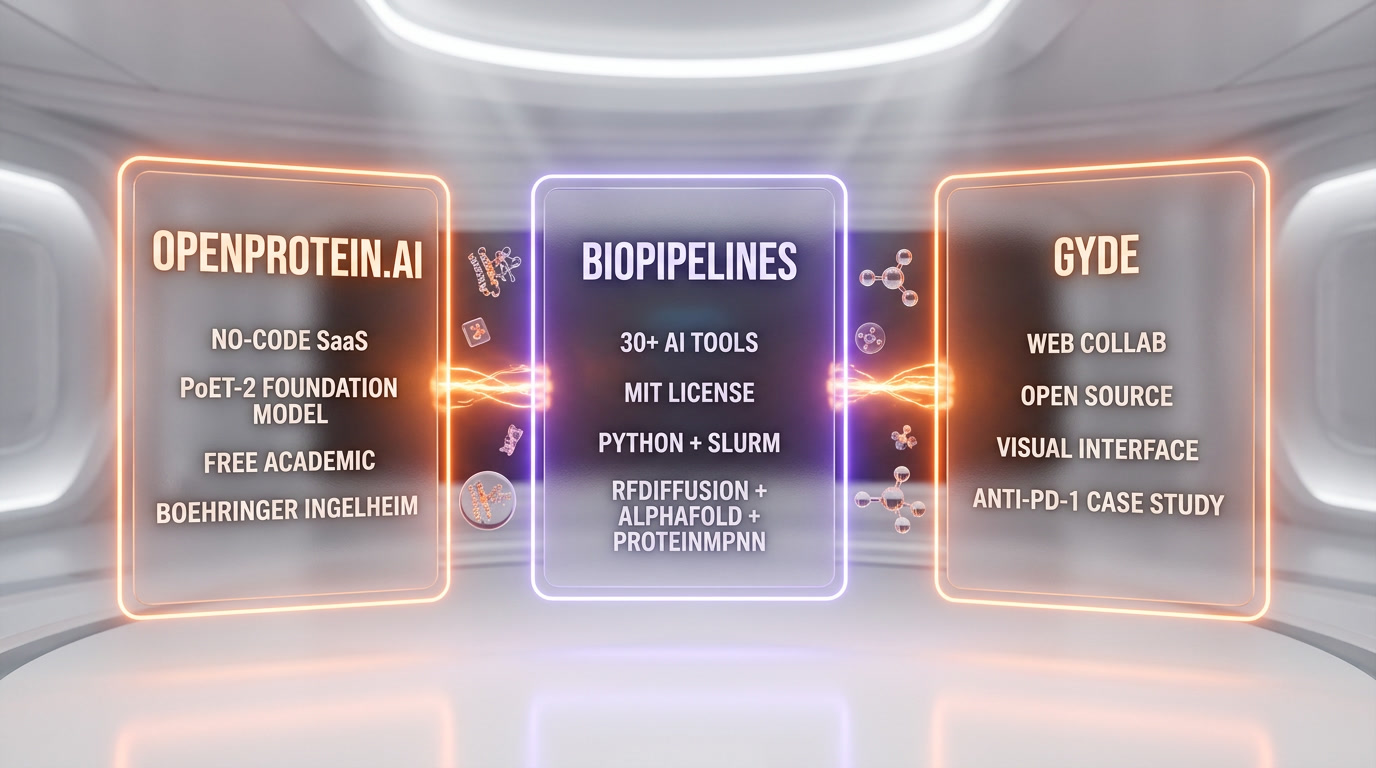
The Three Platforms at a Glance
| Platform | Type | Access | Core Strength | Release / Spotlight |
|---|---|---|---|---|
| OpenProtein.AI | Commercial no-code SaaS | Free for academia, commercial licensing for enterprise, API available | PoET / PoET-2 foundation models, in-house GPUs, sequence-to-function training | MIT News feature, April 17, 2026 |
| BioPipelines | Open-source Python framework | MIT license, pip-installable, SLURM + Jupyter |
30+ integrated tools, reproducible workflows in a few lines of code | bioRxiv preprint, March 13, 2026 |
| GYDE | Open-source web collaboration | Free, self-hostable, web UI, saved sessions | Visual sequence-structure-function explorer for antibodies and proteins | bioRxiv preprint, March 27, 2026 |
The three are not direct competitors. OpenProtein.AI is a hosted product with proprietary foundation models. BioPipelines is infrastructure — the plumbing that connects RFdiffusion, ProteinMPNN, AlphaFold, and Boltz2 into one pipeline. GYDE is the shared whiteboard where a wet-lab scientist and a computational collaborator look at the same results. A lab could realistically use all three in the same week.
Our Methodology
We researched the three platforms in parallel using MIT News (April 17, 2026), the OpenProtein.AI official website, the two bioRxiv preprints (BioPipelines and GYDE), the Nature commentary on open-source protein structure AI (d41586-025-03546-y), the respective GitHub repositories, and the Mirage News summary. We cross-checked quotes, authorship, release dates, and integration lists against the original preprints and GitHub READMEs. We have not personally tested these platforms — this is a synthesis and positioning analysis, not a hands-on review. Where we cite a number (30+ tools, 20x potency, MIT license), the source is the primary document.
Post-AlphaFold: Why 2026 Is the Year Protein Design Goes No-Code
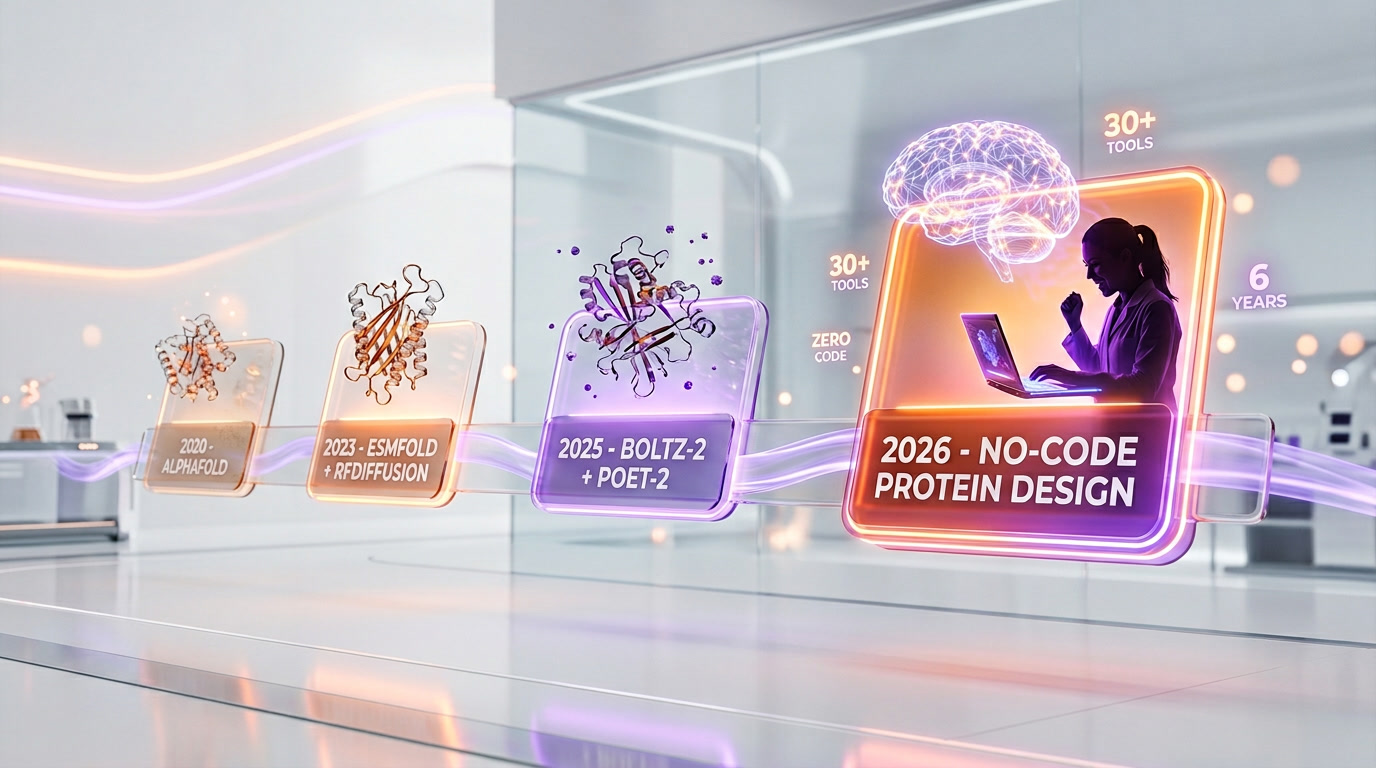
AlphaFold 2 (DeepMind, 2020) solved protein structure prediction with a level of accuracy that rewrote molecular biology curricula. ESMFold (Meta, 2023) pushed the same capability onto a single transformer and 15 billion parameters, making it faster and open. Then came the design-side breakthroughs: RFdiffusion (Baker Lab, 2023) for de novo backbone generation, ProteinMPNN (Baker Lab, 2023) for inverse folding, and Boltz-1 and Boltz-2 (MIT, 2024-2025) for joint structure and binding affinity prediction.
Every one of those models is powerful. None of them is friendly. Running RFdiffusion end-to-end to design a binder that actually folds, checking it with AlphaFold, re-threading with ProteinMPNN, then ranking candidates by predicted affinity is a multi-day engineering project. Most experimental biologists — the people who will actually clone, express, and test the proteins — cannot do this without a dedicated computational collaborator.
That gap is exactly what the three 2026 platforms attack. OpenProtein.AI removes the infrastructure (their homepage says "We bring the GPUs!"). BioPipelines removes the glue code. GYDE removes the file-sharing and result-interpretation friction. Different layers, same thesis: the model quality is already good enough, the bottleneck is access.
OpenProtein.AI: The No-Code SaaS With In-House Foundation Models
OpenProtein.AI is the most mature of the three. It is a commercial product based in Singapore (the operating entity is NE47 Bio at 21 Biopolis Road), with a free tier for academic researchers and an enterprise partnership model validated by Boehringer Ingelheim's adoption.
The differentiator is the PoET family of foundation models. PoET (presented at NeurIPS 2023) is described in its paper as "a generative model of protein families as sequences-of-sequences." It can generalize about evolutionary constraints and incorporate new information on protein sequences without retraining — which in practice means a biologist can feed it a small set of known variants and receive ranked design suggestions in minutes. PoET-2, released in 2025, reportedly outperforms larger models on the same task with fewer compute resources and less experimental data.
What users actually do on the platform:
- Design substitution libraries, combinatorial variants, and bespoke libraries from a target sequence
- Train sequence-to-function models on their own mutagenesis data
- Predict and visualize structures for every design candidate
- Compare libraries by success probability and cost-effectiveness before ordering DNA
- Work across antibodies, capsid proteins, and enzymes — OpenProtein explicitly supports "any protein type and measurable property"
One published validation on the OpenProtein website claims antibodies designed on the platform achieved "20x greater potency than conventional mutagenesis" in a head-to-head comparison. We did not independently validate the benchmark setup.
The quote that captures the product philosophy comes from Bepler in the MIT News piece: "We've tried really hard to make the platform an open-ended toolbox." That is the difference between a tool and a platform — the ceiling isn't what the vendor thought of, it is what the user can compose.
BioPipelines: 30+ Tools in One Python Import
BioPipelines takes the opposite strategy. Instead of building a hosted black box, it exposes the state-of-the-art open models as a Python framework with standardized interfaces. From the preprint's own description: "a modular and user-friendly Python framework for protein and ligand engineering workflows on SLURM clusters."
The integrated toolchain (as of the March 13, 2026 release) covers five domains:
- Structure generation: RFdiffusion, BoltzGen
- Sequence design: ProteinMPNN, LigandMPNN
- Structure prediction: AlphaFold, Boltz-2
- Compound screening: small-molecule and ligand docking modules
- Analysis: energy metrics, binding-site evaluation, variant scoring
The execution model is what makes it accessible. Two modes ship out of the box: a biopipelines-submit CLI that dispatches jobs to a SLURM cluster for heavy workloads, and a Jupyter / Google Colab mode for interactive design. A biologist with basic Python literacy can define "generate 100 de novo binders to target X, fold them, filter by predicted affinity, export top 20" in under 20 lines of code — and every step is reproducible because the pipeline is code, not a GUI session.
Applications the authors explicitly call out: inverse folding, gene synthesis, de novo protein design, compound library screening, iterative binding-site optimization, and fusion-protein linker optimization. The MIT license and the locbp-uzh/biopipelines GitHub repository mean any lab — or any startup — can fork it.
GYDE: The Collaboration Layer AlphaFold Never Had

GYDE fills a different gap. It is the web-based collaboration platform — open-source, free to self-host, available at proteinverse/gyde on GitHub. From the preprint: "an open-source, versatile, and web-based collaboration platform designed to make computational analyses of proteins and antibodies easily accessible to bench scientists."
The core move is the visual interface for exploring sequence-structure-function relationships. A researcher can pull up a target antibody, overlay real assay data next to computational predictions, and drill down to individual residues. Saved sessions make results shareable — a computational collaborator can run ProteinMPNN, and the wet-lab scientist can open the same session, annotate the top mutations, and hand it to the cloning team.
The case study in the GYDE preprint is an anti-PD-1 rabbit antibody. The team used ProteinMPNN through GYDE to generate mutants, performed frequency analysis on the proposed mutations, integrated experimental affinity data, and identified a variant with improved binding properties. The entire workflow happened inside the browser.
GYDE does not replace OpenProtein.AI or BioPipelines — it composes with them. In practice, a lab could run heavy pipeline jobs through BioPipelines on a cluster, ship results into GYDE for visual analysis and team review, and keep OpenProtein.AI in the toolbox for antibody-specific PoET-2 designs that are easier to run on a hosted platform.
How This Compares to AlphaFold and ESMFold
A question the MIT News piece surfaces but does not resolve: if AlphaFold and ESMFold already democratized structure prediction, what is new?
AlphaFold 2 (2020) and ESMFold (2023) democratized one task: predicting structure from sequence. They did not democratize design. Designing a new protein that actually folds, binds a specific target, expresses well, and survives a wet-lab assay requires a pipeline — not a single model. The 2026 platforms are about pipelines.
Concretely: AlphaFold is a component in BioPipelines. ESMFold is a component users can slot in. OpenProtein.AI's PoET-2 is an alternative to ESM as a representation backbone. The state-of-the-art prediction models became building blocks. The new competitive layer is the orchestration and the user experience.
This mirrors a pattern we've been tracking in developer tooling. Large language models democratized code completion in 2022-2023. The real productivity leap came later — when agentic dev environments like Claude Code turned raw LLM capability into end-to-end workflows. Protein design is going through the same compression now: the models became infrastructure; the interface became the product.
The Economic Impact: Why This Matters for Biotech
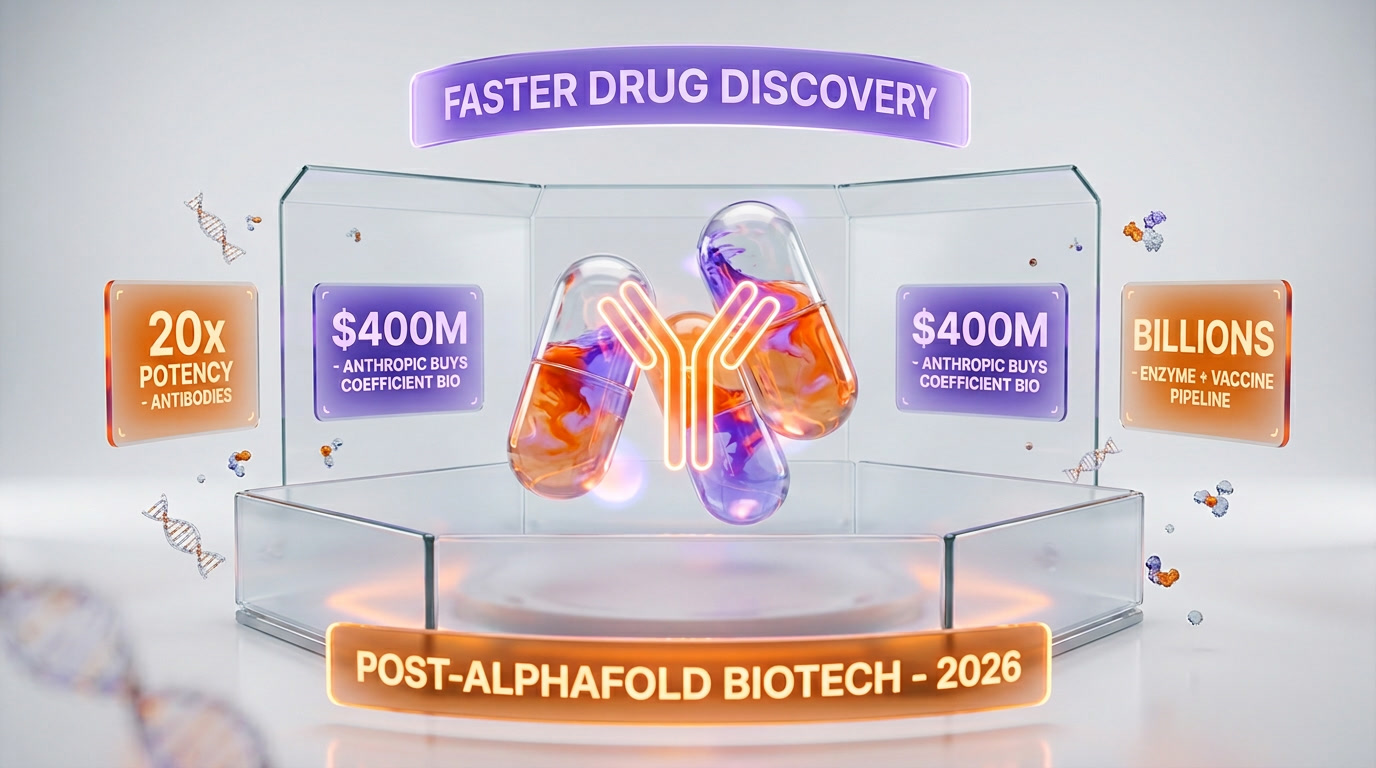
The commercial weight of protein design AI is already visible in the deal flow. Anthropic's $400 million acquisition of Coefficient Bio — announced earlier in 2026 — put the sector on the radar of the AI research labs themselves. Pharmaceutical companies like Boehringer Ingelheim are signing multi-year platform deals instead of one-off service contracts. Biotech startups can now prototype therapeutic antibodies or industrial enzymes with a team of three instead of thirty.
Three concrete areas where no-code protein design changes the unit economics:
- Antibody discovery. Traditional hybridoma and phage-display campaigns take 6-18 months and produce candidates that often need further maturation. PoET-style models combined with GYDE visual triage can propose affinity-matured variants in days — OpenProtein.AI cites a 20x potency improvement in its own antibody benchmark.
- Industrial enzyme engineering. Food, textile, and biofuel companies use enzymes whose performance caps the process economics. BioPipelines' inverse-folding and variant-scoring pipeline compresses iterative mutagenesis rounds that used to take a PhD student two years into Colab sessions measured in days.
- De novo binder design for vaccines. RFdiffusion and ProteinMPNN combined already produce novel binders to tough targets. Making that pipeline one Python import makes it reachable for academic vaccine labs that previously had to outsource computational work.
The Nature commentary on open-source protein structure AI (article d41586-025-03546-y) frames the broader move: the field is shifting from closed, flagship models toward an ecosystem of composable open tools. The 2026 platforms are the productization of that shift.
Why We See a Parallel With AI Developer Tools
We have been writing about tooling democratization across domains for the last two years. The trajectory looks identical every time. A breakthrough model appears (AlphaFold, GPT-4, DALL-E 2). Power users and researchers push it to its limits. A gap opens between what the model can do and what most practitioners can actually ship with it. Then a second wave of tools compresses that gap into a product.
In AI robotics, that second wave looks like Gemini Robotics-ER 1.6 — an embodied reasoning layer sitting on top of raw vision-language capability. In developer tooling, it is Claude Code and its peers turning the model into a shell. In protein design, it is OpenProtein.AI, BioPipelines, and GYDE turning AlphaFold, RFdiffusion, and ProteinMPNN into workflows a biologist can run.
The implication for the biotech market: the competitive advantage of a "we hired a computational biology team" biotech narrows fast when the computational biology team is a Jupyter notebook, a SaaS subscription, and a shared browser link.
What to Watch Next
Three open questions the April 2026 releases do not yet answer.
1. How fast do the open-source frameworks catch up to OpenProtein.AI's hosted performance? BioPipelines ships the models, but running PoET-2 quality designs requires either the OpenProtein API or a comparable open weight. If open weights for frontier protein foundation models appear in the next 12 months, the commercial layer compresses.
2. Does GYDE become the standard protein-design notebook interface? Jupyter became the standard for machine learning. GYDE's visual sequence-structure viewer is more specialized and, arguably, more useful for the biologist audience. If the community settles on it, labs that train their juniors on GYDE today will have a portable skill.
3. When do we see the first clinical candidate originated end-to-end on a no-code protein design platform? The Boehringer Ingelheim partnership is the closest proxy we have. A publicly announced Phase 1 asset with OpenProtein.AI or BioPipelines credited in the IND narrative would be the inflection point.
The Bottom Line
April 2026 is not when AI designed its first protein. That happened years ago. April 2026 is when a biologist without a computational collaborator could credibly sit down on a Monday and ship a designed antibody variant by Friday. OpenProtein.AI lowered the interface barrier. BioPipelines lowered the infrastructure barrier. GYDE lowered the collaboration barrier. The combined effect is the same structural change we've seen in every other AI-adjacent field: the model stops being the product, and the workflow becomes the product.
For biotech founders, computational biology faculty, pharma R&D leads, and bench scientists watching the field: the protein-design stack you will be using in 2027 is being written on GitHub and in preprints right now. The names on the repositories matter less than the architectural message. Pipelines beat models. Visual interfaces beat Jupyter notebooks. Shared sessions beat Slack screenshots. Whoever builds the best combination of those three layers wins the decade.
Frequently Asked Questions
What is OpenProtein.AI?
OpenProtein.AI is a no-code web platform for protein engineering built by MIT alumni Tristan Bepler (PhD 2020) and Tim Lu (PhD 2007). It runs on internally developed foundation models, most notably PoET and PoET-2, and provides tools for designing proteins, predicting protein structure and function, and training sequence-to-function models. Academic researchers use it free of charge, while enterprise clients like Boehringer Ingelheim access it under commercial licenses.
What is BioPipelines and how many tools does it integrate?
BioPipelines is an open-source Python framework released on March 13, 2026 by the University of Zurich Laboratory of Protein Design and Immunoengineering. It integrates 30+ AI tools across five categories — structure generation (RFdiffusion, BoltzGen), sequence design (ProteinMPNN, LigandMPNN), structure prediction (AlphaFold, Boltz-2), compound screening, and analysis. It runs on SLURM clusters or interactively in Jupyter and Google Colab under the MIT license.
What does GYDE stand for and what does it do?
GYDE stands for Guide Your Design and Engineering. It is an open-source, web-based collaboration platform posted on bioRxiv on March 27, 2026. GYDE lets bench scientists run and share sequence-structure-function analyses of proteins and antibodies through a visual interface. A published case study used GYDE with ProteinMPNN to redesign an anti-PD-1 rabbit antibody and obtained a variant with improved affinity.
Is OpenProtein.AI better than BioPipelines for my lab?
They solve different problems. OpenProtein.AI is a hosted product with proprietary foundation models (PoET-2) — pick it if you want a no-code experience, free academic access, and vendor-run GPUs. BioPipelines is infrastructure — pick it if you want to chain RFdiffusion, ProteinMPNN, AlphaFold, and Boltz-2 into reproducible workflows on your own SLURM cluster. Most labs that care about long-term flexibility end up using both: OpenProtein for PoET-backed antibody design, BioPipelines for heavy open-source pipelines.
How are these platforms different from AlphaFold?
AlphaFold (DeepMind, 2020) and ESMFold (Meta, 2023) solved one task: predicting 3D structure from sequence. They are components, not workflows. The 2026 platforms orchestrate multiple models — AlphaFold plus RFdiffusion plus ProteinMPNN plus scoring — into end-to-end design pipelines. In practical terms, AlphaFold answers "what does this protein look like?" while OpenProtein.AI, BioPipelines, and GYDE answer "design me a new one that binds this target."
Who should use OpenProtein.AI versus GYDE?
OpenProtein.AI fits biologists and medicinal chemists who want a hosted, no-code interface and access to proprietary foundation models like PoET-2, particularly for antibody engineering. GYDE fits collaborative teams that need a shared visual workspace for sequence-structure-function analyses — a wet-lab scientist and a computational collaborator can open the same saved session. Many labs will use both: GYDE as the team whiteboard and visual layer, OpenProtein.AI as the hosted design engine.
What are the limitations of these AI protein design platforms?
Three material limits stand out. First, in silico design still needs wet-lab validation — a designed variant that scores well in AlphaFold or PoET-2 can fail to express or misfold at the bench. Second, coverage is uneven: antibodies and soluble enzymes are well-served, while membrane proteins, intrinsically disordered regions, and post-translationally modified proteins remain hard. Third, benchmark claims like OpenProtein's 20x potency improvement come from vendor-published comparisons and have not been independently reproduced at scale.
Does BioPipelines integrate with AlphaFold and RFdiffusion?
Yes. BioPipelines ships with native integrations for AlphaFold, RFdiffusion, ProteinMPNN, LigandMPNN, BoltzGen, and Boltz-2, plus compound screening and analysis modules. The goal of the framework is exactly to remove the glue code between these tools — the preprint describes it as "standardized interfaces to connect bioinformatics tools into reproducible workflows."
Is GYDE free and open source?
Yes. GYDE is open source and freely available at proteinverse/gyde on GitHub. Protein scientists in academia and industry can self-host it to build customized drug discovery analytics platforms. The preprint explicitly positions accessibility and a no-code interface as design principles to increase adoption among bench scientists.
How does this trend compare to other AI tooling democratization?
It follows the same pattern we see in developer tooling. Large language models democratized code completion in 2022-2023, then agentic environments like Claude Code turned raw model capability into end-to-end workflows. Protein design is doing the same compression: AlphaFold, RFdiffusion, and ProteinMPNN are the raw models; OpenProtein.AI, BioPipelines, and GYDE are the workflow layer. The parallel also shows up in AI robotics with embodied reasoning stacks like Gemini Robotics-ER 1.6.
When should I pick BioPipelines over GYDE?
Pick BioPipelines when you need raw throughput, reproducibility, and control — large-scale de novo binder generation, compound library screens, iterative binding-site optimization, or any workflow that will run on a SLURM cluster overnight. Pick GYDE when the priority is visual exploration and team collaboration — triaging designed variants with wet-lab data in the loop, sharing annotated sessions with collaborators, or onboarding a biologist who has never opened a Jupyter notebook. Most serious labs will run both.
Who built BioPipelines and where is it hosted?
BioPipelines was built by the Laboratory of Protein Design and Immunoengineering at the University of Zurich. It is hosted on GitHub at locbp-uzh/biopipelines under the MIT license, with documentation at biopipelines.readthedocs.io. The preprint describing it was posted on bioRxiv on March 13, 2026 and positions the framework as accessible computational protein and ligand design for chemical biologists.