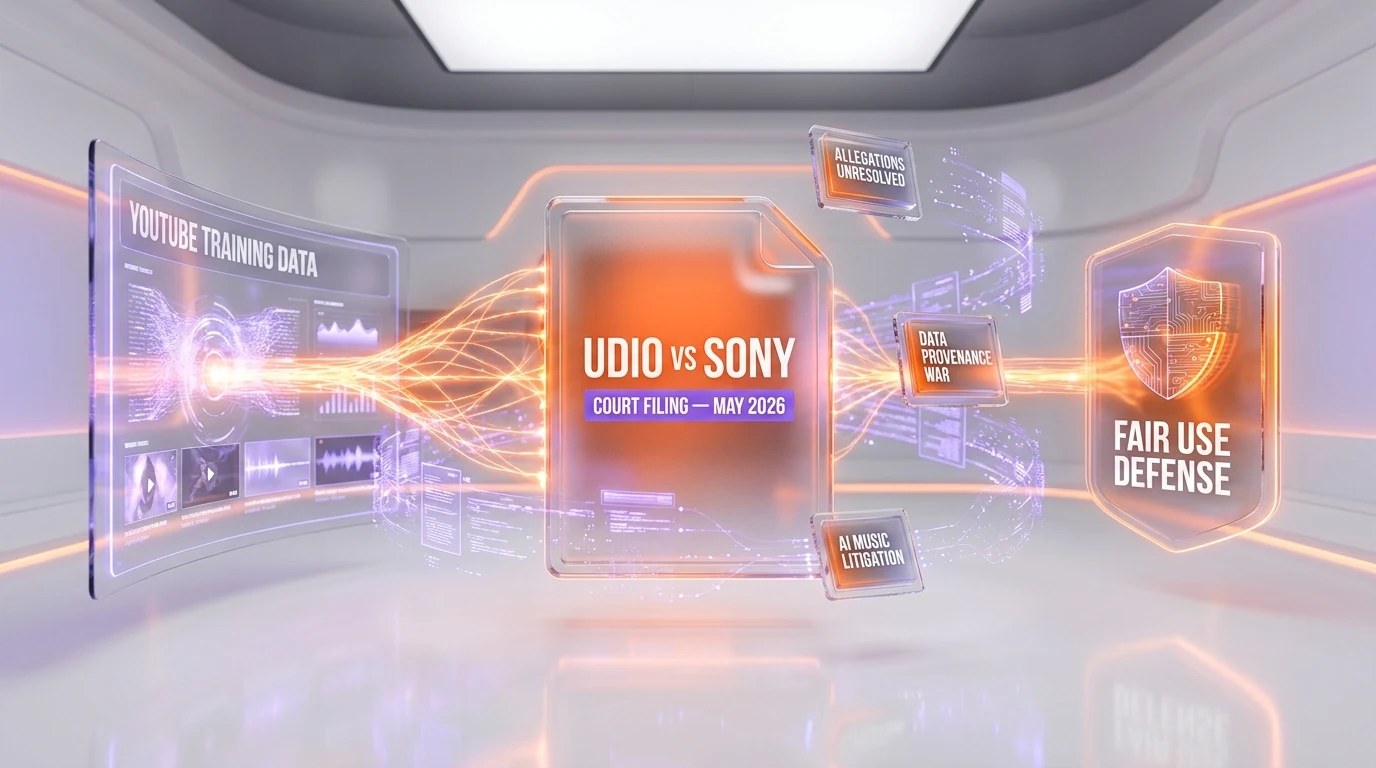
In a court filing in Sony Music v. Udio, AI music generator Udio acknowledged that some of its training data was obtained from YouTube, according to reporting by Music Ally and Digital Music News on May 6, 2026. Udio is defending the practice under a fair use theory. The disclosure surfaces during active copyright litigation against both Udio and rival Suno, brought by Universal Music Group and Sony Music. None of these allegations has been adjudicated — the fair use question is unresolved, and the cases remain at the discovery and motion stage as of mid-May 2026. The strategic story: data provenance, not just output similarity, is becoming the central front in the AI music copyright war.
What the Court Filing Actually Says
On May 6, 2026, Music Ally reported, in its AI roundup, that a court filing in Sony Music Entertainment v. Udio indicated Udio obtained at least some of its model training audio from YouTube. Digital Music News covered the same development. Our analysis here is based on those two trade-press accounts; we have not independently reviewed the underlying docket, and we treat the specifics as reported allegations and filing statements rather than established findings.
The key nuance matters. A filing acknowledgment that training data was sourced from a platform is not, by itself, a finding of infringement. It is a factual position entered into a litigation record — one that Udio is pairing with a legal defense. Udio's posture, as reported, leans on fair use: the argument that ingesting copyrighted recordings to train a generative model is a transformative, non-expressive use that should not require licenses. That theory is contested, untested at trial in this specific context, and the courts have not ruled on it here.
Why YouTube Sourcing Is a Distinct Problem
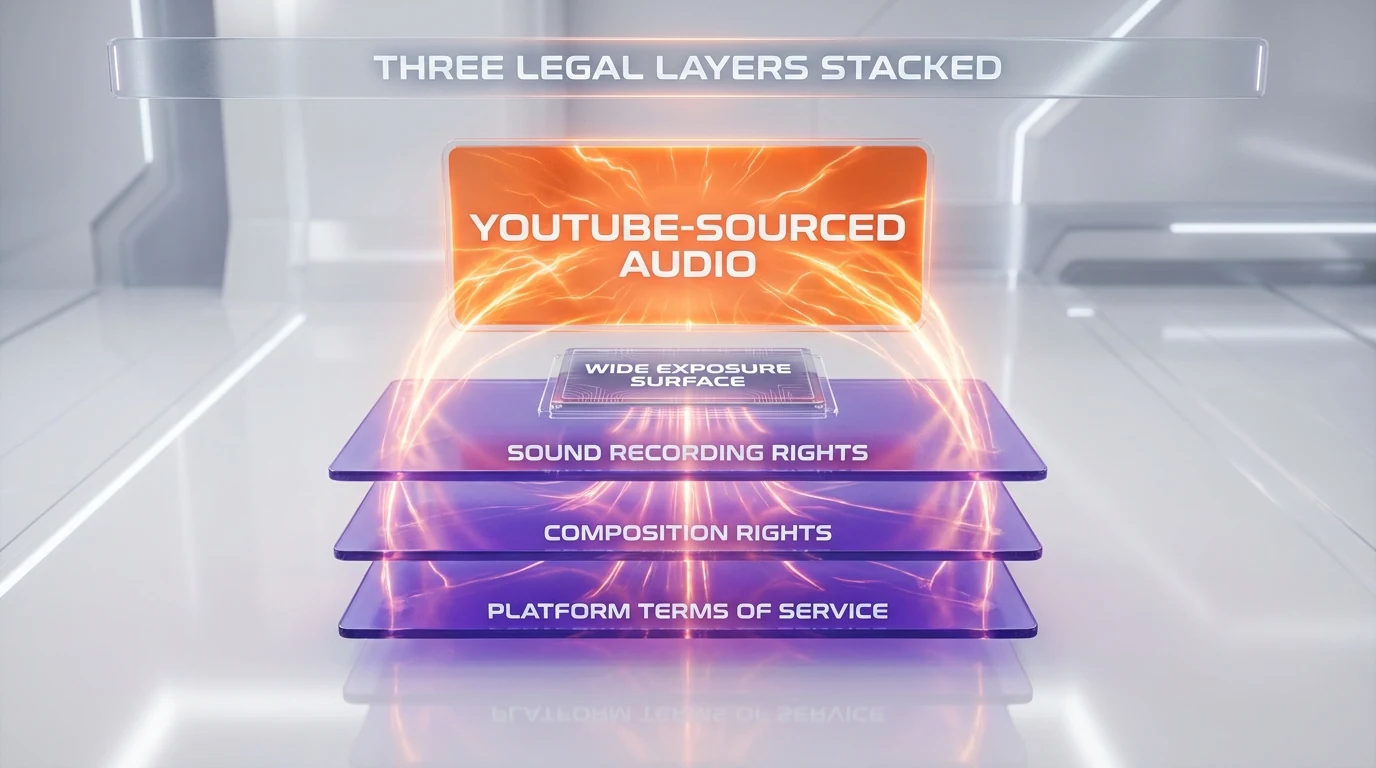
Training on audio scraped from YouTube raises a layered set of questions that go beyond the underlying sound recordings. YouTube's own Terms of Service restrict automated downloading of content. So a YouTube-sourced training pipeline potentially implicates three separate layers at once: the rights of the sound recording owners (the labels), the rights of musical composition owners (publishers and songwriters), and the platform's contractual terms governing access. Each layer is a distinct legal theory a plaintiff can press.
That stacking is what makes provenance disclosures consequential. A model trained on a clean, licensed corpus has a narrow exposure surface. A model trained on platform-scraped audio has a wide one — and once the sourcing is on the record, the litigation shifts from "did the output infringe" to "was the input lawful in the first place."
Allegations Versus Findings — The Honest Framing
It is worth being precise, because the copyright-AI discourse is full of premature verdicts. As of this writing, the court has not ruled that Udio infringed. It has not ruled on whether training on YouTube audio is fair use. The filing reflects Udio's own representations and the plaintiffs' claims inside an ongoing case. Treat everything downstream of that as a developing dispute, not a settled outcome. The interesting question for operators is not "who is guilty" but "what does this signal about where the legal risk now concentrates."
There is also a procedural reason to keep expectations calibrated. Provenance facts that surface at the filing and discovery stage are inputs to a long process, not endpoints. They get contested, contextualized, and sometimes recharacterized as the record develops. A single line in a court document acknowledging that some training audio came from a given platform can read very differently once it is set against the full corpus, the licensing arrangements that did exist, and the technical specifics of how the data was used in the training pipeline. Operators reading trade-press summaries — including this one — should hold the conclusion loosely and watch the docket, not the headlines.
The Fair Use Defense and What Is Genuinely at Stake
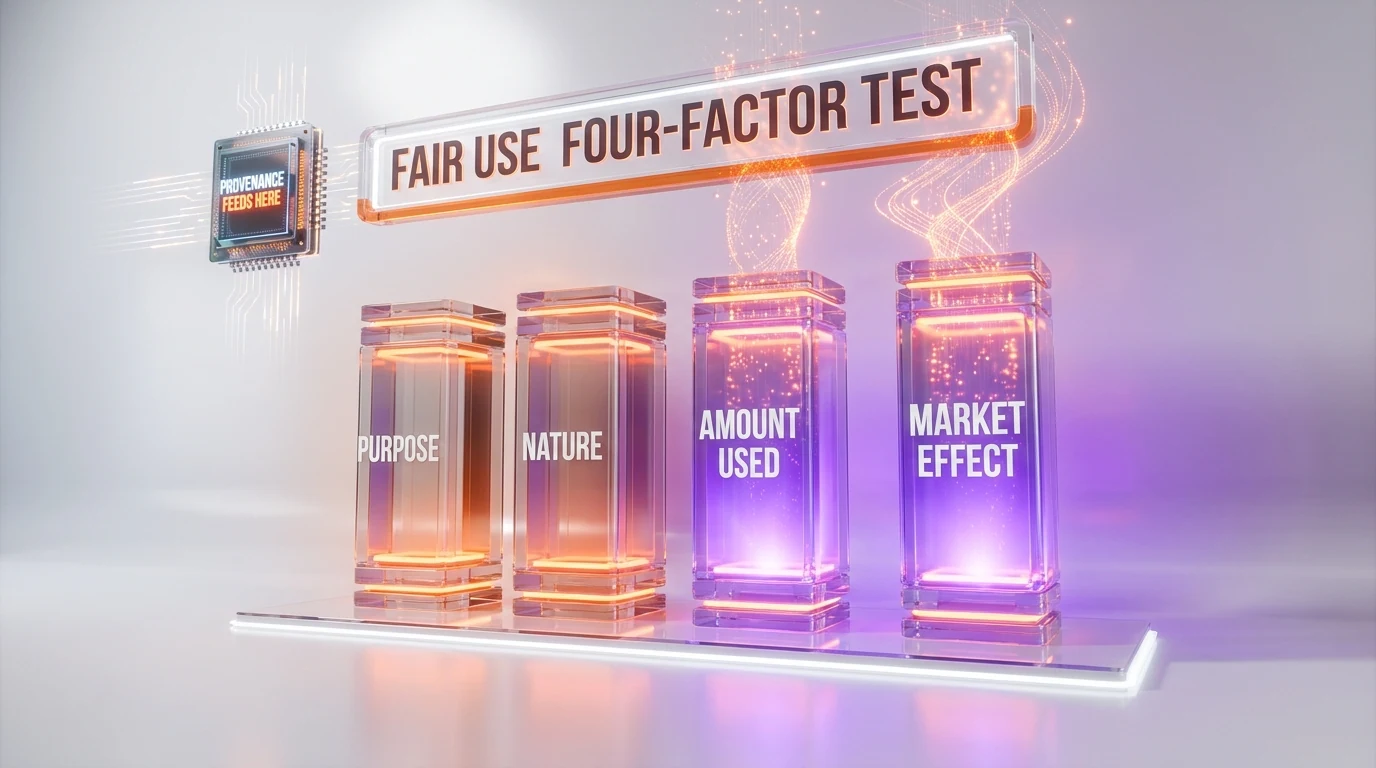
Fair use is the load-bearing pillar of nearly every generative-AI defense in the US, and AI music is no exception. The argument runs roughly as follows: training is an intermediate, non-expressive analytical step; the model learns statistical patterns rather than reproducing protected expression; and the resulting tool enables new creative output. Plaintiffs counter that music generators compete directly in the same market as the licensed recordings they ingested, that the use is commercial and non-transformative in the relevant sense, and that wholesale copying of entire catalogs is not excused by the eventual application.
The courts have not resolved this for music. The factual record — what was copied, how much, from where, and to what market effect — will drive the four-factor analysis. That is exactly why the YouTube-sourcing disclosure carries weight: it feeds directly into the "nature and amount of the work used" and "market effect" prongs that decide fair use outcomes.
The Bartz v. Anthropic Reference Point
The closest adjacent precedent operators keep citing is the Anthropic copyright settlement. We covered the mechanics in our analysis of the $1.5 billion Bartz v. Anthropic settlement and its final approval hearing. The relevant lesson there was not the headline number — it was the structural one: a court signaled that the legality of training can hinge heavily on how the training corpus was acquired, separating the acquisition question from the model-behavior question. That distinction maps almost perfectly onto the Udio situation, where the YouTube provenance issue is precisely an acquisition-channel question.
Why Music Is Harder Than Text
Music carries a heavier rights stack than most text corpora. A single recorded track typically bundles a sound recording copyright and a separate musical composition copyright, often held by different entities, with mechanical and performance rights layered on top. Text training disputes generally contend with one rights holder per work. Music training disputes contend with two or more per track, multiplied across catalogs of millions of recordings. The combinatorial exposure is structurally larger, which is part of why the major labels have been more aggressive and better resourced in this fight than book authors or news publishers.
The Suno and Udio Litigation Map
Udio and Suno are the two flagship general-purpose AI music generators, and both are in active litigation with the major labels. Universal Music Group and Sony Music are central plaintiffs across the matters. The cases are at the discovery and motion stage, where exactly this kind of provenance detail surfaces. The YouTube disclosure in Sony Music v. Udio is one data point in a much larger fact-finding process — and discovery in these cases is where the strategic damage, or vindication, gets built.
Suno's Parallel Discovery Fight
Suno is fighting a related battle over what its own discovery record reveals. We dug into the contractual disclosure dispute in our piece on Suno's effort to keep its Warner settlement terms shielded from UMG and Sony ahead of a summer fair-use ruling. The pattern across both companies is consistent: the labels are pressing hard on what data went in and what commercial arrangements exist, because those facts shape both liability and the eventual settlement leverage. Provenance is the wedge.
Where the Tools Stand
For readers tracking the products themselves rather than the docket, our standing reviews give the operational picture: Suno AI remains the dominant consumer-facing generator by usage, and ElevenMusic entered the arena as ElevenLabs' licensed-positioning entrant. The litigation status of each is now a material product consideration for any business building on top of these models — not a footnote.
The "Legally Clean" Repositioning Around ElevenLabs
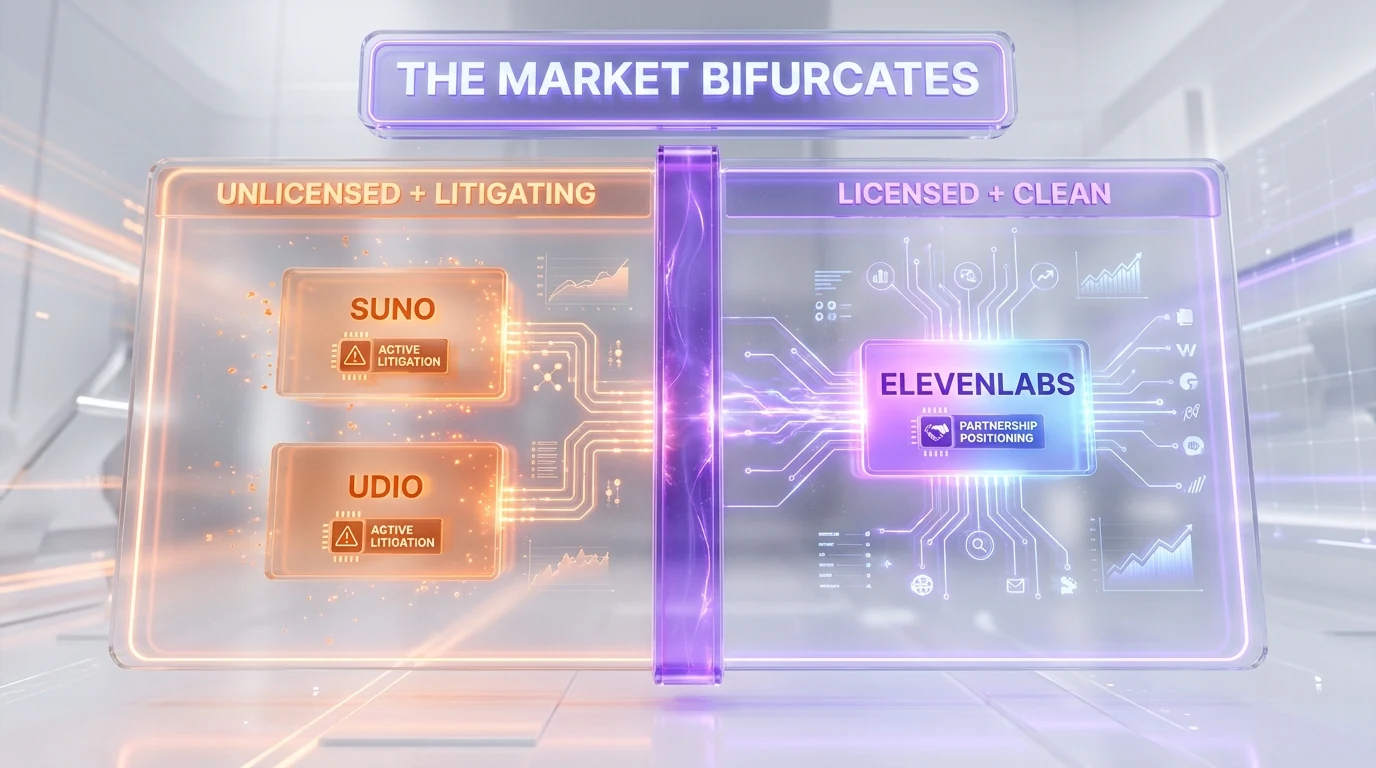
The strategic counter-move in this market is the deliberate repositioning of some players as licensed and provenance-clean. The contrast is being drawn sharply: Suno and Udio operate without comprehensive label licenses and are in active litigation, while ElevenLabs has positioned its music offering around partnership and licensing language. This is not an accident of branding — it is a market-structuring bet that enterprise and platform customers will pay a premium for litigation-insulated audio.
The Distributor Signal
One of the clearest signals of where the industry is heading came from the distribution layer. Believe and TuneCore moved to block Suno-generated tracks from their distribution pipeline while reportedly maintaining partnership relationships with ElevenLabs and Udio. The takeaway for operators: distributors are starting to make provenance-based gatekeeping decisions, and a track's training-data lineage is becoming a distribution eligibility factor, not just a legal abstraction. That is the moment a courtroom question becomes a commercial one.
How the Products Compare on Risk
For a side-by-side on the consumer products themselves, our ElevenMusic vs Suno AI comparison breaks down the feature and positioning differences. The litigation overlay changes the calculus: a tool's raw output quality is now only one axis. The second axis — and increasingly the decisive one for any commercial deployment — is whether the underlying model's training provenance can survive scrutiny if a customer's use is ever challenged downstream.
Data Provenance Is the New Battlefield
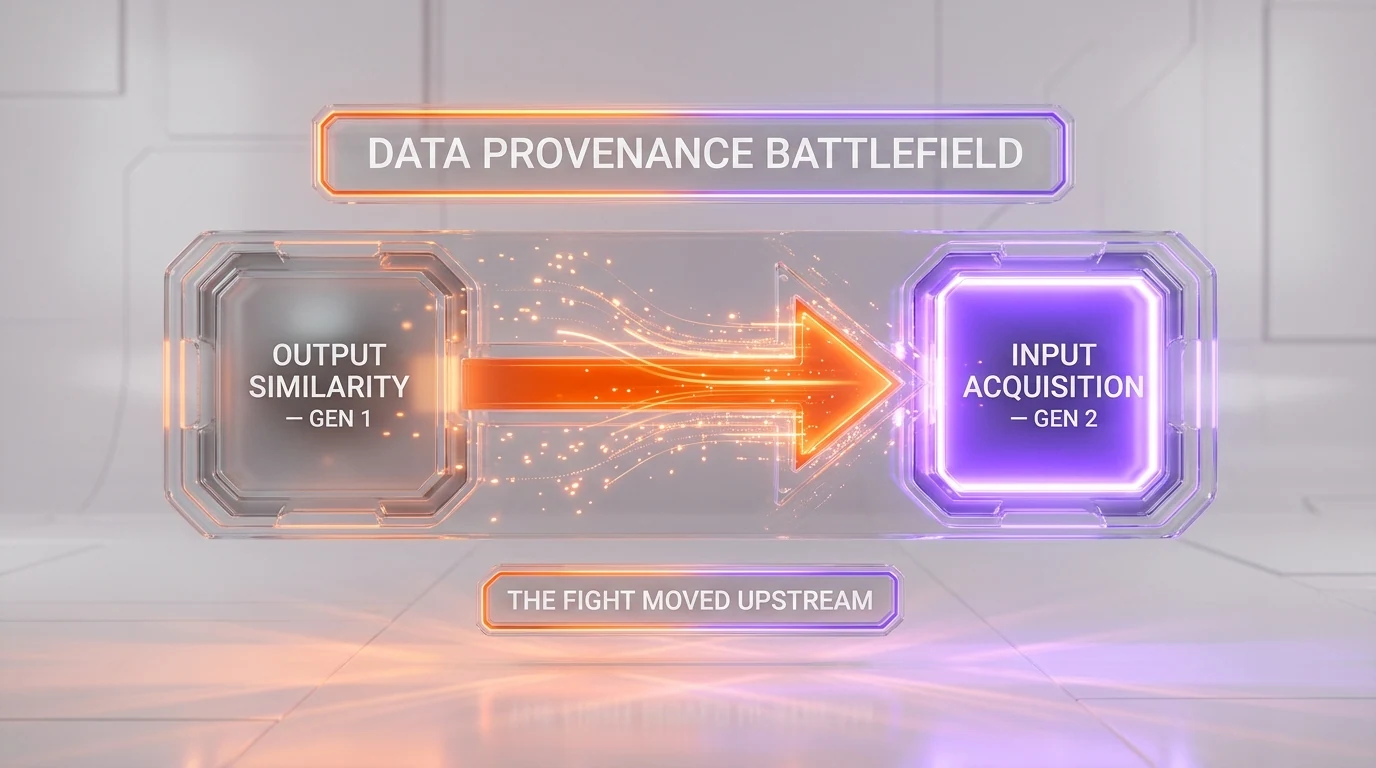
The throughline across Udio, Suno, Anthropic, and the distributor moves is a single strategic shift: the fight has migrated from output to input. For the first generation of generative-AI disputes, the central question was whether a model's output reproduced protected expression. The Udio YouTube disclosure crystallizes the second-generation question — whether the model's input was lawfully acquired in the first place, independent of what the output looks like.
Why This Shift Favors Well-Resourced Plaintiffs
Provenance disputes are discovery-intensive. They reward plaintiffs who can fund prolonged fact-finding into data pipelines, scraping logs, and acquisition channels. The major labels are exactly that kind of plaintiff: deep-pocketed, repeat players with strong incentives to set precedent. That asymmetry shapes strategy. It pushes well-capitalized AI companies toward licensing deals as a risk-retirement mechanism rather than litigating fair use to a verdict, and it pushes under-capitalized ones toward existential exposure.
The settlement gravity matters here. When the dominant resolution path in a category becomes a negotiated license or a paid settlement rather than a clean fair use victory, the strategic value of having paid for licenses early compounds. A company that pre-licensed converts a known, bounded cost into a defensible market position. A company that bet on fair use and lost the bet at the acquisition layer faces an unbounded, retroactive cost plus the reputational drag of being the litigated option in every enterprise procurement conversation. That is the asymmetry the labels are leveraging, and it is why the provenance disclosure is strategically louder than its legal weight today.
What This Means for Builders and Operators
For anyone building on top of AI music models, the practical implication is concrete. Provenance is now a procurement question. Before integrating a generative-audio model into a product, the relevant diligence is no longer just "is the output good and is it cheap" — it is "what is the training-data lineage, is the vendor in active litigation, and what is the indemnification posture if a downstream use is challenged." The market is splitting into a litigated tier and a licensed tier, and that split will increasingly determine which models are safe to build a business on.
What Would Change This Analysis
This read could shift on three triggers. First, a court ruling squarely upholding training-stage fair use for music would substantially de-risk the unlicensed tier and weaken the licensed-premium thesis. Second, a comprehensive licensing settlement between the labels and Suno or Udio would collapse the bifurcation by bringing the litigated tier into the licensed tier. Third, a definitive ruling that platform-scraped acquisition is independently unlawful regardless of fair use would harden the provenance battlefield into the dominant axis permanently. As of mid-May 2026, none of these has occurred, and the dispute remains genuinely open.
The Enterprise Procurement Angle
The group most exposed to this shift is not the AI music companies themselves — it is the businesses building products on top of them. A studio, game developer, advertising agency, or platform that embeds generative audio inherits a slice of the upstream provenance question whenever it ships that audio commercially. Until recently, that risk was abstract enough to ignore. The Udio disclosure, combined with the distributor gatekeeping moves, makes it concrete enough to put in a procurement checklist.
What Diligence Now Looks Like
Practical diligence on a generative-audio vendor now spans three questions that did not exist eighteen months ago. First, what is the documented training-data lineage, and can the vendor attest to it contractually rather than verbally. Second, is the vendor currently named in active copyright litigation, and what is the realistic range of outcomes. Third, what indemnification does the vendor offer if a customer's downstream commercial use is challenged — and is that indemnity capped, conditional, or effectively hollow given the vendor's balance sheet. A model that scores highest on raw audio quality can still be the wrong choice if it fails all three.
Why the Licensed Tier Can Charge a Premium
This is the mechanism that lets a licensed-positioned offering sustain a higher price. Enterprise buyers are not paying purely for output fidelity — they are paying to move the provenance risk off their own balance sheet and onto a vendor that can credibly absorb it. That is a defensible moat precisely because it is hard to retrofit: a model already trained on contested data cannot un-train, and a company already named in litigation cannot un-name itself. The licensed tier's advantage is structural, not cosmetic, and that is why the bifurcation is likely to widen rather than collapse absent a decisive court ruling.
Our Take
Our analysis: the Udio YouTube disclosure is less important for what it proves — it proves nothing yet, the case is unresolved — and more important for what it signals. It confirms that the operative legal question in AI music has moved upstream, from the audible output to the acquisition channel. Companies that built models on platform-scraped audio under a fair use bet are now carrying that bet on the litigation record, where it is visible, discoverable, and durable. Companies that paid for licenses are converting that cost into a positioning moat. Whichever way the courts eventually rule, the market has already started pricing provenance — and that repricing is happening faster than any verdict will.
What's Next
Watch three things over the coming months. The discovery timeline in Sony Music v. Udio and the parallel Suno matters, where additional provenance facts will surface. Any motion-stage ruling that touches the fair use question for music specifically, which would be the first real signal on the core legal theory. And the distribution layer — whether more distributors and platforms follow Believe and TuneCore in making provenance-based eligibility decisions, which would convert the legal question into a permanent commercial filter regardless of how the litigation ends.
Editorial Disclosure
This is an analysis piece based on trade-press reporting from Music Ally and Digital Music News as of May 6, 2026, and on publicly reported litigation developments. ThePlanetTools.ai has no financial relationship with Udio, Suno, ElevenLabs, Universal Music Group, Sony Music, Believe, or TuneCore relevant to this article. All litigation characterizations reflect reported allegations and filing positions, not adjudicated findings. None of the parties has been found liable, and the fair use questions discussed remain legally unresolved.
Frequently Asked Questions
Did Udio admit to using YouTube data for training?
According to Music Ally and Digital Music News reporting on May 6, 2026, a court filing in Sony Music v. Udio indicated that Udio obtained at least some of its training audio from YouTube. This is a reported filing position within active litigation, not an adjudicated finding. Udio is defending the practice under a fair use theory, and no court has ruled on whether the practice was lawful.
What is Sony Music v. Udio about?
It is part of the broader copyright litigation brought by major labels, including Universal Music Group and Sony Music, against AI music generators Udio and Suno. The core dispute is whether training generative music models on copyrighted recordings without licenses is lawful. As of mid-May 2026 the cases are at the discovery and motion stage, and the central fair use question is unresolved.
What is Udio's fair use defense?
Udio argues, as reported, that ingesting copyrighted recordings to train a generative model is a transformative, non-expressive use that should not require licenses. Plaintiffs counter that the use is commercial, competes in the same market as the licensed recordings, and involves wholesale copying. The four-factor fair use analysis for AI music training has not been resolved by any court.
Why does YouTube-sourced training data matter legally?
Training on YouTube-scraped audio can implicate three distinct layers at once: sound recording rights held by labels, musical composition rights held by publishers and songwriters, and YouTube's own Terms of Service restricting automated downloading. Each layer is a separate legal theory a plaintiff can press, which widens the exposure surface compared to a licensed training corpus.
How does this relate to the Bartz v. Anthropic settlement?
The Bartz v. Anthropic settlement signaled that the legality of training can hinge heavily on how the training corpus was acquired, separating the acquisition question from the model-behavior question. That distinction maps onto the Udio situation, where the YouTube provenance issue is precisely an acquisition-channel question rather than an output-similarity question.
Are Suno and Udio licensed by the major labels?
As of mid-May 2026, Suno and Udio operate without comprehensive major-label licenses and are in active litigation with Universal Music Group and Sony Music. By contrast, ElevenLabs has positioned its music offering around partnership and licensing language. The market is bifurcating into an unlicensed-and-litigating tier and a licensed-and-clean tier.
Did Believe and TuneCore block Suno tracks?
Believe and TuneCore moved to block Suno-generated tracks from their distribution pipeline while reportedly maintaining partnership relationships with ElevenLabs and Udio. This indicates distributors are beginning to make provenance-based gatekeeping decisions, turning a track's training-data lineage into a distribution eligibility factor rather than a purely legal abstraction.
Why is AI music copyright harder than AI text copyright?
A single recorded track typically bundles a sound recording copyright and a separate musical composition copyright, often held by different entities, with mechanical and performance rights layered on top. Text training disputes generally contend with one rights holder per work. Music disputes contend with two or more per track across catalogs of millions of recordings, producing structurally larger combinatorial exposure.
Has any court ruled that Udio infringed copyright?
No. As of mid-May 2026, no court has ruled that Udio infringed, and no court has ruled on whether training on YouTube audio qualifies as fair use. The reported filing reflects Udio's own representations and the plaintiffs' claims inside an ongoing case. The dispute should be treated as developing, not settled.
What does "data provenance" mean in this context?
Data provenance refers to the origin and acquisition channel of a model's training data — what was used, from where, and under what terms. The Udio disclosure crystallizes a shift in AI music litigation from output-similarity questions to input-acquisition questions: whether the training data was lawfully obtained in the first place, independent of what the model's output looks like.
What should businesses building on AI music models do now?
Treat provenance as a procurement question. Before integrating a generative-audio model, assess the training-data lineage, whether the vendor is in active litigation, and the indemnification posture if a downstream use is challenged. The market is splitting into a litigated tier and a licensed tier, and that split increasingly determines which models are safe to build a commercial product on.
What would change this analysis?
Three triggers. A court ruling upholding training-stage fair use for music would de-risk the unlicensed tier. A comprehensive licensing settlement between the labels and Suno or Udio would collapse the bifurcation. A definitive ruling that platform-scraped acquisition is independently unlawful regardless of fair use would harden provenance into the permanent dominant axis. As of mid-May 2026, none of these has occurred.
Sources: Music Ally — AI roundup, May 6, 2026 · Digital Music News — Suno / Warner discovery, May 11, 2026. This article reflects reported litigation developments and editorial analysis; characterizations of court filings are reported allegations and positions, not adjudicated findings.