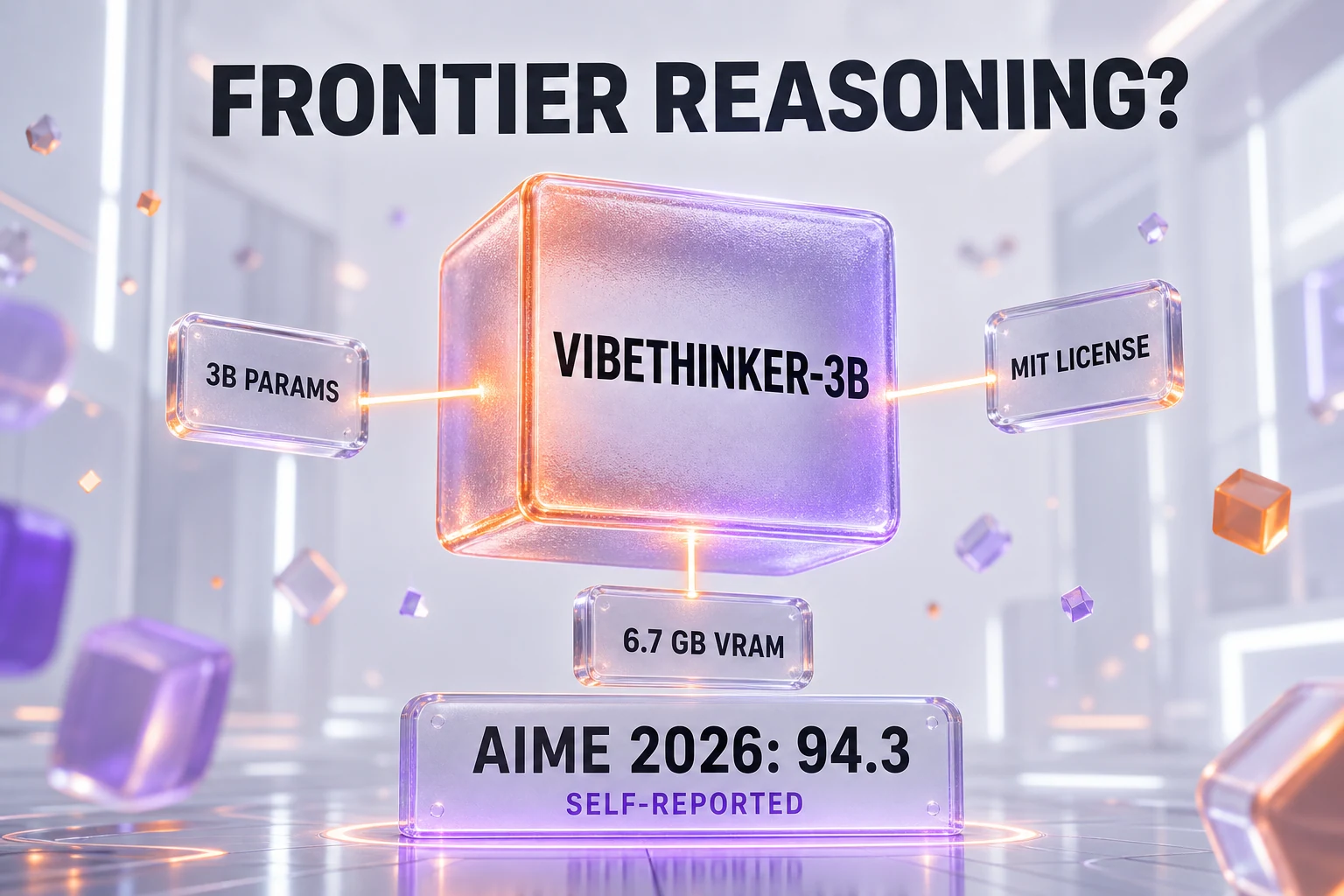
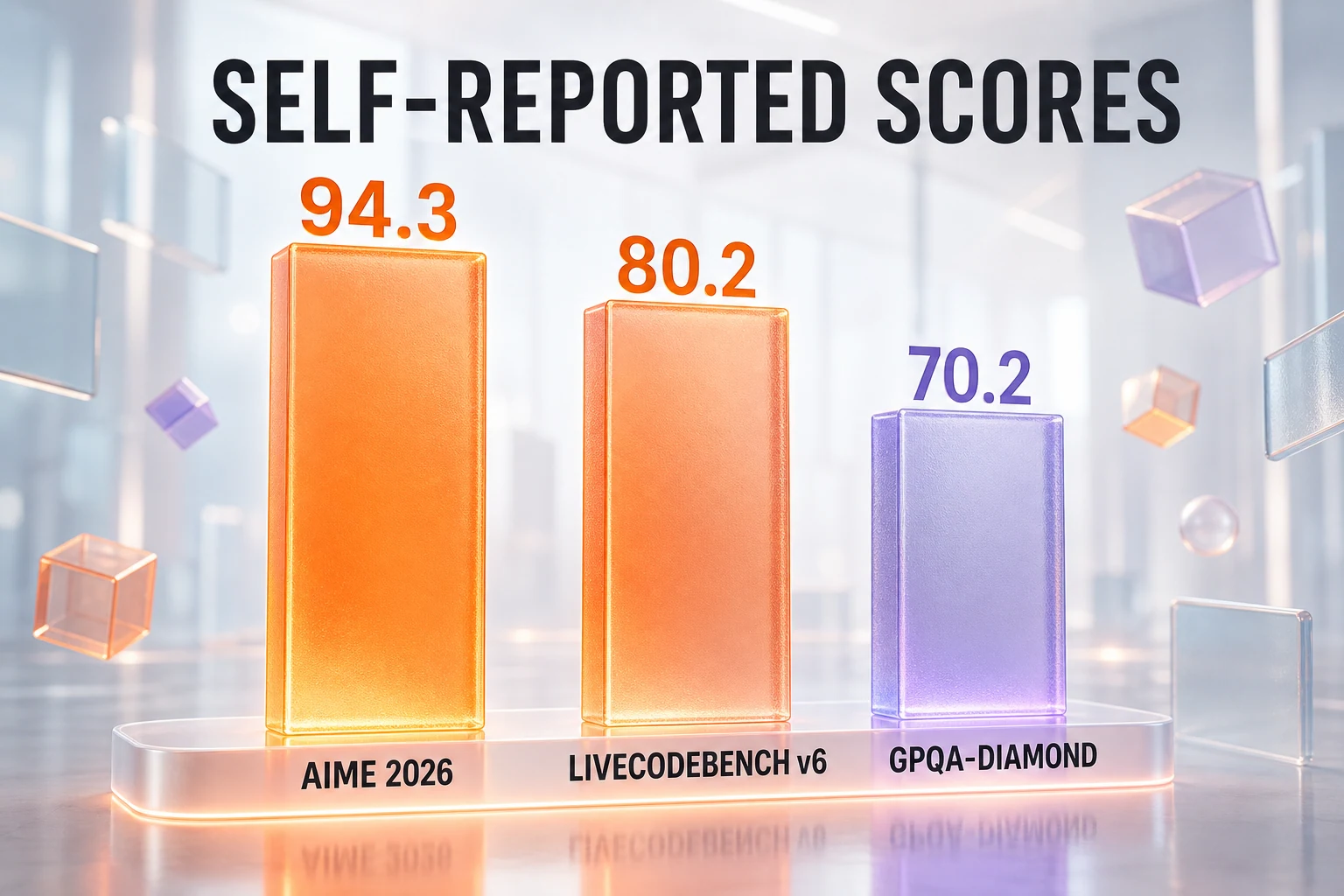
VibeThinker-3B is a 3.1-billion-parameter open-weight reasoning model from Weibo AI (Sina Weibo), released under an MIT license and fine-tuned from Alibaba's Qwen2.5-Coder-3B. It fits in roughly 6.7 GB of VRAM and runs on a single consumer GPU. Its technical report claims a 94.3 score on AIME 2026 and 80.2 Pass@1 on LiveCodeBench v6 — numbers in the range of models hundreds of times larger. The catch: those scores are self-reported, not verified by an independent lab, and the same model scores just 70.2 on the GPQA-Diamond knowledge test. VibeThinker-3B is best read as a verifiable-reasoning specialist, not a general-purpose model.
What Happened
On June 17, 2026, nine researchers at Sina Weibo Inc. published a technical report and model weights for VibeThinker-3B, a dense 3.1-billion-parameter language model. The headline claim is striking: a model small enough to run on a single gaming GPU reportedly matches the verifiable-reasoning performance of flagship systems from DeepSeek, Google, and others that carry hundreds of billions — or trillions — of parameters.
The model is post-trained on top of Alibaba's Qwen family — specifically Qwen2.5-Coder-3B — and shipped under a permissive MIT license on Hugging Face and GitHub. In plain terms: the weights are free to download, free to fine-tune, and free to deploy commercially. That combination of a tiny footprint and an unrestricted license is what turned an otherwise routine research paper into one of the most-debated AI releases of the month.
Here are the numbers Weibo AI put on the table, exactly as the report frames them:
| Benchmark | VibeThinker-3B (self-reported) | What it measures |
|---|---|---|
| AIME 2026 | 94.3 (97.1 with test-time scaling) | Hard competition mathematics |
| LiveCodeBench v6 | 80.2 Pass@1 | Competitive programming |
| LeetCode (recent contests) | 123 of 128 solved (96.1% acceptance) | Unseen coding contests, Apr–May 2026 |
| IFEval | 93.4 | Instruction following |
| IMO-AnswerBench | 76.4 (80.6 with test-time scaling) | Olympiad-level math answers |
| GPQA-Diamond | 70.2 | Graduate-level general science knowledge |
For context on the math claim: Weibo AI says VibeThinker-3B's 94.3 on AIME 2026 sits alongside DeepSeek V3.2 (671 billion parameters) and ahead of Gemini 3 Pro's reported 91.7 — while the VibeThinker weights are smaller than DeepSeek's by more than two orders of magnitude. That is the entire reason the release went viral. It is also exactly where a careful reader should slow down.
The Numbers Come With an Asterisk
Every benchmark figure above carries the same label: self-reported. They come from the authors' own technical report (arXiv 2606.16140), measured on their own evaluation harness, with their own decoding settings. No independent evaluation lab has reproduced them at the time of writing. That is not an accusation — it is simply the status of the data, and it is the single most important thing to understand before quoting "a 3B model beats DeepSeek" anywhere.
This matters because benchmark scores are not objective constants. The same model, on the same test, can swing several points depending on prompt formatting, the number of samples averaged, the maximum token budget, and whether "test-time scaling" (running the model multiple times and selecting the best answer) is switched on. VibeThinker-3B's own headline already shows this: 94.3 jumps to 97.1 on AIME 2026 once test-time scaling is enabled. Those are two very different numbers describing two very different deployment scenarios, and only one of them reflects a single, cheap forward pass.
How to Actually Read a Benchmark Fight
When a small model claims to beat a giant one, four questions separate a real result from a headline. We apply them to VibeThinker-3B below, but they work for any model launch.
1. Who measured it? Self-reported scores from a vendor or research team are a hypothesis, not a verdict. They become trustworthy when an independent party — an evaluation lab, a third-party leaderboard, or a critical mass of practitioners running the public weights — reproduces them. VibeThinker-3B is open-weight and MIT-licensed, which is the best possible setup for independent verification. But that verification has not happened yet. Treat the numbers as "claimed pending replication."
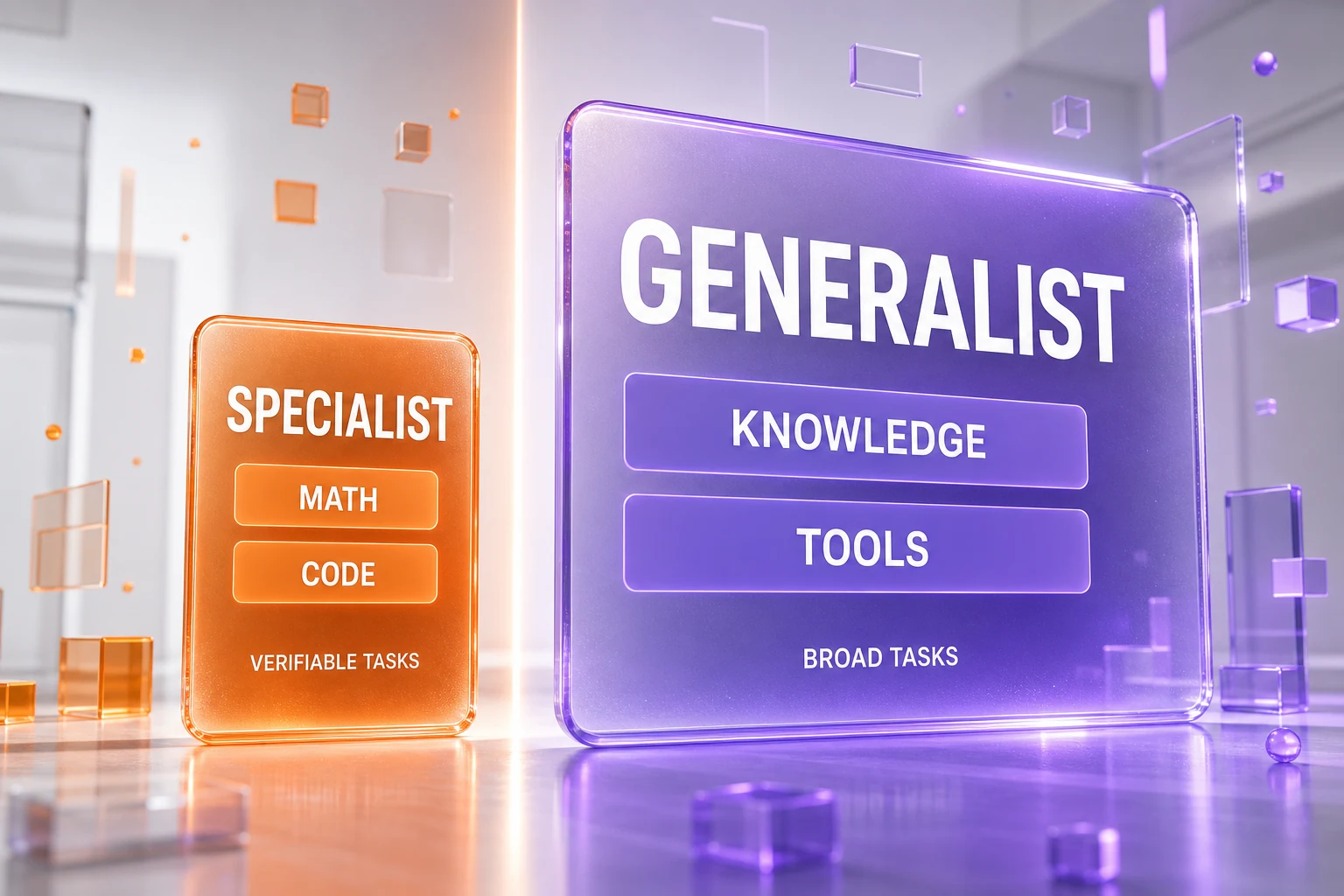
2. What exactly was tested? "Reasoning" is not one skill. AIME and LiveCodeBench measure verifiable reasoning: problems with a single checkable answer where the model can be trained hard against a clear reward signal. GPQA-Diamond measures something different — broad graduate-level knowledge across science. A model can be excellent at the first and mediocre at the second, which is precisely the VibeThinker pattern.
3. Were the settings comparable? A score with test-time scaling enabled should never be compared head-to-head against a competitor's single-pass score. They cost different amounts of compute. When you see a model "matching" a flagship, check whether both numbers were produced under the same rules. VibeThinker's report is reasonably transparent here — it labels its scaled scores — but downstream coverage often drops the asterisk.
4. Does the benchmark resemble your work? AIME problems and LeetCode contests are clean, self-contained, and verifiable. Most real-world tasks are not. If your workflow involves tool calls, long documents, ambiguous instructions, or open-ended knowledge, a high AIME score tells you very little. The Weibo team is explicit that VibeThinker-3B "was not trained on tool-calling or agent-based programming data" — so an agentic coding workflow is outside its design envelope, no matter how good the contest scores look.
The Specialist Trap: Reasoning Is Not General Knowledge
The clearest signal in VibeThinker-3B's own results is the gap between its math-and-code scores and its knowledge score. On GPQA-Diamond it scores 70.2. Gemini 3 Pro scores 91.9 on the same test, and Claude Opus 4.5 scores 87.0. That is a 17-to-22 point gap on broad scientific knowledge — a chasm, in benchmark terms.
This is not a flaw the team hid; it is a direct consequence of the design. A 3.1-billion-parameter model simply cannot store the breadth of world knowledge that a 671-billion or trillion-parameter model holds. What it can do — and what the Spectrum-to-Signal training pipeline optimizes for — is convert a narrow, verifiable problem into a long, correct chain of reasoning. The model "thinks" its way to checkable answers in math and code rather than recalling facts about everything.
So the honest framing is: VibeThinker-3B is a verifiable-reasoning specialist. Ask it to solve a competition math problem or pass a coding contest and it punches far above its weight. Ask it a graduate-level biology question, expect it to call a tool, or hand it an ambiguous real-world brief, and a much larger general-purpose model will outclass it. Both statements are true at the same time, and any coverage that reports only the first half is selling a distortion.
Why a 3B Model Still Matters
Strip away the "beats DeepSeek" headline and a more durable story remains. If even a fraction of the verifiable-reasoning claim holds up under independent testing, VibeThinker-3B is a meaningful data point about efficiency. A model that fits in 6.7 GB of VRAM can run on a single mid-range consumer GPU, locally, with no API bill and no data leaving the machine. For verifiable tasks — generating and checking math solutions, drafting and testing code against unit tests, STEM tutoring with a clear answer key — that economics is hard to ignore.
The MIT license amplifies this. Unlike weights released under restrictive community licenses, MIT permits unrestricted commercial use, modification, and redistribution. A startup can fine-tune VibeThinker-3B on its own domain, ship it inside a product, and owe nothing. This is the same dynamic that made earlier small open-weight models from the broader Chinese and US ecosystems — covered in our pieces on NVIDIA Nemotron 3 Ultra and GLM-5.2 and Kimi K2.7 Code — strategically important well beyond their raw benchmark lines.
There is also a research signal worth separating from the hype. The team's stated method — the "Spectrum-to-Signal Principle," a multi-stage post-training recipe of curriculum supervised fine-tuning, multi-domain reasoning reinforcement learning, and offline self-distillation — is the kind of approach that, if it generalizes, could push the reasoning frontier of small models broadly. The weights are public, so the field can test that claim directly. That is the most valuable thing about an open release: it converts a marketing assertion into a falsifiable experiment.
Who Should Care — And Who Shouldn't
VibeThinker-3B is worth a serious look if you are building or running verifiable-reasoning workloads on constrained hardware: a developer who wants a local model to generate and check code against tests, an educator building a math-tutoring tool with a known answer key, or a researcher studying small-model reasoning who values an MIT-licensed, fully open baseline. For these users, the combination of footprint, license, and claimed math-and-code performance is genuinely attractive — with the standard caveat that you should benchmark it on your own tasks before trusting any single number.
It is the wrong tool if you need broad general knowledge, conversational breadth, reliable tool-calling, or agentic coding across a large repository. The GPQA-Diamond gap and the team's own "no tool-calling training" disclosure both point the same way. For those workloads, a larger general-purpose model — open-weight or proprietary — remains the right call, and the 3B model's contest scores are a poor proxy for how it will behave.
The Bottom Line
VibeThinker-3B is a real and interesting release wrapped in a headline that asks to be taken too literally. The defensible reading is narrow but solid: a 3.1B open-weight, MIT-licensed model that self-reports frontier-range scores on verifiable math and code, runs on a single consumer GPU, and is weak on general knowledge by design. The indefensible reading — "a tiny model just beat the giants at everything" — collapses the moment you separate verifiable reasoning from general capability, and self-reported numbers from independent ones.
The right move is patience. The weights are open, the license is permissive, and the claims are specific enough to be tested. Within weeks, independent runs on the public model will tell us how much of the 94.3 survives contact with someone else's harness. Until then, the most useful thing anyone can do is hold two ideas at once: VibeThinker-3B is an impressive efficiency result, and it is not a replacement for the large models it is being compared to. Read the benchmark fight that way and you will not be fooled by either the hype or the backlash.
Frequently Asked Questions
What is VibeThinker-3B?
VibeThinker-3B is a 3.1-billion-parameter open-weight reasoning model released by Weibo AI (Sina Weibo Inc.) in June 2026 under an MIT license. It is fine-tuned from Alibaba's Qwen2.5-Coder-3B, fits in roughly 6.7 GB of VRAM, and runs on a single consumer GPU. Its technical report (arXiv 2606.16140) targets verifiable reasoning — competition math and competitive programming — rather than general-purpose chat or knowledge.
Are VibeThinker-3B's benchmark scores reliable?
They are self-reported. Scores such as 94.3 on AIME 2026, 80.2 Pass@1 on LiveCodeBench v6, and 96.1% LeetCode acceptance come from the authors' own technical report and evaluation harness, not from an independent lab. Because the weights are open and MIT-licensed, third parties can reproduce them — but at the time of writing that independent verification has not happened. Treat the numbers as claimed pending replication, and note that some figures (97.1 on AIME 2026) require test-time scaling, which costs more compute than a single pass.
Can VibeThinker-3B replace a large model like DeepSeek or Gemini?
No, not as a general replacement. VibeThinker-3B is a verifiable-reasoning specialist. It claims frontier-range scores on math and coding contests, but it scores only 70.2 on GPQA-Diamond — far behind Gemini 3 Pro (91.9) and Claude Opus 4.5 (87.0) on graduate-level general knowledge. It also was not trained on tool-calling or agent-based programming. For broad knowledge, conversation, tool use, or agentic coding, a larger general-purpose model is still the better choice.
What license is VibeThinker-3B released under?
VibeThinker-3B is released under the MIT license, with full weights and code available on Hugging Face (WeiboAI/VibeThinker-3B) and GitHub. MIT is highly permissive: it allows unrestricted commercial use, modification, fine-tuning, and redistribution. That makes it one of the freest options among recent reasoning models, with no usage caps or restrictive community-license clauses.
What hardware does VibeThinker-3B need to run?
The weights are roughly 6.7 GB in BF16, so VibeThinker-3B runs on a single consumer GPU with about 8 GB of VRAM or more — for example a mainstream gaming card. This local, no-API footprint is a core part of its appeal for verifiable-reasoning tasks, since inference can run on-device with no per-token cost and no data leaving the machine.
How does VibeThinker-3B compare to DeepSeek V3.2 on AIME 2026?
On its own self-reported AIME 2026 result, VibeThinker-3B scores 94.3 — which the Weibo AI report places alongside DeepSeek V3.2 (a 671-billion-parameter model) and ahead of Gemini 3 Pro's reported 91.7. The headline comparison is parameter efficiency on one verifiable math benchmark, not overall capability. DeepSeek V3.2 remains a far broader general-purpose model; the AIME parity, if it survives independent testing, speaks to focused reasoning, not equivalence across all tasks.
Why is VibeThinker-3B weak on general knowledge?
Because of its size. A 3.1-billion-parameter model cannot store the breadth of world knowledge held by models hundreds of times larger, which is why it scores just 70.2 on the GPQA-Diamond science-knowledge test. Its training (the "Spectrum-to-Signal Principle" pipeline) optimizes for generating long, correct chains of reasoning on verifiable problems rather than recalling broad facts. The knowledge weakness is a design trade-off, not a bug.
What does "self-reported versus independent" mean for a model benchmark?
Self-reported scores are published by the model's own creators, measured on their own setup. Independent scores are reproduced by an outside party — an evaluation lab, a third-party leaderboard, or many practitioners running the public weights. Self-reported numbers are a starting hypothesis; independent reproduction is what turns them into a trusted result. For VibeThinker-3B, the open MIT weights make independent verification possible, but until it happens the scores should be cited with the "self-reported" label attached.