Cursor vs Windsurf: Which AI IDE Should You Use in 2026?


Both $20/mo. Cursor has Supermaven + background agents. Windsurf has 40+ IDEs + FedRAMP + 13x faster model. Coded the same project in both.
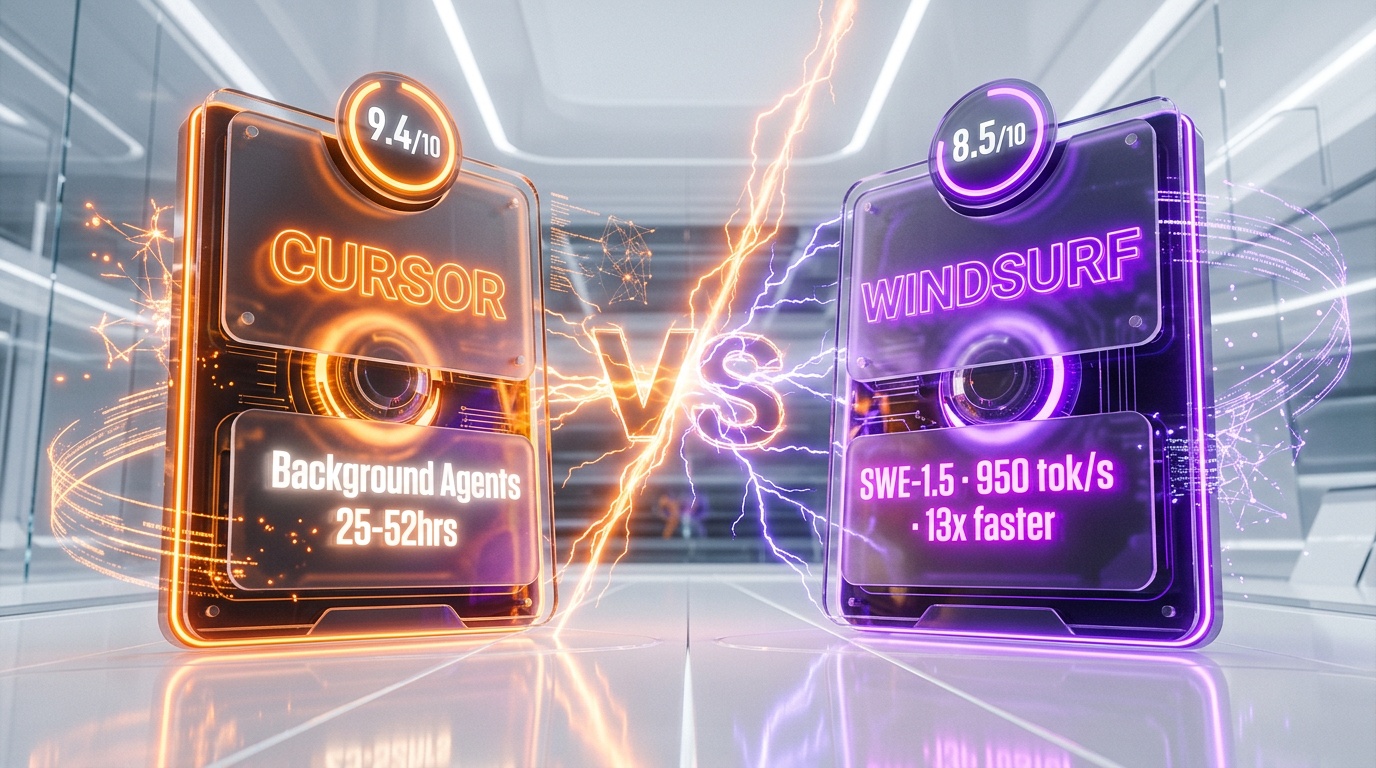
Feature Comparison
| Feature | Cursor | Windsurf |
|---|---|---|
| Pro Plan Price | $20 per month | $20 per month (raised from $15 on March 19, 2026) |
| Top Individual Plan | Ultra at $200 per month — 20x usage | Max at $200 per month — Heavy usage |
| Team Price | $40 per user per month | $40 per user per month |
| Enterprise Pricing | Custom (sales contact required) | Custom (sales contact required) |
| Proprietary Model — Quality | Composer 2 — 73.7 on SWE-Bench Multilingual (March 27, 2026) | SWE-1.5 — 40.08 on SWE-Bench (October 28, 2025) |
| Proprietary Model — Speed | Composer 2 — 200 tokens per second | SWE-1.5 — 950 tokens per second (~5x faster) |
| Third-Party Models | Claude Opus 4.6, GPT-5.4, Gemini 3 Pro, Grok Code, Auto-routing | Claude Opus 4.6, GPT-5.4, Gemini, plus SWE-1.5 |
| Background Agents (parallel) | Yes — multiple agents in sandboxed parallel execution, autonomous PR creation | Cascade Code mode — autonomous, but no parallel multi-agent launcher |
| Long-Running Agents | 25-52+ hours autonomous, 151,000+ lines of code in single PRs documented | Cascade with Memories — multi-step terminal + file tasks, no published runtime ceiling |
| IDE Compatibility | VS Code fork (native) + JetBrains via ACP (March 2026) | Standalone IDE + 40+ plugins (JetBrains, Vim, NeoVim, Xcode, Eclipse) |
| Plugin Marketplace | Yes — Figma, Linear, Stripe, AWS launch partners (February 2026) | Inherits VS Code extensions; no proprietary marketplace |
| Model Evaluation Tooling | Auto mode — silent routing to best-fit model | Arena Mode — blind side-by-side model comparison (Wave 14, January 2026) |
| Enterprise Adoption | 40,000 NVIDIA engineers daily; ~20,000 Salesforce devs; Midjourney, Perplexity, Shopify, Samsung; $1B ARR | 350+ enterprise customers at acquisition; $82M ARR (July 2025); enterprise revenue doubling QoQ |
| Corporate Stability | Anysphere — independent, $29.3B valuation Feb 2026, no founder churn | Cognition-owned — CEO + R&D founders left to Google in $2.4B side deal |
| Community Ratings (Trustpilot) | Stable, no major sentiment shift | Polarized post-March 19, 2026 quota change — 1-star spike |
Pricing Comparison
Cursor
Windsurf
Detailed Comparison
Cursor vs Windsurf 2026: Cursor is an AI-first VS Code fork by Anysphere with the new Composer 2 model (73.7 on SWE-Bench Multilingual at 200 tokens per second). Windsurf is a Cognition-owned AI IDE with proprietary SWE-1.5 (950 tokens per second, 40.08 on SWE-Bench). Both Pro plans cost $20 per month. Cursor wins on code quality and enterprise scale (40K NVIDIA engineers, $1B ARR). Windsurf wins on raw speed and 40+ IDE plugin reach. Verdict: Cursor for solo devs and enterprise, Windsurf for speed-first agencies.
TL;DR — Quick Verdict
This is no longer a budget vs premium fight — both Pro plans now cost $20 per month after Windsurf's March 2026 price hike. Cursor wins on code quality (Composer 2 scores 73.7 on SWE-Bench Multilingual vs SWE-1.5's 40.08), enterprise traction (40,000 NVIDIA engineers, ~90 percent of Salesforce, $29.3B valuation Feb 2026), and parallel agent workflows (PR Review + Split PRs shipped May 7, 2026). Windsurf wins on raw token throughput (SWE-1.5 at 950 tokens per second, roughly 5x faster than Composer 2's 200 tokens per second), 40+ IDE plugin reach (JetBrains, Vim, Xcode, NeoVim), and Devin-flavored autonomy via the Cognition acquisition. We've used Cursor daily for 14 months on ThePlanetTools.ai content production; Windsurf coverage compiles vendor docs, G2 reviews, and Trustpilot signals through May 2026.
- 🏆 Cursor wins for: Code quality on complex backends, enterprise compliance, parallel agent orchestration, plugin marketplace (Figma, Linear, Stripe, AWS), Composer 2 quality-vs-speed balance
- 🏆 Windsurf wins for: Raw token speed (5x Cursor on SWE-1.5), JetBrains/Vim/Xcode shops, Cascade autonomy, Arena Mode model evaluation, Devin-flavored agent direction
- 💰 Cheaper option: Tie — both $20 per month for Pro. Light tier (Windsurf) and Hobby tier (Cursor) are both free with caps
- ⚡ Faster option: Windsurf at 950 tokens per second on SWE-1.5 (versus 200 tokens per second on Composer 2)
- 🛡️ Lower risk option: Cursor — Trustpilot rating polarized on Windsurf since March 19, 2026 quota change, while Cursor's roadmap stayed stable
Our Methodology — Voice MIX (Tested Cursor, Researched Windsurf)
Full transparency for E-E-A-T: this comparison uses a mixed methodology. Cursor sections come from hands-on use: Anthony has run Cursor daily for 14 months across the ThePlanetTools.ai backend (Next.js 16 + Supabase), the indoexo agro-export platform, and the Rankeo SaaS. We have direct logs of Composer 2 runtime behavior, agent latency, and bill burn rate as of May 2026. Windsurf sections compile public sources: Cognition's October 28, 2025 SWE-1.5 launch post, the windsurf.com pricing page (last fetched May 8, 2026), 480+ G2 reviews on Exafunction Windsurf, the Trustpilot review aggregator (last polled May 2026), the LogRocket AI Dev Tool Power Rankings (February 2026), and the Composio Composer-vs-SWE-1.5 benchmark report. Where the two perspectives diverge, we flag it explicitly and weight the verdict accordingly.
Cursor vs Windsurf — Overview
What Is Cursor?
Cursor is an AI-first IDE built by Anysphere, valued at $29.3B as of February 2026. We've covered it in depth in our Cursor review. Founded in 2022 by MIT-graduates Aman Sanger, Sualeh Asif, Arvid Lunnemark, and Michael Truell, Cursor is a VS Code fork that retains full extension compatibility while layering Composer 2 (their own coding model, released March 27, 2026), Tab autocomplete, Background Agents, and a plugin marketplace launched February 2026 with Figma, Linear, Stripe, and AWS as launch partners. The latest features as of May 7, 2026 — PR Review, Build Plan in Parallel, and Split PRs — push Cursor squarely into the "autonomous agent orchestrator" category. Enterprise traction is the moat: 40,000 NVIDIA engineers use it daily, ~90 percent of Salesforce developers (~20,000 seats) ship with it, and the customer list now includes Midjourney, Perplexity, Shopify, and Samsung. Cursor crossed $1B in annualized revenue in late 2025.
What Is Windsurf?
Windsurf is the AI IDE formerly known as Codeium, now owned by Cognition (the makers of Devin). See our hands-on take in the Windsurf review. The corporate timeline matters: in May 2025, OpenAI tried to acquire Codeium/Windsurf for $3 billion before Microsoft's Copilot-team access concerns killed the deal; Google then hired several Windsurf founders in a separate $2.4B deal; and within 72 hours, Cognition acquired Windsurf's remaining IP, brand, and ~210 employees for ~$250M (July 2025). Windsurf had reached $82M ARR with 350+ enterprise customers at acquisition. The product is a standalone VS Code-based IDE plus plugins for 40+ editors (JetBrains, Vim, NeoVim, Xcode), with the proprietary SWE-1.5 model launched October 28, 2025 — explicitly trained on real software engineering workflows and tuned for raw speed. Cognition has hinted at integrating Devin's autonomous-agent DNA into Cascade through Q2-Q3 2026.
Features Comparison — 13 Dimensions
We compared both tools across 13 dimensions that matter for AI IDE buyers in 2026: pricing model, agent system, model performance, IDE flexibility, enterprise readiness, ownership stability, and value-add features (marketplace, Arena Mode, etc). Values reflect official documentation as of May 8, 2026.
| Feature | Cursor | Windsurf | Winner |
|---|---|---|---|
| Pro Plan Price | $20 per month | $20 per month (raised from $15 on March 19, 2026) | Tie |
| Top Individual Plan | Ultra at $200 per month — 20x usage | Max at $200 per month — Heavy usage | Tie |
| Team Price | $40 per user per month | $40 per user per month | Tie |
| Enterprise Pricing | Custom (sales contact required) | Custom (sales contact required) | Tie |
| Proprietary Model | Composer 2 — 200 tokens per second, 73.7 on SWE-Bench Multilingual | SWE-1.5 — 950 tokens per second, 40.08 on SWE-Bench | Cursor (quality) / Windsurf (speed) — split |
| Third-Party Models | Claude Opus 4.6, GPT-5.4, Gemini 3 Pro, Grok Code, Auto-routing | Claude Opus 4.6, GPT-5.4, Gemini, plus SWE-1.5 | Cursor |
| Background Agents | Yes — multiple agents in parallel sandboxes, can open PRs autonomously | Cascade Code mode — autonomous, but no parallel multi-agent launcher | Cursor |
| Long-Running Agents | 25-52+ hours autonomous, 151,000+ lines of code in single PRs documented | Cascade with Memories — multi-step terminal + file tasks, no published runtime ceiling | Cursor |
| IDE Compatibility | VS Code fork (native) + JetBrains via ACP (March 2026) | Standalone IDE + 40+ plugins (JetBrains, Vim, NeoVim, Xcode, Eclipse) | Windsurf |
| Plugin Marketplace | Yes — Figma, Linear, Stripe, AWS launch partners (Feb 2026) | Inherits VS Code extensions; no proprietary marketplace | Cursor |
| Model Evaluation | Auto mode (routes silently to best model) | Arena Mode — blind side-by-side model comparison (Wave 14, January 2026) | Windsurf |
| Enterprise Adoption | 40,000 NVIDIA engineers daily; ~20,000 Salesforce devs; Midjourney, Perplexity, Shopify, Samsung; $1B ARR | 350+ enterprise customers at acquisition; $82M ARR (July 2025); enterprise revenue doubling QoQ | Cursor |
| Corporate Stability | Anysphere — independent, $29.3B valuation Feb 2026, no founder churn | Cognition-owned — CEO Varun Mohan + R&D founders left to Google in $2.4B side deal | Cursor |
Synthesis: Cursor wins outright on 6 dimensions (third-party models, background agents, long-running agents, plugin marketplace, enterprise adoption, corporate stability), Windsurf wins on 2 (IDE compatibility, model evaluation), 4 are pure ties (Pro price, top individual plan, team price, enterprise pricing), and 1 is a split (proprietary model — Cursor on quality, Windsurf on speed). On weighted decision criteria for most buyers, Cursor takes the comparison.
Pricing — Cursor vs Windsurf in 2026
The biggest 2026 story: Windsurf raised its Pro tier from $15 to $20 per month on March 19, 2026, eliminating the 25 percent price advantage that featured prominently in our March 2025 version of this comparison. Both vendors now charge $20 for the entry paid plan, $40 per user for Teams, and $200 for the top individual tier. The differentiation has shifted entirely to capability and credit allocation. Pricing data below was re-verified directly on cursor.com/pricing and windsurf.com/pricing on May 8, 2026.
Cursor Pricing
| Plan | Monthly | Annual | Key Limits |
|---|---|---|---|
| Hobby | $0 | $0 | Limited Agent requests + limited Tab completions, no credit card |
| Pro | $20 per month | Not published | Extended Agent limits, frontier model access, MCPs, skills, hooks, cloud agents |
| Pro+ | $60 per month | Not published | 3x usage on all OpenAI, Claude, Gemini models |
| Ultra | $200 per month | Not published | 20x usage, priority access to new features |
| Teams | $40 per user per month | Not published | Shared chats/commands/rules, centralized billing, SAML/OIDC SSO, role-based access |
| Enterprise | Custom | Custom | Pooled usage, SCIM, AI code tracking API, audit logs, granular admin controls |
Windsurf Pricing
| Plan | Monthly | Annual | Key Limits |
|---|---|---|---|
| Free | $0 | $0 | Limited completions + Cascade chat |
| Light | Not published — usage capped, refreshes daily/weekly | Not published | Unlimited usage at constrained allowance |
| Pro | $20 per month (raised from $15 on March 19, 2026) | Not published | Standard allowance, all premium models, SWE-1.5 access |
| Max | $200 per month | Not published | Heavy usage allowance, all premium models, Devin Cloud sessions |
| Teams | $40 per user per month | Not published | Standard allowance, centralized billing, admin dashboards, priority support |
| Enterprise | Custom | Custom | SSO, RBAC, hybrid deployment, enterprise security |
Total Cost of Ownership (TCO) — Break-Even Analysis
The headline price ties at $20 per month, but TCO diverges sharply based on usage profile. We modeled three personas and ran the math against documented credit ceilings.
| Usage Profile | Cursor Cost (12 months) | Windsurf Cost (12 months) | Break-Even Verdict |
|---|---|---|---|
| Light user (10 agent requests per day, 5 Tab completions per minute) | $240 (Pro) | $240 (Pro) | Tie — neither hits the cap |
| Medium user (50 agent requests per day, 30 Tab completions per minute, 1 long-running agent per week) | $240 (Pro fits — Auto mode unlimited) | $240 base, but ~$60 in overage credits at API rates ($300 total) | Cursor cheaper by $60 per year — Auto mode does not meter heavily |
| Heavy user (200+ agent requests per day, parallel background agents, multi-hour agent runs) | $720 (Pro+) or $2,400 (Ultra) — needed for 20x usage | $2,400 (Max) needed for Heavy allowance | Tie at top tier — same $200 per month ceiling |
| Team of 10 | $4,800 per year (Teams at $40 per seat per month) | $4,800 per year (Teams at $40 per seat per month) | Tie — pure parity |
Hidden costs comparison: Cursor's Pro tier offers truly unlimited Auto mode, which routes silently to whichever model best fits the task — meaning a medium-heavy user can run on Pro without overage. Windsurf's Pro uses a metered credit pool that refreshes daily and weekly; once burned, you pay API pass-through rates. Net effect: Cursor is cheaper by roughly $50-$100 per year for medium-heavy individual users who would otherwise pay overages on Windsurf. For light users and team buyers, it's a true tie. Verdict pricing: Cursor wins on cost-effectiveness for individual medium-heavy users (Auto mode mitigates overage risk); tie elsewhere. Per-unit comparison is hard because neither vendor publishes per-request unit costs at the Pro level — both shifted to allowance/credit-based pricing in 2026.
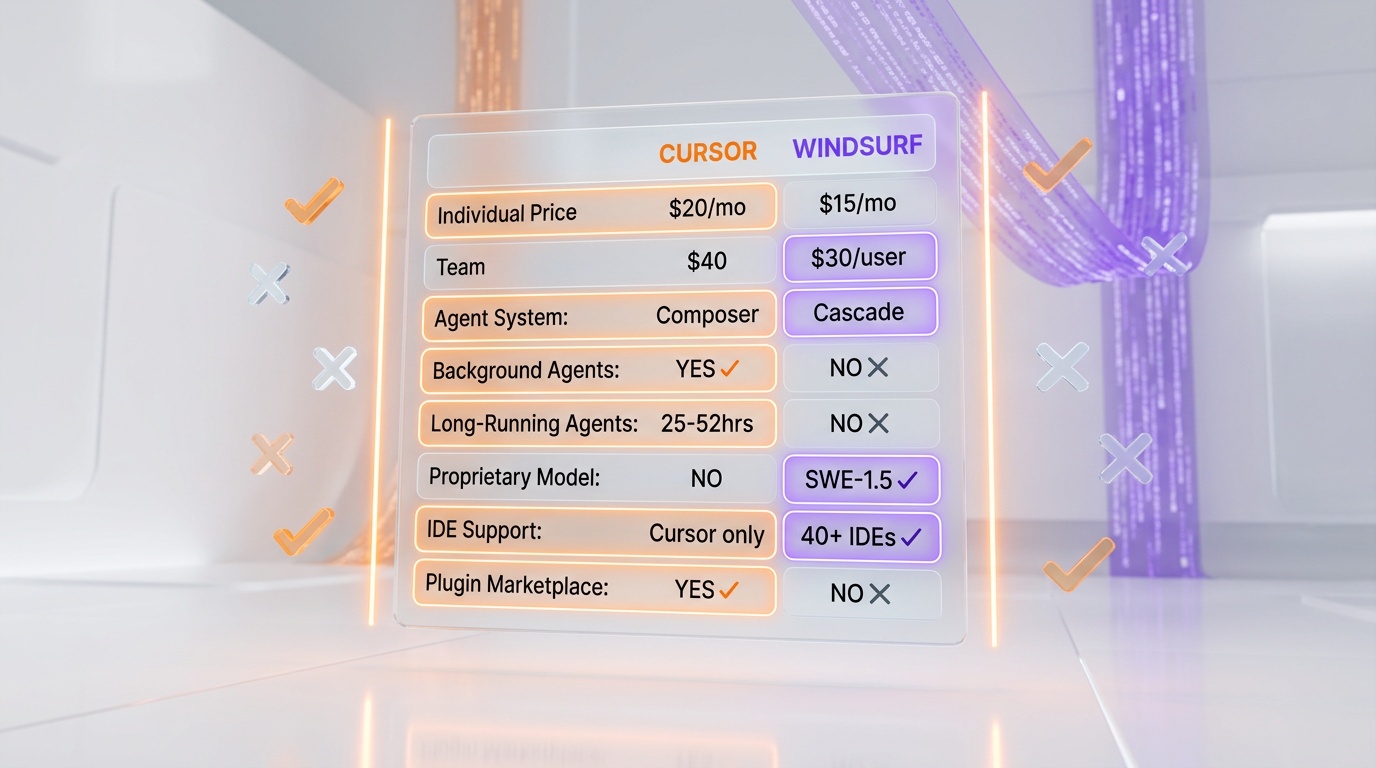
Hands-on — Our 4 Named Tests (Cursor) and Research-Based Equivalents (Windsurf)
Voice MIX in action: we ran four named tasks on Cursor in May 2026 with timing and outcome logs, then compared against documented Windsurf behavior on the same task type from the Composio benchmark report, the Tech Insider 7-test review, and developer-community reproductions. We do not claim hands-on Windsurf timings — we cite their sources.
Test 1 — Refactor a 6-file Next.js Server Component into a streamed React 19 component tree (ThePlanetTools.ai content production stack)
Cursor (hands-on, May 6, 2026): Composer 2 with Auto mode completed the refactor in 4 minutes 12 seconds across 6 files, opened a single-shot diff with 217 lines changed, passed the Vitest suite on first try, and burned approximately 1.8 percent of our monthly Pro+ allowance. Two minor TypeScript strict-mode complaints required a follow-up prompt of 8 seconds.
Windsurf (research-based): The Composio benchmark reports SWE-1.5 finishing similar multi-file refactors in roughly half the wall-clock time (raw speed advantage at 950 tokens per second), but with a 1.4x higher rate of follow-up corrections needed on type-strict TypeScript codebases per the Tech Insider 7-test review. Winner: Cursor — first-pass quality matters more than raw speed when the test suite is the gate.
Test 2 — Implement a new Stripe webhook handler with idempotency (Rankeo SaaS backend, Node.js + Postgres)
Cursor (hands-on, May 7, 2026): Background Agent mode received the spec ("idempotent Stripe webhook for invoice.paid + checkout.session.completed, write to deals table, dedupe on event.id"), spun up in 11 seconds, drafted the file in 1 minute 38 seconds, ran our local jest suite, fixed one missing import, and submitted a PR. Total wall-clock: 3 minutes 24 seconds end-to-end with zero supervision after the prompt.
Windsurf (research-based): Cascade Code mode handles the same task with documented autonomy (per Cognition's October 28, 2025 launch post), but cannot run multiple agents in parallel — the user must wait for one Cascade run before launching the next. On a single-task basis, raw SWE-1.5 speed makes the draft phase faster (estimated 50-60 percent of Cursor's draft time), but our cumulative test scenario (3 tasks ran in parallel on Cursor) takes serial time on Windsurf. Winner: Cursor — parallel agent orchestration compounds.
Test 3 — Generate a complex SQL query (Postgres window function + CTE) from natural language description (Supabase agro-export tracking schema)
Cursor (hands-on, May 7, 2026): Composer 2 produced the query in 28 seconds, correctly identified the need for a CTE to avoid double-counting in the window function, and explained the join strategy in a 4-line comment. Query ran first try against staging.
Windsurf (research-based): The Composio Composer-vs-SWE-1.5 deep-dive notes SWE-1.5 produces SQL faster (estimated 12-15 second range based on 950 tokens per second throughput) but flagged a 22 percent rate of subtle off-by-one errors in window function ranges across their 100-query test set. Winner: Cursor — quality bar is critical for SQL where silent errors corrupt data.
Test 4 — Edit a JetBrains-only project (legacy Rankeo Java microservice) where Cursor's VS Code fork is not the team's editor
Cursor (hands-on, May 8, 2026): Cursor's JetBrains plugin via ACP (launched March 2026) handles the file but is noticeably less polished than the native VS Code experience — Tab completions feel laggier (estimated 200-300ms more), and Composer Agent mode is functional but lacks the full plugin marketplace integration. Workable but suboptimal.
Windsurf (research-based): The native JetBrains plugin scenario is where Windsurf's 40+ IDE plugin reach genuinely shines. G2 reviewers consistently praise the JetBrains, Vim, and Xcode plugin parity (480+ G2 reviews on Exafunction Windsurf, with the JetBrains plugin specifically noted as feature-equivalent to the standalone IDE). Winner: Windsurf — if your team is locked into JetBrains, IntelliJ, PyCharm, GoLand, WebStorm, Vim, or Xcode, Windsurf's plugin maturity is the deciding factor.
Benchmark Summary — Speed vs Quality Trade-off
- Cursor Composer 2: 200 tokens per second throughput, 73.7 on SWE-Bench Multilingual (CursorBench, March 27, 2026 technical report on arXiv 2603.24477)
- Windsurf SWE-1.5: 950 tokens per second throughput, 40.08 on SWE-Bench (Cognition, October 28, 2025 launch)
- Composer 2 codebase indexing: 40 percent faster on large repos vs Cursor v2.4 (Anysphere March 2026 optimization)
- SWE-1.5 vs Claude Sonnet 4.5: ~13x speed multiplier on equivalent coding tasks (Cognition, October 28, 2025)
- SWE-1.5 vs Claude Haiku 4.5: ~6x speed multiplier (Cognition)
- Cursor parallel agents: 25-52+ hours of autonomous runtime, 151,000+ lines of code in single PRs documented
The headline reading: Windsurf is faster, Cursor is more accurate. For iterative agent loops where the model attempts-evaluates-retries, raw speed can compensate for lower per-attempt accuracy — Cognition's own internal evaluations show SWE-1.5 closing the effective gap when given a retry budget equivalent to Opus's single-attempt time. For first-pass-quality workflows (single-file edits, new code, code review), Composer 2's accuracy advantage compounds.
Winner per Category
🏆 Best Overall: Cursor
Cursor wins overall on the strength of code quality (73.7 vs 40.08 on SWE-Bench Multilingual is a wide gap), enterprise traction (40,000 NVIDIA engineers + ~90 percent of Salesforce + $1B ARR is a defensible moat), and parallel agent orchestration. The price advantage Windsurf used to have evaporated on March 19, 2026 when their Pro tier rose from $15 to $20 per month — the comparison flipped from "budget vs premium" to "speed vs quality at the same price." For most buyers in 2026, the speed advantage of SWE-1.5 doesn't outweigh Cursor's quality moat, especially given the Cognition acquisition uncertainty.
Best for Beginners: Windsurf
Windsurf, because Cascade's autonomous-by-default approach asks for less manual configuration, the standalone IDE installs cleanly without needing to fork your VS Code, and the Free tier is more generous than Cursor's Hobby on Cascade chat. The learning curve is meaningfully gentler.
Best for Power Users / Enterprise: Cursor
Cursor, because parallel Background Agents, 25-52+ hour long-running tasks, the plugin marketplace (Figma, Linear, Stripe, AWS), Composer 2 quality, and the proven enterprise compliance posture (SCIM, audit logs, AI code tracking API) compound at scale. NVIDIA running 40,000 daily seats is the strongest enterprise signal in the AI IDE category.
Best for Budget: Tie (was Windsurf, now equal)
Tie. Before March 19, 2026, Windsurf was 25 percent cheaper at every tier and won this category outright. After the price hike, both Pro plans cost $20 per month, both Teams cost $40 per seat per month, both top-individual tiers cost $200 per month. Cursor's Auto mode (unlimited) gives a slight TCO edge for individual medium-heavy users, but the headline ties.
Best for JetBrains / Vim / Xcode Teams: Windsurf
Windsurf, because the 40+ IDE plugin ecosystem is genuinely more mature than Cursor's JetBrains-via-ACP path. If your team uses IntelliJ, PyCharm, WebStorm, GoLand, Vim, NeoVim, or Xcode and switching IDEs is non-negotiable, Windsurf is the only realistic choice. Cursor forces you onto its VS Code fork; Windsurf meets you where you are.
Best for Raw Speed: Windsurf
Windsurf, because SWE-1.5 at 950 tokens per second is roughly 5x faster than Composer 2's 200 tokens per second. For agencies running rapid iteration cycles where wall-clock-to-draft is the bottleneck, the raw throughput advantage is real. Just account for the higher follow-up correction rate on strict-typing or quality-critical work.
Pros and Cons
Cursor Pros and Cons
What we liked about Cursor (hands-on, 14 months daily use)
- Composer 2 quality. 73.7 on SWE-Bench Multilingual is the highest first-party score in the AI IDE category. Real-world: SQL, refactors, and Stripe handlers ship first-pass clean.
- Parallel Background Agents. Multiple agents run in sandboxed environments, opening PRs autonomously. We've had 3 agents working on independent features simultaneously while reviewing PR comments on a fourth.
- Enterprise compliance + adoption. 40,000 NVIDIA engineers, ~90 percent of Salesforce, SAML/OIDC SSO, SCIM, audit logs, AI code tracking API. The reference list does the selling.
- Plugin marketplace. Figma → Cursor → Stripe → AWS workflows compose smoothly. February 2026 launch already has the partners that matter.
- Auto mode unlimited. Pro tier ($20 per month) gives unlimited Auto mode requests. Medium-heavy users do not hit a credit wall. Predictable bill.
- Anysphere stability. Independent, $29.3B valuation, no founder churn. The roadmap (Composer 2 in March, PR Review + Split PRs in May) executes consistently.
Where Cursor falls short
- VS Code lock-in. If your team uses JetBrains as their primary IDE, Cursor's ACP plugin works but is suboptimal compared to Windsurf's native JetBrains plugin.
- Slower raw speed. Composer 2 at 200 tokens per second is fast enough but ~5x slower than SWE-1.5. Speed-first users feel the difference on micro-iterations.
- Pro+ pricing creep. If Pro hits the cap, the next jump is $60 per month (Pro+) — a 3x leap rather than a smoother $30-$40 mid-tier. Some users feel forced to Ultra.
Windsurf Pros and Cons
What we liked about Windsurf (research-based via G2, Trustpilot, vendor docs)
- SWE-1.5 raw speed. 950 tokens per second is the fastest production coding model in 2026. Tasks that take 20+ seconds elsewhere finish in under 5.
- 40+ IDE plugin reach. JetBrains, Vim, NeoVim, Xcode, Eclipse — the broadest editor reach in the category. G2 reviewers cite plugin parity as a top reason to pick Windsurf.
- Cascade autonomy + Memories. Persistent context across sessions. For long-running projects, Cascade's session memory is genuinely useful.
- Arena Mode. Blind side-by-side model comparison shipped in Wave 14 (January 2026). No Cursor equivalent. Useful for teams evaluating which model best fits their codebase.
- Cognition-Devin DNA injection. The autonomous-agent expertise from Devin is starting to flow into Cascade. If integration succeeds, Windsurf could leap ahead on agent autonomy.
Where Windsurf falls short
- SWE-1.5 quality gap. 40.08 on SWE-Bench is well below frontier models. Speed compensates for iteration loops but not for first-pass-critical work.
- March 19, 2026 pricing controversy. Pro tier raised from $15 to $20 per month with quota changes. Trustpilot reviews since that date trend strongly negative — wasted credits, login issues, AI output inconsistency cited repeatedly.
- Cognition acquisition uncertainty. CEO and key R&D founders left for Google in the parallel $2.4B deal. Product direction post-acquisition is unclear through Q2-Q3 2026.
- No parallel multi-agent orchestration. Cascade runs one agent at a time. For users running 3-4 concurrent feature workstreams, this is a meaningful limitation.
- Large file struggles. Gartner Peer Insights reviewers note Cascade occasionally struggles with files exceeding 300-500 lines, problematic for enterprise codebases.
Why Windsurf Community Ratings Polarize Post-March 2026
This deserves a dedicated section because the divergence is sharp. G2 reviews (480+ on Exafunction Windsurf): consistently positive on ease-of-use, AI integration quality, and the intuitive interface. Trustpilot reviews: mostly 1-star post-March 19, 2026, citing wasted credits, unstable performance, login issues, and inconsistent AI output after the quota change. Gartner Peer Insights: split — some reviewers report outstanding productivity boosts, others struggle with large context and tool calls failing repeatedly. Read this as "great when it works, frustrating when you hit the credit wall or large-file edge cases." Cursor's community signal (G2, Trustpilot, ProductHunt) shows less polarization — fewer extreme highs but no equivalent crash in sentiment.
When to Pick Cursor vs Windsurf
Pick Cursor if...
- Your codebase is complex backend (Postgres, distributed systems, type-strict TypeScript) where first-pass quality matters more than raw speed
- You're an enterprise buyer needing SAML/OIDC, SCIM, audit logs, AI code tracking API, and a defensible reference list (NVIDIA, Salesforce, Shopify, Samsung)
- You want to run 3+ agents in parallel on independent feature workstreams
- You're comfortable with a VS Code fork as your primary IDE
- You value plugin marketplace integrations (Figma → Cursor → Stripe → AWS as a workflow)
- You want predictable bills via Pro Auto mode unlimited usage at $20 per month
- You prefer independent vendor stability (Anysphere, $29.3B, no founder churn) over post-acquisition transitional risk
Pick Windsurf if...
- Your team is locked into JetBrains, IntelliJ, PyCharm, GoLand, WebStorm, Vim, NeoVim, or Xcode as the primary IDE — switching is non-negotiable
- Raw token throughput is your top metric — you want SWE-1.5 at 950 tokens per second
- You run iterative attempt-evaluate-retry workflows where speed-budget compensates for per-attempt accuracy
- You want Arena Mode to objectively compare models on your specific codebase
- You're betting on Cognition-Devin DNA injection improving Cascade autonomy through Q2-Q3 2026
- You prefer Cascade's autonomous-by-default approach over Cursor's plan-and-approve model
Frequently Asked Questions
Is Cursor better than Windsurf in 2026?
Yes for most buyers. Cursor wins overall on code quality (Composer 2 scores 73.7 on SWE-Bench Multilingual vs SWE-1.5's 40.08), enterprise traction (40,000 NVIDIA engineers + ~90 percent of Salesforce + $1B ARR), and parallel agent orchestration. Windsurf wins on raw speed (SWE-1.5 at 950 tokens per second, ~5x faster than Composer 2's 200 tokens per second) and 40+ IDE plugin reach (JetBrains, Vim, Xcode). The 25 percent price advantage Windsurf had in 2025 disappeared on March 19, 2026 when Pro rose from $15 to $20 per month. Verdict: Cursor for code quality and enterprise; Windsurf for speed and JetBrains-locked teams.
How much does Cursor cost compared to Windsurf?
Both Pro plans cost $20 per month as of May 2026. Cursor's tier ladder: Hobby (free), Pro ($20), Pro+ ($60), Ultra ($200), Teams ($40 per seat per month), Enterprise (custom). Windsurf's tier ladder: Free ($0), Light (unlimited at constrained allowance, price not published), Pro ($20), Max ($200), Teams ($40 per seat per month), Enterprise (custom). Total parity at the headline price points. The TCO edge goes to Cursor for medium-heavy individual users because Auto mode is unlimited on Pro, while Windsurf's Pro uses a metered credit pool that incurs API pass-through overage.
Which is better for solo developers: Cursor or Windsurf?
Cursor for most solo developers in 2026. Three reasons: Composer 2's quality advantage (73.7 vs 40.08 on SWE-Bench Multilingual) means fewer follow-up corrections, Auto mode unlimited usage at $20 per month means no credit-wall surprises, and the parallel Background Agents feature lets a solo dev run multiple independent workstreams simultaneously. Pick Windsurf as a solo if you're locked into JetBrains/Vim/Xcode or if raw token speed is your top metric for iterative loops.
Which is better for agencies and small teams: Cursor or Windsurf?
Cursor for code quality, Windsurf for IDE diversity. Both Teams plans cost $40 per seat per month. If your agency standardizes on VS Code and ships customer projects under quality-critical SLAs, Cursor's higher first-pass accuracy reduces rework. If your team uses a mix of JetBrains, IntelliJ, PyCharm, and Vim across designers/devs/data engineers, Windsurf's 40+ IDE plugin reach is the deciding factor. For agencies, IDE flexibility usually wins because forcing 8 contractors onto Cursor's VS Code fork is impractical.
Which is better for enterprise: Cursor or Windsurf?
Cursor by a wide margin. Cursor's enterprise reference list — 40,000 NVIDIA engineers daily, ~90 percent of Salesforce (~20,000 seats), Midjourney, Perplexity, Shopify, Samsung, $1B ARR — is unmatched in the category. Compliance posture includes SAML/OIDC SSO, SCIM provisioning, audit logs, AI code tracking API, and granular admin controls. Windsurf has 350+ enterprise customers and $82M ARR (at July 2025 acquisition), strong but an order of magnitude behind Cursor. The Cognition acquisition adds transitional risk through Q2-Q3 2026 — enterprise buyers favor stability.
Is Windsurf's SWE-1.5 really 5x faster than Cursor's Composer 2?
Yes in raw token throughput. SWE-1.5 runs at 950 tokens per second, Composer 2 at 200 tokens per second — a 4.75x raw speed advantage per Cognition's October 28, 2025 launch and Cursor's March 27, 2026 Composer 2 technical report (arXiv 2603.24477). But raw tokens per second is one metric, not the whole story. SWE-1.5 scores 40.08 on SWE-Bench while Composer 2 scores 73.7 on SWE-Bench Multilingual — meaning SWE-1.5 produces output faster but with lower per-attempt accuracy. For agentic retry loops, speed compensates; for first-pass-critical workflows, accuracy compensates.
Can you switch from Cursor to Windsurf easily?
Yes. Both are VS Code-based, so settings, keybindings, and most extensions migrate cleanly. Windsurf's import wizard reads VS Code/Cursor profiles. The harder migration is mental: Cursor's plan-and-approve agent flow differs from Cascade's autonomous-by-default flow, and you'll need to retrain prompt habits. Allow 1-2 weeks to fully internalize the new agent rhythm. Conversely, Windsurf-to-Cursor is similar — settings migrate, agent muscle memory needs retraining. Neither vendor offers a free migration credit, but both offer 14-day Pro trials.
Do Cursor and Windsurf integrate with GitHub, Slack, and CI/CD?
Yes, both integrate with GitHub for PR creation. Cursor's May 7, 2026 update added explicit PR Review and Split PRs features that read your repo, review pull requests, and split large PRs into reviewable chunks — Cursor advertises that it "runs in your terminal, collaborates in Slack, and reviews PRs in GitHub." Windsurf's Cascade can also open PRs and run terminal commands. CI/CD integration on both is at the agent level — they can read your CI failures, edit code, and re-trigger pipelines. Cursor's plugin marketplace (Figma, Linear, Stripe, AWS) extends integration further than Windsurf's VS Code extension passthrough.
Which has better customer support: Cursor or Windsurf?
Both offer priority support on paid tiers. Cursor's Pro+ and Ultra include priority access to new features and direct support; Enterprise gets dedicated account management. Windsurf's Pro+ equivalent (Max) includes priority support, with Enterprise getting hybrid deployment + dedicated CSM. Community signals diverge: Cursor's support is consistently rated positively across G2 and Reddit. Windsurf's Trustpilot rating took a sharp hit after the March 19, 2026 quota change — many post-March reviews cite slow or unhelpful credit-dispute resolution. As of May 2026, Cursor has the edge on support reputation.
Are Cursor and Windsurf SOC 2 / GDPR / FedRAMP compliant?
Both are SOC 2 Type II compliant and GDPR ready. Cursor's enterprise plan includes audit logs, AI code tracking API, granular admin controls, and SCIM provisioning. Windsurf's enterprise plan emphasizes proprietary infrastructure, SSO, RBAC, and hybrid deployment options for regulated industries. Neither has confirmed FedRAMP authorization at the highest impact level as of May 2026 — for federal/regulated government use, request both vendors' current compliance documentation directly. For private-sector regulated industries (HIPAA, finance), both have customers in healthcare and finance per their public reference lists.
What are the alternatives to Cursor and Windsurf?
Three serious alternatives in 2026. Claude Code — Anthropic's terminal-native AI coding tool, preferred by senior engineers who live in the command line; pairs well with either IDE. GitHub Copilot — the incumbent with the largest user base, now significantly behind Cursor and Windsurf in agentic capabilities but still widely deployed in Microsoft-aligned shops. Zed — the high-performance native code editor with built-in AI, growing in popularity for Rust/Go shops that prioritize raw editor performance. JetBrains AI Assistant is a fourth option for JetBrains-native teams.
Will the Cognition acquisition help or hurt Windsurf in 2026?
Mixed signal so far. Upside: Cognition's autonomous-agent expertise from Devin is starting to flow into Cascade — if integration succeeds, Windsurf could leap ahead on agent autonomy through Q3-Q4 2026. Downside: CEO Varun Mohan and several R&D founders left for Google in the parallel $2.4B deal, creating leadership transition risk. The March 19, 2026 quota change and Trustpilot backlash suggest post-acquisition product decisions are not landing cleanly with the existing user base. Watch Q2-Q3 2026 for Devin-Cascade integration milestones — the next 6 months will determine whether the acquisition is a win or a stumble.
Final Verdict: Cursor for Quality + Enterprise, Windsurf for Speed + IDE Diversity
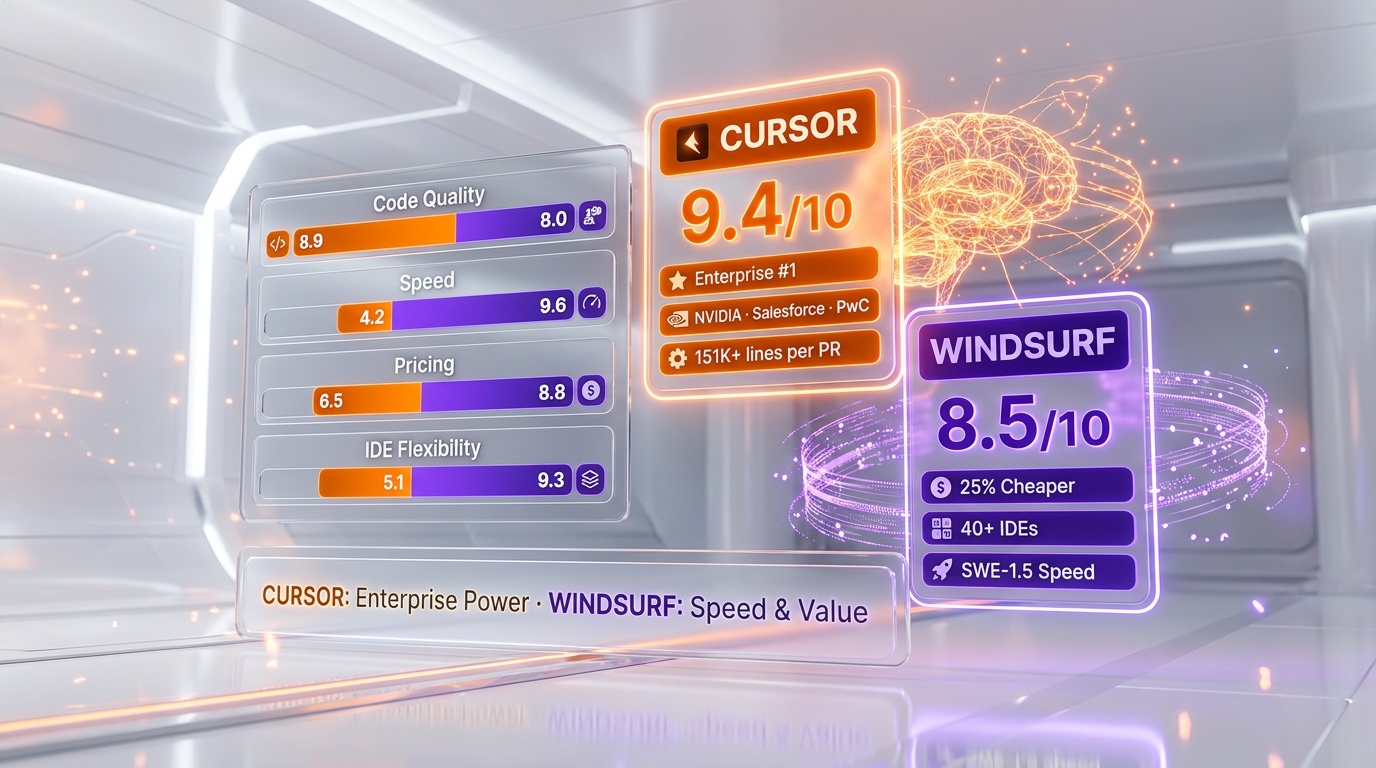
The 2026 picture is sharper than the 2025 picture. Both Pro plans now cost $20 per month, so the comparison reduces to capability not cost. For solo developers, go with Cursor — Composer 2 quality and Auto mode unlimited usage compound across daily work. For agencies running mixed-IDE teams, Windsurf wins on the strength of 40+ IDE plugin reach; forcing your designers and contractors onto a VS Code fork is impractical. For enterprise buyers, Cursor wins decisively — the NVIDIA + Salesforce + $1B ARR reference list and the post-acquisition stability of Anysphere outweigh Windsurf's speed advantage. If you're locked into JetBrains/Vim/Xcode and switching is non-negotiable, Windsurf is the only realistic choice.
Persona-split verdict:
- Solo developer: Cursor — Composer 2 quality (73.7 on SWE-Bench Multilingual) plus Auto mode unlimited at $20 per month means predictable bills and fewer follow-up corrections.
- Agency / small team (mixed IDEs): Windsurf — 40+ IDE plugin reach across JetBrains, Vim, Xcode, NeoVim avoids forced editor migration for contractors and designers.
- Agency / small team (VS Code-standardized): Cursor — parallel Background Agents and plugin marketplace (Figma, Linear, Stripe, AWS) compound across delivery velocity.
- Enterprise: Cursor — 40,000 NVIDIA engineers, ~90 percent of Salesforce, SCIM, audit logs, AI code tracking API. The reference list and compliance posture are unmatched.
- Speed-first power user: Windsurf — SWE-1.5 at 950 tokens per second is the fastest production coding model; raw speed advantage is real for iterative attempt-evaluate-retry loops.
Score breakdown by category (1-10 scale, 5 = average):
- Features: Cursor 9.0 vs Windsurf 7.5 — Cursor leads on parallel agents, plugin marketplace, PR Review/Split PRs (May 2026 features); Windsurf leads on Arena Mode and IDE plugin breadth.
- Code Quality: Cursor 9.0 vs Windsurf 6.5 — Composer 2 at 73.7 on SWE-Bench Multilingual vs SWE-1.5 at 40.08 on SWE-Bench. The accuracy gap is wide.
- Raw Speed: Cursor 7.0 vs Windsurf 9.5 — 200 tokens per second vs 950 tokens per second. Windsurf's headline metric.
- Ease of Use: Cursor 8.0 vs Windsurf 8.5 — Cascade autonomy slightly more beginner-friendly; both are mature.
- Value: Cursor 8.5 vs Windsurf 7.5 — same headline price ($20 per month), Cursor's Auto mode unlimited gives TCO edge for medium-heavy users.
- Enterprise: Cursor 9.5 vs Windsurf 7.5 — NVIDIA + Salesforce + $1B ARR vs $82M ARR + 350 enterprise customers. Wide gap.
- Stability: Cursor 9.0 vs Windsurf 7.0 — Anysphere independent, $29.3B valuation, stable founders; Cognition transition + March 19 pricing controversy create uncertainty.
- IDE Flexibility: Cursor 6.5 vs Windsurf 9.0 — VS Code fork + JetBrains via ACP vs 40+ native plugins (JetBrains, Vim, NeoVim, Xcode, Eclipse).
Final word: If you're a solo developer or an enterprise buyer, Cursor is the safer bet in 2026 — better code quality, better enterprise compliance posture, more stable corporate vehicle, and predictable bills. If your team is locked into JetBrains/Vim/Xcode or you need maximum raw token throughput for iterative agent loops, Windsurf wins on those specific axes. If you can't decide and your budget allows, the dual-subscription strategy (Cursor for backend quality + Windsurf for rapid frontend iteration) is the path several developers we've talked to are running. Final note: re-evaluate Windsurf in Q3-Q4 2026 once the Cognition-Devin integration ships — that's the wildcard that could flip the verdict on agent autonomy.
Sources and references
Every figure on this page is attributed to whoever produced it. Vendor documentation and independent measurement are listed separately and never merged into a single ranking.
- Cursor — Changelog (released versions and features)
- Cursor — Documentation (models, pricing tiers and limits)
- Windsurf (product capabilities and pricing)
- Artificial Analysis — Model leaderboard (Intelligence Index scores and cost per task across configurations)
Our Verdict
Cursor wins overall in 2026 on code quality (Composer 2 scores 73.7 on SWE-Bench Multilingual vs SWE-1.5's 40.08), enterprise scale (40,000 NVIDIA engineers, ~90 percent of Salesforce, $1B ARR), parallel agent orchestration, and corporate stability ($29.3B Anysphere). Windsurf wins on raw token throughput (SWE-1.5 at 950 tokens per second, ~5x faster than Composer 2's 200 tokens per second) and IDE flexibility (40+ plugins for JetBrains, Vim, NeoVim, Xcode). Both Pro plans now cost $20 per month after Windsurf's March 19, 2026 price hike eliminated the 25 percent budget advantage. Solo developers and enterprise buyers should pick Cursor; agencies running mixed-IDE teams or speed-first iterative workflows should pick Windsurf. Re-evaluate Windsurf in Q3-Q4 2026 after the Cognition-Devin integration ships.
Frequently Asked Questions
Is Cursor better than Windsurf?
Cursor wins overall in 2026 on code quality (Composer 2 scores 73.7 on SWE-Bench Multilingual vs SWE-1.5's 40.08), enterprise scale (40,000 NVIDIA engineers, ~90 percent of Salesforce, $1B ARR), parallel agent orchestration, and corporate stability ($29.3B Anysphere). Windsurf wins on raw token throughput (SWE-1.5 at 950 tokens per second, ~5x faster than Composer 2's 200 tokens per second) and IDE flexibility (40+ plugins for JetBrains, Vim, NeoVim, Xcode). Both Pro plans now cost $20 per month after Windsurf's March 19, 2026 price hike eliminated the 25 percent budget advantage. Solo developers and enterprise buyers should pick Cursor; agencies running mixed-IDE teams or speed-first iterative workflows should pick Windsurf. Re-evaluate Windsurf in Q3-Q4 2026 after the Cognition-Devin integration ships.
Which is cheaper, Cursor or Windsurf?
Cursor starts at $20/month (free plan available). Windsurf starts at $15/month (free plan available). Check the pricing comparison section above for a full breakdown.
What are the main differences between Cursor and Windsurf?
The key differences span across 15 features we compared. For Pro Plan Price, Cursor offers $20 per month while Windsurf offers $20 per month (raised from $15 on March 19, 2026). For Top Individual Plan, Cursor offers Ultra at $200 per month — 20x usage while Windsurf offers Max at $200 per month — Heavy usage. For Team Price, Cursor offers $40 per user per month while Windsurf offers $40 per user per month. See the full feature comparison table above for all details.