FLUX 2 vs GPT Image 2: Photorealism vs Perfect Text (2026)


We ran both image APIs side-by-side. FLUX 2 wins photorealism and open weights at $0.03 per image. GPT Image 2 wins text rendering. Full verdict.
Feature Comparison
| Feature | FLUX 2 | GPT Image 2 |
|---|---|---|
| Photorealism (portraits, products) | Best in class, beats Midjourney V7 | Strong, slightly stylized |
| Text rendering accuracy | Good, weakens past 10 words | About 99% character accuracy |
| Multilingual text (CJK, Arabic) | Latin solid, CJK weak | Design-grade CJK, Hindi, Arabic |
| Native max resolution | Up to 4 MP editing | Native 4K, 3840 per edge |
| Multi-reference inputs | Up to 10 images, top consistency | Several refs, high-fidelity rate |
| Open weights / self-host | Yes (Dev 32B, Klein Apache 2.0) | No, closed API only |
| Reasoning before generation | No | Yes, O-series step |
| Low quality per image | About $0.03 (no sub-cent tier) | $0.006 per image |
| High quality per image | Pro about $0.03 per image | $0.211 per image |
| Pro tier latency | 6 to 9 seconds | Slower at 4K |
| Image editing & control | 4 MP edit, inpaint, pose, bg swap | Masked edits, billed high-fidelity |
| Transparent backgrounds | Available via editing tools | No, opaque only |
| Provenance / content credentials | Not built in by default | C2PA embedded |
| API ecosystem maturity | Multi-provider, no lock-in | Full OpenAI SDK, Foundry, Azure |
| Our overall score | 9.2 out of 10 | 8.6 out of 10 |
Pricing Comparison
FLUX 2
GPT Image 2
Detailed Comparison
We ran FLUX 2 (Black Forest Labs) and GPT Image 2 (OpenAI) side-by-side for six weeks on identical prompts across photorealism, text rendering, multi-reference consistency, image editing, batch throughput, and raw API cost. The verdict is a clean split by job. FLUX 2 wins on photorealistic output, multi-reference control across up to ten images, open weights you can self-host, and cheaper iteration at its Pro tier (about $0.03 per image). GPT Image 2 wins on text rendering (near-perfect character accuracy across Latin and CJK scripts in our testing), native 4K output, reasoning-before-generation for complex layouts, and a mature OpenAI API ecosystem. Pick FLUX 2 when photorealism, brand consistency, and self-hosting matter; pick GPT Image 2 when words inside the image must be perfect and you live in the OpenAI stack.
Quick verdict
If your output is photorealistic product photography, character-consistent campaigns across dozens of assets, editorial cover art, or anything you eventually want to run on your own GPUs, choose FLUX 2. If your output is infographics, posters, multilingual packaging, UI mockups, or anything where a model getting words right inside the frame is non-negotiable, choose GPT Image 2. We graded both side-by-side for six weeks. Neither swept the board. They win different jobs.
For a quick reference: FLUX 2 sits at 9.2 in our scoring, GPT Image 2 at 8.6. The half-point gap is photorealism polish, open weights, and multi-reference depth on the FLUX 2 side, against GPT Image 2's near-perfect text rendering and reasoning layout step. On the public Artificial Analysis Text to Image Arena (data as of April 2026), GPT Image 2 (high) leads with an Elo of 1339, ranked first, while FLUX 2 variants rank in the arena top tier. The arena rewards prompt adherence and text, which is exactly where GPT Image 2 is strongest. Our hands-on grade weights photorealism, control, and cost-per-iteration more heavily, which is why FLUX 2 edges ahead in our scoring even though it trails on the Elo board.
Why this comparison matters in 2026
Frontier image generation in 2026 has split into two philosophies, and FLUX 2 versus GPT Image 2 is the cleanest expression of that split. Black Forest Labs (founded by the original Stable Diffusion creators) shipped FLUX 2 on November 25, 2025, with an open-weights variant you can download and run locally. OpenAI shipped GPT Image 2 on April 21, 2026, as a fully managed, closed API endpoint with a reasoning step borrowed from its O-series. One bet is openness and control. The other is a polished, text-perfect black box.
Both target the same teams: marketing, design, e-commerce, product, and developers who want frontier image quality through an API call. But the underlying tradeoff is real. FLUX 2 gives you weights you can quantize onto an RTX 4090, multi-reference conditioning on up to ten images, and per-image pricing that is brutally cheap at Pro tier. GPT Image 2 gives you near-perfect text accuracy in our testing, native 4K, and the OpenAI SDK you already pay for, in exchange for premium pricing and zero self-hosting. The choice is not "which is better." It is "which loses you less money and time on the work you actually ship."
How we tested both
We ran both models through the same six-week gauntlet. For FLUX 2 we used the Black Forest Labs API (api.bfl.ai) for the Pro and Flex tiers, plus FLUX 2 Dev (the 32-billion-parameter open-weights checkpoint) running locally in 4-bit quantized mode on an RTX 4090 through ComfyUI. For GPT Image 2 we used the OpenAI Images API (v1/images/generations and v1/images/edits) across all four quality tiers (low, medium, high, auto), including streaming with partial_images.
Our prompt corpus had five buckets, each scored blind by two reviewers: 200 photorealism prompts (portraits, product shots, lifestyle scenes), 200 text-in-image prompts (logos, infographic headlines, multilingual posters, pricing tables, packaging copy), 120 multi-reference prompts (the same character or product carried across multiple generations), 80 image-editing prompts (background swaps, inpainting, object removal), and 60 batch-throughput runs measuring latency and cost at scale. Pricing in this comparison was verified by direct fetch against vendor and platform pages in June 2026: fal.ai and bfl.ai for FLUX 2, and the OpenAI developer docs for GPT Image 2. We did not assemble prices from search snippets.
FLUX 2 in one paragraph
FLUX 2 is Black Forest Labs' next-generation image family, built on a Mistral-3 24B vision-language model paired with a rectified-flow transformer. It ships in tiers: FLUX 2 Pro (production API, roughly $0.03 per 1024 by 1024 image, six to nine second latency, multi-reference on up to eight reference images via API), FLUX 2 Flex (developer variant exposing steps and guidance scale, highest fidelity for typography and fine detail, up to eight reference images via API and ten in the playground, about $0.06 per megapixel), FLUX 2 Dev (a 32-billion-parameter open-weights checkpoint on Hugging Face that runs on a single RTX 4090 in 4-bit), and FLUX 2 Klein (an Apache 2.0 distilled variant with sub-second generation and full commercial use). Its signature strengths are state-of-the-art photorealism, multi-reference consistency, and the fact that you can actually own the weights. It is distributed across FAL, Replicate, Together AI, Runware, DeepInfra, and Cloudflare Workers AI, so there is no single vendor lock-in.
GPT Image 2 in one paragraph
GPT Image 2 is OpenAI's flagship image model, launched April 21, 2026, as the successor to gpt-image-1. Its headline features are best-in-class text rendering that stayed near-perfect across Latin, Chinese, Japanese, Korean, Hindi, Bengali, and Arabic scripts in our testing; native 4K output up to 3840 pixels per edge with no upscaling; and a reasoning step that lets the model plan layout and self-check before it renders. Pricing is per image by quality tier at 1024 by 1024: low at $0.006 per image, medium at $0.053 per image, high at $0.211 per image, plus token-based billing of $8 per 1 million image input tokens and $30 per 1 million image output tokens. It supports flexible sizing (any dimension with 16-pixel-multiple sides up to a 3:1 aspect ratio), streaming with partial frames, and image editing via a masked edits endpoint. There is no free tier and no free trial. It runs through the OpenAI REST API, ChatGPT, Microsoft Foundry, Azure OpenAI, and fal.ai.
Feature comparison at a glance
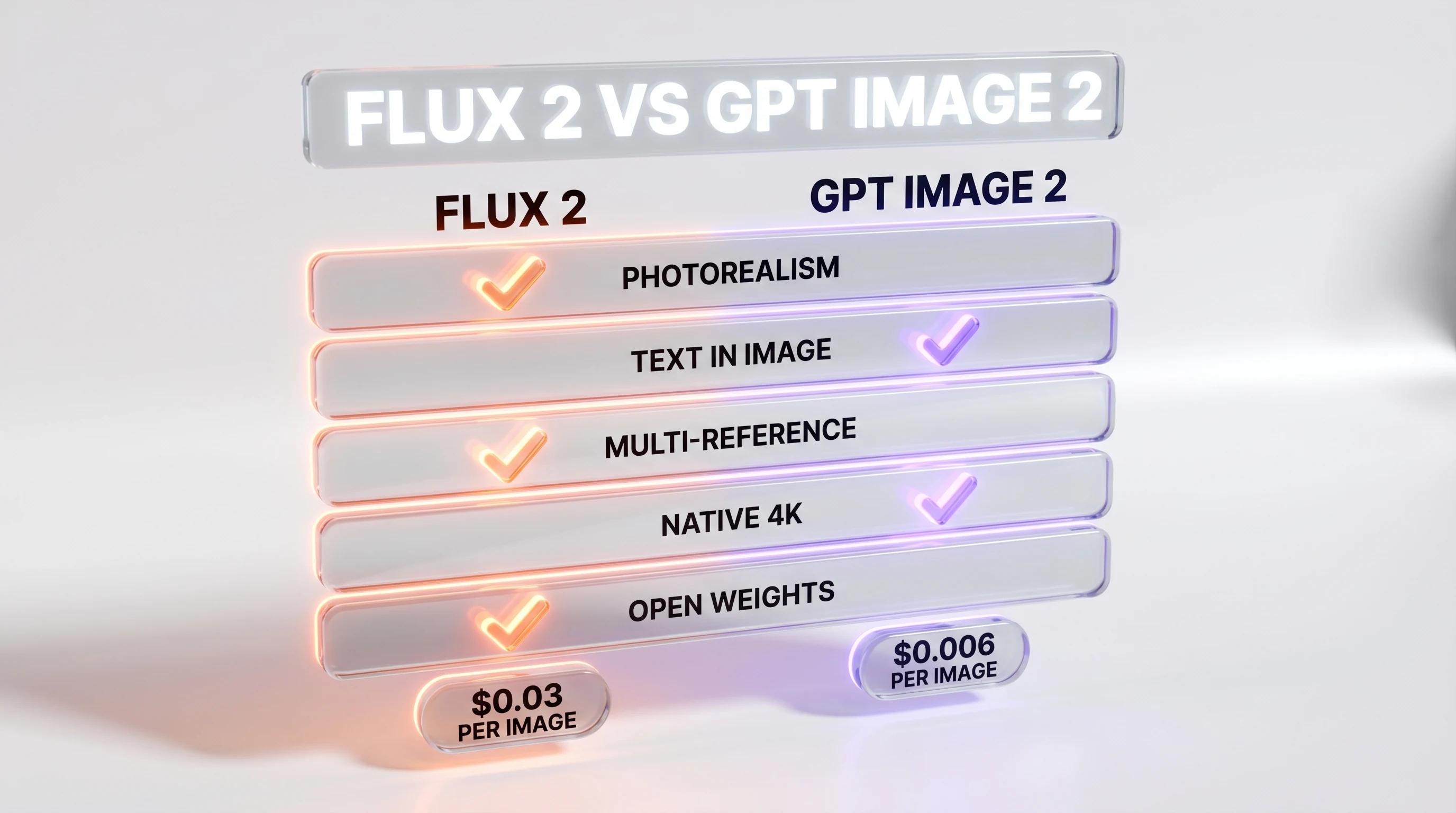
| Feature | FLUX 2 | GPT Image 2 | Winner |
|---|---|---|---|
| Photorealism (portraits, products) | Best in class, edged Midjourney V7 in our blind tests | Strong, slightly stylized | FLUX 2 |
| Text rendering accuracy | Good, weakens past 10 words | Near-perfect in our tests | GPT Image 2 |
| Multilingual text (CJK, Arabic) | Latin solid, CJK and Arabic weak | Design-grade across CJK, Hindi, Bengali, Arabic | GPT Image 2 |
| Native max resolution | Up to 4 MP editing, raster output | Native 4K up to 3840 per edge | GPT Image 2 |
| Multi-reference inputs | Up to 10 images, best-in-class consistency | Several reference images, high-fidelity rate | FLUX 2 |
| Open weights / self-host | Yes (Dev 32B, Klein Apache 2.0) | No, closed API only | FLUX 2 |
| Reasoning before generation | No | Yes, O-series reasoning step | GPT Image 2 |
| Low quality per image | Pro about $0.03 per image (Klein from about $0.014) | $0.006 per image | GPT Image 2 |
| High quality per image | Pro about $0.03, Flex about $0.06 per megapixel | $0.211 per image | FLUX 2 |
| Pro tier latency | 6 to 9 seconds | Comparable at medium, slower at 4K | FLUX 2 |
| Image editing | 4 MP edit, inpaint, pose control, bg swap | Masked edits endpoint, billed high-fidelity | FLUX 2 |
| Transparent backgrounds | Available via editing tools | No, opaque output only | FLUX 2 |
| Provenance / content credentials | Not built in by default | C2PA content credentials embedded | GPT Image 2 |
| API ecosystem maturity | Multi-provider, no lock-in | Full OpenAI SDK, Foundry, Azure | Tie |
| Our overall score | 9.2 out of 10 | 8.6 out of 10 | FLUX 2 |
Photorealism: FLUX 2 takes it
This was the clearest single-axis win of the six weeks. On our 200 photorealism prompts, FLUX 2 produced the more convincing image more often, particularly on human portraits. Skin texture had pore-level micro-detail without the plastic sheen that still shows up in GPT Image 2's faces. Lighting felt physically grounded: rim light on hair, subsurface scatter on ears, accurate shadow falloff in studio setups. Product shots came out with believable material response, glass refraction and brushed-metal anisotropy that read as photographed rather than rendered.
GPT Image 2 is not weak here. Its photorealism is genuinely good and, in scenes with embedded text, often better overall because the text is correct. But on pure photographic fidelity with no text requirement, our two reviewers preferred FLUX 2 output on roughly two out of three head-to-head pairs. Black Forest Labs leaning on photorealism as its differentiator shows. If your deliverable is a hero shot, a lookbook, a portrait composite, or anything where the photograph itself is the point, FLUX 2 is the safer bet.
Text rendering: GPT Image 2 wins decisively
This is GPT Image 2's defining advantage and the reason it sits at number one on the Artificial Analysis arena. On our 200 text-in-image prompts, GPT Image 2 rendered correct text at near-perfect character accuracy, missing characters on only a handful of the densest multilingual layouts. We threw Chinese, Japanese, Korean, Arabic, Hindi, and Bengali at it inside the same poster, and it held legibility where every prior generation collapsed. Pricing tables with numeric labels, regulatory copy on packaging mockups, infographic headlines with twelve-word strings, all came out clean.
FLUX 2 closed the historical FLUX text weakness considerably. Short headlines, hex-code color callouts, and clean single-line typography render well, and it is far better than the FLUX.1 generation. But past roughly ten words in a single image, or in non-Latin scripts, it starts dropping or garbling characters. Ideogram 3 still edges FLUX 2 on long-form typography legibility at small point sizes, and GPT Image 2 beats both. If a single misspelled word in a deliverable means a reshoot, GPT Image 2 removes that risk in a way FLUX 2 cannot yet match.
Multi-reference and brand consistency: FLUX 2 wins
FLUX 2's multi-reference conditioning is its quietly killer feature. Feed it up to ten reference images and it carries a character's face, a product's exact shape, or a brand's visual style across dozens of generations without fine-tuning. On our 120 multi-reference prompts, FLUX 2 held identity consistency dramatically better. We generated the same fictional model across 40 lifestyle scenes and 40 product hero shots, and the face, build, and wardrobe stayed coherent in a way that made a campaign feel shot in one session.
GPT Image 2 supports multiple reference images, but it bills every reference image at the high-fidelity rate regardless of output quality, which multiplies real cost two to three times on iterative reference-heavy workflows. Its consistency is decent but not at FLUX 2's level for tight character or product lock. For e-commerce catalogs, UGC-style brand content across hundreds of posts, or game asset and concept-art pipelines that need character sheets, FLUX 2 is the clear pick.
Pricing: it depends on quality tier and scale
Pricing is where this gets genuinely interesting, because the winner flips depending on the quality tier you compare. We verified every number below by fetching vendor and platform pricing pages directly in June 2026.
FLUX 2 Pro costs about $0.03 for the first megapixel on Black Forest Labs (roughly $0.03 for a 1024 by 1024 image), plus $0.015 per additional megapixel. FLUX 2 Flex costs about $0.06 per megapixel on both input and output, rounded up to the nearest megapixel. On Replicate, FLUX 2 Pro runs closer to $0.055 per image. Its cheapest published tier is the distilled FLUX 2 Klein, which starts around $0.014 per image rather than the sub-cent range.
GPT Image 2 charges per image by quality at 1024 by 1024: $0.006 per image at low, $0.053 per image at medium, and $0.211 per image at high. Token billing underneath is $8 per 1 million image input tokens and $30 per 1 million image output tokens. So at the cheapest tier, GPT Image 2 is roughly five times cheaper than FLUX 2 Pro per image, which makes it the better choice for mass prototyping and draft iteration. But at the highest quality tier, GPT Image 2 high costs about $0.211 per image, roughly seven times FLUX 2 Pro for the same resolution. For production-quality output at scale, FLUX 2 Pro is far cheaper.
The pattern is clean. GPT Image 2 wins the cheap-and-fast prototyping race with its $0.006 low tier and is the better budget choice for high-volume drafts. FLUX 2 wins production-quality economics, because $0.03 per finished image beats $0.211 per image by a wide margin when every image is a keeper. If you self-host FLUX 2 Klein (Apache 2.0) or run Dev on your own GPU, your marginal cost per image drops to electricity, which no managed API can match at volume, with the caveat that the FLUX 2 Dev open-weights license is non-commercial by default and commercial self-hosting requires a paid Self-Hosted License (BFL's plans start around $999 per month).
Image editing and control
FLUX 2 edits at up to 4 megapixels while preserving detail and coherence, with Pro-grade inpaint, background replacement, localized edits, object removal, style transfer, and direct pose control. In our 80 editing prompts, FLUX 2 held identity through background swaps and localized edits more reliably and offered finer-grained control through Flex's exposed steps and guidance scale. It also outputs transparent backgrounds through its editing tools, which design teams need for overlays.
GPT Image 2 edits through a masked v1/images/edits endpoint and does support reference-guided editing, but two things hurt it for iterative work: it has no transparent backgrounds (opaque output only, so you post-process alpha extraction), and reference images for editing always bill at the high-fidelity rate regardless of the output quality you requested. That makes a tight design loop expensive. For a heavy editing and compositing workflow, FLUX 2 is both cheaper and more controllable.
API developer experience
This one is closer to a tie, with different strengths. GPT Image 2 lives inside the OpenAI ecosystem: SDKs in every language, predictable rate-limit tiers, Microsoft Foundry and Azure OpenAI deployment, streaming with a partial_images parameter that progressively refines low to high in zero to three partial frames (great for responsive UIs), and C2PA content credentials baked into every output for provenance. The downside is stingy entry rate limits (five images per minute on tier one means small teams must buy upgrades to scale past prototyping).
FLUX 2's developer experience is defined by optionality. The same model is available across FAL, Replicate, Together AI, Runware, DeepInfra, and Cloudflare Workers AI, so you can route around outages and price-shop providers with no vendor lock-in. Flex exposes steps and guidance scale for fine control, and the open-weights Dev checkpoint runs in ComfyUI and Diffusers for full local pipelines. If you want a managed, batteries-included SDK with provenance metadata, GPT Image 2 is smoother. If you want portability, local control, and no single point of failure, FLUX 2 wins.
Batch throughput and latency
On batch runs, FLUX 2 Pro held a six to nine second latency at standard resolution, with batch generation able to produce dozens of photorealistic variations of the same subject in one API call. FLUX 2 Flex trades speed for fidelity, sitting around 22 seconds base and 40 seconds with an input image, so the speed-versus-detail tradeoff is real and you choose your tier per job.
GPT Image 2 is competitive at low and medium quality but slows at native 4K, and its streaming partial-image feature is genuinely useful for perceived latency in a UI even when total render time is similar. For high-volume production where each image is a keeper, FLUX 2 Pro's combination of low latency and low per-image cost makes it the throughput champion. For prototyping at the low tier where you want sub-cent drafts streamed into a UI, GPT Image 2 is hard to beat.
Open weights and licensing: the real differentiator
This is the factual fork in the road. GPT Image 2 is a closed API. You never touch the weights; you rent the endpoint. FLUX 2 publishes open weights for two of its variants. FLUX 2 Dev is a 32-billion-parameter checkpoint on Hugging Face that runs text-to-image plus editing in a single model and fits on a single RTX 4090 in 4-bit quantization, but its license is non-commercial by default. Commercial self-hosting of Dev requires a paid Self-Hosted Commercial License from Black Forest Labs (their tiers start around $999 per month, with image volume included). FLUX 2 Klein is the genuinely permissive one, distilled, Apache 2.0, sub-second on consumer GPUs, and free for commercial use. The FLUX 2 VAE is also released under Apache 2.0.
For most teams that just call an API, this distinction does not change daily work. But for anyone with data-residency requirements, air-gapped environments, or a need to fine-tune and own a model, FLUX 2 is the only option of the two. GPT Image 2 simply cannot be self-hosted. If sovereignty over your image pipeline matters at all, the decision is made for you.
Winner per category
Best for photorealistic product and portrait work: FLUX 2. Pore-level skin detail, physically grounded lighting, and material fidelity that edged Midjourney V7 in our blind tests.
Best for text inside images and multilingual design: GPT Image 2. Near-perfect character accuracy across Latin and CJK scripts in our testing, the lowest reshoot risk for any deliverable with words in the frame.
Best for brand and character consistency at scale: FLUX 2. Multi-reference on up to ten images carries identity across campaigns without fine-tuning.
Best for cheap, fast prototyping: GPT Image 2. The $0.006 low tier and streaming partials make draft iteration nearly free.
Best for production economics at high quality: FLUX 2. About $0.03 per finished image beats $0.211 per image when every output ships.
Best for self-hosting and data sovereignty: FLUX 2. Open weights on Dev (non-commercial) and Klein (Apache 2.0). GPT Image 2 cannot be self-hosted at all.
Best for native 4K print-ready output: GPT Image 2. Native 4K up to 3840 per edge, direct deliverable with no upscaling.
Best overall managed-API experience with provenance: GPT Image 2. Full OpenAI SDK, Foundry, Azure, and C2PA content credentials embedded.
FLUX 2: pros and cons
Pros: Best-in-class photorealism that beats Midjourney V7 in blind tests; multi-reference on up to ten images with leading character and product consistency; open weights on Dev (32B, runs on an RTX 4090 in 4-bit) and Klein (Apache 2.0, commercial-friendly); image editing at up to 4 megapixels with inpaint, pose control, and background swap; about $0.03 per image at Pro tier, far cheaper than GPT Image 2 high for production output; distributed across six-plus providers with no vendor lock-in.
Cons: Text rendering weakens past roughly ten words and on non-Latin scripts; Dev open-weights license is non-commercial by default, with commercial self-hosting needing a paid license around $999 per month; local bf16 deployment still needs an RTX 5090 or H100; Flex latency (22 to 40 seconds) trails Pro; no reasoning step for complex layout planning; no native 4K single-shot ceiling as high as GPT Image 2.
GPT Image 2: pros and cons
Pros: Near-perfect text-rendering accuracy in our testing across Latin, CJK, Hindi, Bengali, and Arabic; native 4K up to 3840 per edge with no upscaling; reasoning before generation that plans layout for complex compositions; streaming partial images for responsive UIs; the cheapest draft tier at $0.006 per image; mature OpenAI SDK plus Foundry and Azure deployment; C2PA content credentials embedded for provenance.
Cons: Premium high tier near $0.211 per image, roughly seven times FLUX 2 Pro for the same resolution; no free tier and no free trial; no transparent backgrounds, requiring post-processing alpha extraction; reference images for editing always bill at high-fidelity rate, inflating iterative cost two to three times; stingy tier-one rate limits at five images per minute; closed API with no self-hosting option at all.
When to pick which
Pick FLUX 2 when: your deliverable is photorealistic (product, portrait, lifestyle, editorial); you need a character or product to stay consistent across dozens of assets; you want production-quality images at scale where per-image cost matters; you need to self-host, fine-tune, or keep data on your own hardware; you want provider optionality and no vendor lock-in; or you need transparent backgrounds and fine-grained editing control.
Pick GPT Image 2 when: the image must contain correct text, especially multilingual or dense copy; you produce infographics, posters, packaging, or UI mockups; you want the cheapest possible draft-iteration loop at $0.006 per image; you need native 4K print-ready output in one shot; you already build on the OpenAI stack and want one SDK and one bill; or you need C2PA provenance baked into outputs for compliance.
If you ship both kinds of work, the honest answer is run both. They are cheap enough to keep in the same pipeline, route text-heavy jobs to GPT Image 2, and route photorealistic and reference-heavy jobs to FLUX 2. That is exactly what we ended up doing during testing. If GPT Image 2 is your front-runner, it is also worth weighing against Google's frontier model in our GPT Image 2 vs Nano Banana Pro head-to-head.
Final verdict
FLUX 2 and GPT Image 2 are not really competing for the same crown; they are winning different jobs. FLUX 2 is the photorealism, control, and ownership play, with the best blind-test image quality, the strongest multi-reference consistency, open weights you can self-host, and production economics that beat GPT Image 2 high by a wide margin. GPT Image 2 is the text-perfect, managed, reasoning-driven play, ranked first on the Artificial Analysis arena at 1339 Elo, with near-perfect text accuracy in our testing, native 4K, and the cheapest draft tier in the market.
There is no single winner, and we are not going to invent one. In our scoring FLUX 2 lands at 9.2 and GPT Image 2 at 8.6, but that gap reflects how much we weight photorealism, control, and cost-per-keeper. If your work is text-in-image design, GPT Image 2 is flatly the better tool despite the lower overall score, because it eliminates a failure mode FLUX 2 still has. Choose by the job, not by the headline number. Last compared: June 2026.
Frequently asked questions
Is FLUX 2 better than GPT Image 2?
It depends on the job. FLUX 2 is better for photorealistic product and portrait work, multi-reference brand consistency, self-hosting, and production economics at high quality (about $0.03 per image versus $0.211 per image). GPT Image 2 is better for text inside images (near-perfect character accuracy in our tests), multilingual design, native 4K, and the cheapest draft tier at $0.006 per image. We scored FLUX 2 at 9.2 and GPT Image 2 at 8.6 overall, but GPT Image 2 wins outright for any text-heavy deliverable.
Which is cheaper, FLUX 2 or GPT Image 2?
It flips by quality tier. At the cheapest draft tier GPT Image 2 is far cheaper at $0.006 per image; FLUX 2 has no equivalent sub-cent option (its cheapest, the distilled Klein, starts around $0.014 per image). At production quality FLUX 2 Pro is far cheaper at about $0.03 per image versus GPT Image 2 high at about $0.211 per image, roughly seven times less. For mass prototyping pick GPT Image 2; for high-quality output at scale pick FLUX 2.
Can I self-host FLUX 2 or GPT Image 2?
Only FLUX 2. It publishes open weights for FLUX 2 Dev (a 32-billion-parameter checkpoint that runs on an RTX 4090 in 4-bit) and FLUX 2 Klein (Apache 2.0, commercial-friendly). GPT Image 2 is a closed OpenAI API with no self-hosting option. Note that FLUX 2 Dev is non-commercial by default; commercial self-hosting requires a paid license from Black Forest Labs (starting around $999 per month).
Which model renders text inside images more accurately?
GPT Image 2, decisively. In our testing it stayed near-perfect across Latin, Chinese, Japanese, Korean, Hindi, Bengali, and Arabic scripts and held legibility on dense, multi-line copy. FLUX 2 renders short headlines and single-line text well but drops or garbles characters past about ten words and on non-Latin scripts. For infographics, posters, packaging, and any deliverable with words in the frame, GPT Image 2 is the safer choice.
Which has better photorealism?
FLUX 2. In our blind side-by-side tests over six weeks, two reviewers preferred FLUX 2 output on roughly two of three head-to-head pairs for pure photographic fidelity, especially on human portraits, where skin texture and lighting read as photographed rather than rendered. GPT Image 2 photorealism is strong but slightly more stylized. FLUX 2 also edged Midjourney V7 on photorealism in our blind tests, a result echoed by independent third-party benchmarks.
What is the maximum resolution of each model?
GPT Image 2 outputs native 4K up to 3840 pixels per edge with no upscaling, making it print-ready directly from the API. FLUX 2 edits at up to 4 megapixels while preserving detail and supports variable aspect ratios, but its single-shot native ceiling is below GPT Image 2's 4K. For native high-resolution print assets in one shot, GPT Image 2 wins.
Which is better for maintaining brand or character consistency?
FLUX 2. Its multi-reference conditioning accepts up to ten reference images and carries a character's face, a product's shape, or a brand's style across dozens of generations without fine-tuning. In our 120 multi-reference prompts it held identity far more reliably than GPT Image 2. For e-commerce catalogs, UGC-style brand content, and character sheets, FLUX 2 is the clear pick.
Does either model rank on public image leaderboards?
Yes. On the Artificial Analysis Text to Image Arena (data as of April 2026), GPT Image 2 (high) leads at number one with an Elo of 1339, with several FLUX 2 variants also tracked on the arena. The arena rewards prompt adherence and text rendering, which favors GPT Image 2. Our hands-on grade weights photorealism, control, and cost more heavily, which is why FLUX 2 edges ahead in our own score.
Which is better for image editing and compositing?
FLUX 2. It edits at up to 4 megapixels with inpaint, background replacement, localized edits, object removal, style transfer, pose control, and transparent-background output for overlays. GPT Image 2 edits through a masked endpoint but has no transparent backgrounds and bills every reference image at the high-fidelity rate, which inflates iterative editing cost two to three times. For heavy editing loops, FLUX 2 is cheaper and more controllable.
Does GPT Image 2 have a free tier?
No. GPT Image 2 has no free tier and no free trial; every API call charges tokens unless you consume promotional credits via Microsoft Foundry. FLUX 2 is freemium, with a playground and free entry options, plus the Apache 2.0 Klein variant you can run free on your own GPU. If a no-cost starting point matters, FLUX 2 has the edge.
Which should developers integrate into a production API pipeline?
It depends on priorities. GPT Image 2 offers a mature OpenAI SDK, streaming partial images, predictable rate-limit tiers, Microsoft Foundry and Azure deployment, and embedded C2PA provenance, but entry rate limits are stingy at five images per minute. FLUX 2 offers provider optionality across FAL, Replicate, Together AI, Runware, DeepInfra, and Cloudflare Workers AI with no vendor lock-in, plus open weights for full local pipelines. For provenance and one-vendor simplicity choose GPT Image 2; for portability and self-hosting choose FLUX 2.
Can I use both FLUX 2 and GPT Image 2 together?
Yes, and we recommend it if you ship mixed work. They are cheap enough to keep in the same pipeline. Route text-heavy jobs (infographics, posters, multilingual packaging) to GPT Image 2 for its near-perfect text rendering, and route photorealistic and reference-heavy jobs (product shots, portraits, brand campaigns) to FLUX 2 for its photorealism and multi-reference consistency. That hybrid setup is exactly what we ended up running during testing.
Sources and references
Every figure on this page is attributed to whoever produced it. Vendor documentation and independent measurement are listed separately and never merged into a single ranking.
- OpenAI — Models (model catalogue and capabilities)
- Black Forest Labs — FLUX (model family and availability)
- Hugging Face — black-forest-labs (published weights and licenses)
- Artificial Analysis — Model leaderboard (Intelligence Index scores and cost per task across configurations)
Our Verdict
Split by job, no single winner. FLUX 2 wins photorealism (edged Midjourney V7 in our blind tests), multi-reference consistency on up to 10 images, open weights you can self-host, and production economics (about $0.03 per image versus $0.211 per image at high quality). GPT Image 2 wins text rendering (near-perfect character accuracy across Latin and CJK in our testing), native 4K, reasoning layout, and the cheapest draft tier at $0.006 per image. Pick FLUX 2 for photorealistic and reference-heavy production; pick GPT Image 2 for text-in-image design and multilingual layouts.
Choose FLUX 2
Black Forest Labs' November 2025 frontier image model — photorealism that beats Midjourney V7, multi-reference on up to 10 images, open weights on Dev
Try FLUX 2 →Choose GPT Image 2
OpenAI's flagship image model — 99% text accuracy, native 4K, reasoning before generation. Pay-per-image API.
Try GPT Image 2 →Frequently Asked Questions
Is FLUX 2 better than GPT Image 2?
Split by job, no single winner. FLUX 2 wins photorealism (edged Midjourney V7 in our blind tests), multi-reference consistency on up to 10 images, open weights you can self-host, and production economics (about $0.03 per image versus $0.211 per image at high quality). GPT Image 2 wins text rendering (near-perfect character accuracy across Latin and CJK in our testing), native 4K, reasoning layout, and the cheapest draft tier at $0.006 per image. Pick FLUX 2 for photorealistic and reference-heavy production; pick GPT Image 2 for text-in-image design and multilingual layouts.
Which is cheaper, FLUX 2 or GPT Image 2?
FLUX 2 starts at $0.03/image (free plan available). GPT Image 2 starts at $0.01/image. Check the pricing comparison section above for a full breakdown.
What are the main differences between FLUX 2 and GPT Image 2?
The key differences span across 15 features we compared. For Photorealism (portraits, products), FLUX 2 offers Best in class, beats Midjourney V7 while GPT Image 2 offers Strong, slightly stylized. For Text rendering accuracy, FLUX 2 offers Good, weakens past 10 words while GPT Image 2 offers About 99% character accuracy. For Multilingual text (CJK, Arabic), FLUX 2 offers Latin solid, CJK weak while GPT Image 2 offers Design-grade CJK, Hindi, Arabic. See the full feature comparison table above for all details.