GPT Image 2 vs Midjourney: API Text Power vs Artistic Subscription 2026

We tested both. GPT Image 2 nails text inside images at 99% and bills per image; Midjourney wins aesthetics on a $10 flat fee. Full verdict and prices.
Feature Comparison
| Feature | GPT Image 2 | Midjourney |
|---|---|---|
| Text rendering accuracy | About 99 percent | Weak, often garbled |
| Aesthetic quality | Clean, design-grade | Best in class |
| Max native resolution | Up to 3840 per side (4K) | 2K on V7 |
| Billing model | Per image, token-based | Flat monthly subscription |
| Entry cost | About $0.006 per image | $10 per month |
| High quality per image | About $0.211 | Flat fee, no per image |
| Official public API | Yes, mature | No |
| Multilingual text | Latin, CJK, Arabic, Hindi, Bengali | Not rated |
| Fast iteration mode | Streaming partials | Draft Mode, about 10x faster |
| Community and ecosystem | OpenAI SDK, Azure, Foundry | 21 million plus on Discord |
| Anime and illustration | General purpose | Niji model, category leader |
| Private generation | API private by default | Stealth Mode, Pro and up |
| Free tier | None | None |
| Benchmark rank | Number one, Artificial Analysis Arena | Not currently listed |
| Our overall score | 8.6 out of 10 | 8.9 out of 10 |
Pricing Comparison
GPT Image 2
Midjourney
Detailed Comparison
We ran GPT Image 2 and Midjourney V8.1 side-by-side on identical prompts for several weeks across text-in-image design, photorealism, artistic style, and real production cost. They are not the same kind of product. GPT Image 2 is a pay-per-image API from OpenAI that bills tokens and renders words inside images at roughly 99 percent accuracy. Midjourney is a monthly creative subscription that starts at $10 per month, lives on Discord and the web, and produces the most consistently beautiful art of any model we tested. The verdict is a split by use case: GPT Image 2 for text, infographics, control, and automation; Midjourney for aesthetics, exploration, and a flat monthly bill.
Quick verdict
If you need a model that puts readable words inside an image — posters, ads, infographics, product mockups, multilingual banners — or you want to wire image generation into software through an API, choose GPT Image 2. If you want the most beautiful artistic output for a predictable flat fee, you generate a high volume of images, and you enjoy an iterative, community-driven creative workflow, choose Midjourney. We tested both. Neither wins across the board. They solve different problems and bill in fundamentally different ways.
For a quick reference: GPT Image 2 sits at 8.6 in our scoring and ranks number one on the Artificial Analysis Image Arena leaderboard. Midjourney sits at 8.9 in our scoring, carries a 21 million plus user community, and remains the benchmark for pure aesthetic quality. The gap is not quality versus quality — it is API control and text rendering on one side, artistic polish and flat-rate volume on the other.
Why this comparison matters in 2026
For years Midjourney was the default answer to "which AI image generator should I use." That is no longer true in 2026. OpenAI shipped GPT Image 2 as a frontier API model that does something Midjourney still cannot do reliably: render legible text inside an image. At the same time, the two products serve opposite buyers. One is a developer-facing endpoint that charges per image and integrates into pipelines. The other is a creator subscription you open in a browser and pay for once a month.
That difference shapes everything downstream — cost math, workflow, who on your team uses it, and what kind of output you get. This comparison is less "which is better" and more "which one fits the work you actually do, and which billing model loses you less money at your volume." We tested both on the same briefs so the trade-offs are concrete rather than theoretical.
GPT Image 2 vs Midjourney at a glance
| Dimension | GPT Image 2 | Midjourney V8.1 | Edge |
|---|---|---|---|
| Vendor | OpenAI | Midjourney, Inc. | Tie |
| Product type | Pay-per-image API and ChatGPT | Monthly creative subscription | Depends |
| Billing model | Per image, token-based | Per month, flat fee | Depends |
| Entry cost | About $0.006 per image (low quality) | $10 per month (Basic) | Depends |
| Text inside images | About 99 percent accuracy | Weak, often garbled | GPT Image 2 |
| Artistic aesthetic | Clean, design-grade | Best in class | Midjourney |
| Max native resolution | Up to 3840 pixels per side (4K) | 2K, 2048 px on V8.1 | GPT Image 2 |
| API access | Yes, official, mature | No official public API | GPT Image 2 |
| Community and ecosystem | OpenAI SDK, Azure, Foundry | 21 million plus on Discord | Depends |
| Free plan | None | None | Tie |
| Our score | 8.6 out of 10 | 8.9 out of 10 | Midjourney |
The headline split is visible in one line: GPT Image 2 wins anything involving text, resolution, and programmatic access, while Midjourney wins raw aesthetic quality and offers a billing model that protects heavy users from surprise bills. Below we break down each axis with what we actually saw.
How we tested both
We ran both tools side-by-side on the same set of briefs. For GPT Image 2 we generated through the OpenAI API at low, medium, and high quality tiers, and inside ChatGPT for the conversational workflow. For Midjourney we worked through the official web app and Discord on the V8.1 default model, with Draft Mode for fast iteration. The prompt set covered five buckets: posters and banners with required on-image text, photorealistic product and portrait shots, stylized concept art, multilingual layouts, and quick social-media creatives.
We graded on five things: text accuracy inside the image, aesthetic quality, prompt adherence, output resolution and print readiness, and true cost per finished asset including retries. Where a metric was not publicly measured by an independent benchmark, we say "not rated" rather than inventing a number. Pricing for GPT Image 2 was verified directly against the OpenAI developer pricing documentation. Midjourney plan pricing was cross-checked across multiple sources because Midjourney does not publish an official public API and its pricing page blocks automated access — we flag that transparently below.
Text inside images: the decisive axis
This is the single biggest reason to pick one over the other, and it is not close. GPT Image 2 renders text inside an image at roughly 99 percent character accuracy, including multilingual scripts — Latin, Chinese, Japanese, Korean, Hindi, and Bengali. In our tests it produced headlines, call-to-action buttons, pricing tables, and infographic labels that came out legible and correctly spelled on the first or second try. For anyone making posters, ads, packaging mockups, or data visualizations, that is transformative.
Midjourney, by contrast, has long been weakest at text. Ask Midjourney for a poster with a tagline and you can still get convincing-looking gibberish — letters that resemble words but spell nothing. V8.1, the default since June 2026, renders text noticeably better than earlier versions, but it still does not match GPT Image 2 and remains the weakest part of the product. If your work depends on words appearing correctly inside the image, Midjourney will cost you hours of manual retouching in Photoshop. This single axis sends a large share of design and marketing buyers straight to GPT Image 2.
Aesthetic quality and artistic style
Flip the question to "which one makes the most beautiful image" and Midjourney takes the lead. After years of fine-tuning on aesthetic preference, Midjourney produces the most consistently striking, art-directed output of any model we tested. Its lighting, color grading, composition, and sense of mood are hard to match. For concept art, editorial illustration, mood boards, album covers, and anything where the goal is "make it gorgeous," Midjourney's default look is a genuine advantage. Its Niji model for anime and illustration is a category leader in its own right.
GPT Image 2 is no slouch — its output is clean, controlled, and design-grade — but it tends toward a slightly more literal, polished, sometimes smoother look rather than Midjourney's painterly flair. GPT Image 2 is the better tool when you need the image to be correct and on-brief. Midjourney is the better tool when you need the image to be beautiful and surprising. Both can do both; the bias of each model is real and showed up consistently in our prompts.
Resolution, control, and output flexibility
GPT Image 2 outputs native resolution up to 3840 pixels per side — print-ready 4K straight from the API with no upscaling. It supports flexible aspect ratios in multiples of 16 pixels up to a 3 to 1 ratio, four quality tiers (low, medium, high, auto), streaming partial images for progressive UI, and image editing with masks. Because it is reasoning-driven, it plans layout before rendering, which is why complex compositions like infographics hold together.
Midjourney V8.1, the default model since June 2026, renders native 2K (about 2048 pixels per side) in HD mode — a step up from earlier versions but still short of GPT Image 2’s 4K. Its control surface is different in spirit: parameters like stylize, chaos, weird, and seed, plus Omni Reference and Draft Mode (about ten times faster for iteration). Midjourney's strength is creative steering — nudging a vibe across many variations. GPT Image 2's strength is precise, deterministic control suited to production and automation. If you need exact dimensions, transparent precision, and programmatic repeatability, GPT Image 2 wins. If you want to explore a creative space fast, Midjourney's variation workflow is more fun and more productive.
Pricing: pay-per-image versus flat monthly — explained honestly
The two products bill in completely different units, so comparing them takes care. We will not pretend a per-image price and a monthly subscription are the same number. Here is each, then the math that makes the choice clear.
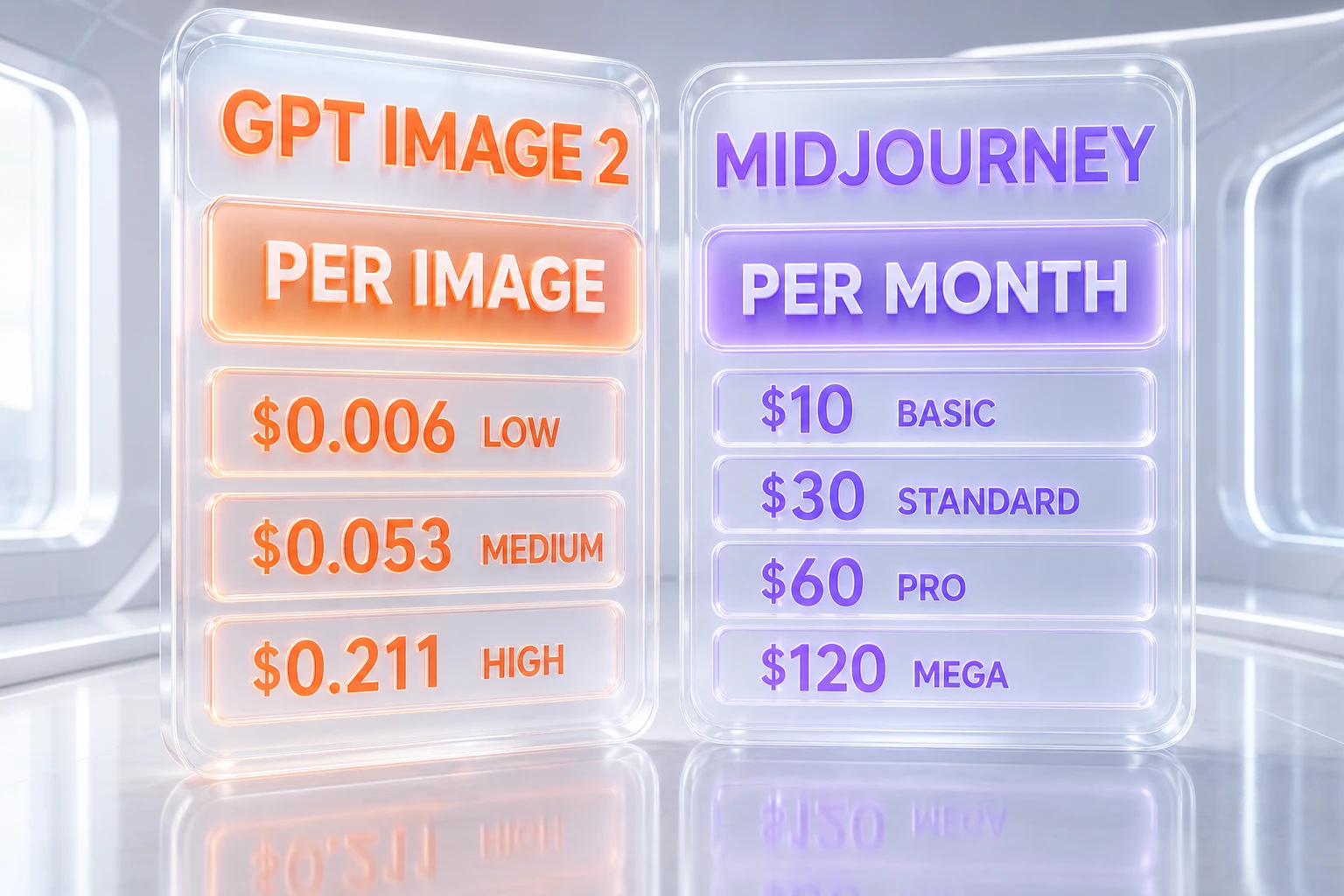
GPT Image 2 — pay per image through the API. Pricing is token-based: about $5 per million text input tokens, $8 per million image input tokens, and $30 per million image output tokens (batch processing roughly halves those rates). Translated to a 1024 by 1024 image, that works out to roughly $0.006 per image at low quality, about $0.053 at medium, and about $0.211 at high quality. There is no free tier and no free trial — every call charges. If you edit with reference images, real cost per finished asset runs closer to two to three times the quoted per-image number.
Midjourney — flat monthly subscription. Four tiers: Basic at $10 per month (about 3.3 fast GPU hours, roughly 200 images), Standard at $30 per month (15 fast hours plus unlimited Relax Mode generations), Pro at $60 per month (30 fast hours plus Stealth Mode for private generation), and Mega at $120 per month (60 fast hours). Annual billing knocks off 20 percent. Extra fast GPU time is $4 per hour. There is no free plan. Standard and above include Relax Mode, which lets you generate unlimited images more slowly once your fast hours run out — the key reason heavy users love the flat fee.
The math that decides it. If you generate a handful of images occasionally or you only need a few high-quality assets per project, GPT Image 2's pay-per-image model is cheaper — you pay $0.006 to $0.211 each and owe nothing when idle. If you generate hundreds or thousands of images per month, Midjourney's flat fee plus Relax Mode is dramatically cheaper, because you stop metering per image entirely. A creator pumping out 2,000 images a month on Midjourney Standard pays $30 flat; the same volume at GPT Image 2 medium quality would cost well over $100. Low volume and text-critical work favor GPT Image 2. High volume and artistic exploration favor Midjourney.
Workflow and who it is for
GPT Image 2 is a developer and product tool. You hit it from an SDK, deploy it through Azure OpenAI or Microsoft Foundry, stream partial images into a UI, and bake it into a content pipeline. You can also use it conversationally inside ChatGPT. It fits teams automating image generation at scale, marketers who need on-image text, and engineers building image features into apps.
Midjourney is a creator tool. You prompt it in the web app or Discord, riff on variations, build an Omni Reference library, and refine a visual style over many iterations. There is no official public API, so it does not slot into automated software pipelines the way GPT Image 2 does. It fits illustrators, art directors, designers, and solo creators who value aesthetic quality and a community to learn from. The 21 million plus user base means prompt knowledge and inspiration are everywhere.
Speed, iteration, and output formats
Speed matters differently for each tool because of how you use them. GPT Image 2 supports streaming with partial images — the API can return zero to three progressively refined frames so a user interface can show an image sharpening in real time, which feels fast inside an app even when the final high-quality render takes longer. At 2K it lands in the single-digit to low-double-digit second range, and 4K naturally takes longer. It outputs PNG by default, plus JPEG and WebP with adjustable compression, and embeds C2PA content credentials for provenance.
Midjourney's iteration story is built around Draft Mode, which generates at roughly ten times the speed of a normal render at half the cost, letting you sketch a direction quickly before committing fast GPU hours to a polished version. That exploratory loop — generate four variations, upscale the one you like, vary it again — is the heart of the Midjourney workflow and is genuinely productive for creative discovery. Where GPT Image 2 optimizes for deterministic, repeatable production output, Midjourney optimizes for fast, fluid creative exploration. Neither approach is strictly better; they suit different temperaments and different jobs.
Full feature comparison
| Feature | GPT Image 2 | Midjourney V8.1 | Winner |
|---|---|---|---|
| Text rendering accuracy | About 99 percent | Weak, often garbled | GPT Image 2 |
| Aesthetic quality | Clean, design-grade | Best in class | Midjourney |
| Max native resolution | Up to 3840 per side | 2K, 2048 px on V8.1 | GPT Image 2 |
| Billing model | Per image, token-based | Flat monthly | Tie |
| Entry cost | About $0.006 per image | $10 per month | Tie |
| Official public API | Yes, mature | No | GPT Image 2 |
| Multilingual text | Latin, CJK, Hindi, Bengali | Not rated | GPT Image 2 |
| Image editing and masks | Yes, native endpoint | Web editor with inpainting | Tie |
| Reference and consistency | Reference images, high fidelity | Omni Reference | Tie |
| Fast iteration mode | Streaming partials | Draft Mode (about 10x faster) | Midjourney |
| Community and learning | Developer docs | 21 million plus on Discord | Midjourney |
| Private generation | API is private by default | Stealth Mode (Pro and up) | Tie |
| Free tier | None | None | Tie |
| Benchmark rank | Number one, Artificial Analysis Arena | Not currently listed | GPT Image 2 |
| Our overall score | 8.6 out of 10 | 8.9 out of 10 | Midjourney |
Where each one ranks on the benchmarks
On the Artificial Analysis Image Arena, which scores models by blind human preference voting, GPT Image 2 (high quality) holds the number one position with an Elo around 1339 across more than ten thousand comparisons. That places it at the top of the public text-to-image leaderboard in 2026. Midjourney is not currently listed on that particular leaderboard, so we will not attach a hard Elo number to it — inventing one would be dishonest. What is well established independently is that Midjourney remains the reference point for aesthetic quality, while GPT Image 2 leads decisively on text rendering, where it reports about 99 percent character accuracy versus Midjourney's well-documented weakness with words.
Pros and cons of each
GPT Image 2 — strengths
- Best-in-class text rendering at about 99 percent accuracy, including CJK, Hindi, and Bengali
- Native 4K output up to 3840 pixels per side, print-ready with no upscaling
- Reasoning before generation keeps complex layouts like infographics coherent
- Mature official API with SDKs, Azure, and Microsoft Foundry deployment
- Pay-per-image billing means you owe nothing when idle
- Number one on the Artificial Analysis Image Arena leaderboard
GPT Image 2 — weaknesses
- Premium per-image cost — about $0.211 at high quality 1024 by 1024
- No free tier or free trial, every call charges tokens
- Reference-image edits bill at high fidelity, multiplying real cost two to three times
- Aesthetic output is clean but less painterly than Midjourney
- Entry rate limits are stingy on the lowest tier
Midjourney — strengths
- Best aesthetic quality of any model we tested, with rich lighting and composition
- Flat monthly billing protects heavy users from surprise per-image bills
- Relax Mode gives unlimited slower generations on Standard and above
- Niji model is a category leader for anime and illustration
- 21 million plus user community for prompts, inspiration, and learning
- Draft Mode iterates roughly ten times faster for exploration
Midjourney — weaknesses
- Text inside images is the weakest area — improved on V8.1 but still behind GPT Image 2
- No official public API, so it does not fit automated software pipelines
- No free plan — entry is $10 per month minimum
- Stealth Mode for private generation requires the $60 per month Pro tier
- Less literal prompt control — it interprets creatively rather than exactly
When to pick GPT Image 2, and when to pick Midjourney
Pick GPT Image 2 if you make posters, ads, packaging, infographics, or any visual with required on-image text; you need multilingual typography; you want print-ready 4K straight from the source; you are a developer wiring image generation into an app or pipeline; or your volume is low enough that pay-per-image beats a monthly fee. It is the production and automation choice, and the text-rendering choice.
Pick Midjourney if your priority is the most beautiful possible image; you make concept art, illustration, editorial visuals, or mood boards; you generate a high volume of images and want a flat predictable bill; you value an iterative, exploratory creative workflow; or you want a large community to learn from. It is the artistic-quality choice, and the high-volume flat-rate choice. The one place it falls down hard is text inside the image — if that matters, look elsewhere.
Real cost scenarios we ran the numbers on
Abstract pricing is hard to reason about, so here are three concrete profiles from the way real teams work. The occasional designer who needs maybe 30 high-quality images a month with text spends about $6 to $7 on GPT Image 2 at high quality, versus $10 minimum on Midjourney Basic — and GPT Image 2 nails the text, so it wins on both cost and fit. The prolific creator generating 2,000 to 3,000 stylized images a month pays a flat $30 on Midjourney Standard with Relax Mode covering the overflow, while the same volume at GPT Image 2 medium quality would run well past $100 — Midjourney wins decisively. The product engineer embedding image generation into an app cannot use Midjourney at all because there is no public API, so GPT Image 2 wins by default regardless of price.
The pattern is consistent: the right answer is set less by which tool is "cheaper" in the abstract and more by your volume, your need for text, and whether you require programmatic access. Run your own numbers against those three axes and the choice usually makes itself.
Final verdict
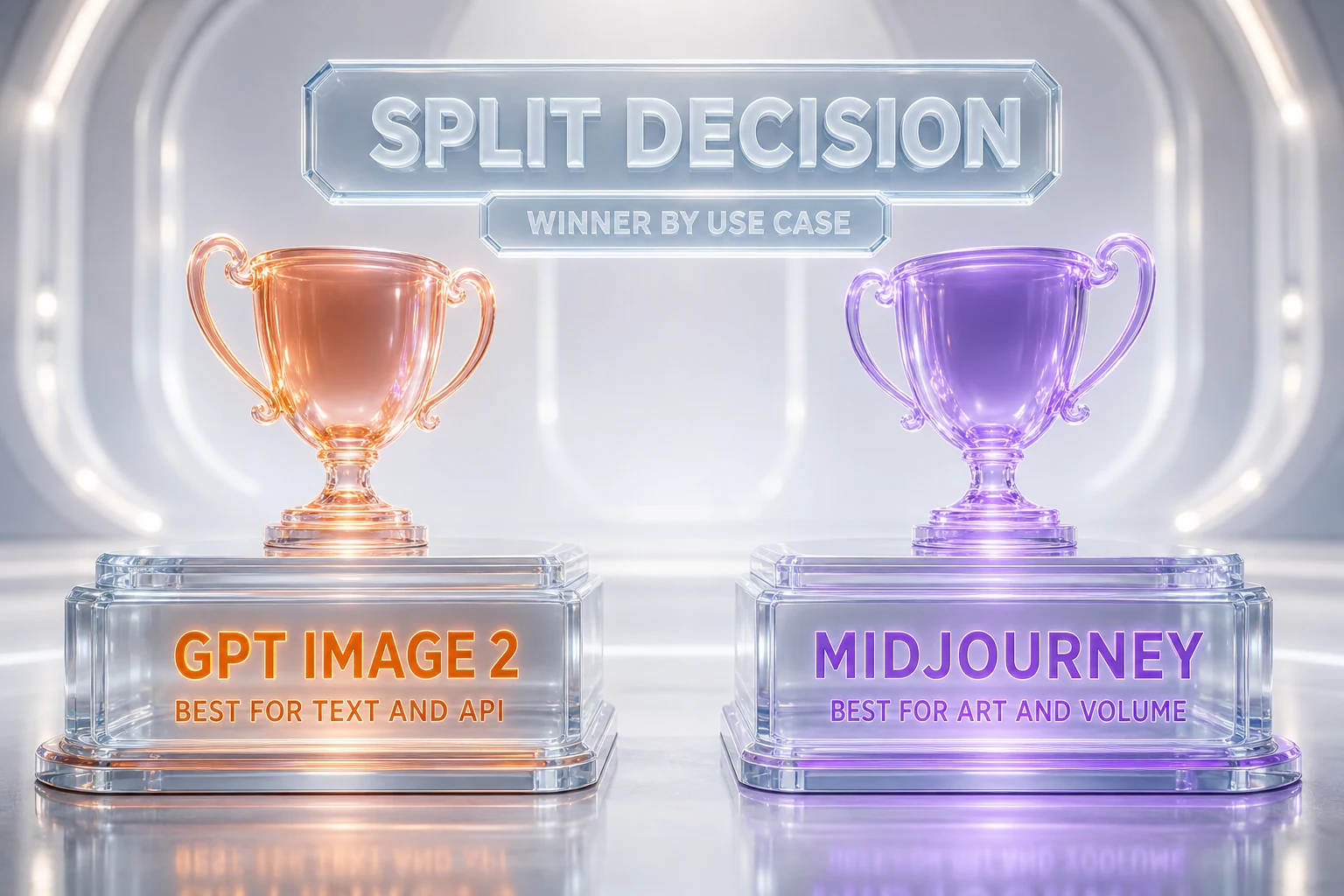
This is a split decision, and an honest one. GPT Image 2 and Midjourney are not really competing for the same job. GPT Image 2 is the better tool if you need words inside the image, print-ready resolution, programmatic API access, or low-volume pay-as-you-go economics — and it sits at number one on the public image arena. Midjourney is the better tool if you want the most beautiful art, a flat monthly bill that scales to thousands of images, and a thriving creative community — and our reviewers scored it a touch higher overall at 8.9 versus 8.6 on the strength of pure aesthetic quality.
If we had to compress it: choose GPT Image 2 for design, text, and automation; choose Midjourney for art, exploration, and volume. Many serious creators we know run both — Midjourney to generate the gorgeous base image, GPT Image 2 to add the legible text on top. There is no single winner here, because there is no single job. Match the tool to the work and the billing model to your volume, and either one will earn its keep.
Frequently asked questions
Is GPT Image 2 better than Midjourney?
It depends on the job. GPT Image 2 is better for text inside images, print-ready 4K resolution, and API automation, and it ranks number one on the Artificial Analysis Image Arena. Midjourney is better for pure aesthetic quality, artistic style, and high-volume generation on a flat monthly fee. Neither wins across the board — pick by use case.
How much does GPT Image 2 cost compared to Midjourney?
They bill differently. GPT Image 2 charges per image: roughly $0.006 at low quality, $0.053 at medium, and $0.211 at high quality for a 1024 by 1024 image, with no free tier. Midjourney charges a flat subscription: $10 per month for Basic, $30 for Standard, $60 for Pro, and $120 for Mega, with 20 percent off annual billing. Low volume favors GPT Image 2; high volume favors Midjourney's flat fee.
Which model renders text inside images better?
GPT Image 2, by a wide margin. It renders text inside an image at roughly 99 percent character accuracy across Latin, Chinese, Japanese, Korean, Hindi, and Bengali scripts. Midjourney, even on the default V8.1, still lags well behind on text and can produce garbled lettering, making it a weaker choice for posters, ads, and infographics that need legible words.
Does Midjourney have an API?
No. Midjourney does not offer an official public API. You use it through the web app or Discord. If you need to generate images programmatically inside software, GPT Image 2 is the clear choice because it ships a mature official API with SDKs and Azure or Microsoft Foundry deployment options.
What is the current Midjourney version?
Midjourney V8.1 is the current default model. It was released on April 30, 2026 and became the default on June 11, 2026, replacing V7. In HD mode it renders at higher resolution than V7 and improves prompt adherence and text, though text inside images is still its weakest area compared with GPT Image 2.
Which produces higher-resolution images?
GPT Image 2. It outputs native resolution up to 3840 pixels per side — true 4K straight from the API without upscaling. Midjourney V8.1 renders native 2K (about 2048 pixels per side) in HD mode. For print-ready output, GPT Image 2 has the resolution edge.
Is Midjourney better for artistic and creative work?
Yes. After years of tuning for aesthetic preference, Midjourney produces the most consistently beautiful, art-directed output of any model we tested. For concept art, illustration, editorial visuals, and mood boards, its default look and its Niji anime model are genuine advantages over GPT Image 2's cleaner, more literal style.
Does either offer a free plan?
No. Neither has a free plan. GPT Image 2 charges per image through the API with no free tier or trial. Midjourney requires a paid subscription starting at $10 per month for Basic, with no free option. Both are paid-only tools.
Can I generate unlimited images on Midjourney?
Effectively, yes, on Standard and above. Those tiers include Relax Mode, which lets you generate unlimited images at a slower speed once your monthly fast GPU hours run out. That is why high-volume creators favor Midjourney's flat fee — there is no per-image meter once you are in Relax Mode.
Should I use GPT Image 2 or Midjourney for marketing visuals?
For marketing visuals with on-image text — headlines, calls to action, pricing, brand copy — use GPT Image 2 because its text rendering is reliable. For mood-driven brand imagery, concept work, or social content where the look matters more than embedded words, Midjourney's aesthetic quality wins. Many teams run both: Midjourney for the base art, GPT Image 2 for the legible text overlay.
Which is easier for non-developers?
Midjourney, for most people. It works through a web app and Discord with no code required and a huge community to learn from. GPT Image 2 is most powerful through its API, which suits developers, though it is also available conversationally inside ChatGPT for non-technical users who do not need automation.
Can I use both together?
Yes, and many creators do. A common workflow is to generate the beautiful base image in Midjourney, then use GPT Image 2 to add accurate text or refine the layout, combining Midjourney's aesthetic strength with GPT Image 2's text-rendering precision. They complement each other rather than fully replacing one another.
Related comparisons
Still weighing your options? See how these two stack up against other frontier image models. Read our GPT Image 2 vs Nano Banana Pro breakdown to compare the two leading API image models head-to-head, or our Midjourney vs Adobe Firefly comparison if you are choosing between the top creative subscriptions. You can also read our full reviews of GPT Image 2 and Midjourney on their own.
Last compared: June 2026. Pricing for GPT Image 2 verified directly against OpenAI developer documentation; Midjourney plan pricing cross-checked across multiple public sources, as Midjourney does not publish an official public API and its pricing page restricts automated access. Benchmark rank sourced from the Artificial Analysis Image Arena. We tested both tools hands-on and disclose that ThePlanetTools may earn a commission from some links at no extra cost to you.
Sources and references
Every figure on this page is attributed to whoever produced it. Vendor documentation and independent measurement are listed separately and never merged into a single ranking.
- OpenAI — Models (model catalogue and capabilities)
- Midjourney — Documentation (model versions and parameters)
- Artificial Analysis — Model leaderboard (Intelligence Index scores and cost per task across configurations)
Our Verdict
Split decision by use case. GPT Image 2 wins on text inside images (about 99 percent accuracy), native 4K resolution, official API access, and low-volume pay-per-image economics, and it ranks number one on the Artificial Analysis Image Arena. Midjourney wins on pure aesthetic quality, flat-rate billing that scales to thousands of images, the Niji anime model, and a 21 million plus creative community. Pick GPT Image 2 for design, text, and automation; pick Midjourney for art, exploration, and high-volume flat-fee work. winner_id is null because the two solve different jobs.
Choose GPT Image 2
OpenAI's flagship image model — 99% text accuracy, native 4K, reasoning before generation. Pay-per-image API.
Try GPT Image 2 →Frequently Asked Questions
Is GPT Image 2 better than Midjourney?
Split decision by use case. GPT Image 2 wins on text inside images (about 99 percent accuracy), native 4K resolution, official API access, and low-volume pay-per-image economics, and it ranks number one on the Artificial Analysis Image Arena. Midjourney wins on pure aesthetic quality, flat-rate billing that scales to thousands of images, the Niji anime model, and a 21 million plus creative community. Pick GPT Image 2 for design, text, and automation; pick Midjourney for art, exploration, and high-volume flat-fee work. winner_id is null because the two solve different jobs.
Which is cheaper, GPT Image 2 or Midjourney?
GPT Image 2 starts at $0.01/image. Midjourney starts at $10/month. Check the pricing comparison section above for a full breakdown.
What are the main differences between GPT Image 2 and Midjourney?
The key differences span across 15 features we compared. For Text rendering accuracy, GPT Image 2 offers About 99 percent while Midjourney offers Weak, often garbled. For Aesthetic quality, GPT Image 2 offers Clean, design-grade while Midjourney offers Best in class. For Max native resolution, GPT Image 2 offers Up to 3840 per side (4K) while Midjourney offers 2K on V7. See the full feature comparison table above for all details.