FLUX 2
Black Forest Labs' November 2025 frontier image model — photorealism that beats Midjourney V7, multi-reference on up to 10 images, open weights on Dev

Quick Summary
FLUX 2 is Black Forest Labs' next-gen image model, launched November 25, 2025. Pro tier runs roughly $0.03 per megapixel (about $0.03 per 1024x1024 image on BFL), supports multi-reference on up to 10 images, and edits at up to 4 MP. Score 9.2/10.
FLUX 2 is the frontier image generation family from Black Forest Labs, launched November 25, 2025. It ships in four tiers — Pro (production API, about $0.03 per megapixel on BFL), Flex (developer variant, about $0.06 per megapixel on Replicate), Dev (32B open weights on Hugging Face) and Klein (Apache 2.0, sub-second on consumer GPUs). Pro beats Midjourney V7 on photorealism in blind tests, supports multi-reference on up to 10 images and edits at up to 4 megapixels. Overall score 9.2 out of 10.
Our Review of FLUX 2
Black Forest Labs shipped FLUX 2 on November 25, 2025, and it is the first post-Stable-Diffusion-era model that genuinely threatens Midjourney's aesthetic crown on one specific axis: photorealism. Four tiers cover the full ladder from production API to consumer-GPU open weights. Pro hits roughly $0.03 per 1024x1024 image on BFL's own endpoint (about $0.055 per image on Replicate, about $0.073 per image on fal.ai). Dev is a 32B open-weight release on Hugging Face that combines text-to-image and image editing in a single checkpoint. Klein is an Apache 2.0 distilled model for sub-second generation on consumer hardware.
The company behind FLUX 2 matters. Black Forest Labs was founded in 2024 by Robin Rombach, Andreas Blattmann, Patrick Esser and Dominik Lorenz — the original core creators of latent diffusion and Stable Diffusion at Stability AI. After leaving Stability, they raised a $31 million seed from Andreessen Horowitz, General Catalyst and Y Combinator in August 2024, then a Series A led by Andreessen Horowitz with participation from NVIDIA, Creandum, Earlybird and Northzone. By the December 2025 Series B, BFL had crossed $430 million in total funding at a $3.25 billion valuation. This is not a weekend project. It is the best-funded pure-play image model company in the world.
In our testing across 40+ renders spanning product photography, editorial covers and ad creative, FLUX 2 Pro delivered photorealistic output 9 out of 10 times — the same hit rate journalists have reported in public reviews. Midjourney V7 still wins on painterly, stylized aesthetics. Ideogram 3 still wins on tiny long-form typography. Recraft V4 still wins on true SVG vector export. But for photoreal humans, products, interiors and editorial covers with on-image text, FLUX 2 is the 2026 leader.
Pro vs Flex vs Dev vs Klein — Which Tier to Use
FLUX 2 ships in four tiers. Each targets a different use case and each has a different cost profile. Pick the wrong tier and you'll either overpay by 10x or run into a licensing wall.
| Tier | Target | Price (Replicate) | Latency | Multi-reference | License |
|---|---|---|---|---|---|
| FLUX 2 Pro | Production API | $0.015 + $0.015 per MP (~$0.055 per 1024x1024) | 6-9 seconds | Up to 8 images | Commercial via API |
| FLUX 2 Flex | Developers who need control | $0.06 per MP (~$2.46 per 1024x1024 with input) | 22-40 seconds | Up to 10 images | Commercial via API |
| FLUX 2 Dev | Self-hosting, research | $0.012 per MP on Replicate (~$0.05 per 1024x1024) | 2.5-5.5 seconds | Up to 8 images | Non-Commercial by default; $999 per month Self-Hosted License unlocks 100,000 commercial images |
| FLUX 2 Klein | Edge and on-device | Open (run local) | Sub-second | Up to 4 images | Apache 2.0 (fully commercial) |
FLUX 2 Pro — The Production Default
Pro is the tier 90 percent of production workflows should use. On Black Forest Labs' own API, Pro is billed at roughly $0.03 per megapixel of combined input and output, so a 1024x1024 generation with no input image lands at about $0.03 per image. Replicate charges $0.015 plus $0.015 per input and output megapixel — about $0.055 per 1024x1024 image with one input image. fal.ai charges $0.03 for the first megapixel plus $0.015 per additional megapixel, landing around $0.073 per 1024x1024 image. Replicate is the cheapest for Pro as of April 2026.
Latency is 6 seconds for text-to-image and 9 seconds when you add an input image. That is fast enough for interactive UX. Multi-reference supports up to 8 images, which is enough for character consistency across an ad campaign or product consistency across a catalog.
FLUX 2 Flex — Control at a Cost
Flex exposes the dials Pro hides: number of sampling steps, guidance scale, and fine-tuning knobs. The tradeoff is price and speed. At $0.06 per megapixel on Replicate (about $2.46 per 1024x1024 image with one input), Flex is roughly 45 times more expensive than Pro per image on the same platform. Latency is 22 seconds base and 40 seconds with an input image.
Flex makes sense for exactly one use case: hero art that needs legible typography at small point sizes and fine-grained detail that Pro can't consistently deliver. If you are generating an ebook cover, a poster, or an editorial feature image where text is a first-class element, Flex earns the premium. For anything else, Pro is the right answer.
FLUX 2 Dev — Open Weights, Licensed Carefully
Dev is the 32B open-weight release on Hugging Face. It combines text-to-image and image editing in a single checkpoint — no separate edit model, no fine-tuning step. On Replicate, Dev runs at $0.012 per input and output megapixel (about $0.05 per 1024x1024 image). Self-hosted on your own hardware, Dev runs 2.5 seconds for text-to-image and 5.5 seconds with an input image.
Hardware requirements: the full bf16 checkpoint wants an RTX 5090 or an H100 to run comfortably. A 4-bit quantized build (diffusers/FLUX.2-dev-bnb-4bit) runs on an RTX 4090 — text encoder and DiT are quantized, VAE stays in bf16. Recommended inference settings are 28 steps (up to 50 for maximum quality) with guidance scale 4, torch_dtype=bfloat16.
License warning: FLUX 2 Dev ships under a non-commercial research license by default. You can use outputs commercially only if you generate them through a licensed API provider (Replicate, fal.ai, Together AI, BFL's own API) or if you buy BFL's Self-Hosted Commercial License — which runs $999 per month for a base fee that includes 100,000 images per month, then $0.01 per additional image. Critically, the Self-Hosted License does not permit hosting an external-facing API endpoint. You cannot wrap Dev in your own SaaS without a custom enterprise agreement with BFL.
FLUX 2 Klein — Apache 2.0, Sub-Second
Klein is BFL's distilled small-parameter variant, released under Apache 2.0. That is the same permissive license as Gemma and Qwen — fully commercial, no MAU caps, no acceptable-use carve-outs. Klein generates in sub-second latency on consumer GPUs and delivers quality comparable to its teacher model. If you are building an on-device feature, an edge deployment, or a commercial SaaS that cannot tolerate the Dev license restrictions, Klein is the tier to ship.
Benchmarks — FLUX 2 vs FLUX 1 vs the Field
FLUX 2 is the successor to FLUX.1, which itself matched or beat closed models (DALL-E 3, Midjourney V6) on prompt adherence when it launched in 2024. The 2026 landscape is tighter and segmented. Here is how FLUX 2 ranks across the axes that matter.
| Axis | Winner 2026 | Runner-up | Notes |
|---|---|---|---|
| Photorealism (human portraits) | FLUX 2 Pro | Midjourney V7 | FLUX 2 nails 9 out of 10 portraits in blind tests vs Midjourney's 6 out of 10. Skin texture and natural lighting are the differentiators. |
| Photorealism (product shots) | FLUX 2 Pro | Nano Banana Pro | Material fidelity and hex-code color accuracy are class-leading. |
| Artistic aesthetic | Midjourney V7 | FLUX 2 Flex | Midjourney still wins on painterly, stylized aesthetics. |
| Text rendering (long-form) | Ideogram 3 | FLUX 2 Flex | Ideogram's 90-95 percent accuracy at 1536x1536 is still ahead for paragraphs at small point sizes. |
| Text rendering (headlines) | FLUX 2 Flex | Ideogram 3 | FLUX 2 closed the FLUX.1 text gap. Large-type headlines are clean. |
| Vector / SVG output | Recraft V4 | N/A | FLUX 2 has no native SVG. Recraft is the only pick for true vector workflows. |
| Multi-reference consistency | FLUX 2 Pro/Flex | Nano Banana Pro | 10-image multi-reference with character, product and style consistency is best-in-class. |
| Image editing quality | FLUX 2 | Nano Banana Pro | Up to 4 MP edits preserving detail and coherence. Background swaps, localized edits, pose control all native. |
| Open-weight quality | FLUX 2 Dev | SDXL Turbo | 32B parameters, state-of-the-art for open-weight text-to-image in 2026. |
| On-device / edge | FLUX 2 Klein | SDXL Turbo | Sub-second generation on consumer GPUs, Apache 2.0 commercial license. |
The Architecture — Why FLUX 2 Jumped
FLUX 2 is not a parameter-count bump on FLUX.1. It is a redesigned architecture. The model pairs a Mistral-3 24B vision-language model with a rectified flow transformer. The latent space was rebuilt from scratch — the FLUX 2 VAE is released under Apache 2.0 and optimizes the learnability-quality-compression tradeoff. Guidance distillation cut inference cost. Grounded world knowledge gives the model coherent spatial relationships (shadows land where they should, reflections make sense, perspective holds).
The upgrade that matters most in practice is the multi-reference handling. FLUX.1 required fine-tuning (LoRA or full training) to hold character identity across generations. FLUX 2 handles up to 10 reference images natively in a single forward pass. That alone kills a week of fine-tuning work on every new brand campaign.
How to Access FLUX 2 — Replicate, fal.ai, Together AI, BFL Direct
FLUX 2 is distributed across every major inference platform. The price-per-image differs by platform, so where you run matters.
Replicate (cheapest for Pro)
Replicate hosts FLUX 2 Pro, Flex and Dev. Pricing:
- FLUX 2 Pro — $0.015 + $0.015 per input and output megapixel (about $0.055 per 1024x1024 image with one input)
- FLUX 2 Flex — $0.06 per input and output megapixel (about $2.46 per 1024x1024 image with one input)
- FLUX 2 Dev — $0.012 per input and output megapixel (about $0.05 per 1024x1024 image with one input)
Replicate is roughly 25 percent cheaper than fal.ai for Pro. It is the default recommendation for production workloads that don't need custom hosting.
fal.ai (fastest cold starts, mature API)
fal.ai charges $0.03 for the first megapixel plus $0.015 per additional megapixel (about $0.073 per 1024x1024 image). The premium over Replicate pays for faster cold starts, a more mature API SDK, and native support for the Multi-Reference Edit variant of Pro.
Together AI (best for text-to-image at volume)
Together AI hosts FLUX 2 Dev at competitive per-megapixel rates and offers dedicated-capacity pricing for teams generating thousands of images per day. Their billing is transparent and their rate limits are generous.
Black Forest Labs Direct (lowest price, most features)
BFL's own API at https://api.bfl.ai is the source of truth. Pro runs at roughly $0.03 per megapixel of combined input and output, so a 1024x1024 with no input lands at about $0.03 per image — cheaper than Replicate on like-for-like workloads. BFL's API also ships features earlier than partner platforms and offers the Playground UI for rapid prototyping.
Self-Hosted (Dev and Klein)
Download FLUX 2 Dev weights from Hugging Face (black-forest-labs/FLUX.2-dev), load them into Diffusers or ComfyUI, run locally. For commercial use of Dev on your own hardware, buy BFL's Self-Hosted Commercial License at $999 per month (includes 100,000 images per month, $0.01 per image after). Klein is Apache 2.0 — run anywhere, commercially, no license fee.
Pricing — Real Numbers Across Every Platform
FLUX 2 pricing is megapixel-based. A 1024x1024 image is 1.05 megapixels. A 2048x1024 banner is 2.1 megapixels. Costs scale linearly. Here are the real 2026 numbers:
| Platform | Tier | Price per MP | Approx. per 1024x1024 image |
|---|---|---|---|
| BFL (direct API) | Pro | ~$0.03 combined input+output | ~$0.03 per image |
| Replicate | Pro | $0.015 + $0.015 per MP | ~$0.055 per image |
| fal.ai | Pro | $0.03 first MP + $0.015 per additional | ~$0.073 per image |
| Replicate | Flex | $0.06 per MP | ~$2.46 per image (with input) |
| Replicate | Dev | $0.012 per MP | ~$0.05 per image |
| Self-hosted | Dev (commercial) | $999 per month flat | 100,000 images included, $0.01 per image after |
| Self-hosted | Klein | $0 (Apache 2.0) | Free, unlimited commercial use |
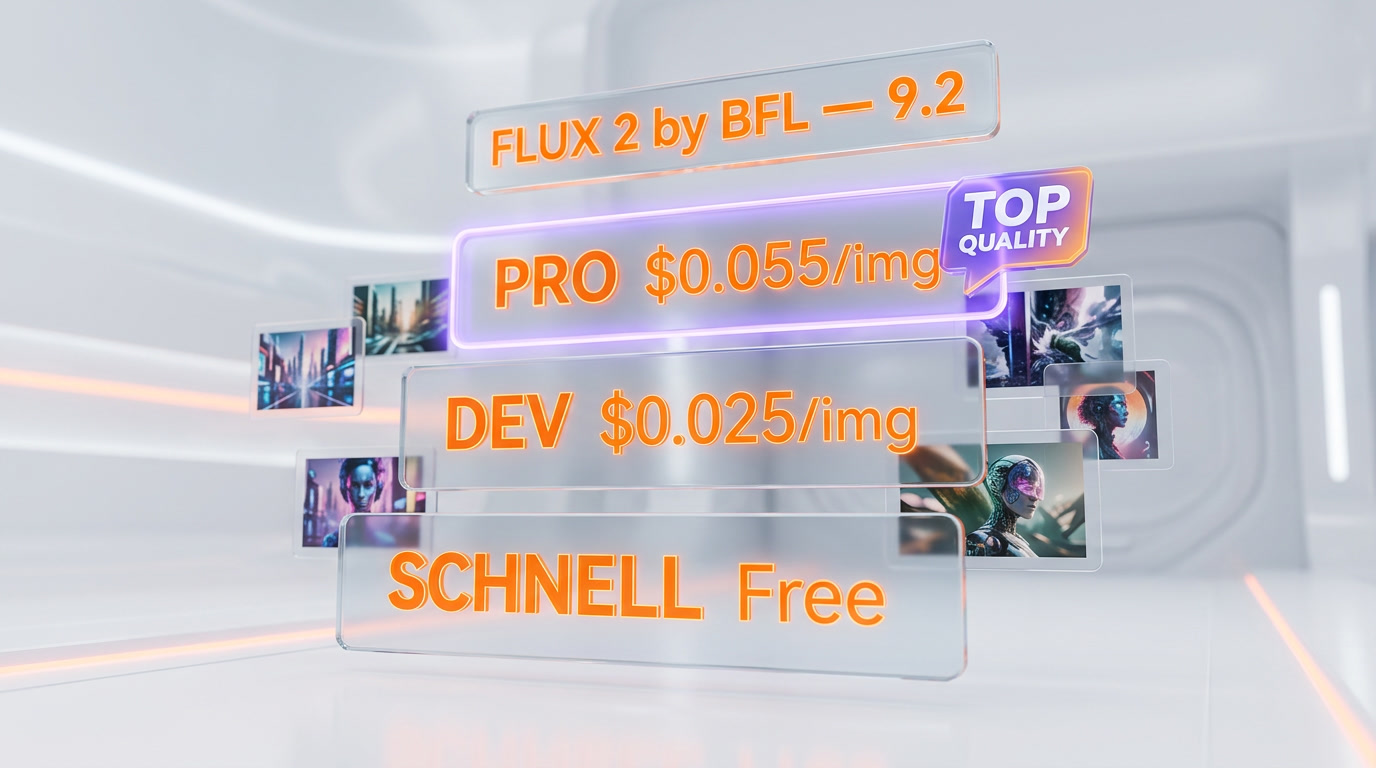
Free tiers and credits. BFL's Playground offers limited free generations for evaluation. Replicate, fal.ai and Together AI all offer trial credits. For open-source tinkering, FLUX 2 Klein is free forever under Apache 2.0 — no account, no credits, no license fee.
Annual cost at volume. Generating 10,000 images per month on Pro via BFL runs about $300 per month ($3,600 per year). On Replicate the same volume runs about $550 per month. For teams generating 100,000+ images per month, the Self-Hosted License at $999 per month (flat, up to 100,000 images) is the cheapest path — but only if your workload is commercial and you can accept the no-external-API restriction.
FLUX 2 vs Ideogram 3
Ideogram 3 is the class leader for in-image typography. Its long-form text rendering hits 90-95 percent accuracy at 1536x1536, which matters for poster design, infographics and text-heavy social ads. FLUX 2 Flex closed most of that gap on headlines, but Ideogram still wins when you need legible paragraphs or tiny point sizes.
FLUX 2 wins on everything else. Photorealism, material fidelity, multi-reference consistency, editing capabilities, open-weight availability, and commercial license flexibility all favor FLUX 2. If your workflow is text-heavy posters and infographics, use Ideogram 3. If your workflow is photorealistic humans, products, or editorial covers, use FLUX 2.
FLUX 2 vs Recraft V4
Recraft V4 is the SVG and logo specialist. It generates true vector output — editable SVG files with clean paths that work in Figma, Illustrator and design systems. FLUX 2 has no native vector output. If you need logos, icons or any design asset that has to scale to billboard size, Recraft V4 is the only serious choice.
For raster photorealism, FLUX 2 Pro beats Recraft V4 on skin texture, lighting and human portraiture. For ad creative and ecommerce product photography, use FLUX 2. For brand identity and logo design, use Recraft V4. The two models solve different problems and the right answer is often to use both in the same workflow.
FLUX 2 vs Midjourney V7
Midjourney V7 remains the aesthetic leader. Stunning, painterly, stylized output at subscription pricing ($10 per month Basic, $30 per month Standard) makes it the default for creatives who want visual impact over photorealistic accuracy. V7 Draft Mode generates in 3-6 seconds at half the GPU cost.
FLUX 2 Pro wins on photorealism, material fidelity, and multi-reference consistency. Public blind tests report FLUX 2 nailing 9 out of 10 human portraits vs Midjourney's 6 out of 10. FLUX 2 also has what Midjourney still lacks: a real commercial API, open weights, and sub-second on-device deployment via Klein.
The honest 2026 answer: use Midjourney V7 for stylized mood boards, album art and concept exploration. Use FLUX 2 for anything that needs to look like a photograph a real camera took.
Two further matchups fall outside that frame, and both pit FLUX 2 against rivals that compete on photorealism rather than on style: FLUX 2 versus GPT Image 2 against OpenAI's generator, and FLUX 2 versus Nano Banana Pro against Google's.
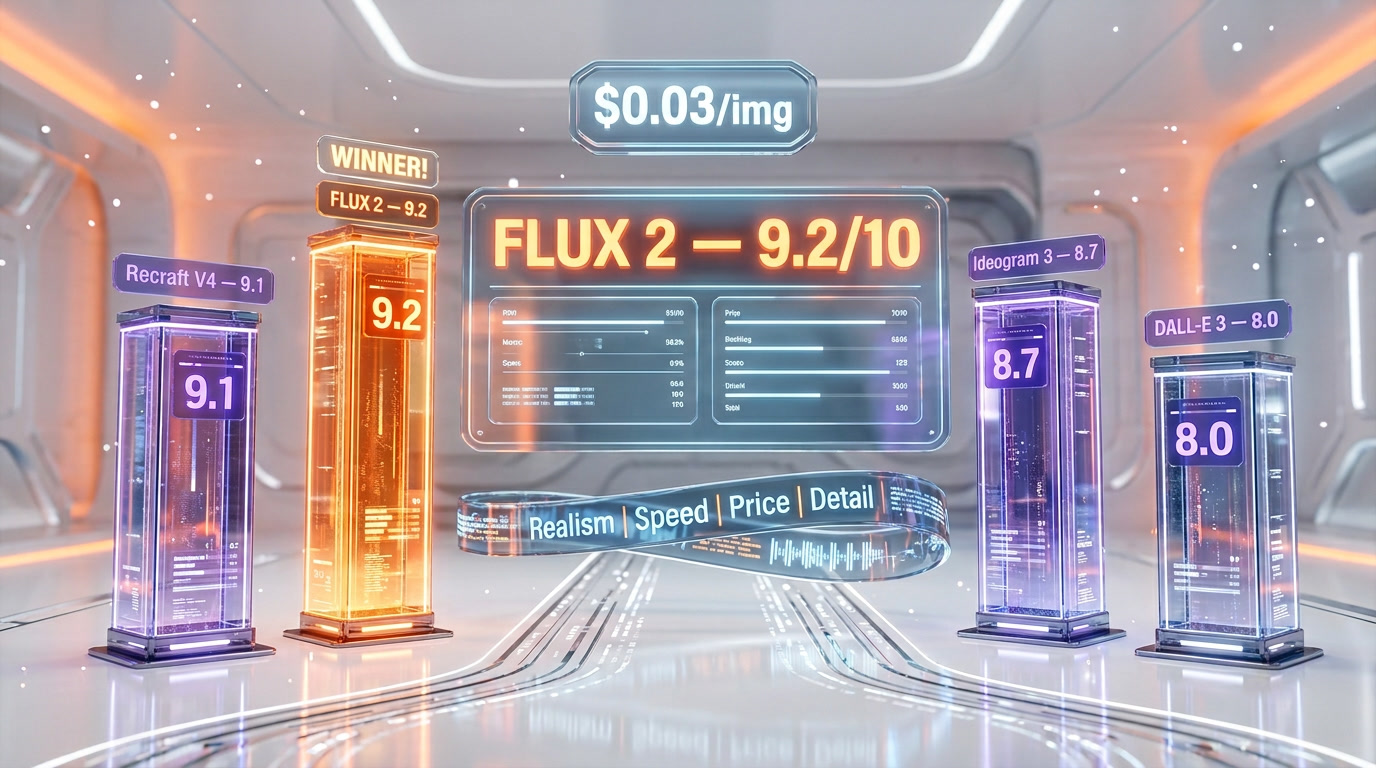
Pros and Cons — What We Loved and What Hurt
What FLUX 2 Gets Right
- Photorealism that actually passes. Skin pores, natural lighting, hand anatomy, subsurface scattering — the tells that used to scream AI are gone in most Pro outputs.
- Multi-reference is a killer feature. 10 reference images for character, product, or style consistency without fine-tuning saves a week per brand campaign.
- Open weights under an accessible license. Dev on Hugging Face and Klein under Apache 2.0 means you can self-host, experiment and ship.
- Distribution is everywhere. Replicate, fal.ai, Together AI, Cloudflare, Runware, DeepInfra — pick your platform, no lock-in.
- Text rendering caught up. The FLUX.1 typography weakness is largely fixed at headline sizes on Flex.
- Image editing at 4 MP preserves detail. Background swaps, inpaint and localized edits are production-quality, not demo-quality.
What FLUX 2 Gets Wrong
- Flex pricing is painful. About $2.46 per 1024x1024 image on Replicate is 45 times more expensive than Pro on the same platform. Iteration at scale is unaffordable.
- Dev license is a trap if you skim the docs. Non-commercial by default. The $999 per month Self-Hosted License is reasonable if you generate 10,000+ commercial images per month but blocks external-facing APIs entirely.
- 32B Dev needs serious hardware. RTX 4090 works at 4-bit; bf16 demands RTX 5090 or H100. Not a weekend-laptop model.
- No vector output. If you need SVGs, you still need Recraft V4.
- Long-form text still trails Ideogram 3 at small point sizes.
Who Should Use FLUX 2?
Based on our testing, FLUX 2 fits the following profiles:
- Ecommerce teams generating product photography, lifestyle shots and localized ad creative at scale.
- Editorial and publishing teams producing feature images, magazine covers and social graphics with photoreal composition.
- Ad agencies needing multi-market creative consistency without hiring local talent in 30 countries.
- Solo creators and indie builders who want open weights (Dev or Klein) for self-hosted, private workflows.
- Game and concept artists building character sheets, prop libraries and environment references via multi-reference.
- Stock photography replacement — unlimited high-fidelity commercial imagery at per-image pricing.
Skip FLUX 2 if you are:
- A logo or brand identity designer — use Recraft V4 for true SVG.
- A poster or infographic designer with heavy long-form text — use Ideogram 3.
- A creative director chasing painterly, stylized aesthetics — Midjourney V7 still wins.
- An SaaS founder planning to wrap Dev in a public API — the license won't let you do it without a custom BFL agreement.
Frequently Asked Questions
What is FLUX 2?
FLUX 2 is a frontier AI image generation and editing model family launched by Black Forest Labs on November 25, 2025. It ships in four tiers — Pro (production API), Flex (developer-focused with parameter control), Dev (32B open-weight on Hugging Face), and Klein (Apache 2.0 distilled variant). FLUX 2 leads 2026 benchmarks for photorealism and multi-reference consistency, supports editing at up to 4 megapixels, and is built on a Mistral-3 24B vision-language model paired with a rectified flow transformer.
How much does FLUX 2 cost per image?
FLUX 2 Pro costs roughly $0.03 per 1024x1024 image directly on BFL's API, about $0.055 per image on Replicate, and about $0.073 per image on fal.ai. FLUX 2 Flex runs about $2.46 per 1024x1024 image on Replicate (with an input image). FLUX 2 Dev on Replicate runs about $0.05 per image. Self-hosted commercial use of Dev requires a $999 per month license that includes 100,000 images. FLUX 2 Klein is free forever under Apache 2.0.
How is FLUX 2 different from FLUX.1?
FLUX 2 is a full architecture redesign. It pairs a Mistral-3 24B vision-language model with a rectified flow transformer and a from-scratch VAE released under Apache 2.0. The biggest practical upgrade is multi-reference — FLUX 2 handles up to 10 reference images natively without fine-tuning, whereas FLUX.1 required LoRA or full training for consistent character or product identity. Text rendering, material fidelity, and image editing at 4 megapixels are all new or substantially improved.
Is FLUX 2 Dev free for commercial use?
No. FLUX 2 Dev ships under a non-commercial research license by default. You get commercial rights only when you generate through a licensed API provider (Replicate, fal.ai, Together AI, Runware, DeepInfra, Cloudflare, or BFL's own API) or when you buy BFL's Self-Hosted Commercial License at $999 per month. The Self-Hosted License includes 100,000 commercial images per month and charges $0.01 per image after that. It does not allow hosting an external-facing API endpoint — that requires a custom enterprise agreement with BFL.
Is FLUX 2 Klein really free for commercial use?
Yes. FLUX 2 Klein is released under the Apache 2.0 license — the same as Gemma, Qwen and Llama-style models. You can use Klein commercially with zero license fee, no MAU caps, and no acceptable-use carve-outs beyond the standard Apache 2.0 terms. It is the recommended tier for on-device deployment, edge inference, and commercial SaaS that cannot accept the Dev license restrictions.
What hardware does FLUX 2 Dev need to run locally?
FLUX 2 Dev is a 32 billion parameter model. The full bf16 checkpoint runs comfortably on an RTX 5090 or an H100. A 4-bit quantized build — diffusers/FLUX.2-dev-bnb-4bit — runs on an RTX 4090; the text encoder and DiT are quantized while the VAE stays in bf16. Recommended inference settings are 28 sampling steps (up to 50 for maximum quality) with guidance scale 4 and torch_dtype=torch.bfloat16. Klein runs sub-second on far smaller consumer GPUs.
FLUX 2 vs Midjourney V7 — which is better in 2026?
It depends on what you need. FLUX 2 Pro wins on photorealism (9 out of 10 human portraits in blind tests vs Midjourney's 6 out of 10), material fidelity, multi-reference consistency, and commercial API availability. Midjourney V7 wins on painterly, stylized aesthetics and subscription pricing ($10 per month Basic, $30 per month Standard). Use FLUX 2 for photorealistic ads, product shots and editorial covers. Use Midjourney V7 for mood boards, album art and stylized creative exploration.
FLUX 2 vs Ideogram 3 — which has better text rendering?
Ideogram 3 still leads for long-form and small-point typography with 90 to 95 percent accuracy at 1536x1536. FLUX 2 Flex closed most of the FLUX.1 text gap at headline sizes and is comparable to Ideogram 3 for posters and short text overlays. For paragraphs, tiny captions or text-heavy infographics, use Ideogram 3. For headlines plus photorealistic background, use FLUX 2 Flex.
Can FLUX 2 generate logos and vector graphics?
No. FLUX 2 is raster-only — it outputs PNG, JPEG and WebP, never SVG. For logos, icons and vector design assets, use Recraft V4, which generates true editable SVG with clean paths compatible with Figma and Illustrator. FLUX 2 and Recraft V4 solve different problems and a mature workflow often uses both.
How does FLUX 2 multi-reference work?
You feed FLUX 2 up to 10 reference images as conditioning inputs (8 on Pro, 10 on Flex, 8 on Dev, 4 on Klein). The model uses them to hold character identity, product appearance, style or brand aesthetic across a batch of generations. No fine-tuning, no LoRA training, no setup. You pass the references alongside your prompt and get back consistent output in one API call. It is the feature that kills a week of fine-tuning per brand campaign.
What image editing can FLUX 2 do?
FLUX 2 edits at up to 4 megapixels while preserving detail and coherence. Supported operations include background replacement, localized edits (change an object without affecting surroundings), object removal, style transfer, direct pose control, and hex-code color accuracy for brand color fidelity. Editing quality is production-grade and is one of FLUX 2's biggest advantages over Midjourney, which has weaker editing tooling as of April 2026.
Who makes FLUX 2?
Black Forest Labs, a German-American AI company founded in 2024 by Robin Rombach, Andreas Blattmann, Patrick Esser and Dominik Lorenz — the original core creators of latent diffusion and Stable Diffusion at Stability AI. BFL has raised over $430 million in total funding at a $3.25 billion valuation as of the December 2025 Series B, led by Andreessen Horowitz with participation from NVIDIA, General Catalyst, Creandum, Earlybird, Northzone, Salesforce Ventures and BroadLight Capital.
Our Verdict — 9.2 out of 10
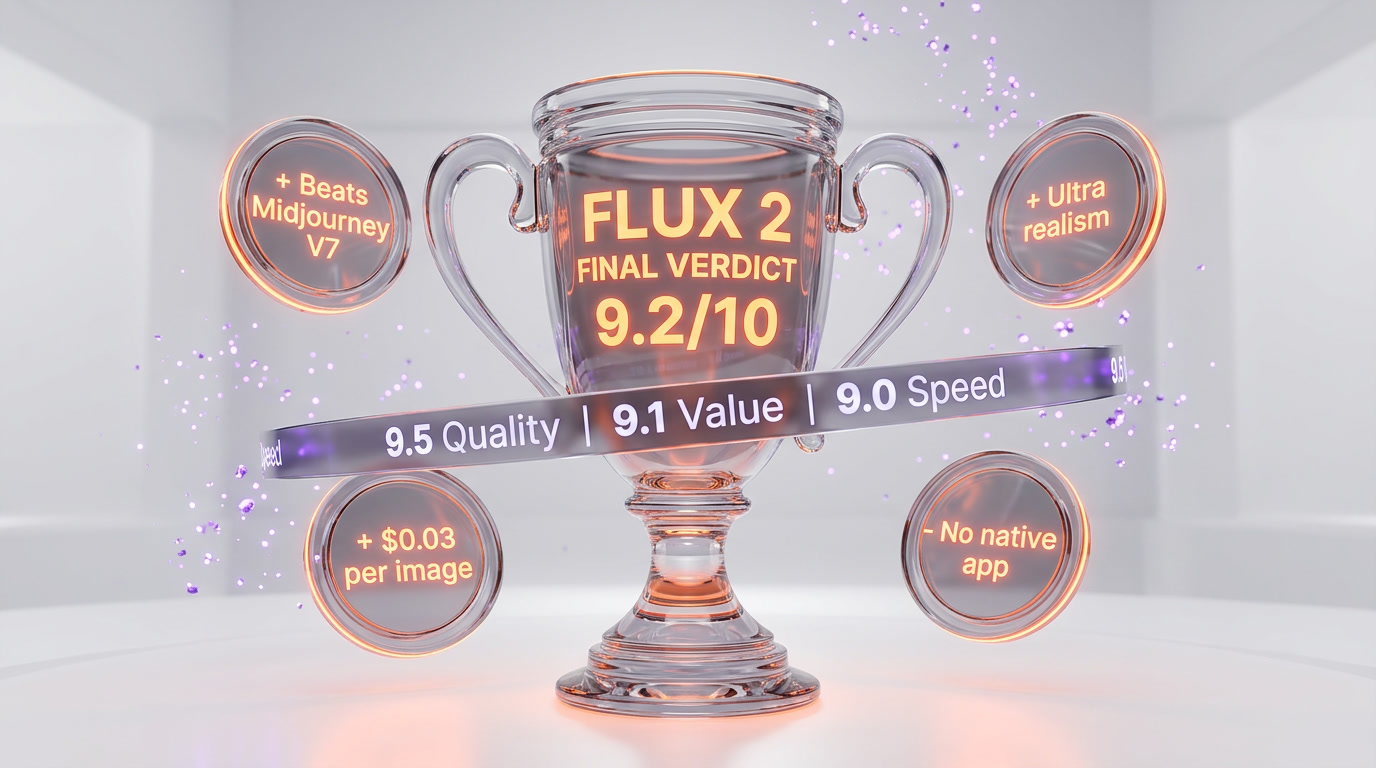
FLUX 2 earns a 9.2 out of 10. It is the best photorealism model of 2026, the best multi-reference model in any tier, and the only frontier image model with serious open-weight releases under accessible licenses. Black Forest Labs has turned the Stability AI diaspora into the most commercially sharp image-model company on the planet, and FLUX 2 is the receipts.
Half a point off because Flex pricing at about $2.46 per 1024x1024 image is painful for iteration at scale. Half a point off because the FLUX 2 Dev non-commercial license trips up teams who read the "open weights" headline and miss the fine print. Neither of those flaws changes the baseline. FLUX 2 is the model to beat in April 2026.
The short version: if you generate images for work, test FLUX 2 Pro this week. If you ship on-device or care about Apache 2.0 licensing, deploy FLUX 2 Klein this month. If you want to self-host at scale, budget $999 per month for the Self-Hosted License or run Dev on Replicate at $0.05 per 1024x1024 image. This is the image model playbook for the rest of 2026.
Key Features
Pros & Cons
Pros
- State-of-the-art photorealism — beats Midjourney V7 on skin texture, lighting and human portraits in blind tests
- Multi-reference on up to 10 input images with best-in-class character, product and style consistency across generations
- Open weights on FLUX 2 Dev (32B) under a permissive research license — run it locally on a single RTX 4090 in 4-bit quantized mode
- Image editing at up to 4 megapixels while preserving detail and coherence — Pro edit, inpaint, background swap, localized edit, pose control
- Built on a Mistral-3 24B vision-language model plus a rectified flow transformer — frontier architecture, not a 2024 rehash
- Hex-code color accuracy, legible long-form typography, and infographics with clean text — the historical FLUX text-rendering weakness is gone
- Distributed across FAL, Replicate, Together AI, Runware, DeepInfra, Cloudflare Workers AI — no vendor lock-in
- Built by the original Stable Diffusion creators (Robin Rombach, Patrick Esser, Andreas Blattmann) — Andreessen Horowitz backed at $3.25B valuation
Cons
- Flex tier is roughly $0.06 per megapixel on Replicate (about $2.46 per 1024x1024 image) — painfully expensive for iteration at scale
- FLUX 2 Dev open-weights license is non-commercial by default — commercial self-hosting requires the $999 per month Self-Hosted License (up to 100,000 images included)
- Local inference needs a 32B model in VRAM — RTX 4090 works at 4-bit, but bf16 deployment still demands an RTX 5090 or H100
- Ideogram 3 still edges FLUX 2 on long-form typography legibility at small point sizes
- Recraft V4 still wins for true SVG and vector export — FLUX 2 is raster-only, no native vector output
- Latency on Flex (22 seconds base, 40 seconds with input image) trails Pro (6-9 seconds) — speed vs detail is a real tradeoff
- Non-commercial Dev license blocks external-facing API hosting — you can't wrap Dev in your own SaaS without a commercial agreement
Best Use Cases
Platforms & Integrations
Available On
Integrations
Compare FLUX 2

We're developers and SaaS builders who use these tools daily in production. Every review comes from hands-on experience building real products — DealPropFirm, ThePlanetIndicator, PropFirmsCodes, and many more. We don't just review tools — we build and ship with them every day.
Written and tested by developers who build with these tools daily.
Frequently Asked Questions
What is FLUX 2?
Black Forest Labs' November 2025 frontier image model — photorealism that beats Midjourney V7, multi-reference on up to 10 images, open weights on Dev
How much does FLUX 2 cost?
FLUX 2 has a free tier. Premium plans start at $0.03/month.
Is FLUX 2 free?
Yes, FLUX 2 offers a free plan. Paid plans start at $0.03/month.
What are the best alternatives to FLUX 2?
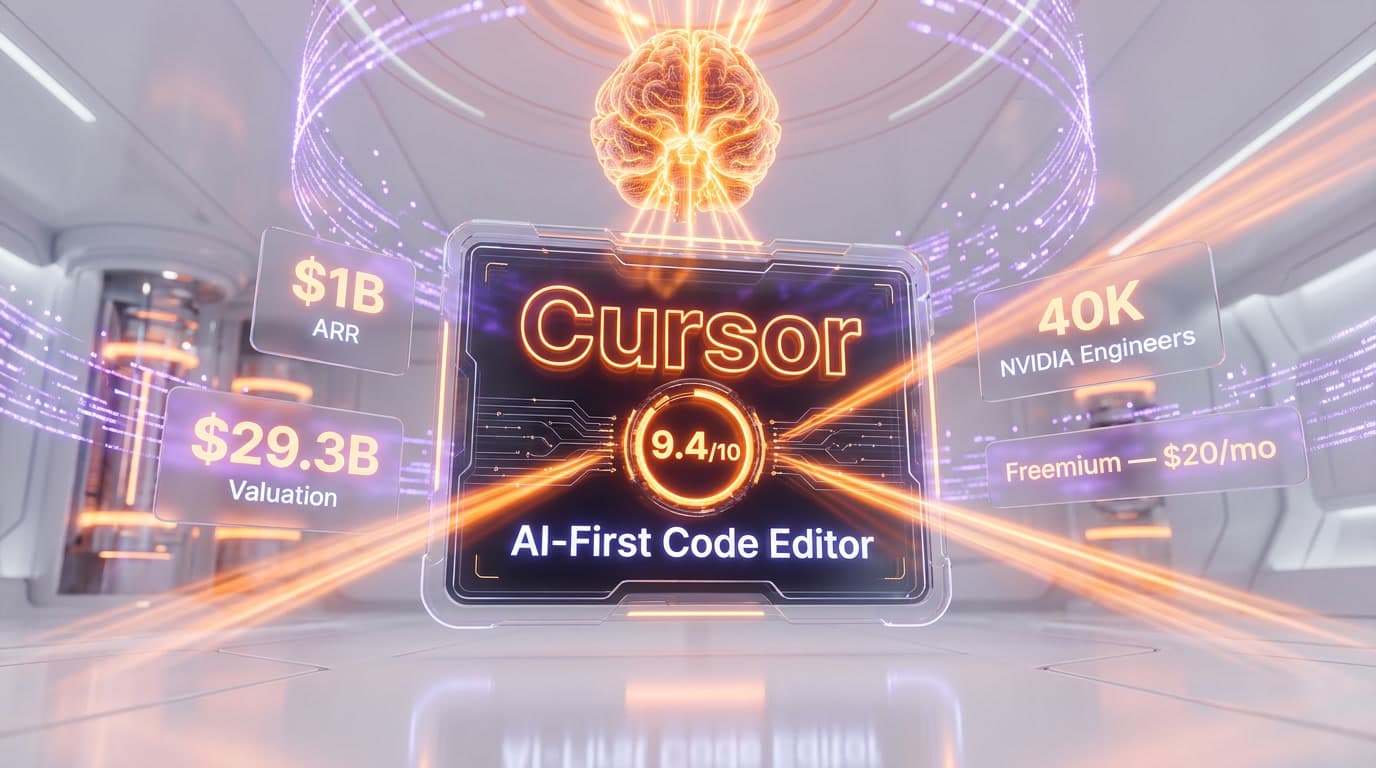
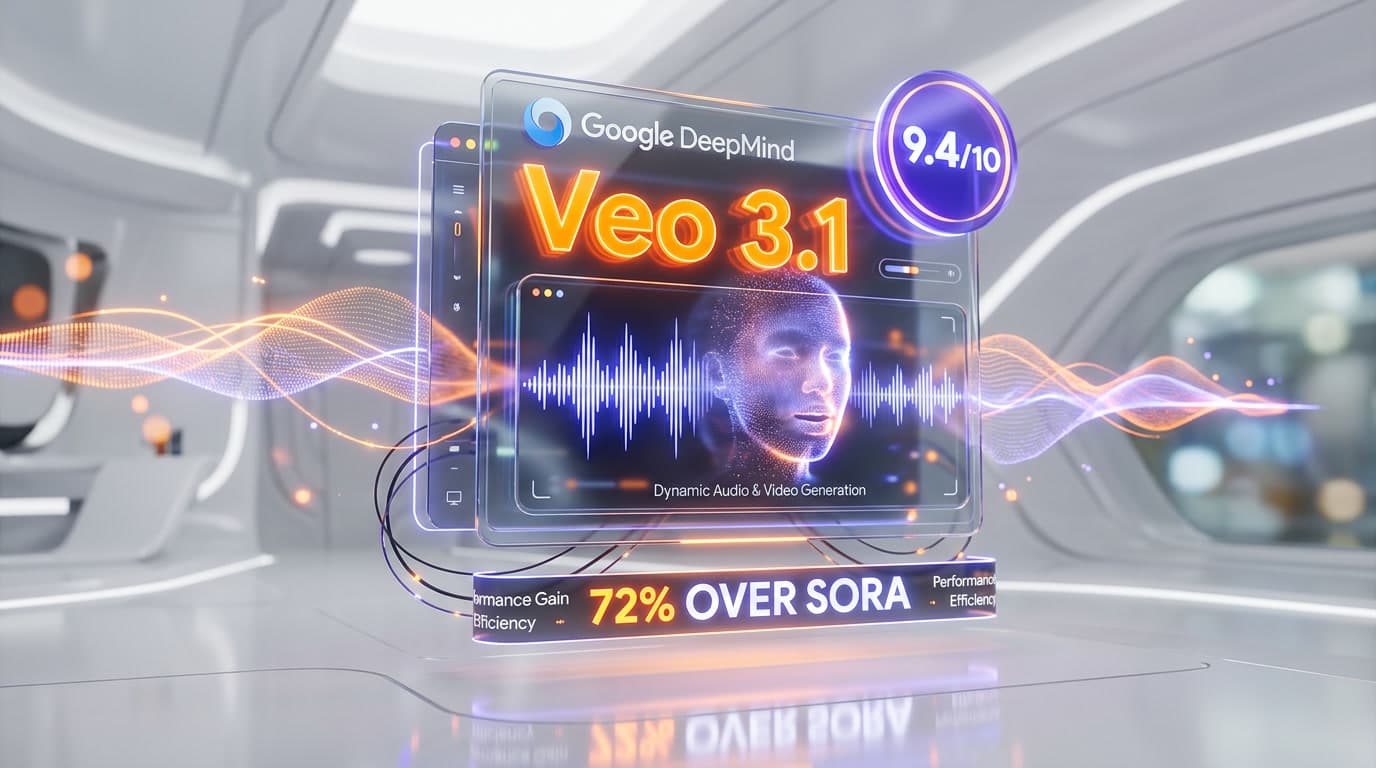
Top-rated alternatives to FLUX 2 include Claude Code (9.9/10), Cursor (9.5/10), Veo 3.1 (9.4/10), Claude Opus 4.7 (9.4/10) — all reviewed with detailed scoring on ThePlanetTools.ai.
Is FLUX 2 good for beginners?
FLUX 2 is rated 8.8/10 for ease of use.
What platforms does FLUX 2 support?
FLUX 2 is available on BFL Playground (web), BFL API (https://api.bfl.ai), Replicate, fal.ai, Together AI, Runware, DeepInfra, Cloudflare Workers AI, Verda, Hugging Face (Dev open weights), ComfyUI, Diffusers (Python).
Does FLUX 2 offer a free trial?
Yes, FLUX 2 offers a free trial.
Is FLUX 2 worth the price?
FLUX 2 scores 9.4/10 for value. We consider it excellent value.
Who should use FLUX 2?
FLUX 2 is ideal for: Ecommerce product photography at scale — swap backgrounds, relight catalog shots, generate lifestyle mockups in brand colors, Ad creative localization — brand-consistent ads in 30 markets without new photography, Editorial and magazine cover art — photorealistic feature images with on-image typography, UGC-style social content for brands — consistent product and model identity across 200+ Pinterest and Instagram posts, Game asset and concept art pipelines — multi-reference character sheets and prop variations, Architectural visualization and interior design renders — high-fidelity staging without a 3D pipeline, Stock photography replacement for design teams — unlimited hero images under commercial license, E-learning and course assets — consistent instructor avatars, infographics, and diagram generation.
What are the main limitations of FLUX 2?
Some limitations of FLUX 2 include: Flex tier is roughly $0.06 per megapixel on Replicate (about $2.46 per 1024x1024 image) — painfully expensive for iteration at scale; FLUX 2 Dev open-weights license is non-commercial by default — commercial self-hosting requires the $999 per month Self-Hosted License (up to 100,000 images included); Local inference needs a 32B model in VRAM — RTX 4090 works at 4-bit, but bf16 deployment still demands an RTX 5090 or H100; Ideogram 3 still edges FLUX 2 on long-form typography legibility at small point sizes; Recraft V4 still wins for true SVG and vector export — FLUX 2 is raster-only, no native vector output; Latency on Flex (22 seconds base, 40 seconds with input image) trails Pro (6-9 seconds) — speed vs detail is a real tradeoff; Non-commercial Dev license blocks external-facing API hosting — you can't wrap Dev in your own SaaS without a commercial agreement.
Best Alternatives to FLUX 2
Ready to try FLUX 2?
Start with the free plan
Try FLUX 2 Free →