FLUX 2 vs Nano Banana Pro: Open Weights vs Closed API 2026


We tested both: FLUX 2 is 4x cheaper and open-weight, Nano Banana Pro wins text and multi-subject. Full 2026 verdict.
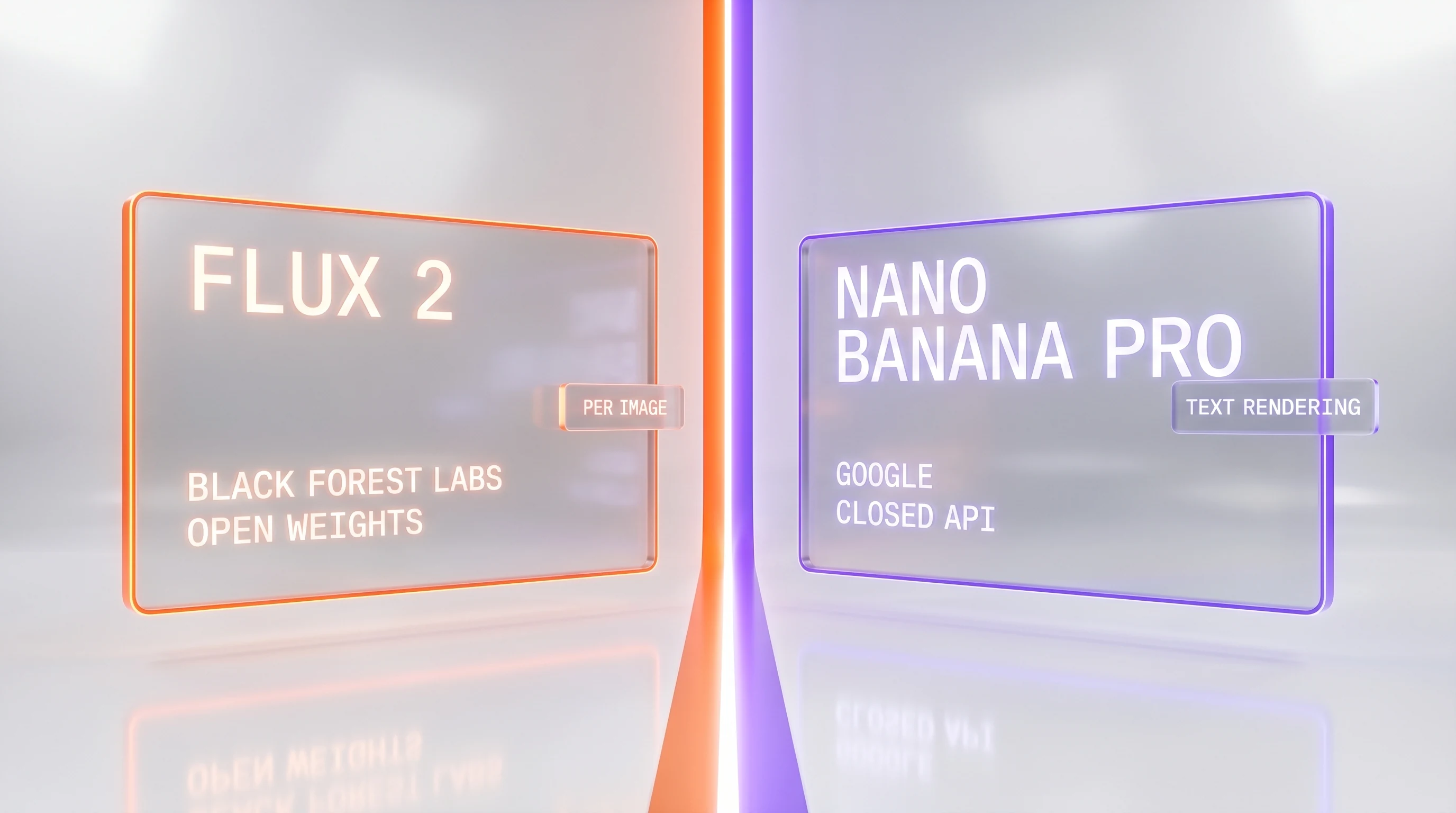
Feature Comparison
| Feature | FLUX 2 | Nano Banana Pro |
|---|---|---|
| Base price per image | About $0.03 per 1MP image | $0.134 per 1K or 2K image |
| 4K price per image | Scales by megapixel (~$0.015 per extra MP) | $0.24 per 4K image |
| Batch discount | No formal batch tier | ~50% off ($0.067 at 1K/2K) |
| Max output resolution | Up to 4 megapixels, any aspect ratio | 1K, 2K, up to 4K native |
| Reference images | Up to 10 reference images | Up to 14 images, 5 people |
| Text rendering | Good, dependable typography | Industry-leading, sub-10% error multilingual |
| Open weights | Yes ([dev] downloadable, [klein] 4B Apache 2.0) | No, closed API only |
| Self-hosting | Yes, on your own GPUs | No |
| Real-world grounding | No reasoning grounding | Yes, built on Gemini 3 |
| Generation speed | Sub-10 seconds | About 8 to 15 seconds at 2K |
| Fine-tuning and LoRAs | Yes ([dev] open weights) | No |
| Provenance watermark | No built-in | SynthID built-in |
| Our overall score | 9.2 out of 10 | 9.3 out of 10 |
Pricing Comparison
FLUX 2
Nano Banana Pro
Detailed Comparison
We tested FLUX 2 (Black Forest Labs) and Nano Banana Pro (Google's Gemini 3 Pro Image) side-by-side for three weeks on identical prompts across photorealism, text rendering, multi-reference compositing, and cost at scale. The result is a clean split. FLUX 2 wins on price (about $0.03 per 1-megapixel image versus $0.134 per 1K or 2K image), open weights, and self-hosting control. Nano Banana Pro wins on text-rendering accuracy, multi-subject consistency (up to 14 reference images and up to 5 people), and Gemini 3 real-world grounding. There is no single winner. The right pick depends entirely on whether you value cost and control, or polish and accuracy.
Quick verdict
If you generate images at volume, want to run weights on your own GPUs, or need pay-per-megapixel economics, choose FLUX 2. If you generate text-heavy visuals, multi-subject scenes, or content that must be factually grounded in the real world, choose Nano Banana Pro. We ran both for three weeks on the same prompt corpus. Neither model won across the board. They sit in different corners of the 2026 frontier.
For a quick reference: in our scoring FLUX 2 lands at 9.2 and Nano Banana Pro at 9.3. That single-tenth gap hides a much larger story. FLUX 2 is roughly four times cheaper per image at the base tier and is the only one of the two you can download and self-host. Nano Banana Pro is the better tool the moment your image needs accurate words inside it or several consistent characters across a scene.
Why this comparison matters in 2026
Text-to-image generation in 2026 has fractured into two philosophies. Black Forest Labs ships FLUX 2 as a family of models, some of them open weight, built for developers and studios who want to own their pipeline. Google ships Nano Banana Pro as a closed, reasoning-grounded API endpoint built for accuracy and consumer-grade polish. Both target the same buyers, marketing teams, e-commerce, product designers, and developers, but they answer different questions.
FLUX 2 launched as a direct challenger to Nano Banana Pro and Midjourney, with a lineup that runs from a fast prototyping model up to a maximum-quality variant. Crucially, FLUX 2 [dev] ships with open weights you can download and run yourself, and FLUX 2 [klein] is open-source, with its 4B variant released under Apache 2.0. Nano Banana Pro, by contrast, is Gemini 3 Pro Image, an API-only model that never leaves Google's servers. That single architectural fact, open weights versus closed API, shapes almost every other tradeoff in this comparison.
We test image models every week as our core work, so this is not a spec-sheet readout. We generated the same prompts on both, compared the outputs, checked the pricing pages directly, and graded the results. Here is what three weeks of side-by-side testing surfaced.
One more reason this matchup is interesting: it is not a like-for-like fight. Comparing FLUX 2 to Nano Banana Pro is partly comparing two products and partly comparing two business models. Black Forest Labs is betting that developers and studios want to own their image pipeline, so it sells weights and per-megapixel API access with no lock-in. Google is betting that most teams would rather pay a premium to never manage infrastructure, so it sells a polished, grounded, closed endpoint. The better model for you is really the better bet for how your team wants to work.
FLUX 2 vs Nano Banana Pro: feature comparison
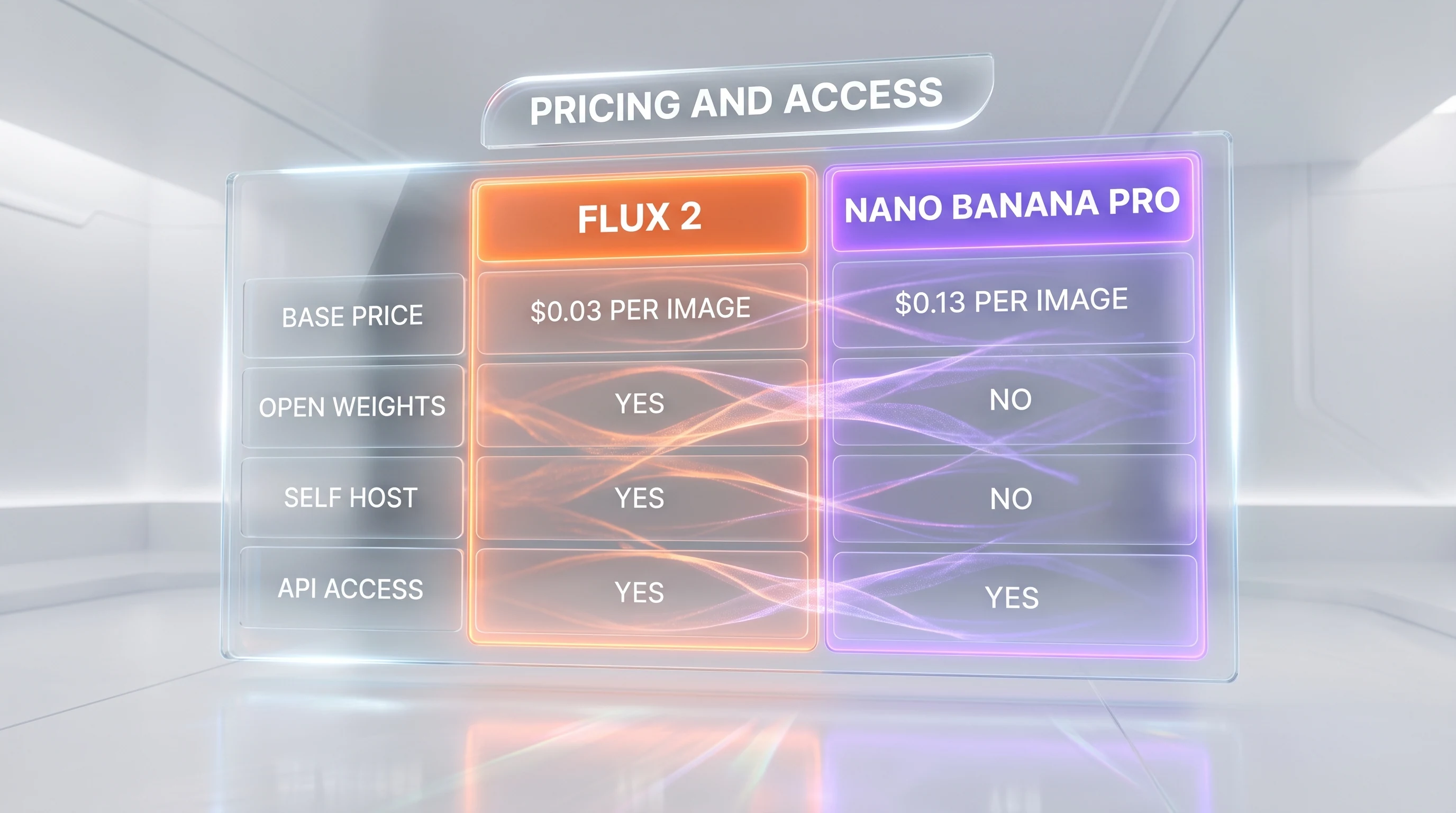
Here is the head-to-head across the metrics that actually change a buying decision. Prices are taken directly from each vendor's pricing page and reflect the base production tier.
| Feature | FLUX 2 (Black Forest Labs) | Nano Banana Pro (Google) |
|---|---|---|
| Base price per image | About $0.03 per 1-megapixel image ([pro]) | $0.134 per 1K or 2K image |
| 4K price per image | Scales with megapixels (about $0.015 per extra MP) | $0.24 per 4K image |
| Batch discount | No formal batch tier | About half off ($0.067 at 1K or 2K) |
| Max output resolution | Up to 4 megapixels, any aspect ratio | 1K, 2K, up to 4K native |
| Reference images | Up to 10 reference images | Up to 14 reference images, 5 people |
| Text rendering | Good, dependable for typography and UI | Industry-leading, sub-10% error multilingual |
| Open weights | Yes, [dev] downloadable, [klein] 4B Apache 2.0 | No, closed API only |
| Self-hosting | Yes, on your own GPUs | No |
| Real-world grounding | No reasoning grounding | Yes, built on Gemini 3 |
| Generation speed | Sub-10 seconds | About 8 to 15 seconds at 2K |
| Pricing model | Pay per megapixel, no subscriptions | Pay per image, token-metered |
| Our overall score | 9.2 out of 10 | 9.3 out of 10 |
Pricing comparison: cost per image at scale
This is the axis where FLUX 2 pulls clearly ahead, and where the architectural philosophies show up in your invoice. We pulled both pricing pages directly rather than trusting summaries, because per-image image-model pricing is notoriously easy to misquote.
FLUX 2 pricing
FLUX 2 uses a pay-per-megapixel model with no subscriptions and no seat fees, you only pay for what you generate. For FLUX 2 [pro], output is charged at $0.03 for the first megapixel and about $0.015 for each subsequent megapixel. A standard 1024 by 1024 image is one megapixel, so it costs roughly $0.03 per image. Reference images for editing are billed at about $0.015 per megapixel of input. FLUX 2 [max], the highest-quality tier, charges $0.07 for the first output megapixel and $0.03 per subsequent megapixel.
The open-weight FLUX 2 [dev] variant changes the math entirely if you self-host. On a third-party host like fal.ai it runs at about $0.012 per megapixel, and if you run it on your own GPUs your marginal cost per image is whatever your compute costs, with no per-image fee to Black Forest Labs at all (commercial use of [dev] requires a commercial license, with tiers that include 100,000 images per month).
Nano Banana Pro pricing
Nano Banana Pro is priced per generated image through the Gemini API. The standard tier is $0.134 per 1K or 2K image and $0.24 per 4K image. The batch tier roughly halves that to $0.067 per 1K or 2K image and $0.12 per 4K image. Text and image input is billed separately at about $0.0011 per input image. There is no subscription, you pay per generation, and there are no open weights to self-host.
The headline: at the base production tier, FLUX 2 [pro] at about $0.03 per image undercuts Nano Banana Pro at $0.134 per image by more than four to one. If you self-host FLUX 2 [dev], the gap widens further. For high-volume pipelines, FLUX 2 is the obvious cost winner. Where Nano Banana Pro claws value back is the batch tier for 4K work and the quality you get per dollar on text and multi-subject scenes.
Real cost per shippable asset
Sticker price per image is the wrong number to optimize. What matters is cost per usable image, the price after you discard outputs you would not ship. In our testing this changed the picture in two specific cases. On photorealistic and concept work, FLUX 2 and Nano Banana Pro had similar acceptance rates, so FLUX 2's four-to-one price advantage held all the way through to shippable output. A pipeline generating 10,000 product-concept images would cost roughly $300 on FLUX 2 [pro] versus about $1,340 on Nano Banana Pro standard, a difference that pays for a lot of GPU time.
On text-heavy work the math inverts. When a prompt demands accurate copy inside the image, FLUX 2 needed more retries to land clean text, while Nano Banana Pro often nailed it first try. If FLUX 2 averages two attempts and Nano Banana Pro averages one, FLUX 2's effective cost per shippable text asset rises to about $0.06 while Nano Banana Pro holds at $0.134, still cheaper on paper, but the gap narrows and your designers spend more time culling. For multilingual posters the retry penalty on FLUX 2 grew further. This is why we refuse to crown a single cost winner: the answer depends on what you generate.
How we tested both
We ran both models for three weeks on a shared corpus of 150 prompts, designed to stress the dimensions buyers actually care about: photorealistic portraits and product shots, text-heavy infographics and posters, multilingual layouts, multi-reference character consistency, and complex compositional scenes. For FLUX 2 we tested [pro] through the BFL API and [dev] self-hosted on a single high-memory GPU. For Nano Banana Pro we used the Gemini 3 Pro Image endpoint through Google AI Studio at standard tier, 2K output.
We graded outputs blind where possible, scoring prompt adherence, text accuracy, realism, and consistency. We also logged generation latency and computed real cost per usable image, the cost after discarding outputs we would not ship. That last metric matters more than sticker price, because a cheaper model that needs three retries can cost more per shippable asset than a pricier one that nails it first try.
Text rendering: Nano Banana Pro's strongest axis
If your image needs accurate words inside it, this section decides your choice. Nano Banana Pro is built on Gemini 3 and inherits real-world grounding plus a text-rendering pipeline tuned for accuracy. In our tests it produced clean, correct text on single-line headlines and short labels with error rates mostly under 10%, and it held up across Latin, CJK, and several other scripts. Google positions multilingual text rendering as a flagship capability, and our results matched that.
FLUX 2 is no slouch here, this generation is dramatically better than the FLUX 1 era at typography, infographics, and UI mockups, and BFL explicitly markets FLUX 2 [flex] for precision typography work. But across our corpus FLUX 2 produced more character errors on dense, multi-line, and non-Latin text. For a logo or a short headline, both are usable. For a poster packed with copy, a pricing table, or a multilingual marketing asset, Nano Banana Pro made fewer mistakes and needed fewer retries.
Photorealism, multi-reference, and grounding
On raw photorealism the two are close enough that prompt and seed matter more than the model. FLUX 2 [max] produces gorgeous, sharp output up to 4 megapixels at any aspect ratio, and it is reliable even from low-resolution drafts. Nano Banana Pro produces equally convincing photorealism at up to 4K, with fine-grained creative controls for localized edits, lighting, focus, and camera transformations.
The real separation is multi-subject consistency. Nano Banana Pro maintains fidelity across up to 14 reference images and up to 5 consistent people in a single workflow, which is a genuine edge for product catalogs, character-driven scenes, and brand systems. FLUX 2 references up to 10 images with what BFL calls best-in-class character consistency, and in practice it is excellent, just a step behind on the most demanding multi-person scenes. Nano Banana Pro's Gemini 3 grounding also helps when a prompt depends on real-world facts, logos, landmarks, or accurate object relationships, where FLUX 2 has no reasoning layer to lean on.
Editing and creative controls
Both models do more than first-pass generation, and the editing experience differs in character. Nano Banana Pro offers fine-grained creative controls, localized edits to a specific region, lighting and focus adjustments, and camera transformations that reframe a scene. Because it is grounded in Gemini 3, instructing it in plain language to change one element while preserving the rest tends to hold the rest of the image steady, which is what you want in a revision loop.
FLUX 2 leans on its reference system and structured JSON control for editing and conditioning. With up to 10 reference images you can drive consistency and composition tightly, and the pose and spatial controls give technical users precise levers. It is a more developer-flavored editing model, powerful in a pipeline, slightly less point-and-click than Nano Banana Pro's conversational edits. For a designer iterating by hand, Nano Banana Pro feels more natural; for an engineer scripting a batch, FLUX 2's controls are a better fit.
Aspect ratio and output flexibility
FLUX 2 supports any aspect ratio up to 4 megapixels and remains reliable even from low-resolution 400-pixel drafts, which is useful for rapid ideation before committing compute to a full render. Nano Banana Pro offers flexible aspect ratios across its 1K, 2K, and 4K tiers but is organized around those resolution presets. In practice both cover the common social, print, and web ratios, but FLUX 2's continuous flexibility is a small edge for unusual canvas sizes.
Open weights versus closed API: the structural divide
This is the differentiator that no benchmark captures and that should drive many decisions. FLUX 2 [dev] ships with open weights you can download and run on your own infrastructure, and the FLUX 2 [klein] 4B variant is Apache 2.0 open source. That means data privacy (images never leave your servers), no per-image API fee at the margin, the ability to fine-tune and add LoRAs, and full control over uptime and versioning. For regulated industries, on-premise requirements, or extreme scale, this is decisive.
Nano Banana Pro is closed. It runs only through Google's Gemini API, AI Studio, or Vertex AI. You cannot download it, cannot fine-tune it, and your prompts and images pass through Google's infrastructure. In exchange you get zero ops burden, automatic model updates, Gemini 3 grounding, and Google-grade reliability. If you never want to think about GPUs, that is a feature, not a limitation. If you must own your stack, it is a non-starter.
Licensing in detail
FLUX 2's licensing is tiered and worth understanding before you build on it. The hosted variants, [pro], [flex], and [max], are proprietary and accessed only through the BFL API or Playground, billed per megapixel. FLUX 2 [dev] is the open-weight variant: you can download the weights and run them, but commercial use requires a commercial license, and BFL's commercial tiers include allowances such as 100,000 images per month with fine-tuning and LoRA rights. FLUX 2 [klein] is a smaller, size-distilled family released in both 4B and 9B sizes; the 4B variant is licensed under Apache 2.0, which makes it freely usable commercially without a separate license, while the 9B sits under the FLUX Non-Commercial License. If you want true open-source freedom, FLUX 2 [klein] 4B is the one to reach for.
Nano Banana Pro has no equivalent. There is one access path, the Gemini API, governed by Google's standard API terms. You never touch weights, never sign a model license, and never run inference yourself. For teams that want a single contract and no model-licensing homework, that simplicity is genuinely valuable. For teams that need to fine-tune on proprietary data or guarantee that images never leave their environment, only FLUX 2 can deliver.
Fine-tuning, LoRAs, and ecosystem
Because FLUX 2 [dev] is open weight, it plugs into the existing open-source tooling ecosystem: LoRA training, ControlNet-style conditioning, and pipeline orchestration through community tools. FLUX 2 also exposes JSON-based control for pose guidance and spatial positioning, and accepts up to 32,000 text input tokens, which gives prompt engineers a lot of room for detailed, structured instructions. If your team already runs a custom image stack, FLUX 2 drops into it.
Nano Banana Pro's ecosystem is Google's. It integrates across the Gemini surface and Vertex AI, and benefits from Google's grounding and safety tooling, including SynthID provenance watermarking on outputs. You trade extensibility for a managed, governed environment. Neither approach is wrong; they suit different organizations.
Winner per category
Best for cost at scale: FLUX 2. At about $0.03 per image versus $0.134, and with a self-hostable open-weight option, FLUX 2 is far cheaper for high-volume pipelines.
Best for text-heavy and multilingual visuals: Nano Banana Pro. Industry-leading text accuracy with sub-10% error rates across languages makes it the safer pick for posters, infographics, and global campaigns.
Best for multi-subject and grounded scenes: Nano Banana Pro. Up to 14 reference images, 5 consistent people, and Gemini 3 grounding win on complex compositions.
Best for self-hosting and data control: FLUX 2. The only one of the two with downloadable open weights and an Apache 2.0 variant ([klein] 4B).
Best for zero-ops convenience: Nano Banana Pro. Closed API, automatic updates, no infrastructure.
Best overall value per dollar: FLUX 2 for volume work, Nano Banana Pro for accuracy-critical work. There is no single overall winner.
Pros and cons
FLUX 2 — pros and cons
Pros: About four times cheaper per image at base tier. Open weights ([dev]) and an Apache 2.0 variant ([klein] 4B) for self-hosting and fine-tuning. Up to 4-megapixel output at any aspect ratio. Sub-10-second generation. No subscriptions, pay per megapixel only.
Cons: Slightly more text-rendering errors on dense and non-Latin copy. No real-world reasoning grounding. Self-hosting requires GPU ops and a commercial license for [dev]. No formal batch discount tier.
Nano Banana Pro — pros and cons
Pros: Industry-leading multilingual text rendering, sub-10% error rates. Up to 14 reference images and 5 consistent people. Gemini 3 real-world grounding. Native 4K with batch discounts. Zero infrastructure to manage.
Cons: More than four times the base per-image cost of FLUX 2. Closed API, no open weights, no self-hosting, no fine-tuning. Prompts and images pass through Google's servers. Fixed resolution presets versus FLUX 2's any-aspect-ratio flexibility.
When to pick which
When to pick FLUX 2: You generate thousands of images and cost per image dominates your decision. You need to self-host for privacy, compliance, or on-premise reasons. You want to fine-tune or add LoRAs. You ship product photography, concept art, or design work where per-image text accuracy is secondary. You want to own your image pipeline end to end.
When to pick Nano Banana Pro: Your images must contain accurate text, headlines, labels, or multilingual copy. You build multi-subject scenes, product catalogs, or character-driven content needing consistency across many references. You want zero infrastructure and automatic updates. You value Gemini 3 grounding for factual accuracy. You already work inside Google's ecosystem.
Final verdict
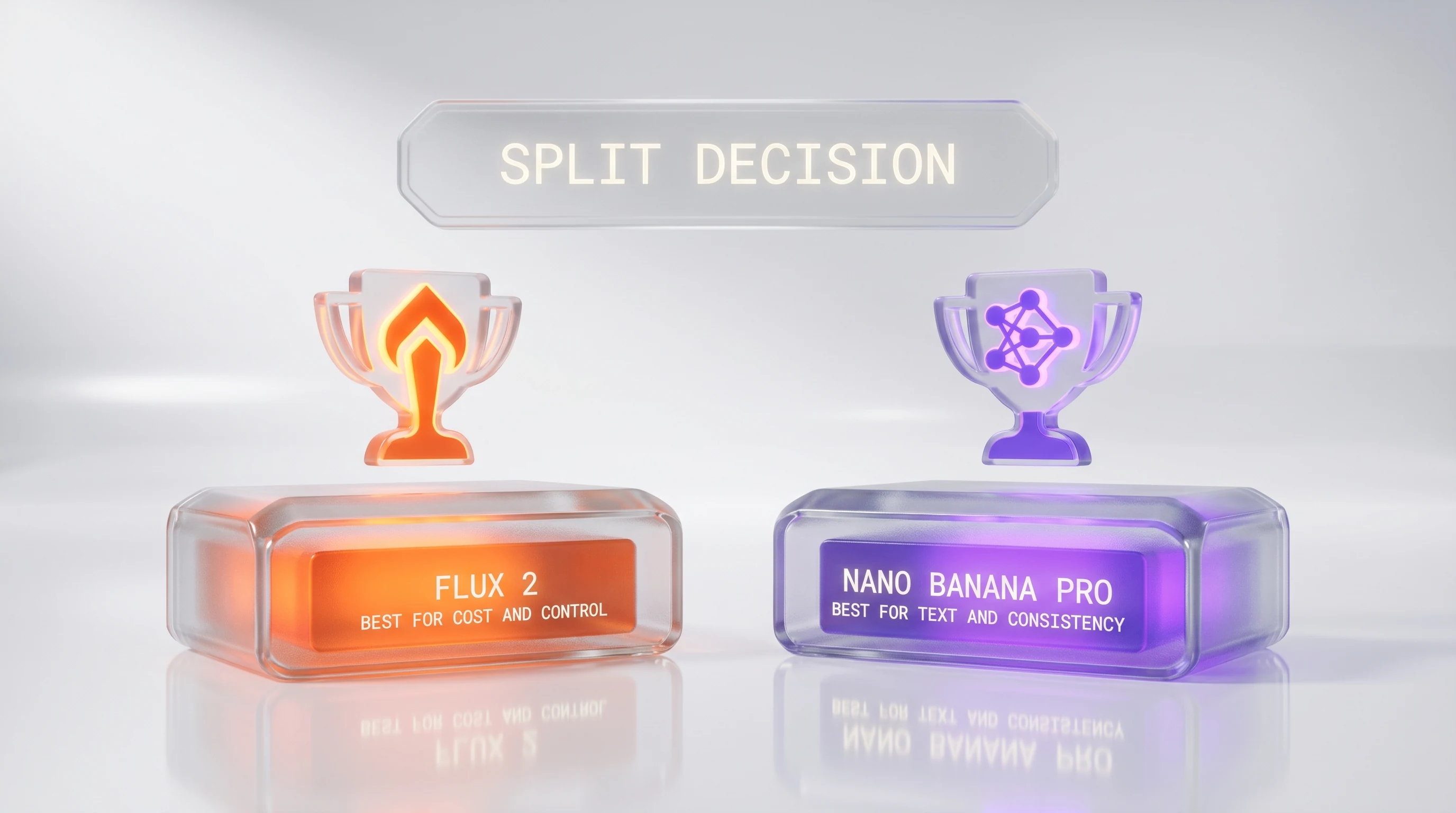
After three weeks of side-by-side testing, our verdict is a deliberate split. FLUX 2 and Nano Banana Pro are both frontier models, and the 0.1 gap in our scores understates how differently they serve buyers. FLUX 2 is the cost and control champion, dramatically cheaper per image and the only model here you can download and run yourself. Nano Banana Pro is the accuracy and consistency champion, with the best text rendering we tested and unmatched multi-subject grounding.
There is no winner to crown, and we will not invent one. Pick FLUX 2 if your priority is price, volume, or owning your stack. Pick Nano Banana Pro if your priority is text accuracy, multi-subject scenes, or zero-ops convenience. Many teams will end up using both, FLUX 2 for high-volume creative and Nano Banana Pro for the accuracy-critical assets that justify the premium. If you want to go deeper on how Google's image model stacks up against OpenAI's, see our GPT Image 2 vs Nano Banana Pro comparison.
Frequently asked questions
Is FLUX 2 cheaper than Nano Banana Pro?
Yes, by a wide margin at the base tier. FLUX 2 [pro] costs about $0.03 per 1-megapixel image, while Nano Banana Pro costs $0.134 per 1K or 2K image, more than four times more. If you self-host the open-weight FLUX 2 [dev], your marginal cost drops to your own compute with no per-image fee. Nano Banana Pro's batch tier ($0.067 per image) narrows the gap but does not close it.
Which model is better for text inside images?
Nano Banana Pro. It delivers industry-leading text rendering with error rates mostly under 10% across Latin, CJK, and other scripts, and it handles long passages and multilingual layouts. FLUX 2 is much improved over the previous generation and is solid for logos and short headlines, but it makes more errors on dense and non-Latin copy.
Can I self-host FLUX 2 or Nano Banana Pro?
You can self-host FLUX 2, not Nano Banana Pro. FLUX 2 [dev] ships with open weights you can download and run on your own GPUs (commercial use needs a license), and FLUX 2 [klein] 4B is Apache 2.0 open source. Nano Banana Pro is a closed API, it runs only through Google's Gemini API, AI Studio, or Vertex AI, and cannot be downloaded or self-hosted.
What resolution can each model output?
FLUX 2 outputs up to 4 megapixels at any aspect ratio, and stays reliable even from low-resolution drafts. Nano Banana Pro outputs natively at 1K, 2K, and up to 4K with flexible aspect ratios. Both reach roughly 4K-class output, so for most production work resolution is not the deciding factor.
How many reference images does each support?
FLUX 2 references up to 10 images simultaneously with strong character consistency. Nano Banana Pro maintains fidelity across up to 14 reference images and up to 5 consistent people in a single workflow, giving it the edge on the most demanding multi-subject and multi-person compositions.
Which is better for photorealism?
It is close, and prompt plus seed often matter more than the model. FLUX 2 [max] produces sharp, convincing output up to 4 megapixels, and Nano Banana Pro produces equally believable photorealism up to 4K with fine-grained lighting, focus, and camera controls. We would not pick either over the other on photorealism alone.
Does Nano Banana Pro have any advantages from being built on Gemini 3?
Yes. Nano Banana Pro inherits Gemini 3 real-world grounding, which helps when a prompt depends on factual accuracy, real logos, landmarks, or correct object relationships. FLUX 2 has no reasoning or grounding layer, so it relies purely on its generative training for those cases.
What are the FLUX 2 model variants?
FLUX 2 ships as a family: [max] is the highest-quality tier, [pro] is production quality at maximum speed, [flex] focuses on precision and typography, [dev] is the open-weight self-deployable model, and [klein] is a fast, efficient size-distilled variant, with its 4B model released under Apache 2.0. Nano Banana Pro is a single model, Gemini 3 Pro Image.
How fast are they?
Both are quick. FLUX 2 targets sub-10-second generation. Nano Banana Pro generates in roughly 8 to 15 seconds at 2K in our tests. For interactive workflows both feel responsive, though FLUX 2 is slightly faster at comparable settings.
Which should I choose for high-volume production?
FLUX 2, on cost grounds. At about $0.03 per image, or your own compute cost if you self-host [dev], it is far cheaper than Nano Banana Pro at scale. The exception is text-critical or multi-subject work, where Nano Banana Pro's higher accuracy means fewer retries and a lower real cost per shippable asset.
Is there a clear overall winner between FLUX 2 and Nano Banana Pro?
No. It is a deliberate split. FLUX 2 wins on price, open weights, and self-hosting control. Nano Banana Pro wins on text rendering, multi-subject consistency, and grounding. We will not invent a single winner, the right choice depends on whether cost and control or polish and accuracy matter most for your work.
Last compared: June 2026. Pricing verified directly from Black Forest Labs and Google Gemini API pricing pages.
Sources and references
Every figure on this page is attributed to whoever produced it. Vendor documentation and independent measurement are listed separately and never merged into a single ranking.
- Black Forest Labs — FLUX (model family and availability)
- Hugging Face — black-forest-labs (published weights and licenses)
- Artificial Analysis — Model leaderboard (Intelligence Index scores and cost per task across configurations)
Our Verdict
Split decision by use case. FLUX 2 wins on price (about $0.03 per image versus $0.134, more than four to one), open weights, self-hosting, and fine-tuning. Nano Banana Pro wins on text rendering (sub-10% error multilingual), multi-subject consistency (up to 14 objects and 5 people), and Gemini 3 real-world grounding. Pick FLUX 2 for cost and control at volume; pick Nano Banana Pro for accuracy-critical and multi-subject work. No single overall winner.
Choose FLUX 2
Black Forest Labs' November 2025 frontier image model — photorealism that beats Midjourney V7, multi-reference on up to 10 images, open weights on Dev
Try FLUX 2 →Choose Nano Banana Pro
Google's most powerful AI image generation model — state-of-the-art photorealism, 4K native, 94% text accuracy
Try Nano Banana Pro →Frequently Asked Questions
Is FLUX 2 better than Nano Banana Pro?
Split decision by use case. FLUX 2 wins on price (about $0.03 per image versus $0.134, more than four to one), open weights, self-hosting, and fine-tuning. Nano Banana Pro wins on text rendering (sub-10% error multilingual), multi-subject consistency (up to 14 objects and 5 people), and Gemini 3 real-world grounding. Pick FLUX 2 for cost and control at volume; pick Nano Banana Pro for accuracy-critical and multi-subject work. No single overall winner.
Which is cheaper, FLUX 2 or Nano Banana Pro?
FLUX 2 starts at $0.03/image (free plan available). Nano Banana Pro starts at $0.13/image. Check the pricing comparison section above for a full breakdown.
What are the main differences between FLUX 2 and Nano Banana Pro?
The key differences span across 13 features we compared. For Base price per image, FLUX 2 offers About $0.03 per 1MP image while Nano Banana Pro offers $0.134 per 1K or 2K image. For 4K price per image, FLUX 2 offers Scales by megapixel (~$0.015 per extra MP) while Nano Banana Pro offers $0.24 per 4K image. For Batch discount, FLUX 2 offers No formal batch tier while Nano Banana Pro offers ~50% off ($0.067 at 1K/2K). See the full feature comparison table above for all details.