GPT-5.6 Luna vs MiniMax M3: Managed Intelligence vs Open Weights


OpenAI's July 30 cut erased MiniMax M3's price edge: output is now identical, Luna is cheaper on input and leads 51-44. MiniMax still owns open weights.
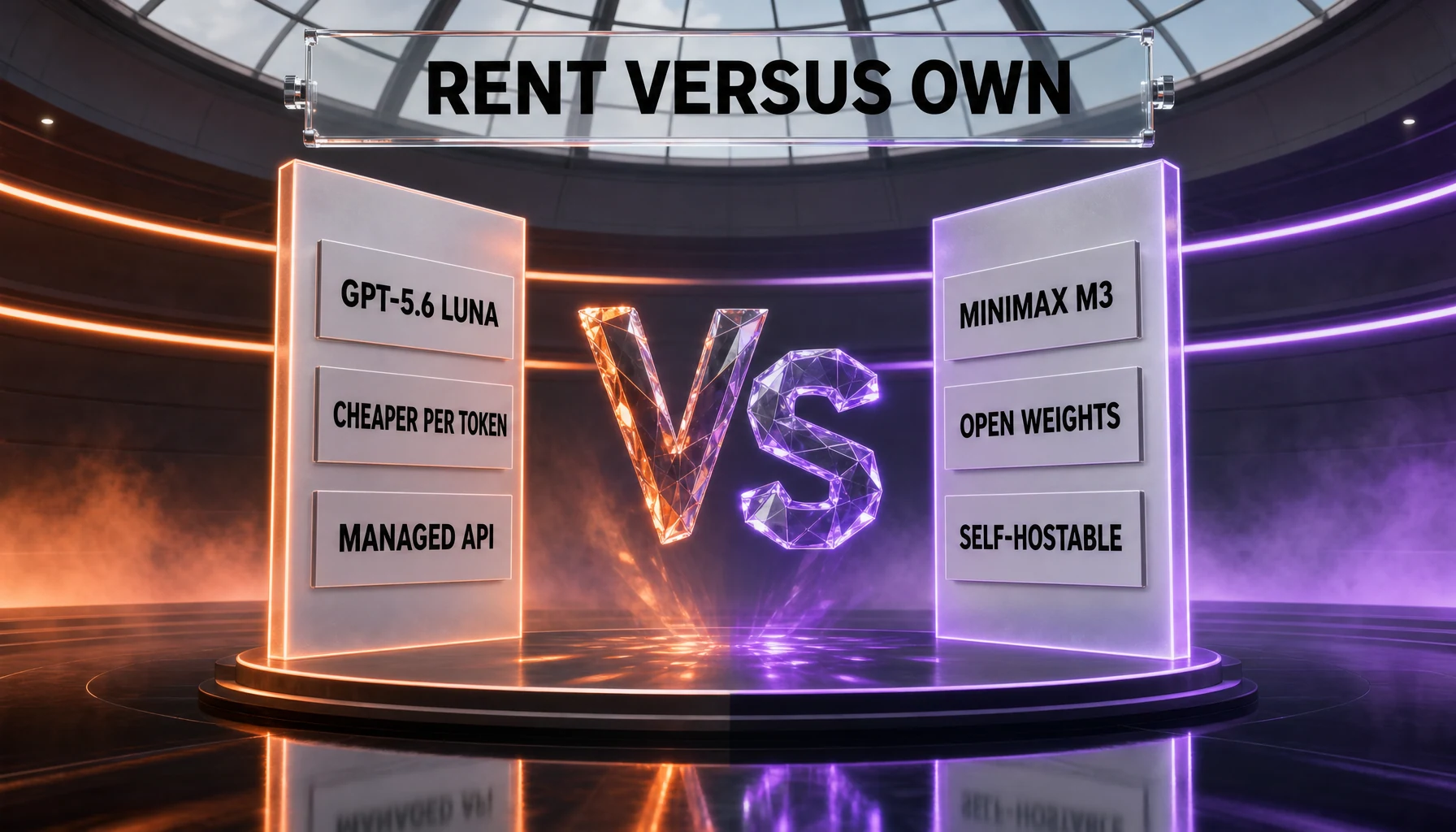
Feature Comparison
| Feature | GPT-5.6 Luna | MiniMax M3 |
|---|---|---|
| AA Intelligence Index (Artificial Analysis v4.1, same evaluator) | 51 | 44 |
| Input price (per million tokens) | 0.20 dollars (0.40 long context) | 0.30 dollars (0.60 above 512K input tokens) |
| Output price (per million tokens) — exact tie at 1.20 dollars | 1.20 dollars (1.80 long context) | 1.20 dollars (2.40 above 512K input tokens) |
| Cached input read (per million tokens) | 0.02 dollars | 0.06 dollars |
| Batch discount | 50 percent off every rate | None listed |
| Context window | 1,050,000 tokens | 1,000,000 tokens |
| Long-context rate (per million tokens) | 0.40 dollars in, 1.80 dollars out | 0.60 dollars in, 2.40 dollars out |
| Weights and self-hosting | Closed (API, ChatGPT, Codex) | Open weights, self-hostable |
| Architecture transparency | Proprietary (undisclosed) | Open MoE, 428B total / 23B active |
| Modality | Text and reasoning focus | Natively multimodal |
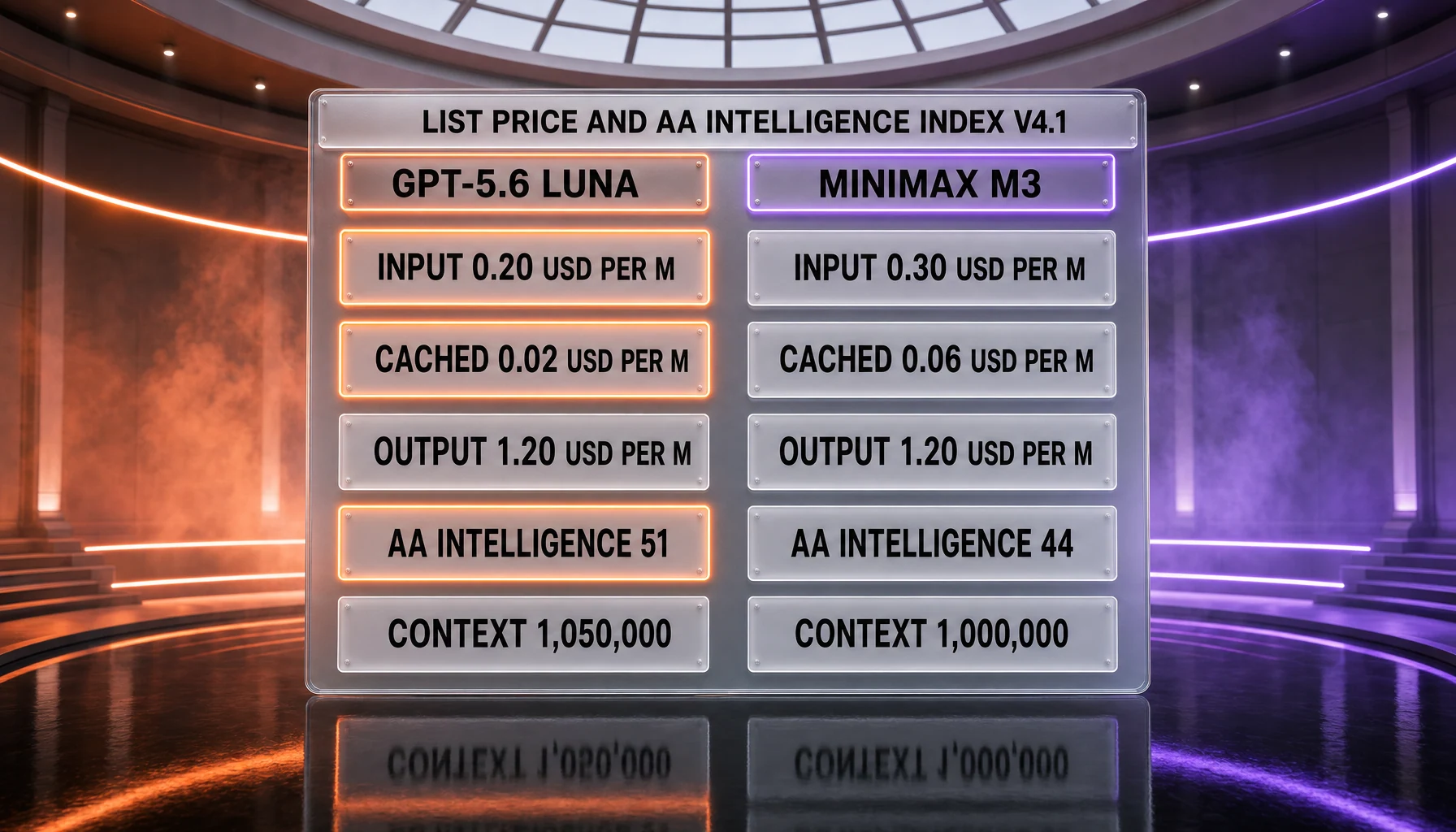
Pricing Comparison
GPT-5.6 Luna
MiniMax M3
Detailed Comparison
GPT-5.6 Luna and MiniMax M3 are the two large language models compared here, and after OpenAI's July 30, 2026 price cut they are the closest-priced pairing we have covered. GPT-5.6 Luna is the cost-efficient tier of OpenAI's GPT-5.6 generation, a closed, managed model priced at 0.20 dollars per million input tokens and 1.20 dollars per million output tokens on its standard short-context rate, with a 1,050,000-token context window. MiniMax M3, released June 1, 2026, is an open-weight mixture-of-experts model with 428 billion total parameters and about 23 billion active, natively multimodal, priced at 0.30 dollars input and 1.20 dollars output per million tokens for prompts up to 512K input tokens, with a 1,000,000-token context window. On the one independent evaluator that scores both the same way, the Artificial Analysis Intelligence Index version 4.1, GPT-5.6 Luna leads 51 to 44. Output pricing is now identical at 1.20 dollars per million tokens, while Luna is 1.5 times cheaper on input and three times cheaper on cached reads. MiniMax M3 no longer holds a price advantage anywhere; what it does hold is open weights you can self-host, native multimodality, and its own sparse attention design. Best for price and independent capability: GPT-5.6 Luna. Best for open weights, self-hosting, and native multimodal work: MiniMax M3.
Quick Verdict
Updated July 31, 2026. This is still a split verdict by use case, but the split has moved, and an earlier version of this page got it wrong. On July 30, 2026 OpenAI cut GPT-5.6 Luna's list prices by 80 percent across input, cached input, and output. The price advantage that used to define MiniMax M3 in this matchup is gone: output now costs exactly the same on both models, and Luna is cheaper on every other rate. We researched both models from vendor documentation and independent measurement rather than from secondhand summaries, and we re-read every rate directly off each vendor's own pricing page on July 31, 2026. We have not run weeks of controlled, identical-task benchmarking of the two against each other, so where we lean on numbers we attribute them to their source and keep independent scores strictly apart from vendor-reported ones. MiniMax M3 remains a serious model — it simply now competes on openness rather than on price. Here is the short version.
- Best for independent capability: GPT-5.6 Luna. On the Artificial Analysis Intelligence Index version 4.1 — the one composite that scores both models the same way — Luna sits at 51 while MiniMax M3 scores 44, a clear seven-point lead.
- Output price: an exact tie. Both models charge 1.20 dollars per million output tokens at their standard rate. Not close, not approximate — the same number on both pricing pages.
- Best for cost: GPT-5.6 Luna, which is a reversal of what this page said before July 30, 2026. Input costs 0.20 dollars per million tokens against MiniMax's 0.30, cached reads cost 0.02 dollars against 0.06, and OpenAI's Batch API halves the whole bill again. MiniMax lists no batch discount.
- Best for open weights and self-hosting: MiniMax M3, and this is now its central argument. The weights ship openly, so you can download, self-host, and fine-tune on your own hardware. GPT-5.6 Luna is closed and API-only.
- Best for a larger context window: GPT-5.6 Luna, narrowly, at 1,050,000 tokens against MiniMax's 1,000,000. Both vendors charge more for long context, so neither is flat.
- Best for native multimodal work: MiniMax M3. It is built as a natively multimodal mixture-of-experts model, a more explicit story than Luna's text-and-reasoning focus.
Bottom line: if you are buying tokens from an API, GPT-5.6 Luna is now the cheaper and the higher-scoring of the two, and there is no longer a price argument for choosing MiniMax M3 on the hosted path. If you want to own and self-host your weights, keep every token inside your own infrastructure, or need native multimodal handling, MiniMax M3 is still the only one of the two that offers any of it. We did not crown a single overall winner because those are different purchases, but we are not going to pretend the price question is still open: it is settled, and Luna won it.
At a Glance
Before the detail, here is the side-by-side that frames everything below. All pricing was taken directly from each vendor. The one independent capability figure comes from the Artificial Analysis Intelligence Index version 4.1, and any vendor-reported benchmark is kept out of this table and labeled separately in the text.
| Dimension | GPT-5.6 Luna | MiniMax M3 |
|---|---|---|
| Vendor | OpenAI | MiniMax |
| Model type | Closed, managed API | Open weight, self-hostable |
| Released | GPT-5.6 generation (efficiency tier) | June 1, 2026 |
| Input price (per million tokens) | 0.20 dollars short context, 0.40 dollars long context | 0.30 dollars up to 512K input tokens, then 0.60 dollars |
| Output price (per million tokens) | 1.20 dollars short context, 1.80 dollars long context | 1.20 dollars up to 512K input tokens, then 2.40 dollars |
| Cached input read (per million tokens) | 0.02 dollars | 0.06 dollars |
| Batch discount | 50 percent off every rate | None listed |
| AA Intelligence Index (v4.1, independent) | 51 | 44 |
| Context window | 1,050,000 tokens | 1,000,000 tokens |
| Long-context pricing | Separate higher rate; threshold not published | Doubles above 512K input tokens |
| Architecture | Proprietary (undisclosed) | Open MoE, 428B total / 23B active |
| Modality | Text and reasoning focus | Natively multimodal |
| Self-hostable | No | Yes |
Overview of Each Model
GPT-5.6 Luna
GPT-5.6 Luna is the efficiency tier of OpenAI's GPT-5.6 generation. In the current naming scheme the number is the generation and the names Sol, Terra, and Luna are durable capability tiers rather than model sizes: Sol is the flagship for the hardest problems, Terra is the mid tier, and Luna is the cost-efficient tier built for high-volume, latency-sensitive, and price-sensitive work. It shares the family plumbing, including a 1,050,000-token context window, and since OpenAI's July 30, 2026 price cut it is priced at 0.20 dollars per million input tokens and 1.20 dollars per million output tokens on the standard short-context rate — a fraction of the flagship rate, and an 80 percent reduction on what it charged the day before. On the one independent evaluator that scores both models in this matchup the same way, the Artificial Analysis Intelligence Index version 4.1, Luna scores 51 — the higher of the two, and a genuinely strong number for a model priced this low. Its defining traits are managed reliability, the consistency of running on OpenAI's infrastructure, and a Batch API that halves every rate again. One trait it does not have, despite what an earlier version of this comparison said: flat pricing across the whole window. OpenAI lists a separate, higher long-context rate for Luna at 0.40 dollars input and 1.80 dollars output per million tokens. The other trade-offs are the ones inherent to a closed model: there is no downloadable weight, no self-hosting, and no data-sovereignty option beyond what OpenAI offers as a service. For the full breakdown, see our GPT-5.6 Luna review.
MiniMax M3
MiniMax M3 is MiniMax's open-weight flagship, released on June 1, 2026. It is a mixture-of-experts model with 428 billion total parameters and about 23 billion active per token, which is the engineering trick behind its aggressive pricing: activating only a slice of the network per token keeps inference cheap. It is natively multimodal, uses a sparse attention design to make its long context affordable to serve, and ships open weights, so you can download, self-host, fine-tune, and redistribute the model rather than renting it through an API. Standard pricing is 0.30 dollars per million input tokens and 1.20 dollars per million output tokens for prompts up to 512K input tokens, with a 1,000,000-token context window; the rate doubles above 512K input tokens, a detail that matters for long-context work. Those published rates already carry what MiniMax labels a permanent 50 percent discount, so they are the real prices rather than a launch promotion that will expire. What has changed is the competitive context, not MiniMax's own price list: these rates have not moved, but OpenAI's have, and Luna now undercuts them on input and matches them exactly on output. On its own harness, MiniMax reports a 59 percent result on SWE-bench Pro — and we flag that explicitly as a vendor self-reported figure, not an independently charted one, so it does not sit on the same footing as the independent index scores elsewhere in this comparison. Our full MiniMax M3 review covers the architecture and licensing in more depth.
Pricing Compared
This section used to be the clearest argument for MiniMax M3. It is now the clearest argument against it. OpenAI cut GPT-5.6 Luna's rates by 80 percent on July 30, 2026, and MiniMax M3 did not respond, so a price gap that ran to five times on output closed completely overnight. We read every number below directly off each vendor's own pricing documentation on July 31, 2026, rather than from secondhand summaries.
| Model and tier | Input (per million tokens) | Cached input read (per million tokens) | Output (per million tokens) |
|---|---|---|---|
| GPT-5.6 Luna (standard, short context) | 0.20 dollars | 0.02 dollars | 1.20 dollars |
| GPT-5.6 Luna (long context) | 0.40 dollars | 0.04 dollars | 1.80 dollars |
| GPT-5.6 Luna (Batch API, short context) | 0.10 dollars | 0.01 dollars | 0.60 dollars |
| MiniMax M3 (standard, up to 512K input tokens) | 0.30 dollars | 0.06 dollars | 1.20 dollars |
| MiniMax M3 (above 512K input tokens) | 0.60 dollars | 0.12 dollars | 2.40 dollars |
Read the output column first, because output dominates real agentic spend: both models charge 1.20 dollars per million output tokens at their standard rate. That is not a rounding-level approximation or a near-tie we are smoothing over — it is the identical figure on both vendors' pricing pages, and it is the single most important number in this comparison. Everywhere else Luna is now the cheaper model. Input costs 0.20 dollars per million tokens against MiniMax's 0.30, so Luna is 1.5 times cheaper. Cached reads cost 0.02 dollars against 0.06, so Luna is three times cheaper on the rate that matters most for repeated-context workloads such as agents replaying a long system prompt. And OpenAI applies a 50 percent Batch API discount to every one of those lines, taking Luna to 0.10 dollars input and 0.60 dollars output for work that tolerates asynchronous turnaround. MiniMax lists no batch discount at all, so it has no answer to that halving.
Long context does not rescue the comparison either, though it is more complicated than this page previously claimed. Both vendors charge more for long context; neither is flat. MiniMax publishes its threshold plainly: above 512K input tokens the rate doubles to 0.60 dollars input and 2.40 dollars output. OpenAI lists a separate long-context rate for Luna at 0.40 dollars input and 1.80 dollars output, but does not publish the token count at which a request moves onto it, so we will not invent one. OpenAI is explicit that the higher rate applies "for the full request", not only to the tokens past the threshold — one token over the line reprices the entire prompt. MiniMax does not say, so budget for the worse case on its side. What we can compare is the rates themselves, and Luna is cheaper on both sides of the long-context tier: 0.40 dollars against 0.60 on input, and 1.80 dollars against 2.40 on output.
An earlier version of this page described Luna as charging one flat rate across its entire 1,050,000-token window with no step-up, and treated that as an advantage over MiniMax. That was wrong, independently of the price cut, and we have removed it everywhere rather than leaving it to age quietly. Luna's long-context rate has been on OpenAI's pricing page all along.
Capability and Benchmarks
Benchmarks are a minefield when vendors pick favorable evaluations and report them their own way, so we discipline this hard: we lean on the one independent evaluator that scores both models with the same battery — Artificial Analysis — and we treat any vendor-reported figure as an attributed claim, not a verified fact. That distinction is the backbone of this section.
| Signal | GPT-5.6 Luna | MiniMax M3 | Like-for-like? |
|---|---|---|---|
| AA Intelligence Index (Artificial Analysis v4.1) | 51 | 44 | Yes — same independent evaluator |
| Context window | 1,050,000 tokens | 1,000,000 tokens | Effectively tied, slight edge Luna |
| Long-context rate (per million tokens) | 0.40 dollars in, 1.80 dollars out | 0.60 dollars in, 2.40 dollars out | Rates comparable; thresholds are not |
The cleanest signal is the Artificial Analysis Intelligence Index, because it is one evaluator running the same battery on both models: GPT-5.6 Luna at 51 against MiniMax M3 at 44, a clear seven-point lead for Luna. That is the strongest independent evidence in the matchup, and it points to Luna as the more capable model on measured general intelligence. It is also a genuinely impressive score for a model priced as low as Luna, and MiniMax's 44 is impressive in turn for an open-weight model you can carry off and run yourself.
We deliberately keep independent scores and vendor-reported scores apart, because mixing them is how misleading comparisons get built. Beyond the independent index, MiniMax publishes its own benchmark results, and the one most often quoted is a 59 percent figure on SWE-bench Pro. We present that strictly as a vendor self-reported number run on MiniMax's own harness: it is not charted by an independent evaluator, GPT-5.6 Luna does not report the same benchmark the same way, and there is no verified head-to-head to build from it, so it cannot be lined up against the independent index as if it were the same kind of evidence. Treated honestly, it tells you MiniMax is competitive on agentic coding by its own measurement, and nothing more precise than that. The number we trust for a like-for-like read remains the Artificial Analysis Intelligence Index, and it favors Luna.
Architecture and What Is Actually Different
It is tempting to treat two cheap models as interchangeable endpoints you poke through an API, but the engineering underneath shapes cost, control, and where each can run. The two could hardly be more different in philosophy.
GPT-5.6 Luna is a closed model, so OpenAI discloses behavior rather than internals. What you get is a managed service: the model runs on OpenAI's infrastructure, you reach it through the API or inside ChatGPT and Codex, and you never see or move the weights. The upside is operational simplicity and consistency — no hardware to provision, no serving stack to maintain, a Batch API that halves every rate, and the reliability of a large vendor's platform. The trade-offs are the usual closed-model ones: no self-hosting, no downloadable weights, and no path to run the model inside your own boundary for data sovereignty.
MiniMax M3 is the opposite — transparent at the weight level because the model ships openly. It is a mixture-of-experts design with 428 billion total parameters and roughly 23 billion active per token, which means only a fraction of the network fires for any given token; that is how MiniMax serves a frontier-adjacent model at budget prices. It pairs that with a sparse attention scheme to keep its 1,000,000-token context affordable, and it is natively multimodal rather than text-only. Because the weights are open, you can download the model, run it on your own GPUs, fine-tune it, and keep every token inside your own infrastructure. The cost of that freedom is operational: a 428-billion-parameter model needs real GPU capacity to serve, so self-hosting shifts spend from per-token billing to hardware and engineering.
The practical upshot is that GPT-5.6 Luna gives you a polished, managed, and now cheaper model you cannot inspect or move, while MiniMax M3 gives you an inspectable, movable, natively multimodal model that you can operate yourself. Neither philosophy is wrong, but the trade has changed shape: choosing MiniMax M3 over Luna used to buy you both sovereignty and a lower token bill, and since July 30, 2026 it buys you sovereignty alone.
Total Cost of Ownership
Per-token price is the headline, but the real economics depend on prompt length, volume, and whether you self-host. Here is how to think about it without overstating the case in either direction.
Start with the headline case, because it is the one that used to decide this comparison. A pipeline that generates a billion output tokens a month at standard rates costs about 1,200 dollars on GPT-5.6 Luna and about 1,200 dollars on MiniMax M3. The same number, because the output rate is the same number. Before July 30, 2026 that line read 6,000 dollars against 1,200 dollars, and it was the strongest argument on the page for MiniMax; it no longer exists. Add input to make it realistic — a billion input tokens alongside a billion output tokens — and Luna comes to about 1,400 dollars against MiniMax's 1,500 dollars, a gap of roughly 7 percent in Luna's favor rather than the five-fold gap in MiniMax's favor that this page used to describe. Scale that shape in either direction and it holds: about 140 dollars against 150 dollars at a tenth of the volume, about 14,000 dollars against 15,000 dollars at ten times it.
Two levers move that picture, and both now point the same way. If your work tolerates asynchronous turnaround, OpenAI's Batch API halves Luna's whole bill: that billion output tokens drops to about 600 dollars, against 1,200 dollars on MiniMax, which lists no batch discount. And if your prompts run long, MiniMax's rate doubles above 512K input tokens, taking the same billion output tokens to about 2,400 dollars, while Luna's long-context rate takes it to about 1,800 dollars. Cached reads widen the gap again for agentic workloads that replay a long system prompt on every turn, at 0.02 dollars per million tokens on Luna against 0.06 on MiniMax. There is no usage pattern we can construct from the two published price lists where the hosted MiniMax M3 API comes out cheaper than Luna.
For the self-hosted path, the calculus flips from per-token billing to capital and operations, and this is where MiniMax M3's remaining economic argument lives. Its open weights remove the API meter entirely, but you pay in hardware: a 428-billion-parameter mixture-of-experts model needs substantial GPU capacity and a serving stack, plus the engineering to run it reliably. For a team with steady, high volume and the operational maturity to run model infrastructure, self-hosting MiniMax M3 can still be the cheapest option of all, and it is the only one of the two that guarantees data never leaves your premises. That case is real, and it is unaffected by anything OpenAI does to its list prices. But it is a capital-and-headcount argument, not a per-token one, and it should be modeled as such: against Luna at 0.20 dollars input and 1.20 dollars output, the volume at which owned GPUs beat rented tokens is now considerably higher than it was in July. For a team with spiky or modest volume, the hosted MiniMax API is the sensible comparison, and there Luna is simply cheaper.
How We Tested
Honesty about methodology matters more in a close, cross-vendor comparison than almost anywhere else. Here is exactly what is hands-on and what is research.
We ran both models through their APIs on reasoning and coding prompts to confirm they behave as documented — Luna's managed endpoint, and MiniMax M3's endpoint and multimodal handling. Those behavioral observations are first-hand. Pricing is a different kind of claim and we treat it as research rather than experience: every rate on this page was read directly off each vendor's own pricing documentation, most recently on July 31, 2026. That re-read is how we caught two errors at once. The first was the July 30, 2026 OpenAI price cut, which inverted the cost verdict. The second had nothing to do with the cut: this page had described Luna as charging one flat rate across its whole context window, when OpenAI has always listed a separate, higher long-context rate for it. We are flagging both here rather than folding the corrections in silently. What we have not done is stand up a self-hosted MiniMax M3 cluster or run weeks of controlled, identical-task benchmarking of the two against each other on a private suite. For that reason, every capability claim that rests on a number is attributed to its source: the Artificial Analysis Intelligence Index version 4.1 for the one independent, same-evaluator read, and MiniMax for its own self-reported figures, each labeled as such and never stacked against an independent score as if they were equivalent evidence. We took all pricing directly from each vendor rather than trusting secondhand summaries. Where we could not verify a like-for-like number — most importantly on agentic coding, where only MiniMax reports a figure and it is self-reported — we said so and left the head-to-head uncommitted. That is the standard we hold ourselves to, and it is the only honest way to compare a closed managed model against an open-weight one.
Winner by Category
A single overall winner would be dishonest here, because these two models are tuned for different buyers. Here is who wins what.
- Best for independent capability: GPT-5.6 Luna. It sits at 51 on the Artificial Analysis Intelligence Index version 4.1, a clear seven points ahead of MiniMax M3 at 44.
- Best for hosted-API cost: GPT-5.6 Luna, reversing what this page said before July 30, 2026. Output is an exact tie at 1.20 dollars per million tokens, and Luna takes every other rate: 0.20 dollars against 0.30 on input, 0.02 against 0.06 on cached reads, plus a 50 percent Batch API discount that MiniMax does not match.
- Best for self-hosted cost at scale: MiniMax M3, on a different kind of arithmetic. Open weights remove per-token billing entirely, which no closed model can do at any price — but it is a hardware and headcount investment, not a cheaper invoice.
- Best for open weights and self-hosting: MiniMax M3. Downloadable open weights you can run, fine-tune, and keep inside your own infrastructure; Luna cannot be self-hosted at all.
- Best for a larger context window: GPT-5.6 Luna, narrowly — 1,050,000 tokens against 1,000,000. On long-context pricing neither model is flat, but Luna's long-context rates are the lower pair at 0.40 dollars input and 1.80 dollars output against 0.60 and 2.40.
- Best for native multimodal work: MiniMax M3, which is built as a natively multimodal model rather than a text-and-reasoning-first one.
- Best for managed simplicity: GPT-5.6 Luna. A hosted OpenAI endpoint with nothing to provision or operate, against an open model you either rent from MiniMax or run yourself.
Pros and Cons
GPT-5.6 Luna — Pros
- Higher independent capability: 51 on the Artificial Analysis Intelligence Index version 4.1, a clear seven points ahead of MiniMax M3 at 44.
- Cheaper than MiniMax M3 on every rate that differs: 0.20 dollars against 0.30 on input and 0.02 against 0.06 on cached reads, with output an exact tie at 1.20 dollars.
- A 50 percent Batch API discount on every rate, which MiniMax M3 does not offer at all.
- Managed and reliable — runs on OpenAI's infrastructure with nothing to provision, serve, or maintain.
- Slightly larger context window than MiniMax M3, at 1,050,000 versus 1,000,000 tokens.
- Lower long-context rates than MiniMax M3, at 0.40 dollars input and 1.80 dollars output against 0.60 and 2.40.
- Available inside ChatGPT and Codex as well as the API, easing adoption for teams already on OpenAI.
GPT-5.6 Luna — Cons
- Closed model: no downloadable weights, no self-hosting, and no data-sovereignty option beyond OpenAI's service. Against an open-weight rival this is the whole argument, and no price cut changes it.
- Long-context pricing is not flat, and OpenAI does not publish the token count at which a request moves onto the higher rate, so you cannot model the crossover precisely.
- Its price advantage is a vendor decision that can be reversed as abruptly as it was granted — it arrived overnight on July 30, 2026, and nothing stops it leaving the same way.
- No native open multimodal story comparable to MiniMax M3's explicit multimodal design.
- Capability lead over MiniMax M3 is modest at seven index points, not a wide gap.
- You are locked to OpenAI's platform, pricing, and availability with no self-run fallback.
MiniMax M3 — Pros
- Open weights you can download, self-host, fine-tune, and keep entirely inside your own infrastructure — the one advantage in this matchup that no competitor price cut can erase.
- Matches GPT-5.6 Luna exactly on the output rate that dominates agentic spend, at 1.20 dollars per million tokens.
- Published rates carry what MiniMax calls a permanent 50 percent discount, so they are real prices rather than an expiring launch promotion.
- Natively multimodal mixture-of-experts design, 428 billion total parameters with about 23 billion active per token.
- 1,000,000-token context window, effectively matching Luna on raw length.
- Strong independent capability for an open-weight budget model at 44 on the Artificial Analysis Intelligence Index version 4.1.
- Self-hosting can remove per-token billing entirely for teams with steady, high volume.
MiniMax M3 — Cons
- Trails GPT-5.6 Luna on the one independent index that scores both, 44 versus 51.
- No longer cheaper than GPT-5.6 Luna anywhere on the hosted path: it ties on output, loses on input and cached reads, and has no batch discount to answer OpenAI's 50 percent one.
- Pricing doubles above 512K input tokens, so long-context work is far less cheap than the headline rate suggests.
- No independently charted coding score; its 59 percent SWE-bench Pro result is vendor self-reported, not verified.
- Self-hosting the 428-billion-parameter model requires serious GPU capacity and operational effort.
- Slightly smaller context window than Luna, at 1,000,000 versus 1,050,000 tokens.
When to Pick Each
When to pick GPT-5.6 Luna
Pick GPT-5.6 Luna for essentially any workload you intend to buy through an API, because since July 30, 2026 it is both the cheaper and the higher-scoring option. If you want the higher independent score, it leads the Artificial Analysis Intelligence Index version 4.1 at 51 to 44. If you want the lower bill, it matches MiniMax M3 exactly on output at 1.20 dollars per million tokens and undercuts it on input at 0.20 dollars against 0.30, on cached reads at 0.02 against 0.06, and on long context at 0.40 and 1.80 against 0.60 and 2.40. Pick it especially if your work tolerates asynchronous turnaround, because the Batch API halves all of that again and MiniMax has no equivalent. Pick it if you already live inside ChatGPT, Codex, or the OpenAI API and want a cheap, reliable model that drops straight into that stack. The one thing to weigh honestly is that this pricing is a vendor decision on a closed model: you are renting a position that OpenAI can reprice, which is precisely the risk the open-weight alternative exists to remove.
When to pick MiniMax M3
Pick MiniMax M3 when control matters more than the invoice, because control is what it still wins. Pick it if you need to own your weights: the open release lets you self-host, fine-tune, and keep data entirely inside your own infrastructure, which no closed model can offer at any price, and which no OpenAI price cut can take away. Pick it if you run steady, high volume and have the operational maturity to serve a 428-billion-parameter mixture-of-experts model yourself, because removing the per-token meter entirely still beats renting tokens from anyone once your utilization is high enough. Pick it if native multimodal handling is central to your workflow, since it is designed as a multimodal model rather than a text-and-reasoning-first one. Pick it if being able to inspect and modify the model is a requirement rather than a preference. What you should no longer pick it for is the hosted-API bill: it ties Luna on output, loses on input, cached reads, and long context, and has no batch discount. And size any long-context budget on the doubled rate above 512K input tokens, not the headline one.
Final Verdict
This is still a split verdict, but it is no longer a split between capability and price — it is a split between renting and owning. GPT-5.6 Luna now takes both of the axes it used to split with MiniMax M3. On the one independent signal that scores both the same way, the Artificial Analysis Intelligence Index version 4.1, Luna leads 51 to 44. On price, after OpenAI's July 30, 2026 cut, output is an exact tie at 1.20 dollars per million tokens and Luna wins everything else: input, cached reads, long context, and a 50 percent Batch API discount MiniMax does not offer. We are stating that plainly because this page previously said the opposite, and a reader who acted on the old version would have chosen MiniMax M3 for a price advantage that no longer exists.
What MiniMax M3 keeps is not small, and it is not a consolation prize. Open weights mean you can download the model, run it inside your own boundary, fine-tune it, and never send a token to a vendor — and that is worth more than a rate card to anyone with a data-sovereignty requirement, a regulatory constraint, or enough steady volume to amortize their own GPUs. It is natively multimodal, it carries a 1,000,000-token context window, and at 44 on the independent index it is a genuinely capable open model. None of that depends on what OpenAI charges next month, which is exactly the point of owning weights instead of renting access.
So: if you are buying tokens, buy Luna — it is cheaper and it scores higher, and there is no longer a case to be made against it on either axis. If you need to own the model rather than rent it, buy MiniMax M3, and budget it as a hardware and headcount decision rather than a cheaper invoice. Both answers are correct, for different buyers, but the price question that used to separate them is settled. Every capability figure here is drawn from the Artificial Analysis independent index or explicitly labeled as a vendor self-reported claim, and every rate is taken directly from each vendor's own pricing documentation, re-read on July 31, 2026.
If you are weighing Luna against other models, we also ran it head-to-head with Anthropic's mid-tier flagship in GPT-5.6 Luna vs Claude Sonnet 5, and we compared the flagship tier against another open-weight budget challenger in GPT-5.6 Sol vs DeepSeek V4. For the deep dive on each model on its own, see our full GPT-5.6 Luna review and MiniMax M3 review, and for where they land in the wider field, our best AI coding tools of 2026.
Frequently Asked Questions
Is GPT-5.6 Luna better than MiniMax M3?
On independent capability, yes, by a modest margin: GPT-5.6 Luna scores 51 on the Artificial Analysis Intelligence Index version 4.1, while MiniMax M3 scores 44 on the same independent index. Since OpenAI's July 30, 2026 price cut, Luna is also the cheaper of the two on the hosted path — output is an exact tie at 1.20 dollars per million tokens, and Luna wins input at 0.20 dollars against 0.30 and cached reads at 0.02 against 0.06. MiniMax M3 keeps one decisive advantage that no price cut touches: it ships open weights you can download, self-host, and fine-tune. So Luna is better if you are renting tokens, and MiniMax M3 is better if you need to own the model.
How much cheaper is MiniMax M3 than GPT-5.6 Luna?
It is not cheaper. That was true before July 30, 2026 and is no longer true after it. At standard rates MiniMax M3 costs 0.30 dollars per million input tokens and 1.20 dollars per million output tokens, against GPT-5.6 Luna at 0.20 dollars input and 1.20 dollars output. Output is an exact tie; Luna is 1.5 times cheaper on input and three times cheaper on cached reads at 0.02 dollars against 0.06. OpenAI also applies a 50 percent Batch API discount that MiniMax does not match. Above 512K input tokens MiniMax doubles to 0.60 dollars input and 2.40 dollars output, while Luna's long-context rate is 0.40 dollars input and 1.80 dollars output. All rates were read directly off each vendor's pricing documentation on July 31, 2026.
Does MiniMax M3 pricing really double above 512K tokens?
Yes. MiniMax M3 bills 0.30 dollars per million input tokens and 1.20 dollars per million output tokens only while the prompt stays at or below 512K input tokens. Above that the rate doubles to 0.60 dollars input and 2.40 dollars output. What is no longer true is the other half of the comparison this page used to draw: GPT-5.6 Luna does not charge one flat rate across its whole window. OpenAI lists a separate long-context rate for Luna at 0.40 dollars input and 1.80 dollars output, though it does not publish the token count at which a request moves onto it. So both models step up on long context, and Luna is the cheaper of the two on both sides of the step. Neither vendor documents whether the higher rate applies to the whole request or only the excess, so budget for the worse case.
Is MiniMax M3 open source?
MiniMax M3 is open weight rather than fully open source in the strictest sense. It is a mixture-of-experts model with 428 billion total parameters and about 23 billion active per token, and MiniMax publishes the weights so you can download, self-host, fine-tune, and run the model on your own hardware. That is the decisive difference from GPT-5.6 Luna, which is a closed model you can only reach through OpenAI. If owning and controlling the model matters to you, MiniMax M3 is the only one of the two that offers it.
Can I self-host MiniMax M3 or GPT-5.6 Luna?
You can self-host MiniMax M3 because its open weights are downloadable, so you can run it inside your own infrastructure for data control and to remove per-token billing. You cannot self-host GPT-5.6 Luna, which is available only through OpenAI as a managed API and inside ChatGPT and Codex. Running MiniMax M3 yourself is not free, though: a 428-billion-parameter mixture-of-experts model needs serious GPU capacity, so self-hosting trades per-token cost for hardware and operational cost.
What is the context window for each model?
GPT-5.6 Luna ships a 1,050,000-token context window, the same plumbing as the rest of the GPT-5.6 family. MiniMax M3 offers a 1,000,000-token context window. The two are effectively tied on raw length, with Luna slightly larger. On pricing across that window, both vendors charge more for long context — neither is flat, and an earlier version of this page was wrong to say Luna was. MiniMax publishes its threshold at 512K input tokens, above which the rate doubles to 0.60 dollars input and 2.40 dollars output. OpenAI publishes both the rate and the trigger for Luna: its model page states that "Prompts with >272K input tokens are priced at 2x input and 1.5x output for the full request", which lands at 0.40 dollars input and 1.80 dollars output. Luna is cheaper on the long-context rates and its threshold arrives earlier, at 272,000 tokens against MiniMax's 512,000.
Which model is better for coding?
There is no independent head-to-head coding score in this matchup, so we are careful here. On overall independent capability, the Artificial Analysis Intelligence Index favors GPT-5.6 Luna, which is the cleanest like-for-like signal available. MiniMax M3 self-reports 59 percent on SWE-bench Pro, but that is a vendor figure run on MiniMax's own harness, not an independently charted result, and there is no verified counterpart to place beside it, so we treat it as a claim rather than a scoreboard entry. The cost argument that used to complicate this choice is gone: since July 30, 2026 Luna is both cheaper on the hosted path and stronger on the one independent index, so for coding bought through an API it is the straightforward pick. MiniMax M3 earns its consideration when you need to run the model on your own hardware.
Which is cheaper for work close to the full one million token context?
GPT-5.6 Luna, on the published rates. Above 512K input tokens MiniMax M3 doubles to 0.60 dollars per million input tokens and 2.40 dollars output. OpenAI's long-context rate for Luna is 0.40 dollars input and 1.80 dollars output, so Luna is 1.5 times cheaper on input and about 1.33 times cheaper on output in that regime. The honest caveat is that the two thresholds sit at different points: Luna switches at 272,000 input tokens, MiniMax at 512,000. A prompt between those two figures is billed at the long-context rate by OpenAI and at the standard rate by MiniMax. OpenAI says the higher rate applies "for the full request"; MiniMax does not specify, so model the worse case on its side.
Where does GPT-5.6 Luna sit in the GPT-5.6 lineup?
Luna is the efficiency tier of OpenAI GPT-5.6 generation. In the naming scheme the number is the generation and Sol, Terra, and Luna are durable capability tiers rather than sizes: Sol is the flagship, Terra is the mid tier, and Luna is the cost-efficient tier tuned for high-volume, latency-sensitive, and price-sensitive work. Luna shares the family plumbing, including the 1,050,000-token context window, and since July 30, 2026 it is priced at 0.20 dollars input and 1.20 dollars output per million tokens on the standard short-context rate — an 80 percent cut on its previous rates, and far below Sol.
Is MiniMax M3 multimodal?
Yes. MiniMax M3 is natively multimodal, built to handle more than text as a first-class capability rather than through a bolted-on adapter. It is also a mixture-of-experts architecture with 428 billion total parameters and about 23 billion active per token, which is how it keeps inference cost low enough to price aggressively. GPT-5.6 Luna is the efficiency tier of a primarily text-and-reasoning family; if native multimodal handling is central to your workflow, MiniMax M3 has the more explicit story here.
Which should I choose for a high-volume production workload?
For high volume bought through an API, GPT-5.6 Luna is now the rational default: output ties MiniMax M3 exactly at 1.20 dollars per million tokens, Luna is cheaper on input and cached reads, and the 50 percent Batch API discount has no MiniMax equivalent. The one high-volume case that still favors MiniMax M3 is self-hosting, where open weights remove per-token billing entirely — but that is a hardware and engineering investment rather than a cheaper invoice, and it only pays off at sustained utilization. Many teams run both, though the reason has changed: MiniMax M3 now earns its place for sovereignty and multimodal work rather than for cheap bulk.
When were these models released and is this comparison current?
MiniMax M3 was released on June 1, 2026. GPT-5.6 Luna is part of OpenAI GPT-5.6 generation. This comparison was last updated on July 31, 2026, and that update was substantial: OpenAI cut Luna's prices by 80 percent on July 30, 2026, which reversed the cost verdict, and we simultaneously corrected a separate error in which this page had described Luna as charging one flat rate across its whole context window. All rates were re-read directly off each vendor's pricing documentation, and the independent capability figures are drawn from the Artificial Analysis Intelligence Index version 4.1. Any vendor-reported benchmark is labeled as such and kept separate from independent scores.
Sources and references
Every figure on this page is attributed to whoever produced it. Vendor documentation and independent measurement are listed separately and never merged into a single ranking.
- OpenAI — API pricing (per-token, cached, long-context and batch rates, re-read July 31, 2026)
- MiniMax — pay-as-you-go pricing (per-token, cached and above-512K rates, re-read July 31, 2026)
- Artificial Analysis — GPT-5.6 Luna (independent index score)
- Hugging Face — MiniMaxAI/MiniMax-M3 (published weights and license)
- Artificial Analysis — MiniMax M3 (independent index score)
- Artificial Analysis — Model leaderboard (Intelligence Index scores and cost per task across configurations)
Our Verdict
Split decision, but no longer the split this page used to describe. GPT-5.6 Luna wins independent capability on the one index that scores both the same way, leading MiniMax M3 51 to 44 on the Artificial Analysis Intelligence Index version 4.1 — and since OpenAI's July 30, 2026 price cut it wins on price too. Output is an exact tie at 1.20 dollars per million tokens on both models, while Luna takes input at 0.20 dollars against 0.30, cached reads at 0.02 against 0.06, and long context at 0.40 and 1.80 against 0.60 and 2.40, plus a 50 percent Batch API discount MiniMax does not offer. MiniMax M3 keeps what no price cut can touch: open weights you can download, self-host, and fine-tune, native multimodality, and a 1,000,000-token context window. Neither model charges a flat rate across its full window, contrary to what an earlier version of this comparison stated. Pick GPT-5.6 Luna if you are renting tokens through an API; pick MiniMax M3 if you need to own and run the model yourself.
Choose GPT-5.6 Luna
OpenAI's fastest, most economical GPT-5.6 tier — $0.20 per million input tokens, sub-second warm latency, and a 1.05M-token context for high-volume routine work.
Try GPT-5.6 Luna →Choose MiniMax M3
Open-weight frontier model from MiniMax combining near-frontier coding, a 1M token context window, and native multimodality — from $0.30 per million input tokens.
Try MiniMax M3 →Frequently Asked Questions
Is GPT-5.6 Luna better than MiniMax M3?
Split decision, but no longer the split this page used to describe. GPT-5.6 Luna wins independent capability on the one index that scores both the same way, leading MiniMax M3 51 to 44 on the Artificial Analysis Intelligence Index version 4.1 — and since OpenAI's July 30, 2026 price cut it wins on price too. Output is an exact tie at 1.20 dollars per million tokens on both models, while Luna takes input at 0.20 dollars against 0.30, cached reads at 0.02 against 0.06, and long context at 0.40 and 1.80 against 0.60 and 2.40, plus a 50 percent Batch API discount MiniMax does not offer. MiniMax M3 keeps what no price cut can touch: open weights you can download, self-host, and fine-tune, native multimodality, and a 1,000,000-token context window. Neither model charges a flat rate across its full window, contrary to what an earlier version of this comparison stated. Pick GPT-5.6 Luna if you are renting tokens through an API; pick MiniMax M3 if you need to own and run the model yourself.
Which is cheaper, GPT-5.6 Luna or MiniMax M3?
GPT-5.6 Luna starts at $0.2 in / $1.2 out per M tokens. MiniMax M3 starts at $0.3 in / $1.2 out per M tokens. Check the pricing comparison section above for a full breakdown.
What are the main differences between GPT-5.6 Luna and MiniMax M3?
The key differences span across 10 features we compared. For AA Intelligence Index (Artificial Analysis v4.1, same evaluator), GPT-5.6 Luna offers 51 while MiniMax M3 offers 44. For Input price (per million tokens), GPT-5.6 Luna offers 0.20 dollars (0.40 long context) while MiniMax M3 offers 0.30 dollars (0.60 above 512K input tokens). For Output price (per million tokens) — exact tie at 1.20 dollars, GPT-5.6 Luna offers 1.20 dollars (1.80 long context) while MiniMax M3 offers 1.20 dollars (2.40 above 512K input tokens). See the full feature comparison table above for all details.