GPT-5.6 Luna
OpenAI's fastest, most economical GPT-5.6 tier — $0.20 per million input tokens, sub-second warm latency, and a 1.05M-token context for high-volume routine work.

Quick Summary
GPT-5.6 Luna is OpenAI's fastest, most economical GPT-5.6 model, generally available July 9, 2026. It costs $0.20 per million input and $1.20 per million output tokens — the lowest in the family — with a 1.05M-token context. We tested it hands-on. Score 8.6 out of 10.
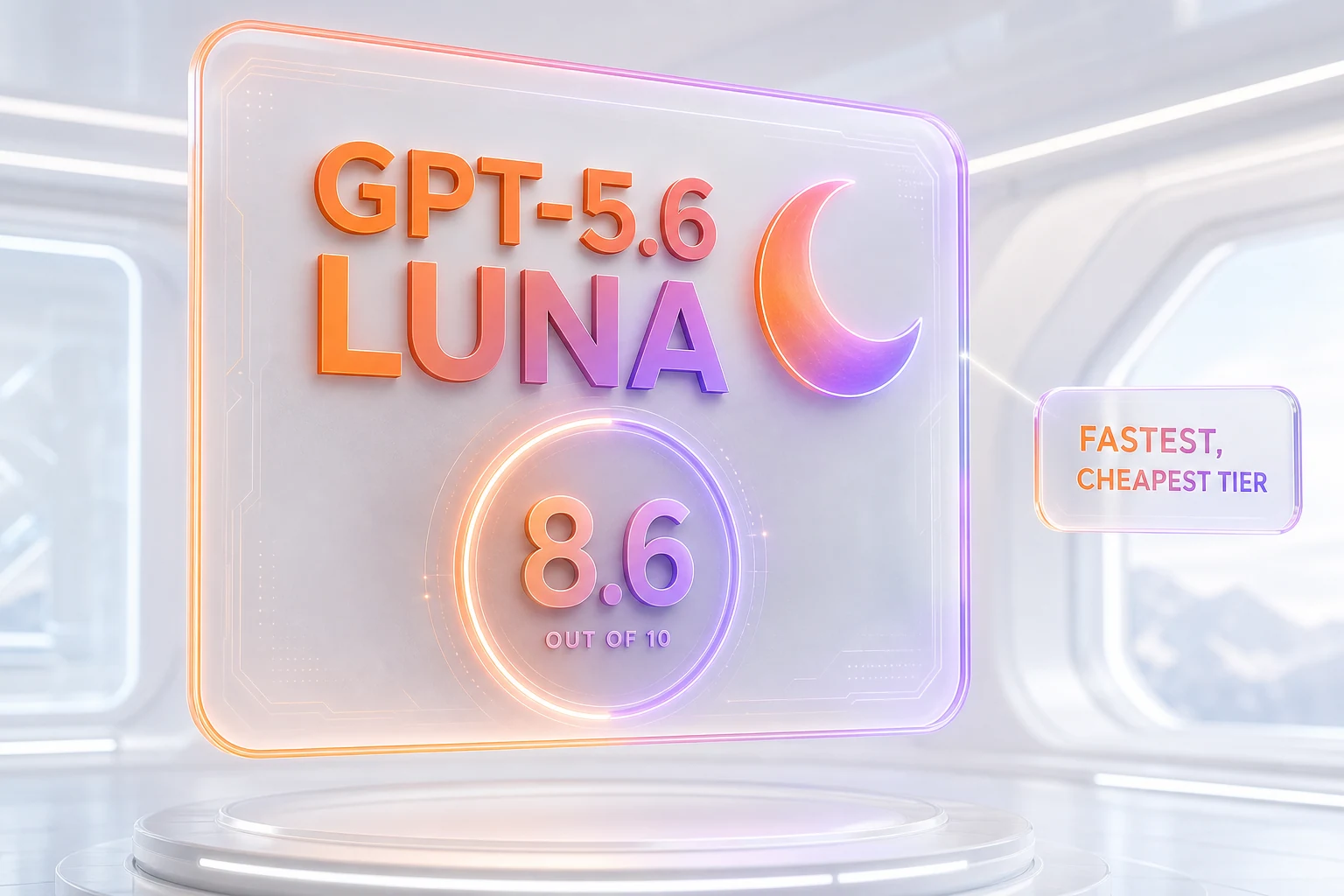
GPT-5.6 Luna is OpenAI's fastest and most economical GPT-5.6 model, generally available July 9, 2026 via the API, Codex, and ChatGPT for Work. It costs $0.20 per million input tokens, $0.02 per million cached input tokens, and $1.20 per million output tokens — the lowest rates in the GPT-5.6 family. It ships a 1,050,000-token context window, a 128,000-token maximum output, a February 16, 2026 knowledge cutoff, and text-and-image input with text output. OpenAI positions it as the new standard for intelligence and efficiency for high-volume, low-latency work. We tested it hands-on through the API. Score 8.6 out of 10.
Quick Verdict
Score: 8.6 out of 10. GPT-5.6 Luna is the tier you reach for when volume and speed matter more than the last few points of raw intelligence. It is the economy member of OpenAI's GPT-5.6 family — sitting below the flagship Sol and the balanced Terra — and it is priced at $0.20 input and $1.20 output per million tokens, the cheapest of the three. In our own API testing it summarized a dense policy document, drafted a launch email, classified and routed a batch of support tickets, and returned warm replies in well under a second, all cleanly and for a fraction of a cent. It is the right default for summarization, drafting, classification, and routine automation at scale. It is the wrong pick when a task needs frontier reasoning, fine-tuning, or native audio.
- ✅ The cheapest tier in the family at $0.20 input and $1.20 output per million tokens, with a full 1,050,000-token context, billed at one flat rate up to 272,000 input tokens
- ✅ Fast in practice — a warm one-word reply came back in 658 milliseconds, and our routine tasks finished in one to three seconds
- ✅ Disciplined on routine work — it obeyed strict formats such as "JSON only," classified five tickets correctly, and summarized a policy document accurately on the first try
- ❌ Independent benchmarks put Luna at the bottom of the family (Artificial Analysis Intelligence Index 51 versus Sol's 59) — it trails on genuinely hard, multi-step reasoning
- ❌ No fine-tuning, no native audio, not selectable in the consumer ChatGPT app, and never submitted to the independent SWE-bench Verified leaderboard
Best for: teams and builders running very high volume, latency-sensitive, well-scoped tasks — bulk summarization, short-form drafting, classification and extraction, and routine automation. Luna is built for pipelines that push millions of tokens per day and care about cost per task and response time far more than about squeezing out the last reasoning point.
GPT-5.6 Luna Pricing at a Glance
| GPT-5.6 tier | Model ID | Input | Cached input | Output |
|---|---|---|---|---|
| Luna (economy) | gpt-5.6-luna | $0.20 | $0.02 | $1.20 |
| Terra (balanced) | gpt-5.6-terra | $2.00 | $0.20 | $12.00 |
| Sol (flagship) | gpt-5.6-sol | $5.00 | $0.50 | $30.00 |
All prices are per million tokens and were verified on OpenAI's developer pricing documentation on July 30, 2026. Luna is the cheapest line on every column, and Batch mode halves those figures again. For a plain-English explainer on how input, output, and cached token rates work, see our guide on AI model pricing explained. Sources: OpenAI API pricing and the GPT-5.6 announcement.
How We Tested GPT-5.6 Luna
This is an early hands-on review, not a matured verdict. GPT-5.6 Luna reached general availability on July 9, 2026 — two days before this review — after a gated preview that opened to trusted partners on June 26. We ran the production model, gpt-5.6-luna, directly through the OpenAI Chat Completions API using our own key on July 11, 2026, from Bali. We did not test a demo or a chat wrapper; every result below came back over HTTPS from OpenAI's servers with a 200 status, and the responses reported their model as gpt-5.6-luna.
Because Luna is pitched as the fastest, cheapest tier for high-volume routine work, we deliberately built a battery that mirrors that pitch rather than a frontier reasoning gauntlet: a fast summarization of a dense regulatory memo, a short-form marketing email, a five-ticket classification-and-routing task returning strict JSON, and a dedicated latency probe run three times to measure round-trip speed. We also sent one deliberately harder logic problem to show, honestly, where the economy tier's ceiling sits relative to the flagship. Seven calls total, all returned successfully, and together they cost under a third of a cent in tokens. We report the real outputs, latencies, and token counts below. Our methodology mirrors the approach we describe in our explainer on agentic models versus chatbots. Primary references throughout: OpenAI's Luna model card and Artificial Analysis for independent scores.
What Is GPT-5.6 Luna?
GPT-5.6 Luna is the economy member of OpenAI's GPT-5.6 family, released alongside the flagship Sol and the balanced Terra on July 9, 2026. In OpenAI's naming system the number denotes the generation while Sol, Terra, and Luna are durable capability tiers rather than model sizes — the same idea persists across releases, so "Luna" should keep meaning "the fastest, most economical tier" in future generations. Luna's model ID is gpt-5.6-luna, and it targets the workloads that dominate raw token volume: summarization, drafting, classification, extraction, and routine automation where latency and cost matter most.
OpenAI frames the whole GPT-5.6 line as a "new standard for intelligence and efficiency," and within that line Luna is the efficiency end of the spectrum. It aims to run the same jobs a mid-tier model would, but faster and at a lower cost per task, accepting a step down in raw capability in exchange. Luna shares the family's full plumbing — a 1,050,000-token context window, a 128,000-token maximum output, and a February 16, 2026 knowledge cutoff — so choosing the cheapest tier does not cost you context. Where Luna steps back from Sol and Terra is raw intelligence: independent scoring from Artificial Analysis places it at the bottom of the three tiers. The new multi-agent "ultra" reasoning mode is concentrated on the flagship Sol, not Luna. Details are documented on OpenAI's models reference and summarized in the launch post.
Key Features
Speed and low latency
Speed is Luna's headline feature, and it held up in our testing. A bare one-word reply came back in 1,268 milliseconds on the first, cold call, then in 721 and 658 milliseconds once the connection was warm — sub-second round trips from Bali to OpenAI's servers and back. Our heavier routine tasks landed in roughly one to three seconds. For interactive assistants, autocomplete-style features, and high-throughput pipelines where each request must clear quickly, that responsiveness is the whole point of choosing the economy tier over a slower, smarter one. Speed on a large language model comes from the balance between model size and inference optimization, and Luna is tuned for the fast end. Latency will vary by region, prompt size, and reasoning effort; ours are small-prompt figures. References: Luna model card, GPT-5.6 launch.
1,050,000-token context window
Luna carries the same 1.05M-token context window and 128,000-token maximum output as the flagship Sol. That parity matters: many vendors reserve the biggest context for the top tier, so getting a full million-token window on the cheapest model removes a common reason to pay up. Luna can read long transcripts, multi-document bundles, and large logs without fragmenting the input across calls, which suits summarization and retrieval work at scale. Pricing is flat up to 272,000 input tokens; above that threshold OpenAI charges twice the input rate and 1.5 times the output rate, applied to the full request rather than the excess. See OpenAI's Luna model card and its pricing docs.
Reasoning effort scale from low to max
Every Luna API call accepts a reasoning-effort parameter that ranges from low through xhigh up to the new max level. Reasoning tokens are billed at the output rate and share the completion-token budget, so a high-effort run on a dense problem spends more and can truncate the visible answer if your token cap is set too low. In our testing Luna used zero reasoning tokens on a plain summarization and classification job at low effort, and 73 reasoning tokens on a high-effort logic problem — you pay for thinking only when you ask for it. The multi-agent "ultra" tier that orchestrates several sub-agents is a flagship Sol feature; on Luna you have the low-to-max ladder, which is more than enough for the routine tasks it targets. Documented on the OpenAI models reference; behavior confirmed in our own runs cross-checked against Artificial Analysis.
Programmatic Tool Calling and the agentic stack
Luna includes Programmatic Tool Calling, where the model writes and runs JavaScript in an isolated, ephemeral runtime to orchestrate tool calls in code rather than one call at a time — and it is compatible with Zero Data Retention. On top of that it ships the full tool suite: function calling, structured outputs, streaming, web search, file search, image generation, code interpreter, hosted shell, computer use, and MCP (Model Context Protocol) clients. For the cheapest tier in the family to inherit the complete agentic toolbox, rather than a stripped-down subset, is unusual and genuinely useful for automation. References: Luna model card, GPT-5.6 launch.
Improved prompt caching and Batch API
Cached input on Luna is billed at $0.02 per million tokens — a 90 percent discount on the $0.20 standard input rate — with cache writes at 1.25 times input and a 30-minute minimum cache lifetime. For a summarizer or classifier that re-sends a large system prompt on every call, caching is the single biggest lever on effective cost, and at Luna's rates that lever is cheaper than anywhere else in the family. Luna also supports the Batch API at half price ($0.10 input and $0.60 output per million tokens) for non-urgent jobs like overnight bulk processing — the lowest per-token rate OpenAI offers on a GPT-5.6 model. Verified against OpenAI's pricing documentation and the announcement.
Text and image input, text output
Luna accepts text and image input and returns text. There is no native audio input or output, and image generation is a callable tool rather than an output modality — the same shape as the rest of the GPT-5.6 family. For summarization and classification work, which is Luna's lane, vision input covers scanned pages, charts, and screenshots, and the text-only output keeps responses predictable for downstream parsing. Anyone who needs a cheap multimodal option should also weigh Gemini 3 Flash, Google's economy tier and Luna's most direct rival. Sourced from the Luna model card and models reference.
No fine-tuning at launch
Fine-tuning is not supported on Luna at launch. Teams that depend on tuned production variants cannot bring them to Luna yet and will need to stay on an older fine-tunable model. This is the same gap the flagship Sol and the balanced Terra have, and OpenAI has not published a timeline. If tuned behavior is core to your stack, factor this in before migrating a high-volume pipeline to the cheaper tier. Confirmed on the Luna model card; see also the pricing docs for the full family.
GPT-5.6 Luna Pricing in 2026
Luna's pricing has two tiers: one flat per-token rate up to 272,000 input tokens, a long-context rate above it, plus the usual Batch and Priority modes. Every figure below was verified on OpenAI's developer pricing page on July 30, 2026.
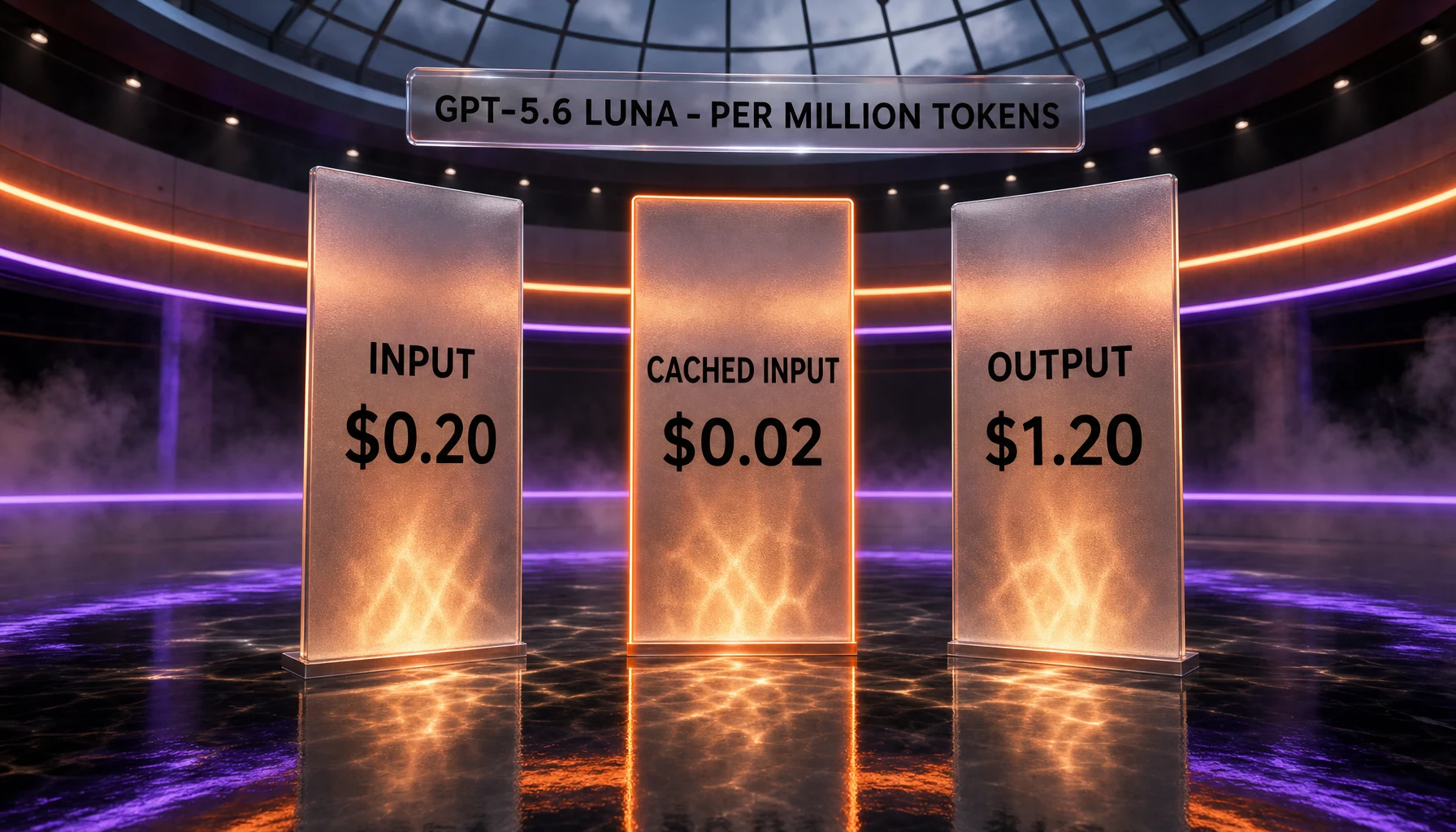
API pricing (per million tokens)
| Mode | Input | Output |
|---|---|---|
| Standard | $0.20 | $1.20 |
| Cached input | $0.02 | Not applicable |
| Batch (50 percent off) | $0.10 | $0.60 |
| Priority (two times standard) | $0.40 | $2.40 |
Luna does carry a long-context surcharge: past 272,000 input tokens the rate becomes $0.40 per million input and $1.80 per million output, and it applies to the whole request, not just the tokens above the line. Below that threshold the rate is flat, which is easy to forecast at the scale Luna targets, where a small per-token difference multiplies across millions of calls. The most useful comparison is internal: Luna at $0.20 and $1.20 is 4 percent of flagship Sol's $5.00 and $30.00, and 10 percent of the balanced Terra's $2.00 and $12.00. Independent testing from Artificial Analysis, run in July 2026 before the July 30 price cut, put Luna's cost per task at about $0.21, against roughly $0.55 for Terra and $1.04 for Sol — the cheapest run of the three by a wide margin. Longtime OpenAI users can compare it against the previous-generation GPT-5.4 and GPT-5.5 to size the saving. References: OpenAI pricing, Artificial Analysis.
Best for: teams running very high-volume, cost-sensitive traffic — bulk summarization, drafting, and classification pipelines — where a lower rate per token turns directly into margin. Prototypes and solo builders should start on Luna and only step up to Terra or Sol when a task's quality bar demands it.
What We Found Testing Luna
Here is what actually came back from gpt-5.6-luna over the API. All seven calls succeeded; latencies ran from 658 milliseconds on a one-word reply to about 2.8 seconds on the longest generation, and the whole battery cost under a third of a cent in tokens.
Fast summarization
We handed Luna a dense paragraph on the phased rollout of the European Union's AI Act and asked for the key compliance dates as three bullet points. It returned an accurate, well-structured brief in 1,881 milliseconds: it correctly captured the August 2024 entry into force, the February 2025 prohibited-practice rules, the August 2025 date for general-purpose AI obligations and the AI Office, the August 2027 grace period for pre-existing general-purpose models, and the headline August 2, 2026 full application, with high-risk requirements phased across 2027, 2028, and 2030. Nothing was invented and nothing important was dropped — exactly the reliable synthesis that summarization pipelines depend on, delivered in under two seconds for a fraction of a cent.
Short-form drafting
We asked Luna for a 55-to-70-word launch email for a fictional scheduling app, friendly tone, one clear call to action, no subject line. It produced a clean, on-brand draft in 2,764 milliseconds — a warm opener, a plain description of the benefit, and a single "Try it today" close — that we would send with light editing. One honest nit: the draft landed at roughly 52 words, a hair under the 55-word floor we set, so a strict word budget may need a second pass or a slightly higher target. For routine marketing and product copy, though, this is precisely the fast first draft Luna is built to produce.
Classification and extraction
We sent five support messages and a fixed label set — billing, bug, feature_request, praise, account — and instructed Luna to return only a JSON array of id-and-label objects. It returned clean, parseable JSON on the first try in 1,003 milliseconds, and every one of the five labels was correct: the duplicate charge as billing, the broken export button as a bug, the dark-mode request as a feature request, the compliment as praise, and the email-change question as account. No prose wrapper, no stray Markdown fences. For a pipeline that feeds a database, that reliability on "output only JSON" at roughly one second per call is worth more than a benchmark point.
The latency probe
To isolate raw speed from generation length, we sent the simplest possible prompt — reply with one word — three times and measured the round trip. The first, cold call took 1,268 milliseconds; the next two, with the connection warm, came back in 721 and 658 milliseconds. Sub-second latency on a warm path is exactly what makes Luna suitable for interactive features and high-throughput queues, where a half-second saved per request compounds across a day's traffic. These are small-prompt numbers from a single region on a single day, so treat them as directional rather than a guaranteed service level.
The honest reasoning probe
Finally, to show where the economy tier's ceiling sits, we handed Luna a deliberately harder problem: find three consecutive prime numbers that sum to 41, then give the product of their ages. At high reasoning effort Luna spent 73 reasoning tokens, worked cleanly to 11, 13, and 17, and returned the correct product, 2,431, in 1,543 milliseconds. Credit where due — it nailed our probe. But one puzzle solved is an anecdote, not a benchmark, and we will not oversell it. The real signal comes from independent scoring: on the Artificial Analysis Intelligence Index, Luna sits at 51 against Sol's 59 and Terra's 55, so on genuinely hard, multi-step reasoning the flagship tiers should pull ahead. Our battery validates Luna for fast routine work; it does not claim Luna equals the flagship on frontier problems, and we would not make that claim from an early hands-on. Independent scores via Artificial Analysis; model behavior per the Luna model card.
Benchmarks: How Luna Ranks
Independent numbers matter more than vendor slides, so we separate the two. The clearest third-party read comes from Artificial Analysis, which places Luna at the value end of the GPT-5.6 family.
| Benchmark (source) | Luna | Terra | Sol |
|---|---|---|---|
| Artificial Analysis Intelligence Index (independent) | 51 | 55 | 59 |
| Artificial Analysis Coding Agent Index v1.3 (independent, read August 2, 2026) | 58.66 (Codex harness, max effort) | 62.28 (Codex harness, max effort) | 66.57 (Codex harness, max effort) |
| Artificial Analysis cost per task (independent, July 2026, before the July 30 price cut) | $0.21 | $0.55 | $1.04 |
| Terminal-Bench 2.1 (self-reported by OpenAI) | 84.7% | 87.4% | 88.8% |
| Terminal-Bench 2.1 (measured by Artificial Analysis, as of August 3, 2026) | 80.9% | 88.0% | 88.0% |
Read of the table: on the independent Artificial Analysis Intelligence Index, Luna scores 51 against Terra's 55 and Sol's 59 — the lowest of the family, an eight-point gap below the flagship. On the Artificial Analysis Coding Agent Index v1.3, which scores a coding harness paired with a model at a stated reasoning effort, all three tiers run through Codex, so the family compares directly at a matched setting: at max effort Luna scores 58.66 against Terra's 62.28 and Sol's 66.57 (read August 2, 2026). The coding gap inside the family is therefore narrower than the intelligence gap — 7.91 points between Luna and Sol on the coding index, against eight index points on intelligence. Where Luna wins outright is cost per task: about $0.21 against Terra's $0.55 and Sol's $1.04 when Artificial Analysis ran the family in July 2026, before the July 30 price cut — roughly a fifth of the flagship's cost per job at those rates. According to OpenAI's own figures, Luna hits 84.7 percent on Terminal-Bench 2.1; we label that self-reported because OpenAI published it; Artificial Analysis runs Terminal-Bench 2.1 in its own battery and measures Luna at 80.9 percent as of August 3, 2026 — 3.8 points below OpenAI's figure. One honest gap: Luna was not submitted to the independent SWE-bench Verified leaderboard, so there is no third-party score from that particular suite, checked August 2, 2026. We do not cite AIME or MMLU figures for Luna because Artificial Analysis's battery does not cover them; it does measure GPQA Diamond, at 91.1 percent as of August 3, 2026. Sources: Artificial Analysis and the OpenAI GPT-5.6 announcement.
Luna vs Terra vs Sol, and vs Gemini 3 Flash
The most useful comparison for Luna is inside its own family. All three tiers share the plumbing — a 1.05M-token context, the same tool stack, the same February 16, 2026 cutoff — and differ on capability and price.
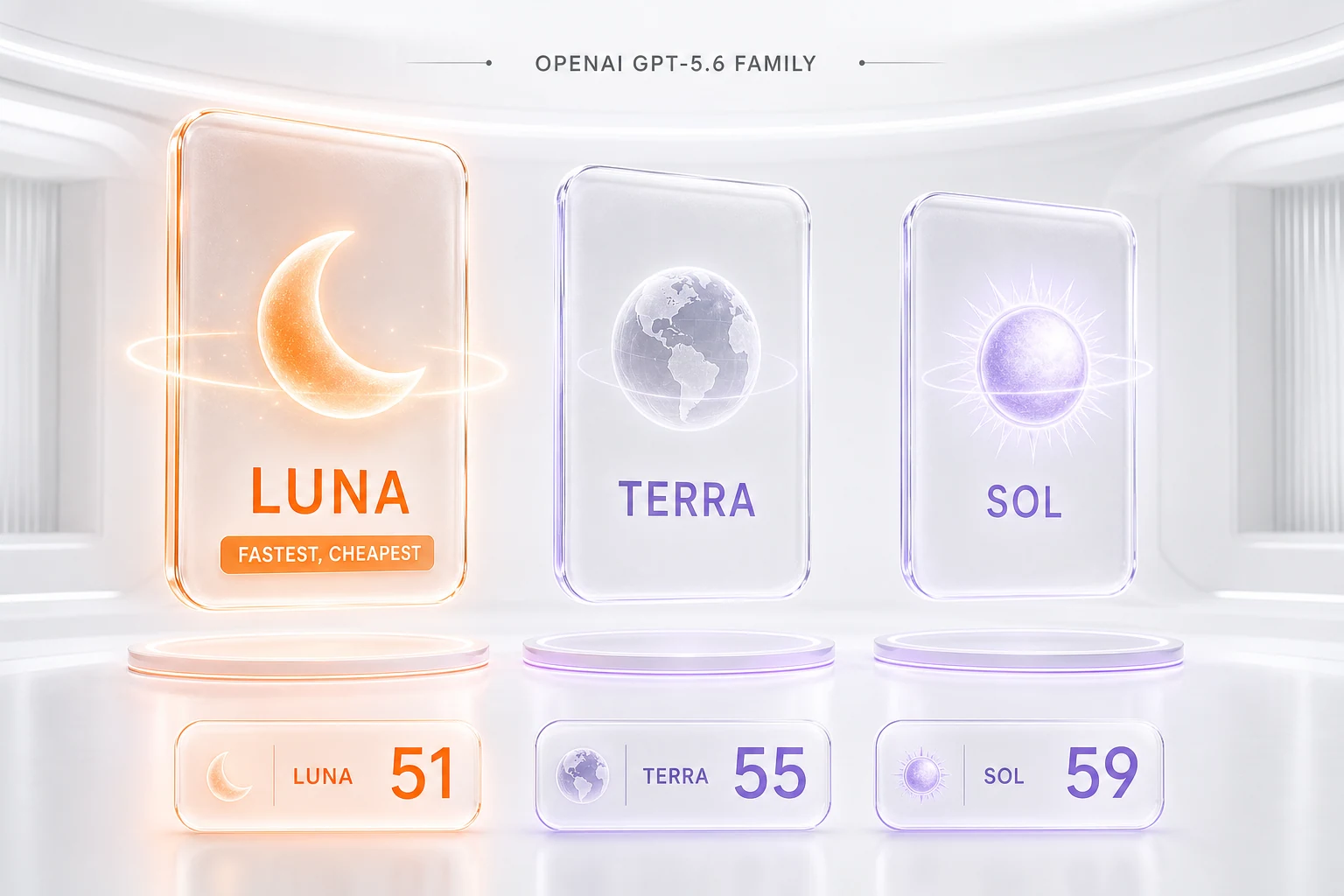
| Attribute | Luna (economy) | Terra (balanced) | Sol (flagship) |
|---|---|---|---|
| Input (per 1M tokens) | $0.20 | $2.00 | $5.00 |
| Output (per 1M tokens) | $1.20 | $12.00 | $30.00 |
| AA Intelligence Index | 51 | 55 | 59 |
| AA Coding Agent Index v1.3 (Codex, max effort) | 58.66 | 62.28 | 66.57 |
| AA cost per task (July 2026, pre-cut) | $0.21 | $0.55 | $1.04 |
| Context window | 1.05M | 1.05M | 1.05M |
| Best for | Fastest, cheapest routine work | High-volume business | Hardest problems, long-horizon agents |
Pick Luna for the high-volume, low-stakes end: bulk summarization, drafting, classification, extraction, and routine automation where speed and cost beat marginal quality. Step up to Terra when a task needs more judgment — the four-point Intelligence Index gap between the two tiers is real, and Terra is still only 40 percent of the flagship's price. Reserve Sol for genuinely hard work — complex agentic coding, long-horizon planning, or jobs that benefit from the multi-agent ultra reasoning tier. A common and sensible pattern is to route simple traffic to Luna and escalate only the requests that need more. The tier-by-tier detail sits in GPT-5.6 Terra versus GPT-5.6 Luna.
Across vendors, Luna's most direct rival is Gemini 3 Flash, Google's economy tier aimed at the same fast, cheap, high-volume lane; anyone choosing an economy model should benchmark the two on their own prompts. Teams comparing the balanced and frontier tiers should also weigh Claude Sonnet 5 and use Claude Fable 5 or Grok 4.3 as frontier reference points. And if your traffic already runs on GPT-5.5, Luna is the obvious cost-down test for the portion of it that does not need frontier quality. As always, run your own LLM evaluation on your real prompts before committing. Independent scores via Artificial Analysis; pricing via OpenAI.
Every head-to-head with GPT-5.6 Luna
Luna has since been measured against most of the economy tier. Here is each published matchup and the question it settles.
- Luna versus Claude Haiku 4.5 — Anthropic's fast tier at 1 and 5 dollars per million tokens against Luna's 0.20 and 1.20, and whether that gap buys anything back.
- Luna versus Claude Sonnet 5 — what a mid-tier model does that an economy model cannot, at several times the rate.
- Luna versus MiniMax M3 — the open-weight challenger that matches Luna on output at 1.20 dollars per million tokens and sits a shade above it on input.
- Luna versus Kimi K2.6 — Moonshot's value model at 0.95 and 4.00, and where the extra spend shows up.
- Luna versus DeepSeek V4 — the budget open-weight lineage that competes with Luna on running cost rather than on capability.
- Muse Spark 1.1 versus Luna — how that challenger holds up against Luna on the same routine workloads.
Pros and Cons After Testing
What we liked
- The cheapest run in the family. At $0.20 input and $1.20 output per million tokens, Luna is the clearest value pick in the GPT-5.6 line — independent testing put its cost per task at about $0.21, roughly a fifth of the flagship per job, before OpenAI's July 30, 2026 cut widened the gap further.
- Genuinely fast. Warm one-word replies in 658 milliseconds and routine tasks in one to three seconds in our runs, snappy enough for interactive features and high-throughput queues.
- Disciplined on routine work. It obeyed "output only JSON," classified all five test tickets correctly, and summarized a dense policy document accurately on the first try — the behaviors that make an economy model safe to wire into a pipeline.
- Full context, flat to 272K. A 1,050,000-token window and 128,000-token output identical to the flagship, at one rate up to 272,000 input tokens — above that, input doubles and output rises by half.
- Effective cost is even lower than the sticker. Cached input at $0.02 per million tokens (a 90 percent discount) and a Batch API at half price push real-world spend below any other GPT-5.6 tier.
- The complete agentic toolbox. Programmatic Tool Calling, function calling, structured outputs, web and file search, code interpreter, computer use, and MCP all ship on the cheapest tier, not just the flagship.
Where it falls short
- It is the least intelligent tier. Luna sits at the bottom of the family on the independent Artificial Analysis Intelligence Index (51 versus Terra's 55 and Sol's 59); on genuinely hard reasoning the higher tiers should win.
- No fine-tuning at launch. Teams that rely on tuned production variants cannot migrate them to Luna yet, and there is no announced timeline.
- Invisible in consumer ChatGPT. Luna is available through the API, Codex, and ChatGPT for Work only — individual ChatGPT users get the flagship Sol, not Luna.
- Text and image in, text out only. No native audio and no image generation as an output; image creation is an external tool call.
- A benchmark data gap. Luna was not submitted to SWE-bench Verified, so its independent agentic-coding evidence rests on the Artificial Analysis Coding Agent Index alone, at 58.66 as of August 2, 2026.
Real-World Use Cases
High-volume summarization
Luna's fast, accurate synthesis and 1.05M-token context make it a strong summarization engine for transcripts, reports, and document bundles. In our test it condensed a dense regulatory paragraph into a correct three-point brief in under two seconds, and at Luna's rates that job costs a fraction of a cent — the economics that make bulk summarization viable.
Short-form content drafting
For first-pass marketing copy, product descriptions, and templated emails, Luna produces clean drafts quickly. Our launch-email test came back on-brand in under three seconds; a human still owns the final edit, but the speed and cost make Luna a natural drafting assistant at volume.
Classification and extraction
Feeding unstructured text into a fixed label set or JSON schema is Luna's sweet spot. It returned valid, correctly labeled JSON with no wrapper in our five-ticket test, at roughly one second per call — exactly what a database-backed pipeline needs at scale.
Routine automation and routing
Triaging tickets, tagging content, and routing requests by category are natural fits for a fast, cheap, disciplined model. Luna's strict output formatting means results drop straight into a workflow tool without post-processing.
Interactive assistants and autocomplete
Sub-second warm latency makes Luna suitable for in-product assistants, search suggestions, and autocomplete-style features where responsiveness is the experience. The lower cost per call also makes always-on features affordable.
Long-context retrieval on a budget
The full million-token window plus 90-percent-off cached input make Luna viable for retrieval-augmented pipelines over large corpora without paying flagship rates or hitting a context surcharge — provided the task does not need frontier reasoning.
Batch and back-office pipelines
For non-urgent overnight jobs — bulk classification, translation, or document processing — the Batch API halves Luna's rate to $0.10 input and $0.60 output per million tokens, the cheapest large-run option in the GPT-5.6 family.
Tiered routing with a smarter model
Because Luna shares the family's API shape, it slots neatly into a router that sends simple requests to Luna and escalates the hard ones to Terra or Sol — capturing most of the cost saving while keeping a quality backstop for the requests that need it.
Frequently Asked Questions
What is GPT-5.6 Luna?
GPT-5.6 Luna is the fastest and most economical capability tier of OpenAI's GPT-5.6 family, generally available July 9, 2026 via the API, Codex, and ChatGPT for Work. It sits below the flagship Sol and the balanced Terra, carries a 1,050,000-token context window and a 128,000-token maximum output, and accepts text and image input with text output. OpenAI positions the family as a new standard for intelligence and efficiency, with Luna as the efficiency end. Its model ID is gpt-5.6-luna.
How much does GPT-5.6 Luna cost?
GPT-5.6 Luna costs $0.20 per million input tokens, $0.02 per million cached input tokens, and $1.20 per million output tokens — the lowest rates in the GPT-5.6 family. Batch mode halves those rates to $0.10 input and $0.60 output, and Priority processing doubles them to $0.40 and $2.40. Prompts above 272,000 input tokens are billed at twice the input rate and 1.5 times the output rate, applied to the full request. Prices were verified on OpenAI's developer pricing page on July 30, 2026.
How is GPT-5.6 Luna different from GPT-5.6 Terra and Sol?
Luna is the economy tier, Terra is balanced, and Sol is the flagship. All three share the same 1,050,000-token context, the same tool stack, and the same February 16, 2026 knowledge cutoff, but they differ on capability and price. Luna is the cheapest at $0.20 input and $1.20 output per million tokens, and the least capable — it scores 51 on the independent Artificial Analysis Intelligence Index, versus 55 for Terra and 59 for Sol. The multi-agent ultra reasoning tier is a Sol feature.
Is GPT-5.6 Luna fast?
Yes, in our testing. A one-word reply came back in 1,268 milliseconds on a cold call and in 721 and 658 milliseconds once warm — sub-second round trips — and heavier routine tasks landed in roughly one to three seconds. Speed is Luna's headline feature and the main reason to choose it over a smarter, slower tier. Latency varies by region, prompt size, and reasoning effort, so treat our small-prompt figures as directional.
What is GPT-5.6 Luna's context window?
GPT-5.6 Luna has a 1,050,000-token context window and a maximum output of 128,000 tokens — identical to the flagship Sol and the balanced Terra. The per-token rate is flat up to 272,000 input tokens; above that, OpenAI charges twice the input rate and 1.5 times the output rate on the full request. Reasoning tokens count against both the context window and the output billing rate.
Can you use GPT-5.6 Luna in ChatGPT?
Not in the consumer ChatGPT app. Luna is available through the OpenAI API, inside Codex, and in ChatGPT for Business and Enterprise (Work) plans. Individual ChatGPT Plus and Pro users can select the flagship Sol but not Terra or the economy Luna, which are aimed at developers and organizations running higher volumes.
Does GPT-5.6 Luna support fine-tuning?
No. Fine-tuning is not supported on GPT-5.6 Luna at launch, the same as the flagship Sol and the balanced Terra. Teams that run tuned production variants cannot migrate them to Luna yet and should stay on an older fine-tunable model until OpenAI adds support. No timeline has been announced.
Is GPT-5.6 Luna multimodal?
Partly. GPT-5.6 Luna accepts text and image input and produces text output. It does not support native audio input or output, and it does not generate images as an output modality — image generation is a callable tool. For summarization and classification work, vision input covers scanned pages, charts, and screenshots, which is what Luna's target audience needs.
What did GPT-5.6 Luna score on independent benchmarks?
On the independent Artificial Analysis Intelligence Index, Luna scores 51, versus 55 for Terra and 59 for Sol. On the Artificial Analysis Coding Agent Index v1.3, all three tiers run through the Codex harness, so at max reasoning effort they compare directly: Luna 58.66, Terra 62.28, Sol 66.57 (read August 2, 2026). Luna's cost per task on the Intelligence Index measured about $0.21 in July 2026, the lowest of the three. OpenAI self-reports 84.7 percent on Terminal-Bench 2.1; Artificial Analysis independently measures Luna at 80.9 percent on that suite as of August 3, 2026 — 3.8 points below the vendor figure. Luna was not submitted to the independent SWE-bench Verified leaderboard, so there is no third-party score from that suite; Artificial Analysis does measure GPQA Diamond, at 91.1 percent, while AIME and MMLU are not in its battery.
What is GPT-5.6 Luna best for?
Luna is best for high-volume, latency-sensitive, well-scoped work: bulk summarization, short-form drafting, classification and extraction, routine automation, interactive assistants, and long-context retrieval on a budget. It is built for pipelines that process millions of tokens per day and care about cost per task and response time more than the last few points of reasoning quality. It is not the right pick for frontier reasoning, fine-tuning, or native audio.
Does GPT-5.6 Luna support function calling and structured outputs?
Yes. Luna supports function calling, structured outputs, streaming, and Programmatic Tool Calling, where the model writes and runs JavaScript in an isolated runtime to orchestrate tool calls. It also has native web search, file search, code interpreter, computer use, and MCP client support. In our testing it reliably returned strict, parseable JSON when asked, which is what structured-output workflows depend on.
Should I choose GPT-5.6 Luna or Gemini 3 Flash?
Both are economy tiers built for fast, cheap, high-volume work, so the right choice depends on your prompts. Luna gives you the GPT-5.6 family's full agentic toolbox, a 1,050,000-token context, and an Artificial Analysis Intelligence Index of 51 at $0.20 input and $1.20 output per million tokens. Gemini 3 Flash is Google's competing economy model with its own pricing and ecosystem. Run both on your real workload and compare quality, latency, and cost before committing to either.
Verdict: 8.6 out of 10
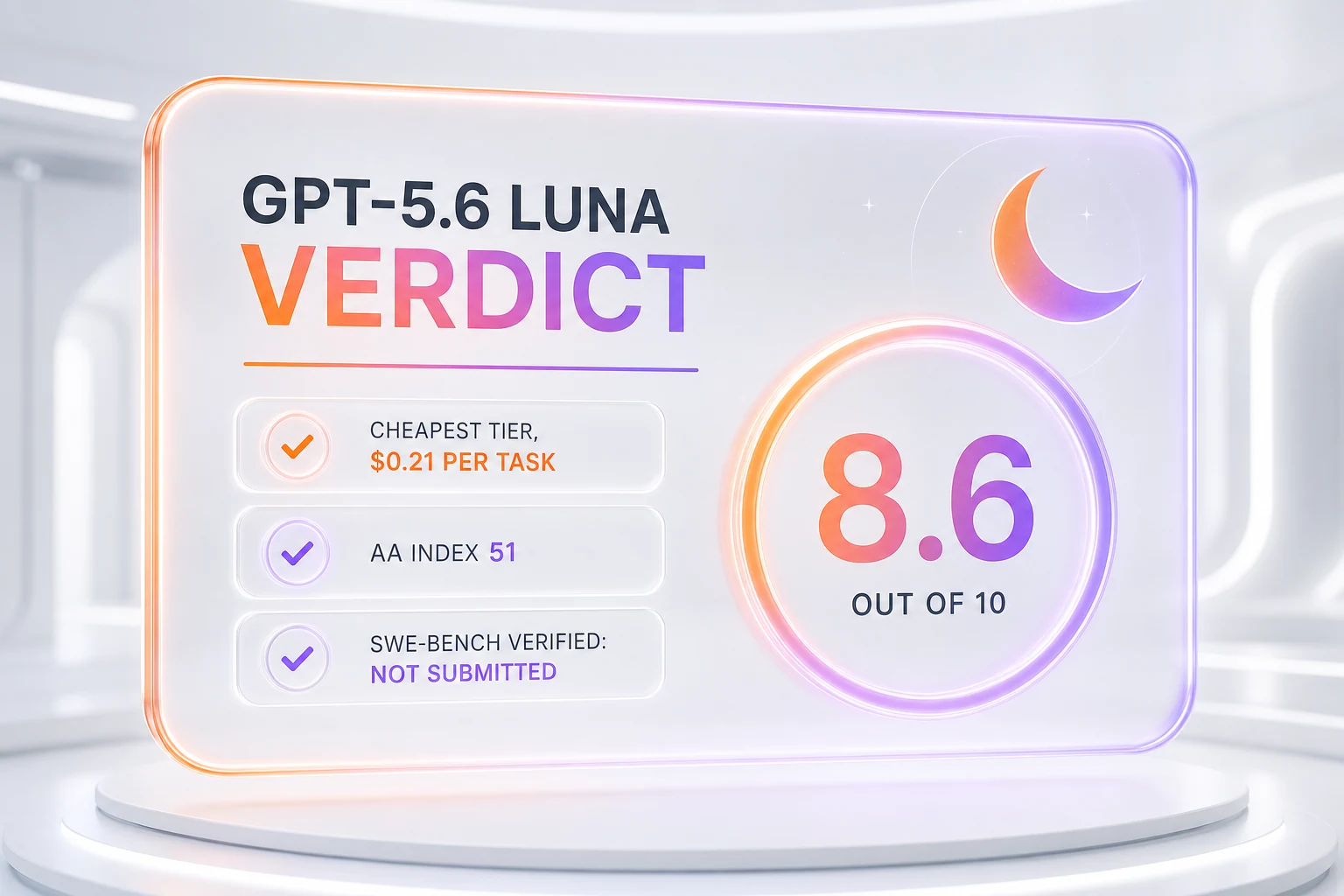
GPT-5.6 Luna earns an 8.6 out of 10 for one clear reason: it does the high-volume routine jobs well, faster and cheaper than any other tier in the family, and in our hands-on testing that trade held up. It summarized a dense policy document accurately in under two seconds, classified five tickets correctly as strict JSON, drafted usable marketing copy, and returned warm replies in 658 milliseconds — all for under a third of a cent across the whole battery. What keeps it from a higher score is honest and specific: it is the least intelligent tier in the family, sitting eight points below the flagship on the independent Artificial Analysis Intelligence Index, it has no fine-tuning at launch, it is invisible in the consumer ChatGPT app, and it was never submitted to SWE-bench Verified, leaving a real data gap under a developer-first pitch.
Score breakdown:
- Features: 8.2 out of 10 — full 1.05M context, the complete agentic tool stack, Programmatic Tool Calling, and reasoning effort up to max. Held back by being the least capable tier, no fine-tuning, no native audio, and the missing multi-agent ultra mode reserved for Sol.
- Ease of Use: 8.8 out of 10 — a drop-in
gpt-5.6-lunamodel ID on the standard Chat Completions and Responses APIs, flat pricing with no context surcharge, fast responses, and clean structured outputs in our tests. - Value: 9.3 out of 10 — the strongest column. The cheapest tier in the family at $0.20 input and $1.20 output per million tokens, cached input at a 90 percent discount, and Batch at half again.
- Support: 8.2 out of 10 — OpenAI's developer docs, model cards, and pricing pages are clear and current, but Luna is API, Codex, and Work only, so there is no consumer-app on-ramp and it is only two days into general availability.
Final word: Choose GPT-5.6 Luna as your default tier for high-volume, latency-sensitive, well-scoped work and route the hard requests elsewhere. Summarization, drafting, classification, extraction, and routine automation are exactly its lane, and nothing else in the GPT-5.6 family runs them cheaper or faster. Step up to the balanced Terra when a task needs more judgment, and reserve the flagship Sol for genuinely hard problems where an eight-point Intelligence Index gap changes the outcome. If you are shopping the economy tier across vendors, run Luna against Gemini 3 Flash on your own prompts and decide from your own numbers. Last tested: July 11, 2026.
Sources
- OpenAI — Introducing GPT-5.6 (Sol, Terra, Luna)
- OpenAI — GPT-5.6 Luna model card
- OpenAI — API pricing
- Artificial Analysis — independent LLM benchmarks (Intelligence Index, cost per task)
- Artificial Analysis — Coding Agent Index v1.3 leaderboard
- ThePlanetTools.ai hands-on API testing of gpt-5.6-luna, July 11, 2026 (seven calls via the Chat Completions API).
Key Features
Pros & Cons
Pros
- The cheapest tier in the family at $0.20 per million input tokens and $1.20 per million output tokens — independent Artificial Analysis testing measured about $0.21 per task before the July 30, 2026 price cut, roughly a fifth of the flagship's cost per job at those rates.
- Genuinely fast in our testing: a warm one-word reply returned in 658 milliseconds, and routine tasks finished in one to three seconds.
- Disciplined on routine work — it obeyed strict JSON-only formatting, classified all five test tickets correctly, and summarized a dense policy document accurately on the first try.
- Full 1,050,000-token context window and 128,000-token maximum output, identical to the flagship, with flat pricing and no context-length surcharge.
- Cached input at $0.02 per million tokens (a 90 percent discount) and a Batch API at half price push effective cost below every other GPT-5.6 tier.
- The complete agentic toolbox — Programmatic Tool Calling, function calling, structured outputs, web and file search, code interpreter, computer use, and MCP — ships on the cheapest tier.
Cons
- It is the least intelligent tier in the family, scoring 51 on the independent Artificial Analysis Intelligence Index versus Terra's 55 and Sol's 59 — it trails on genuinely hard, multi-step reasoning.
- No fine-tuning at launch, and OpenAI has not announced a timeline, so tuned production variants cannot migrate to Luna yet.
- Not selectable in the consumer ChatGPT app — Luna is limited to the API, Codex, and ChatGPT for Work plans.
- Text and image input with text output only: no native audio, and image generation is an external tool call rather than an output modality.
- Never submitted to the independent SWE-bench Verified leaderboard, leaving a gap on that particular suite — its independent agentic-coding evidence is the Coding Agent Index v1.3, at 58.66.
Best Use Cases
Platforms & Integrations
Available On
Integrations
Compare GPT-5.6 Luna

We're developers and SaaS builders who use these tools daily in production. Every review comes from hands-on experience building real products — DealPropFirm, ThePlanetIndicator, PropFirmsCodes, and many more. We don't just review tools — we build and ship with them every day.
Written and tested by developers who build with these tools daily.
Frequently Asked Questions
What is GPT-5.6 Luna?
OpenAI's fastest, most economical GPT-5.6 tier — $0.20 per million input tokens, sub-second warm latency, and a 1.05M-token context for high-volume routine work.
How much does GPT-5.6 Luna cost?
GPT-5.6 Luna costs $0.2/month.
Is GPT-5.6 Luna free?
No, GPT-5.6 Luna starts at $0.2/month.
What are the best alternatives to GPT-5.6 Luna?
Top-rated alternatives to GPT-5.6 Luna can be found in our WebApplication category, where we've reviewed and scored every tool on ThePlanetTools.ai.
Is GPT-5.6 Luna good for beginners?
GPT-5.6 Luna is rated 8.8/10 for ease of use.
What platforms does GPT-5.6 Luna support?
GPT-5.6 Luna is available on Web, REST API, OpenAI Codex, ChatGPT for Work.
Does GPT-5.6 Luna offer a free trial?
No, GPT-5.6 Luna does not offer a free trial.
Is GPT-5.6 Luna worth the price?
GPT-5.6 Luna scores 9.3/10 for value. We consider it excellent value.
Who should use GPT-5.6 Luna?
GPT-5.6 Luna is ideal for: High-volume document and transcript summarization, Short-form content and email drafting at scale, Text classification and structured data extraction into JSON, Routine automation, tagging, and ticket routing, Interactive assistants, search suggestions, and autocomplete features, Long-context retrieval-augmented generation on a budget, Batch and back-office processing pipelines, Tiered routing — simple traffic on Luna, hard requests escalated to Terra or Sol.
What are the main limitations of GPT-5.6 Luna?
Some limitations of GPT-5.6 Luna include: It is the least intelligent tier in the family, scoring 51 on the independent Artificial Analysis Intelligence Index versus Terra's 55 and Sol's 59 — it trails on genuinely hard, multi-step reasoning.; No fine-tuning at launch, and OpenAI has not announced a timeline, so tuned production variants cannot migrate to Luna yet.; Not selectable in the consumer ChatGPT app — Luna is limited to the API, Codex, and ChatGPT for Work plans.; Text and image input with text output only: no native audio, and image generation is an external tool call rather than an output modality.; Never submitted to the independent SWE-bench Verified leaderboard, leaving a gap on that particular suite — its independent agentic-coding evidence is the Coding Agent Index v1.3, at 58.66..
Ready to try GPT-5.6 Luna?
Get started today
Try GPT-5.6 Luna Now →