GPT-5.6 Sol vs MiniMax M3: Top Intelligence vs Rock-Bottom Price (2026)


GPT-5.6 Sol leads the independent AA Index 59 to 44. MiniMax M3 is open-weight, natively multimodal, and about 17x cheaper. A split verdict.
Feature Comparison
| Feature | GPT-5.6 Sol | MiniMax M3 |
|---|---|---|
| AA Intelligence Index (Artificial Analysis v4.1, same evaluator) | 59 | 44 (tied with DeepSeek V4-Pro) |
| Input price (per million tokens, standard rate) | 4.00 dollars up to 272K input, 8.00 above | 0.30 dollars (context up to 512K) |
| Output price (per million tokens, standard rate) | 20.00 dollars up to 272K input, 30.00 above | 1.20 dollars (context up to 512K) |
| Long-context pricing (Sol steps at 272K input, M3 at 512K) | 8 and 30 dollars above 272K input tokens | Doubles to 0.60 and 2.40 dollars above 512K |
| Context window | 1,050,000 tokens | 1,000,000 tokens |
| Weights and license | Closed (API, ChatGPT, Codex) | Open weights, downloadable and self-hostable |
| Self-hostable | No | Yes |
| Native modality | Text and image input, text output | Native text, image, and video input; computer use |
| Architecture | Closed, undisclosed | Open-weight MoE, 428B total and 23B active, MSA sparse attention |
| AA Coding Agent Index v1.3 (Artificial Analysis, independent, read August 2, 2026) | 66.57 — 2nd of 52 (Codex harness, max effort) | Not on the independent leaderboard |
| Ecosystem and hosting | US-hosted, OpenAI agentic stack, regional data residency | China-hosted API, or self-host anywhere |
| SWE-bench Pro (vendor self-reported) | Not reported on this benchmark | 59 percent (MiniMax self-reported) |
Pricing Comparison
GPT-5.6 Sol
MiniMax M3
Detailed Comparison
GPT-5.6 Sol and MiniMax M3 are the two large language models compared here, and they sit at opposite corners of the 2026 frontier. GPT-5.6 Sol is OpenAI's top-capability tier, generally available July 9, 2026, priced at 4 dollars per million input tokens and 20 dollars per million output tokens on requests up to 272,000 input tokens — promotional rates OpenAI cut on August 21, 2026 — rising to 8 dollars input and 30 dollars output above that threshold. MiniMax M3 is MiniMax's open-weight flagship, released June 1, 2026, priced at 0.30 dollars input and 1.20 dollars output per million tokens on contexts up to 512K, roughly 13 times cheaper on input and about 17 times cheaper on output. On the one independent evaluator that scores both models the same way, Artificial Analysis, GPT-5.6 Sol leads the Intelligence Index 59 to 44. MiniMax M3 answers with a downloadable, self-hostable mixture-of-experts model, a 1,000,000-token context, and native text, image, and video input. This is a split verdict, not a single winner. Best for peak measured intelligence and the OpenAI ecosystem: GPT-5.6 Sol. Best for price, open weights, and native multimodality: MiniMax M3.
Quick Verdict
This is a split verdict by use case, not a single overall winner. We ran both models side-by-side through their APIs, pulled the pricing directly from each vendor's own pages, and added our own hands-on notes from using both on reasoning and coding prompts. We have not run weeks of controlled, identical-task benchmarking of the two head-to-head, so where we lean on numbers we attribute them to their source, and where a figure is a vendor's own we label it. The honest summary is that these two models are not really chasing the same buyer. Here is the short version.
- Best for peak measured intelligence: GPT-5.6 Sol. On the Artificial Analysis Intelligence Index version 4.1 — the one composite that scores both models with the same battery — Sol sits at 59 while MiniMax M3 scores 44, a clear 15-point lead.
- Best for price: MiniMax M3, and it is not close. At current rates its output at 1.20 dollars per million tokens is about 17 times cheaper than Sol at 20 dollars, and its input at 0.30 dollars is roughly 13 times cheaper than Sol at 4 dollars.
- Best for open weights and self-hosting: MiniMax M3. It ships a downloadable open-weight mixture-of-experts model you run on your own hardware for full data sovereignty. GPT-5.6 Sol is closed and API-only.
- Best for measured coding: GPT-5.6 Sol, by availability of evidence. It places second of 52 on the Artificial Analysis Coding Agent Index v1.3 at 66.57, through the Codex harness at max reasoning effort, and MiniMax M3 is not placed on that leaderboard at all — a difference in what has been measured, not a demonstration that Sol codes better. Sol also ships a full agentic tool stack on by default.
- Best for native multimodality: MiniMax M3. It takes native text, image, and video input and supports computer use, where Sol reads text and image and returns text only.
- Best for ecosystem and compliance: GPT-5.6 Sol. US hosting with regional data-residency endpoints and the full OpenAI stack across ChatGPT, Codex, and the API, where MiniMax's hosted API runs in China, though its open weights let you self-host anywhere.
Bottom line: if you need the strongest measured model, the top charted coding score, or US-hosted compliance, pick GPT-5.6 Sol. If you are cost-constrained, want to own your weights, or need native video and self-hosting, MiniMax M3 gives you frontier-adjacent quality at a fraction of the price. We did not crown a single winner because the two models optimize for different things, and the numbers back both stories at once: a real capability gap and a much wider price gap. You can read the deeper single-model breakdowns in our GPT-5.6 Sol review and our MiniMax M3 review.
At a Glance
Before the detail, here is the side-by-side that frames everything below. All pricing in this table was fetched directly from each vendor's pricing page in July 2026 and is marked verified; GPT-5.6 Sol's rates were re-read on OpenAI's pricing page on August 28, 2026, after the promotional cut described below. Benchmark figures are attributed to their source; the independent numbers come from Artificial Analysis, and any vendor-reported figure is labeled as such in the benchmarks section.
| Dimension | GPT-5.6 Sol | MiniMax M3 |
|---|---|---|
| Vendor and origin | OpenAI (US) | MiniMax (Shanghai, China) |
| License | Closed — API, ChatGPT, and Codex only | Open weights, downloadable and self-hostable |
| Available | July 9, 2026 (general availability) | June 1, 2026 |
| Input price (per million tokens) | 4 dollars up to 272K input, 8 dollars above (verified) | 0.30 dollars up to 512K context, 0.60 above (verified) |
| Output price (per million tokens) | 20 dollars up to 272K input, 30 dollars above (verified) | 1.20 dollars up to 512K context, 2.40 above (verified) |
| Cached input (per million tokens) | 0.40 dollars up to 272K input, 0.80 above (verified) | 0.06 dollars read up to 512K context, 0.12 above (verified) |
| Context window | 1,050,000 tokens (verified) | 1,000,000 tokens (verified) |
| Native modality | Text and image input, text output | Native text, image, and video input; computer use |
| Architecture | Closed, undisclosed | Open-weight MoE, 428B total, 23B active, MSA |
| Self-hostable | No | Yes |
| AA Intelligence Index | 59 (Artificial Analysis v4.1) | 44 (Artificial Analysis v4.1) |
| Independent coding score | Charted, ranked first (see Benchmarks) | Not on the independent leaderboard |
Two patterns jump out. First, on the single independent yardstick that scores both, GPT-5.6 Sol is meaningfully ahead on intelligence, and it is the only one of the two with a charted independent coding score. Second, on price, MiniMax M3 is not a little cheaper but an order of magnitude cheaper, and it adds open weights and native video that a closed flagship cannot match. Everything below is really an argument about which of those two facts matters more for your workload.
Overview
GPT-5.6 Sol in one paragraph
GPT-5.6 Sol is the top-capability tier of OpenAI's GPT-5.6 family, generally available on July 9, 2026 across ChatGPT, Codex, and the API. It is built for the hardest reasoning, agentic, and coding work, with a reasoning-effort scale and new maximum and multi-agent modes for problems that reward extra compute. It carries a 1,050,000-token context window, accepts text and image input, and ships a complete agentic tool stack — function calling, web search, file search, code interpreter, computer use, and MCP — on by default. It is a closed model: no downloadable weights, no self-hosting, US-hosted with regional data-residency endpoints. On the independent Artificial Analysis Intelligence Index it leads its class, and it is the pricier of the two by a wide margin. The trade it offers is simple: the strongest measured model and the deepest ecosystem, at a premium price. Sol has two cheaper siblings worth knowing about — see our GPT-5.6 Terra and GPT-5.6 Luna pages if the flagship is more than you need.
MiniMax M3 in one paragraph
MiniMax M3 is the open-weight flagship from MiniMax, a Shanghai lab, released June 1, 2026. It is a mixture-of-experts model with 428 billion total parameters and roughly 23 billion active per token, using the lab's MiniMax Sparse Attention to keep long-context inference efficient. It is natively multimodal — text, image, and video input — supports computer use, and carries a 1,000,000-token context window. The headline is the price: 0.30 dollars input and 1.20 dollars output per million tokens at standard rates, among the lowest at this capability level. Because the weights are downloadable, you can self-host M3 in your own cloud or on-premise, which is the answer to data-residency worries about its China-hosted API. On the independent Artificial Analysis Intelligence Index it is one of the strongest open-weight models, tied with DeepSeek V4-Pro. The trade it offers is the mirror image of Sol's: frontier-adjacent quality, native multimodality, and ownership of your weights, at a fraction of the cost.
Pricing, Verified
We pulled both price sheets directly from each vendor in July 2026, and re-read OpenAI's on August 28, 2026. GPT-5.6 Sol is usage-based on the OpenAI API: 4 dollars per million input tokens, 0.40 dollars per million cached input tokens, and 20 dollars per million output tokens for requests up to 272,000 input tokens, with Batch and Flex both at half price. Above 272,000 input tokens Sol switches to a long-context rate of 8 dollars input and 30 dollars output, applied to the whole request rather than to the excess. MiniMax M3 is dramatically lower and carries one wrinkle worth understanding.
These are promotional rates. OpenAI cut GPT-5.6 Sol's API and credit pricing on August 21, 2026, and its two published descriptions of how long the cut lasts do not say the same thing. The GPT-5.6 launch page carries an update reading: "OpenAI dropped the API and credit pricing of GPT-5.6 Sol by over 20% for the next 3 months." The API pricing page states: "GPT-5.6 Sol's promotional pricing is available at least through November 21, 2026." One phrasing closes a window, the other sets a floor and leaves the end open, and we are not going to pick between them. Budget for both readings, and do not plan around the rate reverting on any particular date — neither page says it will. Sol's standard rate before the cut was 5 dollars input and 30 dollars output per million tokens, which is the figure this comparison carried until August 28, 2026.
MiniMax publishes a two-tier structure keyed to context length. For any request whose context stays at or below 512K tokens, input is 0.30 dollars and output is 1.20 dollars per million. For requests that push above 512K tokens toward the one-million-token ceiling, both rates double, to 0.60 dollars input and 2.40 dollars output per million. This matters if you routinely stuff the full window with long documents or large agent traces: your effective rate is the higher tier, not the headline one. We flag it because it is easy to miss and it changes budgeting for long-context jobs.
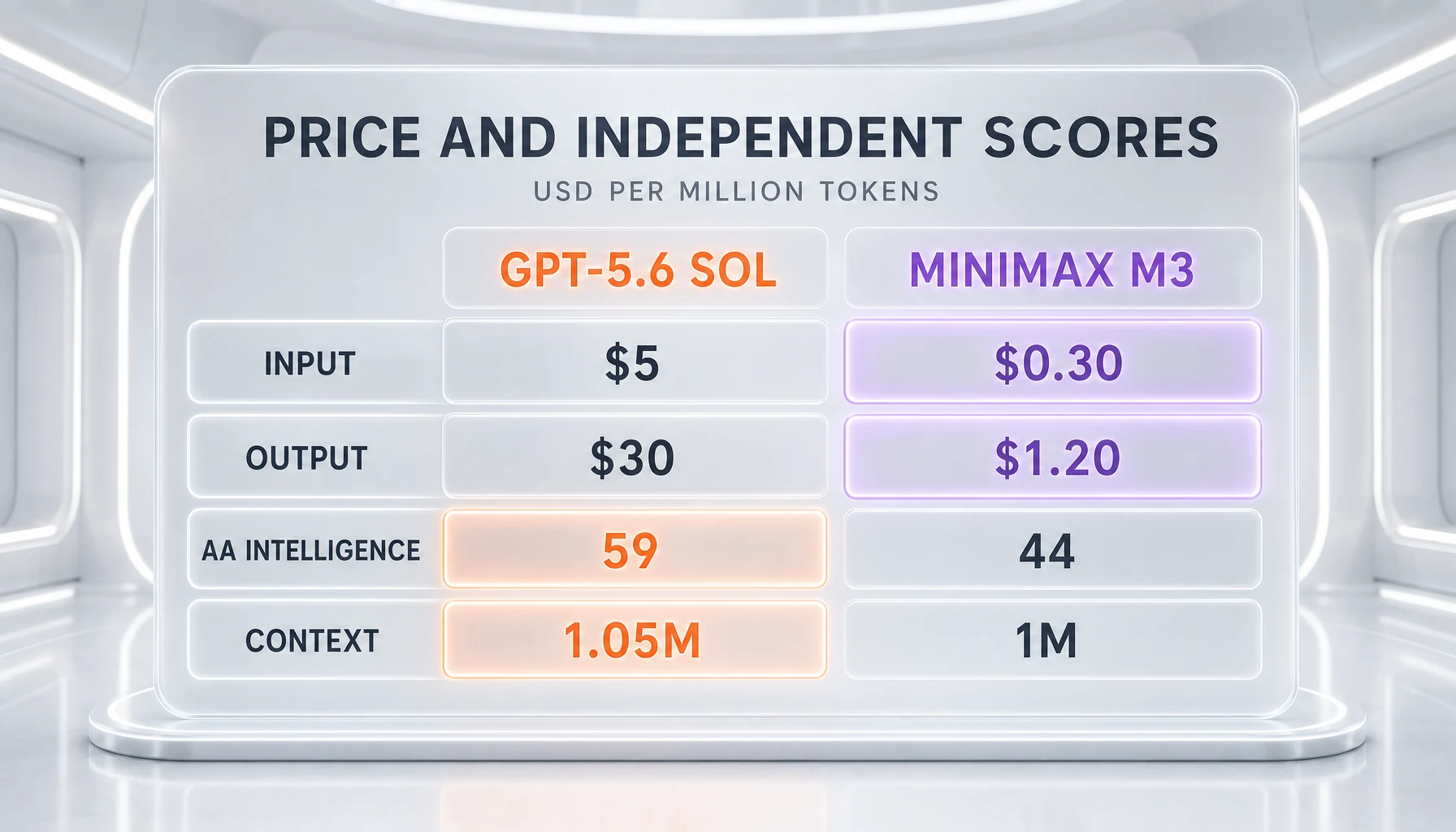
Even with the long-context surcharge, MiniMax stays far cheaper. Below each vendor's threshold it is roughly 13 times cheaper on input and about 17 times cheaper on output than Sol. Above 512K input tokens, where both models are on their long-context rates, MiniMax is still around 13 times cheaper on input and about 12 times cheaper on output. Neither model prices flat: Sol steps up at 272,000 input tokens and MiniMax at 512K, so Sol's step lands first, and a request sitting between those two thresholds pays Sol's long-context rate against MiniMax's standard one. In absolute terms Sol remains the expensive option at any context length. If per-token spend is your binding constraint, this section decides the comparison on its own.
Benchmarks and What They Mean
The one apples-to-apples signal we trust for both models is the Artificial Analysis Intelligence Index version 4.1, because a single third party runs the same battery on each. On that index, GPT-5.6 Sol scores 59 and MiniMax M3 scores 44. That is a 15-point gap, and it is the clearest single number in this comparison: MiniMax M3 is a strong model, but Sol is measurably ahead on general reasoning and problem-solving.
It helps to put the 44 in context. Among open-weight models in mid-2026, that score ties MiniMax M3 with DeepSeek V4-Pro at the front of the open pack — no small feat for a downloadable model, and the reason M3 is a genuine alternative rather than a budget compromise. The gap to Sol is real, but so is the fact that M3 is playing in the frontier's neighborhood while giving away its weights.
On coding, the only independent evidence belongs to Sol. It places second of 52 on the Artificial Analysis Coding Agent Index v1.3 at 66.57, through the Codex harness at max reasoning effort, and MiniMax M3 is not placed on that leaderboard at all. Combined with an agentic tool stack that is on by default, that makes Sol the safer pick when your success metric is measured coding performance under a third-party protocol. This is a result no open-weight rival has yet matched on that particular leaderboard.
MiniMax has its own coding story, and it is worth reporting carefully. MiniMax self-reports 59 percent on SWE-bench Pro, a figure it says beats GPT-5.5 and Gemini 3.1 Pro and approaches Claude Opus 4.7 on that specific test. We treat that as a vendor claim, not an independent result, because it comes from MiniMax's own harness rather than a neutral evaluator. One coincidence is worth flagging so it does not mislead anyone: that self-reported 59 percent on SWE-bench Pro is a coding pass rate from the vendor, and it is unrelated to Sol's independent Artificial Analysis Intelligence score, which happens to read 59 as well. The two numbers measure different things, come from different sources, and should never be added together or ranked against each other. For a like-for-like open-weight coding contrast, our GPT-5.6 Sol versus DeepSeek V4 comparison walks the same ground with a different challenger.
Architecture and Deployment
The two models are built on opposite philosophies, and it shows in what you can do with them. MiniMax M3 is an open-weight mixture-of-experts model: 428 billion total parameters with roughly 23 billion active per token, so it runs far more cheaply than a dense model of comparable size, and it uses MiniMax Sparse Attention to hold a million-token context without the usual quadratic blowup. Because the weights are downloadable, you can quantize, fine-tune, and deploy M3 inside your own environment, which is the whole point for teams with sovereignty requirements.
GPT-5.6 Sol does not disclose its architecture, and it does not need to for its intended buyer: you consume it as a hosted service through the OpenAI API, ChatGPT, and Codex, with the agentic tool stack, reasoning-effort control, and multi-agent modes handled for you. That is a strength if you want managed capability and a weakness if you need to own the model. The dividing line is deployment, not just performance: Sol is the model you rent at the top of the market, and M3 is the model you can own and run anywhere. If self-hosting is not a requirement, Sol's managed stack removes a lot of operational work; if it is a requirement, only M3 can satisfy it.
Economics at Scale
Price is where this comparison stops being close. Consider a workload that generates 100 million output tokens a month — a mid-sized production application. On GPT-5.6 Sol at 20 dollars per million, that is 2,000 dollars in output alone. On MiniMax M3 at 1.20 dollars per million, the same volume is 120 dollars. That is the 17-times gap made concrete, and it is before you add input tokens, where M3's roughly 13-times advantage compounds the savings. Self-hosting shifts the math again: you trade per-token API fees for fixed infrastructure cost, which can pay off at very high volume or when data cannot leave your walls.
The counter-argument is value density, and it is a real one. If a task is high-stakes and low-volume — a legal analysis, a hard refactor, a research synthesis where a wrong answer is expensive — then paying 20 dollars per million output tokens for the strongest measured model is a rounding error against the cost of being wrong. Sol's 15-point lead on the independent Intelligence Index is exactly the kind of edge that justifies a premium on that class of work. The practical pattern many teams land on is to route bulk, tolerant traffic to MiniMax M3 and reserve Sol for the hardest reasoning and coding, which is also the logic behind our best AI coding tools roundup.
How We Compared Them
Our method here is a mix of hands-on use and sourced research, and we want to be transparent about which is which. We ran both models through their APIs on the same reasoning and coding prompts to get a feel for tone, reliability, and tool behavior, and we pulled every price in this article directly from each vendor's own pricing pages in July 2026, then marked those figures verified — returning to OpenAI's page on August 28, 2026 to re-read Sol's rates after they changed. For capability, we did not run a controlled, weeks-long, identical-task benchmark ourselves; instead we lean on the Artificial Analysis Intelligence Index, because it applies one consistent protocol to both models. We cannot say the same of the Coding Agent Index: MiniMax M3 has no entry on it, so that protocol was never applied to MiniMax M3 at all — and the index pairs each model with its own coding harness rather than running a common one. Where a number comes from a vendor's own testing — MiniMax's SWE-bench Pro figure, for example — we label it a vendor claim and keep it separate from the independent scores. That separation is deliberate: mixing an independent index with a self-reported benchmark is how misleading head-to-head charts get made, and we would rather under-claim than stack numbers that do not belong together.
Winner by Category
Because this is a split decision, the useful question is not which model wins overall but which wins for a given need. Here is how the categories fall.
- Measured intelligence: GPT-5.6 Sol, 59 to 44 on the independent Intelligence Index.
- Independent coding: GPT-5.6 Sol, second of 52 at 66.57 on the AA Coding Agent Index v1.3, where M3 is not charted at all.
- Price: MiniMax M3, roughly 13 times cheaper on input and about 17 times cheaper on output.
- Open weights and self-hosting: MiniMax M3, the only one you can download and run yourself.
- Native multimodality: MiniMax M3, with text, image, and video input plus computer use.
- Context window: GPT-5.6 Sol by a hair, 1,050,000 versus 1,000,000 tokens — effectively a tie.
- Ecosystem and compliance: GPT-5.6 Sol, US-hosted with the full OpenAI agentic stack and regional data residency.
- Long-context cost predictability: MiniMax M3, whose price step lands at 512K input tokens against Sol's at 272,000 — both models step up, but M3 holds its headline rate almost twice as far, and stays cheaper in absolute terms at every length.
Pros and Cons
GPT-5.6 Sol — Pros
- Highest measured intelligence of the two: 59 on the independent Artificial Analysis Intelligence Index against 44, a clear 15-point lead.
- Second of 52 on the independent AA Coding Agent Index v1.3, at 66.57 — a charted third-party coding score MiniMax M3 does not have at all.
- Complete agentic tool stack on by default — function calling, web search, file search, code interpreter, computer use, and MCP.
- US-hosted with regional data-residency endpoints, clearing Western compliance bars that a China-hosted API cannot.
- Reasoning-effort scale plus new maximum and multi-agent modes for the hardest tasks, and prompt caching at a 90 percent discount with a half-price Batch API.
- Deep, mature ecosystem across ChatGPT, Codex, and the Responses API.
GPT-5.6 Sol — Cons
- Costs an order of magnitude more per token — 20 dollars output per million versus 1.20 dollars for MiniMax, and 30 dollars above 272,000 input tokens.
- Closed model: no downloadable weights, no self-hosting, no full data-sovereignty option.
- Text and image in, but no native video input, where MiniMax M3 reads video natively.
- No fine-tuning of the Sol base model, so tuned production variants must live on other models.
- Premium pricing makes very high-volume, cost-sensitive workloads hard to justify.
MiniMax M3 — Pros
- Dramatically cheaper: about 17 times lower output cost and roughly 13 times lower input cost than Sol at current rates.
- Open weights you can download, quantize, fine-tune, and self-host for full data sovereignty.
- Frontier-adjacent capability: 44 on the independent Artificial Analysis Intelligence Index, tied with DeepSeek V4-Pro at the top of the open-weight pack.
- Native multimodality — text, image, and video input — plus computer use, broader than Sol's text-and-image input.
- Efficient mixture-of-experts design, 428 billion total and about 23 billion active per token, with MiniMax Sparse Attention over a 1,000,000-token context.
- A strong vendor-reported coding result: 59 percent on SWE-bench Pro on MiniMax's own harness.
MiniMax M3 — Cons
- Trails Sol on the independent Intelligence Index, 44 versus 59, and has no charted score on the independent coding leaderboard.
- Prices double above 512K tokens, to 0.60 dollars input and 2.40 dollars output per million, so long-context jobs cost more than the headline rate.
- Hosted API runs in China, a non-starter for many US and EU regulated buyers unless they self-host the open weights.
- Its coding case leans on a vendor self-reported SWE-bench Pro figure rather than an independent leaderboard placement.
- Self-hosting a 428-billion-parameter model requires serious hardware and operational effort.
When to Pick Each
When to pick GPT-5.6 Sol
Pick GPT-5.6 Sol when capability and integration matter more than per-token cost. If you are doing serious agentic coding, multi-step reasoning, or computer-use automation on the OpenAI stack, it is the stronger model on both independent indices, and its tool stack, image input, and reasoning-effort control give you leverage MiniMax M3 does not match out of the box. Pick it if you are a Western enterprise with data-residency or compliance obligations, because US hosting and regional residency endpoints clear bars a China-hosted API cannot. And pick it when your workload is moderate in volume but high in value, where paying 20 dollars per million output tokens for the best answer is trivial against the cost of a wrong one. If you already live inside ChatGPT, Codex, or the Responses API, Sol is the natural default, and our GPT-5.6 Sol versus Claude Sonnet 5 comparison covers the closest premium alternative.
When to pick MiniMax M3
Pick MiniMax M3 when cost, control, or multimodality dominate. If you are running high-volume inference where token spend is the binding constraint, a roughly 17-times-cheaper output rate changes what is economically viable, turning workloads that are unaffordable on Sol into routine ones. Pick it if you need to own your weights: the open-weight release lets you self-host, fine-tune, and keep data inside your jurisdiction, with the China-hosted API as a convenience rather than the only option. Pick it if your work involves native video input or computer-use agents, where M3's multimodality covers more ground than Sol. You give up a measurable slice of frontier capability and the charted independent coding score, and you take on the operational work of self-hosting if compliance requires it — but you get most of the quality, more input modalities, and a fraction of the price. If you are weighing M3 against other open-weight options, our DeepSeek V4 review covers its closest rival on the Intelligence Index.
Final Verdict
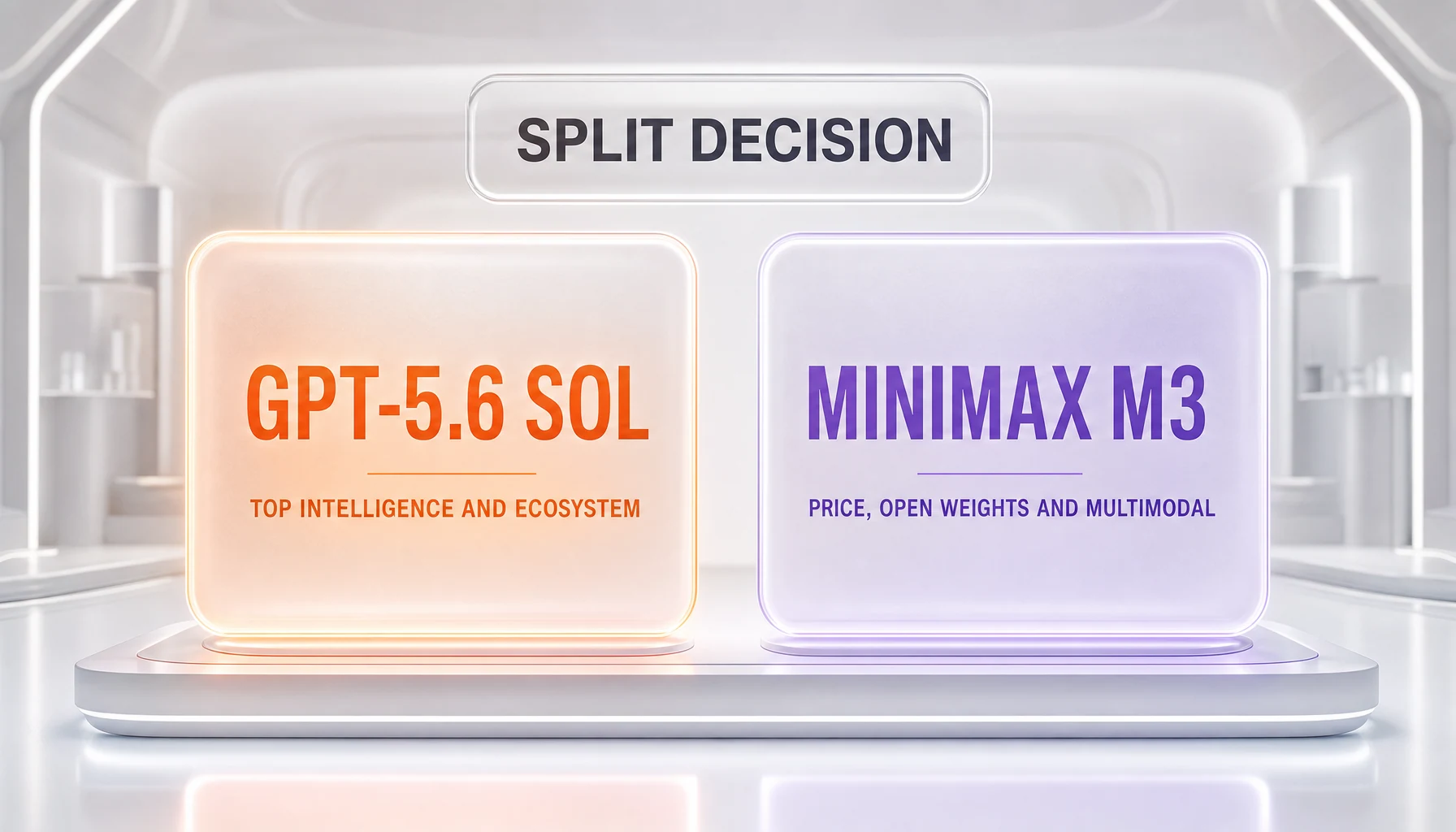
This is a split verdict by use case, tilted toward GPT-5.6 Sol on capability and toward MiniMax M3 on price and openness. On the one independent signal that scores both models the same way, the Artificial Analysis Intelligence Index version 4.1, Sol leads 59 to 44, and it is the only one of the two with a charted independent coding score, at 66.57 on the AA Coding Agent Index v1.3. It is the stronger measured model, the more deeply integrated one for agentic work, and the only one that clears Western data-residency requirements through OpenAI hosting. If your priority is peak capability, charted coding, or compliance, Sol is the pick, premium price and all.
MiniMax M3 wins the other half of the argument decisively. It is roughly 13 times cheaper on input and about 17 times cheaper on output at current rates, it ships open weights you can download and self-host, it matches Sol's context window within a rounding error, and it reads native video that Sol cannot. Its 44 on the independent Intelligence Index ties it with DeepSeek V4-Pro at the front of the open-weight field, and its self-reported SWE-bench Pro result shows real coding strength even if it is not an independent number. If your priority is price, control, or multimodality, M3 is the pick, and it is not a compromise so much as a different bet. We did not name a single winner because these two models are optimized for different jobs, and both stories are true at the same time: a genuine capability gap and a much larger price gap. Choose the one whose gap you can least afford.
Frequently Asked Questions
Is GPT-5.6 Sol better than MiniMax M3?
On measured capability, yes. GPT-5.6 Sol leads MiniMax M3 on the Artificial Analysis Intelligence Index 59 to 44 — only Claude Opus 5 and Claude Fable 5 score higher as of August 4, 2026 — and it places second of 52 at 66.57 on the independent AA Coding Agent Index v1.3, a charted score MiniMax M3 does not have. But MiniMax M3 is roughly 17 times cheaper per output token, ships open weights you can self-host, and takes native image and video input, so the better model depends on whether you are optimizing for peak intelligence and ecosystem or for price, openness, and multimodality.
How much cheaper is MiniMax M3 than GPT-5.6 Sol?
A lot. At current rates, MiniMax M3 output at 1.20 dollars per million tokens is about 17 times cheaper than GPT-5.6 Sol at 20 dollars, and MiniMax input at 0.30 dollars is roughly 13 times cheaper than Sol at 4 dollars. Above 512K input tokens, where both models are on their long-context rates, MiniMax stays around 13 times cheaper on input and about 12 times cheaper on output. Sol’s 4 and 20 dollar rates are promotional: OpenAI cut them on August 21, 2026, calling the cut "for the next 3 months" on its launch page and "available at least through November 21, 2026" on its pricing page. OpenAI’s prices were re-read on August 28, 2026; MiniMax’s were taken from its own pages in July 2026.
Why do MiniMax M3’s prices double above 512K tokens?
MiniMax publishes a two-tier structure. For requests whose context stays at or below 512K tokens, input is 0.30 dollars and output is 1.20 dollars per million. For requests that push above 512K tokens toward the one-million-token ceiling, both rates double to 0.60 dollars input and 2.40 dollars output. Long documents and large agent traces cost more per token, so budget for the higher tier when you routinely run near the top of the context window.
Is MiniMax M3 open source?
It is open weight. MiniMax M3 ships a downloadable model you can run on your own hardware, which is what makes self-hosting and full data residency possible. As with most open-weight releases, that is not the same as fully open source: the weights are published, but the complete training code and data recipe are not, so you can deploy and fine-tune the model without being able to reproduce the training run from scratch. GPT-5.6 Sol, by contrast, is closed and API-only.
Which has the bigger context window, GPT-5.6 Sol or MiniMax M3?
They are within a rounding error of each other. GPT-5.6 Sol carries a 1,050,000-token context window, and MiniMax M3 carries 1,000,000 tokens. Both comfortably hold large codebases, long documents, or extended agent histories in a single prompt, so context length is effectively a tie and should rarely be the deciding factor between them.
Is MiniMax M3’s 59 percent on SWE-bench Pro comparable to Sol’s scores?
No, and it is important not to stack the numbers. MiniMax’s 59 percent on SWE-bench Pro is a vendor self-reported pass rate measured on MiniMax’s own harness. Sol’s coding evidence comes from Artificial Analysis, a third-party evaluator, on a different index and a different protocol. They are different benchmarks under different regimes, so we report MiniMax’s figure as a vendor claim and never rank it head-to-head against Sol’s independent number.
Can you self-host GPT-5.6 Sol?
No. GPT-5.6 Sol is a closed model available only through OpenAI’s API, ChatGPT, and Codex. There are no downloadable weights, so there is no self-hosting or on-premise option. If self-hosting for data sovereignty is a hard requirement, MiniMax M3’s open weights are the reason to look its way, since you can run the model inside your own environment.
Which model is better for coding?
Sol has the stronger independent evidence. It places second of 52 on the Artificial Analysis Coding Agent Index v1.3 at 66.57, a charted independent score, where MiniMax M3 does not appear on the leaderboard at all. That is the number we weight most heavily, because it is measured by a third party under a fixed protocol and a full agentic tool stack ships on by default. MiniMax’s own camp points to a self-reported 59 percent on SWE-bench Pro, which it says beats GPT-5.5 and Gemini 3.1 Pro on that specific test; we report it as a vendor figure and do not rank it directly against the independent index.
Does MiniMax M3 support images and video?
Yes. MiniMax M3 is natively multimodal, accepting text, image, and video input, and it supports computer use for agentic workflows. That is broader input coverage than GPT-5.6 Sol, which takes text and image in but not video. If your workload involves reading video frames or driving a screen, MiniMax M3 covers more of it out of the box; if you mainly need text and image reasoning, both models handle it.
Is MiniMax M3 safe for enterprise and data residency?
It depends on how you deploy it. MiniMax’s hosted API runs in China, which many US and EU regulated buyers cannot use for sensitive data. The escape hatch is the open weights: because you can self-host MiniMax M3 in your own cloud or on-premise, you can keep data inside your jurisdiction. GPT-5.6 Sol takes the opposite route, offering US hosting with regional data-residency endpoints but no self-hosting at all.
Which should I choose for high-volume production?
For pure token volume where cost is the binding constraint, MiniMax M3 changes the math: at roughly 17 times cheaper per output token, workloads that are uneconomical on Sol become routine. For high-value, moderate-volume work where a wrong answer is expensive and engineer time dominates, Sol’s 15-point lead on the independent Intelligence Index can justify the premium. Many teams run both, routing bulk traffic to MiniMax M3 and hard reasoning or coding tasks to Sol.
What is the final verdict, GPT-5.6 Sol or MiniMax M3?
It is a split decision, because the two models optimize for different things. GPT-5.6 Sol is the stronger measured model and the deeper ecosystem, and it clears Western compliance bars MiniMax’s hosted API cannot. MiniMax M3 is far cheaper, open-weight and self-hostable, and natively multimodal including video. Choose Sol for peak capability and compliance; choose MiniMax M3 for price, control, and multimodality. Neither is a mistake, and the numbers back both stories at once.
Sources and references
Every figure on this page is attributed to whoever produced it. Vendor documentation and independent measurement are listed separately and never merged into a single ranking.
- OpenAI — API pricing (per-token, cached and batch rates)
- Artificial Analysis — GPT-5.6 Sol (independent index score and cost per task)
- Hugging Face — MiniMaxAI/MiniMax-M3 (published weights and license)
- Artificial Analysis — MiniMax M3 (independent index score)
- Artificial Analysis — Model leaderboard (Intelligence Index scores and cost per task across configurations)
Our Verdict
Split decision. GPT-5.6 Sol wins peak measured intelligence on the one independent index that scores both models the same way, leading 59 to 44 on the Artificial Analysis Intelligence Index version 4.1, and it is the only one of the two with a charted independent coding score, at 66.57 on the AA Coding Agent Index v1.3. It also reads image input and clears Western data-residency requirements through OpenAI hosting. MiniMax M3 wins on price and openness: roughly 13 times cheaper per input token and about 17 times cheaper per output token at current rates, downloadable open weights you can self-host, a matching one-million-token context, and native text, image, and video input with computer use. Pick GPT-5.6 Sol for top measured capability, the OpenAI ecosystem, and US-hosted compliance; pick MiniMax M3 for price, open weights, and native multimodality.
Choose GPT-5.6 Sol
OpenAI's flagship GPT-5.6 capability tier, with Programmatic Tool Calling and a 1.05M-token context.
Try GPT-5.6 Sol →Choose MiniMax M3
Open-weight frontier model from MiniMax combining near-frontier coding, a 1M token context window, and native multimodality — from $0.30 per million input tokens.
Try MiniMax M3 →Frequently Asked Questions
Is GPT-5.6 Sol better than MiniMax M3?
Split decision. GPT-5.6 Sol wins peak measured intelligence on the one independent index that scores both models the same way, leading 59 to 44 on the Artificial Analysis Intelligence Index version 4.1, and it is the only one of the two with a charted independent coding score, at 66.57 on the AA Coding Agent Index v1.3. It also reads image input and clears Western data-residency requirements through OpenAI hosting. MiniMax M3 wins on price and openness: roughly 13 times cheaper per input token and about 17 times cheaper per output token at current rates, downloadable open weights you can self-host, a matching one-million-token context, and native text, image, and video input with computer use. Pick GPT-5.6 Sol for top measured capability, the OpenAI ecosystem, and US-hosted compliance; pick MiniMax M3 for price, open weights, and native multimodality.
Which is cheaper, GPT-5.6 Sol or MiniMax M3?
GPT-5.6 Sol starts at $4 in / $20 out per M tokens. MiniMax M3 starts at $0.3 in / $1.2 out per M tokens. Check the pricing comparison section above for a full breakdown.
What are the main differences between GPT-5.6 Sol and MiniMax M3?
The key differences span across 12 features we compared. For AA Intelligence Index (Artificial Analysis v4.1, same evaluator), GPT-5.6 Sol offers 59 while MiniMax M3 offers 44 (tied with DeepSeek V4-Pro). For Input price (per million tokens, standard rate), GPT-5.6 Sol offers 4.00 dollars up to 272K input, 8.00 above while MiniMax M3 offers 0.30 dollars (context up to 512K). For Output price (per million tokens, standard rate), GPT-5.6 Sol offers 20.00 dollars up to 272K input, 30.00 above while MiniMax M3 offers 1.20 dollars (context up to 512K). See the full feature comparison table above for all details.