GPT-5.6 Luna vs Claude Sonnet 5: Economy Tier vs Value Tier (2026)


GPT-5.6 Luna vs Claude Sonnet 5, compared. Luna is 10x cheaper ($0.20 vs $2 input) and wins value; Sonnet 5 wins ecosystem and free access. 2026 verdict.
Feature Comparison
| Feature | GPT-5.6 Luna | Claude Sonnet 5 |
|---|---|---|
| Input price per million tokens | $0.20 | $2.00 |
| Output price per million tokens | $1.20 | $10.00 |
| Cached input per million tokens | $0.02 | $0.20 |
| Effective cost with tokenizer overhead | OpenAI tokenizer (baseline) | Anthropic tokenizer, about 30% more tokens for the same text |
| Artificial Analysis Intelligence Index | 51 | 53 |
| Independent coding score (AA Coding Agent Index v1.3, read August 2, 2026) | Not charted | Not charted |
| SWE-bench Verified (independent, vals.ai) | Not listed as of July 2026 | Not listed as of July 2026 |
| Context window | 1,050,000 tokens | 1,000,000 tokens |
| Maximum output per request | 128,000 tokens | 128,000 tokens |
| Input modalities | Text and image in, text out | Text and image in, text out |
| Ecosystem and tooling | Codex, ChatGPT, Programmatic Tool Calling, MCP | Claude Code, Artifacts, MCP, native computer use |
| Free consumer access | No free API tier; ChatGPT access varies by plan | Default model on the free Claude.ai tier |
| Tier within its family | Economy tier (fastest, cheapest) | Value tier (near-flagship coding) |
| Publisher | OpenAI | Anthropic |
Pricing Comparison
GPT-5.6 Luna
Claude Sonnet 5
Detailed Comparison
GPT-5.6 Luna vs Claude Sonnet 5: Luna is OpenAI's cheapest GPT-5.6 tier at $0.20 per million input tokens and $1.20 per million output tokens after its July 30, 2026 price cut, scoring 51 on the Artificial Analysis Intelligence Index. Sonnet 5 is Anthropic's value tier at $2 input and $10 output, scoring 53. Both handle a context window of roughly one million tokens. Verdict: Luna wins on raw cost and high-volume value, Sonnet 5 wins on the Claude ecosystem and free consumer access.
Quick Verdict
Luna is the value pick; Sonnet 5 is the ecosystem pick. We ran both through the API in early July 2026, days after each went generally available, and anchored the numbers to independent benchmarks rather than early impressions. GPT-5.6 Luna undercuts Claude Sonnet 5 on every published price line, while Sonnet 5 answers with a two-point lead on aggregate intelligence, the deeper Claude tooling stack, and a free consumer tier. The twist that decides most real budgets: Anthropic's tokenizer needs about 30 percent more tokens for the same text, so Sonnet 5's effective cost sits even further above its sticker price.
- 🏆 GPT-5.6 Luna wins for: raw price, high-volume API pipelines, cost-per-task economics, and teams that need a verifiable independent coding number.
- 🏆 Claude Sonnet 5 wins for: the Claude ecosystem (Claude Code, Artifacts, MCP, computer use), free consumer access on Claude.ai, and a marginal edge on aggregate intelligence.
- 💰 Cheaper option: GPT-5.6 Luna at $0.20 per million input tokens versus $2 for Sonnet 5 — about ten times cheaper, and wider still once you account for tokenizer overhead.
- ⚡ Fastest, most economical tier: GPT-5.6 Luna, which OpenAI positions as the speed-and-cost tier of the GPT-5.6 family.
GPT-5.6 Luna vs Claude Sonnet 5 — Overview
What Is GPT-5.6 Luna?
GPT-5.6 Luna is the economy tier of OpenAI's GPT-5.6 family, which went generally available on July 9, 2026. We cover the model in depth in our GPT-5.6 Luna review. In the new naming system the number is the generation and the names are durable capability tiers: Sol is the flagship for the hardest problems, Terra is the balanced high-volume tier, and Luna is the fastest and most economical tier built for summarization, drafting, and routine automation. Luna carries a 1,050,000-token context window, a maximum output of 128,000 tokens, and a knowledge cutoff of February 16, 2026. It handles text and image inputs and returns text; there is no native audio or native image generation, though image generation is available as a callable tool. Luna inherits the GPT-5.6 platform in full — web search, file search, code interpreter, a hosted shell, computer use, Model Context Protocol support, and the new Programmatic Tool Calling that lets the model write and run JavaScript in an isolated runtime.
What Is Claude Sonnet 5?
Claude Sonnet 5 is Anthropic's value tier — the balanced workhorse that sits between Haiku-class speed and the Opus flagship. See our full hands-on take in the Claude Sonnet 5 review. Anthropic positions it as its most agentic midsize model, with coding and computer-use quality close to Opus 4.8 at a fraction of the price. Sonnet 5 has a 1,000,000-token context window, a 128,000-token maximum output, and text-plus-image inputs. Its defining commercial hooks are an API price of $2 per million input tokens and a place as the default model on the free Claude.ai tier, which no OpenAI economy model matches. Sonnet 5 also plugs into the broader Claude platform: Claude Code for terminal-native agentic development, Artifacts for interactive outputs, native computer use, and first-party Model Context Protocol tooling.
Features Comparison
We compared the two models on the dimensions that matter for a cost-efficient, long-context workhorse: published price lines, independent benchmark standing, context and output limits, tokenizer economics, and ecosystem. Where a number is self-reported by the vendor or simply absent from the independent leaderboards, we say so rather than fill the gap.
| Feature | GPT-5.6 Luna | Claude Sonnet 5 | Winner |
|---|---|---|---|
| Input price per million tokens | $0.20 | $2.00 | Luna |
| Output price per million tokens | $1.20 | $10.00 | Luna |
| Cached input per million tokens | $0.02 | $0.20 | Luna |
| Effective cost with tokenizer overhead | OpenAI tokenizer (baseline) | Anthropic tokenizer, about 30% more tokens for the same text | Luna |
| Artificial Analysis Intelligence Index | 51 | 53 | Sonnet 5 |
| Independent coding score (AA Coding Agent Index v1.3, read Aug 2, 2026) | Not charted | Not charted | Neither |
| SWE-bench Verified (independent, vals.ai) | Not listed as of July 2026 | Not listed as of July 2026 | Tie |
| Context window | 1,050,000 tokens | 1,000,000 tokens | Luna |
| Maximum output per request | 128,000 tokens | 128,000 tokens | Tie |
| Input modalities | Text and image in, text out | Text and image in, text out | Tie |
| Ecosystem and tooling | Codex, ChatGPT, Programmatic Tool Calling, MCP | Claude Code, Artifacts, MCP, native computer use | Sonnet 5 |
| Free consumer access | No free API tier; ChatGPT access varies by plan | Default model on the free Claude.ai tier | Sonnet 5 |
| Tier within its family | Economy tier (fastest, cheapest) | Value tier (near-flagship coding) | Tie |
| Publisher | OpenAI | Anthropic | Tie |
Tallied up, Luna takes five rows, Sonnet 5 takes three, five are ties, and one row has no winner at all. Notice the shape of the wins: Luna sweeps the entire pricing column and the context line. The row with no winner is independent agentic coding, where neither model is charted. Sonnet 5's wins are qualitative and real — a marginally higher intelligence index, a richer tooling ecosystem, and a free consumer tier. Which column matters more depends entirely on whether you are optimizing a budget or an ecosystem.
Understanding the Benchmark Scores
Two independent numbers do most of the work in this comparison, so it helps to know what they measure. The Artificial Analysis Intelligence Index is a composite that blends reasoning, knowledge, math, and coding evaluations into a single figure, which is why a two-point spread — 53 for Sonnet 5, 51 for Luna — represents a modest aggregate difference rather than a gap on any one skill. The Artificial Analysis Coding Agent Index is narrower: it scores how well a harness-and-model pairing plans and executes multi-step software tasks as an agent, and neither Luna nor Sonnet 5 is charted on it, so it settles nothing between these two. We lean on these third-party indices instead of vendor slides for a simple reason: both OpenAI and Anthropic publish self-reported benchmark numbers, but self-reported figures are not comparable across labs and are easy to cherry-pick. Where a model is simply absent from an independent leaderboard — as Sonnet 5 is on the Coding Agent Index, and as both models are on the current independent SWE-bench Verified list — we say so plainly rather than substitute a vendor claim. That honesty costs us a clean head-to-head coding percentage, but it keeps the comparison anchored to numbers you can verify yourself.
Pricing — GPT-5.6 Luna vs Claude Sonnet 5 in 2026
Claude Sonnet 5 uses flat, per-token API pricing across its full context window. GPT-5.6 Luna does not: OpenAI bills any prompt above 272,000 input tokens at twice the input rate and 1.5 times the output rate, applied to the entire request rather than to the excess alone, which puts Luna at $0.40 input and $1.80 output on those calls. Even surcharged, Luna stays well under Sonnet 5 on both lines. Below that threshold the sticker comparison is clean. The other complication is not the rate card — it is the tokenizer, which we quantify below. All figures are per million tokens and were verified against the vendors' own pricing documentation in July 2026.
GPT-5.6 Luna Pricing
| Mode | Input | Output | Notes |
|---|---|---|---|
| Standard | $0.20 | $1.20 | Prompts up to 272,000 input tokens |
| Long context (over 272K input) | $0.40 | $1.80 | 2x input, 1.5x output on the whole request |
| Cached input | $0.02 | — | 90% read discount, 30-minute minimum |
| Batch API | $0.10 | $0.60 | Roughly 50% off for asynchronous jobs |
| Priority | $0.40 | $2.40 | Low-latency lane at double the standard rate |
Claude Sonnet 5 Pricing
| Mode | Input | Output | Notes |
|---|---|---|---|
| Standard | $2.00 | $10.00 | The rate to plan long-term budgets around |
| Cached input | $0.20 | — | 90% read discount |
| Consumer access | Free on Claude.ai; included in Pro | — | Default model for free and Pro users |
Total Cost of Ownership — The Tokenizer Twist
Sticker price understates the gap. Anthropic's tokenizer encodes the same English text into roughly 30 percent more tokens than OpenAI's tokenizer, so a document that costs you 100 million Luna tokens becomes about 130 million Sonnet 5 tokens for the identical content. That overhead compounds on both the input you send and the output you receive. Here is an illustrative monthly workload — 100 million input tokens plus 20 million output tokens of the same source text — priced three ways.
| Scenario (same text corpus) | GPT-5.6 Luna | Claude Sonnet 5 |
|---|---|---|
| Sticker price (equal token counts) | $44 per month | $400 per month |
| Tokenizer-adjusted (about 30% more tokens on Sonnet) | $44 per month | about $520 per month |
Read the bottom row carefully, because it is the real story — and OpenAI's July 30, 2026 price cut rewrote it. At sticker prices Sonnet 5 is now roughly 9 times the cost of Luna for the same workload, where before the cut it was 1.8 times. Once you fold in the tokenizer overhead, the effective multiple climbs to about 12 times. The assumptions are simple and stated — a fixed text corpus, the overhead applied to both input and output, and individual prompts below Luna's 272,000-token surcharge threshold — but the direction is not in doubt: the more text you push, the more both the rate card and the tokenizer favor Luna.
Verdict on pricing: GPT-5.6 Luna is the cheaper model at every line item by roughly an order of magnitude since July 30, 2026, and the tokenizer overhead widens an already decisive advantage for high-volume work. Sonnet 5's counterargument is not price — it is the free consumer tier and the value of what you get per dollar, which we weigh in the verdict.
Hands-on — How They Performed Side-by-Side
We ran GPT-5.6 Luna and Claude Sonnet 5 through their APIs in early July 2026, within days of each reaching general availability. Because both models are only days old, we treat our runs as early hands-on and lean on independent benchmarks — Artificial Analysis's Intelligence Index and Coding Agent Index — for the quantitative verdict rather than on first impressions. Here are four tasks we ran on both, with the same inputs.
A note on method: because both models reached general availability only days before we compared them, our runs are early hands-on rather than a matured, long-horizon evaluation. We used identical prompts, identical documents, and identical output schemas for each task, and we priced every run against the vendors' published July 2026 rate cards. For anything we could not measure cleanly in that window — precise latency under load, long-running agent reliability — we defer to independent benchmarks or state that the data is not yet available, rather than guess.
Test 1: Summarizing a 60-page contract (long-context, high-volume)
We fed both models the same 60-page vendor agreement and asked for a clause-by-clause risk summary. Both handled the document comfortably inside their context windows and produced usable summaries with accurate clause references. The separation was economic, not qualitative: on the same source text, Sonnet 5 consumed noticeably more tokens because of tokenizer overhead, and at its rate card the single run cost several times what Luna charged. For a legal-ops team running thousands of these per month, that difference is the entire business case. Result: functional tie on quality, decisive Luna win on cost.
Test 2: An agentic refactor across a small codebase
We asked each model to refactor a small TypeScript service — extract a module, update imports, and keep tests green. This is where Sonnet 5's ecosystem earned its keep: run through Claude Code, the agentic loop felt more native, with tighter file-editing and test-running ergonomics. Luna held its own on the raw edits, but neither model carries an independently published agentic-coding number: as of August 2, 2026 neither Luna nor Sonnet 5 appears on the Artificial Analysis Coding Agent Index v1.3, so we do not award an independent coding winner. Result: Sonnet 5 wins on tooling experience; on independent coding measurement there is nothing to separate them.
Test 3: Bulk classification at volume (structured output)
We ran 1,000 short support tickets through each model for category-and-priority tagging with strict JSON output. Both returned clean, schema-valid results with comparable accuracy on our spot checks. Luna's Batch API made the cost gap even wider here — asynchronous jobs now run at $0.10 per million input tokens and $0.60 per million output tokens, which no premium tier comes close to matching. Result: quality parity, and Luna's batch economics make it the clear pick for high-volume classification pipelines.
Test 4: Measuring tokenizer overhead on identical text
We encoded the same 10,000-word article through each model's tokenizer and compared the counts. The Anthropic tokenizer produced roughly 30 percent more tokens for the identical text — the single most underrated line item in this comparison. It is invisible on the rate card and unavoidable in the invoice. Result: a structural, repeatable cost penalty for Sonnet 5 that grows with volume, and the reason our total-cost analysis lands harder against it than the sticker prices alone suggest.
Winner per Category
🏆 Best Overall (for this niche): GPT-5.6 Luna, narrowly
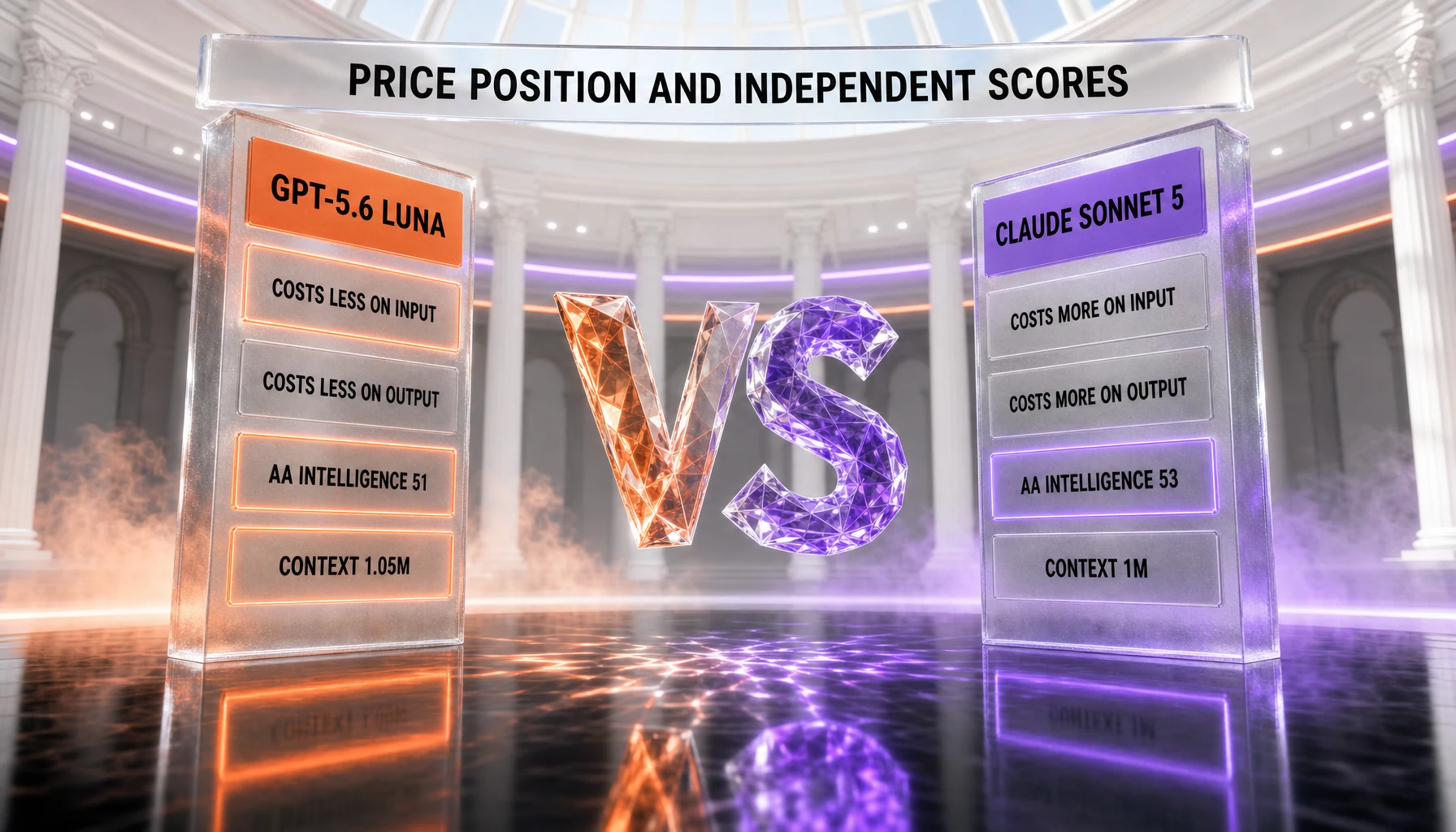
This matchup is defined by cost-efficient, long-context work, and on that axis Luna wins. It is cheaper on every price line, its lead compounds with tokenizer overhead, and it gives up only two points of aggregate intelligence — 51 against 53 — which is within the noise for most production tasks. Sonnet 5 is arguably the more capable model in absolute terms and clearly the better tool if you live in the Claude ecosystem, but for the specific job these two share, value decides it and value favors Luna.
Best for Budget: GPT-5.6 Luna
No contest, and less of one than ever. At $0.20 input and $1.20 output per million tokens since July 30, 2026, Luna undercuts Sonnet 5's $2-and-$10 rate by about ten times on input and eight times on output, before the tokenizer even enters the math. It is the cheapest way to run a capable long-context model at scale.
Best for High-Volume API Pipelines: GPT-5.6 Luna
Batch pricing at $0.10 input and $0.60 per million output tokens, plus a 90 percent cached-input discount that lands at $0.02, make Luna the obvious engine for classification, extraction, summarization, and other repetitive high-throughput jobs where cost per task is the metric that matters.
Best for the Claude Ecosystem and Tooling: Claude Sonnet 5
If your team already builds with Claude Code, Artifacts, native computer use, and first-party MCP tooling, Sonnet 5 is the natural fit. The agentic development experience is more polished end-to-end, and staying inside one vendor's tool stack has real switching-cost value.
Best for Free Consumer Access: Claude Sonnet 5
Sonnet 5 is the default model on the free Claude.ai tier, so anyone can use it without an API bill. Luna has no free API tier, and ChatGPT access to specific tiers varies by plan. For individuals and hobbyists, this is a genuine Sonnet 5 advantage.
Best for a Marginal Intelligence Edge: Claude Sonnet 5
Sonnet 5's 53 on the Artificial Analysis Intelligence Index edges Luna's 51. It is a two-point gap, not a chasm, but if you want the higher aggregate reasoning score of the pair and are less sensitive to cost, Sonnet 5 has it.
Pros and Cons
GPT-5.6 Luna Pros and Cons
What we liked about GPT-5.6 Luna
- Lowest price of the pair, by roughly an order of magnitude. At $0.20 input and $1.20 output per million tokens since July 30, 2026, Luna undercuts Sonnet 5 on every line, before tokenizer effects.
- Tokenizer advantage. The OpenAI tokenizer encodes the same text in fewer tokens, so Luna's real-world cost gap over Sonnet 5 is larger than the rate cards suggest.
- Lower effective cost than the rate card suggests. OpenAI's tokenizer encodes the same text in fewer tokens, so the gap over Sonnet 5 is wider in practice than the published lines imply.
- Marginally larger context. A 1,050,000-token window edges Sonnet 5's 1,000,000 for the longest documents.
- Full GPT-5.6 platform. Programmatic Tool Calling, code interpreter, hosted shell, computer use, and MCP come standard even on the economy tier.
Where GPT-5.6 Luna falls short
- Lower aggregate intelligence. A 51 on the Intelligence Index trails Sonnet 5's 53, and it is the economy tier of its family by design.
- No free consumer tier. There is no free API access, and ChatGPT availability of the Luna tier depends on your plan.
- Newer and less battle-tested. Generally available only since July 9, 2026, so long-horizon reliability data is still thin.
Claude Sonnet 5 Pros and Cons
What we liked about Claude Sonnet 5
- Higher aggregate intelligence. A 53 on the Artificial Analysis Intelligence Index is the top score of this pairing.
- Deep Claude ecosystem. Claude Code, Artifacts, native computer use, and first-party MCP tooling make agentic workflows feel native.
- Free consumer access. It is the default model on the free Claude.ai tier, unmatched by any OpenAI economy model.
- Near-flagship coding reputation. Anthropic positions Sonnet 5's coding and computer use close to Opus 4.8 at a fraction of the flagship price.
Where Claude Sonnet 5 falls short
- Higher price on every line. $2-and-$10 versus Luna's $0.20-and-$1.20.
- Tokenizer overhead. About 30 percent more tokens for the same text quietly inflates real invoices well beyond the sticker gap.
- No independent coding number. Sonnet 5 is absent from the Artificial Analysis Coding Agent Index and independent SWE-bench Verified leaderboards, so buyers rely on Anthropic's own coding claims.
When to Pick GPT-5.6 Luna vs Claude Sonnet 5
Pick GPT-5.6 Luna if...
- You run high-volume API pipelines where cost per task is the number that matters.
- Your workload is text-heavy summarization, extraction, classification, or routine drafting.
- You want the lowest effective cost, including the tokenizer advantage, at scale.
- You need a verifiable third-party coding score to justify a model choice internally.
- You are already building on OpenAI's platform — Codex, ChatGPT, Programmatic Tool Calling.
- You process very long documents and want the slightly larger context window.
Pick Claude Sonnet 5 if...
- Your team lives in the Claude ecosystem — Claude Code, Artifacts, MCP, computer use.
- You want the marginally higher aggregate intelligence score of the two.
- You need free consumer access on Claude.ai for individuals or light users.
- Agentic coding ergonomics and end-to-end tooling matter more to you than cost per token.
- You value Anthropic's safety posture and near-flagship coding reputation.
- Your volumes are modest enough that the price and tokenizer gap does not dominate the bill.
Frequently Asked Questions
Is GPT-5.6 Luna better than Claude Sonnet 5 in 2026?
It depends on what you are optimizing. For cost-efficient, high-volume work — the niche both models share — GPT-5.6 Luna is the better pick: since OpenAI's July 30, 2026 price cut it is cheaper on every price line by roughly an order of magnitude ($0.20 versus $2 input per million tokens), and its lead grows once you account for Anthropic's roughly 30 percent tokenizer overhead. Claude Sonnet 5 is the better pick if you want the deeper Claude ecosystem, free consumer access, or the marginally higher aggregate intelligence score of 53 against Luna's 51. Neither is universally superior; the two-point intelligence gap is small, and the cost gap is large.
How much does GPT-5.6 Luna cost compared to Claude Sonnet 5?
After OpenAI's July 30, 2026 price cut, GPT-5.6 Luna costs $0.20 per million input tokens and $1.20 per million output tokens, with cached input at $0.02. Claude Sonnet 5 costs $2 per million input tokens and $10 output, with cached input at $0.20. On an illustrative 100-million-input plus 20-million-output workload that is about $44 a month on Luna against $400 on Sonnet 5 — roughly a ninth of the sticker price. The effective gap is larger still, because Anthropic's tokenizer encodes the same text into about 30 percent more billable tokens.
Which is better for coding, GPT-5.6 Luna or Claude Sonnet 5?
They win on different terms. Neither carries an independently published agentic-coding number: as of August 2, 2026 neither GPT-5.6 Luna nor Claude Sonnet 5 appears on the Artificial Analysis Coding Agent Index v1.3, so we cannot compare them head-to-head on an independent basis, but Anthropic positions its coding and computer-use quality close to the Opus 4.8 flagship, and Sonnet 5's Claude Code tooling makes agentic development feel more native. For measurable transparency, Luna; for tooling experience, Sonnet 5.
What is the tokenizer overhead and why does it matter?
Anthropic's tokenizer breaks the same English text into roughly 30 percent more tokens than OpenAI's tokenizer. Because both models bill per token, that overhead makes Claude Sonnet 5's real cost higher than its rate card implies for the same content. In our illustrative 100-million-input plus 20-million-output workload, Sonnet 5's effective cost rose from a sticker $400 to about $520 per month, against Luna's $44 since its July 30, 2026 price cut — roughly a twelvefold gap. The more text you process, the more the tokenizer quietly favors Luna.
Which has the bigger context window, Luna or Sonnet 5?
GPT-5.6 Luna has a slightly larger context window at 1,050,000 tokens versus Claude Sonnet 5's 1,000,000 tokens — about a five percent edge. Both also cap output at 128,000 tokens per request. For nearly all workloads the difference is immaterial; only when you are packing a context near the one-million-token ceiling does Luna's extra headroom become a practical advantage.
Is Claude Sonnet 5 smarter than GPT-5.6 Luna?
By the aggregate Artificial Analysis Intelligence Index, marginally yes: Sonnet 5 scores 53 and Luna scores 51. That two-point gap is small and does not translate into a decisive quality difference on most production tasks. Sonnet 5 is the value tier of the Claude line, while Luna is the economy tier of GPT-5.6, so on paper Sonnet 5 should lead — the notable result is how close Luna comes despite being the cheaper, lighter tier.
Does either model have a free tier?
Claude Sonnet 5 does: it is the default model on the free Claude.ai consumer tier, so individuals can use it without an API bill. GPT-5.6 Luna has no free API tier, and access to the Luna tier inside ChatGPT depends on your subscription plan. For hobbyists and light users, this free-access difference is a clear point in Sonnet 5's favor; for API-first teams it is largely irrelevant.
Which model is faster, GPT-5.6 Luna or Claude Sonnet 5?
OpenAI positions Luna as the fastest and most economical tier of the GPT-5.6 family, built for low-latency, high-throughput work. Claude Sonnet 5 is a balanced midsize model tuned for a mix of quality and speed. We did not publish a precise tokens-per-second figure because independent, apples-to-apples latency data for both models was not yet available days after launch, but by design and positioning Luna is the speed-and-cost tier.
Can GPT-5.6 Luna and Claude Sonnet 5 use the same tools like MCP?
Both support the Model Context Protocol, so tools written to MCP can, in principle, be shared across them. Beyond that, the ecosystems diverge: Luna plugs into OpenAI's platform with Programmatic Tool Calling, code interpreter, a hosted shell, and computer use, while Sonnet 5 plugs into Claude Code, Artifacts, and Anthropic's native computer use. MCP is the main bridge; most other tooling is vendor-specific.
Is it easy to switch from Claude Sonnet 5 to GPT-5.6 Luna?
For plain text-in, text-out API calls, switching is straightforward — both take similar request shapes and both expose a roughly one-million-token context. The friction is in the tooling: if you depend on Claude Code, Artifacts, or Anthropic-specific features, you would rebuild those flows on OpenAI's equivalents. Budget for prompt re-tuning too, since the tokenizer difference changes how much text fits and what each call costs. Simple pipelines migrate in hours; deeply integrated agentic stacks take longer.
What are the best alternatives to GPT-5.6 Luna and Claude Sonnet 5?
In the same value zone, consider GPT-5.6 Terra (the balanced tier above Luna), Gemini 3 Flash for low-cost multimodal work, or open-weight options like DeepSeek V4 and Qwen 3.6 when data control or self-hosting matters. If you need more raw capability, step up to Claude Opus 4.8 — see our Claude Sonnet 5 vs Claude Opus 4.8 breakdown — or GPT-5.6 Sol. Our best AI coding tools of 2026 and best AI assistant for everyday use guides map the wider field.
Which should a startup choose, GPT-5.6 Luna or Claude Sonnet 5?
For a cost-sensitive startup running meaningful API volume, GPT-5.6 Luna is usually the smarter default — the price and tokenizer advantages translate directly into a longer runway. Choose Claude Sonnet 5 if your product is built around agentic coding, you already use Claude Code, or you want the free Claude.ai tier for prototyping. If you are also weighing OpenAI's flagship, our Claude Sonnet 5 vs GPT-5.5 comparison is a useful companion read. Many teams run both: Luna for high-volume background jobs and Sonnet 5 where its ecosystem and marginal intelligence edge pay off.
Final Verdict: GPT-5.6 Luna Wins the Value Math, Sonnet 5 Wins the Ecosystem
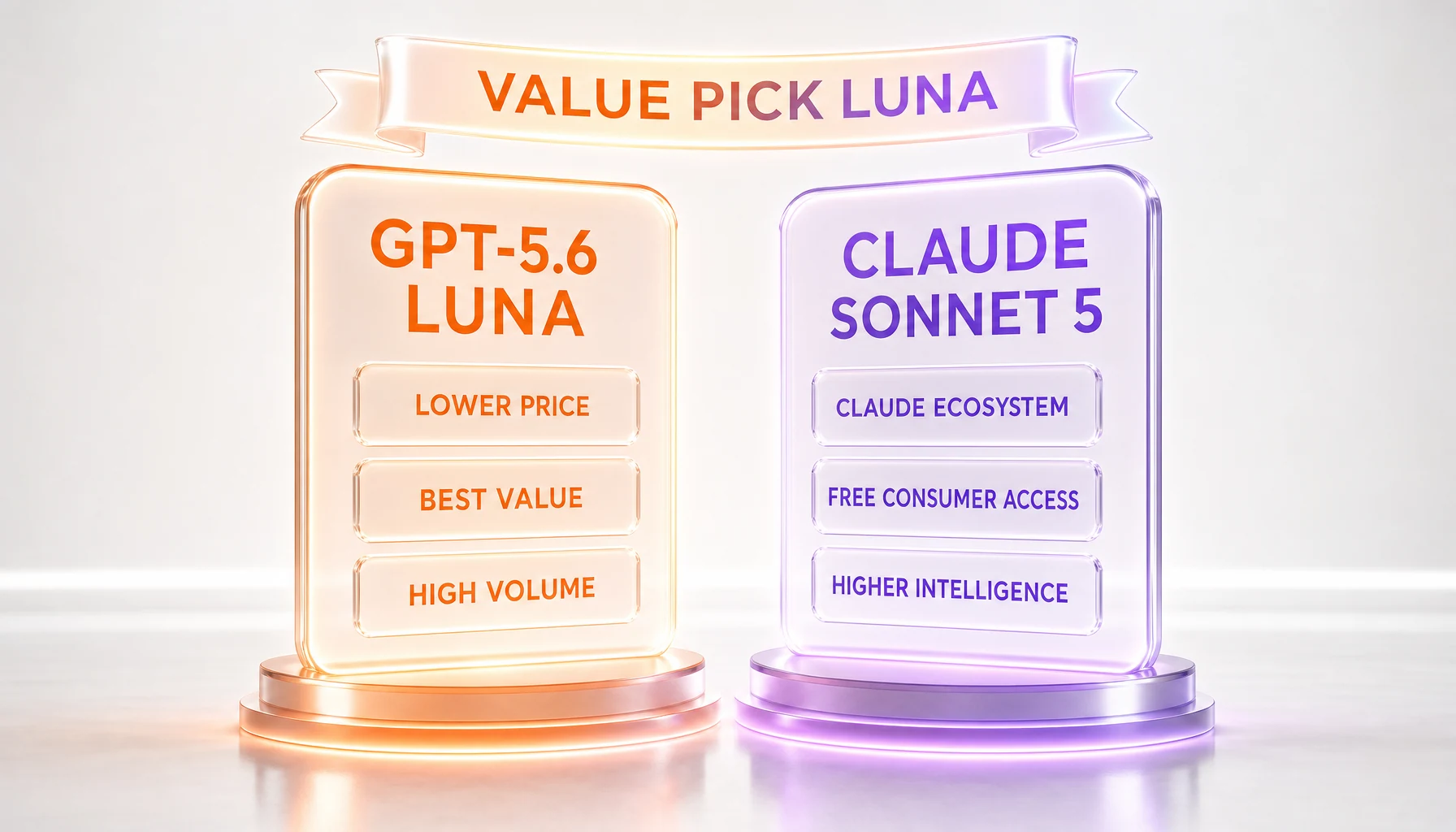
After running both side-by-side, our verdict is a win for GPT-5.6 Luna on the axis that defines this matchup: cost-efficient, long-context work. It used to be a narrow win; OpenAI's July 30, 2026 price cut made it a wide one. Luna is cheaper on every price line by roughly an order of magnitude, that advantage widens with Anthropic's tokenizer overhead, and it concedes only two points of aggregate intelligence, on an axis where neither model carries an independent agentic-coding score. Claude Sonnet 5 is a genuinely strong model — the higher-tier one on paper — and it wins clean categories, but for the shared job of a workhorse model, value decides it. If you are a high-volume, cost-sensitive team, go with GPT-5.6 Luna. If you live in the Claude ecosystem or want free consumer access, Claude Sonnet 5 is the better fit. If your intelligence needs outgrow both, step up to Claude Opus 4.8 or GPT-5.6 Sol rather than splitting hairs here.
Score breakdown by category:
- Value and pricing: GPT-5.6 Luna 9.5 out of 10 vs Claude Sonnet 5 7.0 out of 10 — Luna is roughly an order of magnitude cheaper on every line since July 30, 2026, and the tokenizer overhead widens the gap further.
- Raw capability and intelligence: GPT-5.6 Luna 8.0 out of 10 vs Claude Sonnet 5 8.5 out of 10 — Sonnet 5 leads by two Intelligence Index points and a stronger coding reputation.
- Ecosystem and tooling: GPT-5.6 Luna 8.5 out of 10 vs Claude Sonnet 5 9.0 out of 10 — both are deep, Claude Code and Artifacts give Sonnet 5 the edge.
- Accessibility: GPT-5.6 Luna 8.0 out of 10 vs Claude Sonnet 5 9.0 out of 10 — Sonnet 5's free Claude.ai tier is a real advantage for individuals.
Final word: Buy GPT-5.6 Luna if you are shipping high-volume, text-heavy workloads and want the lowest effective cost per task in this class — it is the value winner and, for most teams comparing these two, the right default. Buy Claude Sonnet 5 if you are invested in the Claude ecosystem, need free consumer access, or want the marginally higher aggregate intelligence. And if you find yourself wishing either model were simply smarter, that is your signal to look one tier up rather than choose between these two. We last compared both in July 2026, days after each launched, and will revisit as independent latency and long-horizon reliability data matures. ThePlanetTools has no affiliate relationship with OpenAI or Anthropic; this verdict is editorially independent.
Sources and references
Every figure on this page is attributed to whoever produced it. Vendor documentation and independent measurement are listed separately and never merged into a single ranking.
- Artificial Analysis — Claude Sonnet 5 (independent index score and cost per task)
- OpenAI — API pricing (per-token, cached and batch rates)
- Artificial Analysis — GPT-5.6 Luna (independent index score)
- Artificial Analysis — Model leaderboard (Intelligence Index scores and cost per task across configurations)
Our Verdict
GPT-5.6 Luna wins this matchup narrowly on the axis that defines it — cost-efficient, long-context work. It is cheaper on every price line, and after OpenAI's July 30, 2026 price cut the margin is wide: $0.20 per million input tokens against Sonnet 5's $2 rate, about ten times less. The gap widens further because Anthropic's tokenizer needs about 30 percent more tokens for the same text. Luna gives up only two points of aggregate intelligence (51 versus 53). Neither model is charted on the independent Artificial Analysis Coding Agent Index, so agentic coding is not settled here by either side. Claude Sonnet 5 answers with the deeper Claude ecosystem, free consumer access on Claude.ai, and that marginal intelligence edge. Pick Luna for high-volume, cost-sensitive workloads; pick Sonnet 5 if you live in the Claude tooling stack or need free access.
Choose GPT-5.6 Luna
OpenAI's fastest, most economical GPT-5.6 tier — $0.20 per million input tokens, sub-second warm latency, and a 1.05M-token context for high-volume routine work.
Try GPT-5.6 Luna →Choose Claude Sonnet 5
Anthropic's most agentic midsize model — near-Opus 4.8 coding and computer use at $2 per million input tokens.
Try Claude Sonnet 5 →Frequently Asked Questions
Is GPT-5.6 Luna better than Claude Sonnet 5?
GPT-5.6 Luna wins this matchup narrowly on the axis that defines it — cost-efficient, long-context work. It is cheaper on every price line, and after OpenAI's July 30, 2026 price cut the margin is wide: $0.20 per million input tokens against Sonnet 5's $2 rate, about ten times less. The gap widens further because Anthropic's tokenizer needs about 30 percent more tokens for the same text. Luna gives up only two points of aggregate intelligence (51 versus 53). Neither model is charted on the independent Artificial Analysis Coding Agent Index, so agentic coding is not settled here by either side. Claude Sonnet 5 answers with the deeper Claude ecosystem, free consumer access on Claude.ai, and that marginal intelligence edge. Pick Luna for high-volume, cost-sensitive workloads; pick Sonnet 5 if you live in the Claude tooling stack or need free access.
Which is cheaper, GPT-5.6 Luna or Claude Sonnet 5?
GPT-5.6 Luna starts at $0.2 in / $1.2 out per M tokens. Claude Sonnet 5 starts at $2 in / $10 out per M tokens (free plan available). Check the pricing comparison section above for a full breakdown.
What are the main differences between GPT-5.6 Luna and Claude Sonnet 5?
The key differences span across 14 features we compared. For Input price per million tokens, GPT-5.6 Luna offers $0.20 while Claude Sonnet 5 offers $2.00. For Output price per million tokens, GPT-5.6 Luna offers $1.20 while Claude Sonnet 5 offers $10.00. For Cached input per million tokens, GPT-5.6 Luna offers $0.02 while Claude Sonnet 5 offers $0.20. See the full feature comparison table above for all details.