Midjourney vs Adobe Firefly: Best AI Image Generator for Creatives in 2026?


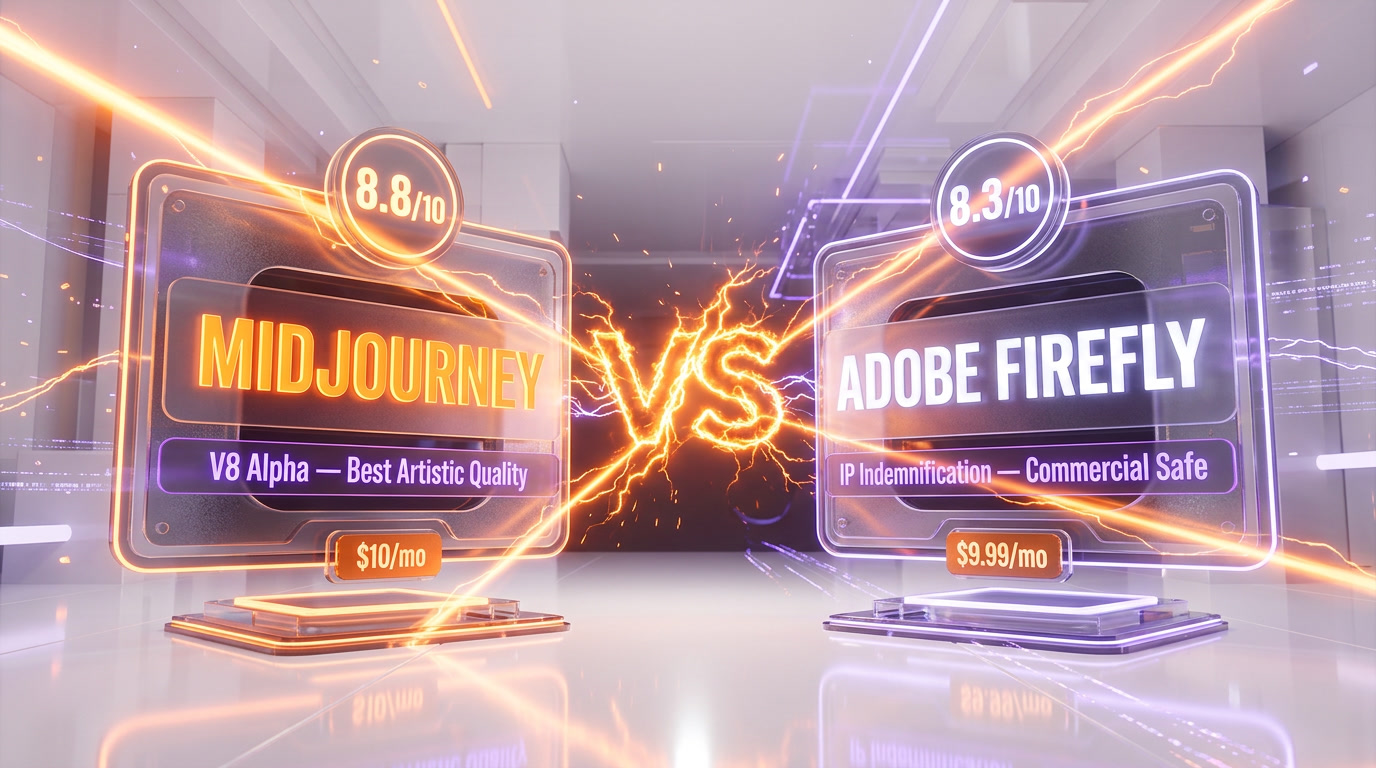
Midjourney makes jaw-dropping images. Firefly makes lawsuit-proof ones. Tested both on the same 20 prompts. For freelancers, this could cost you thousands.
Feature Comparison
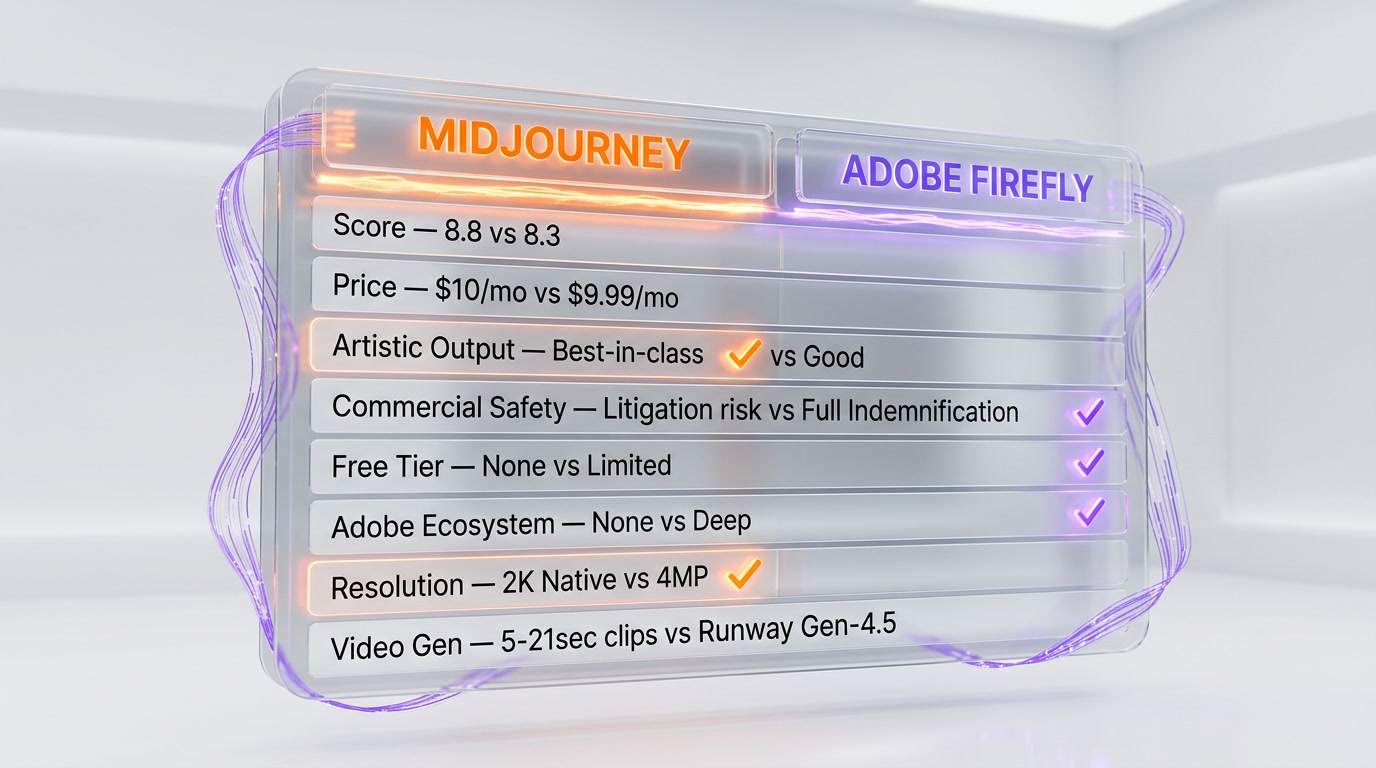
| Feature | Midjourney | Adobe Firefly |
|---|---|---|
| ThePlanetTools Score | 8.8/10 | 8.3/10 |
| Starting Price | $10/month (Basic) | $9.99/month (Standard) |
| Artistic Output Quality | Best-in-class, cinematic, painterly | Clean, professional, stock-photo style |
| Commercial IP Safety | Paid plan rights, ongoing litigation risk | Full Adobe IP indemnification |
| Free Tier | None (discontinued 2024) | Limited free access with standard generations |
| Adobe Ecosystem Integration | None | Deep (Photoshop, Illustrator, Premiere, After Effects) |
| Generation Speed | V8 Alpha: ~4-5x faster than V6, under 10s | Fast, near-instant standard generations |
| Max Resolution | Native 2K (V8 Alpha with --hd flag) | Native 4MP (Image Model 5) |
| Prompt Flexibility | Very high, nuanced artistic control, --sref | Good, plain-language editing commands |
| Video Generation | 5-21 second clips (since June 2025) | Yes + partner models (Runway Gen-4.5, OpenAI) |
| Monthly Generation Volume | ~200 images (Basic), unlimited Relax (Standard) | Unlimited standard gens, 2,000 credits for premium |
| Style Personalization | Personalization profiles, --sref, style memory | Generative Match, Style Reference |
Pricing Comparison
Midjourney
Adobe Firefly
Detailed Comparison
We've spent serious time with both of these tools in early 2026 — running identical prompts, stress-testing edge cases, and pushing each platform through real production workflows. Here's the short version: Midjourney (score 8.8 out of 10, from $10 per month) is still the undisputed king of artistic AI image generation. Adobe Firefly (score 8.3 out of 10, from $9.99 per month) is the smarter, safer choice for commercial work inside the Adobe ecosystem. They're not really competing for the same user — and understanding that distinction is the whole ballgame. Best for creatives and artists who want jaw-dropping output: Midjourney. Best for designers and agencies who need legally clean, workflow-integrated images: Adobe Firefly.
Quick Comparison: Midjourney vs Adobe Firefly (2026)
| Category | Midjourney V7/V8 Alpha | Adobe Firefly (Image Model 5) | Winner |
|---|---|---|---|
| Our Score | 8.8 out of 10 | 8.3 out of 10 | Midjourney |
| Starting Price | $10 per month | $9.99 per month | Tie |
| Artistic Output Quality | Best-in-class | Good, functional | Midjourney |
| Commercial IP Safety | Paid plan rights, litigation risk | Full Adobe indemnification | Adobe Firefly |
| Free Tier | None (discontinued 2024) | Limited free access | Adobe Firefly |
| Adobe Ecosystem Integration | None | Deep (Photoshop, Illustrator, Premiere) | Adobe Firefly |
| Generation Speed | V8 Alpha: ~4–5x faster than V6 | Fast, near-instant standard generations | Midjourney (V8 Alpha) |
| Max Resolution | Native 2K (V8 Alpha, --hd flag) | Native 4MP (Image Model 5) | Tie |
| Prompt Flexibility | Very high, nuanced artistic control | Good, plain-language editing | Midjourney |
| Video Generation | Yes (5–21 sec clips, since June 2025) | Yes + partner models (Runway Gen-4.5) | Adobe Firefly |
| Monthly Generation Volume | ~200 images (Basic), unlimited Relax (Standard) | 2,000 credits per month (Standard), unlimited standard gens | Adobe Firefly |
| Personalization / Style Memory | Yes (personalization profiles, --sref) | Generative Match, Style Reference | Midjourney |
Overview: Two Very Different Philosophies
After spending a lot of time with both platforms, the clearest way to describe them is this: Midjourney has taste. Adobe Firefly has purpose.
Midjourney came out of nowhere in 2022 and basically rewired what people thought AI art could look like. By the time V5 dropped, it had developed something almost like a signature aesthetic — painterly, moody, cinematic, with an uncanny sense of light and atmosphere. V6 sharpened the photorealism. V7 (default since June 2025) pushed prompt fidelity to a new level and introduced personalization profiles that actually learn your visual preferences over time. And V8 Alpha, which launched on March 17, 2026, is already showing a 4–5x speed boost over V6, native 2K resolution via the --hd flag, and dramatically improved text rendering. This thing is moving fast.
Adobe Firefly took a fundamentally different approach. Rather than building the most aesthetically ambitious model, Adobe focused on building the most defensible one. Trained exclusively on Adobe Stock, licensed content, and public domain imagery, every image Firefly generates comes with Adobe's IP indemnification — meaning if anyone ever challenges you legally over a Firefly-generated commercial asset, Adobe has your back. For a freelancer working on a local blog, that might not matter. For a creative agency running a global brand campaign, it can be the difference between signing a client and losing one.
What surprised us during testing is how far Firefly has evolved in 2025. The October 2025 Image Model 5 generates photorealistic images at native 4MP resolution. The platform now integrates partner models including Runway Gen-4.5, Google Nano Banana Pro, and OpenAI's GPT Image Generation — turning Firefly into less of a single tool and more of a multi-model creative hub. Adobe also ran an unlimited generation promotion through March 16, 2026 (now extended to April 22, 2026 for eligible subscribers), which spiked search interest massively and brought a lot of new users in to try it.
Both tools start at almost exactly the same price — Midjourney at $10 per month, Firefly at $9.99 per month — but what you get for that money is completely different. Let's dig in.
Feature-by-Feature Comparison
1. Image Quality and Artistic Output
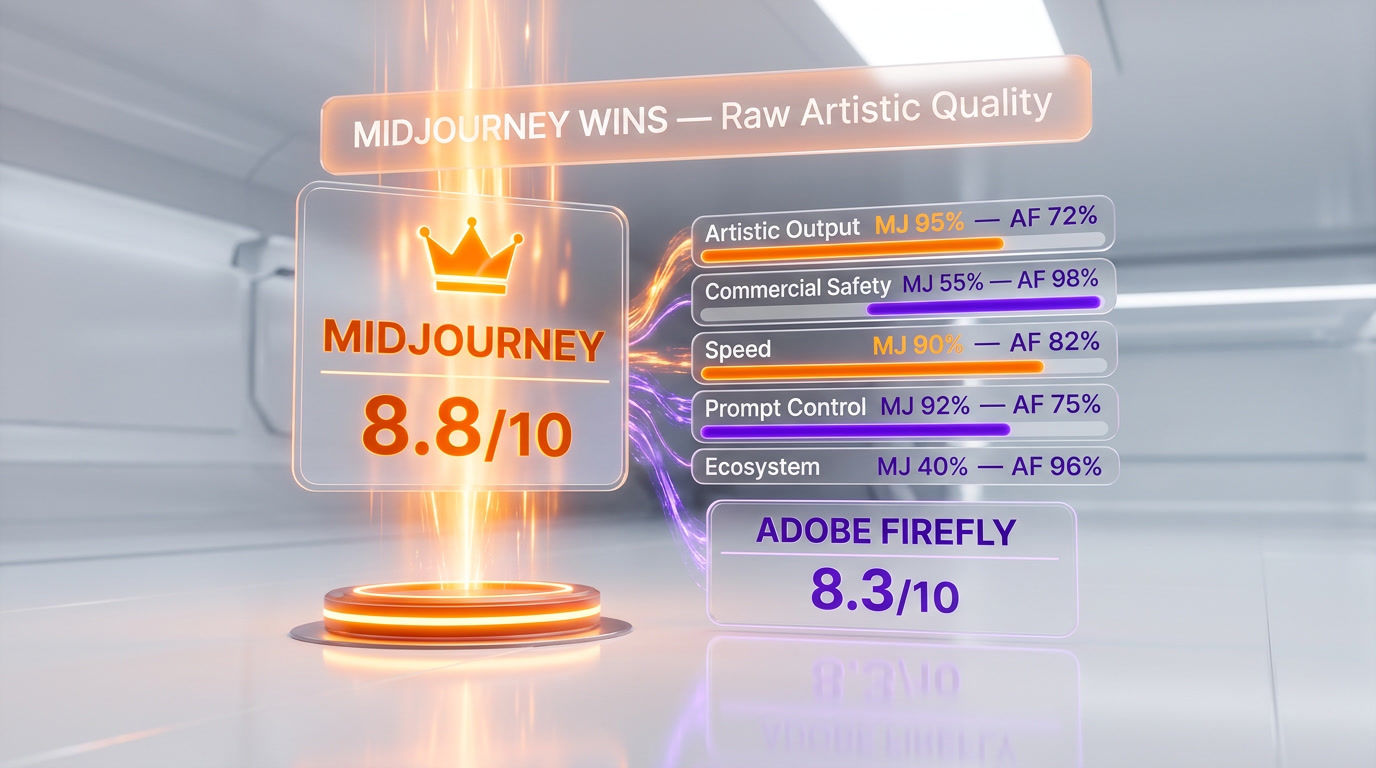
This is Midjourney's home turf, and it's not particularly close. V7 produces images with a level of visual intelligence that still genuinely impresses us — the way it handles atmospheric lighting, complex fabric textures, reflective surfaces, and human skin is miles ahead of where AI image generation was even 18 months ago. We ran the same prompts through both tools — a moody noir cityscape, a detailed fantasy character portrait, a product hero shot for a fictional sneaker — and Midjourney won every round on pure aesthetic quality.
Adobe Firefly Image Model 5 produces clean, professional, photorealistic results. It's particularly strong on product photography style outputs and anything that needs to look "real" rather than "artistic." But there's a quality ceiling that you hit quickly with Firefly — images tend to look polished in a stock-photo way, where Midjourney images feel like they were art directed by someone with genuine creative vision.
V8 Alpha, available now on alpha.midjourney.com, is already showing even more dramatic improvements in complex multi-element compositions. Specific color palettes, spatial arrangements, material textures — they all render with noticeably higher fidelity than V7. This gap is only going to widen.
2. Commercial Safety and IP Indemnification
Adobe Firefly wins this category outright, and for large commercial clients it might be the only category that matters. Firefly was designed from the ground up with commercial safety as a core principle. Adobe provides explicit IP indemnification for content generated by the native Firefly model, meaning commercial use at scale is legally defensible.
Midjourney's situation is more complicated. Paid subscribers receive commercial usage rights under their Terms of Service — but the platform has faced copyright litigation. In June 2025, Universal Pictures and Disney filed copyright infringement suits against Midjourney over training data practices, with Warner Bros. Discovery adding additional legal action in September 2025. These cases are ongoing. For most individual creatives, this is a background noise issue. For enterprise clients and regulated industries, it's a genuine dealbreaker.
Adobe Firefly's native model remains the only fully indemnified option. Even the partner models (Runway, Google, OpenAI) integrated into Firefly Boards operate under their own training data policies and aren't covered by Adobe's indemnification — so enterprise users should stick to the native Firefly model for client deliverables.
3. Workflow Integration
Firefly by a mile. This is where Adobe's decades of ecosystem dominance pays off. Firefly lives inside Photoshop's Generative Fill, Illustrator's Generative Recolor, Adobe Express, Premiere Pro's Generative Extend, and After Effects. You can generate, edit, and extend images without leaving the tools you already use every day. The integration feels native — not bolted on.
We tried using Generative Fill in Photoshop with Firefly Image Model 5 to extend a product shot background, and it was genuinely seamless. Plain-language editing commands worked reliably. The output matched the existing image's lighting and color grading without any manual correction. That's the kind of integration Midjourney simply cannot offer — Midjourney still lives primarily in its own web interface and Discord, with a limited API that only became available in late 2025.
4. Pricing and Value
At first glance these tools are priced identically. Look a little closer and the value calculation shifts.
Midjourney Basic ($10 per month) gives you roughly 200 fast-mode generations — enough for casual experimentation but tight for regular professional use. The Standard plan at $30 per month is where Midjourney actually becomes useful, giving you ~15 GPU hours of fast generation plus unlimited Relax Mode generations (slower, but truly unlimited). The Pro plan at $60 per month adds Stealth Mode (private gallery) and 30 GPU hours. There's no free tier — you pay before you generate your first image.
Adobe Firefly Standard at $9.99 per month includes 2,000 monthly credits. Here's the key nuance: standard image generations don't consume credits at all on paid plans. Credits are only spent on premium features like AI video or partner model outputs. For image-focused designers, this is effectively unlimited standard image generation for $9.99 per month. Firefly also maintains a limited free tier with access to standard generations at lower priority.
If you're primarily generating still images, Firefly's pricing structure is dramatically more generous than Midjourney's. If you want the best artistic quality, Midjourney's $30 Standard plan is what most serious users end up on.
5. Speed and Performance
In our testing with standard V7 on Midjourney, fast-mode generations took roughly 20–40 seconds for a standard 4-image grid. Relax Mode can stretch to several minutes during peak hours. V8 Alpha on alpha.midjourney.com is dramatically faster — we saw standard jobs rendering in under 10 seconds, consistent with the reported 4–5x speed improvement over V6. The --draft mode in V7 is 10x faster and costs half the GPU time, making it excellent for rapid ideation.
Adobe Firefly's standard image generations through the web app are near-instant for most tasks — typically under 10 seconds. Generative Fill in Photoshop is similarly snappy. The partner models (Runway video, Google Nano Banana Pro) can be slower, but the core image generation workflow feels faster in everyday use.
6. Prompt Flexibility and Style Control
Midjourney's prompt system, especially in V7, is significantly more expressive. Parameters like --sref (style reference), --cref (character reference), --iw (image weight), and the personalization profile system give advanced users incredible control over aesthetic outcomes. The V8 Alpha's new --q 4 quality mode adds additional coherence for complex scenes. Omni Reference in V7 lets you maintain subject identity across completely different stylistic contexts — invaluable for character design work.
Firefly's prompt system is deliberately simpler and more accessible, emphasizing plain-language instructions. Structure Reference and Style Reference in the Text to Image module offer meaningful control, but the ceiling is lower. This is a deliberate product decision — Firefly is trying to serve designers who want reliable, predictable results, not artists who want to push the model into unexpected territory.
7. Video Generation
Both platforms now offer video generation, but Firefly has a meaningful edge here — not because of its own video model, but because of its partner model integrations. Runway Gen-4.5 is available directly inside Firefly, meaning you get access to one of the best video generation models in the industry without leaving the Adobe ecosystem. Firefly's own Video Model is positioned as the "industry's first commercially safe AI video model," which matters for commercial production.
Midjourney's video generation (launched June 2025) produces 5–21 second clips from static images. The quality is solid — cinematic, with the same aesthetic sensibility as the image model — but it's a newer feature and still feels less polished than dedicated video tools. No partner model integrations on the video side yet.
Pricing Comparison
| Plan | Midjourney | Adobe Firefly |
|---|---|---|
| Free Tier | None | Yes (limited, web only) |
| Entry Plan | Basic — $10 per month (~200 fast gens) | Standard — $9.99 per month (2,000 credits; unlimited standard image gens) |
| Mid Tier | Standard — $30 per month (15 GPU hrs + unlimited Relax) | Pro — $20 per month (higher video credit volume, all premium features) |
| Pro Tier | Pro — $60 per month (30 GPU hrs + Stealth Mode) | Creative Cloud Pro — includes 4,000+ Firefly credits + all CC apps |
| Max / Enterprise | Mega — $120 per month (60 GPU hrs); Enterprise with API | Enterprise Creative Cloud — custom pricing for teams |
Frequently Asked Questions
Is Midjourney better than Adobe Firefly for image generation?
Midjourney (score 8.8 out of 10, from $10 per month) produces superior artistic output — painterly, cinematic, with exceptional lighting, textures, and atmosphere. Adobe Firefly (score 8.3 out of 10, from $9.99 per month) produces clean, professional, photorealistic results better suited for commercial work. Midjourney wins on artistic quality and prompt flexibility. Firefly wins on commercial IP safety (full Adobe indemnification), workflow integration (native in Photoshop, Illustrator, Premiere), and generation volume (unlimited standard image gens on paid plans).
Which is safer for commercial use — Midjourney or Firefly?
Adobe Firefly is the clear winner for commercial safety. Trained exclusively on Adobe Stock, licensed content, and public domain imagery, Firefly provides explicit IP indemnification — if anyone challenges you legally over a Firefly-generated commercial asset, Adobe has your back. Midjourney provides commercial usage rights on paid plans, but faces ongoing copyright litigation from Universal Pictures, Disney, and Warner Bros. Discovery over training data practices. For enterprise clients and regulated industries, Firefly is the only defensible choice.
Which is cheaper — Midjourney or Adobe Firefly?
Entry prices are nearly identical: Midjourney Basic at $10 per month (~200 fast generations) vs Firefly Standard at $9.99 per month (unlimited standard image generations). But at the $10 tier, Firefly is dramatically more generous — unlimited standard images vs Midjourney's ~200. Most serious Midjourney users land on the $30 per month Standard plan (unlimited Relax mode). Firefly's paid plans effectively offer unlimited standard image generation, making it better value for volume-focused workflows.
Can Midjourney and Adobe Firefly generate video?
Both now offer video generation. Midjourney produces 5-21 second clips from static images (launched June 2025). Adobe Firefly integrates partner models including Runway Gen-4.5, plus its own commercially safe AI video model. Firefly has the edge here — access to one of the best video generation models (Runway Gen-4.5) directly inside the Adobe ecosystem, plus native commercial safety on its own video model.
Does Adobe Firefly work inside Photoshop?
Yes. Firefly is deeply integrated into Photoshop (Generative Fill), Illustrator (Generative Recolor), Adobe Express, Premiere Pro (Generative Extend), and After Effects. You can generate, edit, and extend images without leaving the tools you already use. Midjourney lives primarily in its own web interface and Discord with a limited API. For designers already in the Adobe ecosystem, Firefly's native integration is a major workflow advantage.
Which has better prompt control and style customization?
Midjourney by a significant margin. Parameters like --sref (style reference), --cref (character reference), --iw (image weight), personalization profiles, and V8 Alpha's --q 4 quality mode give advanced users incredible control over aesthetic outcomes. Firefly offers Structure Reference and Style Reference but with a lower ceiling. Midjourney is for artists who want to push the model; Firefly is for designers who want predictable, reliable results.
Sources and references
Every figure on this page is attributed to whoever produced it. Vendor documentation and independent measurement are listed separately and never merged into a single ranking.
- Midjourney — Documentation (model versions and parameters)
- Adobe Firefly (model capabilities and plans)
- Artificial Analysis — Model leaderboard (Intelligence Index scores and cost per task across configurations)
Our Verdict
Midjourney wins for raw artistic quality, stylistic depth, and creative output — it remains the gold standard for concept artists, illustrators, and creatives who prioritize visual craft. Adobe Firefly is the smarter choice for designers already in the Adobe ecosystem who need commercially safe, indemnified assets they can drop straight into client work. If you just want the best-looking images, go Midjourney. If you need legal peace of mind and Photoshop integration, Firefly is your tool.
Choose Adobe Firefly
Adobe's all-in-one creative AI studio for images, video, audio, and vectors — commercially safe and deeply integrated with Creative Cloud.
Try Adobe Firefly →Frequently Asked Questions
Is Midjourney better than Adobe Firefly?
Midjourney wins for raw artistic quality, stylistic depth, and creative output — it remains the gold standard for concept artists, illustrators, and creatives who prioritize visual craft. Adobe Firefly is the smarter choice for designers already in the Adobe ecosystem who need commercially safe, indemnified assets they can drop straight into client work. If you just want the best-looking images, go Midjourney. If you need legal peace of mind and Photoshop integration, Firefly is your tool.
Which is cheaper, Midjourney or Adobe Firefly?
Midjourney starts at $10/month. Adobe Firefly starts at $9.99/month (free plan available). Check the pricing comparison section above for a full breakdown.
What are the main differences between Midjourney and Adobe Firefly?
The key differences span across 12 features we compared. For ThePlanetTools Score, Midjourney offers 8.8/10 while Adobe Firefly offers 8.3/10. For Starting Price, Midjourney offers $10/month (Basic) while Adobe Firefly offers $9.99/month (Standard). For Artistic Output Quality, Midjourney offers Best-in-class, cinematic, painterly while Adobe Firefly offers Clean, professional, stock-photo style. See the full feature comparison table above for all details.