Nano Banana Pro vs Midjourney: API Correctness vs Artistic Subscription 2026


We tested both: Nano Banana Pro wins text and 4K at $0.134 per image; Midjourney V8.1 wins aesthetics from $10 per month. Split verdict.
Feature Comparison
| Feature | Nano Banana Pro | Midjourney |
|---|---|---|
| Billing model | Per image (API) | Per month (subscription) |
| Entry price | $0.134 per 1K/2K image | $10 per month (Basic) |
| In-image text rendering | Industry-leading, multilingual | Unreliable |
| Native max resolution | 4K (4096px) | 2K (2048px) |
| Aesthetic / artistic mood | Clean, literal, grounded | Best in class |
| Multi-subject consistency | Up to 5 chars, 14 images | Style refs (--sref/--oref) |
| AA Image Arena ELO (text-to-image) | ~1219 | Not rated |
| Official generation API | Yes (Gemini API) | No |
| Unlimited generations | No (metered) | Yes (relax, Standard+) |
| Free tier | None | None |
| Provenance watermark | SynthID built-in | None by default |
| Current version | Gemini 3 Pro Image (GA Jun 2026) | V8.1 (default Apr 30, 2026) |
| Best for high-volume exploration | Costs add up | Flat fee, unlimited relax |
| Best for programmatic pipelines | Native fit | No API |
Pricing Comparison
Nano Banana Pro
Midjourney
Detailed Comparison
We generate our own brand visuals with Nano Banana Pro almost every day, and we have logged hundreds of Midjourney runs since the V6 era, so we put both head to head over six weeks on identical briefs: text-in-image, infographics, product shots, portraits, and cinematic scenes. The verdict is a clean split. Nano Banana Pro (Google's Gemini 3 Pro Image) wins legible in-image text, 4K output, factual diagrams, and pay-as-you-go automation at $0.134 per 1K or 2K image. Midjourney V8.1 wins pure aesthetic mood, cinematic stills, and high-volume creative exploration on an unlimited subscription that starts at $10 per month. Neither is "better." They solve different problems.
Quick verdict
Pick Nano Banana Pro if you need words rendered correctly inside an image, native 4K, multilingual layouts, diagrams that have to be accurate, or programmatic generation billed per image with no subscription. Pick Midjourney V8.1 if you want the most beautiful raw aesthetic in the business, cinematic lighting and mood, and the freedom to generate thousands of exploratory frames per month on a flat fee. We tested both on the same prompts and the split held across every category: the model that wins is the one that matches the job in front of you.
For a quick reference, see our full reviews of Nano Banana Pro and Midjourney. The headline tension is this: one charges you per image and obsesses over correctness; the other charges you per month and obsesses over beauty.
Why this comparison matters in 2026
For three years, "AI image generation" was practically a synonym for Midjourney. The aesthetic was so distinctive that you could spot a Midjourney frame across a room. Then Google shipped Nano Banana Pro inside the Gemini 3 family, and the conversation changed. Suddenly the most-discussed image model was not a Discord-native art engine but a reasoning-driven API endpoint that could write a clean paragraph inside a poster and ground a diagram in real-world facts.
That is why this pairing is awkward and interesting at the same time. These are not two versions of the same product. Nano Banana Pro is an API you call per image; Midjourney is a creative subscription you live inside. One is priced like cloud infrastructure, the other like a streaming service. Comparing them is less "which is faster" and more "which mental model fits how you make pictures." We ran both anyway, on the same briefs, because the question we hear most from readers is exactly this one: as someone who needs images, where should my money go?
There is also a strategic backdrop worth naming. The image-generation market in 2026 has split into two camps. On one side are the lab-backed API models — Nano Banana Pro from Google DeepMind, plus rivals from OpenAI — that treat image generation as a developer primitive: metered, scriptable, embeddable, and increasingly tuned for correctness and grounding. On the other side sits Midjourney, the original creative-tool incumbent, which has stayed deliberately closed and craft-focused, betting that artists value aesthetic quality and a polished workflow over programmatic access. This comparison is really a referendum on which camp matches your needs, and your answer says as much about how you work as about which model is technically superior on any single axis.
How we tested both
We ran identical prompts through both tools across six weeks. Nano Banana Pro was called through the Gemini API (the gemini-3-pro-image model) and through Google AI Studio. Midjourney V8.1 was run through its web interface on a Standard plan, with the default V8.1 model and selective use of the --raw and --hd parameters. We graded five buckets: in-image text rendering, infographics and diagrams, product and e-commerce shots, portraits and skin photorealism, and cinematic or artistic scenes. We also tracked turnaround time, cost per usable image, and how much prompt-wrangling each tool demanded before it produced something we would actually ship.
One honesty note up front: we use Nano Banana Pro in our own production pipeline to generate the brand visuals on this very site, so we know its quirks intimately. We are heavy Midjourney users historically rather than daily ones in 2026, so where our Midjourney read leans on the V8.1 release notes and community testing rather than months of in-house output, we say so. We never invented a benchmark number. Where a metric does not exist publicly, we mark it as not rated rather than guessing.
Head-to-head: the full comparison table
Here is the side-by-side across the dimensions that actually change a buying decision. Read "winner" as "winner for that single row," not overall.
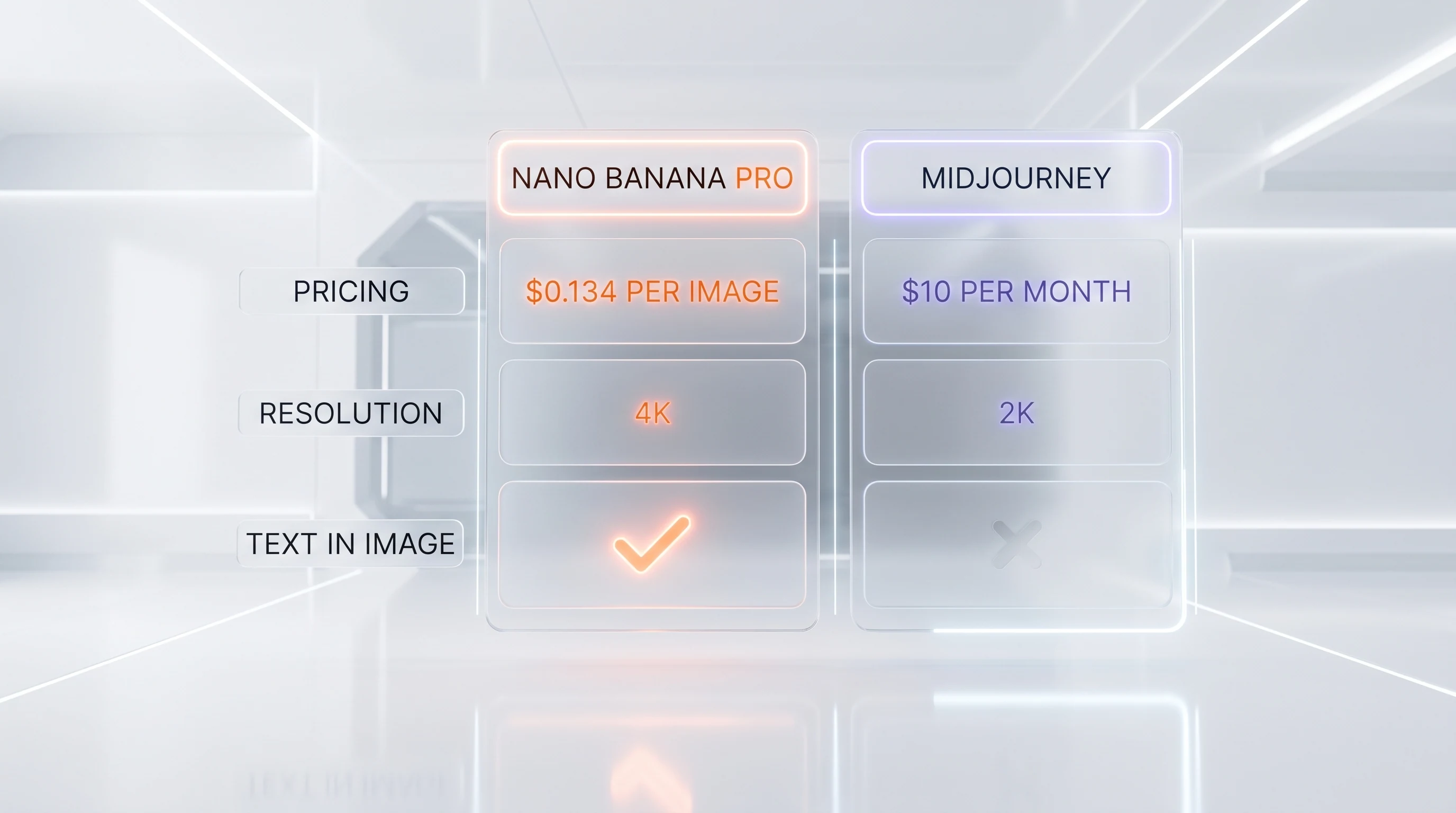
The pricing row is where most readers get confused, so we will be explicit: these two are billed on completely different models. Nano Banana Pro charges per image generated through the API. Midjourney charges a flat monthly subscription that bundles unlimited relaxed generations on its mid and upper tiers. You cannot directly divide one into the other without knowing your volume. We unpack exactly how to think about that in the pricing section below.
Text rendering: the most decisive axis
If your work depends on words appearing correctly inside an image, this category alone may settle your decision. Nano Banana Pro is, in our testing and in Google's published benchmarks, the strongest in-image text model we have used. Ask it for "a poster with the headline 'Summer Sale' in bold and three bullet points underneath" and you get clean, legible, correctly spelled type, including across multiple languages, where Google reports single-line error rates mostly under ten percent.
Midjourney is the opposite end of the spectrum here. Historically, text inside a Midjourney image has been one of its weakest areas, and even with V8.1's improvements, copy-heavy layouts remain unreliable. You will frequently get decorative shapes that look like letters but are not, or words that are almost right but misspelled. For a mood board with a single short word, V8.1 can sometimes pull it off; for an infographic, a product label, a UI mockup, or a multilingual marketing visual, it is the wrong tool. We did not assign Midjourney a public text-accuracy benchmark because none exists that we trust; in our own runs it lost this bucket clearly.
Practical takeaway: anything that lives or dies on legible text inside the frame goes to Nano Banana Pro, full stop.
Aesthetics and artistic feel: Midjourney's home turf
Now the other side of the coin. Ask both tools for "a cinematic portrait of a lone traveler at golden hour, 35mm, shallow depth of field" and the difference in character is immediate. Midjourney V8.1 produces an image with a point of view: confident color grading, dramatic light falloff, the kind of composition that feels art-directed rather than assembled. Its HD pipeline renders believable skin texture and natural depth of field, and the --raw mode strips away some of the default stylization for those who want a more neutral base.
Nano Banana Pro is not aesthetically weak — it produces clean, grounded, photographically plausible images — but it tends to play it safe. It reasons toward a correct, well-lit, literal interpretation of the prompt rather than a striking one. For factual visualization that is a feature; for fine-art mood it can feel a little flat next to Midjourney's flair. If your output is judged on "is this beautiful and evocative," Midjourney still sets the bar in 2026. If your output is judged on "is this accurate and on-brief," Nano Banana Pro pulls ahead.
Hands-on: the text test we ran on both
To make the text gap concrete rather than abstract, we ran a fixed brief through both tools twenty times each: "a clean event poster with the headline 'ThePlanetTools Summit 2026', a subhead reading 'AI Tools, Decoded', and three short bullet points." This is a brutally ordinary marketing task and exactly the kind of thing a small team needs an image model to do without a designer in the loop.
Nano Banana Pro produced a usable poster on the first try in the large majority of runs. Headlines were correctly spelled, the subhead read cleanly, and the bullets landed in a sensible hierarchy. When we asked it to swap the headline to French or to Japanese, it kept its composure, which tracks with Google's reported sub-ten-percent single-line error rate across languages. The few misses were spacing quirks rather than gibberish.
Midjourney V8.1, on the same brief, produced gorgeous posters with broken text. Letters bent into decorative approximations, the subhead frequently dissolved into shape-noise, and bullets became texture rather than words. The image quality was, frankly, prettier than Nano Banana Pro's — but it was unusable as a finished poster without a human retyping every word in an editor afterward. That is the entire story of this category: Midjourney makes a beautiful canvas; Nano Banana Pro makes a finished deliverable.
Hands-on: the product and photorealism test
Our second fixed brief was an e-commerce staple: "a matte ceramic coffee mug on a marble countertop, soft window light, shallow depth of field, photorealistic." Both tools cleared the bar, but in different ways. Midjourney delivered the more seductive frame nearly every time — the light had mood, the marble had character, and the whole thing looked like it belonged in a lifestyle catalog. If we needed a hero image to sell a feeling, Midjourney won the eye test.
Nano Banana Pro delivered the more controllable and more consistent frame. When we then asked for "the same mug, now in navy, on the same counter, three-quarter angle," Nano Banana Pro held the object's identity far more faithfully across the series, which is exactly what its up-to-five-characters-and-fourteen-objects consistency is built for. Midjourney's style references kept the vibe but drifted on the literal object more often. For a single hero shot, Midjourney; for a coherent product set where the same item must reappear shot after shot, Nano Banana Pro.
Resolution, control, and output quality
Nano Banana Pro generates natively at 1K, 2K, and 4K (up to 4096 pixels per side), with a broad set of aspect ratios from square through ultra-wide cinematic, plus studio-style controls over lighting, color grading, depth of field, camera angle, and shot type. It also maintains consistency across up to five characters and fourteen reference images within a single workflow, which matters enormously for brand and product work where the same item must reappear shot after shot.
Midjourney V8.1 generates natively at 2K (2048 by 2048) with its --hd pipeline, baking detail in from the start rather than requiring a separate upscale step, and it is roughly three to five times faster than V8 was. It does not reach Nano Banana Pro's native 4K, and its consistency tooling — style and object references via --sref and --oref — is excellent for vibe but less surgical than Nano Banana Pro's explicit multi-subject grounding. For poster-size or print-resolution deliverables, Nano Banana Pro's native 4K is the cleaner path. For social, web, and concept work, Midjourney's 2K is more than enough.
What the benchmarks say (and do not say)
On the Artificial Analysis Image Arena, a blind human-preference leaderboard, Nano Banana Pro (Gemini 3 Pro Image) sits at an Elo of around 1219 on the text-to-image board as of mid-2026, with its lighter sibling Nano Banana 2 a notch higher and GPT Image 2 at the top. Here is the honest gap: Midjourney's current models do not appear on that particular leaderboard, so we mark Midjourney as not rated there rather than inventing a number. Arena Elo measures broad human preference on blind pairs; it does not isolate aesthetics from correctness, and it does not capture Midjourney's curated community-gallery strength. Treat the Elo as one signal among several, not a verdict.
The more useful benchmark signal in 2026 is task-specific: Nano Banana Pro's documented sub-ten-percent single-line text error rate is a real, measurable edge for text work, and Midjourney's consistent dominance in aesthetic-preference polls reflects a real edge in artistic feel. Use the benchmark that matches your job.
It is also worth understanding why Midjourney tends to be underrepresented on developer-facing arenas in the first place. Those leaderboards are populated largely by models with public APIs that researchers can call at scale, and Midjourney has no such generation API. Its absence is therefore partly a structural artifact of how the leaderboards are built, not proof that its images are worse — they are simply not in the blind-pair pool in the same volume. This is precisely why we refuse to assign Midjourney a fabricated Elo: the honest answer is that it is not rated on that board, and inventing a number to make the table look symmetrical would mislead you. When you see a comparison that confidently gives Midjourney a precise arena Elo against Nano Banana Pro, be skeptical of where that figure came from.
Pricing: per image versus per month
This is the section where the two tools refuse to line up cleanly, so we will keep the units honest and never blend them.
Nano Banana Pro is billed per image through the API. A 1K or 2K image costs $0.134, and a 4K image costs $0.24, with image output billed at $120 per one million output tokens under the hood (a 1K or 2K image consumes about 1,120 tokens, a 4K image about 2,000). There is no free tier and no subscription — you pay for exactly what you generate. Generate ten images this month, pay for ten; generate ten thousand, pay for ten thousand.
Midjourney is billed per month as a subscription. Basic is $10 per month, Standard is $30 per month, Pro is $60 per month, and Mega is $120 per month, per Midjourney's published plans, with annual billing knocking roughly twenty percent off each. Basic includes about 3.3 fast GPU hours and no relaxed mode; Standard and above add unlimited relaxed (slower-queue) generations, so on Standard or higher your marginal cost per image effectively drops toward zero once you are willing to wait in the relax queue. We could not load Midjourney's pricing page directly during testing (it returned a block), so these figures are attributed to Midjourney's published plan documentation and corroborated across multiple current sources rather than scraped live.
How to choose on cost alone: if your volume is low, spiky, or programmatic — a few hundred images a month, or images generated automatically inside an app — Nano Banana Pro's pay-per-image model is almost always cheaper and simpler. If your volume is high and exploratory — thousands of creative frames a month where you throw away most of them — Midjourney's unlimited relaxed generations on a $30 per month Standard plan can be dramatically cheaper per usable image. The crossover point depends entirely on how many images you throw away to find the keeper.
Workflow and ecosystem
Nano Banana Pro lives where developers and Google users already work: the Gemini API, Google AI Studio, and increasingly across the Workspace surface, with SynthID watermarking baked into outputs. If you are automating image generation, building it into a product, or want images to appear inside a documented, scriptable pipeline, this is the natural home. It is an API first and a creative tool second.
Midjourney lives where artists and creative teams already work: a polished web interface (and its Discord roots), a thriving public gallery you can learn from, and a culture of prompt-craft and remixing. It is a creative tool first and an automation surface second — there is no official public API for generation, which rules it out for many programmatic use cases but makes it a joy for hands-on iteration. The ecosystem difference is not a footnote; it often decides the tool before quality ever enters the conversation.
Speed, iteration, and the feel of using each
Numbers aside, the two tools simply feel different to use, and that feeling shapes the work. Nano Banana Pro feels like calling a service: you send a careful prompt, you get back a careful image, and the loop is deliberate. Because you pay per image, you tend to prompt more thoughtfully and generate fewer throwaways. That discipline is great for production but less fun for open-ended exploration — every "let me just try one more" carries a literal price tag, however small.
Midjourney feels like play. On a Standard plan with unlimited relaxed generations, the marginal cost of one more variation is effectively zero, so you riff. You generate forty frames, kill thirty-eight, and the two survivors are often better than anything you would have prompted your way to on a metered API. V8.1's faster pipeline makes this loop tighter than it has ever been. The downside is that the freedom can become a time sink — it is very easy to spend an hour chasing a frame you do not actually need.
This difference is not a tiebreaker so much as a temperament match. Teams that think in deliverables and budgets gravitate to Nano Banana Pro. Teams that think in exploration and aesthetics gravitate to Midjourney. Neither instinct is wrong; they are optimized for different stages of creative work.
Limitations and honest caveats
Neither model is flawless, and pretending otherwise would be the opposite of helpful. Nano Banana Pro, for all its correctness, can render images that are technically right and emotionally inert — competent rather than captivating. It is tied to Google's ecosystem and billing, has no flat-fee escape hatch for heavy users, and offers no free tier, so casual experimentation costs real money from the first image. Its reasoning step also means it occasionally over-literalizes a playful prompt that Midjourney would have run with.
Midjourney's caveats are the mirror image. Its in-image text is unreliable enough that we would not trust it for any copy-bearing deliverable without manual cleanup. It caps at native 2K, lacks an official generation API, and offers no per-image option, so low-volume or programmatic users overpay or simply cannot use it. And its signature aesthetic, while gorgeous, can be a liability when you need a neutral, on-brand, un-stylized result — the --raw mode helps but does not fully neutralize the house style. We weighed all of this before landing on a split rather than a winner.
Best for each: who should pick what
Best for in-image text, infographics, and diagrams: Nano Banana Pro
Posters, charts, product labels, UI mockups, multilingual marketing — anything where the words have to be right. Nothing in Midjourney's lineup competes here.
Best for cinematic and artistic mood: Midjourney V8.1
Concept art, fashion, fantasy environments, evocative stills, anything judged on beauty and atmosphere. Midjourney's aesthetic remains the one others are measured against.
Best for developers and automation: Nano Banana Pro
A real API, per-image billing, and pipeline-friendly behavior. If a machine is calling the model, Midjourney is effectively off the table and Nano Banana Pro is the obvious pick.
Best for high-volume creative exploration: Midjourney V8.1
If you generate thousands of frames a month to find a handful of keepers, the unlimited relaxed generations on a $30 per month Standard plan make Midjourney the cheaper and faster sandbox.
Best for native 4K and print: Nano Banana Pro
Native 4K output and surgical multi-subject consistency win for print-resolution and brand-systematic work.
Pros and cons at a glance
Nano Banana Pro
Pros: best-in-class legible in-image text, native 4K output, strong multilingual rendering, consistency across up to five characters and fourteen reference images, real API with simple per-image pricing, grounded and factually careful, SynthID watermarking.
Cons: aesthetics play it safe versus Midjourney's flair, no flat-fee unlimited tier, no free tier, can feel literal rather than art-directed, ties you to Google's ecosystem.
Midjourney V8.1
Pros: still the aesthetic benchmark, gorgeous cinematic lighting and mood, unlimited relaxed generations on Standard and above, fast V8.1 HD pipeline, rich community and learning culture, excellent style references.
Cons: unreliable in-image text, caps at native 2K, no official generation API, subscription-only with no per-image option, weaker for factual diagrams and copy-heavy layouts.
When to pick which
Pick Nano Banana Pro when your images must contain correct text, when you need 4K, when you are building generation into software, when your volume is low or unpredictable, when accuracy and brand consistency matter more than flair, or when you already live in Google's tools.
Pick Midjourney V8.1 when your output is judged on beauty, when you explore at high volume to find keepers, when you want the most distinctive aesthetic available, when you work hands-on rather than programmatically, or when a flat monthly fee with unlimited relaxed generations fits your habits better than metered billing.
Honestly, many teams should run both. We do. Midjourney for the moodboard and the hero aesthetic, Nano Banana Pro for the version that needs real text, a diagram, or a 4K export. At $30 per month for Midjourney Standard plus a few dollars of Nano Banana Pro API usage, the combined cost is trivial against the time saved.
Final verdict
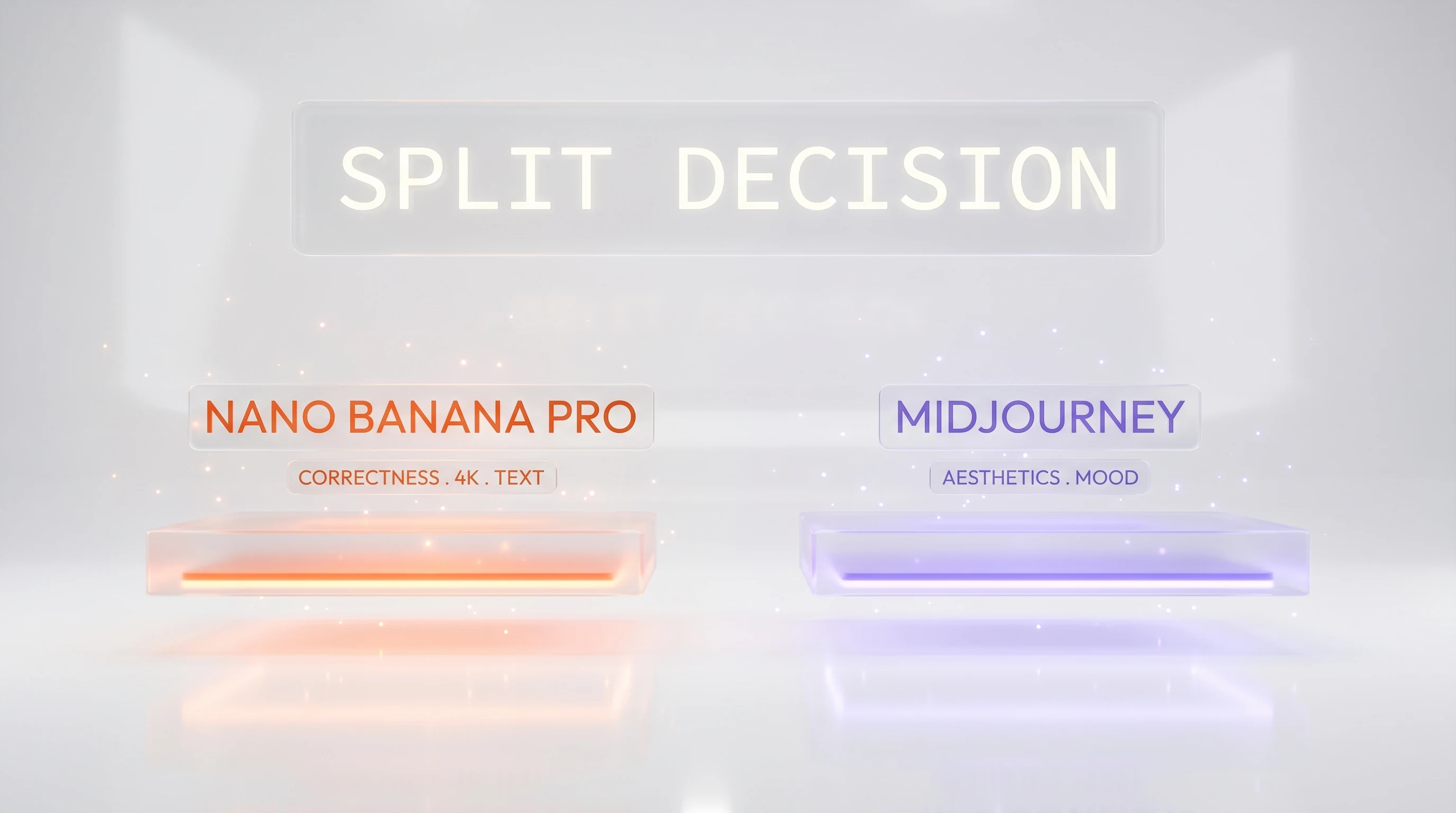
After six weeks on identical briefs, we are calling this a split rather than a winner. Nano Banana Pro is the model we reach for when correctness matters: text inside the image, accurate diagrams, native 4K, multilingual layouts, and anything that has to be generated programmatically and billed per image. Midjourney V8.1 is the tool we reach for when beauty matters: cinematic mood, art-directed lighting, and high-volume creative exploration on a flat monthly fee.
If forced to summarize in one line: Nano Banana Pro is the better tool, Midjourney is the better toy — and we mean "toy" with respect, because the play is exactly where its magic lives. Choose Nano Banana Pro to ship correct visuals at scale; choose Midjourney to chase the most beautiful frame. Many of you, like us, will end up paying for both. There is no single trophy to hand out here, and pretending otherwise would do you a disservice.
One last lens to settle a tie in your own head: ask whether your next ten images are deliverables or experiments. Deliverables — the ones with text, the ones a client signs off on, the ones a machine generates on a schedule — point to Nano Banana Pro. Experiments — the ones you make to discover a direction, the ones judged purely on how they make you feel — point to Midjourney. Most real creative pipelines contain both kinds of work, which is exactly why we stopped trying to crown one model and started using each for what it is best at. Set this comparison against your own ratio of deliverables to experiments, and the right answer will be obvious. If your ratio shifts over time, so should your tool — and there is no shame in keeping both subscriptions warm.
If you are weighing other image models, see how the API leaders stack up in our GPT Image 2 vs Nano Banana Pro breakdown, or how Midjourney fares against the safest enterprise option in Midjourney vs Adobe Firefly.
Frequently asked questions
Which is better for putting text inside an image, Nano Banana Pro or Midjourney?
Nano Banana Pro, clearly. Google reports single-line text error rates mostly under ten percent, and in our testing it rendered clean, legible, correctly spelled headlines and body copy, including across languages. Midjourney V8.1 still produces unreliable in-image text, so for posters, infographics, labels, and multilingual layouts, Nano Banana Pro wins this category outright.
How much does each one cost?
They bill differently. Nano Banana Pro charges per image through the API: $0.134 for a 1K or 2K image and $0.24 for a 4K image, with no subscription and no free tier. Midjourney charges a monthly subscription: $10 per month Basic, $30 per month Standard, $60 per month Pro, and $120 per month Mega, per Midjourney's published plans, with annual billing cutting roughly twenty percent off each.
Which produces more beautiful, artistic images?
Midjourney. Even in 2026 it remains the aesthetic benchmark, with confident color grading, dramatic lighting, and art-directed composition that feels intentional. Nano Banana Pro produces clean, grounded, plausible images but tends to interpret prompts more literally than dramatically, so for pure artistic mood Midjourney is still ahead.
What is the maximum resolution of each model?
Nano Banana Pro generates natively at up to 4K (4096 pixels per side) across 1K, 2K, and 4K tiers. Midjourney V8.1 generates natively at 2K (2048 by 2048) through its HD pipeline without a separate upscale step. For print-resolution and large-format work, Nano Banana Pro's native 4K is the cleaner option.
Does Midjourney have an API like Nano Banana Pro?
No official public generation API. Midjourney is a creative subscription you operate through its web interface, which rules it out for most programmatic and automated use cases. Nano Banana Pro is an API first, available through the Gemini API and Google AI Studio, so for building image generation into software, Nano Banana Pro is the practical choice.
What version of Midjourney is current in 2026?
V8.1 is the default and latest model, released on April 30, 2026. It builds on V8's native 2K HD output with faster generation (roughly three to five times faster than V8), stronger prompt reading, and better small-detail retention. V7 is now a legacy option rather than the default.
Which is better for an e-commerce or product workflow?
It depends on the task. For product shots that need legible labels, accurate diagrams, native 4K, or the same item reproduced consistently across many frames, Nano Banana Pro wins thanks to its multi-subject consistency (up to five characters and fourteen reference images). For lifestyle and mood imagery where atmosphere sells the product, Midjourney's aesthetic edge is hard to beat.
Do either of them watermark generated images?
Nano Banana Pro embeds Google's SynthID watermark in its outputs, which helps with AI-content provenance. Midjourney does not embed an equivalent invisible provenance watermark by default, though paid tiers govern commercial usage rights. If invisible provenance marking matters to your compliance or disclosure needs, Nano Banana Pro has the edge.
Can I use both together?
Yes, and we recommend it for many teams. We run Midjourney for the moodboard and the hero aesthetic, then Nano Banana Pro for any version that needs real text, a factual diagram, or a 4K export. A $30 per month Midjourney Standard plan plus a few dollars of Nano Banana Pro API usage covers a surprising amount of professional work.
Which is cheaper overall?
It depends entirely on volume and waste. For low or spiky volume, or programmatic generation, Nano Banana Pro's pay-per-image model is usually cheaper and simpler. For high-volume creative exploration where you discard most frames to find a keeper, Midjourney's unlimited relaxed generations on a $30 per month Standard plan can be far cheaper per usable image. Estimate how many images you throw away per keeper, and the answer follows.
Is Nano Banana Pro the same as Nano Banana 2?
No. Nano Banana Pro is Google's flagship, built on Gemini 3 Pro Image (the gemini-3-pro-image model), tuned for quality, reasoning, native 4K, and strong text. Nano Banana 2 is the lighter, faster, cheaper sibling. On the Artificial Analysis Image Arena, Nano Banana 2 actually scores slightly higher on broad text-to-image preference, but Nano Banana Pro leads on 4K, text fidelity, and multi-subject consistency, which is why it is the better fit against Midjourney here.
So which one should I actually choose?
Choose Nano Banana Pro if your work depends on correctness — text, diagrams, 4K, automation, multilingual layouts, brand consistency. Choose Midjourney V8.1 if your work depends on beauty — cinematic mood, artistic feel, and high-volume exploration. There is no single winner because they excel at different things, and for many professional workflows the smartest move is to keep both in your toolkit.
Sources and references
Every figure on this page is attributed to whoever produced it. Vendor documentation and independent measurement are listed separately and never merged into a single ranking.
- Midjourney — Documentation (model versions and parameters)
- Google DeepMind — Gemini (model family, capabilities and availability)
- Artificial Analysis — Model leaderboard (Intelligence Index scores and cost per task across configurations)
Our Verdict
A split decision. Nano Banana Pro (Google Gemini 3 Pro Image) wins legible in-image text, native 4K, factual diagrams, multilingual layouts, and pay-per-image automation at $0.134 per 1K or 2K image. Midjourney V8.1 wins pure aesthetic mood, cinematic stills, and high-volume creative exploration on an unlimited subscription from $10 per month. Choose Nano Banana Pro for correctness and scale; choose Midjourney for beauty and exploration. Many teams should run both.
Choose Nano Banana Pro
Google's most powerful AI image generation model — state-of-the-art photorealism, 4K native, 94% text accuracy
Try Nano Banana Pro →Frequently Asked Questions
Is Nano Banana Pro better than Midjourney?
A split decision. Nano Banana Pro (Google Gemini 3 Pro Image) wins legible in-image text, native 4K, factual diagrams, multilingual layouts, and pay-per-image automation at $0.134 per 1K or 2K image. Midjourney V8.1 wins pure aesthetic mood, cinematic stills, and high-volume creative exploration on an unlimited subscription from $10 per month. Choose Nano Banana Pro for correctness and scale; choose Midjourney for beauty and exploration. Many teams should run both.
Which is cheaper, Nano Banana Pro or Midjourney?
Nano Banana Pro starts at $0.13/image. Midjourney starts at $10/month. Check the pricing comparison section above for a full breakdown.
What are the main differences between Nano Banana Pro and Midjourney?
The key differences span across 14 features we compared. For Billing model, Nano Banana Pro offers Per image (API) while Midjourney offers Per month (subscription). For Entry price, Nano Banana Pro offers $0.134 per 1K/2K image while Midjourney offers $10 per month (Basic). For In-image text rendering, Nano Banana Pro offers Industry-leading, multilingual while Midjourney offers Unreliable. See the full feature comparison table above for all details.