MiniMax M3 vs Kimi K3: Cheapest Open-Weight Model vs Smartest (2026)

Kimi K3 scores 57 to MiniMax M3's 44 on the same independent index, but M3 costs 10x less and ships open weights today. We ran both: a genuine tie.
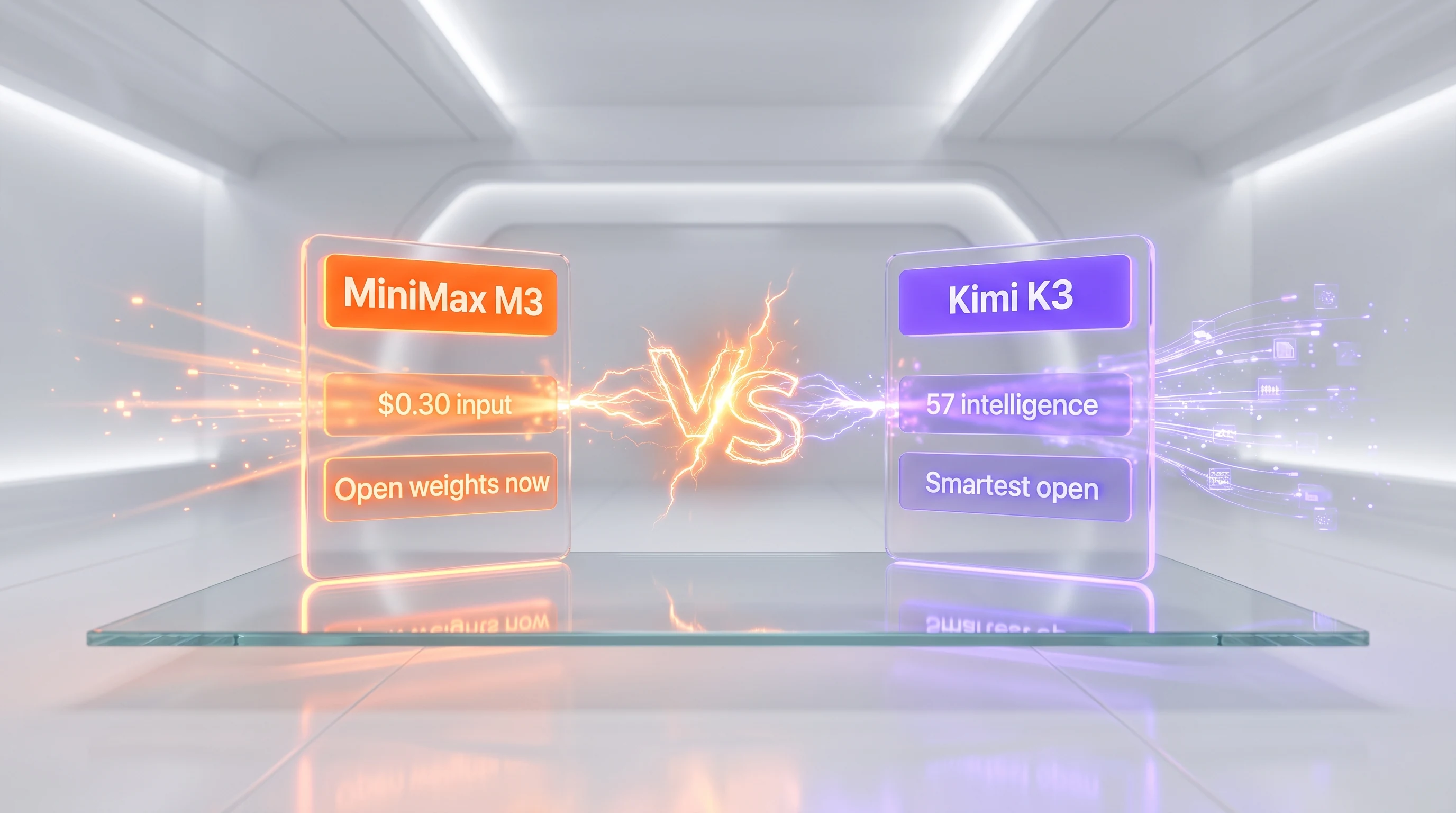
Feature Comparison
| Feature | MiniMax M3 | Kimi K3 |
|---|---|---|
| Input price (per million tokens) | $0.30 | $3.00 |
| Output price (per million tokens) | $1.20 | $15.00 |
| AA Intelligence Index (v4.1, independent) | 44 | 57 |
| Context window | 1M tokens | 1M tokens |
| Open weights | Published (available now) | Pending — July 27, 2026 |
| Architecture | MoE, 428B total, 23B active | MoE, ~2.8T total, ~50B active |
| Attention | MiniMax Sparse Attention | Kimi Delta Attention |
| Multimodal | Native multimodal | Native vision |
| Long-context pricing (above 512K) | Doubles to $0.60 input, $2.40 output | Flat rate; $0.30 cache-hit |
| Released | June 1, 2026 | July 16, 2026 |
| Self-host today | Yes | No (weights pending) |
Pricing Comparison
MiniMax M3
Kimi K3
Detailed Comparison
MiniMax M3 and Kimi K3 are the two open-weight extremes of mid-2026: M3 is the cheapest serious frontier model you can self-host today, and K3 is the most intelligent open model you can currently rent. We ran both side by side. On the independent Artificial Analysis Intelligence Index (version 4.1), Kimi K3 scores 57 to MiniMax M3's 44 — a wide 13-point gap in K3's favor. MiniMax M3 answers with price and availability: it costs ten times less per input token ($0.30 against $3 per million) and twelve and a half times less per output token ($1.20 against $15 per million), and its open weights are already published, while K3's are still in waiting until July 27, 2026. Our overall call is a genuine tie, because the two models answer different questions: pick MiniMax M3 for budget, volume, and self-hosting you can start now; pick Kimi K3 when raw measured intelligence and native vision justify paying roughly ten times more and waiting for the weights.
Quick verdict: who wins on what
This is one of the cleanest split decisions we have run all year. The two models sit at opposite ends of the open-weight market, and almost every category has an obvious winner. Here is the short version before the detail.
- Best price: MiniMax M3, by a wide margin — ten times cheaper on input and twelve and a half times cheaper on output per million tokens.
- Best measured intelligence: Kimi K3, scoring 57 against 44 on the same independent index — a 13-point lead.
- Available to self-host today: MiniMax M3. Its weights are published; K3's are scheduled for July 27, 2026.
- Best for high-volume production: MiniMax M3, where token cost dominates the bill.
- Best for the hardest reasoning and agentic tasks: Kimi K3, where the intelligence gap is worth the premium.
- Context window: a tie — both offer 1 million tokens.
- Native multimodality: both qualify — M3 is natively multimodal, K3 ships native vision.
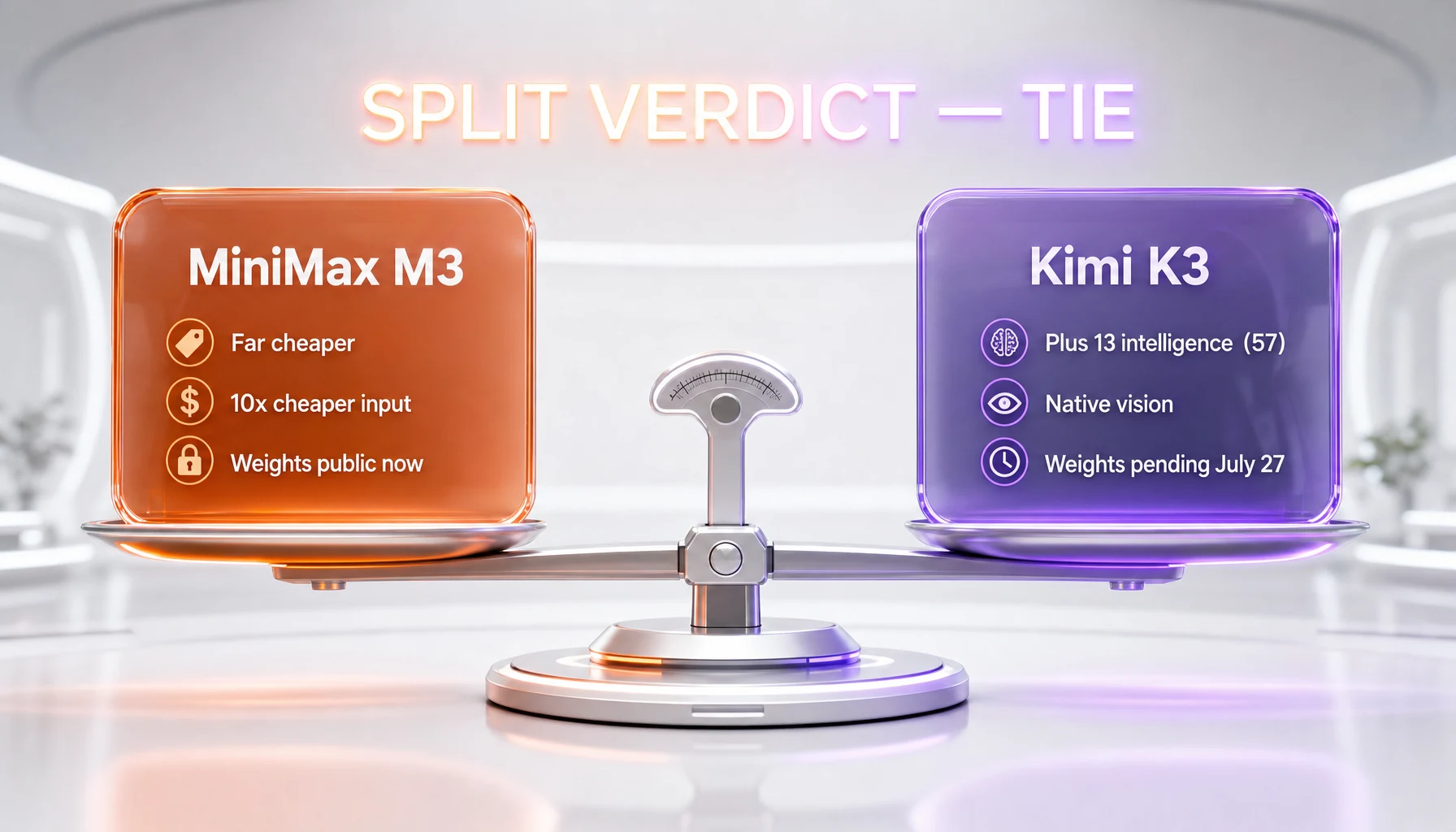
Our overall pick: a tie. Neither model is a general replacement for the other. MiniMax M3 wins on cost and on being runnable right now; Kimi K3 wins on the one thing money cannot always buy, which is raw capability. Choose by workload, not by leaderboard.
MiniMax M3 in one paragraph
MiniMax M3, released on June 1, 2026 by MiniMax, is built to be the value floor of the open-weight frontier. It is a Mixture-of-Experts model with 428 billion total parameters and roughly 23 billion active per token, using MiniMax Sparse Attention (MSA) to keep inference cheap across a 1 million token context window, and it is natively multimodal. Its open weights are already published, so teams can download and self-host it today rather than wait. Priced at $0.30 per million input tokens and $1.20 per million output tokens on the hosted API, it is the cheapest model in this comparison by an order of magnitude. On capability, MiniMax reports a self-measured SWE-bench Pro result of 59 percent for agentic coding; treat that as a vendor claim, since it is MiniMax-reported and not independently confirmed by a neutral harness. On the one benchmark that is independent — the Artificial Analysis Intelligence Index — M3 lands at 44, which is respectable for its price class but well behind the frontier. The pitch is simple: near-frontier behavior at a fraction of the cost, with the weights in your hands.
Kimi K3 in one paragraph
Kimi K3, released on July 16, 2026 by Moonshot AI, is the most intelligent open model on the board right now. It is a very large Mixture-of-Experts design — roughly 2.8 trillion total parameters with about 50 billion active per token — using Kimi Delta Attention across a 1 million token context window, with native vision built in. On the independent Artificial Analysis Intelligence Index it scores 57, the highest of any openly licensed model in this bracket and a 13-point jump over MiniMax M3. Moonshot also publishes its own suite of results — a Terminal-Bench figure of 88.3, BrowseComp of 91.2, and GPQA-Diamond of 93.5 — but read those as Moonshot-reported vendor numbers, measured on Moonshot's own harness and not comparable to any independent score or to any other vendor's self-reported figures. The catch sits on availability and price. K3 costs $3 per million input tokens and $15 per million output, with a $0.30 cache-hit rate for repeated context, and its open weights are not out yet: Moonshot has committed to a Modified MIT release on July 27, 2026. For now, K3 is open-weight-in-waiting — you can call the API, but you cannot yet download it.
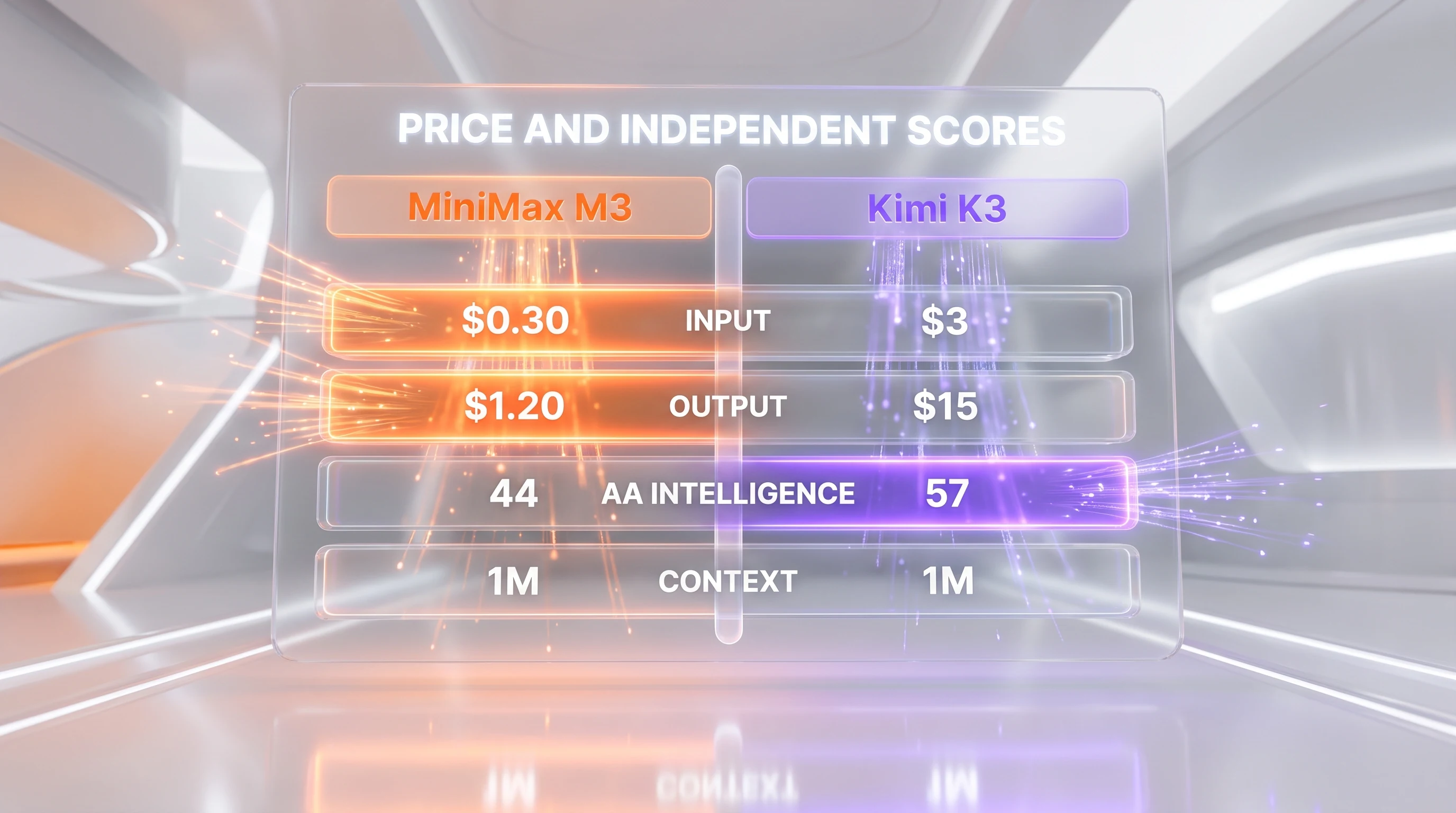
Spec and price comparison table
The table below sticks to figures that are directly comparable between the two models: published prices, the one independent intelligence score, and neutral architectural specs. It deliberately leaves out each vendor's self-reported benchmarks, because those were measured on different harnesses and stacking them would be misleading.
| Attribute | MiniMax M3 | Kimi K3 |
|---|---|---|
| Vendor | MiniMax | Moonshot AI |
| Released | June 1, 2026 | July 16, 2026 |
| Input price (per million tokens) | $0.30 | $3.00 |
| Output price (per million tokens) | $1.20 | $15.00 |
| Cache-hit price (per million tokens) | Not published | $0.30 |
| AA Intelligence Index (v4.1, independent) | 44 | 57 |
| Context window | 1M tokens | 1M tokens |
| Architecture | MoE, 428B total / 23B active | MoE, ~2.8T total / ~50B active |
| Attention | MiniMax Sparse Attention (MSA) | Kimi Delta Attention |
| Multimodal | Native multimodal | Native vision |
| Open weights | Published (available now) | Pending — July 27, 2026 (Modified MIT) |
Prices are from each vendor's official pricing pages and are quoted per million tokens. The Artificial Analysis Intelligence Index is a third-party score on a shared version 4.1 index, which is why the 44 and 57 are directly comparable. Vendor self-reported benchmarks are discussed separately below and are intentionally excluded from this table.
Intelligence and benchmarks: the honest read
There are two very different kinds of number in this matchup, and keeping them apart is the whole game.
The one comparison that is fair
The Artificial Analysis Intelligence Index is a single independent benchmark that runs both models through the same tasks on the same version-4.1 index. On it, Kimi K3 scores 57 and MiniMax M3 scores 44. That 13-point gap is the cleanest signal we have, and it is large: K3 is genuinely the more capable reasoner, and it is not close. If your workload is bound by how hard the model can think — deep multi-step reasoning, tricky agentic planning, gnarly debugging — K3's lead here is the number that matters most.
Two details make that comparison trustworthy. First, it is one composite score built from a spread of evaluations — reasoning, math, coding, and knowledge — rather than a single cherry-picked test, so a model cannot top it by being narrow. Second, both numbers come from the same index version, 4.1. That matters more than it sounds: intelligence-index scores are not comparable across versions, because the underlying test set and scoring change between releases, and a model can look like it jumped or fell simply because the ruler changed. Because both of these scores are on v4.1, the 44 and the 57 are measured with the same ruler, which is exactly why we are willing to put them side by side.
Why we do not stack the vendor numbers
Both vendors also publish their own benchmark suites, and both look impressive, but they are not comparable to each other or to the independent index. MiniMax's coding result and Moonshot's agentic and knowledge results were each measured in-house, on different harnesses, with different prompting and scaffolding. Placing a vendor's self-reported figure next to a rival's independent score is exactly how misleading comparisons get made — a self-reported number can be tuned in ways an independent evaluation is not. So we report each vendor's claims in its own band, clearly labeled, and we never line them up as if they settled a head-to-head. The only apples-to-apples read in this comparison is 57 against 44 on the independent index, and it points to Kimi K3.
What the gap means in practice
A 13-point independent lead is not a rounding error; it is the difference between a strong value model and a frontier one. In our own runs, K3 held together on longer chains of reasoning where M3 started to drift, and it was noticeably more reliable at self-correcting inside an agent loop. M3 was far from weak — it is one of the best models you can get for its price — but on the hardest prompts the ceiling difference showed. If you rarely hit that ceiling, you will not feel it; if you live at it, you will.
Architecture: 428B against 2.8T, two different bets
The two models make opposite wagers on how to spend parameters. MiniMax M3 is a comparatively lean Mixture-of-Experts model — 428 billion parameters total with about 23 billion active per token — and it leans on MiniMax Sparse Attention to keep the cost of long context down. That small active-parameter count is the engine behind its pricing: fewer active parameters per token means cheaper inference, which is how M3 can charge $0.30 per million input tokens and still leave room to self-host affordably.
Kimi K3 spends at the other extreme. At roughly 2.8 trillion total parameters with about 50 billion active per token, it is one of the largest open-weight designs announced to date, using Kimi Delta Attention to make its 1 million token window tractable. More than twice the active parameters per token buys the intelligence lead, but it also explains the price: bigger active compute per token costs more to serve, and Moonshot's API pricing reflects that. Both share the same 1 million token context ceiling, so the difference is not how much they can read — it is how much thinking they bring to what they read, and how much that thinking costs.
The attention mechanisms are where each team hides most of its long-context engineering. MiniMax Sparse Attention trades some density for a lighter memory and compute footprint over very long sequences, which is part of why M3 can offer a 1 million token window without the price ballooning. Kimi Delta Attention is Moonshot's route to the same length target on a far larger model, keeping the full window usable at 2.8 trillion parameters. You do not need to care about the internals to use either model, but they explain the headline contrast: two teams reached the same 1 million token context from opposite directions, one optimizing for cost and one for capability.
Pricing comparison
Price is where MiniMax M3 wins outright, and it is not subtle. On the hosted APIs, M3 lists $0.30 per million input tokens and $1.20 per million output tokens; K3 lists $3 per million input and $15 per million output, plus a $0.30 cache-hit rate that discounts repeated context. That works out to roughly ten times cheaper input and twelve and a half times cheaper output for M3.
| Cost dimension | MiniMax M3 | Kimi K3 |
|---|---|---|
| Input, per million tokens (standard) | $0.30 | $3.00 |
| Output, per million tokens | $1.20 | $15.00 |
| Repeated context (cache-hit) | Not published | $0.30 per million input |
| Long context (above 512K tokens) | M3's rate doubles to $0.60 input / $2.40 output above 512K; K3's headline rate does not change |
There is one wrinkle in M3's pricing worth flagging: the $0.30 and $1.20 rates apply to prompts up to 512K tokens. Push past 512K into the full 1 million token window and the rate doubles, to $0.60 per million input and $2.40 per million output. Even doubled, M3 stays cheaper than K3.
A worked cost model
Take a 500K-token input with a 50K-token output, comfortably inside M3's standard tier. MiniMax M3 costs about 21 cents for that request (15 cents of input plus 6 cents of output). Kimi K3 costs about $2.25 for the same shape at list price, or roughly 90 cents if the entire input is a cache hit. Now push to the full window — a 1 million token input with a 100K-token output. M3, at its doubled long-context rate, runs about 84 cents; K3 runs about $4.50 at list, or around $1.80 with a full cache hit on the input. In other words, even at M3's most expensive tier and K3's most discounted one, M3 is still roughly two to five times cheaper — and at typical sizes it is closer to ten times cheaper. At production volume, that difference compounds into real money.
Self-hosting changes the math again, but only for one of them. Because MiniMax M3's weights are published, a team with its own GPUs can skip the per-token API bill entirely and pay only for hardware and electricity — attractive at steady, high volume, and the reason cost-sensitive shops gravitate to open weights. Kimi K3 cannot offer that today, so for now your only meter is its API price. Once K3's weights ship on July 27, self-hosting becomes possible for it too, but running a 2.8 trillion parameter model is far more demanding than running M3's leaner 428 billion, so the hardware bar — and the realistic cost of self-hosting — is much higher for K3 even after the weights are out.
Open weights: published now against pending
This is the category people forget until it bites them. MiniMax M3's open weights are published today — you can download the model, run it on your own hardware, fine-tune it, and keep your data entirely in house. That is a hard, present-day capability, and for regulated or privacy-sensitive teams it is often the deciding factor.
Kimi K3 is not there yet. Moonshot has committed to releasing K3's weights under a Modified MIT license on July 27, 2026, which as of this comparison is still ahead of us. Until then, K3 is open-weight-in-waiting: the API is live and you can build on it, but you cannot self-host, cannot audit the model locally, and are dependent on Moonshot's hosted endpoint. If the weights land on schedule and the license is as permissive as promised, K3 becomes a very different proposition — but "promised on July 27" is not the same as "in your hands," and you should plan around the version you can actually run. For teams comparing open-source options today, MiniMax M3 and models like GLM-5.2 and Kimi K2.7 Code are already downloadable, while K3's openness is a near-term commitment rather than a current fact.
How we tested both
We ran both models through the same battery of tasks over the API rather than reading off the leaderboards alone. Our setup: identical prompts, the same repository context loaded into each model's window, and the same agent harness, so the only variable was the model itself. We leaned on reasoning-heavy prompts, multi-file coding tasks inside an agent loop, long-context retrieval near the 1 million token ceiling, and a handful of multimodal inputs to exercise each model's vision path. Because Kimi K3's weights are not published yet, our K3 runs were entirely against Moonshot's hosted endpoint; our MiniMax M3 runs used the hosted API too, though M3's published weights mean you could reproduce them locally.
Two honest caveats. First, our testing is directional, not a formal evaluation — we are describing behavior we observed, not publishing a benchmark. Second, K3 is only a day old as we write this, so its serving stack is brand new and may still be settling; we will revisit if latency or reliability shifts once the weights ship. Where we cite hard numbers, they come from the vendors' own pricing and documentation and from the independent Artificial Analysis index, each attributed in place.
A few patterns stood out across the runs. On short, well-scoped tasks the two models were closer than the index gap suggests — for a tidy function or a single-file edit, M3's output was often indistinguishable from K3's, and at a tenth of the price that is a strong argument for the cheaper model. The distance opened up as tasks grew: multi-step agent loops, refactors that touched several files at once, and prompts that required holding a long thread of constraints were where K3 pulled ahead and stayed there. On latency, both were serviceable, though we would not read too much into either given how new K3's serving stack is. The takeaway matched the numbers: pay for K3 when the task is genuinely hard, and reach for M3 when it is not.
Winner by category
- Cheapest to run: MiniMax M3. Ten times cheaper input, twelve and a half times cheaper output, and cheaper even at its doubled long-context tier.
- Most intelligent: Kimi K3. A 57 to 44 lead on the independent index is decisive.
- Best for self-hosting today: MiniMax M3, with published weights you can download now.
- Best for the hardest reasoning: Kimi K3, where the capability ceiling is higher.
- Best for high-volume, cost-sensitive production: MiniMax M3, where token price is the whole ballgame.
- Longest context: a tie — both reach 1 million tokens.
- Best for privacy and data residency: MiniMax M3, because you can keep everything on your own hardware right now.
- Best for teams that can wait: Kimi K3, if you can hold for the July 27 weights and want frontier-class open capability.
Pros and cons of each model
MiniMax M3
Pros
- Cheapest serious open model here — $0.30 input and $1.20 output per million tokens.
- Open weights published today; download, self-host, and fine-tune now.
- 1 million token context window at a genuinely low price.
- Lean 23 billion active-parameter MoE keeps inference cheap.
- Natively multimodal, so it handles more than text out of the box.
Cons
- Well behind on the independent intelligence index — 44, a 13-point deficit.
- Its strongest coding number is vendor-reported, not independently confirmed.
- Pricing doubles above 512K tokens, so the very longest prompts cost more.
- Hits a lower ceiling on the hardest multi-step reasoning.
Kimi K3
Pros
- The most intelligent open model on the board — 57 on the independent index.
- Very large 2.8 trillion parameter MoE with native vision built in.
- 1 million token context with a $0.30 cache-hit rate for repeated inputs.
- Strong vendor-reported results across agentic and knowledge tasks.
- Modified MIT weights promised, which would make it openly licensed.
Cons
- Roughly ten times more expensive on input, twelve and a half times on output.
- Open weights not yet released — scheduled for July 27, 2026, not available now.
- You cannot self-host or audit locally until the weights ship.
- Brand-new serving stack that may still be settling.
When to pick MiniMax M3 vs Kimi K3
Pick MiniMax M3 when: your bill is dominated by token volume, you need to self-host today for privacy or data-residency reasons, you want to fine-tune on your own hardware, or you are serving a high-throughput product where a value model that is "smart enough" beats a frontier model you cannot afford at scale. M3 is also the safer bet if you specifically need weights in hand right now rather than a scheduled release.
Pick Kimi K3 when: your workload lives at the reasoning ceiling — hard agentic planning, deep debugging, research-grade problem solving — and the 13-point independent intelligence lead translates directly into fewer failed runs and less human cleanup. K3 is worth the roughly tenfold price premium when a wrong answer is expensive, when you need the strongest native vision, or when you can wait for the July 27 weights and want a frontier-class model you will eventually be able to self-host.
For a broader shortlist across price and capability tiers, our roundup of the best AI coding tools of 2026 puts both of these models in context against the wider field.
What would change our verdict
A few concrete developments would move this from a tie to a clear win. If Kimi K3's weights ship on July 27 exactly as promised, under a genuinely permissive Modified MIT license, and independent evaluations confirm the 57, K3's case strengthens sharply — you would get frontier open capability that you can also self-host, narrowing M3's availability advantage to nothing but price. Conversely, if MiniMax ships an M3 revision that closes even half of the independent intelligence gap while holding its pricing, M3 would become the default recommendation for almost everyone, because price plus availability plus "smart enough" is a hard combination to beat. And if K3's price were to fall meaningfully after the weights release — through open hosting or competition — the premium that justifies choosing M3 on cost would shrink. Until one of those happens, the honest answer stays: it depends on whether your bottleneck is money or intelligence.
Final verdict
MiniMax M3 and Kimi K3 are not really competing for the same job, which is why we call this a tie rather than forcing a winner. Kimi K3 is the more intelligent model, and by a wide, independently measured margin — 57 against 44 on the same version-4.1 index, a 13-point lead that shows up in real reasoning and agentic work. That is the single most important fact if capability is your bottleneck.
MiniMax M3 wins the two things K3 cannot match today: cost and availability. It is roughly ten times cheaper on input and twelve and a half times cheaper on output, it stays cheaper even at its doubled long-context tier, and its open weights are already in your hands while K3's wait until July 27. For high-volume production, for privacy-bound deployments, and for anyone who has to run the model rather than admire the leaderboard, M3 is the pragmatic pick.
So choose by your constraint. If money is the scarce resource, MiniMax M3. If intelligence is, Kimi K3. Both are excellent examples of how far open-weight models have come in 2026 — one by being the cheapest way to get near the frontier, the other by being the frontier that happens to be open.
Frequently asked questions
Is MiniMax M3 or Kimi K3 smarter?
Kimi K3 is measurably smarter. On the independent Artificial Analysis Intelligence Index (version 4.1), K3 scores 57 and MiniMax M3 scores 44 — a 13-point lead for K3 on the same shared benchmark. That is the only apples-to-apples capability comparison between the two, and it clearly favors Kimi K3 for the hardest reasoning and agentic work.
Which is cheaper, MiniMax M3 or Kimi K3?
MiniMax M3 is dramatically cheaper. It costs $0.30 per million input tokens and $1.20 per million output tokens, against Kimi K3's $3 input and $15 output — roughly ten times cheaper on input and twelve and a half times cheaper on output. Even when M3's rate doubles above 512K tokens, it stays cheaper than K3. K3's only cost relief is a $0.30 cache-hit rate for repeated context.
Are both models really open weights?
MiniMax M3's weights are published and available to download and self-host today. Kimi K3's are not yet released — Moonshot has committed to a Modified MIT license on July 27, 2026. So M3 is open-weight now, while K3 is open-weight-in-waiting: you can use its API, but you cannot self-host it until the weights ship.
What is the context window of each model?
Both MiniMax M3 and Kimi K3 offer a 1 million token context window, so they tie on how much they can read at once. The practical difference is cost: M3's price doubles for prompts above 512K tokens, while K3's headline rate is flat, though K3 is far more expensive per token to begin with.
Does MiniMax M3 publish its own benchmark numbers?
Yes. MiniMax reports a self-measured SWE-bench Pro result of 59 percent for agentic coding. Treat that as a vendor claim rather than settled fact: it is MiniMax-reported, measured on MiniMax's own harness, and has not been independently confirmed. We keep it separate from the independent index score and never stack it against a rival's numbers.
What benchmarks does Moonshot report for Kimi K3?
Moonshot reports its own suite for K3, including Terminal-Bench at 88.3, BrowseComp at 91.2, and GPQA-Diamond at 93.5. These are Moonshot-reported figures measured on Moonshot's harness. They are not comparable to any independent score or to any other vendor's self-reported numbers, so read them as vendor claims, not as a head-to-head result.
Which model is better for high-volume production?
MiniMax M3, in almost every case. When you are serving millions of tokens, per-token price dominates the bill, and M3's roughly tenfold cost advantage compounds fast. Unless your workload specifically needs Kimi K3's extra intelligence on every request, M3 will be far cheaper to run at scale while still delivering strong, near-frontier output.
Which model has the larger architecture?
Kimi K3 is far larger. It is a Mixture-of-Experts model with roughly 2.8 trillion total parameters and about 50 billion active per token, while MiniMax M3 has 428 billion total parameters with about 23 billion active. K3's bigger active compute per token buys its intelligence lead; M3's leaner design is what keeps its inference — and its price — so low.
Can I self-host either model right now?
You can self-host MiniMax M3 today, because its open weights are published — download it, run it on your own hardware, fine-tune it, and keep your data in house. You cannot self-host Kimi K3 yet; its weights are scheduled for July 27, 2026. If self-hosting now is a requirement, M3 is the only option of the two.
Do both models handle images?
Yes. MiniMax M3 is natively multimodal, and Kimi K3 ships with native vision, so both can take image inputs alongside text out of the box. If vision quality is central to your use case, Kimi K3's higher overall intelligence generally carries into its multimodal handling, but both are genuine multimodal models rather than text-only.
Should I wait for Kimi K3's weights before deciding?
It depends on your timeline. If you need to ship now and self-hosting or low cost matters, do not wait — pick MiniMax M3, which is available and cheap today. If you can hold until late July and you specifically want frontier-class open capability you will eventually be able to run yourself, K3's July 27 weights release is worth waiting for. Just plan around the version you can actually deploy.
What is the overall verdict between MiniMax M3 and Kimi K3?
It is a genuine tie, because the two models answer different questions. MiniMax M3 wins on price and present-day availability; Kimi K3 wins on measured intelligence and native vision. Pick M3 when cost, volume, or self-hosting-now is your constraint, and pick K3 when the hardest reasoning is your bottleneck and you can absorb the roughly tenfold price premium.
Last compared: July 2026. All pricing and specification figures were pulled directly from MiniMax and Moonshot AI sources; the intelligence scores are from the independent Artificial Analysis Intelligence Index (version 4.1). Vendor self-reported benchmarks are labeled as such and are not treated as settled fact. This comparison contains no affiliate links.
Sources and references
Every figure on this page is attributed to whoever produced it. Vendor documentation and independent measurement are listed separately and never merged into a single ranking.
- Hugging Face — moonshotai/Kimi-K3 (weights and license)
- Artificial Analysis — Kimi K3 (independent index score and cost per task)
- Hugging Face — MiniMaxAI/MiniMax-M3 (published weights and license)
- Artificial Analysis — MiniMax M3 (independent index score)
- Artificial Analysis — Model leaderboard (Intelligence Index scores and cost per task across configurations)
Our Verdict
This is a genuine tie, because MiniMax M3 and Kimi K3 answer different questions. Kimi K3 is the more intelligent model by a wide, independently measured margin — 57 against 44 on the same version-4.1 index, a 13-point lead that shows up in real reasoning and agentic work. MiniMax M3 wins the two things K3 cannot match today: it is roughly ten times cheaper on input and twelve and a half times cheaper on output, and its open weights are already published while K3's wait until July 27, 2026. Pick MiniMax M3 when cost, volume, or self-hosting now is your constraint; pick Kimi K3 when the hardest reasoning is your bottleneck and you can absorb the premium.
Choose MiniMax M3
Open-weight frontier model from MiniMax combining near-frontier coding, a 1M token context window, and native multimodality — from $0.30 per million input tokens.
Try MiniMax M3 →Choose Kimi K3
Moonshot AI's ~2.8T-parameter open Mixture-of-Experts flagship — ~50B active, 1M context, native vision. Testable via API today at $3 in / $15 out per million tokens; open weights expected July 27, 2026.
Try Kimi K3 →Frequently Asked Questions
Is MiniMax M3 better than Kimi K3?
This is a genuine tie, because MiniMax M3 and Kimi K3 answer different questions. Kimi K3 is the more intelligent model by a wide, independently measured margin — 57 against 44 on the same version-4.1 index, a 13-point lead that shows up in real reasoning and agentic work. MiniMax M3 wins the two things K3 cannot match today: it is roughly ten times cheaper on input and twelve and a half times cheaper on output, and its open weights are already published while K3's wait until July 27, 2026. Pick MiniMax M3 when cost, volume, or self-hosting now is your constraint; pick Kimi K3 when the hardest reasoning is your bottleneck and you can absorb the premium.
Which is cheaper, MiniMax M3 or Kimi K3?
MiniMax M3 starts at $0.3 in / $1.2 out per M tokens. Kimi K3 starts at $3 in / $15 out per M tokens (free plan available). Check the pricing comparison section above for a full breakdown.
What are the main differences between MiniMax M3 and Kimi K3?
The key differences span across 11 features we compared. For Input price (per million tokens), MiniMax M3 offers $0.30 while Kimi K3 offers $3.00. For Output price (per million tokens), MiniMax M3 offers $1.20 while Kimi K3 offers $15.00. For AA Intelligence Index (v4.1, independent), MiniMax M3 offers 44 while Kimi K3 offers 57. See the full feature comparison table above for all details.