Muse Spark 1.1 vs MiniMax M3: Smarter vs Available (2026)


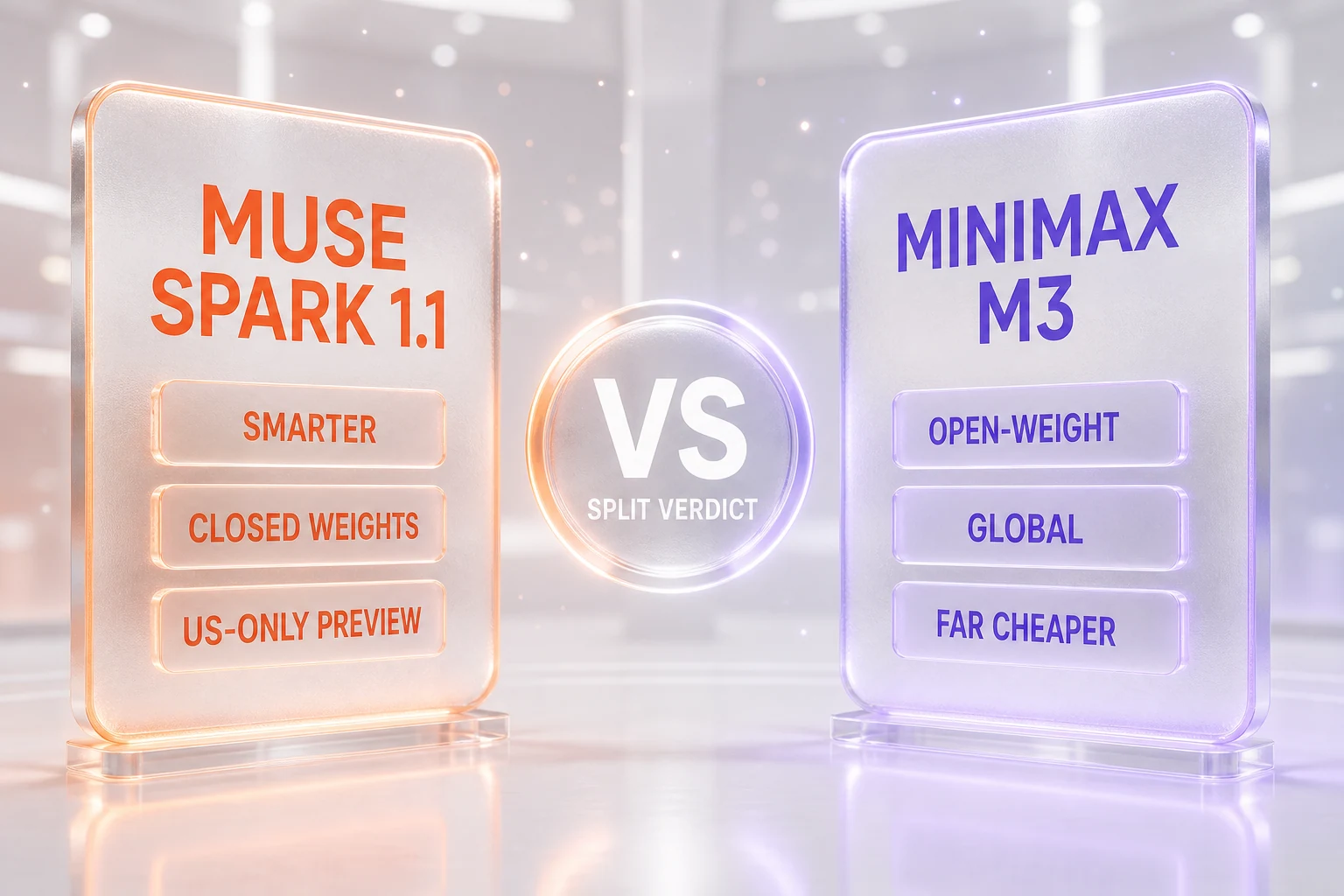
Muse Spark 1.1 leads MiniMax M3 on intelligence, 51 to 44 — but it's a US-only closed preview. MiniMax is open-weight, global, and far cheaper.
Feature Comparison
| Feature | Muse Spark 1.1 | MiniMax M3 |
|---|---|---|
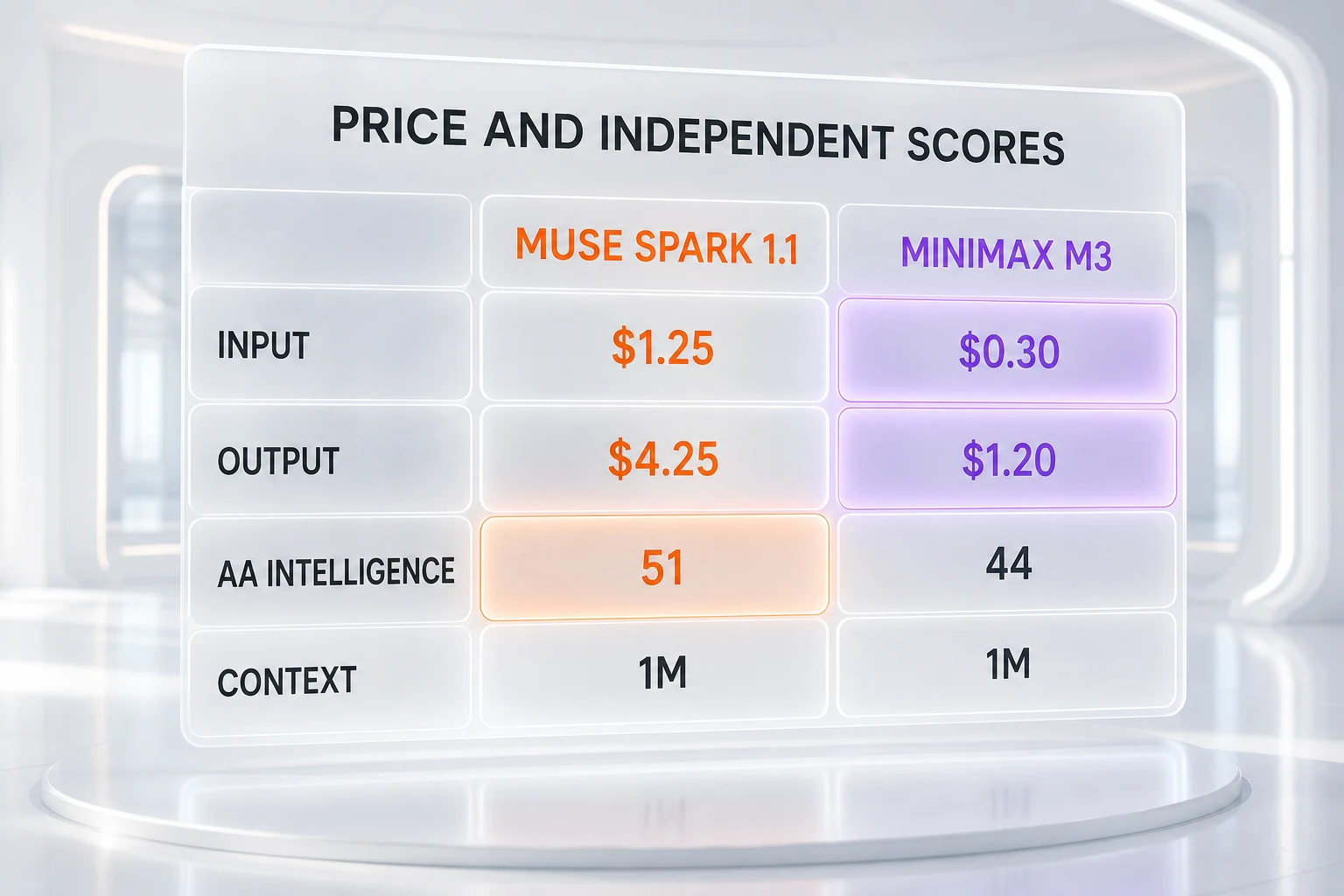
| Independent intelligence (Artificial Analysis v4.1) | 51 | 44 |
| Input price (per million tokens) | 1.25 dollars | 0.30 dollars |
| Output price (per million tokens) | 4.25 dollars | 1.20 dollars |
| Context window | 1,000,000 tokens | 1,000,000 tokens |
| Global availability | United States-only preview (waitlist) | Generally available worldwide |
| Open weights and self-hosting | Closed weights | Open-weight, self-hostable |
| Native multimodality | Multimodal reasoning and agentic | Native multimodal MoE |
Pricing Comparison
Muse Spark 1.1
MiniMax M3
Detailed Comparison
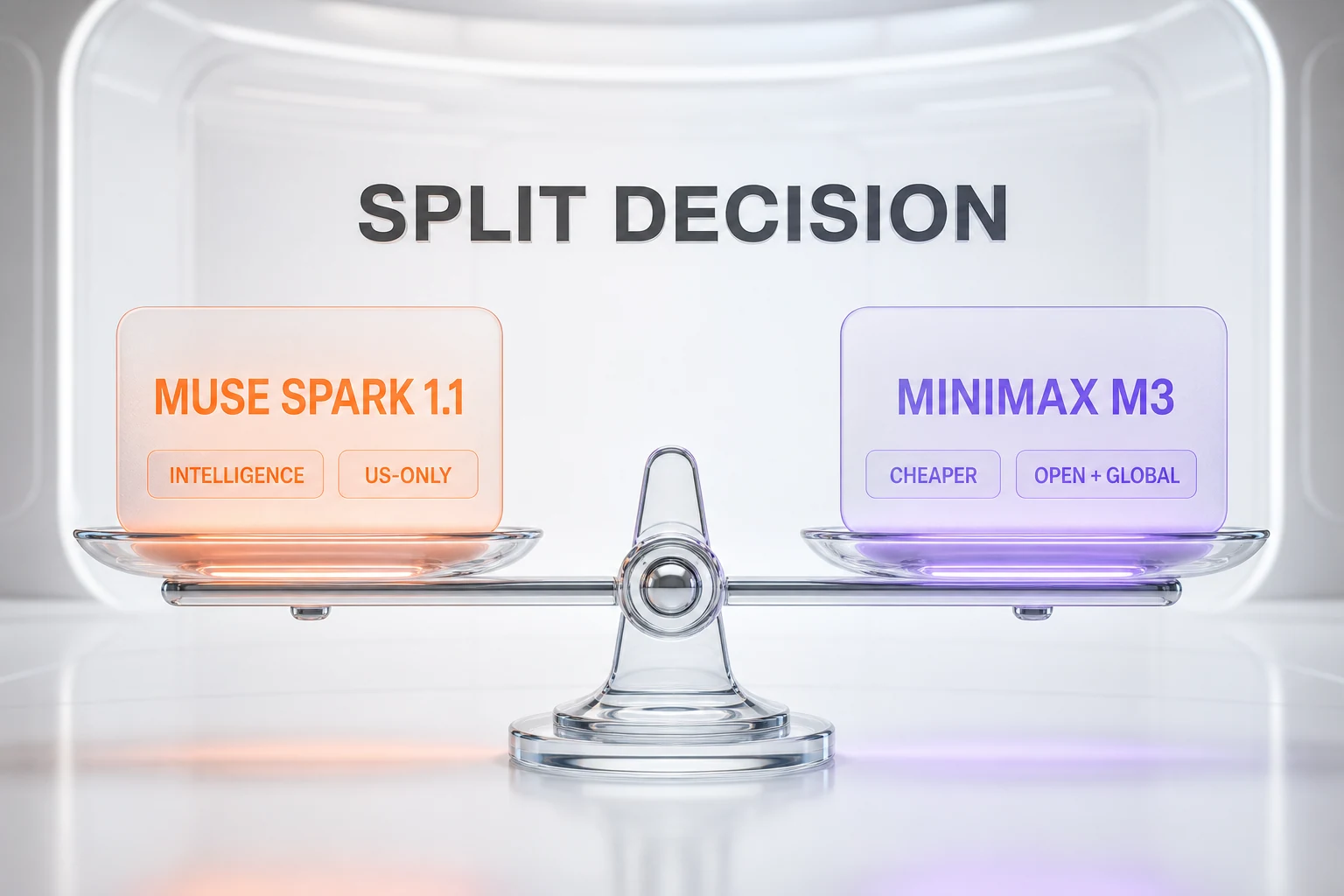
Muse Spark 1.1 and MiniMax M3 are two budget-tier frontier models that sit at opposite ends of the openness spectrum, and they split the win cleanly. Muse Spark 1.1, released July 9, 2026 by Meta Superintelligence Labs, scores higher on measured intelligence, 51 against 44 on the independent Artificial Analysis Intelligence Index version 4.1, but ships only as a closed, United States-only preview behind a waitlist, priced at 1.25 dollars per million input tokens and 4.25 dollars output across a 1,000,000-token context. MiniMax M3, released June 1, 2026, is an open-weight mixture-of-experts model, natively multimodal, generally available worldwide and self-hostable, priced at 0.30 dollars input and 1.20 dollars output per million tokens for prompts up to 512K tokens, with the same one-million-token window. This is a split verdict, not a single winner. Best for measured intelligence: Muse Spark 1.1. Best for price, openness, and global access: MiniMax M3.
Quick Verdict
This is a split verdict by use case, not a single overall winner. We tested MiniMax M3 hands-on through its API and by examining its open weights, and we took the pricing straight from each vendor. We could not run Muse Spark 1.1 ourselves: it ships only as a closed, United States-only preview behind a waitlist, so our read on it is research-led, drawn from Meta's documentation and the independent Artificial Analysis index rather than from weeks of our own controlled testing. We keep independent scores strictly apart from vendor-reported ones. The honest summary is that these two are not really fighting for the same buyer: one is the more intelligent model that most of the world cannot get yet, the other is the cheaper, open one you can download today. Here is the short version.
- Best for measured intelligence: Muse Spark 1.1. On the Artificial Analysis Intelligence Index version 4.1, the one composite that scores both models the same way, it sits at 51 against MiniMax M3 at 44, a clear seven-point lead.
- Best for price: MiniMax M3, and it is not close at standard rates. Input at 0.30 dollars per million tokens is more than four times cheaper than Muse Spark 1.1 at 1.25 dollars, and output at 1.20 dollars is about three and a half times cheaper than Muse at 4.25 dollars.
- Best for open weights and self-hosting: MiniMax M3. The weights ship openly, so you can download, self-host, and fine-tune on your own hardware. Muse Spark 1.1 is closed, a pivot away from Meta's Llama open-weight era, and cannot be run outside Meta's service.
- Best for global availability: MiniMax M3, decisively. It is generally available worldwide, while Muse Spark 1.1 is a preview limited to a United States-only waitlist, so most teams on the planet cannot access it at all today.
- Best for long-context cost predictability: Muse Spark 1.1. Both carry a one-million-token window, but Muse charges one flat rate across it, while MiniMax doubles its rate above 512K tokens.
Bottom line: if you are a United States team that can get preview access and you want the extra seven points of independent intelligence, pick Muse Spark 1.1. If you are anywhere else on Earth, want to self-host, or care about the more than four-times-lower input price, pick MiniMax M3. We did not crown a single winner because the two optimize for opposite things, and the access gap alone makes a global "winner" misleading: the smarter model is the one you probably cannot use yet.
At a Glance
Before the detail, here is the side-by-side that frames everything below. All pricing was taken directly from each vendor. The one independent capability figure comes from the Artificial Analysis Intelligence Index version 4.1, and any vendor-reported benchmark is kept out of this table and labeled separately in the text.
| Dimension | Muse Spark 1.1 | MiniMax M3 |
|---|---|---|
| Vendor | Meta Superintelligence Labs | MiniMax |
| Model type | Closed weights, managed service | Open weight, self-hostable |
| Availability | Preview, United States-only waitlist | Generally available worldwide |
| Released | July 9, 2026 | June 1, 2026 |
| Input price (per million tokens) | 1.25 dollars (flat) | 0.30 dollars up to 512K, then 0.60 dollars |
| Output price (per million tokens) | 4.25 dollars (flat) | 1.20 dollars up to 512K, then 2.40 dollars |
| AA Intelligence Index (v4.1, independent) | 51 | 44 |
| Context window | 1,000,000 tokens | 1,000,000 tokens |
| Long-context pricing | Flat across the full window | Doubles above 512K tokens |
| Architecture | Closed (undisclosed) | Open MoE, 428B total / 23B active |
| Modality | Multimodal reasoning and agentic | Natively multimodal |
| Self-hostable | No | Yes |
Overview of Each Model
Muse Spark 1.1
Muse Spark 1.1 is Meta Superintelligence Labs' agentic reasoning model, released on July 9, 2026 as an incremental upgrade to the original Muse Spark. It is the clearest signal yet of Meta's strategic pivot: after years of shipping Llama as open weights, the Muse Spark line is closed, and 1.1 continues that direction. Positioned as a budget-tier frontier model, it leads this matchup on independent capability, scoring 51 on the Artificial Analysis Intelligence Index version 4.1, the higher of the two here. Artificial Analysis also reports it at 58 percent on the SciCode coding benchmark and 45 percent on Humanity's Last Exam, and credits the 1.1 revision with roughly a twelve-point gain on the Coding Index over the original Muse Spark, which is where most of the upgrade landed. It is built for multimodal reasoning and agentic workflows, carries a 1,000,000-token context window, and prices that whole window at a single flat rate of 1.25 dollars per million input tokens and 4.25 dollars per million output tokens, which is aggressive for a model at its capability tier. The defining catch is access: Muse Spark 1.1 ships only as a preview, limited to a United States-only waitlist, so the majority of teams worldwide cannot use it at all at the time of writing, and there are no downloadable weights and no self-hosting. For the full breakdown, see our Muse Spark 1.1 review, and for the strategic backdrop our report on Meta's Muse Spark and the end of its open-source era.
MiniMax M3
MiniMax M3 is MiniMax's open-weight flagship, released on June 1, 2026 by the Shanghai-based lab. It is a mixture-of-experts model with 428 billion total parameters and about 23 billion active per token, which is the engineering trick behind its aggressive pricing: activating only a slice of the network per token keeps inference cheap. It is natively multimodal, uses a sparse attention design MiniMax calls MSA to make its long context affordable to serve, and ships open weights, so you can download, self-host, fine-tune, and redistribute the model rather than renting it through an API. On its own harness, MiniMax reports a strong 59 percent result on the SWE-bench Pro agentic coding benchmark; we flag that as a vendor self-reported figure that has not been reproduced by an independent evaluator at the time of writing, so treat it as MiniMax's own claim rather than a neutral scoreboard entry. Standard pricing is 0.30 dollars per million input tokens and 1.20 dollars per million output tokens for prompts up to 512K tokens, with a 1,000,000-token context window; note that the rate doubles for any prompt above 512K tokens. On the independent Artificial Analysis Intelligence Index version 4.1 it scores 44, a strong result for a model you can carry off and run on your own hardware, and it is generally available worldwide today. Our full MiniMax M3 review covers the architecture and licensing in more depth, and our launch write-up on the MiniMax M3 open-weight release has the background.
Pricing Compared
Pricing is where the practical case for each model is won, and it is worth being precise. We took every number below directly from each vendor rather than from secondhand summaries.
| Model and tier | Input (per million tokens) | Output (per million tokens) |
|---|---|---|
| Muse Spark 1.1 (flat, full 1,000,000-token window) | 1.25 dollars | 4.25 dollars |
| MiniMax M3 (standard, prompts up to 512K tokens) | 0.30 dollars | 1.20 dollars |
| MiniMax M3 (long context, prompts above 512K tokens) | 0.60 dollars | 2.40 dollars |
Run the arithmetic on the standard tier and MiniMax M3 is clearly the cheaper model. On input, MiniMax at 0.30 dollars per million tokens is more than four times cheaper than Muse Spark 1.1 at 1.25 dollars. On output, the number that dominates most real generation and agentic spend, MiniMax at 1.20 dollars is about three and a half times cheaper than Muse at 4.25 dollars. Those are large multiples, and at scale they decide budgets outright. If your workload is dominated by output tokens, as most generation workloads are, MiniMax is the far cheaper option token for token.
The nuance that softens the picture is MiniMax's 512K threshold. The 0.30 and 1.20 dollar rates apply only while a prompt stays at or below 512K tokens. Cross that line, and because MiniMax M3 supports prompts up to 1,000,000 tokens, the rate doubles to 0.60 dollars input and 2.40 dollars output for that request. Even doubled, MiniMax stays cheaper than Muse Spark 1.1: roughly twice as cheap on input and about one and three-quarter times cheaper on output. Muse Spark 1.1, by contrast, charges a single flat 1.25 dollars input and 4.25 dollars output across its entire 1,000,000-token window, with no step-up. So the honest way to compare is by workload: for short-to-medium prompts MiniMax is dramatically cheaper, and for prompts that consistently run near the context ceiling the gap narrows but never closes, while Muse's flat pricing becomes a real predictability advantage.
Intelligence and Benchmarks
Benchmarks are a minefield when vendors pick favorable evaluations and report them their own way, so we discipline this hard: we lean on the one independent evaluator that scores both models with the same battery, Artificial Analysis, and we treat any vendor-reported figure as an attributed claim, not a verified fact. That distinction is the backbone of this section.
| Signal | Muse Spark 1.1 | MiniMax M3 | Like-for-like? |
|---|---|---|---|
| AA Intelligence Index (Artificial Analysis v4.1) | 51 | 44 | Yes, same independent evaluator |
| Context window | 1,000,000 tokens | 1,000,000 tokens | Tied |
| Long-context pricing behavior | Flat across the full window | Doubles above 512K tokens | Yes, edge Muse |
The cleanest signal here is the Artificial Analysis Intelligence Index, because it is one evaluator running the same battery on both models: Muse Spark 1.1 at 51 against MiniMax M3 at 44, a clear seven-point lead for Muse. That is the strongest independent evidence in the matchup, and it points to Muse Spark 1.1 as the more capable model on measured general intelligence. Artificial Analysis rounds out the Muse picture with a 58 percent SciCode result and 45 percent on Humanity's Last Exam, and it attributes the 1.1 revision with a gain of about twelve points on its Coding Index over the original release, so the upgrade is real and concentrated on code. MiniMax M3's independent score of 44 is impressive in turn for an open-weight model you can carry off and run yourself, and it sits level with the leading open-weight models of its generation.
We keep independent scores and vendor-reported scores strictly apart, because mixing them is how misleading comparisons get built. Beyond the independent index, MiniMax publishes its own coding result for M3 on its own harness, cited earlier and clearly labeled as a vendor self-reported figure. It has not been charted by an independent evaluator and there is no verified head-to-head to build from it, so it cannot be lined up against the independent index as if it were the same kind of evidence, especially since a self-reported vendor number and an independent composite measure different things in different ways. Treated honestly, it tells you MiniMax is competitive on agentic coding by its own measurement, and nothing more precise than that. The number we trust for a like-for-like read remains the Artificial Analysis Intelligence Index, and on that measure Muse Spark 1.1 is ahead.
Access and Availability: The Real Divide
The most decisive difference between these two models is not a benchmark or a price, it is whether you can use the model at all. This is the axis that reshapes the entire comparison, and it runs strongly in MiniMax's favor.
Muse Spark 1.1 ships as a preview, gated behind a United States-only waitlist. That means two things at once: you have to be approved to get in, and you have to be in the United States for that approval to be on the table. For the large majority of developers and teams around the world, Muse Spark 1.1 is not a model they can adopt today at any price; it is a model they can read about. Even inside the United States, preview status implies limited, evolving access rather than a stable production commitment, and closed weights mean there is no fallback path to run it yourself if the waitlist or the terms do not suit you.
MiniMax M3 is the opposite in every respect. It is generally available worldwide, so a team in Jakarta, Lagos, Berlin, or Sao Paulo can call the hosted API on the same footing as one in San Francisco. And because the weights are open, availability is not even contingent on MiniMax keeping an endpoint online in your region: you can download the model and run it on your own hardware anywhere. For anyone outside the United States, for anyone who needs a guarantee that the model will still be reachable next quarter, and for anyone who wants to keep data inside their own borders, this access asymmetry is not a footnote. It is often the whole decision, and it can outweigh a seven-point intelligence gap on a benchmark you cannot yet put to work.
Architecture and Deployment: Open vs Closed
It is tempting to treat two model endpoints as interchangeable, but the engineering and licensing underneath shape cost, control, and where each can run. The two could hardly be more different in philosophy.
Muse Spark 1.1 is a closed model, so Meta discloses behavior rather than internals. What you get, once you are through the waitlist, is a managed service: the model runs on Meta's infrastructure, you reach it through Meta's API, and you never see or move the weights. The upside is operational simplicity and a single flat price across the full context window. The trade-offs are the usual closed-model ones, sharpened by the preview status: no self-hosting, no downloadable weights, and no path to run the model inside your own boundary for data sovereignty. For a company that built its reputation on open Llama releases, this closed posture is a notable strategic shift, and it is the defining constraint of the model.
MiniMax M3 is the opposite, transparent at the weight level because the model ships openly. It is a mixture-of-experts design with 428 billion total parameters and roughly 23 billion active per token, so only a fraction of the network fires for any given token; that is how MiniMax serves a frontier-adjacent model at budget prices. It pairs that with its MSA sparse attention scheme to keep the 1,000,000-token context affordable, and it is natively multimodal. Because the weights are open, you can download the model, run it on your own GPUs, fine-tune it, and keep every token inside your own infrastructure. The cost of that freedom is operational: a 428-billion-parameter model needs real GPU capacity to serve, so self-hosting shifts spend from per-token billing to hardware and engineering. But the option exists, which for Muse Spark 1.1 it simply does not.
How We Compared
Honesty about methodology matters more in a cross-vendor comparison with unequal access than almost anywhere else, so here is exactly what is hands-on and what is research.
We ran MiniMax M3 hands-on through its API on reasoning and coding prompts, and we examined its open-weight release and licensing directly, so our observations of its behavior, its multimodal handling, and its 512K pricing threshold are first-hand. We could not run Muse Spark 1.1 ourselves, because it is a closed, United States-only preview gated behind a waitlist. Our read on Muse Spark 1.1 is therefore research-led: it draws on Meta's own documentation and on the independent Artificial Analysis Intelligence Index version 4.1, and we say so plainly rather than implying a hands-on test we did not perform. That access asymmetry is itself one of the most important findings of this comparison, not a gap to paper over. For every capability claim that rests on a number, we attribute it to its source: the Artificial Analysis index for the one independent, same-evaluator read, and each vendor for its own self-reported figures, labeled as such and never stacked against an independent score as if they were equivalent evidence. We took all pricing directly from each vendor. Where we could not verify a like-for-like number, we said so and left the head-to-head uncommitted. That is the only honest way to compare a model most of the world can download against one most of the world cannot yet reach.
Winner by Category
A single overall winner would be dishonest here, because these two models are tuned for different buyers and, crucially, available to different people. Here is who wins what.
- Best for measured intelligence: Muse Spark 1.1. It sits at 51 on the Artificial Analysis Intelligence Index version 4.1, a clear seven points ahead of MiniMax M3 at 44.
- Best for price: MiniMax M3. More than four times cheaper per input token and about three and a half times cheaper per output token at standard rates, before you even consider self-hosting.
- Best for global availability: MiniMax M3. Generally available worldwide against a United States-only preview waitlist, so for most of the planet MiniMax is the only one of the two you can actually use.
- Best for open weights and self-hosting: MiniMax M3. Downloadable open weights you can run, fine-tune, and keep inside your own infrastructure; Muse Spark 1.1 cannot be self-hosted at all.
- Best for predictable long-context pricing: Muse Spark 1.1. Both hold a 1,000,000-token window, but Muse is flat across it while MiniMax doubles above 512K tokens.
- Best for United States enterprises wanting maximum capability: Muse Spark 1.1, for the teams that can get preview access and value the extra independent intelligence over cost and control.
Pros and Cons
Muse Spark 1.1 - Pros
- Higher independent capability: 51 on the Artificial Analysis Intelligence Index version 4.1, a clear seven points ahead of MiniMax M3 at 44.
- Strong independent coding and reasoning signals, at 58 percent on SciCode and 45 percent on Humanity's Last Exam, with a roughly twelve-point Coding Index gain over the original Muse Spark.
- Flat pricing across the entire 1,000,000-token context window, with no step-up on long prompts.
- Aggressive rates for its capability tier, at 1.25 dollars input and 4.25 dollars output per million tokens.
- Built for multimodal reasoning and agentic workflows on Meta's managed infrastructure.
Muse Spark 1.1 - Cons
- Closed preview limited to a United States-only waitlist, so most teams worldwide cannot access it at all today.
- Closed weights: no self-hosting and no data-sovereignty option beyond Meta's service, a pivot away from Meta's open Llama era.
- More expensive than MiniMax M3 on standard prompts, more than four times more per input token and about three and a half times more per output token.
- Preview status implies limited, evolving access rather than a stable production guarantee.
- We could not test it hands-on, so our read is research-led from documentation and the independent index.
MiniMax M3 - Pros
- Generally available worldwide and self-hostable, so it is usable by teams anywhere, not just in one country.
- Much cheaper on standard prompts: more than four times cheaper per input token and about three and a half times cheaper per output token than Muse Spark 1.1.
- Open weights you can download, self-host, fine-tune, and keep entirely inside your own infrastructure.
- Natively multimodal mixture-of-experts design, 428 billion total parameters with about 23 billion active per token.
- 1,000,000-token context window, exactly matching Muse on raw length.
- Strong independent capability for an open-weight budget model at 44 on the Artificial Analysis Intelligence Index version 4.1.
MiniMax M3 - Cons
- Trails Muse Spark 1.1 on the one independent index that scores both, 44 against 51.
- Pricing doubles above 512K tokens, so long-context work is less cheap than the headline rate suggests.
- Its strongest coding result is vendor self-reported, not independently charted, so treat it as a claim.
- Self-hosting the 428-billion-parameter model requires serious GPU capacity and operational effort.
- As an open model, safety and moderation are your responsibility when you run it yourself.
When to Pick Each
When to pick Muse Spark 1.1
Pick Muse Spark 1.1 when you are a United States team that can get preview access and measured capability matters more to you than cost, control, or portability. If you want the higher independent score, it leads the Artificial Analysis Intelligence Index version 4.1 at 51 to 44, and it backs that up with strong independent coding and reasoning signals and a flat 1.25 dollars input and 4.25 dollars output rate that holds across the entire 1,000,000-token window, so you never hit the step-up that MiniMax applies above 512K tokens. Pick it when your prompts are consistently long and predictable pricing matters, and when a managed Meta endpoint with nothing to provision fits your stack. The hard prerequisite is access: this only works if you can clear the United States-only waitlist, and it commits you to a closed model you cannot inspect, move, or run yourself. For a United States enterprise that values raw capability and managed simplicity over the lowest token price and full ownership, Muse Spark 1.1 is the natural pick, provided you can get in.
When to pick MiniMax M3
Pick MiniMax M3 when access, cost, or control dominate, which for most of the world they do. If you are anywhere outside the United States, this is very likely your only real choice of the two, because it is generally available worldwide while Muse Spark 1.1 is not. If you are running high-volume inference on short-to-medium prompts where token spend is the binding constraint, being more than four times cheaper on input and about three and a half times cheaper on output changes what is economically viable. Pick it if you need to own your weights: the open release lets you self-host, fine-tune, and keep data entirely inside your own infrastructure, which no closed preview can offer. Just size your budget on the rate you will actually pay: if most prompts sit under 512K tokens, MiniMax is dramatically cheaper, and if they routinely run longer, model the doubled rate before you commit. You give up a slice of independent capability, but you get a strong open model at a fraction of the price that you can actually deploy, today, wherever you are.
Final Verdict
This is a split verdict by use case, tilted toward Muse Spark 1.1 on measured intelligence and toward MiniMax M3 on price, openness, and global availability. On the one independent signal that scores both the same way, the Artificial Analysis Intelligence Index version 4.1, Muse leads 51 to 44, a clear seven-point edge, and it delivers that with strong independent coding and reasoning signals. Both models share the same 1,000,000-token context window, but Muse prices it at a single flat rate where MiniMax M3 doubles above 512K tokens. MiniMax M3, in return, costs more than four times less per input token and about three and a half times less per output token at standard rates, ships open weights you can self-host and fine-tune, and is generally available worldwide, a genuinely strong package for a budget open model, and one that most teams can actually adopt today.
We did not crown a single overall winner because the two are not really competing for the same buyer, and because the access gap is real: the smarter model is a closed, United States-only preview that most of the world cannot use yet, while the cheaper, open one is available everywhere. If you are a United States team that can get preview access and you want the extra measured intelligence, the answer is Muse Spark 1.1. If you are anywhere else, want to self-host, or care most about price, the answer is MiniMax M3. Both answers are correct, for different people. Every capability figure here is drawn from the Artificial Analysis independent index or explicitly labeled as a vendor self-reported claim, and only the pricing is taken directly from each vendor.
For the deep dive on each model on its own, see our full Muse Spark 1.1 review and MiniMax M3 review, and for where they land in the broader field, our roundup of the best AI coding tools of 2026.
Frequently Asked Questions
Is Muse Spark 1.1 better than MiniMax M3?
On independent measured intelligence, yes, by a clear margin: Muse Spark 1.1 scores 51 on the Artificial Analysis Intelligence Index version 4.1 against MiniMax M3 at 44 on the same index, a seven-point lead. But "better" depends on whether you can use it. Muse Spark 1.1 is a closed, United States-only preview behind a waitlist, so most of the world cannot access it, while MiniMax M3 is open-weight, generally available worldwide, self-hostable, and more than four times cheaper on input at standard rates. So Muse is the more intelligent model, and MiniMax is the more accessible and cheaper one. This is a split verdict, not a knockout.
How much cheaper is MiniMax M3 than Muse Spark 1.1?
At standard rates, MiniMax M3 costs 0.30 dollars per million input tokens and 1.20 dollars per million output tokens, against Muse Spark 1.1 at 1.25 dollars input and 4.25 dollars output. That makes MiniMax more than four times cheaper on input and about three and a half times cheaper on output. The catch is that MiniMax standard pricing only holds for prompts up to 512K tokens; above that threshold its rate doubles to 0.60 dollars input and 2.40 dollars output, though even then it stays cheaper than Muse. Muse charges a single flat rate across its entire context window. All prices were taken directly from each vendor.
Can I use Muse Spark 1.1 outside the United States?
Not at the time of writing. Muse Spark 1.1 ships as a preview limited to a United States-only waitlist, so access requires both approval and a United States presence. For teams elsewhere in the world, it is currently a model you can read about rather than one you can adopt. If you need a capable model you can use outside the United States today, MiniMax M3 is the practical choice here, because it is generally available worldwide and its open weights let you run it on your own hardware anywhere.
Does MiniMax M3 pricing really double above 512K tokens?
Yes. MiniMax M3 bills 0.30 dollars per million input tokens and 1.20 dollars per million output tokens only while the prompt stays at or below 512K tokens. Once a request crosses 512K tokens, and MiniMax M3 supports up to 1,000,000, the per-token rate doubles to 0.60 dollars input and 2.40 dollars output for that request. It is still cheaper than Muse Spark 1.1 at that point, roughly twice as cheap on input, but the discount shrinks. Muse, by contrast, charges 1.25 dollars input and 4.25 dollars output flat across its full 1,000,000-token window, so for genuinely long prompts Muse's flat pricing becomes more predictable.
Is MiniMax M3 open source?
MiniMax M3 is open weight rather than fully open source in the strictest sense. It is a mixture-of-experts model with 428 billion total parameters and about 23 billion active per token, and MiniMax publishes the weights so you can download, self-host, fine-tune, and run the model on your own hardware. That is the decisive difference from Muse Spark 1.1, which is a closed model available only as a United States-only preview through Meta. If owning and controlling the model matters to you, MiniMax M3 is the only one of the two that offers it.
Why is Muse Spark 1.1 closed if Meta used to be open source?
Muse Spark 1.1 reflects a strategic pivot at Meta. After years of releasing the Llama family as open weights, Meta Superintelligence Labs took the Muse Spark line closed, and version 1.1 continues that closed posture. The practical consequence for this comparison is that you cannot download or self-host Muse Spark 1.1, and combined with its United States-only preview access, that makes it far less reachable than MiniMax M3. Whether the closed strategy pays off for Meta is a separate question; for a buyer today, it simply means Muse Spark 1.1 is a managed, gated service rather than a model you can own.
Which model is smarter, Muse Spark 1.1 or MiniMax M3?
On the one independent evaluator that scores both models the same way, Muse Spark 1.1 is the smarter model. It scores 51 on the Artificial Analysis Intelligence Index version 4.1, seven points ahead of MiniMax M3 at 44. That composite blends reasoning, knowledge, math, and coding evaluations into a single number, and it is the cleanest like-for-like signal available for this matchup. The gap is clear but not enormous, and MiniMax's score of 44 is a strong result for an open-weight model you can run yourself. Remember that the smarter model here is also the one most of the world cannot yet access.
Which model is better for coding?
On independent evidence, Muse Spark 1.1 has the edge: Artificial Analysis reports it at 58 percent on SciCode and credits the 1.1 revision with a roughly twelve-point Coding Index gain over the original, and it leads the overall independent intelligence index. MiniMax reports strong agentic coding results on its own harness, but those are vendor self-reported figures rather than independently charted ones, so we treat them as claims rather than scoreboard entries. For most coding buyers the practical decision is access and cost against capability: MiniMax M3 is far cheaper, self-hostable, and available worldwide, while Muse Spark 1.1 is stronger on the independent signals but gated behind a United States-only preview.
Can I self-host Muse Spark 1.1 or MiniMax M3?
You can self-host MiniMax M3 because its open weights are downloadable, so you can run it inside your own infrastructure for data control and to remove per-token billing. You cannot self-host Muse Spark 1.1, which is a closed model available only as a United States-only preview through Meta. Running MiniMax M3 yourself is not free, though: a 428-billion-parameter mixture-of-experts model needs serious GPU capacity, so self-hosting trades per-token cost for hardware and operational cost. If self-hosting is a requirement, MiniMax M3 is the only viable option of the two.
What is the context window for each model?
Both models offer a 1,000,000-token context window, so they are effectively tied on raw length. The more important difference is pricing behavior across that window. Muse Spark 1.1 charges one flat rate for the whole window, while MiniMax M3 doubles its rate for any prompt above 512K tokens. So while the two are matched on how much context they can hold, Muse is the more predictable choice for consistently long-context work, and MiniMax is the cheaper choice as long as prompts stay under the 512K threshold.
Which should I choose for a high-volume production workload?
For pure high volume where token spend and reach are the binding constraints, MiniMax M3 is usually the rational default, because it is available worldwide, more than four times cheaper on input, and self-hostable, which can cut cost further at scale. Choose Muse Spark 1.1 when you are a United States team that can get preview access and you want the higher independent capability score, managed reliability on Meta's infrastructure, and a flat rate that does not double on long prompts. For many teams the access question settles it before cost even enters the picture, because only one of the two is reachable where they operate.
When were these models released and is this comparison current?
Muse Spark 1.1 was released on July 9, 2026 by Meta Superintelligence Labs. MiniMax M3 was released on June 1, 2026. This comparison was last updated on July 17, 2026, with pricing taken directly from each vendor and the independent capability figures drawn from the Artificial Analysis Intelligence Index version 4.1. Any vendor-reported benchmark is labeled as such and kept separate from independent scores, and we note where our read is research-led because a model was not available for hands-on testing.
Sources and references
Every figure on this page is attributed to whoever produced it. Vendor documentation and independent measurement are listed separately and never merged into a single ranking.
- Hugging Face — MiniMaxAI/MiniMax-M3 (published weights and license)
- Artificial Analysis — MiniMax M3 (independent index score)
- Artificial Analysis — Muse Spark 1.1 (independent index score)
- Artificial Analysis — Model leaderboard (Intelligence Index scores and cost per task across configurations)
Our Verdict
Split verdict, no single winner. Muse Spark 1.1 wins measured intelligence, leading the independent Artificial Analysis Intelligence Index version 4.1 by 51 to 44, and it prices its full one-million-token context at a flat rate. MiniMax M3 wins price, openness, and access: it is more than four times cheaper on input at standard rates, ships open weights you can self-host, and is generally available worldwide, while Muse Spark 1.1 remains a closed, United States-only preview. Pick Muse Spark 1.1 if you are a United States team that can get preview access and want the extra intelligence; pick MiniMax M3 if you are anywhere else, want to self-host, or care most about cost.
Choose Muse Spark 1.1
Meta Superintelligence Labs' closed agentic model: Artificial Analysis Intelligence Index 51 and a 1,000,000-token context, at $1.25 input and $4.25 output per million tokens — about a quarter of frontier input rates.
Try Muse Spark 1.1 →Choose MiniMax M3
Open-weight frontier model from MiniMax combining near-frontier coding, a 1M token context window, and native multimodality — from $0.30 per million input tokens.
Try MiniMax M3 →Frequently Asked Questions
Is Muse Spark 1.1 better than MiniMax M3?
Split verdict, no single winner. Muse Spark 1.1 wins measured intelligence, leading the independent Artificial Analysis Intelligence Index version 4.1 by 51 to 44, and it prices its full one-million-token context at a flat rate. MiniMax M3 wins price, openness, and access: it is more than four times cheaper on input at standard rates, ships open weights you can self-host, and is generally available worldwide, while Muse Spark 1.1 remains a closed, United States-only preview. Pick Muse Spark 1.1 if you are a United States team that can get preview access and want the extra intelligence; pick MiniMax M3 if you are anywhere else, want to self-host, or care most about cost.
Which is cheaper, Muse Spark 1.1 or MiniMax M3?
Muse Spark 1.1 starts at $1.25 in / $4.25 out per M tokens. MiniMax M3 starts at $0.3 in / $1.2 out per M tokens. Check the pricing comparison section above for a full breakdown.
What are the main differences between Muse Spark 1.1 and MiniMax M3?
The key differences span across 7 features we compared. For Independent intelligence (Artificial Analysis v4.1), Muse Spark 1.1 offers 51 while MiniMax M3 offers 44. For Input price (per million tokens), Muse Spark 1.1 offers 1.25 dollars while MiniMax M3 offers 0.30 dollars. For Output price (per million tokens), Muse Spark 1.1 offers 4.25 dollars while MiniMax M3 offers 1.20 dollars. See the full feature comparison table above for all details.