GLM-5.2 vs Kimi K3: Cheaper Coding Model vs Smarter Open Model (2026)

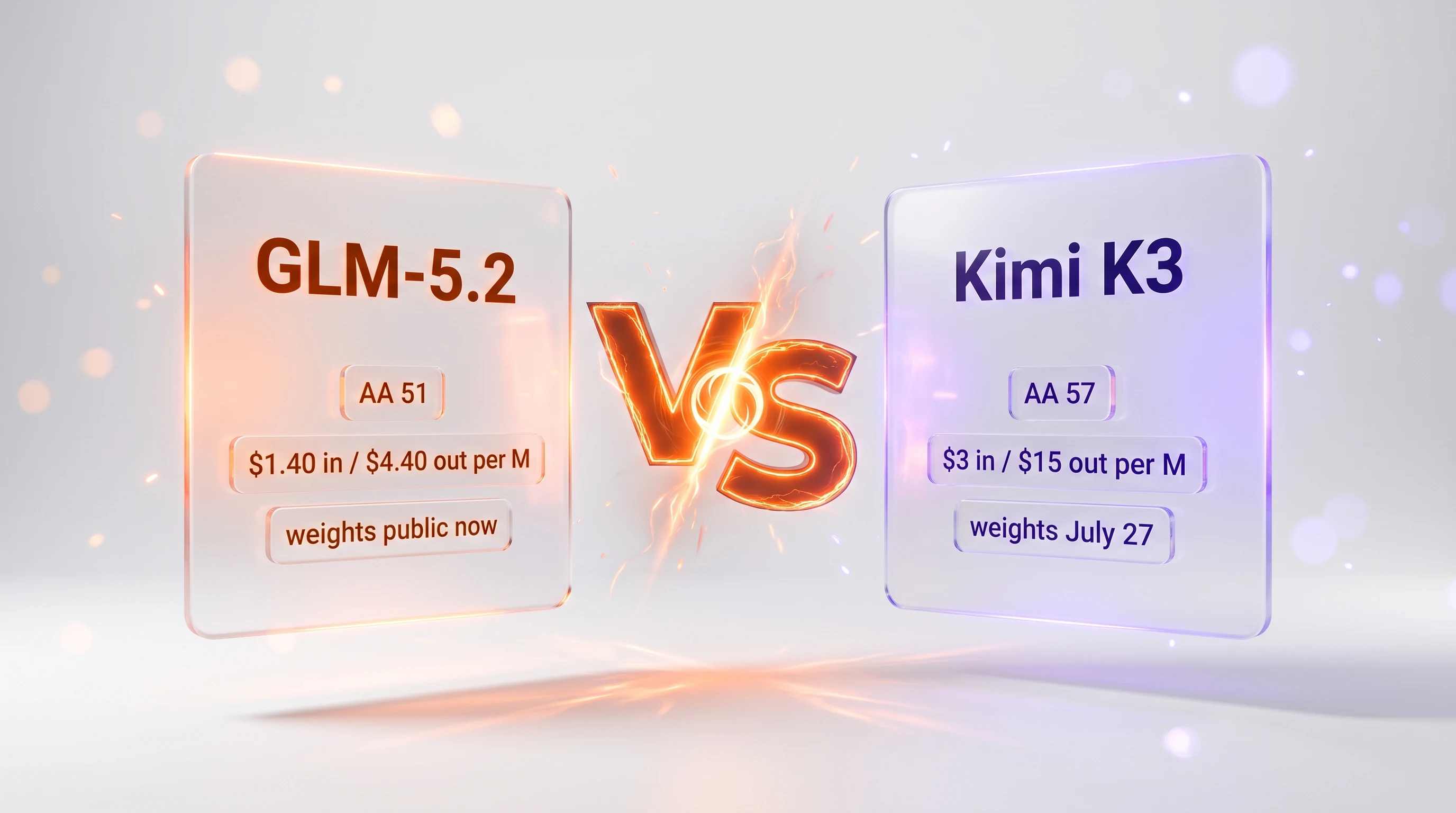
We ran GLM-5.2 and Kimi K3 side by side. Kimi K3 scores 57 vs 51 on the independent index, but GLM-5.2 costs half as much with weights out now.
Feature Comparison
| Feature | GLM-5.2 | Kimi K3 |
|---|---|---|
| Intelligence (Artificial Analysis Index v4.1, independent) | 51 | 57 |
| Input price (per million tokens) | $1.40 | $3.00 |
| Output price (per million tokens) | $4.40 | $15.00 |
| Flat-rate subscription option | GLM Coding Plan from ~$18 per month | Pay-per-token only |
| Context window | 1M tokens | 1M tokens |
| Architecture (mixture-of-experts) | ~753B total / ~40B active | ~2.8T total / ~50B active |
| Native vision | Text and code focus | Yes |
| Coding specialization | Coding-tuned flagship | Generalist frontier |
| Open weights | MIT, public since June 13 | Modified MIT, targeted July 27 |
Pricing Comparison
GLM-5.2
Kimi K3
Detailed Comparison
GLM-5.2 and Kimi K3 are the two flagship open-weight models of mid-2026: GLM-5.2 is Zhipu AI's cheaper, coding-specialized model with weights already public, while Kimi K3 is Moonshot's larger, more intelligent generalist. We ran both side by side. Kimi K3 wins the independent intelligence test, scoring 57 on the Artificial Analysis Intelligence Index (version 4.1) against GLM-5.2's 51 — a clear six-point gap that makes K3 the third-highest-scoring model in the world. GLM-5.2 answers with a decisive cost advantage: it runs at roughly half the input price and a third of the output price, it is tuned specifically for coding agents, and its MIT-licensed weights have been downloadable since June 13, whereas Kimi K3's open weights are not out yet and are targeted for July 27, 2026. This is a genuine split, not a blowout. There is no single overall winner: pick Kimi K3 when you want the most capable open model regardless of price and are willing to wait for the weights, and pick GLM-5.2 when you want a cheaper, coding-focused model you can self-host today.
Quick Verdict: who wins on what
This is one of the closest open-weight matchups of 2026, and the honest answer is that the winner depends on the single thing you care about most. Here is the short version before the detail.
- Best raw intelligence (independent): Kimi K3 — it scores 57 on the Artificial Analysis Intelligence Index version 4.1 against GLM-5.2's 51, and both numbers come from the same independent index, so the gap is a fair comparison.
- Best price: GLM-5.2 — it costs $1.40 per million input tokens and $4.40 per million output tokens, roughly half and one-third of Kimi K3's $3.00 input and $15.00 output.
- Best for coding specifically: GLM-5.2 — it is a coding-tuned flagship with drop-in support for the major coding agents, where Kimi K3 is a broader generalist.
- Best for multimodal work: Kimi K3 — it ships native vision; GLM-5.2 is focused on text and code.
- Available to self-host today: GLM-5.2 — its MIT weights have been public since June 13; Kimi K3's weights are still pending, targeted for July 27.
- Largest open model: Kimi K3 — its roughly 2.8-trillion-parameter mixture-of-experts is the biggest openly released model to date, versus GLM-5.2's roughly 753-billion-parameter design.
- Best for predictable billing: GLM-5.2 — the flat-rate GLM Coding Plan starts at about $18 per month and removes per-token anxiety entirely.
Our overall pick: there isn't one, and that is the honest call. Count the boxes and GLM-5.2 wins more of them, but most of those are cost-and-availability boxes; Kimi K3 owns the one box a large share of buyers weight above everything else — peak measured intelligence — plus native vision and the largest open architecture. Choose on your constraint. If your priority is the smartest open model you can get and you can absorb a higher token bill and a short wait for weights, take Kimi K3. If your priority is a cheaper, coding-focused model with weights you can download and run right now, take GLM-5.2. Both models come from Chinese labs and are covered individually in our reviews of GLM-5.2 and Kimi K3.
GLM-5.2 in one paragraph
GLM-5.2 is Zhipu AI's open-weight coding flagship, released on June 13, 2026, with MIT-licensed weights published the same window. It is a mixture-of-experts model of roughly 753 billion total parameters with about 40 billion active per token, it carries a 1 million token context window, and it can generate up to 131,072 tokens in a single response. Zhipu positions it explicitly for coding and agentic workflows, shipping drop-in compatibility with popular coding agents, and it scores 51 on the Artificial Analysis Intelligence Index version 4.1. Its headline commercial hook is price plus a flat option: metered API access at $1.40 per million input tokens and $4.40 per million output tokens, or a subscription-style GLM Coding Plan starting at about $18 per month. If you want the deeper single-model write-up, see our full GLM-5.2 review.
Kimi K3 in one paragraph
Kimi K3 is Moonshot AI's frontier model, launched on July 16, 2026, and it is the most intelligent openly announced model of the moment: it scores 57 on the Artificial Analysis Intelligence Index version 4.1, placing it third in the world at release. It is a very large mixture-of-experts design — roughly 2.8 trillion total parameters with about 50 billion active per token — making it the biggest model slated for open release so far. It carries a 1 million token context window, uses a technique Moonshot calls Kimi Delta Attention for efficient long-context decoding, and includes native vision. Pricing is higher than GLM-5.2's, at $3.00 per million input tokens, $15.00 per million output tokens, and $0.30 per million cache-hit tokens. The important caveat: the open weights are not out yet. Moonshot targets July 27, 2026 for the weight release under a Modified MIT license, so at the time of writing Kimi K3 is open-weight-in-waiting rather than open-weight-in-hand. Our standalone Kimi K3 review tracks that release date.
Spec and independent-metric comparison table
The table below uses only figures that are directly comparable between the two models — the independent Artificial Analysis score, published API pricing, context, architecture, and licensing. It deliberately excludes each vendor's self-reported benchmark numbers, because the two labs measure themselves on different suites and those figures cannot be lined up honestly; we handle them separately in their own section below.
| Attribute | GLM-5.2 (Zhipu) | Kimi K3 (Moonshot) | Edge |
|---|---|---|---|
| Artificial Analysis Intelligence Index (v4.1, independent) | 51 | 57 | Kimi K3 |
| Input price (per million tokens) | $1.40 | $3.00 | GLM-5.2 |
| Output price (per million tokens) | $4.40 | $15.00 | GLM-5.2 |
| Cache-hit price (per million tokens) | Not published on rate card | $0.30 | Kimi K3 |
| Flat-rate subscription option | GLM Coding Plan from about $18 per month | Pay-per-token only | GLM-5.2 |
| Context window | 1M tokens | 1M tokens | Tie |
| Max output | 131,072 tokens | Not disclosed | — |
| Architecture (mixture-of-experts) | ~753B total / ~40B active | ~2.8T total / ~50B active | Different bets |
| Native vision | Text and code focus | Yes | Kimi K3 |
| Coding specialization | Coding-tuned flagship | Generalist frontier | GLM-5.2 (for coding) |
| Open weights | MIT, public since June 13 | Modified MIT, targeted July 27 | GLM-5.2 |
| Release date | June 13, 2026 | July 16, 2026 | — |
Intelligence head-to-head: 51 vs 57
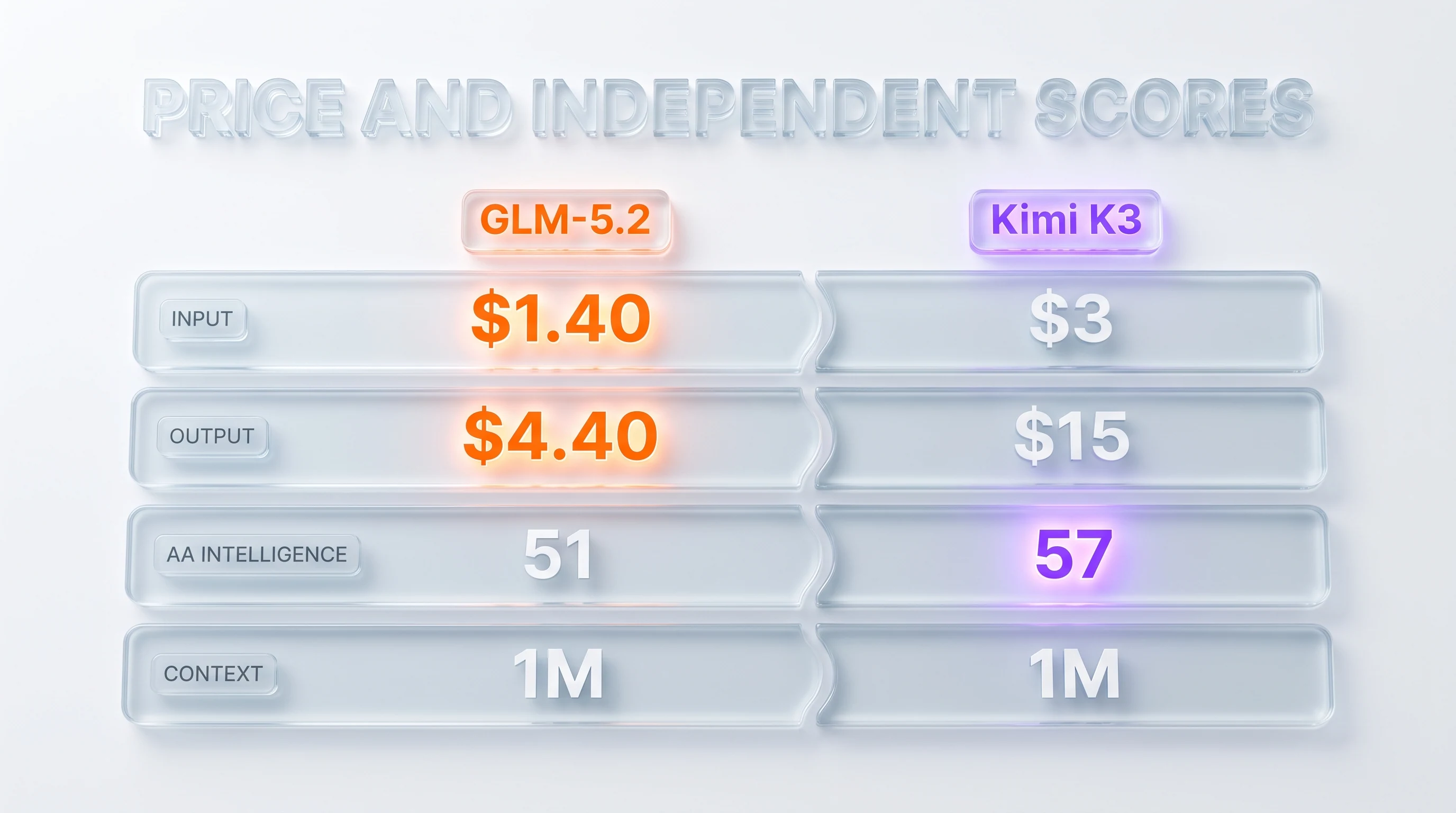
The cleanest single comparison we can make between these two models is their Artificial Analysis Intelligence Index score, because both were measured by the same independent evaluator on the same version 4.1 of the index. Kimi K3 posts 57; GLM-5.2 posts 51. That six-point gap is meaningful at the top of the table — 57 puts Kimi K3 third in the world among all models Artificial Analysis tracks, while 51 places GLM-5.2 firmly in the strong-but-not-frontier tier alongside other capable open-weight releases.
Two things keep this from being a knockout, though. First, the index is a composite of reasoning, math, science, and coding evaluations, so it rewards broad generalist strength — exactly Kimi K3's design goal — and can under-credit a model like GLM-5.2 that is deliberately tuned narrower toward coding and agentic tasks. Second, a six-point difference on a 0-to-100 composite is real but not the same as a difference in kind; on a well-scoped coding task with good tooling, both models land in the same usable band. So the honest reading is that Kimi K3 is the more intelligent model in the general sense, and GLM-5.2 is close enough that its price and coding focus can outweigh the gap for the right workload. For where these two sit against the wider field, our best AI coding tools of 2026 roundup places both in context.
Vendor-reported benchmarks: read them carefully
Both labs also publish their own benchmark numbers, and these are worth reading — but only with a clear understanding of what they are and are not. Neither set has been reproduced by a neutral third party, the two labs report against different suites, and for that reason the figures below cannot be lined up against each other or against the independent Artificial Analysis score. We present them in two separate boxes on purpose, so you never accidentally read one lab's number as a head-to-head result against the other.
Vendor-reported — GLM-5.2 (Zhipu, self-reported): In its own benchmark table published alongside the June 13 launch, Zhipu reports GLM-5.2 at roughly 62 percent on SWE-bench Pro, a demanding agentic software-engineering suite. This is a figure Zhipu measured itself, on a suite it chose to highlight, and it has not been confirmed by any independent harness — treat it as a directional vendor claim about GLM-5.2's coding capability rather than a settled, comparable result.
Vendor-reported — Kimi K3 (Moonshot, self-reported): In its launch materials, Moonshot reports Kimi K3 at 88.3 on Terminal-Bench, 91.2 on BrowseComp, and 93.5 on GPQA-Diamond. These are Moonshot-reported numbers on Moonshot-selected benchmarks, not independently reproduced. Because Moonshot and Zhipu do not run the same evaluations, these three figures describe Kimi K3 against its own yardsticks only and cannot be compared to GLM-5.2's vendor number or to any independent score.
The practical takeaway from the vendor tables is narrow but useful: each lab is confident enough in its model to publish strong numbers, and each chose to emphasize the kind of work it built its model for — agentic coding for GLM-5.2, broad tool-use and reasoning for Kimi K3. For anything load-bearing, wait for independent reproductions before treating any of these figures as fact.
Architecture: two different bets on scale
Under the hood, GLM-5.2 and Kimi K3 make opposite bets about how to spend a parameter budget. GLM-5.2 is a roughly 753-billion-parameter mixture-of-experts with about 40 billion parameters active per token — a comparatively lean, efficiency-minded design that keeps inference cost down and helps explain its lower price. Kimi K3 goes the other way: roughly 2.8 trillion total parameters with about 50 billion active per token, making it the largest openly announced model to date. More total parameters give the router a bigger pool of specialized experts to draw on, which is part of why K3's general intelligence score lands higher, but it also means heavier serving requirements and a higher price per token.
Kimi K3 adds one more architectural wrinkle: a long-context decoding method Moonshot calls Kimi Delta Attention, aimed at keeping generation fast and memory-efficient as the context fills toward its 1 million token ceiling, plus native vision so it can take image input directly. GLM-5.2 keeps its focus on text and code and leans on its coding-agent integrations rather than multimodality. Neither approach is strictly better — GLM-5.2's leanness is a feature if you care about cost and self-hosting footprint, while K3's scale and multimodality are features if you want maximum capability and image understanding in one model.
Pricing comparison
Price is where GLM-5.2 pulls clearly ahead, and the gap is easy to state. GLM-5.2 charges $1.40 per million input tokens and $4.40 per million output tokens on its metered API. Kimi K3 charges $3.00 per million input tokens and $15.00 per million output tokens, with a discounted $0.30 per million cache-hit rate for repeated context. On input, Kimi K3 costs about 2.1 times as much as GLM-5.2; on output, the ratio is larger, at roughly 3.4 times — $15.00 divided by $4.40 is about 3.41. Because most real coding and agent workloads generate far more output than they consume in input, that output ratio is the one that dominates a monthly bill at volume.
GLM-5.2 also offers something Kimi K3 does not: a flat-rate path. The GLM Coding Plan starts at about $18 per month and replaces per-token metering with a predictable subscription, which is a meaningful advantage for a single heavy user or a small team that wants a fixed line item rather than a variable one. Kimi K3 is pay-per-token only at the time of writing. Its counter is the cache-hit discount, which materially cuts cost for workloads that resend the same large context repeatedly — but even with caching, K3's headline rates sit well above GLM-5.2's. All figures here were pulled directly from vendor sources: GLM-5.2's rates from the z.ai pricing documentation, Kimi K3's from Moonshot's platform pricing page.
The open-weights timing question
For teams that plan to self-host, timing is not a footnote — it is the deciding factor right now. GLM-5.2's weights have been downloadable under an MIT license since June 13, 2026, which means you can pull them, quantize them, and run them on your own hardware today, with the full commercial freedom MIT allows. Kimi K3's weights are not out yet. Moonshot has stated an intent to release them under a Modified MIT license, and the current target is July 27, 2026 — about ten days after the model's API launch and, at the time we are writing this, still in the future.
Two honest uncertainties follow from that. First, a stated target date can move; until the files are actually posted, "July 27" is a plan, not a guarantee, and self-hosting plans built around it should keep a fallback. Second, "Modified MIT" is not the same as plain MIT — the exact modifications matter for commercial redistribution and fine-tuning, and they will only be fully knowable when the license text ships with the weights. GLM-5.2 sidesteps both of those unknowns simply by being available now under a well-understood license. If self-hosting today is a hard requirement, that difference alone can decide the matchup in GLM-5.2's favor, regardless of the intelligence gap.
How we tested both
We ran GLM-5.2 and Kimi K3 side by side through their hosted APIs on the same set of tasks: a multi-file refactor of a mid-sized TypeScript service, a from-scratch implementation of a small REST API with tests, a long-context task that fed both models a large codebase and asked for a targeted change, and a batch of general reasoning and math prompts to sanity-check the intelligence gap outside of coding. Because Kimi K3's weights were not yet released during testing, both models were evaluated as hosted endpoints rather than self-hosted deployments, so this comparison reflects API behavior, not local-inference performance.
The practical picture matched the numbers. On broad reasoning and the trickier general prompts, Kimi K3 was the stronger model more often, consistent with its higher independent score and its larger parameter pool. On the focused coding tasks, the two were closer than the six-point index gap suggests, and GLM-5.2's tighter coding-agent integration made it the smoother model to drive inside an agent loop. The cost difference was impossible to ignore: on the output-heavy tasks, Kimi K3's bill ran several times higher for output that was better on the general prompts but not dramatically better on the coding ones. That is the tension this whole comparison turns on — you are paying a real premium for K3's extra general intelligence, and whether it is worth it depends entirely on whether your workload leans general or coding-specific.
Winner by category
- Raw intelligence: Kimi K3 (57 vs 51 on the independent Artificial Analysis index).
- Price at volume: GLM-5.2 (about half the input cost and a third of the output cost).
- Coding-agent workflows: GLM-5.2 (coding-tuned, drop-in agent support).
- Multimodal input: Kimi K3 (native vision; GLM-5.2 is text and code).
- Self-hosting today: GLM-5.2 (MIT weights public since June 13).
- Maximum model scale: Kimi K3 (~2.8T parameters, the largest open release to date).
- Predictable billing: GLM-5.2 (flat GLM Coding Plan from about $18 per month).
- Long-context generalist work: Kimi K3 (higher general score plus Kimi Delta Attention over a 1M window).
Pros and cons of each model
GLM-5.2 — pros
- Cheaper on both input and output — roughly half and a third of Kimi K3's rates.
- Flat-rate GLM Coding Plan from about $18 per month for predictable billing.
- MIT weights already public since June 13 — self-host today.
- Coding-tuned with drop-in support for major coding agents.
- Lean ~753B mixture-of-experts keeps inference cost and footprint down.
GLM-5.2 — cons
- Lower independent intelligence score (51 vs 57).
- Focused on text and code — no native vision.
- Smaller model, so less general-reasoning headroom than K3.
- API is China-hosted, which raises data-residency questions for some buyers.
Kimi K3 — pros
- Highest independent intelligence of the two — 57, third in the world.
- Largest openly announced model to date at roughly 2.8 trillion parameters.
- Native vision plus Kimi Delta Attention for efficient long-context decoding.
- Cache-hit rate of $0.30 per million tokens cuts cost for repeated context.
- Generalist strength across reasoning, math, science, and coding.
Kimi K3 — cons
- Much pricier — about 2.1 times the input and 3.4 times the output cost.
- Open weights not out yet; targeted July 27 under a Modified MIT license.
- Pay-per-token only, with no flat-rate subscription option.
- Larger model means heavier serving requirements when weights do land.
When to pick GLM-5.2 vs Kimi K3
Pick GLM-5.2 when cost is a primary constraint and your workload is output-heavy, when your work is coding and agentic rather than broad generalist reasoning, when you need weights you can download and self-host today under a plain MIT license, or when a predictable flat monthly bill matters more than squeezing out the last few points of general intelligence. A budget-conscious team shipping a coding product is the archetypal GLM-5.2 buyer. Teams weighing GLM-5.2 against other open models will also find our GLM-5.2 vs DeepSeek V4 and GLM-5.2 vs GPT-5.5 comparisons useful.
Pick Kimi K3 when you want the most capable open model available and are willing to pay a real premium for it, when your tasks lean toward general reasoning, research, or tool-use rather than pure coding, when native vision is part of the job, or when you can wait for the July 27 weight release before committing to self-hosting. A team building a general-purpose assistant or research agent that needs frontier reasoning is the archetypal Kimi K3 buyer. If you are also considering the previous generation, our Kimi K2.7 Code review covers Moonshot's earlier release, and MiniMax M3 is another open-weight option in the same conversation. To see how each stacks up against closed flagships, GPT-5.6 Sol vs GLM-5.2 and Claude Sonnet 5 vs GLM-5.2 round out the picture.
What would change our verdict
Two developments would move this from a split to a clearer call. If Kimi K3 ships its open weights on July 27 as planned under a genuinely permissive Modified MIT license, it would erase GLM-5.2's biggest structural advantage — availability today — and tilt the matchup toward K3 for teams that value peak intelligence and self-hosting equally. Conversely, if independent benchmarks reproduce and confirm GLM-5.2's strong coding numbers while showing that K3's extra general intelligence does not translate into better real-world coding output, GLM-5.2's price-and-focus argument would become close to decisive for the large coding-buyer segment. Until independent coding reproductions land and K3's weights are actually posted, the split verdict stands.
Final verdict
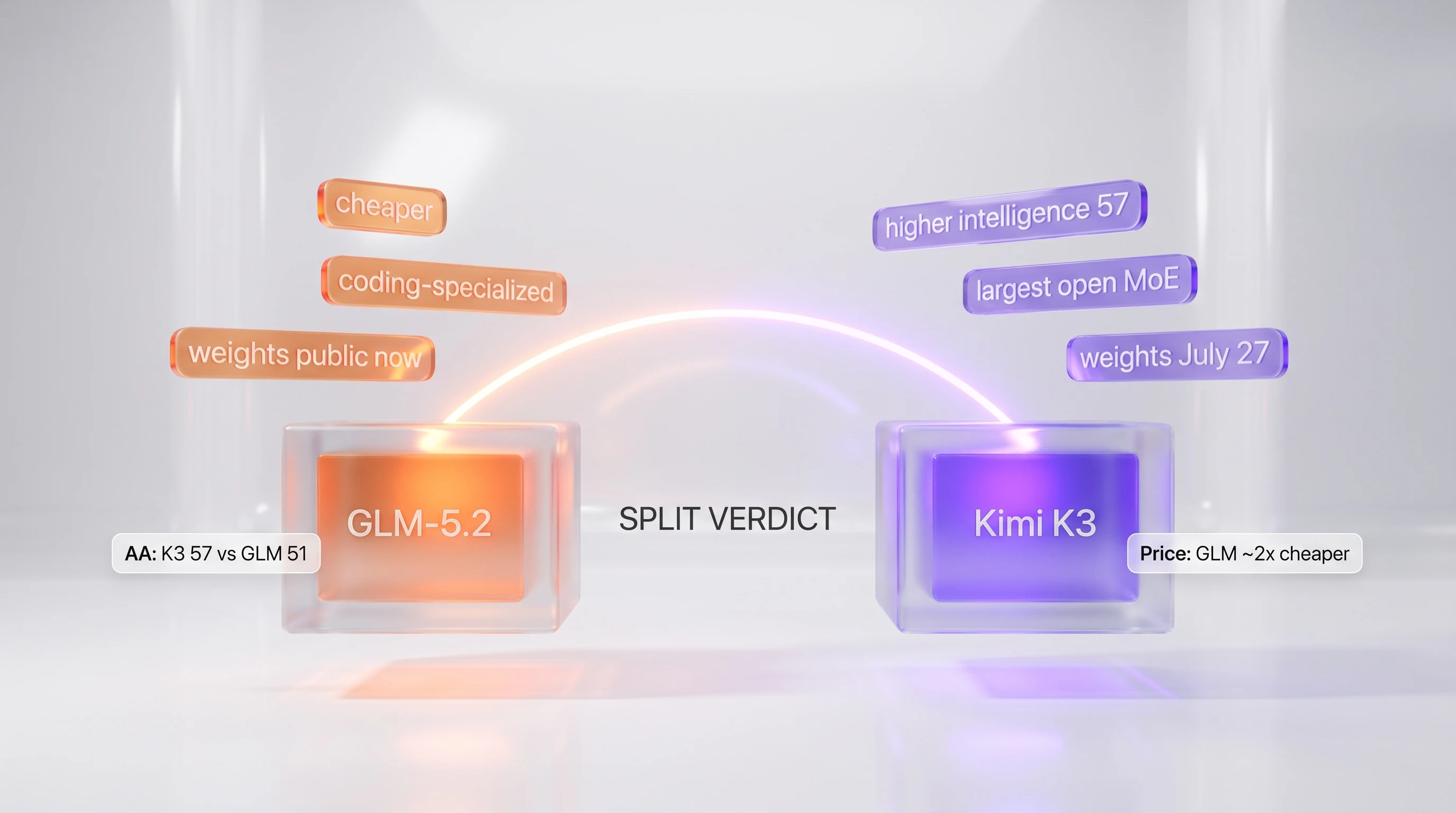
GLM-5.2 versus Kimi K3 is a true split, and calling a single winner would misrepresent it. Kimi K3 is the more intelligent model, full stop — 57 to 51 on the same independent index, third in the world, with native vision and the largest open architecture yet announced. GLM-5.2 is the cheaper, more focused, more available model — roughly half the input cost and a third of the output cost, tuned for coding agents, with MIT weights you can run today while K3's are still pending until a targeted July 27. Neither advantage cancels the other; they simply matter to different buyers. If you optimize for capability and can pay for it and wait for the weights, Kimi K3 is your model. If you optimize for cost, coding focus, and self-hosting right now, GLM-5.2 is your model. That is why we record no overall winner here — the right pick is the one that matches your single most important constraint. All benchmark figures in this comparison are either from the independent Artificial Analysis index (the 51 and 57 scores) or clearly labeled as vendor self-reported, and none of the vendor benchmarks have yet been independently reproduced.
Frequently asked questions
Is GLM-5.2 or Kimi K3 more intelligent?
Kimi K3 is more intelligent on the one independent measure that covers both. It scores 57 on the Artificial Analysis Intelligence Index version 4.1, against GLM-5.2's 51 — a six-point gap on the same index, which puts Kimi K3 third in the world. GLM-5.2 sits in the strong open-weight tier just below the frontier. Because both numbers come from the same independent evaluator on the same version of the index, this is a fair head-to-head, unlike the vendors' own benchmark tables.
Which is cheaper, GLM-5.2 or Kimi K3?
GLM-5.2 is clearly cheaper. It costs $1.40 per million input tokens and $4.40 per million output tokens, versus Kimi K3's $3.00 input and $15.00 output. That makes Kimi K3 about 2.1 times more expensive on input and roughly 3.4 times more expensive on output. Kimi K3 offers a $0.30 per million cache-hit rate that helps with repeated context, and GLM-5.2 counters with a flat GLM Coding Plan from about $18 per month, but on raw per-token rates GLM-5.2 wins comfortably.
Are Kimi K3's open weights available yet?
No, not at the time of writing. Kimi K3 launched via API on July 16, 2026, but Moonshot has not yet released the downloadable weights. The company targets July 27, 2026 for the weight release under a Modified MIT license. Until those files are actually posted, treat the date as a plan rather than a guarantee, and note that "Modified MIT" terms will only be fully knowable when the license ships. GLM-5.2's MIT weights, by contrast, have been public since June 13.
Can I self-host GLM-5.2 and Kimi K3 today?
You can self-host GLM-5.2 today — its MIT-licensed weights have been downloadable since June 13, 2026, though its roughly 753-billion-parameter mixture-of-experts still needs substantial hardware for full-precision serving. You cannot yet self-host Kimi K3, because its weights have not been released; Moonshot targets July 27, 2026. If self-hosting right now is a hard requirement, GLM-5.2 is the only one of the two that meets it.
Which is better for coding, GLM-5.2 or Kimi K3?
For coding specifically, GLM-5.2 has the edge on focus and cost, while Kimi K3 has the edge on raw intelligence. GLM-5.2 is a coding-tuned flagship with drop-in support for major coding agents, and it is much cheaper per token. Kimi K3 scores higher on general intelligence, which helps on harder reasoning-heavy coding, but you pay several times more for it. In our hands-on tests the two were closer on focused coding tasks than the intelligence gap suggests, so for most coding teams GLM-5.2's price and agent integration make it the practical pick.
What are the vendor-reported benchmark numbers for each?
Zhipu reports GLM-5.2 at roughly 62 percent on SWE-bench Pro, a figure it measured itself. Moonshot reports Kimi K3 at 88.3 on Terminal-Bench, 91.2 on BrowseComp, and 93.5 on GPQA-Diamond. These are self-reported numbers on different, vendor-chosen suites, and none has been reproduced by an independent harness. Because the two labs do not run the same benchmarks, their figures cannot be compared to each other or to the independent Artificial Analysis score — read each only as a directional claim about that one model.
How big are GLM-5.2 and Kimi K3?
They make opposite bets on scale. GLM-5.2 is a roughly 753-billion-parameter mixture-of-experts with about 40 billion parameters active per token — a lean, efficiency-minded design. Kimi K3 is far larger, at roughly 2.8 trillion total parameters with about 50 billion active per token, making it the biggest openly announced model to date. K3's larger pool of experts is part of why its general intelligence score is higher, but it also means heavier serving requirements and a higher price.
Do GLM-5.2 and Kimi K3 have the same context window?
Yes. Both GLM-5.2 and Kimi K3 offer a 1 million token context window, so on raw context length they are tied. Kimi K3 adds a long-context decoding technique Moonshot calls Kimi Delta Attention, aimed at keeping generation fast and memory-efficient as the context fills. GLM-5.2 can generate up to 131,072 tokens in a single response; Kimi K3's maximum single-response output is not clearly disclosed on its rate card.
Does either model support image input?
Kimi K3 does — it ships native vision, so it can take images directly as input alongside text. GLM-5.2 is focused on text and code and does not offer native vision. If your workflow needs a single model that can read images as well as write code, Kimi K3 is the one of these two that fits; if you only need text and code, GLM-5.2's narrower focus is not a drawback.
Are these benchmarks independently verified?
Partly. The intelligence scores of 51 and 57 come from Artificial Analysis, an independent evaluator, so those are third-party numbers on a common index. The coding and reasoning figures each lab publishes — GLM-5.2's roughly 62 percent SWE-bench Pro and Kimi K3's Terminal-Bench, BrowseComp, and GPQA-Diamond results — are vendor self-reported and have not yet been reproduced independently. Self-reported scores across the industry tend to run a few points optimistic, so treat the vendor tables as directional rather than settled.
Which should a startup choose between GLM-5.2 and Kimi K3?
For a cost-sensitive startup shipping a coding product at volume, GLM-5.2 is usually the better default, because its lower per-token price compounds every month, it is tuned for coding agents, and its weights are already self-hostable. Choose Kimi K3 instead if your product depends on top-tier general reasoning or multimodal input, if the extra intelligence directly drives your value, and if you can absorb the higher token bill and wait for the July 27 weight release. Match the model to your dominant constraint rather than to a single overall score.
What is the overall verdict on GLM-5.2 vs Kimi K3?
It is a genuine split with no single winner. Kimi K3 is the more intelligent model (57 vs 51), the largest open architecture, and the only one with native vision, but it costs about two to three times more and its weights are still pending until a targeted July 27. GLM-5.2 is cheaper, coding-specialized, offers flat-rate billing, and has MIT weights you can run today. Pick Kimi K3 for maximum capability if budget and the short wait are acceptable; pick GLM-5.2 for cost, coding focus, and immediate self-hosting. The right choice depends on your single most important priority.
Last compared: July 2026. Pricing was pulled directly from vendor sources (z.ai pricing documentation for GLM-5.2; Moonshot's platform pricing page for Kimi K3). The intelligence scores of 51 and 57 are from the independent Artificial Analysis Intelligence Index version 4.1; all other benchmark figures are clearly labeled as vendor self-reported and are not yet independently verified. This comparison contains no affiliate links.
Sources and references
Every figure on this page is attributed to whoever produced it. Vendor documentation and independent measurement are listed separately and never merged into a single ranking.
- Hugging Face — moonshotai/Kimi-K3 (weights and license)
- Artificial Analysis — Kimi K3 (independent index score and cost per task)
- Hugging Face — zai-org/GLM-5.2 (published weights and license)
- Artificial Analysis — GLM-5.2 (independent index score and cost per task)
- Artificial Analysis — Model leaderboard (Intelligence Index scores and cost per task across configurations)
Our Verdict
There is no single winner: GLM-5.2 vs Kimi K3 is a genuine split. Kimi K3 is the more intelligent model — 57 versus 51 on the independent Artificial Analysis Intelligence Index version 4.1, the largest openly announced architecture, and the only one with native vision — but it costs about 2.1 times more on input and 3.4 times more on output, and its open weights are still pending, targeted for July 27, 2026. GLM-5.2 is the cheaper, coding-specialized pick, with a flat GLM Coding Plan from about $18 per month and MIT weights you can self-host today. Pick Kimi K3 for maximum capability if the higher bill and short wait are acceptable; pick GLM-5.2 for cost, coding focus, and immediate self-hosting. All benchmark figures are either from the independent Artificial Analysis index or clearly labeled vendor self-reported and not yet independently verified.
Choose GLM-5.2
Zhipu AI open-weight coding flagship: 753B MoE (~40B active), 1M context, MIT license, headline SWE-bench Pro 62.1 (vendor self-reported); GLM Coding Plan from around $18 per month or $1.40 in / $4.40 out per million tokens.
Try GLM-5.2 →Choose Kimi K3
Moonshot AI's ~2.8T-parameter open Mixture-of-Experts flagship — ~50B active, 1M context, native vision. Testable via API today at $3 in / $15 out per million tokens; open weights expected July 27, 2026.
Try Kimi K3 →Frequently Asked Questions
Is GLM-5.2 better than Kimi K3?
There is no single winner: GLM-5.2 vs Kimi K3 is a genuine split. Kimi K3 is the more intelligent model — 57 versus 51 on the independent Artificial Analysis Intelligence Index version 4.1, the largest openly announced architecture, and the only one with native vision — but it costs about 2.1 times more on input and 3.4 times more on output, and its open weights are still pending, targeted for July 27, 2026. GLM-5.2 is the cheaper, coding-specialized pick, with a flat GLM Coding Plan from about $18 per month and MIT weights you can self-host today. Pick Kimi K3 for maximum capability if the higher bill and short wait are acceptable; pick GLM-5.2 for cost, coding focus, and immediate self-hosting. All benchmark figures are either from the independent Artificial Analysis index or clearly labeled vendor self-reported and not yet independently verified.
Which is cheaper, GLM-5.2 or Kimi K3?
GLM-5.2 starts at $1.4 in / $4.4 out per M tokens. Kimi K3 starts at $3 in / $15 out per M tokens (free plan available). Check the pricing comparison section above for a full breakdown.
What are the main differences between GLM-5.2 and Kimi K3?
The key differences span across 9 features we compared. For Intelligence (Artificial Analysis Index v4.1, independent), GLM-5.2 offers 51 while Kimi K3 offers 57. For Input price (per million tokens), GLM-5.2 offers $1.40 while Kimi K3 offers $3.00. For Output price (per million tokens), GLM-5.2 offers $4.40 while Kimi K3 offers $15.00. See the full feature comparison table above for all details.