Kimi K3
Moonshot AI's ~2.8T-parameter open Mixture-of-Experts flagship — ~50B active, 1M context, native vision. Testable via API today at $3 in / $15 out per million tokens; open weights expected July 27, 2026.

Quick Summary
Kimi K3 is Moonshot AI's flagship open-weight MoE model (~2.8T params, ~50B active, 1M context, native vision). We tested the API and scored it 8.7 out of 10. It costs $3.00 per million input tokens and $15.00 output, and scores 57 on the independent Artificial Analysis Index v4.1 — but its open weights are not out yet (targeted July 27, 2026).
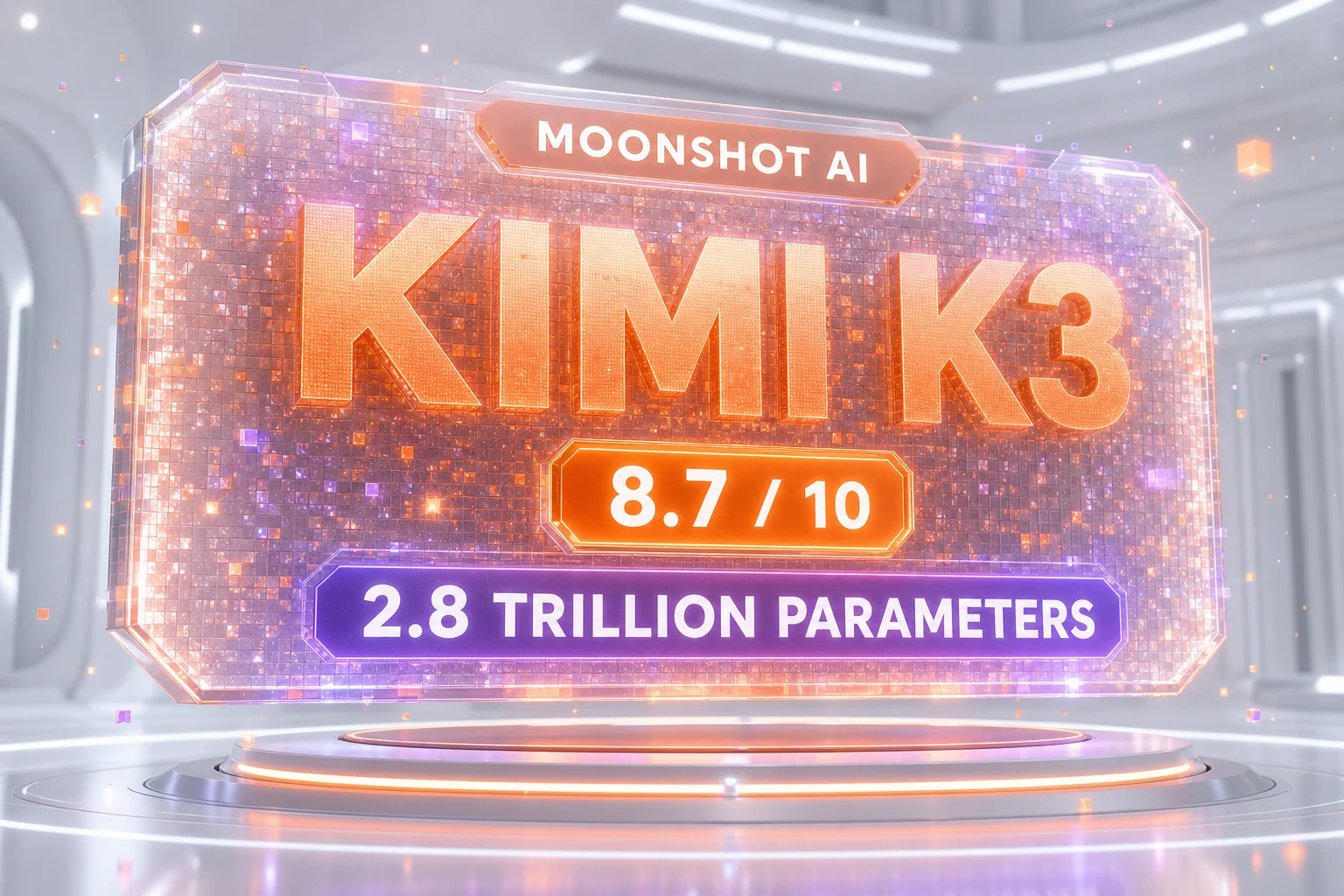
Kimi K3 is Moonshot AI's flagship large language model, launched on July 16, 2026 and served through the Kimi Open Platform under the kimi-k3 model family. It is a Mixture-of-Experts design with roughly 2.8 trillion total parameters — about 50 billion active per token — a 1-million-token context window, and native vision. We scored it 8.7 out of 10 after testing it through the API. It is metered at $3.00 per million input tokens and $15.00 per million output tokens, and it posts 57 on the independent Artificial Analysis Intelligence Index version 4.1, third to fourth in the world. One honest caveat: the open weights were not published at launch, so we tested the hosted API, not a self-hosted model. Moonshot targets an open-weight release by July 27, 2026.
Our Verdict
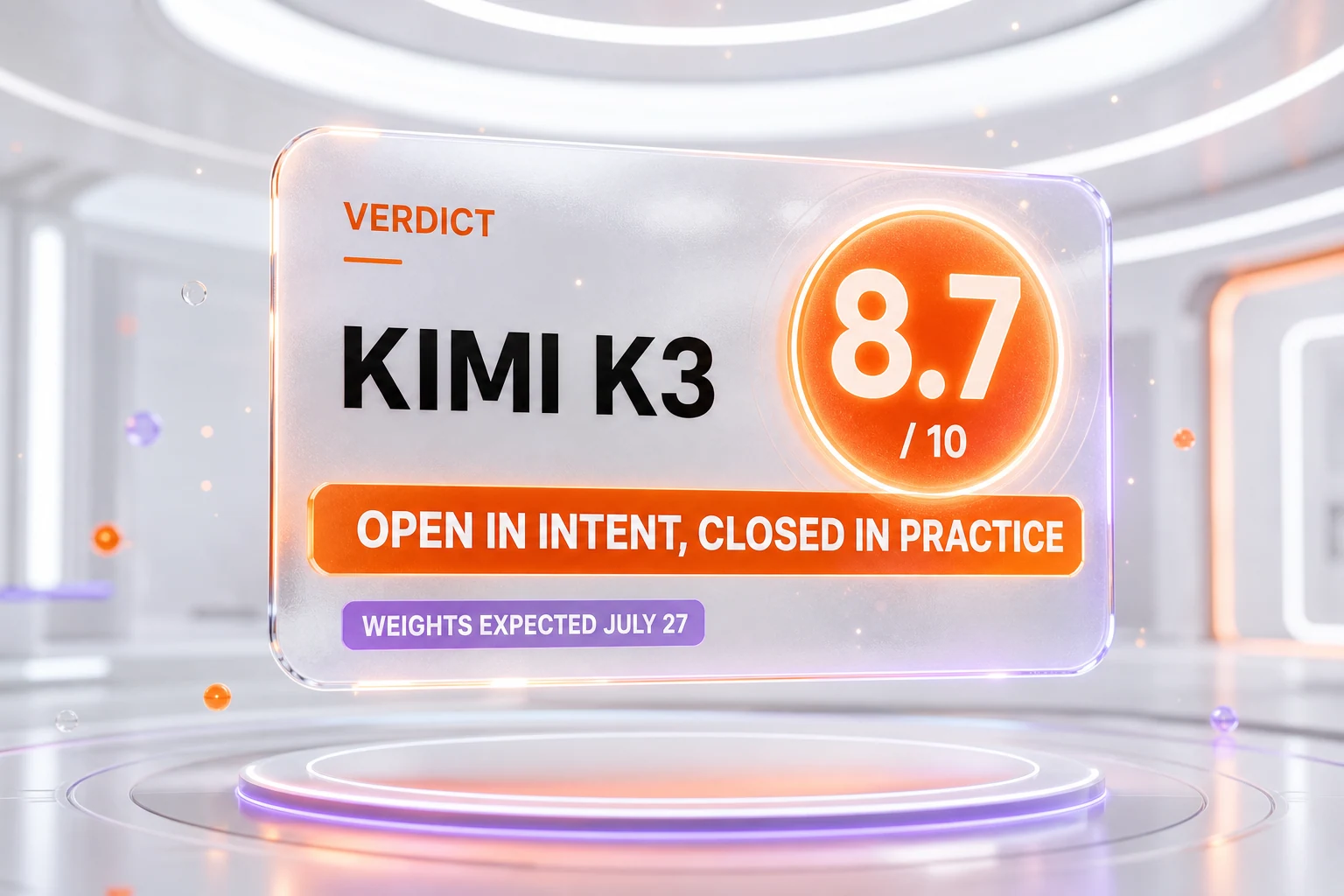
We scored Kimi K3 8.7 out of 10. It is the most capable model any Chinese lab has shipped, and after running it through the Kimi Open Platform API we think it belongs in the frontier conversation alongside Claude Opus 4.8 and GPT-5.6 Sol. What keeps it from a higher mark is not capability but two asterisks. The open weights were not published at launch, so nobody can self-host it yet, and the price has climbed to frontier levels, erasing the cost edge that used to define Chinese models. Best for: teams building long-horizon coding and agent workloads who want near-frontier intelligence with a 1-million-token window, and organizations planning to self-host once the weights land.
Our sub-scores break down as Features 9.3, Ease of Use 8.5, Value 7.8, and Support 8.2. The Features mark reflects the 2.8-trillion-parameter architecture, native vision, and a top-four independent ranking; the Value mark is pulled down by pricing that now sits above Claude Sonnet 5. This is an open-weight-in-waiting model — you can rent it today, but you cannot yet own it.
What Is Kimi K3?
Kimi K3 is Moonshot AI's new frontier model, unveiled on July 16, 2026 after a promotional page briefly leaked on the Kimi Open Platform the day before. It is a sparse Mixture-of-Experts (MoE) system: of its roughly 2.8 trillion total parameters, only about 50 billion are active on any given token, because just 16 of its 896 experts fire per forward pass. That sparsity is the whole trick — it is how a model this large can be served at a price anyone would actually pay, rather than sitting in a lab as a research curiosity. Moonshot calls it the world's first open model in the 3-trillion-parameter class.
The architecture introduces two named building blocks. Kimi Delta Attention (KDA) is an attention scheme tuned for very long contexts, and Attention Residuals (AttnRes) is a training-efficiency change; a third component, Stable LatentMoE, targets the stability of routing tokens to experts at this scale. The model carries a 1-million-token context window and native vision, and Moonshot ships it in more than one flavor: a K3 Max variant aimed at chat and agent use, and a K3 Swarm Max variant oriented toward running many instances in parallel. The framing throughout is agentic — this is pitched as a model for long-horizon coding and autonomous task-running, not just a chatbot. It is a genuine leap over Moonshot's own Kimi K2.6 and Kimi K2.7 Code, which sat lower and cheaper.
Pricing at a Glance
Kimi K3 is billed per token on the Kimi Open Platform, with no per-token free tier for the API. The consumer Kimi web app offers free assistant access, but the model reviewed here is the paid API.
| Rate (per million tokens) | Kimi K3 | Kimi K2.6 (predecessor) |
|---|---|---|
| Input (standard) | $3.00 | $0.95 |
| Output | $15.00 | $4.00 |
| Cache-hit input | $0.30 | — |
| Context window | 1,000,000 tokens | 256,000 tokens |
At $3.00 input and $15.00 output per million tokens, Kimi K3 costs more than Claude Sonnet 5, which lists at $2.00 input and $10.00 output. It still undercuts Claude Opus 4.8 at $5.00 input and $25.00 output, but it costs roughly three to four times what Kimi K2.6 did. The discount that defined Chinese frontier models has evaporated at the top of the lineup.
How We Tested Kimi K3
We ran Kimi K3 through the Kimi Open Platform's OpenAI-compatible API in the days after its July 16, 2026 launch, pointing existing tooling at the hosted endpoints with a base-URL and model-name change. We want to be precise about what that does and does not cover: because the open weights are not public yet, we could not self-host the model, fine-tune it, or profile the architecture ourselves. Everything here is based on the hosted API. This is an open-weight-in-waiting model — you can pay to call it today, but you cannot yet download it. Last tested: July 2026.
Across our sessions the model handled long-context prompts well and its native vision was a real strength, returning accurate, detailed descriptions of images we passed in. We also hit the same two friction points independent developers flagged on day one: Kimi K3 exposes a single, always-on reasoning level that generates a lot of internal reasoning tokens, which runs up output costs faster than a model with a cheap non-reasoning mode; and its tokenizer adds a hidden overhead, so trivial prompts count for more input tokens than rival systems charge. Developer Simon Willison, testing the model on launch day with his standard "draw a pelican riding a bicycle" SVG prompt, reported the single generation cost about 25 cents and burned roughly 13,241 reasoning tokens — a useful concrete data point that matches our own impression that this is a capable but expensive model to run.
Key Features
A 2.8-Trillion-Parameter Sparse MoE
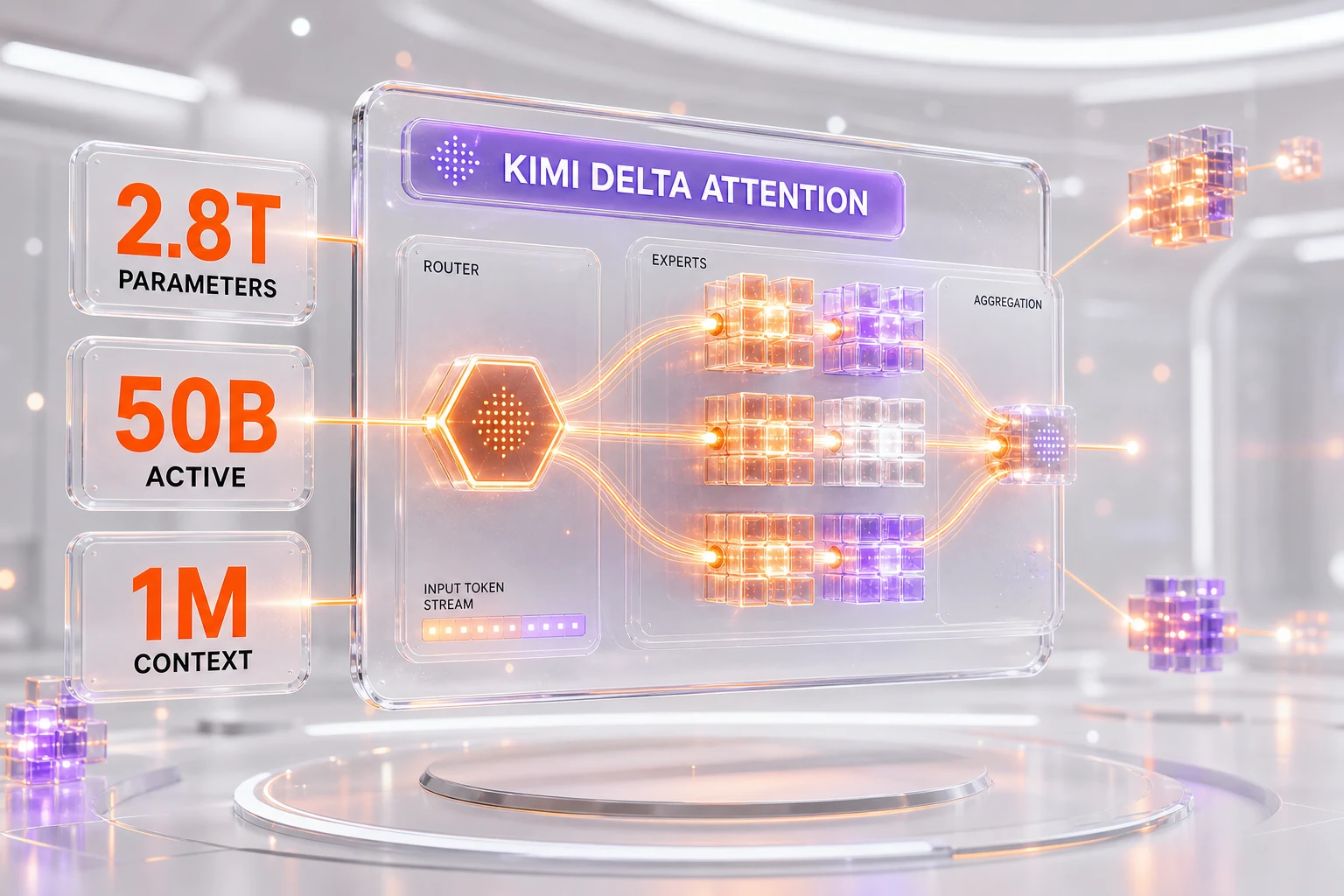
The headline number is scale: roughly 2.8 trillion total parameters make Kimi K3 the largest open-weight model announced to date, more than twice the size of Moonshot's earlier trillion-parameter Kimi K2 line. Because it is a Mixture-of-Experts model, only about 50 billion parameters are active per token, with 16 of its 896 experts firing on any given forward pass. That sparse activation is what lets a model this large run at a workable cost, and it is the foundation the rest of the architecture is built on.
Kimi Delta Attention and the 1M-Token Window
A model with 2.8 trillion parameters and a million-token window would be prohibitively slow with conventional attention, and that is the problem Kimi Delta Attention is built to solve. Moonshot reports that KDA delivers up to a 6.3-times acceleration in decoding within a 1-million-token context — the difference between a long-context feature that exists on a spec sheet and one that is actually usable interactively. The companion technique, Attention Residuals, is reported to lift training efficiency by roughly 25 percent while adding under 2 percent to cost. The 1-million-token window itself is on par with the largest offered by Claude Fable 5 and GPT-5.6 Sol, and four times the 256K window of Kimi K2.7 Code.
Native Vision
Kimi K3 accepts images as input directly rather than routing them through a separate model. In our testing this was one of its most convincing capabilities: asked to describe rendered images, it produced high-quality, specific alt text. Native multimodality plus a million-token window makes it a strong fit for document understanding, where screenshots, diagrams, and scanned pages can be fed in alongside long text.
K3 Max and K3 Swarm Max
Moonshot ships Kimi K3 in more than one configuration. K3 Max is the chat and agent variant most users will call through the API, tuned for interactive and tool-using work. K3 Swarm Max is oriented toward parallelism — running many model instances or sub-agents at once for heavier, distributed workloads. The split reflects Moonshot's framing of K3 as an agentic, coding-first model rather than a single monolithic chatbot, and it is a signal about where the company expects the model to earn its keep.
Where Kimi K3 Ranks: The Independent Score
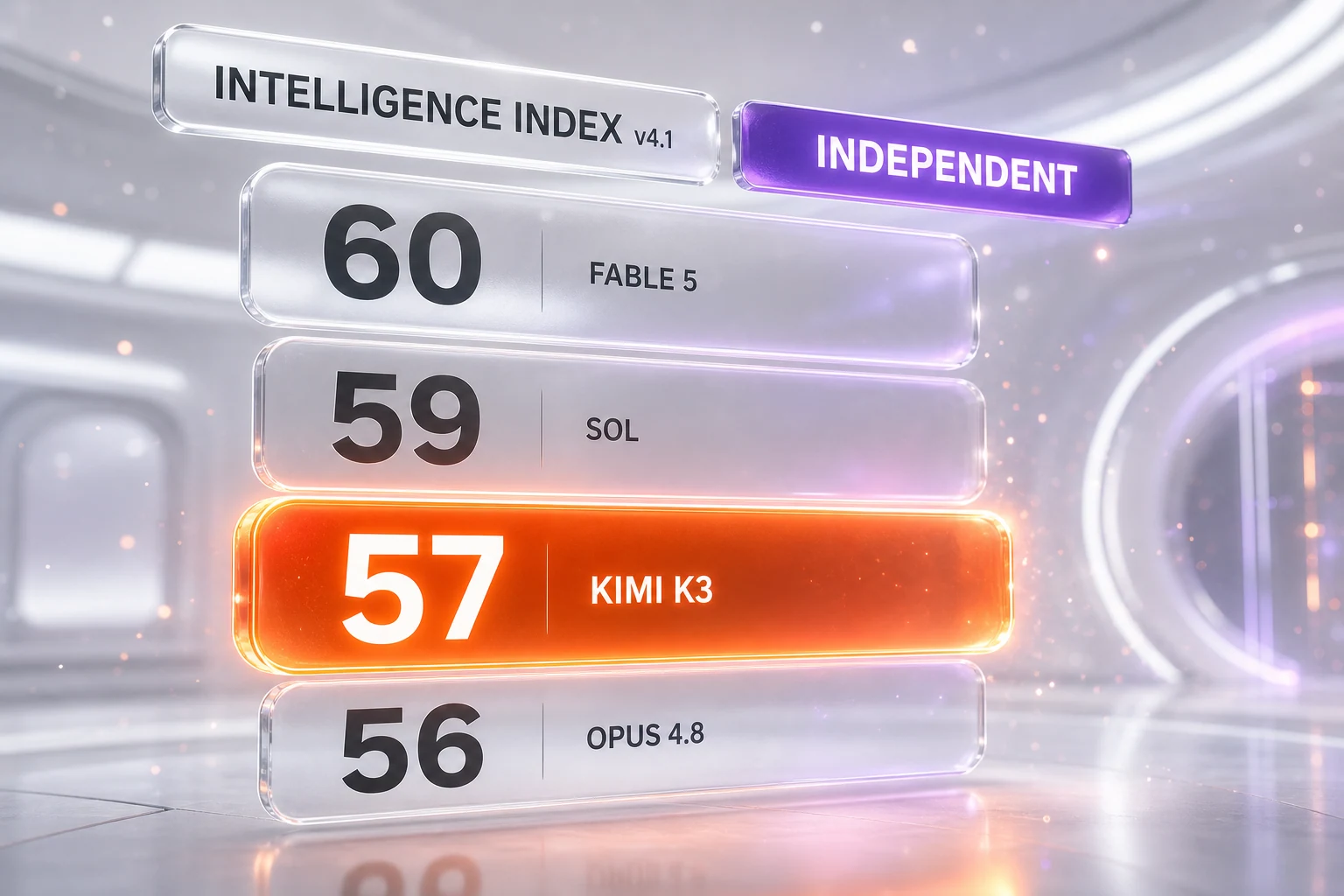
The number that matters most is the one Moonshot did not produce. On the Artificial Analysis Intelligence Index — an independent aggregate that, in its version 4.1, combines nine separate evaluations — Kimi K3 scores 57. That is enough to place it third to fourth among all models in the world. It edges past Claude Opus 4.8 (56) and trails only GPT-5.6 Sol (59) and Claude Fable 5 (60). Because every one of those scores is drawn from the same version 4.1 of the index, the comparison is clean rather than a cross-version mirage. A 57 is the highest independent intelligence score any Chinese lab has posted.
| Model | Maker | Intelligence Index v4.1 (independent) | Weights |
|---|---|---|---|
| Claude Fable 5 | Anthropic | 60 | Closed |
| GPT-5.6 Sol | OpenAI | 59 | Closed |
| Kimi K3 | Moonshot AI | 57 | Open (promised) |
| Claude Opus 4.8 | Anthropic | 56 | Closed |
To put the ascent in perspective, Moonshot's own Kimi K2.6 and Kimi K2.7 Code sat lower on the same index, at 44 and 42, alongside open-weight peers like MiniMax M3. K3 is not an incremental bump on that line; it is a leap into the neighborhood of the closed US frontier — which is exactly why the pricing decision that came with it is so striking.
What Moonshot Reports: Vendor Benchmarks
The independent index is one lens. A vendor's own benchmark sheet is another, and Moonshot's is glossy. Alongside the launch, the company published a run of results on agentic, coding, reasoning, and multimodal tests. These are Moonshot-reported figures — self-selected, self-run, and not independently reproduced at launch — so they belong in their own box, well away from the third-party index above. We reproduce them here for completeness, not as verified results.
| Benchmark (Moonshot-reported) | Score |
|---|---|
| Terminal-Bench 2.1 | 88.3 |
| BrowseComp | 91.2 |
| GPQA-Diamond | 93.5 |
| Program Bench | 77.8 |
| SWE Marathon | 42.0 |
| MMMU-Pro (vision) | 81.6 |
| OmniDocBench | 91.1 |
Every figure in that table comes from Moonshot, and none had been independently confirmed when the model launched. The right way to read a vendor sheet is as a claim, not a result: useful for the story a company wants to tell about its own model, and worth confirming before you rely on it. For a neutral read, the third-party intelligence index is the number to trust; for a definitive one, wait for outside reproductions.
Open, With an Asterisk
Here is the tension at the center of the launch. Moonshot calls Kimi K3 the world's first open model in the 3-trillion-parameter class, and the Kimi K2 family's Modified MIT releases give that claim real history. Yet on July 16, 2026, the weights were not available to download. What shipped on launch day was an API you pay to call and a promise that the weights would follow.
The stated target is a full weight release by July 27, 2026, under the same Modified MIT license. That distinction is worth stating plainly because it changes what "open" buys you today: right now you cannot self-host Kimi K3, fine-tune it on your own hardware, or audit it end to end. You can only rent it. Release dates for weight drops have slipped before across the industry, so the accurate description as of this writing is open-weight-in-waiting — the intent is documented, the artifact is not yet in hand. If Moonshot hits its date, K3 becomes the most capable openly licensed model on earth; if it slips, the headline quietly outruns the reality for a while. We will retest and update this review once the weights are actually public.
Pros and Cons
What We Liked
- Frontier-class intelligence, independently measured. A 57 on the Artificial Analysis Intelligence Index version 4.1 puts it above Claude Opus 4.8 and within striking distance of the very top.
- Real long-context capability. The 1-million-token window plus Kimi Delta Attention makes whole-codebase and long-agent workloads practical, not just theoretically supported.
- Strong native vision. Image understanding held up well in our testing, with accurate, specific descriptions.
- Developer-friendly access. The OpenAI-compatible API means most existing SDKs and coding agents work with a base-URL swap.
- Genuine open-weight roadmap. A Modified MIT weight release is promised, something no closed US frontier model offers.
What Held It Back
- The weights are not out yet. No self-hosting, fine-tuning, or auditing until the targeted July 27, 2026 release lands.
- Frontier pricing. At $3.00 input and $15.00 output per million tokens, the cost advantage that defined Chinese models is gone.
- A single expensive reasoning mode. Always-on reasoning plus tokenizer overhead can run up bills quickly.
- Unverified vendor benchmarks. Moonshot's own figures had not been independently reproduced at launch.
Best Use Cases for Kimi K3
- Long-horizon agentic coding across an entire codebase held in a 1-million-token window.
- Autonomous, multi-step task-running and tool use with the agent-oriented K3 Max variant.
- Distributed, parallel multi-agent workloads via the K3 Swarm Max variant.
- Document and image understanding through native vision — screenshots, diagrams, and scanned pages.
- Retrieval-heavy analysis where a full corpus fits in context instead of being chunked.
- Evaluating a near-frontier model now to self-host it later, once the open weights ship.
- Cost-controlled long-context work using the $0.30 per million cache-hit input tier for repeated prompts.
Kimi K3 Alternatives
If Kimi K3 is not the right fit, four models sit closest to it. Kimi K2.7 Code is Moonshot's own cheaper open-weight model — lower intelligence and a 256K window, but metered at roughly $0.95 input and $4.00 output per million tokens, and its weights are already downloadable. MiniMax M3 is another open-weight contender in the value tier. Among closed US models, Claude Opus 4.8 (56 on the same index) and GPT-5.6 Sol (59) are the most direct rivals on capability, while Claude Fable 5 (60) leads the independent leaderboard outright. The trade is familiar: the closed models give you reliability and mature tooling today; Kimi K3 offers comparable intelligence and, once the weights ship, the option to self-host. For a broader shortlist, see our roundup of the best AI coding tools of 2026.
Every head-to-head with Kimi K3
K3 has been measured against both ends of that field. Here is each published matchup and what it settles. K3 itself is metered at 3.00 and 15.00 dollars per million tokens.
- Claude Opus 5 versus Kimi K3 — Anthropic's current flagship at 5 and 25 dollars per million tokens, and whether the premium survives contact with the value argument.
- Claude Opus 4.8 versus Kimi K3 — the preceding Anthropic flagship, listed at the same 5 and 25 dollars.
- Claude Fable 5 versus Kimi K3 — the most expensive model in this set at 10 and 50 dollars, which makes the price gap the whole story.
- GPT-5.6 Sol versus Kimi K3 — OpenAI's flagship tier at 4 and 20 dollars against the same challenger.
- Kimi K2.6 versus Kimi K3 — the in-house upgrade question, with K2.6 metered at roughly 0.95 and 4.00.
- GLM-5.2 versus Kimi K3 — the other Chinese open-weight contender, at 1.40 and 4.40.
- MiniMax M3 versus Kimi K3 — the cheapest of the value tier, at 0.30 and 1.20.
The Bottom Line
Kimi K3 is a landmark model with a pair of caveats you cannot ignore. On capability it is the real thing: a 2.8-trillion-parameter, million-token, natively multimodal system that scores third to fourth in the world on an independent index, and the strongest showing any Chinese lab has ever managed. In our API testing it delivered — strong long-context handling, genuinely good vision, and the kind of intelligence that puts it in the same bracket as the US frontier.
But you cannot download it yet, and it no longer competes on price. Moonshot is betting that a top-three independent score is worth frontier money, and that customers will stop reaching for Chinese AI purely to save cash. Whether that bet pays off — and whether the July 27 weight release actually lands — will decide how this model is remembered. For now we score it 8.7 out of 10: a near-frontier model that is open in intent, closed in practice, and priced like the incumbents it is chasing.
Frequently Asked Questions
What is Kimi K3?
Kimi K3 is Moonshot AI's flagship large language model, launched on July 16, 2026. It is a sparse Mixture-of-Experts design with roughly 2.8 trillion total parameters, about 50 billion active per token, a 1-million-token context window, and native vision. Moonshot describes it as the world's first open model in the 3-trillion-parameter class, though the weights were not yet published at launch. We tested it through the Kimi Open Platform API and scored it 8.7 out of 10.
How much does Kimi K3 cost?
On the Kimi Open Platform, Kimi K3 is metered at $3.00 per million input tokens, $15.00 per million output tokens, and $0.30 per million cache-hit input tokens. That input-and-output rate sits above Claude Sonnet 5's $2.00 input and $10.00 output list price, and it is a sharp jump from Kimi K2.6, which charged roughly $0.95 per million input and $4.00 per million output. There is no per-token free tier for the API, although Moonshot's consumer Kimi web app offers free assistant access.
Can you self-host Kimi K3, and are its weights open source?
Not yet. At launch on July 16, 2026 the model weights had not been published, so you could pay to call the hosted API but you could not download the model, fine-tune it on your own hardware, or audit it end to end. Moonshot has released its earlier Kimi K2 family under a Modified MIT license and says K3 will follow the same open-weight pattern. Until the weights actually ship, the honest description is open-weight-in-waiting: open in intent, closed in practice.
When will Kimi K3's open weights be released?
Moonshot has said the full model weights are scheduled to be published by July 27, 2026, under a Modified MIT license, according to researchers who reviewed the company's technical documentation. Weight-release dates have slipped before across the industry, so treat July 27 as a target rather than a guarantee. Once the weights land, Kimi K3 would become the most capable openly licensed model available, and self-hosting and fine-tuning would become possible for the first time.
How does Kimi K3 compare to Claude Opus 4.8 and GPT-5.6 Sol?
On the independent Artificial Analysis Intelligence Index version 4.1, Kimi K3 scores 57, one point above Claude Opus 4.8 at 56 and two points below GPT-5.6 Sol at 59, with Claude Fable 5 leading at 60. All four figures come from the same version 4.1 of the index, so the comparison is apples to apples. In practice Kimi K3 is competitive with the US frontier on raw intelligence, and it now charges frontier-level prices to match. The remaining differences are ecosystem, tooling, reliability, and — once the weights ship — the option to self-host.
Is Kimi K3 better than Kimi K2.7 Code?
Yes, on measured intelligence. Kimi K3 posts 57 on the Artificial Analysis Intelligence Index version 4.1, well above every entry in the Kimi K2 line, which tops out at 44 with K2.6 on that same version, and it upgrades the architecture with Kimi Delta Attention, native vision, and a 1-million-token context window against Kimi K2.7 Code's 256K. The trade-off is cost: Kimi K2.7 Code is metered at roughly $0.95 per million input and $4.00 per million output, so K3 is three to four times more expensive. If budget matters more than the fifteen points of measured capability that separate K3 from Kimi K2.7 Code, the K2 line is still the value pick.
How do you access and test Kimi K3?
Kimi K3 is available through the Kimi Open Platform (platform.kimi.ai), which exposes an OpenAI-compatible REST API, so most existing SDKs and coding agents can point at it with a base-URL and model-name change. We tested it this way, calling the hosted endpoints directly. There is also the consumer Kimi web app for chat. Because the open weights are not out yet, running Kimi K3 on your own infrastructure is not possible as of July 2026.
What is Kimi Delta Attention (KDA)?
Kimi Delta Attention is one of two headline architecture changes in Kimi K3. It is a hybrid linear attention mechanism tuned for very long contexts, and Moonshot reports it delivers up to a 6.3-times speedup in decoding inside a 1-million-token window. The companion technique, Attention Residuals (AttnRes), is reported to improve training efficiency by about 25 percent for under 2 percent added cost. Together with the Stable LatentMoE router, they are how Moonshot makes a 2.8-trillion-parameter, million-token model practical to serve.
What is Kimi K3's context window, and does it support vision?
Kimi K3 has a 1-million-token context window, on par with the largest windows offered by frontier US models such as Claude Opus 4.8, Claude Fable 5, and GPT-5.6 Sol, and four times the 256K window of Kimi K2.7 Code. It also ships with native vision, so it can take images as input directly. In our testing the vision was genuinely strong — it produced accurate, detailed descriptions of rendered images — which matches what independent developers reported at launch.
Who should use Kimi K3?
Kimi K3 is built for teams working on long-horizon coding and agent workloads that benefit from a 1-million-token window and near-frontier intelligence, and for organizations that plan to self-host a top-tier open-weight model once the weights ship. It is a weaker fit for cost-sensitive workloads: at $3.00 input and $15.00 output per million tokens it no longer undercuts the US frontier by much, so if price is the priority, Kimi K2.7 Code or MiniMax M3 make more sense today.
What are Kimi K3's limitations?
Three stand out. First, the open weights were not published at launch, so you cannot self-host, fine-tune, or audit the model yet. Second, it is expensive for a Chinese-lab model — frontier-level pricing that erases the traditional cost advantage — and it exposes a single, always-on reasoning level that can run up token bills quickly. Third, Moonshot's own benchmark figures had not been independently reproduced at launch, so its capability claims beyond the third-party intelligence index should be treated as provisional.
Are Kimi K3's benchmark scores independently verified?
Two different kinds of numbers are circulating, and they should not be mixed. The independent one is the Artificial Analysis Intelligence Index score of 57, produced by a third party. Separately, Moonshot publishes its own benchmark sheet — figures on tests such as Terminal-Bench, BrowseComp, and GPQA-Diamond — which are vendor-reported and had not been independently reproduced at launch. Treat Moonshot's self-reported results as claims until outside labs confirm them, and lean on the third-party index for a neutral read.
Sources
Key Features
Pros & Cons
Pros
- Top-four independent intelligence: 57 on the Artificial Analysis Intelligence Index version 4.1, above Claude Opus 4.8 (56)
- Enormous 2.8-trillion-parameter Mixture-of-Experts with only ~50 billion active per token, so it stays servable
- 1-million-token context window plus Kimi Delta Attention for up to 6.3x faster long-context decoding
- Native vision that handled image description accurately in our API testing
- OpenAI-compatible API on the Kimi Open Platform — most SDKs and coding agents work with a base-URL swap
- Open weights promised under a Modified MIT license (targeted July 27, 2026), unlike closed US frontier models
Cons
- Open weights were not published at launch — no self-hosting, fine-tuning, or auditing yet (targeted July 27, 2026)
- Frontier-level pricing at $3.00 input and $15.00 output per million tokens ends the cheap-Chinese-AI advantage
- A single always-on reasoning level can burn through output tokens and run up costs quickly
- Moonshot's own benchmark figures were not independently reproduced at launch — treat vendor claims as provisional
Best Use Cases
Platforms & Integrations
Available On
Integrations
Compare Kimi K3

We're developers and SaaS builders who use these tools daily in production. Every review comes from hands-on experience building real products — DealPropFirm, ThePlanetIndicator, PropFirmsCodes, and many more. We don't just review tools — we build and ship with them every day.
Written and tested by developers who build with these tools daily.
Frequently Asked Questions
What is Kimi K3?
Moonshot AI's ~2.8T-parameter open Mixture-of-Experts flagship — ~50B active, 1M context, native vision. Testable via API today at $3 in / $15 out per million tokens; open weights expected July 27, 2026.
How much does Kimi K3 cost?
Kimi K3 has a free tier. Premium plans start at $3/month.
Is Kimi K3 free?
Yes, Kimi K3 offers a free plan. Paid plans start at $3/month.
What are the best alternatives to Kimi K3?
Top-rated alternatives to Kimi K3 can be found in our WebApplication category, where we've reviewed and scored every tool on ThePlanetTools.ai.
Is Kimi K3 good for beginners?
Kimi K3 is rated 8.5/10 for ease of use.
What platforms does Kimi K3 support?
Kimi K3 is available on API (Kimi Open Platform), Web (kimi.com), Open weights (expected July 27, 2026).
Does Kimi K3 offer a free trial?
No, Kimi K3 does not offer a free trial.
Is Kimi K3 worth the price?
Kimi K3 scores 7.8/10 for value. It offers good value.
Who should use Kimi K3?
Kimi K3 is ideal for: Long-horizon agentic coding across an entire codebase held in a 1M-token window, Autonomous multi-step task-running and tool use with the agent-oriented K3 Max variant, Distributed, parallel multi-agent workloads via the K3 Swarm Max variant, Document and image understanding through native vision (screenshots, diagrams, scanned pages), Retrieval-heavy analysis where a full corpus fits in context instead of being chunked, Evaluating a near-frontier model to self-host later, once the open weights ship, Cost-controlled long-context work using the $0.30 per million cache-hit input tier for repeated prompts.
What are the main limitations of Kimi K3?
Some limitations of Kimi K3 include: Open weights were not published at launch — no self-hosting, fine-tuning, or auditing yet (targeted July 27, 2026); Frontier-level pricing at $3.00 input and $15.00 output per million tokens ends the cheap-Chinese-AI advantage; A single always-on reasoning level can burn through output tokens and run up costs quickly; Moonshot's own benchmark figures were not independently reproduced at launch — treat vendor claims as provisional.
Ready to try Kimi K3?
Start with the free plan
Try Kimi K3 Free →