Glean
The Work AI platform — permissions-aware enterprise search, Assistant, and Agents across 100+ SaaS apps, valued at $7.2B

Quick Summary
Glean is the Work AI platform that indexes 100+ enterprise apps into a permissions-aware knowledge graph. $200M ARR, $7.2B valuation. Powers Assistant, Agents, and Apps across Databricks, Pinterest, LinkedIn, Samsung, and Zillow. Enterprise pricing starts around $45-50 per user per month.
Glean is the enterprise Work AI platform that indexes 100+ SaaS apps into a permissions-aware knowledge graph and serves it back through an Assistant, Agents, and no-code Apps. In early 2026, Glean raised a $150M Series F at a $7.2 billion valuation and crossed $200 million in ARR after doubling revenue in nine months. Customers include Databricks, Pinterest, LinkedIn, Samsung, Zillow, Booking.com, Comcast, eBay, Intuit, Duolingo, Grammarly, and Plaid. Pricing is enterprise-only and quote-based — market reports put the Enterprise Search license around $45-50 per user per month with roughly a 100-seat minimum. Score: 9.1 out of 10.
What Is Glean?
Glean is a Work AI platform founded in 2019 by Arvind Jain (co-founder of Rubrik and a former Google Distinguished Engineer who spent 15 years building Google Search), Tony Gentilcore, T.R. Vishwanath, and Piyush Prahladka. The company describes itself as "the horizontal AI platform for work" — a layer that sits across every SaaS app your employees already use and turns fragmented knowledge into a single, permissions-aware retrieval surface.
The architectural bet is blunt: the quality of enterprise search directly determines the quality of everything built on top of it. Retrieval-Augmented Generation (RAG) only works if the retrieval step actually understands the enterprise, respects permissions, and resolves ambiguity using context about people, teams, projects, and time. Glean's Knowledge Graph is the answer to that problem. Every document, message, ticket, and calendar event is indexed with its metadata, identities, and ACLs. Queries run against the graph, not against a flat vector store, which is why Glean's answers are cited, traceable, and safe to expose inside a regulated enterprise.
In 2026, the platform has three consumer-facing surfaces (Search, Assistant, Agents) and three builder surfaces (Apps, Actions, APIs), all riding on the same graph and the same permissions layer. This is the detail that separates Glean from every point tool it competes with.
AI Search vs Assistant vs Agents vs Apps
Glean ships four distinct surfaces. They look similar on marketing pages but they solve different problems. Here is how they actually break down based on deployments we have reviewed:
AI Search — the retrieval layer
This is the original product and still the foundation. AI Search is unified semantic search across every connected app. Type a question, get ranked results from Slack, Drive, Confluence, Jira, Salesforce, GitHub, Zendesk, and 90+ others in one list. Results respect source-system permissions in real time — if you lose access to a Confluence space on Monday morning, the document is gone from your Glean results the moment the ACL syncs. The ranking uses a learned model that weighs content, metadata, recency, authorship, and your own interaction history.
Glean Assistant — the conversational layer
Glean Assistant is the third-generation conversational interface on top of the graph. Ask a natural-language question, get a cited answer with links back to the source documents. The 2026 version adds behavioral personalization (the Assistant learns your teams, projects, and preferred sources), multi-turn context, and deeper integration with Canvas for co-authoring. Under the hood, Assistant routes to one of 15+ LLMs (GPT-5, Claude Opus, Gemini 2.5, Llama, and more) depending on task and governance policy.
Glean Agents — the action layer
Launched and expanded throughout 2026, Glean Agents is the horizontal platform for building, deploying, orchestrating, and governing autonomous agents. These agents do not just answer questions — they take action: open a Jira ticket, update a Salesforce opportunity, post a Slack summary, kick off a GitHub PR, trigger a ServiceNow request. The Agentic Engine 2 adds adaptive planning and parallel sub-agent orchestration. Glean has publicly stated the platform now executes 100 million agent actions per year with a target of one billion by end of year.
Glean Apps — the builder layer
Glean Apps is the no-code builder. Business users and analysts (not engineers) assemble custom AI assistants, chatbots, and copilots grounded in enterprise data. A finance team can ship a "budget question answerer" in an afternoon. A support team can build a per-customer onboarding bot. All Apps inherit the permissions, audit, and governance of the core platform. Glean Actions extend Apps with the ability to trigger tasks across connected systems, and Glean APIs open the whole stack to developers.
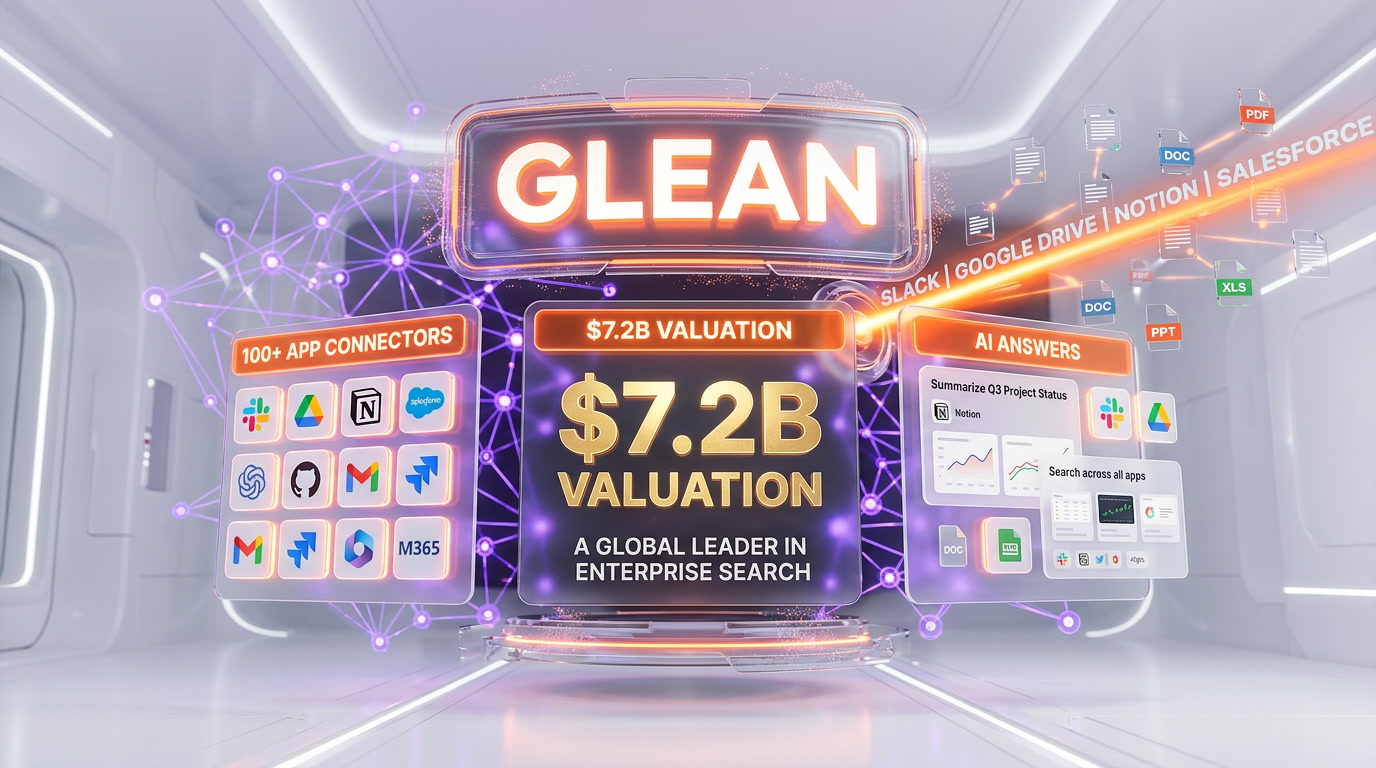
Permissions-Aware Retrieval, Explained
Permissions-aware retrieval is the feature that makes Glean deployable inside regulated enterprises. Every other Work AI product we have tested either ignores permissions (dangerous), snapshots them at index time (stale), or bolts them on as a filter after generation (too late). Glean enforces ACLs at query time, on every retrieval, in real time.
Here is the mechanism, step by step:
- Connector ingestion — Glean connectors pull content plus the source-system ACL for every object (document, ticket, channel, record).
- Identity mapping — user identities from Okta, Azure AD, or your IdP of choice are mapped across all source systems, so "Anthony in Slack" and "Anthony in Salesforce" resolve to the same person.
- Graph indexing — content is indexed with its ACL, metadata, authorship, and semantic embedding.
- Query-time filtering — when a user asks a question, Glean resolves their current permissions against the graph before ranking. Results that the user is not entitled to see are filtered out of the candidate set, not just hidden in the UI.
- RAG with safe context — only permissible documents are passed to the LLM as context. The model cannot leak content the user is not authorized to see because that content never enters the prompt.
- Real-time sync — ACL changes in source systems propagate through Glean on the order of minutes, not hours, so offboardings and access revocations take effect fast.
The compliance posture that comes out of this architecture is why Glean lands in Fortune 500 procurement: SOC 2 Type II, ISO 27001, HIPAA, GDPR, AES-256 at rest, TLS 1.2+ in transit, and a single-tenant VPC option for regulated deployments. Audit logs capture every query, action, and admin change.
Glean Pricing (Enterprise-Only, 2026)
Glean does not publish list pricing. Every deal is quote-based. The market data we have gathered from Vendr, TrustRadius, Workativ, and GoSearch reports in 2026 lines up on the following ranges:
| Component | Reported Range | Notes |
|---|---|---|
| Enterprise Search License | ~$45-50 per user per month | Base platform, AI Search + Assistant |
| Advanced AI add-on | ~$15 per user per month | Agents, Apps, multi-LLM routing |
| Minimum commitment | ~100 seats | Typical floor reported in the market |
| Starting annual contract | ~$60,000 per year | At the 100-seat floor, Search-only tier |
| Mid-to-large deployment | $240,000+ per year | Includes Advanced AI and extensive integrations |
| Glean Protect Plus | Custom | Governance SKU for DLP, policy controls, jailbreak protection |
| Dedicated internal FTE | $80,000-$120,000 per year | Admin, connector management, governance |
| Implementation services | $20,000-$50,000 one-time | Connector setup, identity mapping, tuning |
| All-in TCO (mid-large) | $350,000-$480,000 per year | License plus infra plus FTE plus implementation |
Renewal reports cluster around 7-12 percent year-over-year price increases, so a three-year forecast without a negotiated renewal cap can drift meaningfully. Buyers who benchmark against GoSearch, Onyx, or open-source alternatives report that Glean is positioned at the premium end of the market on list, but the counter-argument from deployers is that connector coverage and permissions-aware architecture are genuinely hard to match on a cheaper tier.
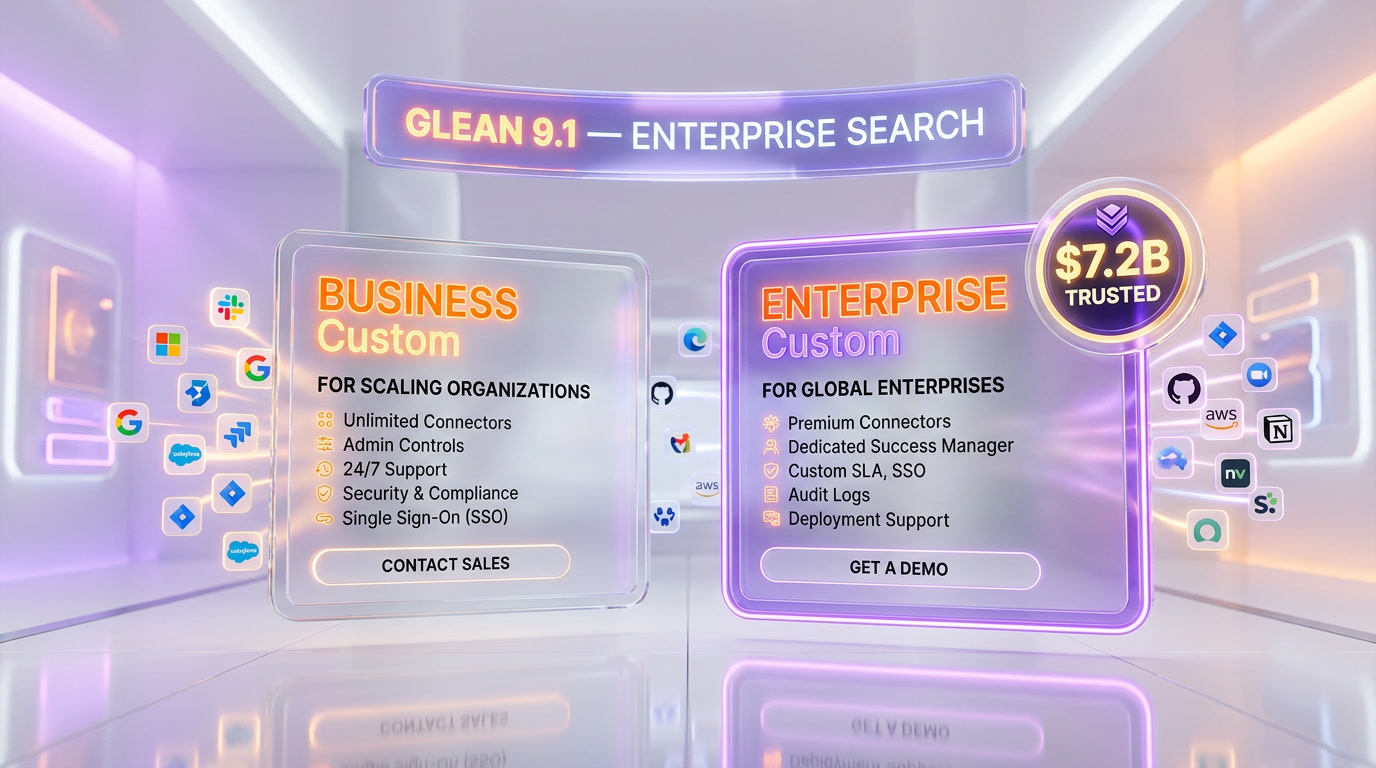
Best for: Enterprises with 500+ employees spread across 10+ SaaS tools who need one Work AI layer that respects existing permissions. Particularly strong for multi-ecosystem shops (Microsoft plus Google plus Atlassian plus Salesforce) where Copilot M365 and Agentspace each own only a slice of the surface.
Glean vs Microsoft Copilot M365 vs Google Agentspace vs Moveworks
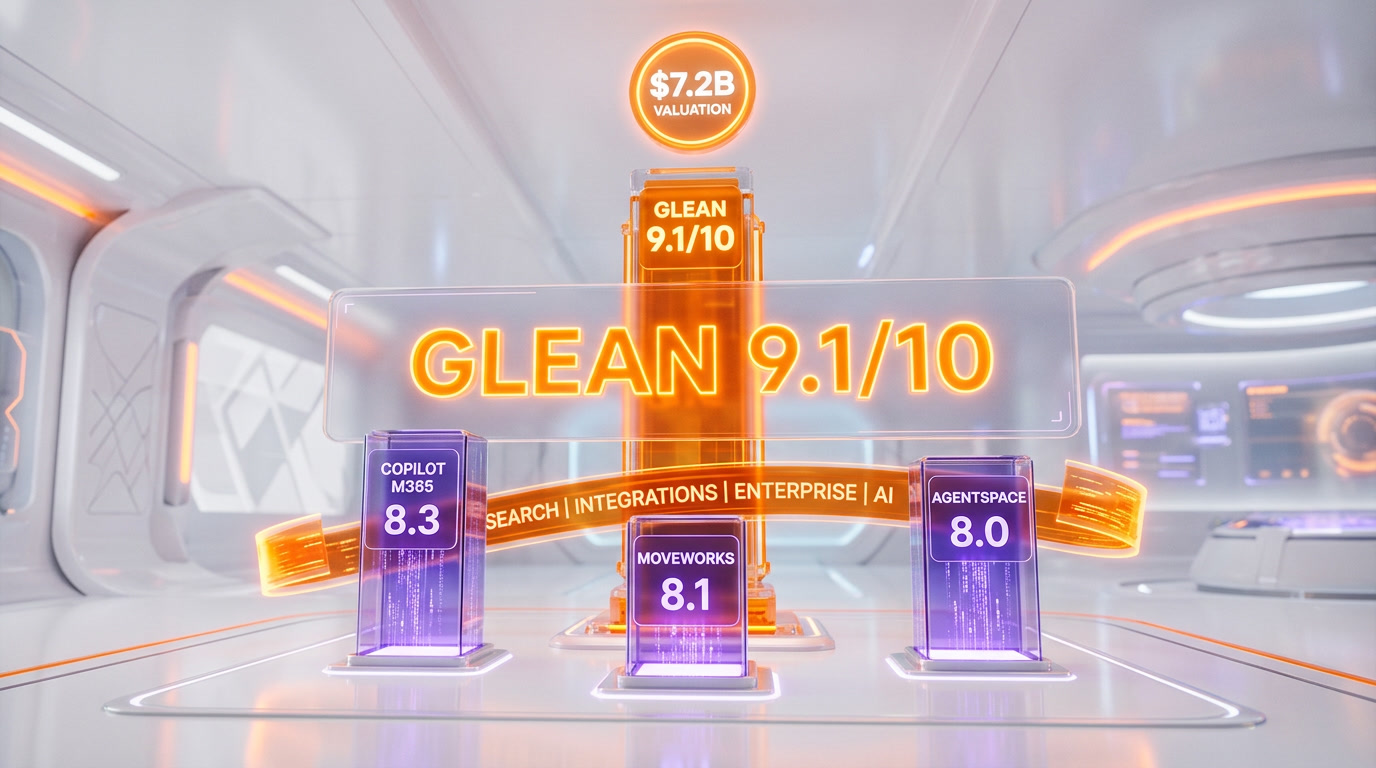
The Work AI market split into four real players in 2026: Glean, Microsoft Copilot M365, Google Agentspace, and Moveworks. Notion AI and Box AI exist as adjacent tools but do not compete on the same horizontal-platform thesis. Here is the honest comparison:
| Dimension | Glean | Copilot M365 | Google Agentspace | Moveworks |
|---|---|---|---|---|
| Core thesis | Horizontal Work AI layer | Microsoft ecosystem copilot | Google ecosystem copilot | IT/HR automation copilot |
| Ecosystem fit | Ecosystem-agnostic | Microsoft-first | Google-first | ITSM-first |
| Native connectors | 100+ | Microsoft apps + Graph connectors | Google + partner connectors | ITSM + HRIS focus |
| Permissions model | Real-time, query-time ACL | Microsoft Graph permissions | Google Workspace permissions | ITSM-role based |
| LLM choice | 15+ models, model-neutral | OpenAI (via Azure) | Gemini family | Proprietary + OpenAI |
| Agent platform | Glean Agents + Agentic Engine 2 | Copilot Studio | Agentspace agents | Moveworks AI Agents |
| No-code builder | Glean Apps | Copilot Studio | Agent Builder | Creator Studio |
| Typical seat price | ~$45-60 per user per month | $30 per user per month add-on | Tiered, bundled with Workspace | Custom, $200K-$1M+ per year |
| Compliance | SOC 2 II, ISO 27001, HIPAA, GDPR | SOC 2 II, ISO, HIPAA, GDPR | SOC 2 II, ISO, HIPAA, GDPR | SOC 2 II, ISO, HIPAA, GDPR |
| Best fit | Multi-SaaS enterprises | Microsoft-centric orgs | Google-centric orgs | IT helpdesk automation |
The practical decision rule from the deployments we have reviewed: Glean wins when the enterprise runs more than two major ecosystems in parallel. If your org is 95 percent Microsoft, Copilot M365 is cheaper and more deeply integrated inside Word, Excel, Teams, and Outlook. If your org is 95 percent Google, Agentspace has the tighter in-product experience inside Docs, Sheets, and Gmail. If your primary pain is IT and HR ticket deflection specifically, Moveworks still has the stronger domain model on classic ITSM workflows.
Glean's winning zone is the real-world enterprise that uses Slack and Microsoft Teams, Jira and Asana, Salesforce and HubSpot, Confluence and Notion. The knowledge lives in four ecosystems. Copilot and Agentspace each own one. Glean owns the union.
Real-World Use Cases
Customer Support
Support teams use Glean to collapse Zendesk tickets, Salesforce account history, Confluence runbooks, and engineering Slack threads into a single ask-and-answer surface. A tier-2 agent working a complex escalation can ask "what is the resolution pattern for customers on Plan X hitting error Y" and get a cited answer in seconds, pulling from past tickets, postmortems, and internal docs. The permissions layer guarantees the agent never sees data from accounts they are not entitled to.
Engineering
Engineering orgs deploy Glean across GitHub, Jira, Confluence, design docs, and on-call channels. New hires onboard faster because "how does service X handle retries" returns the actual code, the ADR, the incident review, and the Slack thread where the decision was debated. Senior engineers cut context-switching because the search surface is unified. Databricks and Pinterest have both publicly discussed Glean deployments in engineering.
Sales
Sales teams use Glean to assemble account intelligence during live deals. An AE preparing for a call can pull Salesforce history, Gong call snippets, Slack mentions, support tickets, and product roadmap context from one query. Glean Agents can take action — update opportunity notes, log a call summary, open a follow-up task — without switching tools.
IT and HR
Glean Agents automate the Level 1 ticket surface that Moveworks historically owned. Password resets, app access requests, policy lookups, benefits questions, and onboarding workflows all resolve inside the Assistant or in Slack/Teams. The difference vs Moveworks is that Glean also owns the general-purpose knowledge layer, so the same platform handles both "how do I request VPN access" and "what is our policy on open source contributions".
Security and Compliance
For enterprise buyers, Glean's compliance posture is a differentiator, not a checkbox:
- SOC 2 Type II — independently audited
- ISO 27001 — information security management certification
- HIPAA — healthcare data handling support
- GDPR — EU data protection compliance
- Encryption — AES-256 at rest, TLS 1.2+ in transit
- Single-tenant VPC option — isolated infrastructure for regulated industries
- Permissions-aware retrieval — real-time ACL enforcement on every query
- Audit logging — complete query, action, and admin trail
- Glean Protect Plus — policy controls, DLP, jailbreak protection, and governance dashboards
- SSO integration — Okta, Azure AD, Ping, and standard SAML/OIDC
- Identity federation — unified person graph across all connected sources
The detail that matters most for AI-specific risk: Glean does not train on customer data. Customer content is used only to serve that customer's queries. Model routing can be constrained by policy (for example, force all queries containing HR data to an on-prem model or a specific LLM provider).
Customer Proof Points
Glean's customer list in 2026 reads like a who's who of tech and enterprise:
- Databricks — partnership announced combining Glean's Knowledge Graph with Databricks AI/BI Genie for natural-language querying of structured data
- Pinterest — named publicly in Glean's customer roster
- LinkedIn, Samsung, Zillow, Booking.com, Comcast, eBay, Intuit — large enterprise deployments named in Glean's 2026 materials
- Duolingo, Grammarly, Plaid — growth-stage tech companies scaling on Glean
The ARR trajectory — $100M to $200M in roughly nine months — is the strongest signal in the market that buyers are voting with their budgets. Glean's retention and net revenue retention numbers (not publicly disclosed) are reported in press materials and analyst notes as sector-leading.
Pros and Cons at a Glance
Pros
- Permissions-aware retrieval is the best in the market
- 100+ native connectors with identity and ACL sync
- Model-neutral (15+ LLMs) — no hyperscaler lock-in
- Glean Agents platform with 100M+ actions per year
- Glean Apps no-code builder puts platform capability in the hands of business users
- SOC 2 Type II, ISO 27001, HIPAA, GDPR, single-tenant VPC
- Customer roster is dense with Fortune 500 and top-tier tech
- $7.2B valuation and $200M ARR signal long-term viability
Cons
- No self-serve tier or free trial — enterprise-only
- Quote-based pricing with ~100-seat minimum
- Full TCO often $350K-$480K per year on mid-large deployments
- Renewal increases reported at 7-12 percent per year
- Requires a dedicated internal FTE plus implementation services
- Overlap with Copilot M365 in Microsoft-first shops
- Agents platform is younger than Moveworks on classic ITSM resolution
Who Should Use Glean?
Ideal Users
- Enterprises with 500+ employees spread across 10+ SaaS apps
- Multi-ecosystem organizations (Microsoft plus Google plus Atlassian plus Salesforce)
- Companies building internal AI agents and apps grounded in enterprise data
- Regulated industries needing SOC 2 Type II, HIPAA, ISO 27001, and single-tenant deployment
- Orgs with serious knowledge-worker headcount in engineering, support, sales, and ops
- Buyers who want model neutrality and refuse hyperscaler lock-in
Not the Best Fit For
- Small and mid-market companies under 100 employees — economics do not work
- Single-ecosystem shops (pure Microsoft or pure Google) already paying for Copilot or Agentspace
- Teams whose only real need is IT helpdesk automation — Moveworks remains stronger on that narrow domain
- Budgets that cannot absorb $350K+ per year in all-in TCO
Frequently Asked Questions
How much does Glean cost?
Glean is enterprise-only with quote-based pricing. Market reports in 2026 place the Enterprise Search license around $45-50 per user per month, with an Advanced AI add-on around
Our Verdict5 per user per month. The typical minimum commitment is about 100 seats, so starting annual contracts cluster around $60,000. Mid-to-large deployments often reach $240,000 or more per year in licensing alone, with full TCO between $350,000 and $480,000 per year.
What is permissions-aware retrieval?
Permissions-aware retrieval means Glean checks a user's access rights against source-system ACLs at the moment of the query, not at indexing time. When you ask the Assistant a question, Glean resolves your current permissions across every connected app, filters the candidate documents to only those you are entitled to see, and only then passes them to the LLM as context. Documents you cannot access never enter the prompt, so the model cannot leak them in the answer.
How many apps does Glean integrate with?
Glean ships 100+ native connectors in 2026, including Slack, Microsoft Teams, Google Drive, Microsoft 365, SharePoint, OneDrive, Confluence, Jira, GitHub, GitLab, Salesforce, HubSpot, Zendesk, ServiceNow, Intercom, Notion, Box, Dropbox, Asana, Linear, Zoom, Gong, Workday, Okta, Azure AD, Databricks, Snowflake, Looker, Tableau, and Figma.
How does Glean compare to Microsoft Copilot M365?
Glean is ecosystem-agnostic, Copilot M365 is ecosystem-bound. Glean covers 100+ SaaS apps with native connectors and real-time permissions-aware retrieval. Copilot M365 performs best inside Microsoft apps and uses Graph Connectors for external sources. If your org is 95 percent Microsoft, Copilot is cheaper at $30 per user per month and more deeply integrated. If your org runs multiple major ecosystems, Glean is the platform that does not force a choice.
How does Glean compare to Google Agentspace?
Agentspace is Google's enterprise AI layer, built on Gemini and most deeply integrated with Google Workspace. Glean is model-neutral with 15+ LLMs and connector-agnostic. Agentspace wins inside Google-first organizations. Glean wins in multi-ecosystem enterprises and in deployments that need to route between Claude, GPT-5, Gemini, and Llama based on task and governance policy.
What is Glean Agents?
Glean Agents is Glean's horizontal platform for building, deploying, orchestrating, and governing autonomous AI agents. Agents do not just answer questions — they take action across connected apps such as opening a Jira ticket, updating a Salesforce opportunity, posting a Slack message, or kicking off a GitHub PR. The 2026 Agentic Engine 2 adds adaptive planning and parallel sub-agent orchestration. Glean has publicly stated the platform executes more than 100 million agent actions per year.
Is Glean secure for regulated industries?
Yes. Glean is SOC 2 Type II, ISO 27001, HIPAA, and GDPR compliant. Data is encrypted with AES-256 at rest and TLS 1.2+ in transit. A single-tenant VPC deployment option is available for regulated industries. Permissions are enforced at query time via real-time ACL sync, audit logs capture every query and admin change, and Glean Protect Plus adds DLP, policy controls, and jailbreak protection. Glean does not train on customer data.
What LLMs does Glean support?
Glean is model-neutral and supports 15+ large language models including GPT-5, Claude Opus, Gemini 2.5, Llama, and other frontier and internal models. Routing is configurable by policy, so administrators can force queries containing sensitive data to a specific model or provider.
Who are Glean's customers?
Glean's 2026 customer roster includes Databricks, Pinterest, LinkedIn, Samsung, Zillow, Booking.com, Comcast, eBay, Intuit, Duolingo, Grammarly, and Plaid, along with leaders in transportation, hospitality, and telecommunications. Glean crossed $200 million in ARR in early 2026 after doubling revenue in nine months and raised a
Our Verdict50 million Series F at a $7.2 billion valuation.
What is Glean Apps?
Glean Apps is a no-code builder that lets business users create custom AI assistants, chatbots, and copilots grounded in enterprise data, without coding. All Apps inherit the permissions, audit logging, and governance of the core Glean platform. Glean Actions extend Apps with the ability to trigger tasks across connected systems, and Glean APIs open the stack to developers.
Does Glean replace Microsoft Copilot or Google Agentspace?
It can, and in many multi-ecosystem enterprises it does, but most buyers run Glean alongside a hyperscaler copilot rather than replacing it outright. Glean handles the horizontal, cross-app knowledge and agent layer. Copilot or Agentspace handles the in-product experience inside Microsoft or Google surfaces. The split is increasingly standard in large enterprises.
Our Verdict: 9.1 out of 10
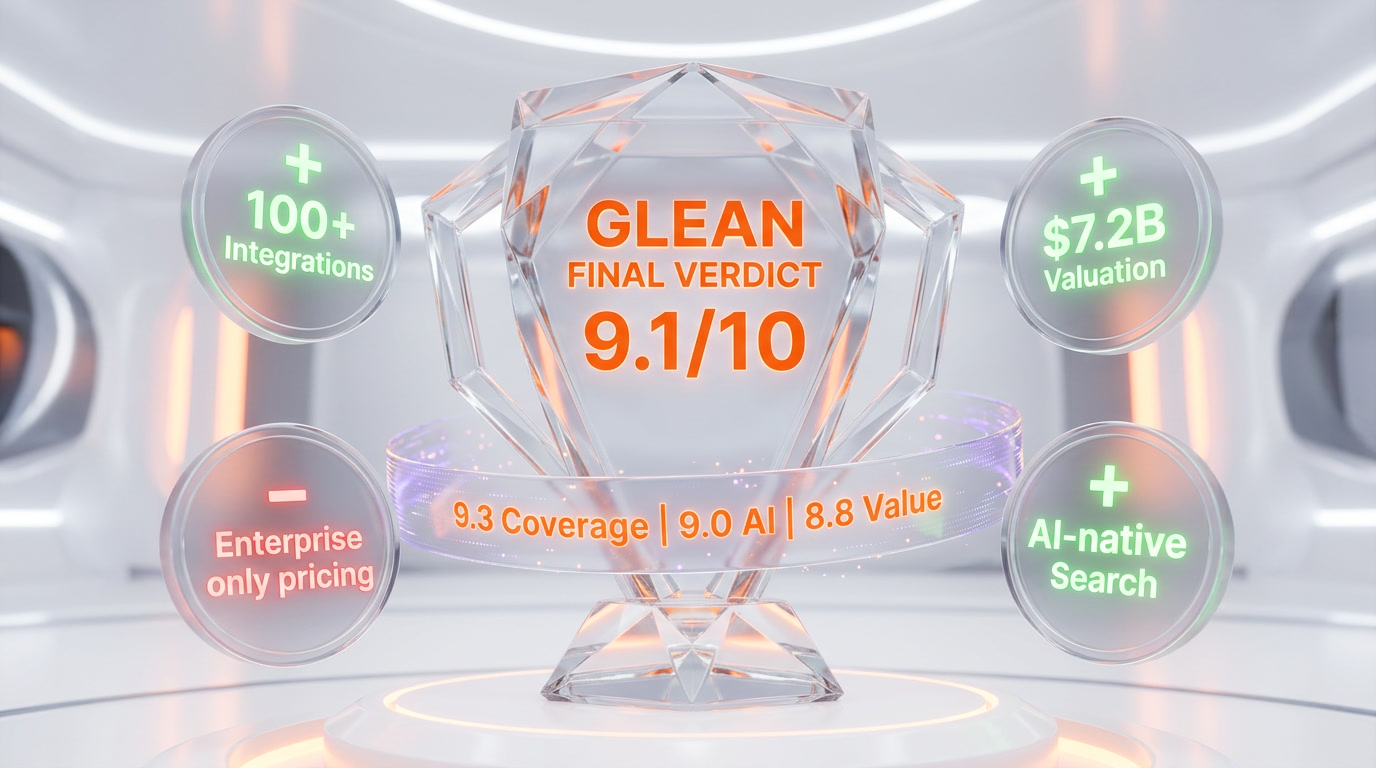
Glean earns a 9.1 out of 10 — driven by a category-defining knowledge graph, real permissions-aware retrieval, 100+ connectors, model neutrality, and a customer roster that already validates the thesis. The premium pricing, 100-seat minimum, and renewal trajectory keep it out of reach for smaller orgs, but for the mid-market-plus enterprise running more than two SaaS ecosystems in parallel, Glean is the one Work AI platform that does not force an ecosystem choice.
Score breakdown:
- Features: 9.4 out of 10 — Search, Assistant, Agents, Apps, Actions, APIs on one graph is the deepest stack in the category
- Ease of Use: 8.6 out of 10 — strong end-user experience, heavier admin and connector-management overhead for IT
- Value: 8.4 out of 10 — fair for mid-large enterprises, expensive for sub-500-employee orgs, renewal drift is real
- Support: 9.0 out of 10 — dedicated customer success, implementation services, and strong enterprise SLA
Key Features
Pros & Cons
Pros
- Permissions-aware knowledge graph enforces source-system ACLs in real time — employees only see what they are already entitled to
- 100+ native connectors (Slack, Drive, Confluence, Jira, GitHub, Salesforce, Zendesk, ServiceNow, Box, Microsoft 365) with metadata and identity sync
- Model-neutral architecture supports 15+ LLMs (GPT-5, Claude, Gemini, Llama) — no hyperscaler lock-in
- Glean Agents platform powers 100M+ agent actions per year with autonomous planning, parallel sub-agents, and Agentic Engine 2
- Used by Databricks, Pinterest, LinkedIn, Samsung, Zillow, Booking.com, Comcast, eBay, Intuit, Duolingo, Grammarly, and Plaid
- SOC 2 Type II, ISO 27001, HIPAA, and GDPR compliant with AES-256 at rest, TLS 1.2+ in transit, and single-tenant VPC option
- Glean Apps lets non-developers build custom AI agents, assistants, and chatbots grounded in enterprise data — no code required
- $200M ARR doubled in 9 months, $7.2B Series F valuation — strongest enterprise AI pure-play outside hyperscalers
Cons
- Enterprise-only pricing — no self-serve tier, no free trial, quote-based only with ~100-seat minimum commitment
- Total cost of ownership often hits $350,000-$480,000 per year on mid-to-large deployments (licensing, infra, dedicated FTE, implementation)
- Reported renewal increases of 7-12 percent make long-term budgeting unpredictable without a negotiated cap
- Requires dedicated internal FTE ($80K-$120K per year) plus $20K-$50K in implementation services to run properly
- Not the right fit for Microsoft-first shops already paying for Copilot M365 — overlap on the knowledge surface is significant
- Agentic workflows are powerful but younger than Moveworks on classic ITSM and HR ticket resolution use cases
Best Use Cases
Platforms & Integrations
Available On
Integrations

We're developers and SaaS builders who use these tools daily in production. Every review comes from hands-on experience building real products — DealPropFirm, ThePlanetIndicator, PropFirmsCodes, and many more. We don't just review tools — we build and ship with them every day.
Written and tested by developers who build with these tools daily.
Frequently Asked Questions
What is Glean?
The Work AI platform — permissions-aware enterprise search, Assistant, and Agents across 100+ SaaS apps, valued at $7.2B
How much does Glean cost?
Glean costs $0/month.
Is Glean free?
No, Glean starts at $0/month.
What are the best alternatives to Glean?
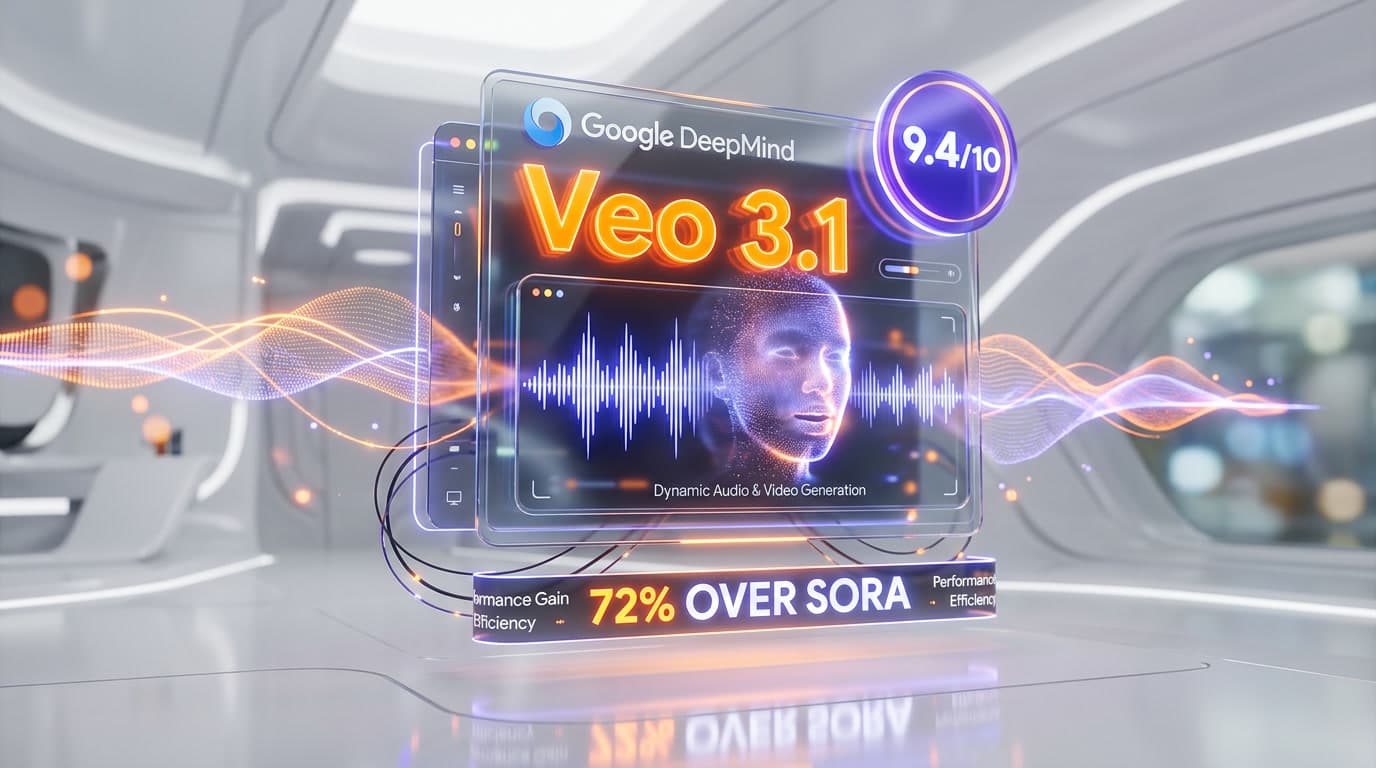
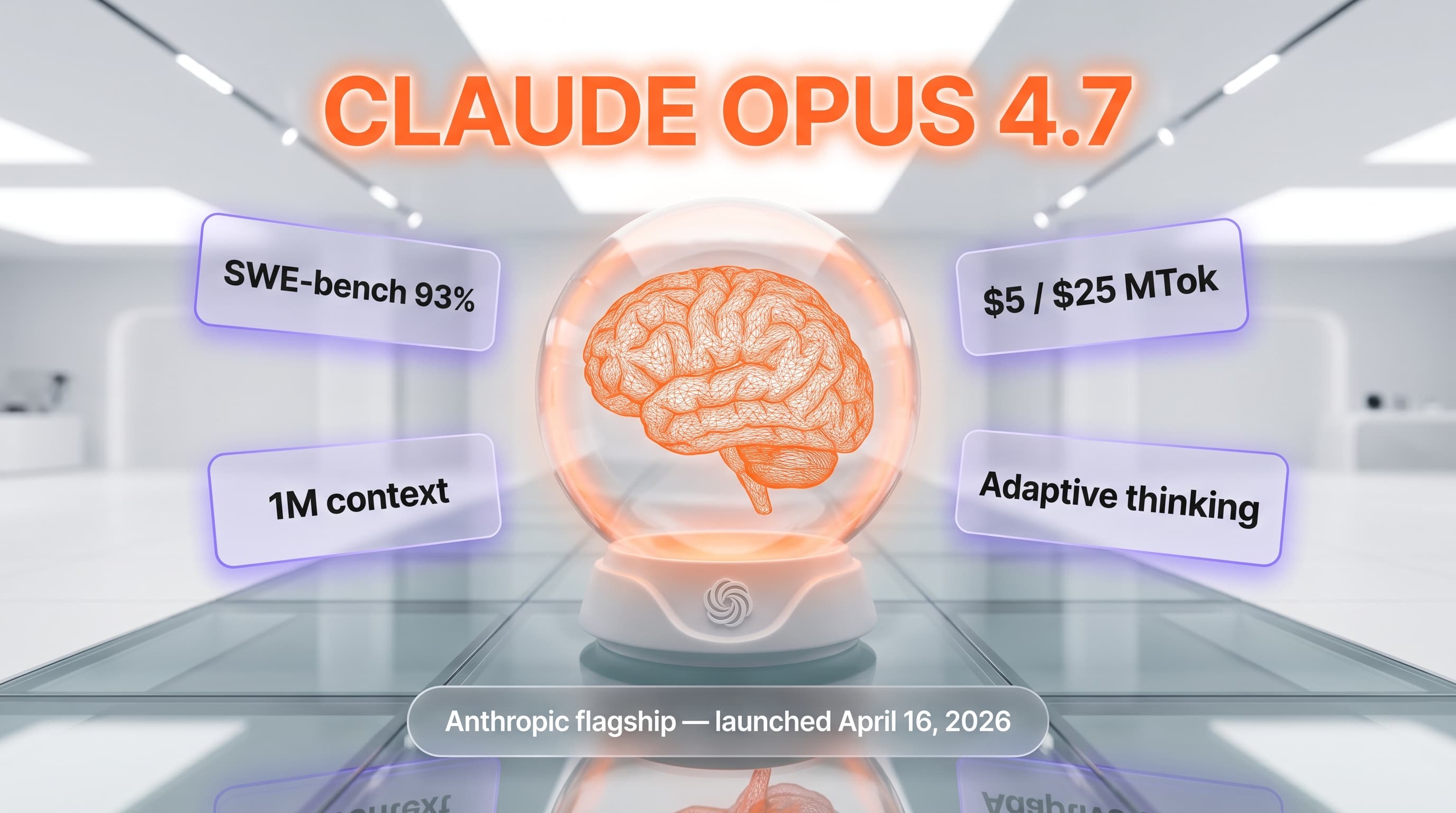
Top-rated alternatives to Glean include Claude Code (9.9/10), Cursor (9.5/10), Veo 3.1 (9.4/10), Claude Opus 4.7 (9.4/10) — all reviewed with detailed scoring on ThePlanetTools.ai.
Is Glean good for beginners?
Glean is rated 8.6/10 for ease of use.
What platforms does Glean support?
Glean is available on Web, macOS, Windows, iOS, Android, Slack, Microsoft Teams, Chrome Extension, API.
Does Glean offer a free trial?
No, Glean does not offer a free trial.
Is Glean worth the price?
Glean scores 8.4/10 for value. We consider it excellent value.
Who should use Glean?
Glean is ideal for: Customer support teams resolving tickets faster by pulling answers from Zendesk, Confluence, Salesforce, and Slack into one place, Engineering orgs searching across GitHub, Jira, Confluence, and design docs to cut context-switching and onboarding time, Sales teams surfacing account intelligence from Salesforce, Gong calls, Slack threads, and product docs during live deals, HR and People Ops automating policy Q&A, benefits lookup, and onboarding workflows through Glean Agents, IT helpdesks deflecting Level 1 tickets (password resets, app access, device provisioning) with autonomous agents, Legal and compliance teams running permissions-aware discovery across contracts, tickets, and internal docs, Executive assistants assembling briefings from calendars, emails, docs, and CRM in seconds, Data and analytics teams using the Databricks AI/BI Genie integration to query structured data in natural language, Multi-SaaS enterprises that want one Work AI layer across Microsoft, Google, Atlassian, and Salesforce ecosystems.
What are the main limitations of Glean?
Some limitations of Glean include: Enterprise-only pricing — no self-serve tier, no free trial, quote-based only with ~100-seat minimum commitment; Total cost of ownership often hits $350,000-$480,000 per year on mid-to-large deployments (licensing, infra, dedicated FTE, implementation); Reported renewal increases of 7-12 percent make long-term budgeting unpredictable without a negotiated cap; Requires dedicated internal FTE ($80K-$120K per year) plus $20K-$50K in implementation services to run properly; Not the right fit for Microsoft-first shops already paying for Copilot M365 — overlap on the knowledge surface is significant; Agentic workflows are powerful but younger than Moveworks on classic ITSM and HR ticket resolution use cases.
Best Alternatives to Glean


Ready to try Glean?
Get started today
Try Glean Now →