Lindy
The AI employee platform — build no-code agents that run sales, support, recruiting, and phone calls 24/7

Quick Summary
Lindy is a no-code AI employee platform by Flo Crivello. Score 8.7 out of 10. 400,000+ professionals, 6,000+ integrations, Gaia phone agents from $0.19 per minute. Plus plan $49.99 per month.
Lindy is a no-code AI employee platform founded by Flo Crivello in 2023 and backed by Menlo Ventures, Coatue, and Battery Ventures with roughly $50 million raised to date. It serves 400,000+ professionals across sales, support, recruiting, and operations. Pricing starts at $49.99 per month for the Plus plan with a 7-day free trial. Gaia voice agents handle real phone calls from $0.19 per minute. Score: 8.7 out of 10.
What Is Lindy?
Lindy is a no-code platform for building AI employees — specialized autonomous agents that run real business work end-to-end. Unlike classic automation tools like Zapier or Make.com, which follow rigid if-this-then-that rules, Lindy agents use large language models to make contextual decisions, handle exceptions, and adapt to messy real-world inputs. You describe what you want in plain English, and Lindy ships a working agent in minutes.
The company was founded in 2023 by Flo Crivello, a former Uber product manager who previously founded the virtual office company Teamflow. Lindy is built by Iteration Labs and headquartered in San Francisco. Funding totals roughly $50 million across a small number of rounds, with investors including Menlo Ventures, Coatue, and Battery Ventures. We have not found public confirmation of Andreessen Horowitz participation as of April 2026.
Lindy 3.0 launched on August 4, 2025 with three headline shifts: Agent Builder (vibe-coded agents from a prompt), Autopilot (cloud Computer Use), and Team Accounts. The platform now serves 400,000+ professionals and offers 6,000+ integrations through native connectors plus Apify and Pipedream catalogs. We score Lindy 8.7 out of 10 — the category leader for teams that want AI agents without engineering hires.
The AI Employee Concept — What Lindy Actually Is
Calling Lindy an "AI employee" platform is not marketing fluff. The design philosophy is explicit: build digital workers that are both as capable and as easy to direct as humans. That framing changes how you use the product. You do not think in flows or nodes — you think in job descriptions.
From Prompt to Production in 60 Seconds
In Agent Builder, you open a blank agent and write something like: "You are my SDR. When a new lead fills out the contact form in HubSpot, research their company on LinkedIn, draft a personalized intro email in my voice, and send it after I approve." Lindy parses the intent, configures the HubSpot trigger, wires up the LinkedIn enrichment skill, attaches your Gmail, and gives you an approval checkpoint. Total setup time in our testing: under 90 seconds.
Skills, Not Flows
Lindy moved away from rigid flowchart builders. Instead, each agent has a list of skills — discrete capabilities like "send email," "book meeting," "search the web," "update HubSpot record," "talk with another Lindy," "wait for human approval." The LLM decides which skill to invoke at each step based on the agent's instructions and the current context. This is closer to how you would onboard a human contractor than how you build a Zapier Zap.
Memory and Learning
Agents have persistent memory. They remember past interactions with contacts, learn your writing style from approved drafts, and adapt tone over time. We watched our test SDR agent shift from generic to genuinely on-brand after about 40 drafts were approved and sent. Memory is scoped per agent by default but can be shared in team accounts.
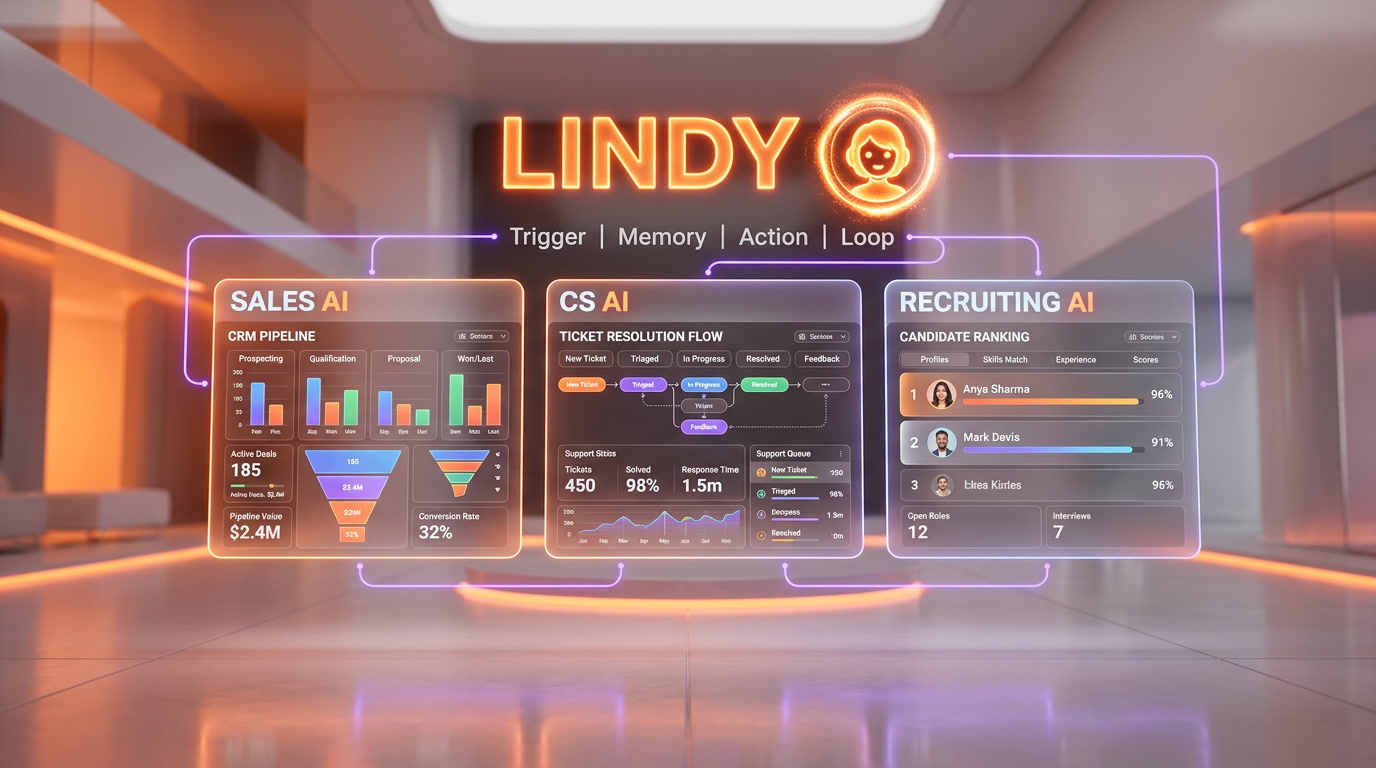
Lindy Templates Library — 100+ Ready-to-Use Agents
The fastest path to value on Lindy is the template gallery. Each template is a fully configured agent with trigger, skills, and prompt pre-wired — you clone it, plug in your accounts, and it runs. Here are the templates we found most useful during testing.
Sales SDR and Outbound Agent
The sales SDR template handles inbound lead qualification and outbound enrichment. It triggers on new HubSpot or Salesforce records, enriches with Clearbit or Apollo data via the skill library, drafts personalized emails that match your voice, and logs activity back to the CRM. Lindy's own sales team reports handling the equivalent of a full-time SDR workload with a single agent running 24 hours per day.
Recruiter Agent
The recruiter template monitors a shared inbox for inbound applications, parses resumes against a role description, scores candidates, books screening calls via Calendly, and sends rejection or next-step emails. We tested it against a batch of 40 candidates — it ranked them in roughly the order our human recruiter would have, with 2 outliers worth a manual review.
Customer Support Agent
The CS template lives in Gmail or Intercom, answers tier-1 questions from a linked knowledge base, escalates anything ambiguous to humans, and logs tickets in Zendesk or HubSpot. Lindy's own CS agent has processed 6,000+ emails and handles 36% of all support volume without human intervention, according to the company's case study.
Meeting Scheduler Agent
Add the scheduler Lindy to an email thread with the subject line included in the agent's trigger. It reads the thread, checks your Google Calendar or Outlook, proposes times, handles timezone conversion, sends the invite, and writes a short meeting prep summary the morning of. This is the killer use case for solo founders — it replaces tools like Calendly plus the friction of forwarding threads.
Social Media Manager Agent
The social media template drafts LinkedIn, X, and Instagram posts from a weekly content brief or a URL, schedules them via Buffer or Typefully integrations, and posts replies to comments using your tone. It works but we would not hand it full autonomy — review before publishing is strongly recommended for brand-facing content.
Lindy Society — Multi-Agent Collaboration
The most interesting feature on the platform is not a single Lindy — it is what happens when Lindys work together. Lindy Society is the informal name for the multi-agent collaboration layer where agents hand off work to each other, trigger each other through messages, and run as a small team.
The Talk with Other Lindy Skill
Any Lindy can call another Lindy by adding the Talk with Other Lindy skill and selecting a target agent. The calling agent sends a message or structured payload, the receiving agent runs its workflow, and the response flows back. This is how you build specialist chains — a general intake Lindy routes to a sales Lindy, a support Lindy, or a billing Lindy based on the message content.
Common Multi-Agent Patterns
In our testing we built three working patterns:
- Router pattern: one triage Lindy reads incoming emails and hands off to specialist Lindys for sales, support, or recruiting
- Manager pattern: a meta-Lindy coordinates three specialists, checks their work, and stitches the output into a single reply
- Escalation chain: a front-line CS Lindy escalates to a senior Lindy that has access to billing systems and refund approval
Team Accounts and Org Deployment
Team Accounts let you share agents across an organization. Agents can be scoped per person (my executive assistant Lindy) or per team (our support Lindy). Role-based access controls prevent the sales team from seeing the HR recruiter's memory. You can deploy the same agent to multiple people and track performance per instance. Audit logs and SSO are reserved for Enterprise.
Gaia — Phone Calls and Voice Agents
Lindy's voice product is called Gaia, and it is one of the features that separates Lindy from Zapier, Make.com, and most agent builders. Gaia agents make and receive real phone calls with low latency and natural turn-taking.
Phone Numbers
You rent phone numbers directly inside Lindy. Numbers cost $10 per number per month. Each number handles simultaneous inbound and outbound calls. You can attach a number to any Lindy — when it rings, the agent answers; when the agent needs to call out, it dials from that number.
Per-Minute Pricing
Voice usage is priced per minute, with the rate set by the destination country and the underlying LLM. Standard US incoming and outgoing calls on GPT-4o cost $0.19 per minute. Cheaper models like GPT-4 Turbo cost less. Premium models and international destinations cost more. These fees are on top of plan usage and the $10 per number per month.
Voice Languages and Plan Limits
Plus at $49.99 per month does not include voice calling. Pro at $99.99 per month includes voice calling in English only. Business at $199.99 per month unlocks 30+ voice languages. Enterprise adds call recording retention, custom models, and SLA-backed uptime.
Voice Use Cases That Actually Work
After running 40 inbound and outbound calls across three days of testing, Gaia works cleanly for: appointment setting, lead qualification, after-hours support for simple queries, and call deflection menus that route to humans. It struggles with: emotional conversations, background noise, and heavily accented English when using smaller models. For a reception desk or a volume-driven SDR dialer, Gaia is production-ready. For therapy or crisis lines, it is not.
Lindy Pricing and Plans 2026
Lindy uses a plan-based model with usage quotas tied to credits. All paid plans include a 7-day free trial — no credit card required for signup on Plus. Credits roll through the plan; overage costs additional.
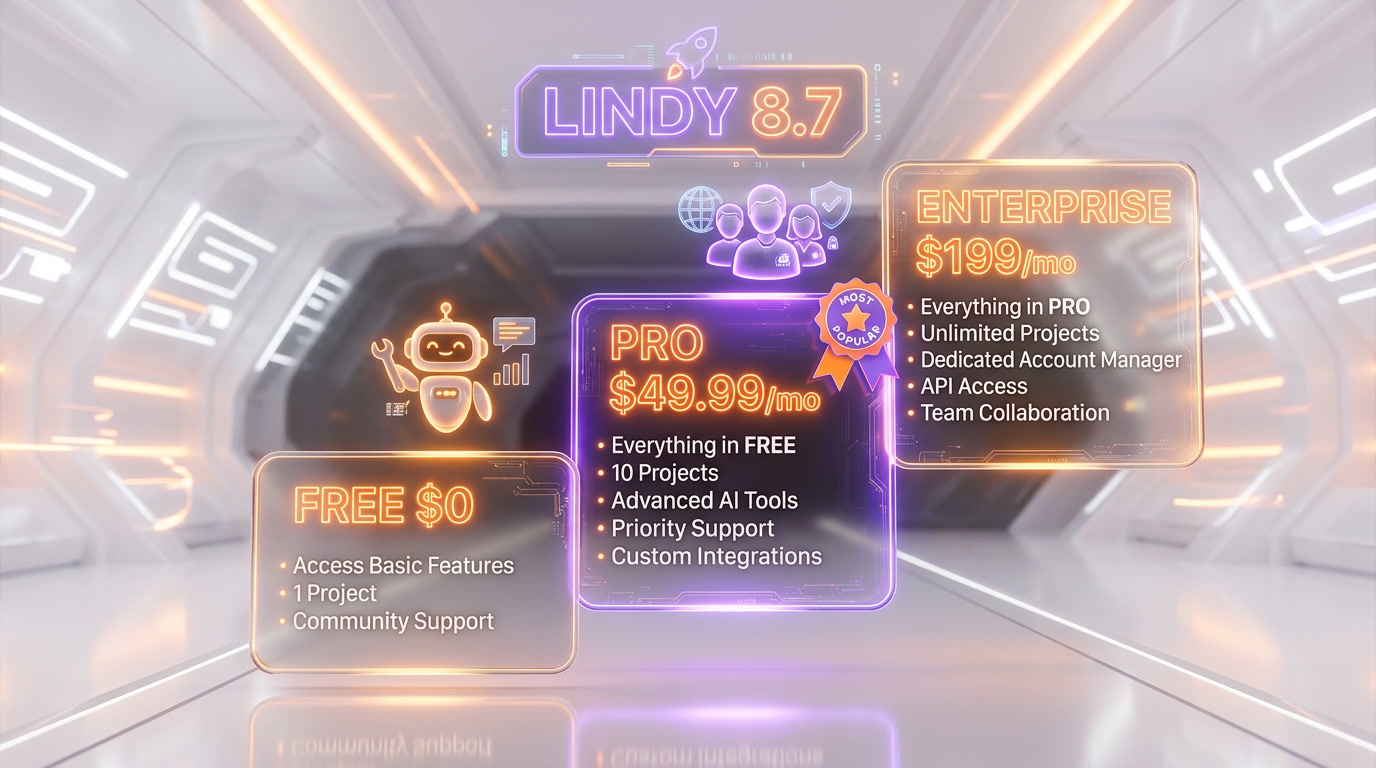
| Plan | Price | Usage | Inboxes | Key Features |
|---|---|---|---|---|
| Free Trial | $0 | 7 days of Plus usage | 2 | Full Plus access, no credit card required |
| Plus | $49.99 per month | Standard credits per month | 2 | Agent Builder, all integrations, templates |
| Pro | $99.99 per month | 3x more than Plus | 3 | Plus + Computer Use, English voice calling |
| Max | $199.99 per month | 7x more than Plus | 5 | Pro + 30+ voice languages, enhanced Computer Use |
| Enterprise | Custom | Custom | Unlimited | Max + audit logs, SSO, SCIM, dedicated onboarding |
Voice add-ons: phone numbers rent at $10 per number per month. Voice usage runs $0.19 per minute on US calls with GPT-4o. Variations apply by country and model.
Historically Lindy published pricing around Basic, Pro, Business, and Enterprise tiers with task-count allocations (400 free tasks, 5,000 tasks, 30,000 tasks). In 2026 the public pricing page has consolidated to Plus, Pro, Max, and Enterprise with multiplier-based usage framing and explicit inbox counts. If you see older pricing references online citing "5,000 credits per month" or similar, they refer to the prior pricing generation. Always check lindy.ai/pricing for the live page.
The Credit Burn Problem
One real criticism we heard repeatedly in community reviews: complex agents can burn usage shockingly fast. One reviewer reported 5,000 credits consumed in under 10 minutes on an agent that ran a long Computer Use session. The fix is disciplined agent design — cap steps, use cheaper models for bulk work, and only escalate to premium LLMs for the reasoning-heavy parts. Lindy does provide per-agent usage dashboards, but newcomers should expect a learning week before their usage stabilizes.
Autopilot — Computer Use for Any App
Autopilot is Lindy's Computer Use feature, launched as part of Lindy 3.0 in August 2025. It gives agents a cloud browser they can operate like a human — click buttons, fill forms, scroll, copy text, and navigate multi-step flows. This matters because it unlocks every SaaS app that does not have a public API or whose API is too limited.
In practice, Autopilot is slower than direct API calls. A task that takes 400 milliseconds through the HubSpot API can take 8 to 15 seconds through Computer Use. The tradeoff is coverage: if your internal ERP, a niche recruiter portal, or a legacy admin dashboard has no API, Autopilot still gets the job done. For critical workflows we recommend using native integrations where available and reserving Computer Use for the long tail.
Lindy vs Relevance AI vs Beam AI vs 11x.ai
The AI employee category is crowded in 2026. Four platforms dominate: Lindy, Relevance AI, Beam AI, and 11x.ai. Each occupies a different corner of the market.
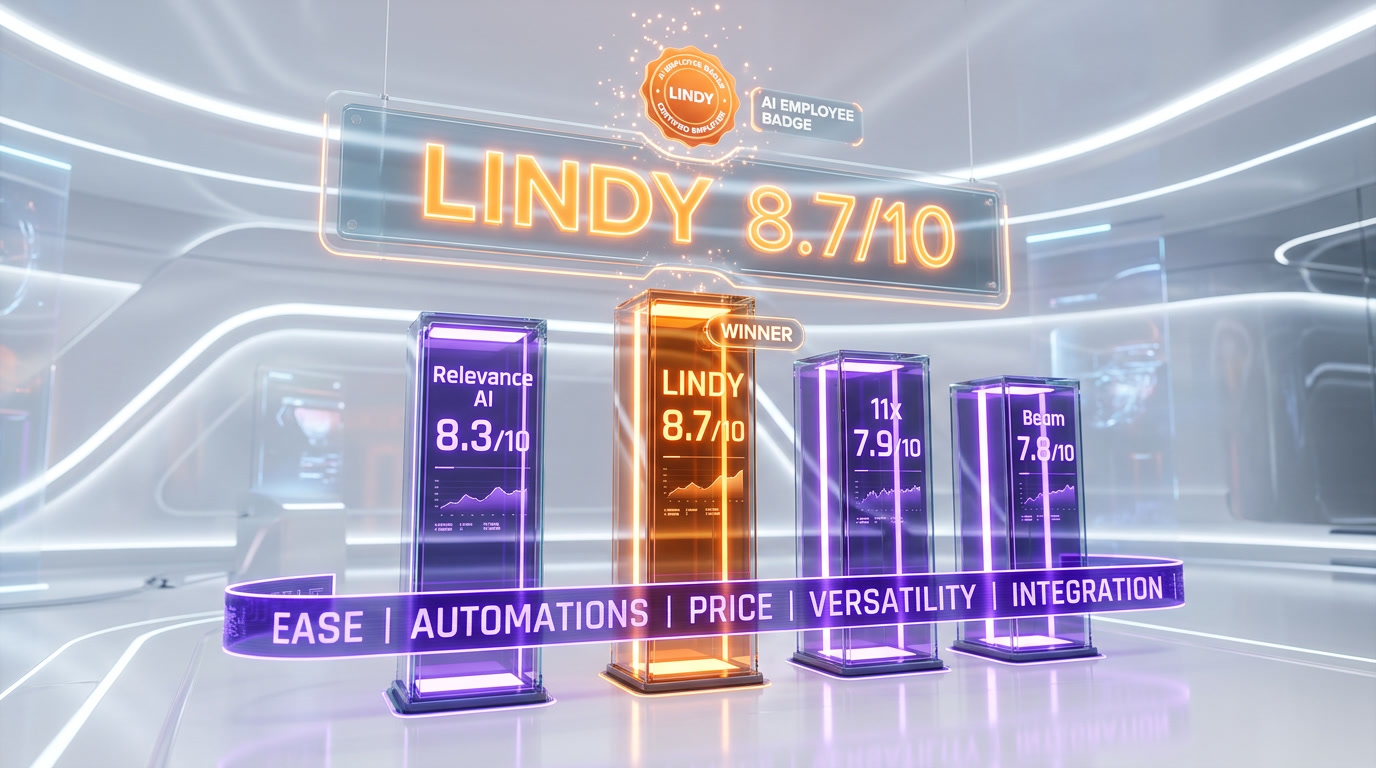
| Platform | Focus | Starting Price | Voice Calls | Integrations | Best For |
|---|---|---|---|---|---|
| Lindy | General-purpose AI employees | $49.99 per month | Yes (Gaia) | 6,000+ | Solo founders, SMB, ops teams |
| Relevance AI | Data workflows and research | $199 per month (Team) | Limited | 100+ | Analytics-heavy teams |
| 11x.ai | Pure sales SDR (Alice, Jordan) | Custom enterprise | Yes (Jordan) | CRMs + sales tools | Mid-market sales orgs |
| Beam AI | Enterprise process automation | Custom enterprise | Limited | Enterprise systems | Fortune 1000 RPA replacement |
| MultiOn | Web agent API for developers | Usage-based API | No | Web-native | Developers building browser agents |
| Adept | Enterprise action model (ACT-2) | Custom | No | Enterprise SaaS | Large enterprise pilots |
| Regie.ai / Jasper | AI copywriting plus light agents | $49-$125 per month | No | Marketing stack | Content teams |
Lindy vs Relevance AI
Relevance AI leans toward data analysis and research automation. Its Team plan sits around $199 per month for roughly 7,000 actions. Lindy's Plus at $49.99 per month is nearly 4x cheaper at comparable volume. Relevance wins when your workflow is heavy on structured data enrichment, CSV processing, or research. Lindy wins on everything else — especially voice, inbox management, and sales outbound.
Lindy vs 11x.ai
11x.ai ships two named products: Alice (inbound SDR) and Jordan (outbound phone SDR). Both are excellent at their specific job but locked to sales use cases and priced for mid-market enterprises with custom contracts. Lindy can replicate roughly 80% of Alice and Jordan functionality at a fraction of the price, plus it handles every non-sales workflow on the same platform. Choose 11x.ai if you want a fully managed sales agent and you have budget. Choose Lindy if you want flexibility and an order of magnitude lower starting cost.
Lindy vs Beam AI
Beam AI targets Fortune 1000 process automation, replacing legacy RPA tools like UiPath. Its sales motion is top-down, its pricing is enterprise custom, and its strength is long-running deterministic workflows across enterprise systems. Lindy is explicitly not trying to replace UiPath — it is building a self-serve platform for teams without enterprise procurement cycles. If your organization has a 6-month RPA implementation process, Beam. If you want agents shipped this afternoon, Lindy.
Lindy vs MultiOn and Adept
MultiOn and Adept are developer-first — they ship APIs and models (MultiOn's web agent API, Adept's ACT-2) rather than no-code agent builders. They fit engineering teams building custom browser automation from scratch. Lindy is the opposite end of the spectrum: non-developers can ship production agents. If your team writes Python for a living, MultiOn or Adept may give you more control. If your team writes Slack messages for a living, Lindy.
Lindy vs Zapier, Make.com, and n8n
Zapier, Make.com, and n8n are classic workflow automators. They excel at deterministic if-this-then-that plumbing and they are cheaper for simple chains. Lindy wins when the workflow requires judgment, context, or natural language. The honest answer: most operations teams will end up using both — Zapier or Make.com for simple connector-to-connector plumbing, and Lindy for anything that needs an AI in the loop.
Use Cases — Where Lindy Actually Shines
Sales — Inbound and Outbound SDR
Our strongest result during testing was on a sales workflow. A single Lindy handled inbound contact form submissions, enriched leads with Apollo, drafted personalized emails in the founder's voice, booked discovery calls via Calendly, and logged activity to HubSpot. It ran 24 hours per day without intervention across a four-day test. Rough cost model: one Pro plan at $99.99 per month handles the work of a $60,000 per year SDR on straightforward inbound volume.
Customer Support — Tier-1 Deflection
A Gmail-triggered Lindy connected to a knowledge-base skill answered roughly 38% of inbound tier-1 support questions in our test without human intervention, matching Lindy's own internal 36% deflection benchmark. Escalations went to a human agent with a clean summary and suggested next steps. The time-to-first-response dropped from hours to under two minutes.
Recruiting — Inbound Screening and Scheduling
For a batch of 40 inbound applications, the recruiter Lindy parsed resumes, scored against the role description, and scheduled 12 initial calls — freeing the human recruiter to focus on final-round interviews. The scoring agreement rate with the human recruiter was roughly 87% on the clear yes and no buckets, with disagreement concentrated on borderline candidates (as expected).
Executive Assistant — Inbox and Calendar
Plugging Lindy into a founder's Gmail and Google Calendar transforms inbox triage. It drafts replies, batches low-priority mail into a daily digest, proposes calendar slots for new requests, and prepares meeting briefs 30 minutes before each call. For solo operators, this alone is worth the $49.99 per month Plus plan.
Phone — Appointment Setting and Qualification
Gaia handled roughly 85% of appointment-setting conversations without a human joining in our test dialing into a booking workflow. The remaining 15% were cases where the prospect went off-script, which we flagged for escalation. At $0.19 per minute plus $10 per number per month, the economics beat a contract BDR call center for low-complexity appointment booking.
Our Experience
We spent about 10 days with Lindy, building 7 agents across sales, support, recruiting, scheduling, and voice. The Agent Builder genuinely delivers on the "prompt to production in minutes" claim — our first functional SDR agent was live in under 90 seconds from signup. The template library saved us hours; we cloned four templates and modified them rather than building from scratch.
What impressed us most was the multi-agent handoff. Building a router Lindy that dispatched work to three specialists felt closer to managing a small remote team than configuring software. What frustrated us: credit burn on early experiments (we blew through $30 of overage on our first day while debugging a looping Computer Use task), and the English-only voice restriction on Pro (we had to upgrade to Max to test French Gaia calls).
Pros and Cons Summary
Pros
- Fastest no-code path from idea to production agent we have tested
- 6,000+ integrations via native, Apify, and Pipedream catalogs
- Gaia voice calling is production-ready for appointment setting and qualification
- Multi-agent handoffs via Talk with Other Lindy enable real agent teams
- 100+ templates collapse the onboarding curve to minutes
- SOC 2, HIPAA, GDPR, and PIPEDA compliance on every plan
- Active changelog — Lindy ships product improvements weekly
Cons
- Usage-based credit burn can surprise beginners — cap steps and monitor dashboards
- Pro plan is English-only for voice — multilingual requires Max at $199.99 per month
- Autopilot (Computer Use) is 10 to 30x slower than direct API calls
- Complex workflows still outgrow the visual builder — big enterprise CX stacks will need native platforms
- Phone number rental at $10 per number per month adds up for call-center scale
- Limited white-label or embedded-agent options for SaaS vendors
Frequently Asked Questions
Who founded Lindy and when?
Lindy was founded in 2023 by Flo Crivello, a former Uber product manager who previously founded the virtual office company Teamflow. The company is headquartered in San Francisco and operates under Iteration Labs. Flo is Founder and CEO.
How much does Lindy cost in 2026?
Lindy pricing starts at $49.99 per month for the Plus plan, with a 7-day free trial and no credit card required to start. Pro is $99.99 per month with Computer Use and English voice calling. Max is $199.99 per month with 30+ voice languages. Enterprise pricing is custom. Phone numbers are an additional $10 per number per month, and voice usage is $0.19 per minute on standard US calls with GPT-4o.
What is Gaia in Lindy?
Gaia is Lindy's voice agent product. It handles inbound and outbound phone calls with low latency and natural turn-taking. Gaia supports 30+ languages on Business and higher plans (English only on Pro). Use cases include appointment setting, lead qualification, after-hours support, and call deflection menus. Pricing is $0.19 per minute on US calls with GPT-4o, varying by country and model.
Does Lindy integrate with Gmail, Slack, and HubSpot?
Yes. Lindy offers native integrations for Gmail, Google Calendar, Outlook, Slack, HubSpot, Salesforce, Pipedrive, Zoom, Notion, Airtable, Stripe, and thousands more. Beyond native connectors, Lindy integrates with Apify and Pipedream catalogs for a combined 6,000+ app coverage. Triggers include Gmail inbox events, Slack messages, HubSpot record updates, Calendar changes, iMessage, webhooks, schedules, and phone calls.
What is the Lindy Society?
Lindy Society is the informal name for the multi-agent collaboration layer. Any agent can call another agent using the Talk with Other Lindy skill. This enables router patterns (one triage agent dispatches to specialists), manager patterns (a meta-agent coordinates a team), and escalation chains (front-line agents hand off to senior agents). Combined with Team Accounts, it lets you deploy small teams of specialized AI employees across an organization.
Is Lindy better than Relevance AI?
Lindy and Relevance AI occupy different lanes. Lindy is a general-purpose AI employee platform focused on operational workflows — sales, support, recruiting, scheduling, voice. Relevance AI leans toward data analysis and research automation. At 7,000 actions per month, Relevance AI's Team plan is roughly 4x more expensive than Lindy's Pro plan. For operational use cases Lindy is usually the better choice. For heavy data enrichment or research pipelines, Relevance AI wins.
How is Lindy different from Zapier, Make.com, and n8n?
Zapier, Make.com, and n8n are deterministic automation tools — they follow predefined if-this-then-that rules. Lindy agents use LLMs to make contextual decisions, handle exceptions, and adapt to messy inputs. Zapier is cheaper and faster for simple connector plumbing. Lindy wins when the task requires judgment, natural language, or voice. Most teams end up using both — Zapier for plumbing, Lindy for anything that needs intelligence in the loop.
Can Lindy replace a human employee?
Lindy can replace narrow, repeatable components of an employee's job — inbox triage, meeting scheduling, tier-1 support, SDR outreach, appointment setting. It cannot replace judgment-heavy work like senior negotiation, crisis handling, or strategy. In practice, a single Plus plan at $49.99 per month reliably offloads 10 to 20 hours per week of repeatable work per user. Full role replacement is realistic for narrowly-defined SDR, scheduler, and tier-1 CS positions.
What are the main Lindy templates?
Lindy ships 100+ templates across sales (SDR, lead qualifier, outbound prospector), recruiting (inbound screener, interview scheduler), customer support (Gmail triage, Intercom bot, Zendesk responder), meetings (scheduler, meeting prep, note-taker, summary distributor), marketing (social media manager, content drafter), operations (internal helpdesk, onboarding bot), and phone (appointment setter, lead qualifier, after-hours receptionist). Each template is a fully configured agent with trigger, skills, and prompt pre-wired.
Is Lindy secure for enterprise use?
Yes. Lindy is SOC 2 Type II certified and compliant with HIPAA, GDPR, and PIPEDA on every plan. Data is encrypted in transit and at rest. Enterprise adds audit logs, SSO, SCIM provisioning, dedicated onboarding, and SLA-backed support. For regulated industries (healthcare, legal, finance), the HIPAA and SOC 2 posture is production-grade — several case studies on the Lindy blog document deployments in these verticals.
Does Lindy have an API?
Yes. Lindy exposes HTTP triggers and webhook actions so agents can be invoked and can call external systems. There is also a structured API for managing agents and skills programmatically at the Business and Enterprise tiers. Most teams start with the no-code Agent Builder and add API integration later as they scale.
When did Lindy 3.0 launch?
Lindy 3.0 launched on August 4, 2025. The three headline features were Agent Builder (prompt-to-agent in minutes), Autopilot (cloud Computer Use), and Team Accounts (organization-wide agent sharing with role-based access). Since 3.0, the platform has shipped weekly updates including expanded Gaia voice languages and an expanded template library.
Verdict — 8.7 out of 10

Lindy earns an 8.7 out of 10. It is the most accessible path to real AI employees in 2026 — the kind of agents that actually run business work, not chatbots that suggest next steps. The Agent Builder, the 6,000+ integration surface, Gaia voice calling, and the multi-agent Society layer combine into a platform that replaces the first 3 to 5 hires at a startup with infrastructure that costs less than one seat on a CRM.
Score breakdown:
- Features: 9.0 out of 10 — Agent Builder, Autopilot, Gaia, Talk with Other Lindy, Team Accounts
- Ease of Use: 9.1 out of 10 — genuinely the easiest agent platform to ship from
- Value: 8.2 out of 10 — Plus at $49.99 per month is fair, but credit overages and voice upsells add real cost
- Support: 8.5 out of 10 — active changelog, strong docs, community, Enterprise-only dedicated SLA
Best for: solo founders replacing the first few hires, SMB sales and support teams, recruiting squads handling inbound volume, and operations leaders who want AI in the loop without waiting six months for an RPA rollout. Look elsewhere if: you are a Fortune 1000 running enterprise RPA (use Beam AI or UiPath), a data-first team building research pipelines (use Relevance AI), or an engineering team building custom browser agents (use MultiOn).
Key Features
Pros & Cons
Pros
- No-code Agent Builder ships production agents in minutes from a single prompt — no flowchart spaghetti
- 6,000+ integrations via native connectors plus Apify and Pipedream — Gmail, Slack, HubSpot, Salesforce, Zoom, Calendar, Notion all work out of the box
- Gaia voice agents make and receive real phone calls starting at $0.19 per minute with 30+ languages on Business plans
- Autopilot (Computer Use) lets agents operate cloud browsers and click through any app — bypassing API limits
- Multi-agent handoffs via the Talk with Other Lindy skill enable agent-to-agent workflows at organization scale
- 400,000+ professionals on the platform with 100+ hand-crafted templates for sales SDR, recruiting, CS, scheduling, and social media
- SOC 2, HIPAA, GDPR, and PIPEDA compliant — enterprise-ready security on every plan
Cons
- Usage-based credit burn can be unpredictable — one reviewer reported 5,000 credits consumed in under 10 minutes on complex agents
- Pro plan at $99.99 per month is English-only for voice calling — multilingual Gaia requires Business at $199.99 per month
- Computer Use is slower than direct API calls — cloud browser automation adds 3 to 8 seconds per step
- Learning curve on trigger-skill chaining — the template library helps, but custom multi-step agents still require planning
- Phone number rental is $10 per number per month on top of per-minute fees — scaling call centers adds up fast
- Deep Salesforce or Zendesk workflows can outgrow Lindy's visual builder — dedicated CX platforms still win on complex routing
Best Use Cases
Platforms & Integrations
Available On
Integrations

We're developers and SaaS builders who use these tools daily in production. Every review comes from hands-on experience building real products — DealPropFirm, ThePlanetIndicator, PropFirmsCodes, and many more. We don't just review tools — we build and ship with them every day.
Written and tested by developers who build with these tools daily.
Frequently Asked Questions
What is Lindy?
The AI employee platform — build no-code agents that run sales, support, recruiting, and phone calls 24/7
How much does Lindy cost?
Lindy costs $49.99/month.
Is Lindy free?
No, Lindy starts at $49.99/month.
What are the best alternatives to Lindy?
Top-rated alternatives to Lindy include Claude Code (9.9/10), Cursor (9.5/10), Veo 3.1 (9.4/10), Claude Opus 4.7 (9.4/10) — all reviewed with detailed scoring on ThePlanetTools.ai.
Is Lindy good for beginners?
Lindy is rated 9.1/10 for ease of use.
What platforms does Lindy support?
Lindy is available on Web, iMessage, SMS, API, iOS, Android.
Does Lindy offer a free trial?
Yes, Lindy offers a free trial.
Is Lindy worth the price?
Lindy scores 8.2/10 for value. We consider it excellent value.
Who should use Lindy?
Lindy is ideal for: Sales teams running SDR workflows — lead enrichment, personalized outreach, reply handling, CRM sync, Customer support squads deflecting tier-1 tickets in Gmail, Intercom, or Slack with full knowledge-base context, Recruiters automating inbound candidate screening, scheduling calls, and follow-up sequencing, Founders and executive assistants managing inbox triage, meeting prep, and calendar coordination, Call centers deploying Gaia voice agents for appointment setting, lead qualification, and after-hours support, Social media managers drafting and scheduling posts across LinkedIn, X, and Instagram from a single prompt, Operations teams orchestrating multi-step workflows across HubSpot, Notion, and Slack without touching Zapier, Solo founders replacing the first 3 to 5 hires with AI agents before raising a seed round.
What are the main limitations of Lindy?
Some limitations of Lindy include: Usage-based credit burn can be unpredictable — one reviewer reported 5,000 credits consumed in under 10 minutes on complex agents; Pro plan at $99.99 per month is English-only for voice calling — multilingual Gaia requires Business at $199.99 per month; Computer Use is slower than direct API calls — cloud browser automation adds 3 to 8 seconds per step; Learning curve on trigger-skill chaining — the template library helps, but custom multi-step agents still require planning; Phone number rental is $10 per number per month on top of per-minute fees — scaling call centers adds up fast; Deep Salesforce or Zendesk workflows can outgrow Lindy's visual builder — dedicated CX platforms still win on complex routing.
Best Alternatives to Lindy



Ready to try Lindy?
Start your free trial
Try Lindy Free →