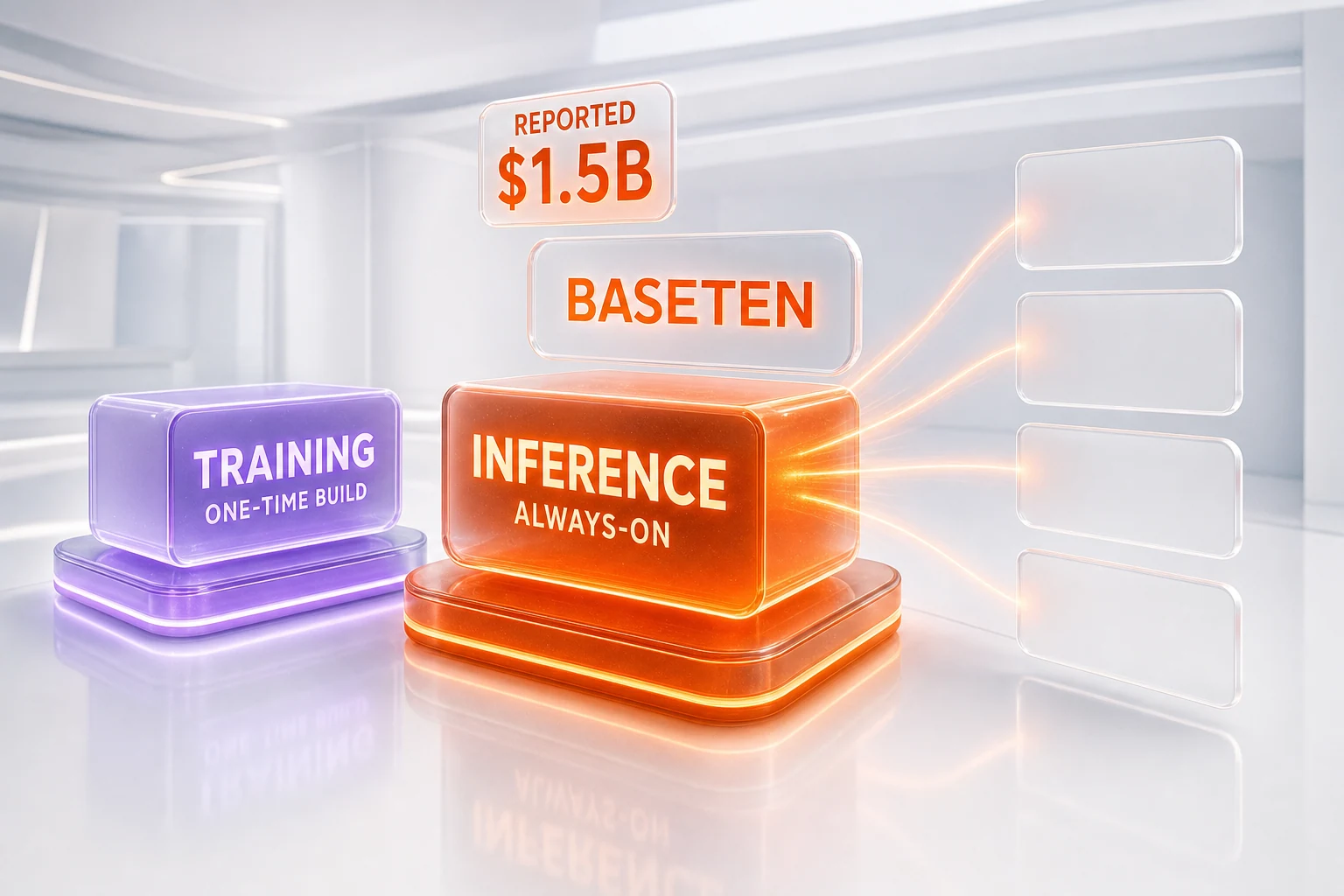
AI inference is the act of running an already-trained model to answer a live request — and in 2026 it is becoming its own infrastructure market, separate from the training market that dominated the last three years. Training is the one-time, capital-heavy job of building a model; inference is the always-on job of serving it to users, every prompt, every day. The clearest signal of that split is Baseten, an inference platform that, according to TechCrunch, is close to finalizing a reported ~$1.5 billion round at a valuation reported between roughly $11 billion and $13 billion — a roughly 160% jump in about five months. The round is not officially closed. But the direction of the money is unmistakable: capital that used to chase who trains the best model is now chasing who runs it cheapest and fastest.
What Happened
On June 18, 2026, TechCrunch reported that Baseten, a San Francisco inference startup founded in 2019, is close to finalizing a new funding round of roughly $1.5 billion. The Wall Street Journal first reported the deal. According to TechCrunch, the round values Baseten at around $13 billion as a headline figure, structured as a "split-priced" round in which some investors enter at an $11 billion floor while others pay the full $13 billion. The round is co-led by Spark Capital, Sands Capital, Altimeter Capital and Wellington Management, per the reporting.
Two caveats matter before anyone treats those numbers as gospel. First, the round is reported, not officially announced — TechCrunch's own framing is that Baseten is "close to finalizing," and the figures trace back to WSJ reporting rather than a Baseten press release. Second, a split-priced structure is a known tactic for lifting a headline valuation, so the "$13 billion" number and the "$11 billion" number describe the same deal seen from two angles. We are reporting what the press has reported; we are not asserting a closed transaction.
What is striking even with those caveats is the speed. Baseten's prior round — a $300 million Series E at a $5 billion valuation — closed only about five months earlier, in January 2026. A roughly 160% valuation increase in under half a year is the kind of move that usually accompanies a category being repriced, not a single company being re-rated. And the category here is inference.
Inference vs Training: Why They Are Two Different Markets
To see why investors are suddenly treating inference as its own arena, you have to separate two jobs that get lumped together as "AI compute."
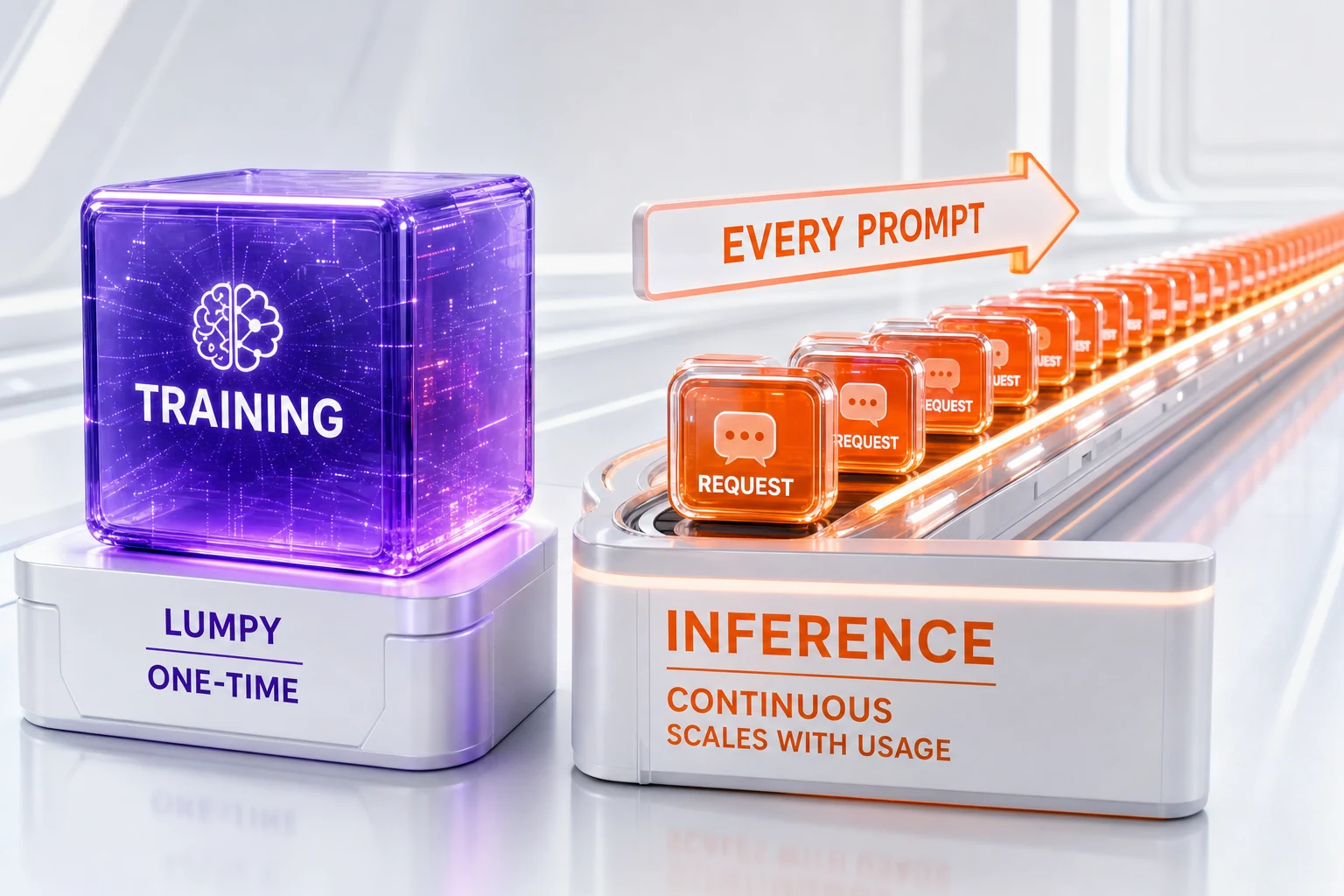
Training is building the model. It is a discrete, enormous, capital-intensive project: thousands of GPUs running for weeks or months to turn raw data into a set of weights. It happens mostly inside the frontier labs and the hyperscalers that bankroll them. When you read about $65 billion raises or 10-gigawatt data center build-outs, you are mostly reading about training and the capacity to train.
Inference is everything that happens after the model exists. As TechCrunch put it in its Modal coverage, inference is "the process of running trained AI models to generate answers from user requests." Every time a coding assistant completes a function, a chatbot answers a question, or a transcription tool processes a call, that is an inference request hitting a GPU somewhere. Inference is not a one-time project; it is a permanent, always-on operating cost that scales with usage rather than with ambition.
That difference in shape is the whole story. Training spend is lumpy and front-loaded. Inference spend is continuous and grows with every new user and every new product feature. As more applications ship on top of both proprietary and open-weight models, the inference bill becomes the dominant line item — and a dominant, recurring line item is exactly the kind of thing that supports a standalone software business.
What Baseten Actually Sells
Baseten is, in plain terms, a production inference platform. A team brings a model — often an open-weight model like Llama, DeepSeek, Qwen or a fine-tuned variant — and Baseten turns it into a reliable API that serves requests at scale, with low latency, autoscaling, observability and the enterprise plumbing (compliance, billing, monitoring) that production workloads demand. Sacra describes it as functioning "similarly to AWS Lambda for AI workloads": you hand over a model, Baseten handles the GPUs, the scaling and the cold starts.
Per TechCrunch, part of Baseten's pitch is routing requests "to the best-for-task model, especially to competent, less-expensive open source alternatives." That last clause is the commercial heart of the inference market. The rise of strong open-weight models — the kind we cover constantly, from Chinese coding models to NVIDIA's own open releases — means companies increasingly do not need to pay frontier-API prices for every task. They can run a cheaper open model in production, if someone makes that easy and reliable. Inference platforms are that someone.
On the demand side, Baseten's customer roster has been reported by the research firm Sacra to include names like Cursor, Notion, Abridge and Clay. We flag that as reported by Sacra rather than confirmed by Baseten, but it fits the pattern: fast-growing AI-native products that serve enormous volumes of requests and need inference handled by specialists rather than rebuilt in-house. (Cursor itself has been very much in the news — it was reportedly acquired by SpaceX in a $60 billion deal, a reminder of how much value is concentrating in the application layer that inference platforms feed.)
The Numbers Behind the Repricing — Reported, Not Confirmed
The valuation leap is easier to stomach when you look at the revenue trajectory investors are reportedly underwriting. The research firm Sacra estimates Baseten reached roughly $600 million in annualized revenue in March 2026, up from about $200 million in December 2025. We stress the word estimates: these are Sacra's figures, not audited numbers released by Baseten, and run-rate annualized revenue is not the same as booked annual revenue. Treated honestly, they describe a company growing extraordinarily fast — not a confirmed financial statement.
Even the bullish read comes with a warning that the smartest skeptics keep raising. Inference platforms "have to run GPUs for long hours to be available to service requests," which puts structural pressure on margins in a way that companies owning their own compute can avoid. One investor, quoted by Newcomer, put the bear case bluntly: "It seems like VCs are just doing a revenue multiple and are assuming the margin doesn't matter." That is the single most important sentence in this entire story. Revenue is exploding; whether the underlying unit economics justify decacorn valuations is genuinely unsettled.
How It Compares: The Inference Land Grab
Baseten is not an outlier — it is the loudest example of a broader repricing. Across 2026, capital has poured into the inference layer at valuations that would have looked absurd a year ago:
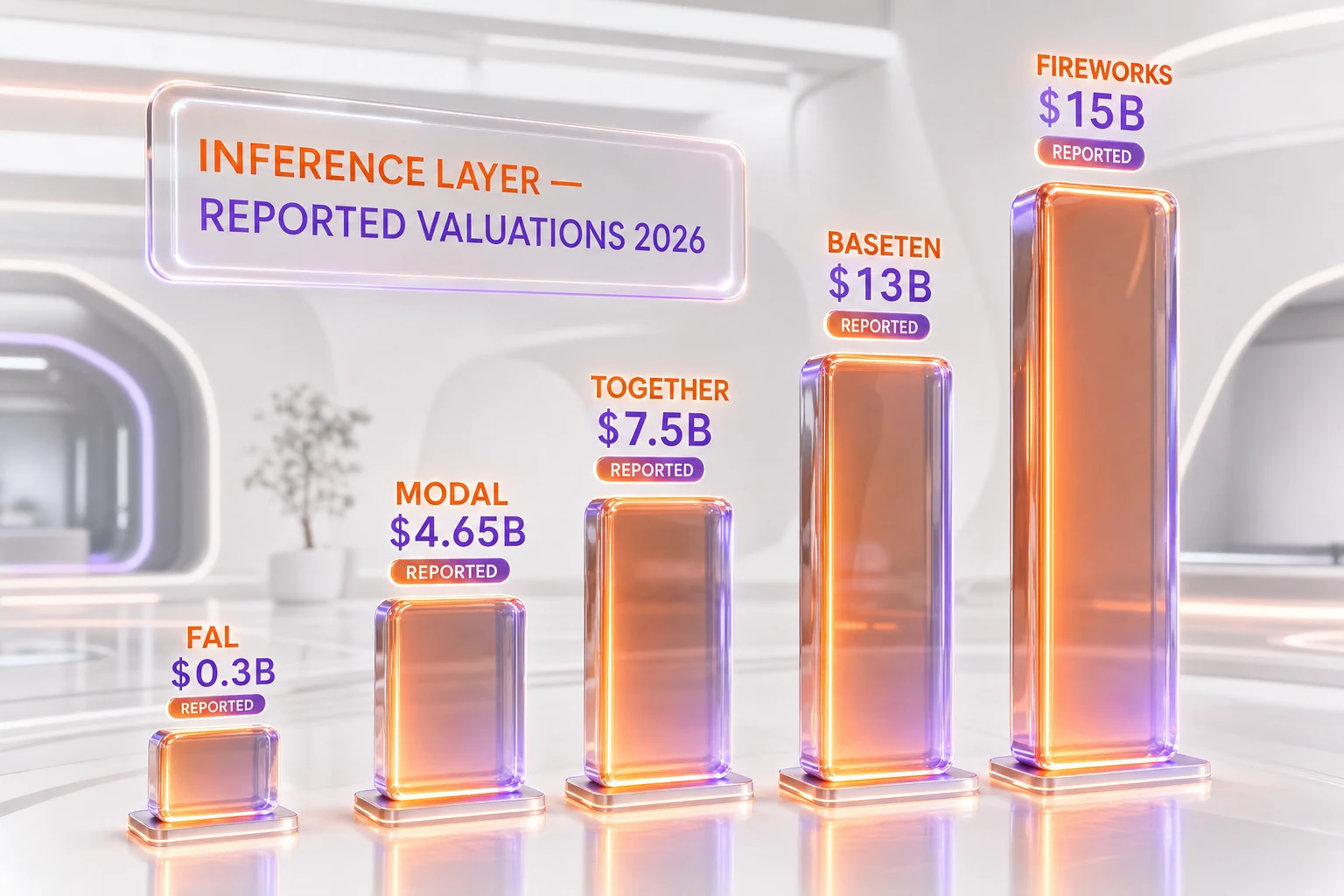
- Fireworks AI — reportedly in talks at around a $15 billion valuation, with CEO Lin Qiao citing roughly $800 million in annualized revenue, up from about $250 million in late 2025 (figures reported via the company and Sacra).
- Together AI — reported at around a $7.5 billion valuation while raising roughly $1 billion, having reportedly passed about $1 billion in ARR.
- Modal — which TechCrunch reported in February 2026 was in talks at a $2.5 billion valuation (up from a $1.1 billion Series B months earlier), and which later reporting put at a roughly $4.65 billion valuation after a ~$355 million raise.
- Fal — reported to be raising roughly $300 million to $350 million for media-focused inference.
- Inferact and RadixArk — seed-stage efforts commercializing the open-source inference engines vLLM and SGLang, reportedly valued at $800 million and $400 million respectively even at the seed stage.
The pattern is unmistakable: every figure above is a reported or estimated number, and almost every one represents a multiple-fold jump in months. When an entire cohort reprices at once, the market is not betting on one team — it is betting on a category. That category is the layer that turns models into served products.
Why It Matters
For three years, the AI story was a training story. Whoever raised the most, bought the most GPUs and trained the biggest model won the headlines — and we have covered those headlines, from Anthropic's $65 billion raise to SoftBank's multi-billion data center bets. Inference was treated as a back-office detail, a feature of whichever cloud you already used.
2026 is the year that assumption broke. As usage scales, the cost and reliability of serving models becomes the constraint that actually determines whether an AI product is viable. A startup can use the best model in the world and still die if its inference is too slow, too expensive or too unreliable. That makes the inference layer strategically valuable in its own right — valuable enough to support independent companies worth billions rather than line items inside a hyperscaler's bill.
There is also a deeper structural reason this market exists: open-weight models. The explosion of capable open models — the steady drumbeat of releases we track from labs in China and the US alike — means the "best model for a task" is increasingly not a single frontier API but a portfolio of options, many of them open and cheap. Someone has to host, route and optimize across that portfolio in production. That is a genuinely new job, and it is the job the inference platforms are racing to own. It is also adjacent to the silicon race — the same logic drove Fractile's inference-chip raise with Anthropic circling UK silicon: cheaper inference is the prize whether you attack it from software or from hardware.
The Bear Case, Stated Honestly
It would be irresponsible to present this as a one-way bet. There are real reasons the inference repricing could prove too aggressive.
First, margins. Renting GPUs to serve other people's models is structurally a lower-margin business than selling software that runs on commodity hardware. If inference platforms cannot maintain pricing power as competition intensifies — and there are many competitors, including the hyperscalers and the labs themselves — the revenue multiples baked into these valuations may not hold.
Second, disintermediation risk. The frontier labs and cloud providers can and do offer their own inference. A platform's edge has to be real engineering — faster cold starts, better routing, lower cost per token — and not just convenience, because convenience is exactly what a hyperscaler can bundle for free.
Third, the reported-versus-real gap. The headline numbers in this story are reported funding figures and third-party revenue estimates. Until Baseten formally announces a closed round and discloses real financials, the prudent stance is to treat the inference boom as a strong, well-supported thesis — not a settled fact.
Our Take
We read the Baseten story less as news about one company and more as confirmation of a structural shift we have been watching build all year. The center of gravity in AI infrastructure is moving from building models to serving them. Training will always matter and will always attract the largest single checks, but the recurring, usage-scaled, open-weight-friendly economics of inference are what make it a durable, standalone market — the kind that can support a whole cohort of multi-billion-dollar companies rather than one or two.
If the Baseten round closes near its reported terms, it will stand as the clearest data point yet that "the AI infrastructure war" is no longer a single front. There is the war to train the best models, and there is the increasingly distinct war to run them. For the builders we serve — the teams shipping products on top of open and closed models alike — the second war is the one whose outcome they will feel first, in their latency graphs and their cloud bills.
What's Next
Watch for three things. One, whether Baseten formally announces the round and on what terms — the gap between "close to finalizing" and "closed" is where this story becomes fact rather than report. Two, whether the margin question gets answered: do these companies demonstrate durable unit economics, or does the cohort compress once growth slows? Three, how the hyperscalers and frontier labs respond — because if inference is now a category worth tens of billions, the largest players will not cede it quietly. We will update this analysis as the round is confirmed or revised.
Frequently Asked Questions
What is AI inference?
AI inference is the process of running an already-trained AI model to generate a response from a live user request — every chatbot answer, code completion or transcription is an inference. It is distinct from training, which is the one-time job of building the model. Inference is always-on and scales with usage, which is why it is becoming its own infrastructure market in 2026.
Why is inference becoming a separate market from training?
Training is lumpy, front-loaded and capital-intensive — it happens inside frontier labs and hyperscalers. Inference is continuous and grows with every user and feature, making it a recurring operating cost rather than a one-time project. That recurring, usage-scaled shape supports standalone software businesses, which is why investors in 2026 are pricing inference platforms like Baseten, Fireworks AI and Together AI as their own category.
Is Baseten's $1.5 billion funding round confirmed?
No. As of June 2026, the round is reported but not officially closed. TechCrunch described Baseten as "close to finalizing" a roughly $1.5 billion round, and the Wall Street Journal first reported it. The figures are reported, not confirmed by a Baseten press release, so they should be treated as reported terms rather than a settled transaction.
What valuation is Baseten reportedly raising at?
According to TechCrunch, the round carries a headline valuation of around $13 billion, structured as a "split-priced" deal in which some investors enter at an $11 billion floor and others pay $13 billion. That is roughly a 160% increase from Baseten's prior $5 billion valuation set in a $300 million Series E around January 2026. All figures are reported, not officially announced.
What does Baseten actually do?
Baseten is a production inference platform. Teams bring a model — often an open-weight model like Llama, DeepSeek or Qwen — and Baseten serves it as a reliable, low-latency API with autoscaling, observability and enterprise features. Sacra likens it to "AWS Lambda for AI workloads." Per TechCrunch, it also routes requests to the best-for-task model, often cheaper open-source alternatives.
Who are Baseten's customers?
The research firm Sacra has reported Baseten customers including Cursor, Notion, Abridge and Clay. We flag these as reported by Sacra rather than confirmed by Baseten. They fit the profile of the market: fast-growing AI-native products serving high volumes of requests that prefer specialist inference infrastructure over building it in-house.
Who are the main players in the AI inference market?
Beyond Baseten, the reported 2026 inference cohort includes Fireworks AI (reportedly around a $15 billion valuation, roughly $800 million annualized revenue per its CEO), Together AI (reportedly around $7.5 billion and roughly $1 billion ARR), Modal (reported at $2.5 billion in February talks, later around $4.65 billion), and Fal (reportedly raising $300-350 million). Seed-stage efforts Inferact and RadixArk commercialize the vLLM and SGLang engines.
How is Baseten's revenue figure sourced?
The roughly $600 million annualized revenue figure for March 2026 (up from about $200 million in December 2025) is an estimate from the research firm Sacra, not an audited number released by Baseten. Annualized run-rate revenue is also not the same as booked annual revenue. The figures describe rapid growth but should be read as third-party estimates.
What is the bear case against the inference boom?
The main risk is margins: inference platforms must run GPUs for long hours to service requests, which structurally pressures margins compared with companies owning their own compute. One investor, quoted by Newcomer, said VCs may be "just doing a revenue multiple and are assuming the margin doesn't matter." There is also disintermediation risk, since hyperscalers and frontier labs offer their own inference.
Why do open-weight models drive the inference market?
Strong open-weight models mean companies no longer need frontier-API pricing for every task — they can run cheaper open models in production. But someone must host, route and optimize across that portfolio reliably at scale. That is a genuinely new job, and it is precisely the job inference platforms like Baseten are racing to own, which is why open-model growth and inference-platform growth are tightly linked.
Does this mean training no longer matters?
No. Training still attracts the largest single checks and remains essential — frontier labs raising tens of billions are doing training-scale work. The shift is that inference has become a distinct, durable market alongside training rather than a back-office detail. The 2026 reframe is "two infrastructure wars," not "inference replaces training."