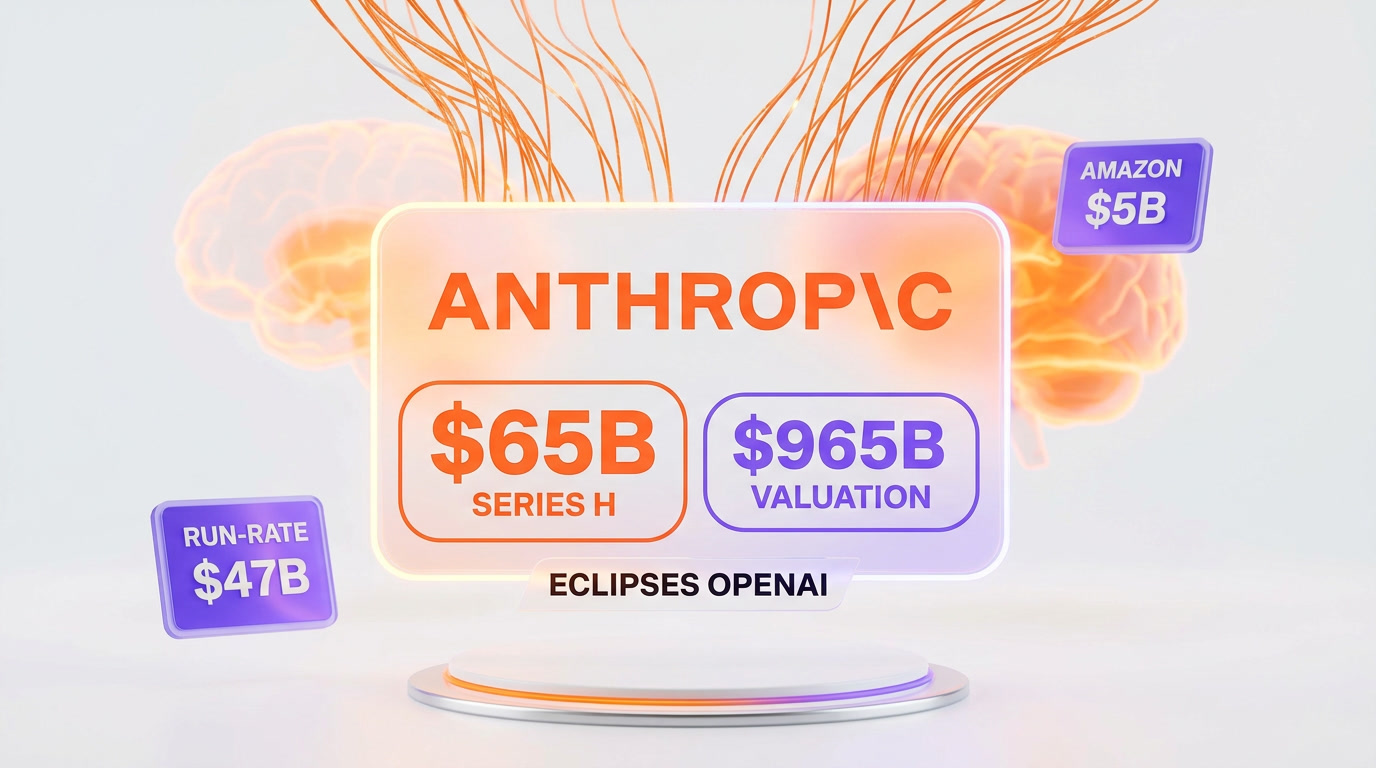
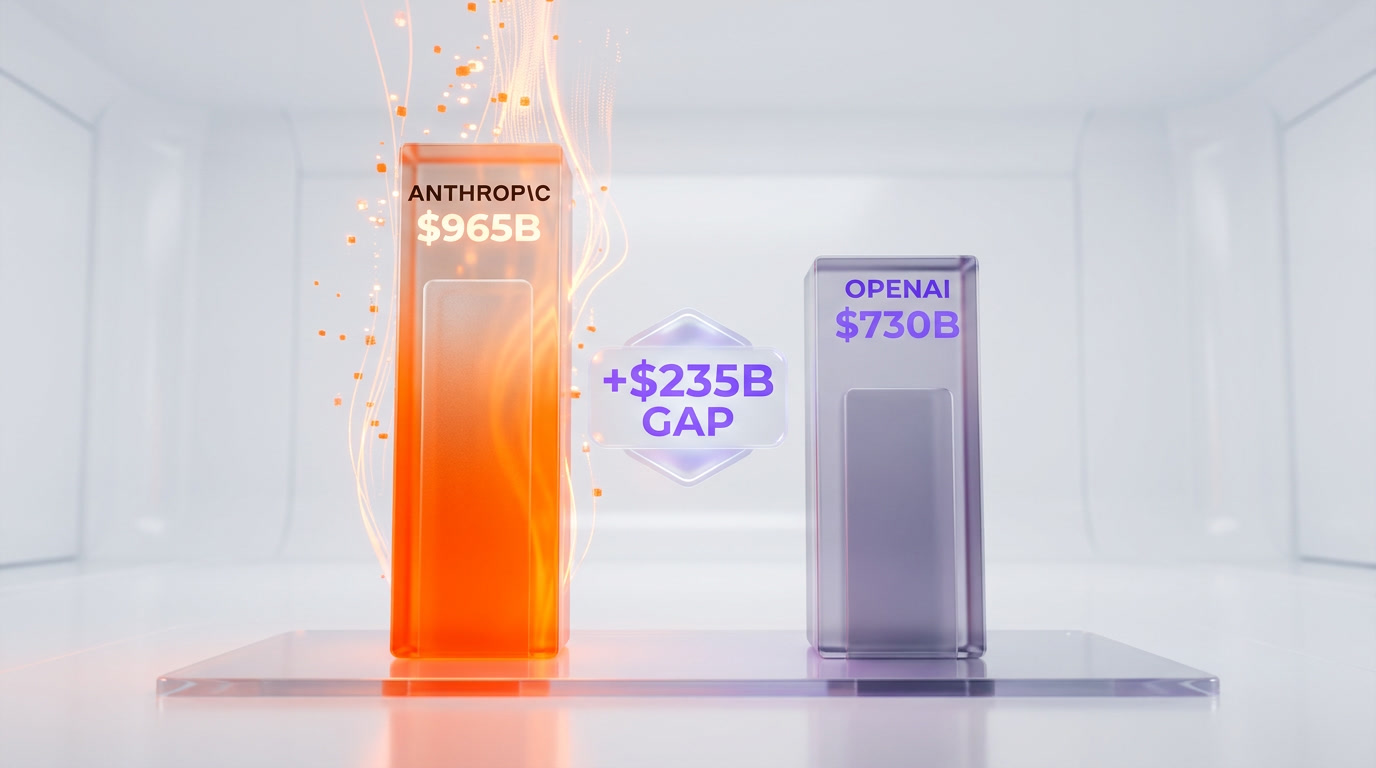
Anthropic raised $65 billion in a Series H round on May 28, 2026, at a $965 billion post-money valuation, the largest private financing in the history of the technology industry. The round pushes Anthropic past OpenAI, valued at roughly $730 billion according to Axios, making it the most valuable private artificial intelligence company in the world for the first time. The company says its run-rate revenue crossed $47 billion earlier this month. The financing was led by Altimeter Capital, Dragoneer, Greenoaks, and Sequoia Capital, and includes $15 billion already committed by hyperscalers, of which $5 billion comes from Amazon.
What Happened
On May 28, 2026, Anthropic announced a Series H financing of $65 billion at a post-money valuation of $965 billion. The numbers are unprecedented. No private company in the history of technology has raised this much in a single round, and at $965 billion the maker of Claude is now within striking distance of a $1 trillion private valuation, a threshold no privately held company has ever crossed. To be precise about the framing: Anthropic is approaching $1 trillion, not at it. The $965 billion figure is the post-money mark disclosed in the official announcement.
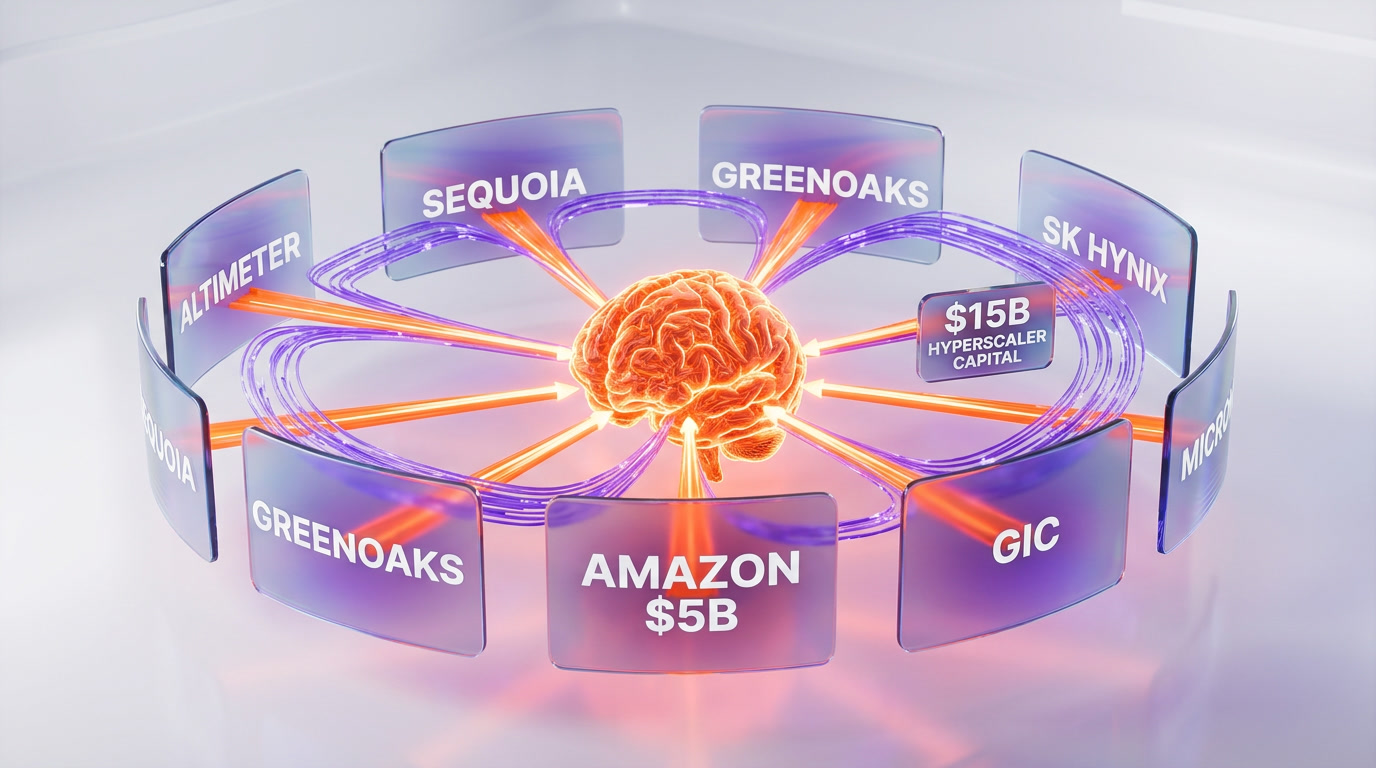
The round was led by Altimeter Capital, Dragoneer, Greenoaks, and Sequoia Capital. The co-lead syndicate is a who's who of late-stage growth capital: Capital Group, Coatue, D1 Capital Partners, GIC, ICONIQ, and XN. Inside the $65 billion total sits $15 billion already committed by hyperscalers, including $5 billion from Amazon, Anthropic's largest strategic backer. The financing also names a roster of infrastructure partners supplying memory, storage, and compute components, including Micron, Samsung, and SK hynix.
Anthropic disclosed that its run-rate revenue crossed $47 billion earlier this month. Run-rate revenue annualizes the most recent period's revenue, so it is a forward-looking snapshot rather than trailing twelve-month bookings, but it signals a business growing at a pace that few software companies have ever matched. For context, that run-rate figure alone would place Anthropic among the larger enterprise software franchises on the planet, and it is being achieved barely four years after the company shipped its first commercial product.
The Valuation Velocity Is the Real Story
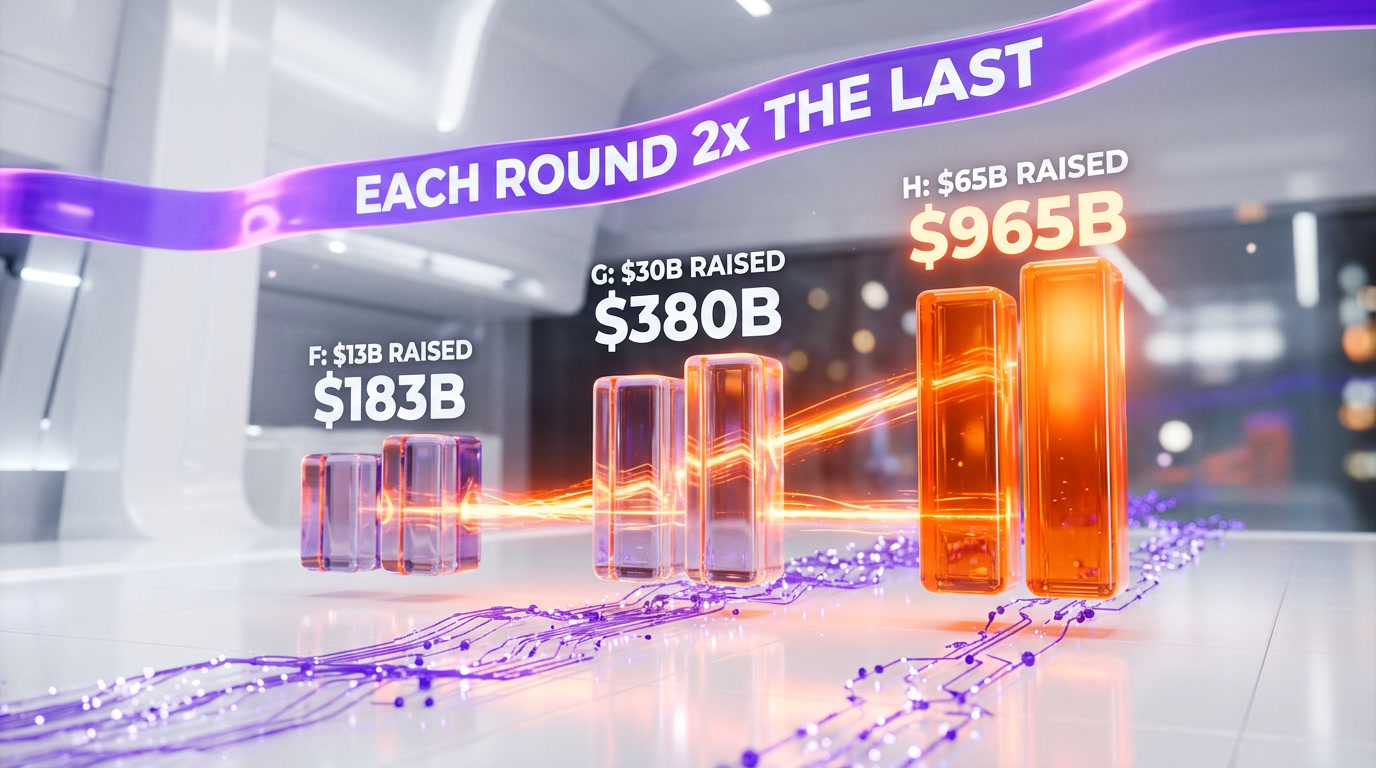
The single most striking element of this round is not the dollar amount. It is the speed. Trace Anthropic's valuation across its last three rounds and the curve bends almost vertically. The Series F closed at $13 billion raised on a $183 billion valuation. The Series G, announced on February 12, 2026, raised $30 billion at $380 billion. Now the Series H raises $65 billion at $965 billion, announced May 28, 2026. That is a move from $183 billion to $965 billion in roughly twelve months, a 5.3x increase in valuation over a single year.
Put differently, Anthropic added more than $580 billion in paper value in the span of three quarters. Each successive round did not merely top the last one; it more than doubled it. The Series G valuation was 2.1x the Series F. The Series H valuation is 2.5x the Series G. Acceleration on acceleration is the pattern, and it is exactly the kind of signal that draws both euphoria and concern from people who watch capital markets for a living.
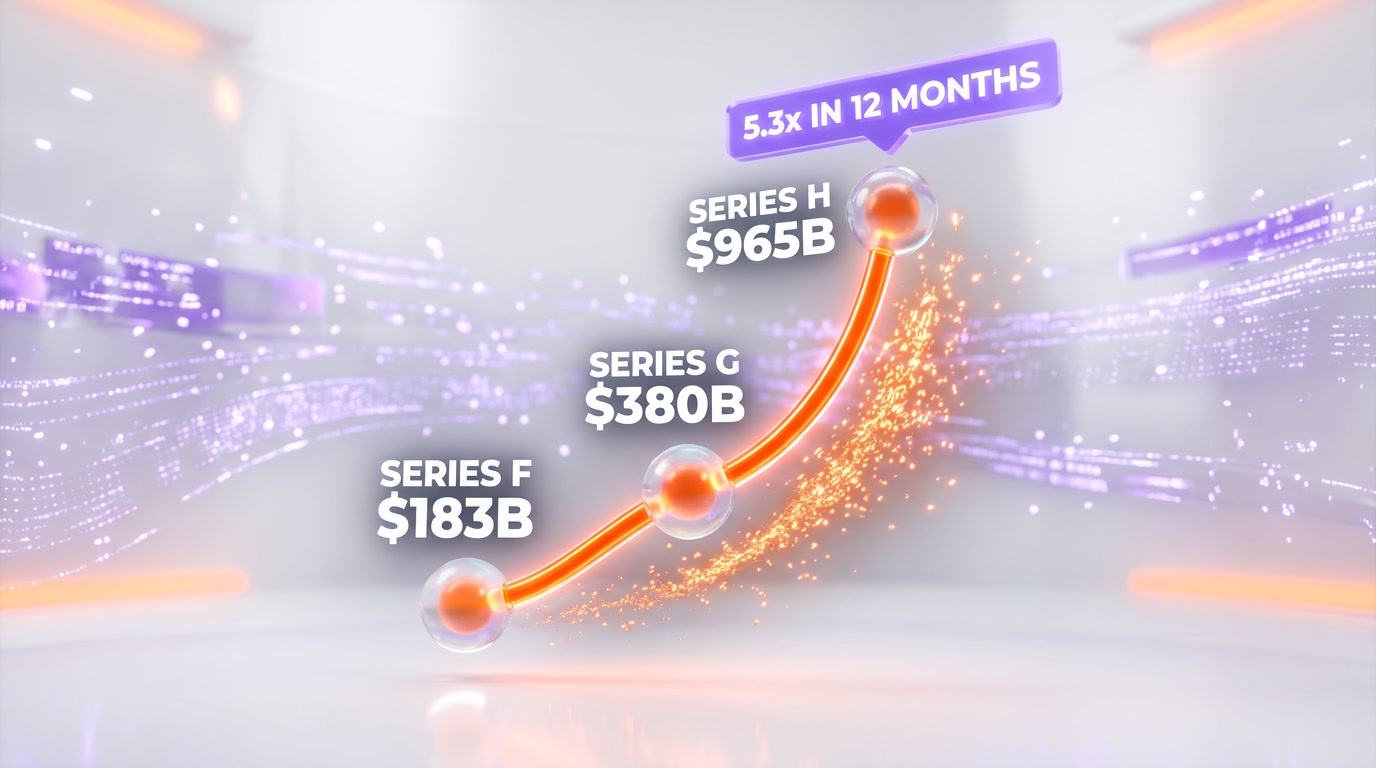
Why does velocity matter more than the headline number? Because it reframes what investors believe they are buying. A flat or slowly rising valuation prices a company on its current cash flows. A valuation that more than doubles every few months prices a company on a belief that the addressable market, and Anthropic's share of it, is expanding faster than anyone modeled even months earlier. The capital is not betting on the present run-rate of $47 billion. It is betting that the run-rate of 2027 and 2028 will make $47 billion look like a footnote.
How the Round Stacks Against Recent Rounds
| Round | Date | Amount Raised | Post-Money Valuation | Multiple vs Prior |
|---|---|---|---|---|
| Series F | 2025 | $13 billion | $183 billion | — |
| Series G | February 12, 2026 | $30 billion | $380 billion | 2.1x |
| Series H | May 28, 2026 | $65 billion | $965 billion | 2.5x |
The amount raised roughly doubled at each step, from $13 billion to $30 billion to $65 billion. The valuation more than doubled at each step. That symmetry is unusual; in most company histories the dollar amount raised grows faster than the valuation as later rounds dilute more. Here, both are compounding together, which tells you the buyers are not price-sensitive in the conventional sense.
Anthropic Eclipses OpenAI for the First Time
For the first time since the modern generative artificial intelligence era began, Anthropic is worth more than OpenAI on paper. OpenAI was most recently valued at roughly $730 billion according to Axios. At $965 billion, Anthropic now sits about $235 billion above its closest rival, a gap larger than the entire valuation of most public technology companies. TechCrunch, Axios, and Bloomberg all reported the milestone, and the throughline across their coverage is the same: the symbolic order of the frontier artificial intelligence field has been rearranged.
It is worth being careful about what "eclipses" means here. These are private valuations set by the most recent marginal buyer, not market capitalizations validated by millions of daily trades on a public exchange. A $965 billion private mark and a $730 billion private mark are both estimates of future value rather than liquid prices. But within the universe of private artificial intelligence companies, the ranking has flipped, and rankings shape narrative, talent flows, and the next round's terms. Being the most valuable private artificial intelligence company is a recruiting magnet and a customer-trust signal as much as it is a financial fact.
The competitive subtext is that Anthropic and OpenAI have pursued meaningfully different strategies. Anthropic has leaned hard into the enterprise and developer markets, with Claude becoming a default in coding workflows and agentic automation. OpenAI has chased consumer scale alongside enterprise. The market, at least as expressed through this round, is now pricing Anthropic's enterprise-and-agents bet at a premium.
The Hyperscaler Entanglement Deepens
One of the most consequential details inside the Series H is the $15 billion already committed by hyperscalers, with $5 billion of that coming from Amazon. This is not new behavior, but the scale of it now is. The largest cloud and compute providers are no longer simply selling capacity to frontier artificial intelligence labs; they are equity-financing them at the same time, locking in both a strategic stake and a guaranteed customer for their own infrastructure.
Amazon's continued backing is the clearest example. Amazon is both a major investor in Anthropic and a primary infrastructure partner, which means a meaningful share of the capital flows in a circle: investment dollars in, compute commitments out, with Anthropic spending heavily on the very platforms its backers operate. This circularity is a recurring feature of the current cycle, and it is one of the reasons the funding environment looks structurally different from previous technology booms. The capital and the compute are increasingly the same conversation.
The infrastructure roster named alongside the round, including Micron, Samsung, and SK hynix for memory and storage components, underscores how physical the artificial intelligence buildout has become. Training and serving frontier models is a hardware problem as much as a software one, and securing memory and storage supply chains is now a board-level concern for any lab operating at Anthropic's scale. We have covered the compute side of this story before, including Anthropic's compute deal with SpaceX for Colossus 1 capacity and its $1.8 billion seven-year cloud agreement with Akamai, both of which fit the same pattern of locking down long-horizon infrastructure.
Who Is Writing the Checks, and Why It Matters
The composition of the syndicate is as informative as the size of the round. The lead group, Altimeter Capital, Dragoneer, Greenoaks, and Sequoia Capital, are crossover and growth investors known for taking concentrated positions in category-defining companies and holding them across the private-to-public transition. Their presence at the front of a round this large signals conviction that Anthropic is a generational outcome rather than a momentum trade.
The co-lead syndicate, Capital Group, Coatue, D1 Capital Partners, GIC, ICONIQ, and XN, broadens the base in a meaningful way. Capital Group and GIC in particular represent deep, patient pools of institutional and sovereign capital. When a sovereign wealth fund and a mutual-fund giant co-lead a private round, they are effectively underwriting the company as a future public-market staple, not a venture bet. That investor mix is one more reason media coverage has framed the Series H as a possible last stop before public markets, even though Anthropic itself has said nothing of the sort.
Layered on top of the financial investors are the hyperscalers, contributing $15 billion with $5 billion from Amazon. Strategic capital from compute providers behaves differently from financial capital: it comes with infrastructure commitments attached and an interest in seeing the lab consume the backer's platform. The blend of patient institutional money, crossover growth funds, and strategically motivated hyperscalers is precisely the kind of coalition that can sustain a near-trillion-dollar private valuation, because each group is buying a different thing from the same company.
What $965 Billion Actually Buys
A valuation of $965 billion is not an abstract trophy. It is a war chest and a mandate. With $65 billion in fresh capital, Anthropic can fund multi-year compute commitments, expand its research headcount aggressively, and absorb the enormous fixed costs of training successively larger models without the quarter-to-quarter pressure a public company faces. The capital buys time and scale, which in frontier artificial intelligence are the two scarcest resources.
It also buys optionality on the talent market. At this valuation, equity compensation at Anthropic is worth a fortune on paper, which makes it dramatically easier to recruit and retain the small population of researchers and engineers capable of pushing model capabilities forward. In a field where a few hundred people materially move the frontier, the ability to out-compensate rivals is a moat in itself.
And it buys narrative dominance. Being the most valuable private artificial intelligence company shapes how enterprises evaluate vendor risk, how developers choose default models, and how the next wave of partnerships gets negotiated. The same dynamic shows up in our coverage of how the broader capital environment has concentrated around a handful of frontier labs, which we detailed in our analysis of the record $300 billion in Q1 2026 venture funding and the concentration of capital at the frontier.
The IPO Question
Whenever a private company reaches a valuation this large, the obvious question is whether an initial public offering is next. Here, a clear distinction matters. Anthropic's official announcement of the Series H does not mention an initial public offering at all. The IPO framing comes from media coverage, not from the company. TechCrunch, for instance, characterized the Series H as a potential final private fundraise before a highly anticipated public offering, but that is a media interpretation rather than a stated company plan.
So the honest reading is this: media reports suggest the Series H could be Anthropic's last major private round before going public, but Anthropic itself has made no such commitment in the announcement. At a $965 billion valuation, the practical universe of private investors large enough to lead a future round is shrinking, which is part of why outside observers see an eventual public listing as likely. But likely is not announced, and we will treat any IPO timeline as speculation until the company says otherwise.
Why It Matters for the Broader Market
Rounds of this size do more than reprice one company. They reset the reference point for the entire frontier artificial intelligence field. When the leading lab is valued near $1 trillion in private markets, every competitor's fundraising conversation starts from a higher anchor, every acquisition target reprices, and every enterprise buyer recalibrates how durable these vendors are. The Series H is a gravitational event, and the bodies around it will move.
It also intensifies the concentration of capital at the very top. The frontier is becoming a contest among a tiny number of extraordinarily well-funded labs, with the gap between the leaders and everyone else widening rather than narrowing. Capital begets compute, compute begets capability, and capability begets revenue that justifies the next round of capital. That flywheel is precisely what investors are paying $965 billion to own a piece of, and it is precisely what makes the field so difficult for new entrants to penetrate.
For developers and enterprises building on Claude, the practical implication is stability. A lab with $65 billion in fresh capital and $47 billion in run-rate revenue is not going anywhere, which lowers the platform risk of standardizing on its models. That durability is part of why Anthropic's tooling, including its work on agentic coding workflows we covered in our breakdown of Claude Opus 4.8, dynamic workflows, and UltraCode in Claude Code, continues to compound adoption among professional teams.
The Risks Hiding Behind the Headline
None of this is without risk, and it would be dishonest to present a $965 billion valuation as a settled verdict. The most obvious concern is the gap between valuation and conventional financial fundamentals. A run-rate of $47 billion is enormous, but a $965 billion valuation implies a multiple that only makes sense if growth continues at extraordinary rates for years. Any deceleration, any margin pressure from the colossal compute bills, or any shift in the competitive landscape could compress that multiple sharply.
The circular financing structure is a second concern. When the same hyperscalers that invest in a lab also supply its compute and book the spending as revenue, the apparent health of the ecosystem can be partly self-reinforcing in ways that are hard to disentangle from the outside. This is not unique to Anthropic; it is a feature of the entire current cycle. But it means the published numbers should be read with an understanding of how interlocked the participants are.
Finally, there is concentration risk for the field as a whole. A market where a handful of labs absorb the overwhelming majority of capital and compute is efficient for the leaders and brutal for everyone else, and history suggests that periods of extreme concentration eventually invite either competition, regulation, or a correction. We are not predicting which; we are noting that a $965 billion private valuation is a high-water mark, and high-water marks are, by definition, the points from which the tide can recede.
The Bottom Line
Anthropic's Series H is the largest private financing in technology history: $65 billion raised at a $965 billion post-money valuation, announced May 28, 2026. It pushes Anthropic past OpenAI's roughly $730 billion mark for the first time, makes it the most valuable private artificial intelligence company in the world, and brings a private company closer to a $1 trillion valuation than any has ever been. The most important number, though, is not $965 billion. It is the velocity that produced it: $183 billion to $965 billion in about a year.
That velocity, the deepening hyperscaler entanglement with $15 billion committed and $5 billion from Amazon, and a run-rate that crossed $47 billion earlier this month together describe a company being priced not on what it is today but on what its backers are convinced it will become. Whether that conviction proves prescient or overextended is the open question of this cycle. What is no longer in question is who currently sits at the top of the frontier artificial intelligence field.
Frequently Asked Questions
How much did Anthropic raise in its Series H round?
Anthropic raised $65 billion in its Series H round, announced May 28, 2026. It is the largest private financing in the history of the technology industry.
What is Anthropic's valuation after the Series H?
Anthropic's post-money valuation is $965 billion following the Series H. That places it close to, but not yet at, a $1 trillion private valuation, a level no privately held company has ever reached.
Is Anthropic now worth more than OpenAI?
Yes. At $965 billion, Anthropic is now valued above OpenAI, which was most recently valued at roughly $730 billion according to Axios. This is the first time Anthropic has surpassed OpenAI, making it the most valuable private artificial intelligence company in the world.
Who led Anthropic's Series H funding round?
The Series H was led by Altimeter Capital, Dragoneer, Greenoaks, and Sequoia Capital. Co-lead investors include Capital Group, Coatue, D1 Capital Partners, GIC, ICONIQ, and XN.
How much did Amazon invest in the Series H?
Amazon committed $5 billion as part of the $15 billion already committed by hyperscalers within the $65 billion round. Amazon remains Anthropic's largest strategic backer and a primary infrastructure partner.
What is Anthropic's run-rate revenue?
Anthropic said its run-rate revenue crossed $47 billion earlier this month. Run-rate annualizes the most recent period's revenue, so it is a forward-looking snapshot rather than trailing annual bookings.
How fast has Anthropic's valuation grown?
Very fast. Anthropic went from a $183 billion valuation at its Series F, to $380 billion at its Series G on February 12, 2026, to $965 billion at its Series H on May 28, 2026, a 5.3x increase in roughly twelve months.
Did Anthropic reach a $1 trillion valuation?
No. Anthropic's Series H valuation is $965 billion, which is approaching $1 trillion but has not crossed it. No privately held company has ever reached a $1 trillion valuation.
Is Anthropic planning an IPO?
Anthropic's official Series H announcement does not mention an initial public offering. Media reports, including TechCrunch, suggest the round could be a final private fundraise before a public listing, but that is media interpretation rather than a stated company plan.
Which infrastructure partners are involved in the round?
The financing names infrastructure partners supplying memory, storage, and compute components, including Micron, Samsung, and SK hynix. The hyperscaler commitments inside the round total $15 billion, including $5 billion from Amazon.
Why does the valuation velocity matter more than the dollar amount?
Because more than doubling a valuation every few months means investors are pricing Anthropic on expected future revenue rather than its current $47 billion run-rate. Acceleration on acceleration signals a belief that the market and Anthropic's share of it are expanding faster than earlier models assumed.
What are the risks behind the $965 billion valuation?
The main risks are a wide gap between valuation and current fundamentals, the circular financing structure where hyperscalers both invest and supply compute, and extreme capital concentration at the frontier that is efficient for leaders but punishing for new entrants.